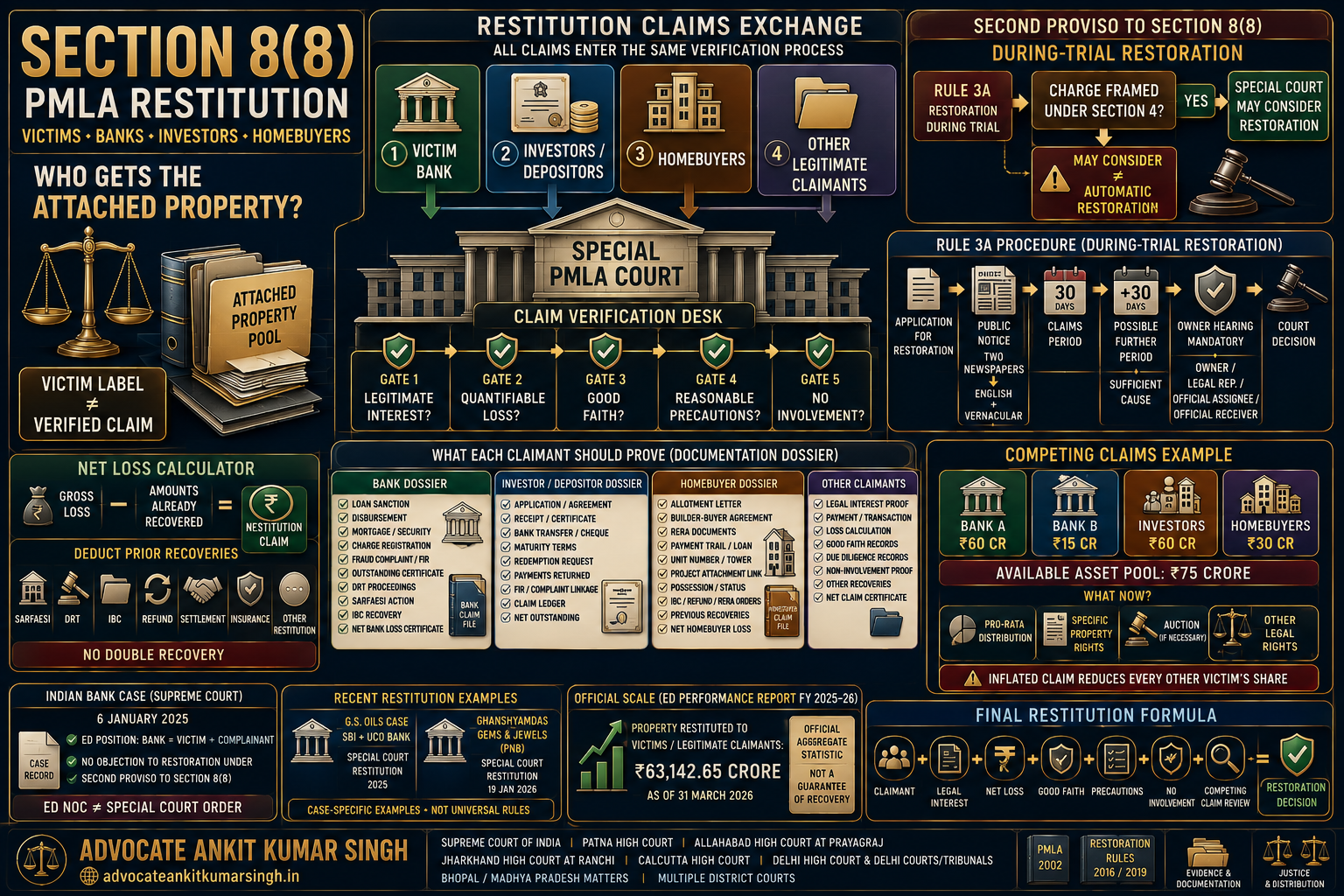
SECTION 8(8) PMLA • SECOND PROVISO • RULE 3A • VICTIM RESTITUTION • SPECIAL COURT
Restoration of ED-Attached Property to Victims, Banks, Investors and Homebuyers under Section 8(8) PMLA: Second Proviso, Special Court Claim Verification, Competing Claims and Restitution Documentation
Victim Banks • Investors • Depositors • Homebuyers • Legitimate Interest • Quantifiable Loss • Competing Claims • Pro-Rata Distribution
Research updated: 9 August 2026 | By Advocate Ankit Kumar Singh
 Advocate Ankit Kumar Singh
Direct Answer: Can Victims Recover Property Attached by ED Before the PMLA Trial Ends?
Potentially yes. Section 8(8) provides a statutory restoration mechanism for qualifying claimants, and its second proviso permits the Special Court, if it thinks fit, to consider restoration during the trial in the prescribed manner.
Rule 3A of the Prevention of Money-laundering (Restoration of Property) Rules provides the detailed during-trial mechanism after framing of charge under Section 4 PMLA.
But restoration is not automatic merely because a person describes himself as:
- a victim;
- a bank;
- an investor;
- a depositor;
- a homebuyer;
- a secured creditor.
The claimant should prove:
LEGITIMATE INTEREST + QUANTIFIABLE LOSS + GOOD FAITH + REASONABLE PRECAUTIONS + NON-INVOLVEMENT + NET UNRECOVERED CLAIM.
The Legal Word Is “Claimant” — Not Merely “Victim”
The Restoration Rules define a claimant through substantive conditions.
A claimant should establish that the person:
- acted in good faith;
- suffered a quantifiable loss;
- suffered the loss as a result of money-laundering;
- took all reasonable precautions;
- was not involved in money-laundering.
Therefore:
FRAUD VICTIM STATUS ≠ AUTOMATIC SECTION 8(8) RESTORATION.
Two Different Restoration Routes
ROUTE ONE — AFTER CONFISCATION
Section 8(8) read with Rule 3 applies to the post-confiscation route contemplated by the statute and Rules.
ROUTE TWO — DURING TRIAL
The second proviso to Section 8(8), read with Rule 3A, permits the Special Court to consider restoration before final confiscation once the prescribed procedural stage is reached.
Do not mix the two procedures.
The Second Proviso to Section 8(8): Why It Matters
Without the during-trial route, genuine victims could potentially wait for completion of lengthy PMLA proceedings before seeking access to attached value.
The second proviso permits earlier judicial consideration.
But the language remains discretionary:
THE SPECIAL COURT “MAY, IF IT THINKS FIT” CONSIDER THE CLAIM.
Accordingly:
CHARGE FRAMED ≠ AUTOMATIC RESTORATION.
Rule 3A: Framing of Charge Is the Critical During-Trial Threshold
Rule 3A applies after framing of charge for the offence punishable under Section 4 PMLA.
Before drafting, verify:
| Stage | Status |
|---|---|
| Prosecution complaint filed? | Yes / No |
| Cognizance? | Yes / No |
| Charge framed under Section 4? | Yes / No |
| Property attached/seized/frozen? | Yes / No |
| Restoration application moved? | Yes / No |
What Property Can Be Considered During Trial?
Rule 3A concerns property:
- attached under Section 5(1);
- seized under Section 17 or Section 18;
- frozen under the applicable PMLA mechanism;
- before confiscation.
The application should precisely identify:
- PAO number;
- property schedule;
- location;
- present possession;
- Section 8 status;
- valuation;
- owner;
- claimant's alleged interest.
Public Notice and Competing Claims
If the Special Court considers it appropriate, Rule 3A permits publication in two daily newspapers:
- one English-language daily;
- one vernacular-language daily;
having sufficient circulation in the locality where the property is situated.
This is not a procedural formality.
Its purpose includes giving other persons claiming a legitimate interest an opportunity to establish their claims before the property pool is distributed.
The Claim Deadline
Under the Restoration Rules, the ordinary claim period following publication is:
30 DAYS.
The Special Court may entertain a delayed claim for a further period not exceeding:
30 DAYS
where sufficient cause is established.
Therefore victims should monitor:
- newspaper publication;
- Special Court orders;
- claim deadlines;
- case-number details.
Claim Verification: The Seven Questions the Court Needs Answered
- Who is the claimant?
- What legally recognisable interest does the claimant possess?
- What amount did the claimant actually lose?
- What amount has already been recovered?
- Was the claimant acting in good faith?
- Were reasonable precautions taken?
- Was the claimant involved in the money-laundering offence?
Build a Claim Verification Sheet
| Field | Evidence |
|---|---|
| Claimant identity | KYC / incorporation / authority |
| Legal interest | Contract / mortgage / allotment / deposit |
| Payment | Bank statement / cheque / transfer |
| Gross loss | Reconciliation statement |
| Recoveries | DRT / IBC / settlement / refund |
| Net claim | Certified loss calculation |
| Good faith | Contemporaneous transaction record |
| Precautions | Due diligence / KYC / approvals |
| Non-involvement | Case record and claimant explanation |
Quantifiable Loss: Use Net Loss, Not an Inflated Headline Number
The restitution application should distinguish:
GROSS EXPOSURE
from:
NET UNRECOVERED LOSS.
Use:
TOTAL VERIFIED LOSS − RECOVERIES ALREADY RECEIVED = NET RESTITUTION CLAIM.
Possible recoveries requiring disclosure may include:
- repayment;
- settlement;
- insurance;
- SARFAESI realisation;
- DRT recovery;
- IBC distribution;
- liquidation proceeds;
- refund;
- other restitution.
Why Double Recovery Must Be Avoided
Suppose an investor originally lost ₹10 lakh but subsequently recovered ₹4 lakh through another proceeding.
The restitution application should not silently present:
₹10 LAKH
as the current uncompensated loss.
It should disclose:
GROSS LOSS: ₹10 LAKH
RECOVERY: ₹4 LAKH
NET OUTSTANDING: ₹6 LAKH.
Transparent calculations materially strengthen claim credibility.
Victim Banks: What Should the Bank Prove?
A bank may simultaneously assert:
- fraud-victim status;
- complainant status;
- loan exposure;
- mortgage;
- security interest;
- outstanding debt.
These are legally different propositions.
The application should separately identify each one.
Bank Restitution Dossier
- Loan sanction.
- Loan agreement.
- Disbursement statement.
- Borrower ledger.
- Mortgage deed.
- Charge documents.
- CERSAI / ROC charge records where applicable.
- Valuation reports.
- Fraud complaint.
- FIR / CBI complaint.
- NPA classification records.
- Outstanding certificate.
- DRT proceedings.
- Recovery certificate.
- SARFAESI action.
- Sale proceeds already recovered.
- IBC proof of claim.
- Resolution-plan distribution.
- Settlement receipts.
- Net unrecovered loss certificate.
Indian Bank: Supreme Court Recognition of the Victim-Bank Restoration Route
In proceedings before the Supreme Court in January 2025, ED stated that the respondent Indian Bank was the victim and complainant and conveyed that it had no objection to restoration under the second proviso to Section 8(8).
The Supreme Court took note of that position and declined to interfere with the impugned orders.
The practical lesson is significant:
A BANK SHOULD NOT PRESENT ITSELF ONLY AS A SECURED CREDITOR.
Where supported by the record, it should separately establish how it is also a genuine victim of the underlying fraudulent transaction.
ED No-Objection: Helpful, but Do Not Misstate the Law
Recent restitution examples show ED supporting or conveying concurrence for restoration to victim banks.
That can substantially narrow the dispute.
But:
ED'S NOC IS NOT THE RESTORATION ORDER.
The judicial order must come from the competent court under the applicable statutory framework.
Recent Bank Examples
SBI AND UCO BANK — G.S. OILS
ED publicly reported restoration approvals concerning attached properties valued at approximately ₹63.05 crore at the time of attachment in favour of SBI and UCO Bank.
PUNJAB NATIONAL BANK — GHANSHYAMDAS GEMS & JEWELS
ED reported that the Special PMLA Court allowed PNB's restitution petition concerning five attached immovable properties in January 2026.
These are useful practical illustrations—not universal rules that every bank automatically receives attached assets.
Investors and Depositors: The Proof Problem
Mass-investment cases often contain:
- thousands of claimants;
- different deposit dates;
- cash and bank payments;
- renewal certificates;
- partial maturity payments;
- multiple investment entities;
- agents/intermediaries;
- incomplete records.
Therefore individual claim verification becomes essential.
Investor / Depositor Restitution Dossier
- KYC.
- Application form.
- Deposit/investment agreement.
- Receipt.
- Certificate.
- Bank transfer.
- Cheque proof.
- Account statement.
- Maturity date.
- Interest calculation.
- Amount repaid.
- Redemption request.
- Complaint/FIR details.
- Claim admitted in another proceeding.
- Prior distribution.
- Net outstanding computation.
Cash Investors Need Stronger Corroboration
Where investment is alleged to have been made in cash, the claimant may need stronger contemporaneous corroboration such as:
- original receipt;
- company ledger;
- deposit certificate;
- tax record;
- agent record;
- contemporaneous communication;
- admission in seized books;
- official claimant database.
A later affidavit by itself may not resolve an otherwise undocumented cash claim.
Homebuyers: Do Not File Only the Builder-Buyer Agreement
A homebuyer claim should ordinarily answer:
- Which project?
- Which tower?
- Which unit?
- Who allotted it?
- How much was paid?
- How much came through bank finance?
- Is the same flat attached?
- Is project land attached?
- Has possession been offered?
- Was refund received?
- Is an IBC resolution plan operating?
- Has any amount already been recovered?
Homebuyer Restitution Dossier
- Allotment letter.
- Builder-buyer agreement.
- RERA registration/details.
- Unit/tower identification.
- Payment schedule.
- Bank statements.
- Housing-loan sanction.
- Lender disbursement.
- Demand letters.
- Receipts.
- Construction status.
- Possession documents.
- Cancellation/refund records.
- RERA claim/order where applicable.
- Consumer order where applicable.
- IBC proof of claim.
- Resolution-plan entitlement.
- Previous distribution.
- Attachment schedule mapping.
- Net unrecovered loss.
Homebuyers May Want the Flat — Not Merely Cash
A homebuyer may have a materially different objective from a bank.
The bank may seek:
- property value;
- sale proceeds;
- debt recovery.
The homebuyer may seek:
- completion of the project;
- possession of an allotted unit;
- removal of the attachment obstacle;
- or monetary restitution.
Therefore the relief must match the claimant's actual legal interest.
Competing Claims: The Difficult Case
Assume the same asset pool attracts:
- Bank A;
- Bank B;
- 500 investors;
- 100 homebuyers;
- a secured creditor;
- an insolvency resolution applicant.
The Special Court should not be invited to treat them as one undifferentiated group.
Prepare a claimant matrix.
Competing-Claim Matrix
| Claimant | Legal Interest | Gross Loss | Recovered | Net Claim |
|---|---|---|---|---|
| Bank A | Fraud victim + mortgage | ₹100 Cr | ₹40 Cr | ₹60 Cr |
| Bank B | Lender | ₹20 Cr | ₹5 Cr | ₹15 Cr |
| Investors | Investment claims | ₹80 Cr | ₹20 Cr | ₹60 Cr |
| Homebuyers | Allotment/payment | ₹40 Cr | ₹10 Cr | ₹30 Cr |
This matrix does not itself determine legal priority.
It allows the Court to see the verified economic position before deciding the statutory claims.
Insufficient Property: Pro-Rata Restoration
The Restoration Rules expressly contemplate pro-rata restoration where the available property is insufficient to meet verified claimant losses.
Rule 3A additionally permits the Special Court, where it thinks fit, to direct auction and disbursement through the Central Government on a pro-rata basis according to the share of loss suffered by each claimant.
Therefore:
CLAIM VERIFICATION DIRECTLY AFFECTS THE DISTRIBUTION RECEIVED BY EVERY OTHER CLAIMANT.
Do Not Assume “Secured Creditor” Automatically Wins the Section 8(8) Pool
A secured creditor may possess powerful rights under:
- mortgage law;
- SARFAESI;
- DRT proceedings;
- IBC;
- other applicable law.
But the Section 8(8) application should not merely assert:
“We are secured, therefore every competing victim claim automatically fails.”
The Court may need to examine the precise property, security, timing, statutory interaction, claimant status and existing recovery proceedings.
Good Faith: What Should Be Shown?
Evidence may include:
- ordinary commercial transaction;
- genuine consideration;
- contemporaneous records;
- normal KYC;
- absence of collusion;
- absence of unusual routing;
- timely complaint after discovery of fraud.
Good faith is factual and must be assessed against the claimant's actual role.
“All Reasonable Precautions” Is Claimant-Specific
A regulated bank may reasonably be expected to possess a different due-diligence record from an individual homebuyer.
Accordingly:
BANK
KYC, credit appraisal, security verification, valuation, compliance.
INVESTOR
Application, scheme materials, payment records, ordinary verification.
HOMEBUYER
Project documentation, allotment, approvals/RERA information reasonably available, bank-backed payment trail.
Do not invent precautions that the statute or transaction did not realistically require.
Non-Involvement: A Separate Requirement
The claimant should not be involved in money-laundering.
Therefore review whether the claimant is alleged to have:
- received POC;
- layered funds;
- participated in sham transactions;
- acted as accommodation entity;
- colluded with accused persons.
A genuine victim claim becomes considerably more complicated if the same claimant is simultaneously alleged to have participated in the laundering structure.
The Property Owner Must Be Heard Under Rule 3A
For during-trial restoration, Rule 3A expressly protects the property owner.
No restoration order under that Rule should be made without an opportunity of hearing to the owner or the specified representative where applicable.
This is especially important where:
- the owner denies the claimant's interest;
- ownership itself is disputed;
- the claimant seeks physical property rather than money;
- several victims claim the same asset.
The Bond Requirement
During-trial restoration does not necessarily mean that the property disappears from the PMLA proceeding.
Rule 3A permits custody to be given subject to a bond requiring production of the restored property before the Special Court when required for the purposes of Sections 8(5), 8(6) or 8(7).
The claimant should therefore understand:
RESTORATION DURING TRIAL MAY CARRY CONTINUING PROCEDURAL CONDITIONS.
ED Concurrence Strategy
Where the records strongly establish that the applicant is a genuine victim, consider placing a structured representation before ED explaining:
- claimant identity;
- victim status;
- payment trail;
- net loss;
- security interest where relevant;
- absence of involvement;
- other recoveries;
- why restitution will not prejudice prosecution.
If ED ultimately supports or does not oppose restoration, record that before the Special Court.
But do not treat ED concurrence as a substitute for judicial adjudication.
Restitution Master Index
A serious application should contain an indexed verification bundle:
- Authority / board resolution / power of attorney.
- Claimant KYC.
- Scheduled-offence FIR/complaint.
- ECIR details where available.
- Prosecution complaint.
- Charge-framing order.
- PAO.
- Section 8(3) order.
- Property schedule.
- Claimant contract.
- Payment proof.
- Loss calculation.
- Recovery calculation.
- Net-claim certificate.
- Good-faith evidence.
- Due-diligence evidence.
- Non-involvement explanation.
- Mortgage/security documents where relevant.
- IBC/DRT/SARFAESI/RERA record where applicable.
- Prior recovery orders.
- Valuation.
- Competing-claim disclosure.
- Proposed restitution mechanism.
- Draft bond/undertaking where appropriate.
Suggested Claim Reconciliation Statement
| Particular | Amount |
|---|---|
| Original principal/payment | ₹_____ |
| Additional legally claimed amount | ₹_____ |
| Gross claimed loss | ₹_____ |
| Refund received | (₹_____) |
| SARFAESI/DRT recovery | (₹_____) |
| IBC distribution | (₹_____) |
| Settlement/insurance/other recovery | (₹_____) |
| Net outstanding claim | ₹_____ |
Adaptable Section 8(8) / Rule 3A Application Structure
This is an adaptable drafting framework and not a prescribed statutory form.
APPLICATION SEEKING RESTORATION OF PROPERTY UNDER THE SECOND PROVISO TO SECTION 8(8) READ WITH RULE 3A OF THE PREVENTION OF MONEY-LAUNDERING (RESTORATION OF PROPERTY) RULES
A. APPLICANT
The Applicant is ______ and claims a legitimate interest in the property / restitution pool on the basis of ______.
B. PMLA PROCEEDING
The prosecution complaint is pending before this Hon'ble Special Court in ______ and charge for the offence punishable under Section 4 PMLA was framed on ______.
C. PROPERTY
The present application concerns Property No. ______ described in PAO / seizure / freezing record ______.
D. LEGITIMATE INTEREST
The Applicant's legal interest arises from ______, supported by Annexures ______.
E. QUANTIFIABLE LOSS
The Applicant suffered gross loss of ₹______. Recoveries already received aggregate ₹______. The presently unrecovered quantified claim is ₹______.
F. GOOD FAITH
The transaction was undertaken bona fide for ______ and is supported by contemporaneous records including ______.
G. REASONABLE PRECAUTIONS
The Applicant undertook the following precautions appropriate to its status and transaction: ______.
H. NON-INVOLVEMENT
The Applicant was not involved in the offence of money-laundering and seeks restoration solely as a legitimate claimant/victim.
I. OTHER RECOVERIES AND PROCEEDINGS
The Applicant discloses the following proceedings and recoveries: ______.
J. COMPETING CLAIMS
The Applicant is aware / unaware of the following competing claims: ______ and submits that all claims may be verified in accordance with the statutory Rules.
PRAYER
The Applicant respectfully prays that this Hon'ble Special Court may be pleased to:
- take the present restoration claim on record;
- cause publication of the statutory notice, if considered appropriate and required under the applicable Rule;
- verify the Applicant's legitimate interest and net quantifiable loss;
- consider the competing claims, if any;
- restore the identified property / appropriate part / appropriate monetary value to the Applicant;
- where the available property is insufficient, consider the statutory pro-rata mechanism and such auction mechanism as is legally available;
- accept such bond or undertaking as the Court considers necessary for during-trial restoration;
- pass such further orders as may be required to protect all genuine claimants and preserve the pending PMLA proceedings.
25 Common Restitution Mistakes
- Calling yourself a victim without proving claimant status.
- Not checking whether charge has been framed.
- Confusing Rule 3 and Rule 3A.
- Not identifying the attached property.
- Claiming gross loss instead of net loss.
- Hiding prior recoveries.
- Ignoring competing victims.
- Assuming first applicant has priority.
- Assuming bank status alone proves entitlement.
- Assuming mortgage alone ends the inquiry.
- Assuming homebuyer status automatically releases a flat.
- Using unsupported cash claims.
- Not proving payment.
- Not proving good faith.
- Not addressing due diligence.
- Ignoring allegations of claimant involvement.
- Not disclosing IBC proceedings.
- Not disclosing DRT/SARFAESI recovery.
- Not mapping the claim to the property pool.
- Missing newspaper claim deadline.
- Assuming ED NOC equals a Court order.
- Ignoring the owner's hearing rights under Rule 3A.
- Seeking physical property where pro-rata monetary distribution is more workable.
- Failing to prepare a claimant-wise spreadsheet.
- Seeking double recovery.
Restitution Claim Verification Flowchart
A successful Section 8(8) claim requires verification of the claimant's legal interest, quantified net loss, good faith, reasonable precautions and non-involvement, followed by consideration of competing claims and the appropriate restoration mechanism.Frequently Asked Questions
1. Can a bank recover property attached by ED?
Potentially yes, where it satisfies the statutory claimant requirements and the Special Court allows restoration.
2. Can property be restored before the PMLA trial ends?
The second proviso to Section 8(8), read with Rule 3A, permits the Special Court to consider during-trial restoration after framing of charge.
3. Is framing of charge important?
Yes. Rule 3A expressly operates after framing of charge for the Section 4 offence.
4. Is victim status enough?
No. The claimant should satisfy the legitimate-interest, quantified-loss, good-faith, reasonable-precautions and non-involvement requirements.
5. Can investors apply?
Yes, subject to the statutory conditions and proof of their individual or verified collective claims.
6. Can homebuyers apply?
A genuine homebuyer may potentially qualify where the claimant establishes the necessary statutory and documentary foundation.
7. Can a homebuyer seek the flat rather than money?
That depends upon the property, project structure, title, attachment, competing rights and the relief legally workable in the particular proceeding.
8. What if several victims claim the same property?
The Special Court may need to verify each claim. The Restoration Rules expressly contemplate pro-rata restoration where assets are insufficient.
9. Can property be auctioned?
Rule 3A expressly provides a mechanism under which the Court may, where necessary, direct auction through the Central Government and pro-rata disbursement.
10. What is quantifiable loss?
The claim should be capable of objective monetary determination through transaction and recovery records.
11. Should previous recoveries be disclosed?
Yes. A credible application should calculate the claimant's present net unrecovered loss.
12. Does a mortgage automatically defeat homebuyer claims?
No universal proposition should be assumed. The precise security, property, timing, statutory rights and competing claimant positions must be examined.
13. Is ED's NOC mandatory?
Section 8(8) does not state a universal NOC requirement. ED's concurrence can be practically important, but the Court passes the restoration order.
14. What did the Supreme Court record in the Indian Bank matter?
ED stated that the bank was the victim and complainant and that it had no objection to restoration under the second proviso to Section 8(8); the Supreme Court took note of that position and declined interference.
15. How long does a claimant have after public notice?
The Rules prescribe thirty days from publication, subject to a further period not exceeding thirty days on sufficient cause.
16. Must the property owner be heard?
Rule 3A expressly requires an opportunity of hearing to the property owner or the specified representative before a during-trial restoration order is passed.
17. Can a claimant obtain custody subject to conditions?
Rule 3A contemplates bond-based custody requiring production of the restored property when the Special Court requires it for the relevant Section 8 proceedings.
18. What is the most important document?
There is no single document. The strongest claim is a reconciled dossier linking legal interest, payment, loss, recoveries, claimant conduct and the particular property.
AI Search Quick Answer
How can victims, banks, investors or homebuyers recover property attached by ED under PMLA? Section 8(8) PMLA allows a qualifying claimant with a legitimate interest and quantifiable loss to seek restoration if the claimant acted in good faith, took all reasonable precautions and was not involved in money-laundering. The second proviso permits restoration during the PMLA trial, and Rule 3A applies after framing of charge under Section 4. The Special Court may invite competing claims through newspaper publication, verify each claimant's interest and net loss, hear the property owner and, where assets are insufficient, consider pro-rata distribution; Rule 3A also permits auction where necessary. Banks should document loan exposure, fraud loss, security and previous recoveries; investors should prove actual investment and outstanding amounts; homebuyers should map their allotment, payments and project/unit to the attached property and disclose any RERA, IBC or other recovery. Calling oneself a victim is not enough—the claim must be verified.
Key Takeaway
Section 8(8) should be understood as:
A JUDICIAL RESTITUTION AND CLAIM-VERIFICATION MECHANISM.
The question is not simply:
“WHO WAS CHEATED?”
It is:
WHO HAS A LEGITIMATE INTEREST, WHAT IS THE VERIFIED NET LOSS, AND HOW SHOULD LIMITED ATTACHED VALUE BE FAIRLY RESTORED?
Use:
CLAIMANT → LEGAL INTEREST → PAYMENT → LOSS → PRIOR RECOVERY → NET CLAIM → GOOD FAITH → REASONABLE PRECAUTIONS → NON-INVOLVEMENT → COMPETING CLAIMS → SPECIAL COURT.
VICTIM LABEL ≠ VERIFIED CLAIM.
GROSS LOSS ≠ NET RESTITUTION ENTITLEMENT.
ED NOC ≠ SPECIAL COURT ORDER.
SECURED CREDITOR STATUS ≠ AUTOMATIC PRIORITY IN EVERY SECTION 8(8) DISPUTE.
AND WHEN THE PROPERTY POOL IS INSUFFICIENT, ACCURATE CLAIM VERIFICATION BECOMES CRITICAL FOR EVERY VICTIM.
Section 8(8) PMLA Restitution and Victim-Claim Analysis
Advocate Ankit Kumar Singh undertakes case-specific consultation and document assessment concerning Section 8(8) PMLA restoration, Rule 3A applications, victim-bank claims, investor and depositor restitution, homebuyer claims, attached projects, competing claimant verification, pro-rata distribution, Section 26 appellate issues and related PMLA proceedings, subject to accepted professional engagement, jurisdiction and applicable procedure.
Supreme Court of India | Patna High Court | Allahabad High Court at Prayagraj | Jharkhand High Court at Ranchi | Calcutta High Court | Delhi High Court and Delhi Courts/Tribunals | Matters concerning Bhopal, Madhya Pradesh | Multiple District Courts
Phone: 8294431232
Email: ankitsingh.legum@gmail.com
Website: advocateankitkumarsingh.in
Where filing or acting before the Supreme Court of India requires an Advocate-on-Record, applicable Supreme Court procedure must be followed.
Official and Primary Research Sources
- India Code — Section 8, Prevention of Money-Laundering Act, 2002
- India Code — Prevention of Money-laundering Restoration Rules, 2016
- India Code — 2019 Amendment inserting Rule 3A for Restoration During Trial
- Supreme Court of India — Government of India v. M/s Indian Bank & Anr., Order dated 6 January 2025
- Directorate of Enforcement — Performance Report FY 2025–26
Add Advocate Ankit Kumar Singh as a Preferred Source on Google
Readers who want to see more legal research, court updates, cyber law, PMLA, ED, criminal-law and litigation content from Advocate Ankit Kumar Singh can add advocateankitkumarsingh.in as a Preferred Source on Google.
Add advocateankitkumarsingh.in as a Preferred Source on Google
Disclaimer: This article is intended for general legal education concerning Section 8(8) PMLA and the Prevention of Money-laundering Restoration Rules. Restoration is not automatic merely because a person is a victim, bank, investor, depositor, homebuyer or secured creditor. Eligibility, legitimate interest, quantifiable loss, good faith, reasonable precautions, non-involvement, competing claims, prior recoveries and the applicable stage of the PMLA proceeding must be examined in each case. Rule 3 and Rule 3A operate at different procedural stages. ED concurrence or a no-objection may be relevant in an individual proceeding but should not be described as a universal statutory prerequisite or as a substitute for the competent court's restoration order. SARFAESI, DRT, IBC, RERA, insolvency and other recovery rights require separate case-specific analysis. No restitution, property release, auction distribution or particular recovery percentage can be guaranteed.