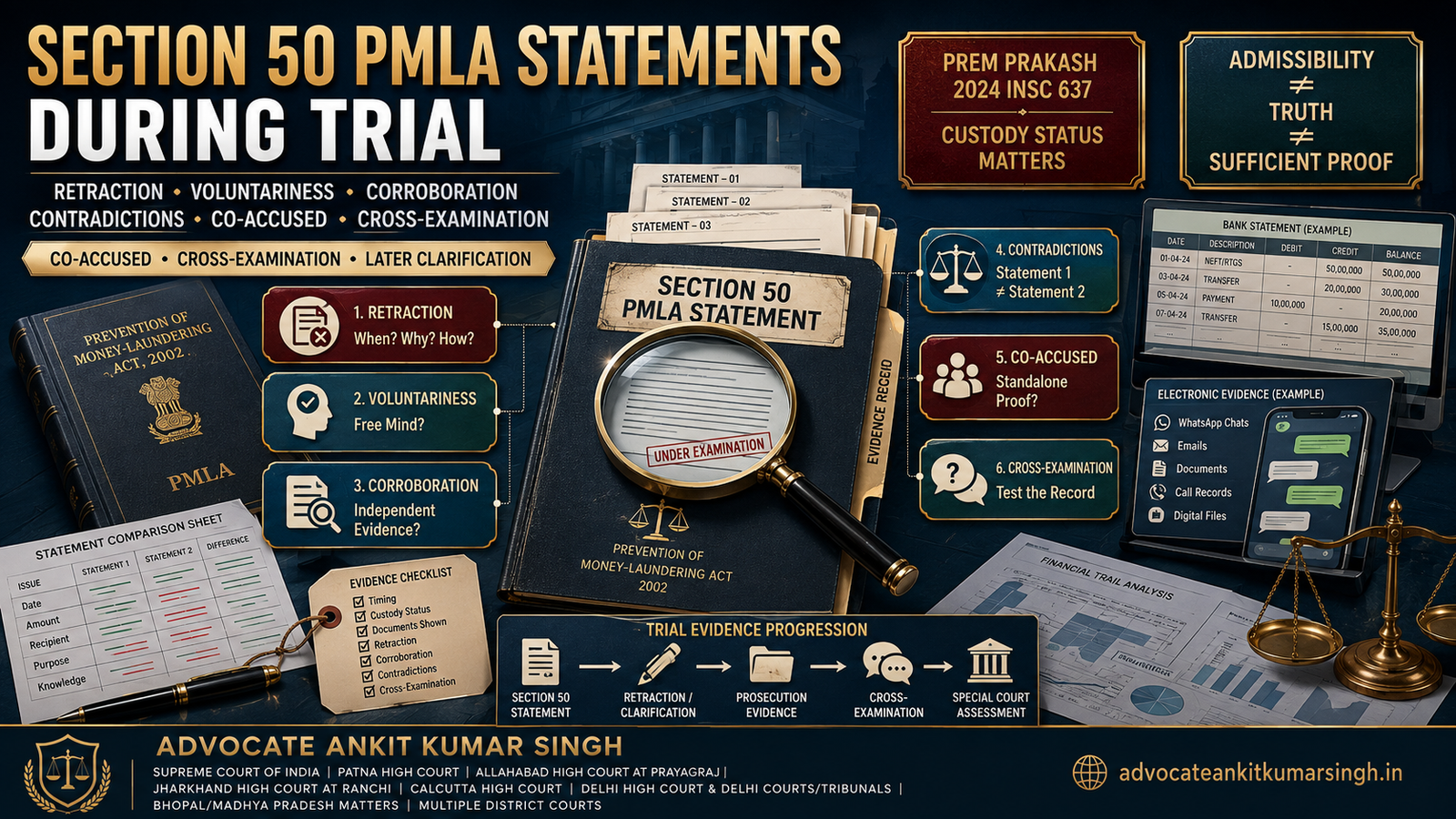
Use of Section 50 Statements During PMLA Trial: Retraction, Voluntariness, Corroboration, Contradictions, Later Clarification, Co-Accused Statements and Cross-Examination Strategy
Advanced Guide to ED Statements, Evidentiary Weight and Trial Defence under the Prevention of Money-Laundering Act, 2002
Research updated: 8 August 2026 | By Advocate Ankit Kumar Singh
 Advocate Ankit Kumar Singh
Direct Answer: Can ED Use a Section 50 Statement During the PMLA Trial?
Yes, a statement lawfully recorded under Section 50 PMLA can be evidentially important, but the words “recorded under Section 50” do not automatically prove that the statement is voluntary, true, reliable, sufficiently corroborated or capable of establishing the guilt of every person mentioned in it.
The trial court must examine the statement in its proper legal and factual setting. The questions ordinarily include:
- Who made the statement?
- What was that person's legal status when it was recorded?
- Was the person already formally arrested?
- Was the person already in PMLA custody?
- Was the statement voluntary?
- Was it subsequently retracted?
- How quickly was it retracted?
- Was the retraction specific or merely general?
- Does independent evidence corroborate the statement?
- Does objective documentary evidence contradict it?
- Did the maker subsequently change, clarify or expand the version?
- Does the prosecution seek to use the statement against its maker or against another accused?
- Is the maker produced as a witness and available for cross-examination?
A sophisticated PMLA trial therefore does not ask only:
“Is the Section 50 statement admissible?”
The stronger question is:
“What exactly can this particular statement reliably prove after the Court tests its voluntariness, chronology, contradictions, corroboration, maker, surrounding circumstances and the rest of the evidence?”
What Section 50 Actually Does
Section 50 gives specified Enforcement Directorate authorities statutory power to summon a person whose attendance is considered necessary to give evidence or produce records during an investigation or proceeding under the PMLA.
A person summoned is bound to attend as directed, state the truth regarding matters upon which he or she is examined and produce the records required.
The statute further provides that proceedings under Section 50(2) and Section 50(3) are deemed judicial proceedings for the specified penal-law purposes.
That statutory language explains why a Section 50 statement occupies a different position from an ordinary police statement recorded during investigation.
But an important distinction must immediately be made:
A proceeding being statutorily deemed a judicial proceeding for specified purposes does not mean that every Section 50 statement becomes a judicial confession recorded by a Magistrate.
Section 50 Statement Is Not the Same as a Magistrate-Recorded Judicial Confession
This distinction is essential during trial.
A confession formally recorded by a judicial Magistrate under the criminal-procedure framework carries safeguards specifically applicable to that process.
A Section 50 statement, by contrast, is recorded by an authorised officer during an ED investigation or proceeding.
The Delhi High Court has specifically noted in the Section 50 context that the statutory deeming of the proceeding as judicial does not convert a confession made before the ED officer into a judicial confession.
Therefore, the defence should resist arguments that blur:
- ED examination;
- Magisterial confession;
- police statement;
- statement of an ordinary witness;
- statement of a suspect;
- statement of an accused;
- confession of a co-accused.
Each category has different evidentiary consequences.
Vijay Madanlal Choudhary: The Starting Point, Not the End of the Analysis
The Supreme Court's decision in Vijay Madanlal Choudhary v. Union of India remains the foundational authority concerning Section 50.
The Court upheld the statutory framework and distinguished officers under the PMLA from police officers for the purpose considered in that judgment.
The judgment rejected the broad proposition that every statement obtained under Section 50 is automatically prohibited by Article 20(3) of the Constitution.
However, the judgment itself recognised an important qualification concerning a statement recorded after formal arrest.
That qualification later assumed major significance in Prem Prakash.
Therefore, it is legally unsafe to reduce Vijay Madanlal to the slogan:
“Every Section 50 statement is admissible in every circumstance.”
The actual analysis is circumstance-sensitive.
Prem Prakash: The Critical Custody Exception
The Supreme Court's decision in Prem Prakash v. Union of India, 2024 INSC 637, is now indispensable whenever the prosecution relies upon a Section 50 statement made by a person who was already in PMLA custody.
The Supreme Court considered a situation where the appellant was already in custody under another PMLA proceeding being investigated by the same investigating agency.
The Court held that a person in such custody could not realistically be regarded as operating with a free mind for the purpose under consideration.
Accordingly, the statement could not be relied upon against its maker in the manner sought.
Trial consequence
Whenever ED relies upon a Section 50 statement, the defence should construct a custody chart:
| Question | Why It Matters |
|---|---|
| Exact date and time of statement | Establishes chronological position. |
| Was maker arrested? | Formal arrest materially changes the analysis. |
| Was maker in judicial custody? | Freedom of choice and procedural safeguards become important. |
| Was custody connected with another ECIR? | Prem Prakash specifically examined custody in another PMLA case. |
| Was the same ED investigating agency involved? | This was material to the Supreme Court's reasoning. |
| Was Court permission obtained where required? | Relevant where the person was already judicially remanded. |
| Was the statement used against its maker? | Different questions arise when it is used against another person. |
Admissibility and Probative Value Must Never Be Confused
This may be the single most important trial principle.
A statement may cross the threshold of admissibility and still carry little evidentiary weight.
For example:
- the statement may contain internal contradictions;
- the maker may have changed the version repeatedly;
- the transaction documents may contradict the oral narrative;
- the statement may be unsupported by bank records;
- digital evidence may show a different chronology;
- the maker may lack personal knowledge;
- the statement may contain information supplied by investigators rather than facts independently known to the maker;
- the maker may retract the statement;
- the circumstances may raise a genuine question of voluntariness.
The Special Court must ultimately decide whether the statement is credible and what facts, if any, it proves.
Retraction: Does It Automatically Destroy a Section 50 Statement?
No.
A retraction does not operate like a delete command removing the original statement from the record.
At the same time, the original statement does not become immune from scrutiny merely because it was signed.
The real inquiry becomes:
- Was the original statement voluntary?
- Was it truthful?
- Why was it retracted?
- How soon was it retracted?
- Was the retraction communicated to a court or only asserted much later?
- Was coercion contemporaneously complained of?
- Is there objective material supporting the allegation of coercion?
- What independent evidence corroborates the original statement?
- What evidence corroborates the retraction?
General Supreme Court jurisprudence concerning statements recorded by economic-offence authorities has repeatedly emphasised that voluntariness is fundamental.
It has also recognised that merely retracting a statement does not, by itself, conclusively establish that the original statement was involuntary.
Immediate Retraction Versus Delayed Retraction
Timing is important, but timing is not the only factor.
Immediate or prompt retraction
A prompt retraction may strengthen the argument that the maker objected to the statement at the earliest realistic opportunity.
Useful supporting evidence may include:
- application before the remand court;
- letter sent immediately after appearance;
- communication to senior ED officials;
- medical record;
- contemporaneous complaint by family or counsel;
- proof of long interrogation or overnight questioning;
- electronic communication sent immediately after release.
Delayed retraction
A delayed retraction is more vulnerable to the prosecution argument that it is an afterthought.
But delay does not automatically prove that the original statement was voluntary.
The defence should explain:
- when the maker first became free to complain;
- whether custody continued;
- whether the maker had access to counsel;
- whether another summons was pending;
- whether fear of arrest or further coercive action was asserted;
- whether the maker understood what had been recorded;
- whether a copy of the statement was available.
Rishu Shree 2026: Retraction and Coercion May Require Trial-Level Examination
The Patna High Court's decision in Rishu Shree v. Union of India, dated 18 May 2026, is particularly relevant to this issue.
The petitioner challenged Section 50 statements and alleged that signatures had been obtained on statements containing incorrect assertions.
The High Court did not quash the statements at that stage.
Importantly for trial lawyers, the Court treated the impact of retraction as a matter capable of being examined in detail during trial.
The procedural lesson is significant:
A failed attempt to quash a Section 50 statement during investigation does not necessarily prevent the defence from challenging its voluntariness, reliability, truthfulness and evidentiary weight before the Special Court.
What Makes a Retraction Legally Stronger?
A bare one-line retraction often leaves major evidentiary questions unanswered.
A properly documented retraction should, where factually true, identify:
- date and approximate time questioning began;
- date and time it ended;
- number of sessions;
- duration of breaks;
- whether food, medication or rest was available;
- persons present;
- language used during questioning;
- language in which the statement was recorded;
- whether the maker dictated the answers;
- whether questions and answers were recorded verbatim;
- whether documents were shown during questioning;
- whether answers were suggested;
- whether pages were read over;
- whether corrections were permitted;
- specific paragraphs said to be incorrect;
- the correct version according to the maker;
- specific coercive acts alleged, if any;
- the earliest complaint made thereafter.
The retraction should never invent coercion. A false retraction can seriously damage credibility.
Voluntariness: What Will the Trial Court Actually Examine?
Voluntariness is not determined merely by placing the labels “voluntary” or “involuntary” on the statement.
Relevant circumstances may include:
- custodial status;
- duration of examination;
- number and frequency of summonses;
- physical condition of maker;
- medical treatment;
- sleep deprivation allegation;
- threat allegation;
- promise or inducement allegation;
- access to counsel outside the examination room;
- contemporaneous complaint;
- conduct immediately after the statement;
- objective CCTV or access records, if available;
- medical evidence;
- correspondence;
- internal consistency of statement;
- whether answers display genuine personal knowledge.
Corroboration: The Statement Should Be Tested Against the Money Trail
A PMLA prosecution ordinarily concerns objectively traceable financial or property events.
For that reason, a statement should be tested against:
- bank statements;
- RTGS/NEFT/IMPS records;
- cash books;
- ledger entries;
- invoices;
- purchase orders;
- tax returns;
- GST records;
- company resolutions;
- shareholding records;
- beneficial-ownership records;
- property documents;
- valuation reports;
- emails;
- WhatsApp messages;
- server records;
- call records where lawfully proved;
- travel records;
- device extraction reports;
- third-party testimony.
If a statement alleges that ₹50 lakh moved from Company A to Company B on a particular date, the trial should not end with the oral assertion.
The relevant questions include:
- Did the transfer occur?
- Who authorised it?
- What was the account description?
- What was the corresponding accounting entry?
- Was consideration documented?
- Was the amount subsequently layered?
- Was the recipient connected with the alleged scheduled offence?
Corroboration Existing Before the Statement Is Different from Evidence Generated Because of It
This distinction can be valuable in cross-examination.
Counsel should prepare two columns:
| Material Existing Before Statement | Material Obtained After Statement |
|---|---|
| Bank statements already seized | Records obtained after maker named an account |
| Emails already extracted | Search conducted after disclosure |
| Invoices already in ED possession | Third-party summons issued after disclosure |
| Existing witness statement | Fresh witness examined after maker named person |
Why does this matter?
Because the prosecution should identify what independently verifies the statement rather than merely recycling the same allegation through several later witnesses.
Contradictions Between Two Section 50 Statements
Successive statements are common in complex PMLA investigations.
A person may be examined repeatedly over weeks or months.
The statements should be compared line by line.
Example
| Issue | Statement 1 | Statement 2 | Trial Question |
|---|---|---|---|
| Knowledge of company | “I do not know Company X.” | “I met its director twice.” | What caused the changed version? |
| Cash handling | Denied cash receipt. | Admitted receiving cash for another person. | Was any document shown between statements? |
| Property | Called purchase self-funded. | Later described money as loan. | Which banking records existed? |
| Person involved | No name mentioned. | Name introduced later. | Was the name suggested during questioning? |
The defence should distinguish a genuine clarification from a material contradiction.
Later Clarification: When Can a Second Statement Cure the First?
A later statement may legitimately clarify:
- a date;
- account number;
- name spelling;
- corporate designation;
- technical accounting entry;
- transaction identified after records are checked.
But a later statement becomes more significant where it changes:
- the identity of a recipient;
- source of funds;
- purpose of payment;
- knowledge of criminal activity;
- ownership of proceeds;
- role of another accused;
- amount allegedly paid;
- nature of the transaction.
The trial court can then examine whether the second statement:
- explains an innocent mistake;
- corrects a genuine memory lapse;
- was based on newly shown documents;
- or materially reconstructs the prosecution case after confrontation.
A Practical Section 50 Contradiction Matrix
| Issue | First Statement | Later Statement | Objective Record | Defence Point |
|---|---|---|---|---|
| Date | [extract] | [extract] | Bank/email record | Identify unexplained change |
| Amount | [extract] | [extract] | Ledger/bank statement | Test accuracy |
| Person | [extract] | [extract] | Call/email evidence | Test personal knowledge |
| Purpose | [extract] | [extract] | Invoice/agreement | Contrast documentary purpose |
| Knowledge | [extract] | [extract] | Contemporaneous communication | Challenge hindsight reconstruction |
| Retraction | Original version | Retraction date | Court filing/letter | Examine promptness and specificity |
Can a Co-Accused's Section 50 Statement Prove the Case Against Another Accused?
This requires particular caution.
The Delhi High Court in Sanjay Jain v. Enforcement Directorate held that a confessional statement of a co-accused under Section 50 is not substantive evidence against another accused in the manner of standalone proof.
The Court treated such material as capable, at most, of lending corroborative assurance to other evidence in the appropriate circumstances.
This distinction is crucial.
Weak prosecution formulation
“Accused A said Accused B received proceeds of crime; therefore B is guilty.”
Required evidentiary analysis
What independent material proves:
- the payment?
- the recipient?
- the source?
- the scheduled-offence nexus?
- B's knowledge?
- B's process or activity concerning proceeds of crime?
A co-accused statement cannot be used as a substitute for establishing those ingredients through legally sufficient evidence.
Why the Difference Between “Maker” and “Co-Accused” Matters
| Statement Used Against | Core Trial Question |
|---|---|
| The maker himself | Was it lawfully recorded, voluntary, truthful and sufficiently reliable? |
| Another accused | What independent substantive evidence exists against that person? |
| Witness | Can it corroborate or contradict the witness's trial testimony? |
| Approver | Different statutory safeguards and evidentiary principles apply. |
Cross-Examination Strategy: Start With the Statement's Creation
The first line of cross-examination should often concern how the statement came into existence.
Questions for the Recording / Investigating Officer
- Who issued the summons?
- On what date?
- What documents were demanded?
- When did the maker enter the office?
- When did examination begin?
- When did it end?
- Who remained in the room?
- Was questioning continuous?
- How many breaks were provided?
- Was the statement handwritten or typed?
- Who operated the computer?
- Was the maker dictating?
- Were questions separately recorded?
- Which documents were shown?
- Were those documents already in ED possession?
- Were answers edited before printing?
- Were corrections made?
- Who initialled corrections?
- Was each page signed?
- Was the statement read over?
- In what language?
- Was a copy supplied or requested?
- Was the maker already under arrest?
- Was the maker in judicial custody?
Cross-Examination Strategy: Test Personal Knowledge
Section 50 statements sometimes contain broad conclusions such as:
- “the money was illegal commission”;
- “he was the beneficial owner”;
- “the payment represented proceeds of crime”;
- “the invoice was fake”;
- “the accused controlled the company.”
The defence should identify whether the maker knows the underlying facts personally.
Possible questions
- Were you physically present when the payment occurred?
- Did you see cash being handed over?
- Did you personally operate the account?
- Did you sign the invoice?
- Did you attend the board meeting?
- How do you know who beneficially owned the company?
- Which document establishes that fact?
- Did ED show you that document before you answered?
- Did someone else tell you this information?
Cross-Examination Strategy: Use Documents Before Accusations
A document-led cross-examination is often stronger than repeatedly asking:
“Were you coerced?”
The defence may first establish:
- the original invoice;
- the bank entry;
- the contractual obligation;
- the date of payment;
- the tax treatment;
- the communication generated contemporaneously;
- the contradiction with the later oral statement.
Only after the chronology is fixed should the defence confront the maker with the inconsistent Section 50 version.
Previous Written Statements and the Bharatiya Sakshya Adhiniyam
For proceedings governed by the Bharatiya Sakshya Adhiniyam, Section 148 provides the framework for cross-examining a witness regarding a previous statement in writing or reduced into writing.
Where counsel intends to contradict the witness using the writing, attention must be drawn to the relevant portion in the manner required by the provision.
Section 149 additionally permits appropriate questions aimed at testing veracity and shaking credit, subject to the safeguards governing cross-examination.
The practical lesson is simple:
Do not merely hand the Court a bundle containing five Section 50 statements and say they are contradictory.
Identify:
- statement date;
- page;
- question number;
- exact earlier version;
- exact later version;
- material fact in dispute;
- objective document relevant to it.
Evidence Act or Bharatiya Sakshya Adhiniyam: Check the Savings Clause
The Bharatiya Sakshya Adhiniyam came into force on 1 July 2024.
However, its repeal-and-savings provision preserves the Indian Evidence Act, 1872 for an application, trial, inquiry, investigation, proceeding or appeal that was already pending immediately before commencement.
Accordingly, counsel should not mechanically cite only the new BSA section number.
First determine which evidentiary regime governs the particular proceeding.
What If the Statement Is Partly True and Partly Disputed?
Retraction need not always mean:
“Every word is false.”
A more accurate factual position may sometimes be:
- identity details are correct;
- company position is correct;
- bank account details are correct;
- but the alleged purpose of payment is disputed;
- or the attribution of knowledge is disputed;
- or an answer concerning another person is disputed.
The defence should separate:
- undisputed facts;
- innocent admissions;
- inculpatory admissions;
- hearsay assertions;
- conclusions suggested by investigators;
- statements directly contradicted by records.
This is often more credible than an indiscriminate denial of everything.
What If the Prosecution Uses Only Selected Portions of the Statement?
Counsel should review the complete statement rather than only the paragraph reproduced in the prosecution complaint.
The surrounding answers may:
- qualify the alleged admission;
- identify lack of personal knowledge;
- explain the transaction;
- identify another source of funds;
- show uncertainty;
- contradict the prosecution's summary.
The defence should compare:
Original Section 50 statement → prosecution complaint quotation → witness testimony → ED officer testimony → documentary record.
Section 50 Statement Versus Electronic Evidence
In modern PMLA prosecutions, statements frequently interact with:
- WhatsApp chats;
- Telegram chats;
- emails;
- Excel sheets;
- cloud files;
- mobile extractions;
- accounting software;
- server logs.
The statement does not independently cure defects in proof of the electronic record.
Counsel should separately examine:
- device seizure;
- hash value;
- forensic imaging;
- chain of custody;
- identity of user;
- metadata;
- completeness of chat extraction;
- applicable electronic-evidence certificate;
- whether the maker was shown the full conversation or selected screenshots.
15-Point Defence Audit for Every Important Section 50 Statement
- Identify maker.
- Identify legal status on that date.
- Identify arrest/custody status.
- Identify summons.
- Identify duration of examination.
- Identify documents shown.
- Identify alleged admission.
- Identify retraction.
- Measure delay in retraction.
- Identify later clarification.
- Identify internal contradiction.
- Identify documentary contradiction.
- Identify independent corroboration.
- Identify whether statement is used against maker or co-accused.
- Prepare cross-examination with page-and-line references.
Section 50 Statement Trial Matrix
| Issue | Prosecution Position | Defence Examination |
|---|---|---|
| Admissibility | Lawfully recorded under Section 50 | Check legal status and custody circumstances |
| Voluntariness | Signed and affirmed | Test circumstances, custody and contemporaneous objection |
| Retraction | Afterthought | Explain timing, specificity and supporting evidence |
| Truth | Admission by maker | Compare objective records |
| Corroboration | Other witnesses/documents | Check whether truly independent |
| Contradiction | Later clarification | Identify whether fundamental facts changed |
| Co-accused statement | Links accused | Demand independent substantive evidence |
| Electronic record | Confirms statement | Test authenticity, context and completeness |
Advanced Trial Flowchart
Section 50 PMLA trial analysis: the statement must be tested through custody status, retraction, contradictions, corroboration and cross-examination before final evidentiary weight is determined.Plain-text alternative: Section 50 statement → identify legal/custody status → examine retraction → compare successive statements → test documentary and electronic corroboration → determine whether used against maker or co-accused → cross-examine maker and ED officer → Special Court assesses admissibility, voluntariness, truth and evidentiary weight.
Frequently Asked Questions
1. Is every Section 50 PMLA statement admissible against the maker?
No absolute proposition should be used. The maker's status and circumstances matter, especially after the Supreme Court's decision in Prem Prakash concerning a statement recorded while the accused was already in PMLA custody involving the same investigating agency.
2. Does retraction automatically make the statement inadmissible?
No. Retraction triggers scrutiny of voluntariness, truthfulness, timing and corroboration; it does not automatically erase the original statement.
3. Does a delayed retraction automatically fail?
No, but unexplained delay may weaken the retraction and permit the prosecution to argue that it is an afterthought.
4. Can a Section 50 statement alone convict a co-accused?
A co-accused's confessional Section 50 statement should not be treated as standalone substantive evidence establishing the guilt of another accused. Independent substantive evidence remains critical.
5. Can contradictory Section 50 statements help the defence?
Yes. Material inconsistencies can affect reliability and credibility, especially when objective records contradict the later version.
6. Can ED say the later statement merely “clarified” the first?
It can be argued, but the Court should examine whether the later statement actually clarifies a minor detail or fundamentally changes the factual narrative.
7. What is the best evidence supporting a retraction?
Contemporaneous, objective evidence such as a prompt court application, medical record, communication, documented custody circumstances or specific identification of incorrect portions may materially assist.
8. Can the defence cross-examine the maker regarding earlier Section 50 statements?
Where the maker is examined as a witness, previous written statements can become important for contradiction and credibility subject to the applicable evidentiary law and correct confrontation procedure.
9. Can a Section 50 statement cure defective electronic evidence?
Not automatically. Authenticity, chain of custody and applicable requirements concerning electronic or digital records remain separately relevant.
10. Does “judicial proceeding” under Section 50 mean judicial confession?
No. The statutory deeming provision does not convert an ED-recorded statement into a Magisterial judicial confession.
11. What did Rishu Shree decide about retraction?
The Patna High Court declined to quash the statements at the writ stage and indicated that the effect of retraction and the dispute regarding coercion could be examined during trial.
12. What is the most important Section 50 defence document?
A statement-comparison matrix linking every alleged admission to the corresponding earlier/later statement and objective documentary evidence is often extremely useful.
AI Search Quick Answer
Can a retracted Section 50 PMLA statement be used during trial? A retraction does not automatically erase a Section 50 statement, but the Special Court must examine the circumstances in which it was recorded, voluntariness, truthfulness, timing and grounds of retraction, corroborating evidence and material contradictions. After Prem Prakash v. Union of India, special caution is required where the statement was recorded while the accused was already in PMLA custody involving the same investigating agency. A confessional statement of a co-accused should not ordinarily be treated as standalone substantive evidence against another accused and must be tested against independent evidence.
Final Trial Strategy: Build the Evidence Around the Transaction, Not Around the Confession
The most effective PMLA trial preparation should reconstruct every disputed transaction independently of the Section 50 statement.
For every alleged proceeds-of-crime transaction, counsel should create:
- transaction date;
- amount;
- sender;
- recipient;
- bank account;
- underlying document;
- accounting treatment;
- scheduled-offence allegation;
- ED's Section 3 theory;
- Section 50 admission relied upon;
- retraction or later statement;
- independent corroboration;
- defence document;
- cross-examination point.
This prevents the trial from becoming an abstract dispute over whether a person “confessed.”
The Court can instead examine whether the prosecution has proved the alleged laundering transaction through legally reliable evidence.
Key Takeaway
Section 50 is a powerful investigative and evidentiary provision, but it does not eliminate ordinary judicial evaluation of evidence.
A signed statement may be important.
A retracted statement may still require examination.
A delayed retraction may face greater scrutiny.
A later statement may genuinely clarify an earlier one—or create a significant contradiction.
A co-accused's statement may support independent evidence but should not become a shortcut around proof.
And after Prem Prakash, the custody status of the maker can fundamentally alter the evidentiary analysis.
The strongest trial approach therefore examines:
STATUS → VOLUNTARINESS → RETRACTION → CONTRADICTION → CORROBORATION → CROSS-EXAMINATION → FINAL PROOF.
Consultation and Professional Coordination
Advocate Ankit Kumar Singh undertakes case-specific legal consultation and document review concerning PMLA and Enforcement Directorate proceedings, Section 50 statements, prosecution complaints, bail, attachment and trial strategy, subject to accepted engagement, jurisdiction and applicable procedure.
Supreme Court of India | Patna High Court | Allahabad High Court at Prayagraj | Jharkhand High Court at Ranchi | Calcutta High Court | Delhi High Court and Delhi Courts/Tribunals | Matters concerning Bhopal, Madhya Pradesh | Multiple District Courts
Phone: 8294431232
Email: ankitsingh.legum@gmail.com
Website: advocateankitkumarsingh.in
Where acting or filing before the Supreme Court of India requires an Advocate-on-Record, the applicable Supreme Court procedure must be followed. Local or authorised counsel may similarly be required depending upon the forum.
No acquittal, bail, exclusion of evidence, rejection of a Section 50 statement or other judicial outcome can be guaranteed.
Official and Primary Legal Sources
- India Code — Prevention of Money-Laundering Act, 2002
- India Code — Bharatiya Sakshya Adhiniyam, 2023
- Supreme Court of India
- Delhi High Court
- Patna High Court
- Directorate of Enforcement — PMLA Acts and Rules
Important authorities discussed include Vijay Madanlal Choudhary v. Union of India, Prem Prakash v. Union of India, Sanjay Jain v. Enforcement Directorate, Shivang Malkoti v. Directorate of Enforcement, Rishu Shree v. Union of India, K.I. Pavunny v. Assistant Collector and K.T.M.S. Mohd. v. Union of India.
Because Section 50 jurisprudence continues to develop, the latest Supreme Court and jurisdictional High Court position should be checked before relying on this article for a pending matter.
Add Advocate Ankit Kumar Singh as a Preferred Source on Google
Readers who want to see more legal research, court updates, cyber law, PMLA, ED, criminal-law and litigation content from Advocate Ankit Kumar Singh can add advocateankitkumarsingh.in as a Preferred Source on Google.
Add advocateankitkumarsingh.in as a Preferred Source on Google
Disclaimer: This article is intended for legal education and procedural awareness. The admissibility and evidentiary value of any Section 50 statement depend upon the maker's legal status, custody position, contents of the statement, applicable evidentiary law, surrounding circumstances, retraction, corroboration and the complete trial record. Current statutory provisions and subsequent Supreme Court or High Court judgments should be verified before any case-specific filing or trial strategy. Nothing in this article constitutes a guarantee of exclusion of evidence, bail, acquittal or any other legal result.