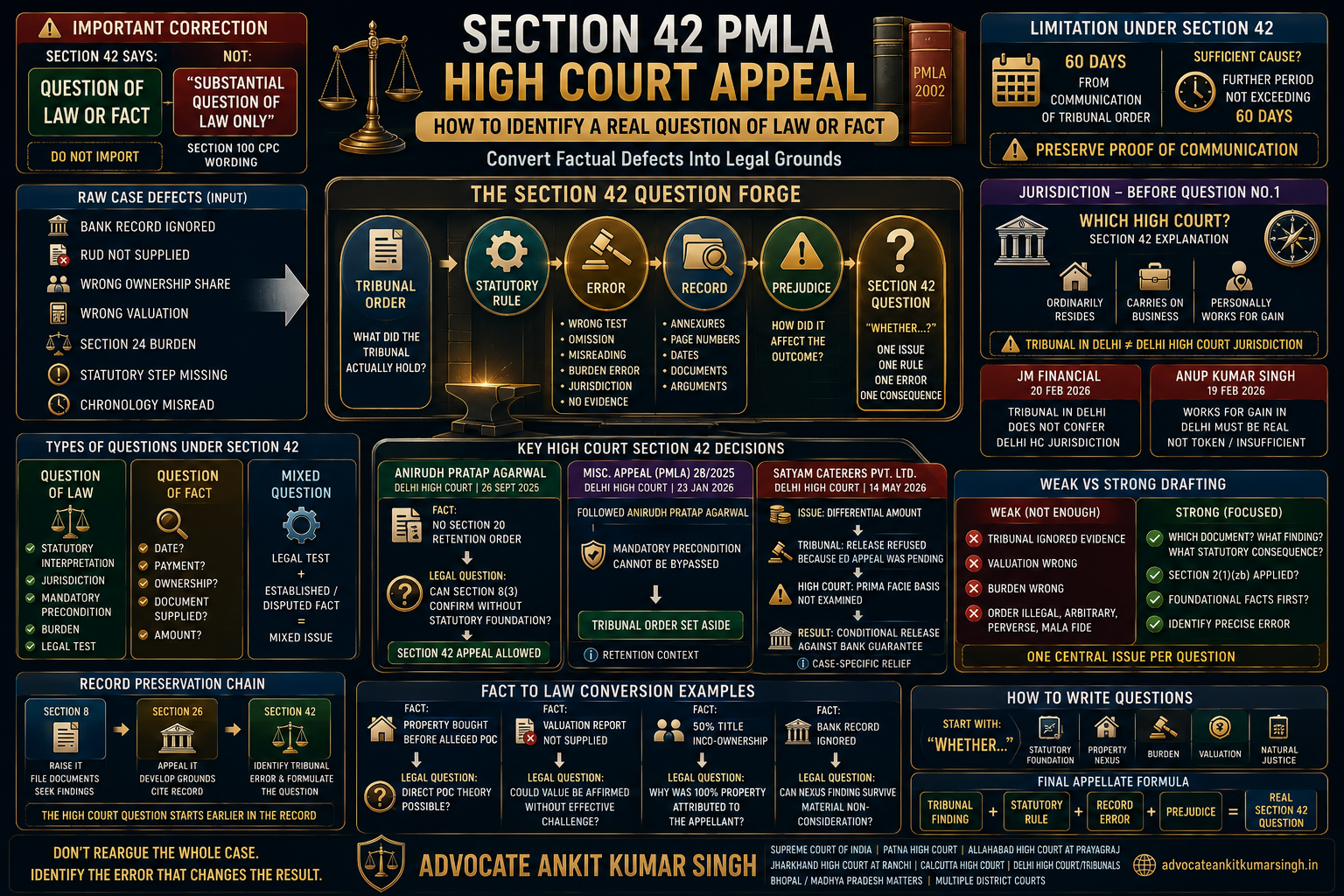
SECTION 42 PMLA • HIGH COURT APPEAL • QUESTION OF LAW OR FACT • APPELLATE TRIBUNAL
High Court Appeal Under Section 42 PMLA: How to Identify a Real Question of Law, Convert Factual Defects Into Legal Grounds and Challenge the Appellate Tribunal
Tribunal Error • Question of Law • Question of Fact • Statutory Misdirection • Evidence Defects • Jurisdiction • 60-Day Limitation
Research updated: 9 August 2026 | By Advocate Ankit Kumar Singh
 Advocate Ankit Kumar Singh
Direct Answer: What Must a Section 42 PMLA High Court Appeal Identify?
A Section 42 appeal should identify a precise question of law or fact arising from the Appellate Tribunal's decision or order.
The statutory wording is important:
QUESTION OF LAW OR FACT.
Section 42 does not state that the appellant must establish a “substantial question of law”.
The practical drafting task is nevertheless to identify an issue that is:
- precise;
- material;
- rooted in the Tribunal order;
- supported by the appellate record;
- capable of changing the outcome.
The strongest drafting formula is:
TRIBUNAL FINDING → STATUTORY RULE → ERROR → RECORD → PREJUDICE → QUESTION FOR HIGH COURT.
First Correction: Section 42 Is Not Section 100 CPC
One of the most important mistakes to avoid is writing:
“This appeal raises the following substantial questions of law as mandatorily required under Section 42 PMLA.”
That imports terminology not found in Section 42.
Section 42 expressly permits an appeal on:
ANY QUESTION OF LAW OR FACT ARISING OUT OF THE APPELLATE TRIBUNAL ORDER.
Counsel may still use the word “substantial” descriptively to explain that an issue is serious or outcome-determinative, but it should not be represented as the statutory threshold contained in Section 42.
What Is the Correct Section 42 Limitation?
The ordinary period is:
60 DAYS
from communication of the Appellate Tribunal's decision or order.
Where sufficient cause is established, the High Court may allow filing within:
A FURTHER PERIOD NOT EXCEEDING 60 DAYS.
Therefore immediately preserve:
- Tribunal order date;
- date of communication;
- email;
- portal record;
- postal receipt;
- certified-copy record, where relevant;
- calculation sheet.
The Question Must Arise From the Tribunal Order
The immediate statutory target is not merely:
THE PAO
or:
THE SECTION 8 ORDER.
It is:
THE APPELLATE TRIBUNAL'S DECISION OR ORDER.
Therefore map:
| Issue Before Tribunal | Tribunal Finding | Section 42 Error |
|---|---|---|
| Lawful source | Rejected | Material evidence ignored / wrong statutory test |
| Section 24 | Burden placed on appellant | Foundational-fact issue |
| Valuation | ED value affirmed | Section 2(1)(zb) allegedly misapplied |
Question of Law, Question of Fact and Mixed Question
QUESTION OF LAW
Asks what the statute legally requires or permits.
Example:
Whether a valid Section 20 retention order is a mandatory statutory prerequisite before continuation of seized property can be confirmed under Section 8(3), in the statutory context applicable to the case.
QUESTION OF FACT
Concerns what actually happened on the record.
Example:
Whether the ₹40 lakh property instalment was paid from the housing-loan disbursement credited one day earlier.
MIXED QUESTION OF LAW AND FACT
Applies a statutory standard to established or disputed facts.
Example:
Whether, on the undisputed acquisition and banking chronology, the Tribunal could legally characterise the property as directly derived from alleged proceeds generated only at a later date.
What Is Not Enough?
These formulations are usually too vague:
“The Tribunal order is illegal.”
“The Tribunal did not appreciate the facts.”
“The Tribunal wrongly believed ED.”
“The order is arbitrary.”
“The evidence proves my innocence.”
“The attachment is disproportionate.”
Each statement requires a second question:
WHY?
The Six-Part Section 42 Ground
For every proposed question prepare:
- FINDING: What did the Tribunal hold?
- RULE: Which statutory provision or legal principle applies?
- ERROR: How did the Tribunal misapply it?
- RECORD: What exact material demonstrates the problem?
- PREJUDICE: Why did it affect the result?
- RELIEF: What should the High Court do?
How to Convert a Factual Defect Into a Legal Ground
Use:
FACTUAL DEFECT + STATUTORY CONSEQUENCE = APPELLATE LEGAL ISSUE.
Example:
FACT: No Section 20 retention order was passed.
LEGAL CONSEQUENCE: Can Section 8(3) confirm retention where the asserted mandatory statutory foundation for retention never existed?
That is materially different from saying:
“A paper was missing.”
Anirudh Pratap Agarwal: A Model Conversion From Fact to Law
In Anirudh Pratap Agarwal v. Enforcement Directorate, the Delhi High Court dealt with a Section 42 appeal concerning retention of seized property.
The decisive factual circumstance was:
NO SECTION 20 RETENTION ORDER HAD BEEN PASSED.
The Court treated Section 20 as substantive and mandatory in the statutory framework before it and held that Section 8(3) performs a confirmatory function; it could not substitute for the missing initial retention foundation.
The appeal was allowed.
Drafting lesson:
IDENTIFY THE FACT → IDENTIFY THE STATUTORY CONDITION → ASK WHETHER THE CONDITION COULD LEGALLY BE BYPASSED.
Source-of-Funds Defect: Weak Ground vs Legal Ground
WEAK
“The Tribunal should have accepted my bank statements.”
STRONGER
Whether the Tribunal's conclusion that the acquisition source was unexplained is sustainable where the contemporaneous loan disbursement, acquisition debit and lender records specifically relied upon by the appellant were not considered while affirming the property-nexus finding.
Then identify:
- Tribunal paragraph;
- paper-book page;
- loan date;
- bank-credit date;
- purchase debit;
- how the omission affected the nexus finding.
Ignoring Evidence: Do Not Say “Everything Was Ignored”
| Evidence | Tribunal Page | Issue | Treatment |
|---|---|---|---|
| Loan sanction | PB ___ | Funding | Not discussed |
| Bank credit | PB ___ | Disbursement | Contrary finding |
| Sale deed | PB ___ | Ownership | Share misread |
The legal question can then be formulated around:
MATERIAL NON-CONSIDERATION, NOT GENERAL DISSATISFACTION.
No-Evidence Finding
A particularly focused appellate challenge can arise where:
- the Tribunal records an affirmative factual conclusion;
- but the record contains no identified material supporting that conclusion.
Draft:
Whether the Tribunal could affirm the finding of beneficial ownership in the absence of any material identified in the impugned order establishing consideration, control, enjoyment or other factual basis attributed to the appellant.
Do not call a finding “no evidence” if there is actually evidence you merely consider insufficient.
Misreading Evidence
Another category is not complete absence of evidence, but:
MATERIAL MISREADING.
Example:
Tribunal says:
“The ₹30 lakh amount was received from Entity X.”
Bank statement actually records:
credit from Bank Y under an identified loan account.
A Section 42 question may then focus upon whether the statutory nexus finding can survive the demonstrated record error.
Chronology Can Become a Legal Ground
Suppose:
Property acquired: January 2020
Alleged direct POC generated: August 2021
A weak ground is:
“The Tribunal ignored chronology.”
A stronger question is:
Whether the Tribunal could legally affirm a finding that the property was directly acquired from the alleged proceeds where the undisputed acquisition preceded the alleged generation of those proceeds, without separately examining whether ED's pleaded case was instead an equivalent-value attachment.
Direct POC vs Equivalent Value: A Real Legal Issue
The two theories should not be collapsed.
Ask whether the Tribunal:
- found the property directly derived from POC;
- found indirect transformation;
- or sustained attachment as equivalent value.
Potential question:
Whether the Tribunal legally erred in sustaining attachment on an equivalent-value theory when the attachment order and adjudication had treated the property as directly derived POC, without addressing the distinct statutory requirements and factual foundation for the different theory.
The exact question must match the record.
Section 24 Reverse Burden: Convert the Burden Complaint Into a Legal Question
Weak:
“The Tribunal wrongly put the burden on me.”
Better:
Whether the Tribunal could invoke the statutory presumption under Section 24 without first determining whether the foundational facts identifying the relevant proceeds of crime and their statutory nexus had been established on the record.
The Supreme Court has recognised that the Section 24 presumption operates after the requisite foundational facts are met.
Third-Party Appellant and Section 24
The statutory distinction between:
PERSON CHARGED UNDER SECTION 3
and:
OTHER PERSON
must be examined carefully.
Possible question:
Whether the Tribunal applied the mandatory accused-person presumption applicable under Section 24(a) to an independent third-party claimant whose statutory position fell for consideration under Section 24(b).
The question must be based upon what the Tribunal actually did.
Valuation Defect: Convert Arithmetic Into Statutory Interpretation
Weak:
“The property is worth only ₹2 crore.”
Stronger:
Whether the Tribunal applied the statutory concept of “value” under Section 2(1)(zb) while sustaining the attachment valuation, and whether use of the adopted valuation date was legally sustainable on the record.
Then show:
- acquisition date;
- ED valuation date;
- Tribunal reasoning;
- ownership share;
- valuation methodology.
Over-Attachment: Arithmetic Must Lead to a Legal Error
Prepare:
| Item | Amount |
|---|---|
| POC quantified | ₹_____ |
| Value already secured | ₹_____ |
| Further property sustained | ₹_____ |
| Alleged duplication/excess | ₹_____ |
Then formulate:
Whether the Tribunal could sustain attachment of ₹___ after recording POC of ₹___ without dealing with the appellant's specific contention that the same value had already been secured through Property/Account ___.
RUD Non-Supply: Convert Procedure Into Prejudice
Weak:
“RUDs were not supplied.”
Stronger:
Whether the Tribunal could affirm the attachment after holding against the appellant on valuation when the valuation report relied upon for that finding had not been supplied despite a specific request, thereby preventing an effective challenge to the valuation methodology.
Use:
DOCUMENT → RELIANCE → NON-SUPPLY → DEFENCE PREVENTED → TRIBUNAL FINDING.
Natural Justice: Identify the Exact Procedural Right
Do not merely write:
“Principles of natural justice have been violated.”
Identify:
- what was requested;
- what was denied;
- which document proves the request;
- what response could not be made;
- which finding was consequently entered.
Possible question:
Whether the Tribunal could rely upon Document X for the adverse finding after declining the appellant an effective opportunity to inspect or respond to the same.
Property-Wise Findings: Convert a Generic Order Into a Legal Issue
Suppose four properties have:
- four acquisition dates;
- different owners;
- different sources;
- different attachment theories.
But Tribunal says:
“All attached properties are proceeds of crime.”
Potential question:
Whether the Tribunal could affirm the attachment collectively without determining the appellant's distinct property-specific objections concerning ownership, source and nexus for each asset.
Contradictory Findings
A Tribunal order may contain internally inconsistent propositions.
Example:
Paragraph 42:
“No direct tracing is available.”
Paragraph 51:
“The property was directly purchased from proceeds of crime.”
That can support a focused question:
Whether the impugned conclusion is sustainable where the Tribunal's own findings concerning tracing and direct acquisition are mutually inconsistent.
Satyam Caterers 2026: Attack the Tribunal's Reason, Not Merely the Result
In Satyam Caterers Pvt. Ltd. v. Directorate of Enforcement, the appellant had obtained reduction of the quantified proceeds of crime before the Adjudicating Authority.
A differential amount had therefore become the subject of a release request.
The Tribunal refused release because ED had itself challenged the reduced quantification and granting release could affect ED's appeal.
The Delhi High Court held that this reasoning could not be sustained because the prima facie merits of ED's separate challenge had not been considered.
The High Court directed release of the differential sum subject to an equivalent bank guarantee.
Drafting lesson:
THE SECTION 42 ERROR WAS IN THE TRIBUNAL'S DECISION-MAKING LOGIC.
Question of Jurisdiction: Often the Strongest Question of Law
Examples:
- Tribunal exercised a power the statute did not confer;
- Tribunal refused to decide an issue it was required to decide;
- mandatory statutory precondition did not exist;
- appeal was dismissed on limitation after applying an incorrect commencement date;
- wrong statutory forum was selected.
Jurisdictional issues should be drafted separately and placed before merits where appropriate.
But First: Are You Before the Correct High Court?
The Explanation to Section 42 defines the relevant High Court.
For a private aggrieved party, examine where that party:
- ordinarily resides;
- carries on business;
- personally works for gain.
Do not select Delhi merely because:
- the Appellate Tribunal sits there;
- the Adjudicating Authority sits there;
- a previous appeal happened to be filed there.
JM Financial 2026: Tribunal Location Does Not Create High Court Jurisdiction
In JM Financial Asset Reconstruction Company Ltd., the Delhi High Court held that the mere location of the Appellate Tribunal in Delhi did not vest it with Section 42 territorial jurisdiction.
The appellant was situated and ordinarily working for gain in Mumbai.
The appeal was dismissed with liberty to approach the appropriate court.
This is a filing-stage issue that should be resolved before the merits brief is finalised.
Anup Kumar Singh 2026: “Works for Gain” Must Be Real
In another February 2026 Section 42 decision, the appellant ordinarily resided in Kolkata and sought to establish a Delhi connection.
The Delhi High Court found the material insufficient to establish that he ordinarily worked for gain in Delhi for purposes of Section 42.
The appeal was dismissed for want of territorial jurisdiction.
Therefore:
DO NOT MANUFACTURE JURISDICTION WITH A TOKEN BUSINESS CONNECTION.
How to Draft the Questions: Use “Whether…”
A clean appellate formulation often begins:
“Whether…”
Examples:
- Whether the Appellate Tribunal erred in sustaining retention despite the admitted absence of the statutory order required under Section ___?
- Whether the Tribunal could invoke Section 24 before determining the foundational facts relating to proceeds of crime?
- Whether the Tribunal legally erred in sustaining the attachment valuation without applying Section 2(1)(zb)?
- Whether the Tribunal could affirm direct-PoC character despite an undisputed acquisition chronology preceding the alleged generation of POC?
- Whether the Tribunal could sustain the adverse finding without considering Annexures A-12 to A-18, which directly addressed the statutory property nexus?
Avoid Argument Disguised as a Question
Bad:
Whether the wholly illegal, arbitrary, perverse, unconstitutional, mala fide and manifestly incorrect order deserves to be set aside immediately?
That is advocacy rhetoric, not issue identification.
Better:
Whether the Tribunal could sustain the finding of beneficial ownership without identifying any material establishing payment of consideration, control or enjoyment by the appellant.
One Question Should Generally Contain One Core Issue
Avoid:
Whether the Tribunal violated Sections 2, 3, 5, 8, 17, 20, 24, 26, 35, Article 14, Article 21 and Article 300A by ignoring all evidence, shifting the burden and confirming attachment?
Split the issues.
A High Court should be able to see:
QUESTION 1 — STATUTORY FOUNDATION
QUESTION 2 — PROPERTY NEXUS
QUESTION 3 — BURDEN
QUESTION 4 — VALUATION
QUESTION 5 — NATURAL JUSTICE
The Question-to-Ground Matrix
| Question | Ground | Record |
|---|---|---|
| Section 24 foundation? | Burden applied prematurely | Tribunal para ___ |
| Direct POC possible? | Chronology inconsistent | Sale deed/bank record |
| Valuation lawful? | Wrong statutory date | Valuation report |
| RUD fairness? | Report withheld | Request + order |
How Many Questions Should Be Framed?
There is no universal ideal number.
But twenty overlapping questions often conceal the strongest three.
Classify:
TIER 1 — DISPOSITIVE
If answered in appellant's favour, appeal may substantially succeed.
TIER 2 — MATERIAL
Affects significant property / quantum / procedure.
TIER 3 — SUPPORTING
Strengthens but does not independently dispose of the case.
Lead with Tier 1.
Preservation: The Section 42 Appeal Begins Before Section 42
A strong legal question may fail practically if the underlying issue was never developed on the record.
At Section 8:
- raise objection;
- file document;
- identify RUD deficiency;
- seek hearing;
- seek property-wise finding.
At Section 26:
- convert objection into appellate ground;
- cite record;
- seek finding from Tribunal;
- file written submissions.
At Section 42:
- identify what Tribunal decided or failed to decide;
- formulate question arising from that decision.
What if the Tribunal Completely Failed to Decide an Issue?
That omission can itself become central.
Possible formulation:
Whether the Tribunal, while exercising appellate jurisdiction under Section 26, could affirm the confirmation order without adjudicating Ground VII concerning the independent ownership of the appellant, despite the issue being specifically pleaded and supported by identified title documents.
Facts Must Be Converted — Not Distorted
Do not manufacture legal questions by changing the record.
Never write:
- “undisputed” where ED disputed it;
- “admitted” where there is no admission;
- “no evidence” where some evidence exists;
- “RUD not supplied” where it was supplied;
- “hearing denied” where multiple hearing opportunities were available.
Precision increases credibility.
Section 42 Appeal Structure
A well-organised appeal may contain:
- Memo of parties.
- Jurisdiction statement.
- Limitation statement.
- Impugned Tribunal order.
- Short synopsis.
- List of dates.
- Relevant statutory framework.
- Questions of law and/or fact.
- Concise facts.
- Grounds.
- Prejudice.
- Interim relief, where required.
- Final prayer.
- Annexures / record extracts as applicable.
Exact filing format must follow the relevant High Court's current rules and Registry practice.
Limitation Statement: Make It Mechanical
| Event | Date |
|---|---|
| Tribunal order | __/__/____ |
| Communication received | __/__/____ |
| 60th day | __/__/____ |
| Appeal filing | __/__/____ |
| Delay, if any | ___ days |
Do not make the Court calculate limitation from a pile of emails.
Section 42 Interim Relief
Where the Tribunal order immediately exposes the appellant to:
- possession;
- release refusal;
- continued restraint;
- business disruption;
- another irreversible consequence;
identify interim relief separately.
The interim prayer must match:
THE TRIBUNAL ORDER NOW UNDER SECTION 42 CHALLENGE.
Satyam Caterers: Conditional Relief Can Be More Workable Than Absolute Relief
The Delhi High Court did not simply ignore ED's interest.
It directed release of the differential amount while requiring an equivalent bank guarantee, with the remaining adjudicated amount preserved in a fixed deposit subject to the pending appeals.
That illustrates an important appellate drafting principle:
OFFER A RELIEF STRUCTURE THAT CORRECTS THE ERROR WHILE PRESERVING THE SUBJECT MATTER OF THE PENDING DISPUTE.
20 Weak Grounds and Their Stronger Conversion
| Weak Statement | Better Section 42 Issue |
|---|---|
| Tribunal ignored evidence | Which material evidence, what finding, what legal consequence? |
| No POC | What statutory element of Section 2(1)(u) was not established? |
| No nexus | Which tracing link is missing and what theory was affirmed? |
| Burden reversed | Were foundational facts first established? |
| Property is old | Was direct-PoC theory legally sustainable on chronology? |
| Property is ancestral | What equivalent-value theory was applied and was its foundation examined? |
| Wrong valuation | Was Section 2(1)(zb) applied? |
| Over attachment | Did Tribunal answer quantified duplication/excess? |
| RUD missing | What relied document, what prejudice? |
| No hearing | What opportunity was denied and how did it affect finding? |
| Joint owner ignored | Was independent ownership claim adjudicated? |
| Company asset | What material legally supports attribution to director? |
| Bank transfer lawful | What evidence and statutory inference were misapplied? |
| Tribunal copied ED | Which independent appellate ground was not decided? |
| Order arbitrary | What relevant factor omitted / irrelevant factor relied upon? |
| Order perverse | What precise record contradiction makes the conclusion unsustainable? |
| Limitation wrong | What statutory starting point/exclusion was misapplied? |
| Tribunal lacked jurisdiction | Which statutory power was absent? |
| Release denied | What legal reason supported withholding release? |
| High Court should reconsider everything | What specific question arises from Tribunal order? |
30-Point Section 42 Drafting Audit
- Obtain complete Tribunal order.
- Record communication date.
- Calculate 60 days.
- Calculate delay, if any.
- Identify correct High Court.
- Do not rely merely on Tribunal's Delhi location.
- Read entire Section 26 memorandum.
- Read ED's Tribunal reply.
- Read rejoinder.
- Read written submissions.
- Identify every Tribunal finding.
- Identify every ground not decided.
- Identify pure legal questions.
- Identify factual questions.
- Identify mixed questions.
- Identify jurisdictional issues.
- Identify mandatory statutory conditions.
- Identify burden-of-proof errors.
- Identify ignored material evidence.
- Identify no-evidence findings.
- Identify material misreading.
- Identify contradictory findings.
- Identify RUD prejudice.
- Identify property-wise omissions.
- Identify valuation errors.
- Draft each question separately.
- Map each question to a ground.
- Map each ground to record pages.
- Draft precise relief.
- Remove adjectives that do not advance the legal issue.
Section 42 Question-Building Flowchart
Section 42 expressly includes questions of law and fact. The strongest appeal converts the Tribunal's specific finding or omission into a precise statutory or evidentiary issue supported by the existing record and linked to material prejudice.Frequently Asked Questions
1. Does Section 42 PMLA require a substantial question of law?
No. The statutory text permits an appeal on any question of law or fact arising out of the Appellate Tribunal's decision or order.
2. Can a Section 42 appeal raise a factual issue?
Yes. Section 42 expressly includes questions of fact. The factual issue should nevertheless be precisely identified and tied to the Tribunal order.
3. What is the limitation?
The ordinary period is sixty days from communication of the Tribunal decision or order.
4. Can delay be condoned?
The High Court may allow filing within a further period not exceeding sixty days where sufficient cause is shown.
5. Can I file in Delhi because the Appellate Tribunal is in Delhi?
Not on that basis alone. The Explanation to Section 42 contains its own statutory High Court definition.
6. What did JM Financial hold in 2026?
The Delhi High Court held that the location of the Appellate Tribunal in Delhi did not by itself confer territorial jurisdiction for a Section 42 appeal.
7. What is the easiest way to identify a legal question?
Ask which statutory rule governed the Tribunal finding and whether the Tribunal applied that rule correctly.
8. Is ignored evidence a question of law?
The underlying omission is factual, but it can create a legal or mixed question where material evidence was ignored in reaching a statutory finding.
9. What is a no-evidence ground?
It challenges an affirmative finding that lacks supporting material. Do not use the expression where evidence exists but is merely disputed or weak.
10. Can chronology become a legal issue?
Yes. For example, an undisputed acquisition date may raise a legal issue concerning whether a direct-PoC theory was sustainable.
11. Can Section 24 burden be challenged?
The manner in which the Tribunal applied Section 24 can be challenged where the issue arises from the order—for example, whether the requisite foundational facts were first addressed.
12. Can valuation become a Section 42 issue?
Yes, particularly where the dispute concerns application of the statutory valuation provision rather than merely choosing between two competing numerical opinions.
13. What if RUDs were not supplied?
Identify the relied-upon document, the non-supply, the defence prevented and the resulting Tribunal finding.
14. Can the Tribunal's failure to decide one ground be challenged?
Potentially yes. The appeal should show that the ground was properly raised, material to the outcome and left unadjudicated.
15. Should every ground become a separate “question of law”?
No. Group overlapping content and identify the truly material questions.
16. Can I challenge merely because I disagree with appreciation of evidence?
Section 42 permits factual questions, but an appeal is stronger when the disputed appreciation is tied to a specific record error, material omission or incorrect statutory consequence.
17. What happened in Anirudh Pratap Agarwal?
The Delhi High Court treated absence of the Section 20 retention order as a substantive statutory defect in the retention framework before it and allowed the Section 42 appeal.
18. What happened in Satyam Caterers?
The High Court set aside the Tribunal's refusal to release the differential amount because the reasoning relied upon an ED appeal whose prima facie merits had not been considered, and ordered conditional release against a bank guarantee.
19. Should Section 42 repeat the entire Section 26 appeal?
No. It should attack the findings and reasoning of the Tribunal order using the established record.
20. What is the strongest drafting rule?
Identify one precise error, one controlling legal rule and one material consequence at a time.
AI Search Quick Answer
What is a real question of law under Section 42 PMLA? Section 42 does not require a “substantial question of law” in the Section 100 CPC sense; it expressly permits a High Court appeal on any question of law or fact arising from the Appellate Tribunal's order. A strong legal question identifies the Tribunal's specific finding, the statutory provision governing that finding, the precise misinterpretation, omitted statutory requirement or material record defect, and the resulting prejudice. For example, the factual absence of a Section 20 retention order can become the legal question whether Section 8(3) confirmation could lawfully operate without the mandatory underlying retention foundation; a wrong bank-source finding can become a mixed question where material contemporaneous evidence was ignored while applying the proceeds-of-crime nexus; and a valuation dispute can become a legal question where the Tribunal failed to apply the statutory valuation rule. The appeal must arise from the Tribunal order, be filed before the correct High Court and ordinarily be filed within sixty days from communication, subject only to the further statutory period permitted by Section 42.
Key Takeaway
Section 42 is not won by adding more adjectives to the Section 26 grounds.
The objective is:
FIND THE ERROR THAT CHANGES THE LEGAL RESULT.
Use:
TRIBUNAL FINDING → RECORD → STATUTORY RULE → ERROR → PREJUDICE → QUESTION.
Remember:
SECTION 42 SAYS “QUESTION OF LAW OR FACT” — NOT “SUBSTANTIAL QUESTION OF LAW.”
“THE TRIBUNAL WAS WRONG” IS NOT A USEFUL QUESTION.
A FACTUAL DEFECT BECOMES POWERFUL WHEN ITS STATUTORY CONSEQUENCE IS IDENTIFIED.
IGNORED EVIDENCE MUST BE IDENTIFIED DOCUMENT BY DOCUMENT.
A JURISDICTIONAL ERROR SHOULD BE RAISED BEFORE MERITS.
AND THE QUESTION MUST ARISE FROM THE APPELLATE TRIBUNAL'S ORDER.
Legal Analysis of Section 42 PMLA High Court Appeals
Advocate Ankit Kumar Singh undertakes case-specific legal consultation and document assessment concerning Section 26 Appellate Tribunal decisions, Section 42 PMLA High Court appeals, formulation of questions of law or fact, attachment and retention challenges, proceeds-of-crime nexus, Section 24 burden issues, valuation disputes, natural-justice defects, relied-upon documents, third-party property rights and related appellate strategy, subject to accepted professional engagement, jurisdiction and applicable court procedure.
Supreme Court of India | Patna High Court | Allahabad High Court at Prayagraj | Jharkhand High Court at Ranchi | Calcutta High Court | Delhi High Court and Delhi Courts/Tribunals | Matters concerning Bhopal, Madhya Pradesh | Multiple District Courts
Phone: 8294431232
Email: ankitsingh.legum@gmail.com
Website: advocateankitkumarsingh.in
Where filing or acting before the Supreme Court of India requires an Advocate-on-Record, applicable Supreme Court procedure must be followed.
The competent High Court for a Section 42 appeal must be determined under the statutory Explanation to Section 42 and not merely by the location of the Appellate Tribunal.
Official and Primary Research Sources
- India Code — Prevention of Money-Laundering Act, 2002, including Sections 24, 26, 35 and 42
- Delhi High Court — Anirudh Pratap Agarwal v. Enforcement Directorate, 26 September 2025
- Delhi High Court — MISC. APPEAL (PMLA) 28/2025, 23 January 2026
- Delhi High Court — Satyam Caterers Pvt. Ltd. v. Directorate of Enforcement, 14 May 2026
- Delhi High Court — JM Financial Asset Reconstruction Company Ltd., 20 February 2026
- Delhi High Court — Anup Kumar Singh v. Directorate of Enforcement, 19 February 2026
- Supreme Court of India — Arvind Kejriwal v. Directorate of Enforcement: Section 24 Foundational-Facts Discussion
Add Advocate Ankit Kumar Singh as a Preferred Source on Google
Readers who want to see more legal research, court updates, cyber law, PMLA, ED, criminal-law and litigation content from Advocate Ankit Kumar Singh can add advocateankitkumarsingh.in as a Preferred Source on Google.
Add advocateankitkumarsingh.in as a Preferred Source on Google
Disclaimer: This article is intended for general legal education concerning appeals under Section 42 of the Prevention of Money-Laundering Act, 2002. Section 42 expressly permits an appeal on a question of law or fact arising out of the Appellate Tribunal's decision or order; the expression “substantial question of law” is not the statutory wording of Section 42 and should not be imported mechanically from other appellate statutes. Whether a particular factual omission, evidentiary dispute, statutory non-compliance, valuation issue, burden issue, jurisdictional objection or natural-justice complaint creates a sustainable Section 42 ground depends upon the Tribunal order, record, applicable statutory version, binding precedent and procedural history of the individual matter. The competent High Court must be determined under the Explanation to Section 42. No appeal, stay, release, de-attachment or other result can be guaranteed.