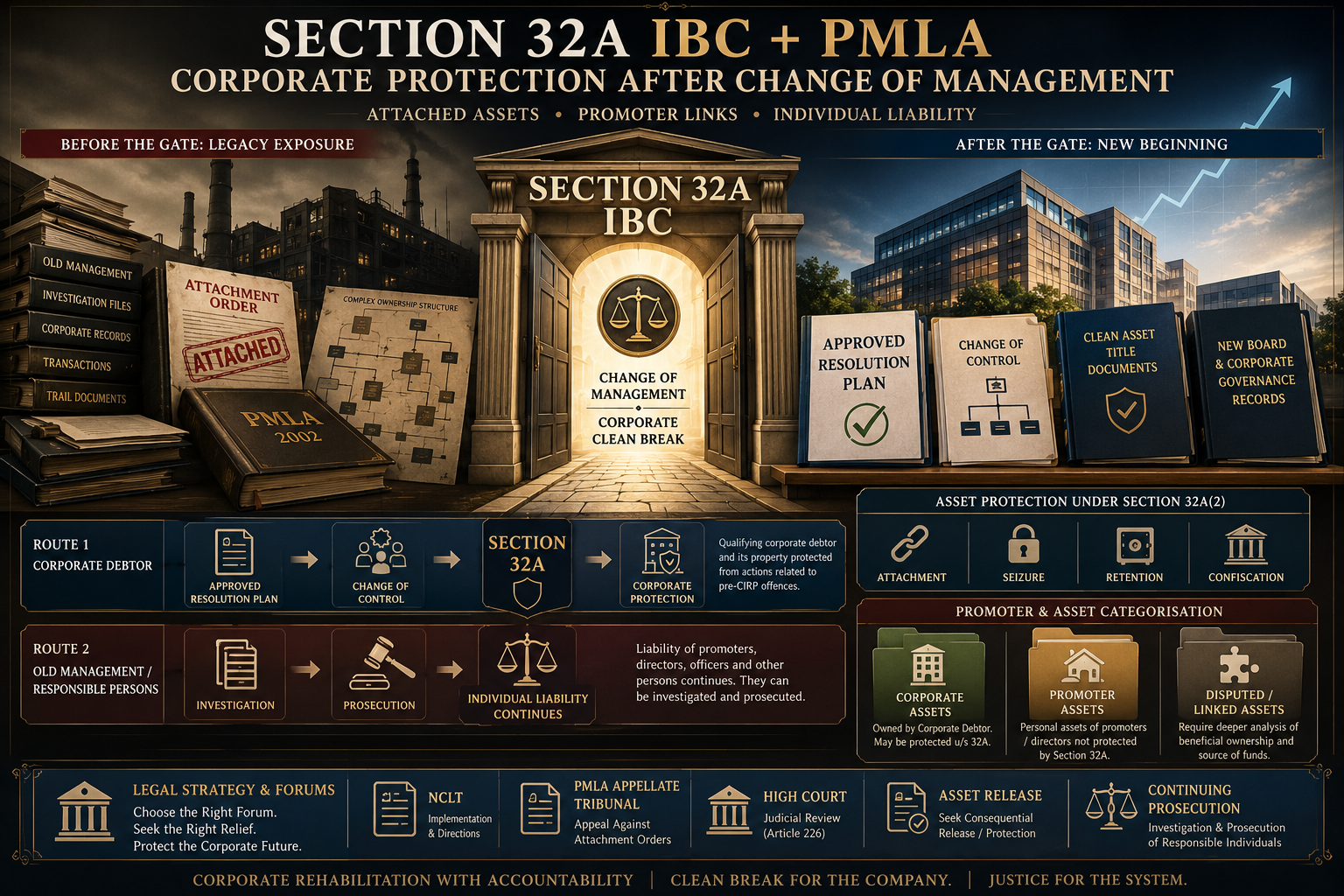
Section 32A IBC and PMLA: Corporate-Debtor Protection After Change of Management – ED Attachment, Promoter-Linked Assets and Continuing Liability
Updated: 9 August 2026
Section 32A of the Insolvency and Bankruptcy Code, 2016 (“IBC”) is one of the most significant provisions governing the intersection between corporate insolvency and criminal or enforcement proceedings.
Its practical importance becomes particularly visible when a corporate debtor undergoing the Corporate Insolvency Resolution Process (“CIRP”) is simultaneously facing investigation or attachment proceedings under the Prevention of Money Laundering Act, 2002 (“PMLA”).
A successful resolution applicant may agree to invest substantial money into a distressed business only to discover that its factory, land, project property, bank accounts or other economically essential assets remain attached because of allegations relating to the company’s former promoters or management.
Section 32A attempts to address this problem by drawing a critical distinction between:
the rehabilitated corporate debtor under genuinely new and independent management
and
the natural persons who allegedly committed, participated in, abetted or conspired in the earlier offence.
The provision therefore does not create a blanket amnesty.
It creates a carefully conditioned statutory separation between the future economic life of the corporate debtor and the criminal liability of those allegedly responsible for its past misconduct.
This detailed guide by Advocate Ankit Kumar Singh explains Section 32A in the context of PMLA proceedings, ED attachment, change of management, promoter-linked assets, asset release and continuing prosecution of former management.
1. What Problem Was Section 32A Designed to Solve?
A resolution applicant acquires or takes control of a distressed corporate debtor through a statutory insolvency process.
The incoming management may have had no involvement whatsoever in:
- the earlier alleged scheduled offence;
- generation of alleged proceeds of crime;
- diversion of company funds;
- fraudulent transactions;
- money laundering;
- false invoicing;
- bank fraud;
- round-tripping;
- layering transactions; or
- other misconduct attributed to former management.
Without statutory protection, a genuine resolution applicant could inherit a company whose commercially essential properties remain indefinitely exposed to historical criminal proceedings.
That risk could discourage legitimate investors from submitting resolution plans.
Section 32A therefore facilitates a legally recognised “clean break” for the qualifying corporate debtor while preserving prosecution against persons responsible for the earlier wrongdoing.
2. Section 32A Contains More Than One Type of Protection
Section 32A should be analysed in three parts.
Section 32A(1)
Deals principally with liability of the corporate debtor for offences committed before commencement of CIRP.
Section 32A(2)
Deals with protection of qualifying property of the corporate debtor against actions relating to a pre-CIRP offence.
Section 32A(3)
Preserves the obligation to provide assistance and cooperation to investigating authorities.
These three limbs should be read together.
The statutory policy is therefore:
Corporate fresh start + protection of qualifying corporate assets + continuing accountability of wrongdoers + continuing cooperation with investigators.
3. First Condition: The Offence Must Pre-Date CIRP
Section 32A is directed toward offences committed before commencement of the corporate insolvency resolution process.
Therefore, one of the first documents counsel should obtain is the CIRP commencement order.
A chronology should then compare:
Date of alleged criminal conduct → Date of alleged laundering transaction → Date of acquisition of property → Date of attachment → Date of commencement of CIRP
The chronology is important because Section 32A should not be treated as a prospective licence for unlawful conduct after commencement of insolvency proceedings.
4. Second Condition: A Resolution Plan Must Be Approved Under Section 31
A common error is to assume that Section 32A becomes fully available merely because CIRP has commenced.
That is not the correct analytical approach.
For the corporate-debtor liability protection contemplated by Section 32A(1), approval of the resolution plan by the Adjudicating Authority under Section 31 is a crucial statutory event.
Therefore distinguish:
During CIRP before plan approval
from
After approval of a qualifying resolution plan.
Before approval, arguments may involve Section 14 moratorium, preservation of corporate assets, PMLA remedies and insolvency jurisdiction.
After qualifying Section 31 approval, Section 32A itself becomes central.
5. Third Condition: Genuine Change in Management or Control
Approval of a resolution plan alone is not enough.
The plan must result in the statutory change in management or control of the corporate debtor.
The incoming person cannot simply be the prohibited old management appearing in a different legal form.
This means practitioners should investigate substance, not merely corporate paperwork.
Relevant questions include:
- Who ultimately owns the successful resolution applicant?
- Who funded the acquisition?
- Who appoints the new directors?
- Who exercises voting control?
- Are former promoters retaining side rights?
- Are there shareholder agreements preserving hidden control?
- Are nominee shareholders involved?
- Is the acquirer related to the old management?
- Does an old promoter retain beneficial ownership?
6. Promoters and Related Parties: The Statutory Boundary
Section 32A deliberately restricts protection where control returns to prohibited persons connected with the earlier corporate debtor.
The principle is important:
IBC resolution cannot be used merely to recycle the same wrongdoing management into the company and then claim a criminal-law clean slate.
A proper eligibility review should therefore compare the successful resolution applicant against:
- former promoters;
- former management;
- persons who previously controlled the corporate debtor;
- related parties;
- beneficial owners;
- connected entities; and
- persons identified by investigating authorities in the statutory manner.
7. Investigating-Authority Condition
Section 32A also addresses a person regarding whom the relevant investigating authority possesses material giving rise to the statutory belief concerning abetment or conspiracy and has taken the further statutory step contemplated by the provision.
This is another reason why a resolution applicant should undertake comprehensive criminal-regulatory due diligence rather than relying only upon Section 29A eligibility.
IBC eligibility and Section 32A protection overlap in purpose but should not be treated as perfectly identical tests.
8. What Happens to Prosecution Against the Corporate Debtor?
Once the requirements of Section 32A(1) are satisfied, the corporate debtor receives the statutory consequence provided for pre-CIRP offences.
This protection reflects a policy decision that a genuinely reorganised company under independent new management should not indefinitely carry the criminal exposure attributable to previous management.
However, this protection belongs to the qualifying corporate debtor.
It should not be casually extended to every natural person previously associated with the company.
9. The Most Important Limitation: Old Management Can Still Be Prosecuted
Section 32A expressly preserves liability of persons who were connected with and involved in the commission of the offence in the manner contemplated by the statute.
Depending upon the facts, this may include:
- former promoters;
- directors;
- officers in default;
- persons in charge of the corporate debtor;
- persons responsible for conduct of its business;
- designated partners where relevant; and
- other associated persons directly or indirectly involved in the alleged offence.
The central proposition is:
Corporate-debtor immunity does not equal personal immunity for the persons allegedly responsible for the offence.
10. Can ED Continue PMLA Prosecution Against Former Promoters and Directors?
Potentially, yes.
Where the statutory and evidentiary requirements of PMLA are otherwise satisfied, Section 32A should not be treated as automatically terminating prosecution of the natural persons allegedly responsible for the underlying conduct.
For example, if an old promoter is independently accused of participation in laundering transactions, the corporate debtor’s fresh start does not automatically erase that promoter’s individual liability.
Likewise, a director cannot ordinarily argue:
“The resolution plan has been approved, therefore my individual criminal liability has disappeared.”
The corporate entity and the natural-person accused must be analysed separately.
11. Section 32A(2): Protection of Corporate Property
For PMLA litigation, Section 32A(2) is especially significant.
Where the statutory conditions are fulfilled, qualifying property of the corporate debtor receives protection against action concerning an offence committed before commencement of CIRP.
The statutory explanation expressly includes within action against property:
- attachment;
- seizure;
- retention; and
- confiscation.
This wording is directly relevant where Enforcement Directorate proceedings have affected corporate assets.
12. What Types of Corporate Property May Become Important?
Depending upon the business, Section 32A disputes may involve:
- factory land;
- plant and machinery;
- office premises;
- commercial property;
- real-estate project land;
- unsold inventory;
- corporate bank accounts;
- receivables;
- shares or securities owned by the corporate debtor;
- vehicles;
- equipment;
- development rights;
- intellectual property; or
- other corporate assets.
But before invoking Section 32A, counsel must establish that the particular property legally belongs to the corporate debtor.
13. Promoter-Owned Assets Are Different
This distinction is critical.
Suppose ED has attached:
Asset A – factory legally owned by the corporate debtor.
and
Asset B – personal property legally owned by the former promoter.
The two properties should not automatically receive identical Section 32A treatment.
Section 32A’s corporate-property protection should not be casually transformed into a shield for the separate personal assets of former promoters or directors.
The title of every asset must therefore be independently investigated.
14. What About Corporate Assets Allegedly Linked to the Promoter?
A more difficult category arises where an asset is legally recorded in the corporate debtor’s name but ED alleges:
- it was acquired from proceeds of crime;
- beneficial ownership lies elsewhere;
- the corporate entity was used merely as a vehicle;
- funds were layered through connected companies;
- the promoter retained beneficial control; or
- the resolution applicant is itself promoter-linked.
In such cases, Section 32A analysis should be accompanied by detailed examination of:
- legal title;
- beneficial ownership;
- acquisition consideration;
- bank trail;
- source of funds;
- corporate approvals;
- related-party transactions;
- shareholding;
- management rights; and
- resolution-applicant connections.
15. Section 32A Is Not a Device to Launder Title Through IBC
The purpose of Section 32A is to facilitate bona fide corporate resolution.
It should not be understood as a mechanism through which:
- old promoters recover the same assets through a connected entity;
- beneficial ownership is concealed;
- related parties acquire assets through nominees;
- criminally implicated persons regain control; or
- a paper change of ownership is presented as genuine independent management.
A serious Section 32A case therefore requires a beneficial-ownership audit, not merely examination of the resolution plan’s cover page.
16. When Can an Attached Corporate Asset Be Released?
Where the resolution plan has been approved and Section 32A conditions are satisfied, continued attachment of qualifying corporate property may require reconsideration in light of the statutory property protection.
The practical objective is to establish:
Pre-CIRP offence + Corporate ownership + Approved resolution plan + Qualifying change of control + Independent eligible resolution applicant = Section 32A property-protection case
The precise procedural route for consequential release will depend upon the existing PMLA orders and the forum presently seized of the matter.
17. Asset Release Is Not the Same as Acquittal of the Promoter
This distinction should be expressly pleaded.
A court or tribunal can be asked to recognise the statutory protection available to qualifying corporate property without being asked to terminate proceedings against former management.
A carefully drafted case may therefore state:
“The incoming corporate debtor seeks protection of its property under Section 32A. It does not seek immunity on behalf of former promoters or any other person whose individual liability remains subject to law.”
This framing helps preserve the conceptual separation built into Section 32A.
18. What Documents Should Be Filed for Release of Attached Assets?
Prepare a dedicated Section 32A dossier containing:
- CIRP admission order;
- resolution plan;
- Committee of Creditors approval records;
- Section 31 NCLT approval order;
- successful resolution applicant details;
- Section 29A eligibility material;
- post-resolution shareholding;
- new board composition;
- beneficial ownership declaration;
- proof of change of management/control;
- provisional attachment order;
- PMLA Adjudicating Authority order;
- schedule of attached properties;
- title documents;
- acquisition records;
- bank trail;
- date-wise offence chronology; and
- resolution-plan implementation documents.
19. Create an Asset-by-Asset Section 32A Matrix
| Issue | Question |
|---|---|
| Ownership | Does the corporate debtor legally own the asset? |
| Offence | Did the alleged offence pre-date CIRP? |
| PMLA | What is the exact attachment/adjudication stage? |
| Resolution Plan | Is the property part of the approved resolution framework? |
| New Management | Has genuine change in management/control occurred? |
| Promoter Link | Is the acquirer related or connected to old management? |
| Investigating Agency | Is the incoming person implicated in the statutory manner? |
| Section 32A | Are all applicable statutory conditions fulfilled? |
| Relief | What precise order is required? |
20. Section 32A(3): New Management Must Still Cooperate With ED
Section 32A does not create a right to obstruct investigation.
Even where the corporate debtor receives protection, the corporate debtor and relevant persons must extend assistance and cooperation to investigating authorities regarding offences committed before CIRP.
New management should therefore preserve:
- accounting records;
- emails;
- bank statements;
- transaction records;
- corporate resolutions;
- contracts;
- digital data;
- tax records;
- property documents;
- employee records; and
- other evidence legally required by investigating authorities.
21. Corporate Immunity Does Not Permit Evidence Destruction
A Section 32A-protected company should implement immediate litigation-hold and evidence-preservation procedures.
The incoming management should identify:
- servers;
- cloud accounts;
- corporate email repositories;
- ERP systems;
- accounting databases;
- physical files;
- former-management records;
- bank records; and
- communications with investigating authorities.
Corporate rehabilitation and investigative cooperation are intended to coexist.
22. Can ED Summon the New Management?
The existence of Section 32A does not by itself mean that investigating authorities are prohibited from seeking legitimate assistance, documents or information from the corporate debtor or persons possessing relevant material.
The new management should distinguish:
cooperation with investigation
from
acceptance of criminal liability for old-management conduct.
A response should therefore preserve Section 32A rights while complying with lawful investigative requirements.
23. What Happens to Old Directors?
Former directors cannot ordinarily convert the corporate debtor’s Section 32A protection into their personal defence merely because the resolution plan has been approved.
Their case must be determined on:
- their actual role;
- knowledge;
- participation;
- documents;
- money trail;
- statutory responsibility;
- mens rea where applicable;
- statements;
- digital evidence; and
- the specific allegations against them.
24. What Happens to Former Promoters?
Former promoters remain particularly important in a Section 32A analysis because the provision deliberately requires genuine separation from prohibited old control.
Two different questions must therefore be asked:
Question 1
Does the incoming resolution applicant have a prohibited connection with the former promoter?
Question 2
Does the former promoter independently remain criminally liable under PMLA or another applicable law?
A favourable answer for the corporate debtor under Section 32A does not automatically answer the second question in favour of the promoter.
25. Corporate Property vs Personal Property: Never Mix the Two
Prepare separate schedules:
Schedule A – Corporate-Debtor Property
Assets legally owned by the company and potentially falling within Section 32A(2).
Schedule B – Former Promoter Property
Separate personal assets of promoters/directors.
Schedule C – Disputed / Beneficial Ownership Property
Assets where legal title, beneficial ownership or acquisition source is disputed.
This three-way separation can substantially improve the clarity of PMLA and insolvency pleadings.
26. Which Forum Should Be Approached?
Depending upon the procedural stage, the matter may involve:
- NCLT;
- NCLAT;
- PMLA Adjudicating Authority;
- PMLA Appellate Tribunal;
- High Court; or
- Supreme Court.
The correct forum should be identified by asking:
What exact order is being challenged and what precise relief is required?
27. NCLT Strategy
NCLT may become relevant where the issue concerns:
- implementation of the approved resolution plan;
- consequences of Section 32A;
- change in management/control;
- corporate-debtor assets;
- directions required for implementation; or
- other questions genuinely arising from insolvency resolution.
However, NCLT jurisdiction should not automatically be treated as a substitute for every statutory PMLA appellate remedy.
28. PMLA Appellate Tribunal Strategy
Where a PMLA attachment has been confirmed and substantive reversal of that order is sought, the statutory appellate framework should be examined.
A strong appeal should combine:
- PMLA merits;
- lack of proceeds-of-crime nexus where applicable;
- ownership;
- money trail;
- corporate title;
- resolution chronology;
- Section 31 approval;
- change of control;
- Section 32A consequences; and
- precise consequential relief.
29. Article 226 Strategy
A High Court writ petition may be considered in an appropriate case involving recognised judicial-review grounds such as:
- jurisdictional error;
- failure to give effect to an operative statutory protection;
- breach of natural justice;
- patent illegality;
- extraordinary implementation difficulty;
- conflicting statutory orders creating an impossible situation; or
- other recognised grounds justifying constitutional intervention.
Where a statutory alternative remedy exists, the writ petition should expressly address why Article 226 jurisdiction should nevertheless be exercised.
30. Important Supreme Court Principle: Wrongdoers Do Not Get the Corporate Benefit
The Supreme Court has upheld Section 32A and recognised the commercial rationale for allowing a genuinely reorganised corporate debtor to begin with a clean break from past offences.
At the same time, the Court has emphasised that the provision does not permit the wrongdoers themselves to escape.
This distinction is fundamental to every Section 32A pleading.
The applicant should therefore avoid arguments that unnecessarily suggest that protection of the corporate debtor requires extinguishment of all criminal proceedings against all individuals.
31. The Correct Litigation Position
A carefully structured submission may proceed as follows:
1. The alleged offence predates CIRP.
2. NCLT has approved the resolution plan under Section 31.
3. Management/control has genuinely shifted to an independent eligible person.
4. The attached assets are legally owned by the corporate debtor.
5. Section 32A therefore protects the qualifying corporate debtor/property.
6. No immunity is sought for former promoters, directors or other alleged wrongdoers.
7. Investigation/prosecution against such persons may continue according to law.
8. The new management will continue providing lawful assistance and cooperation.
32. Section 32A Decision Tree
Was the alleged offence committed before CIRP?
↓
If no → Section 32A protection requires a different analysis.
If yes →
Has NCLT approved a resolution plan under Section 31?
↓
If yes →
Has genuine management/control changed?
↓
Is the incoming person independent of prohibited old management/promoters?
↓
Is the property legally owned by the corporate debtor?
↓
Are Section 32A conditions otherwise satisfied?
↓
Corporate / property protection becomes available for analysis.
Meanwhile:
Old-management and individual liability remains separately examinable.
33. Ten Common Section 32A Mistakes
- Assuming Section 32A automatically applies when CIRP starts.
- Ignoring the requirement of Section 31 approval.
- Ignoring genuine change of management/control.
- Failing to investigate promoter links with the resolution applicant.
- Assuming Section 29A eligibility alone answers every Section 32A question.
- Treating corporate-debtor immunity as promoter immunity.
- Treating corporate assets and promoter-owned assets identically.
- Failing to establish title to every attached property.
- Seeking release of property without filing the complete post-resolution chronology.
- Assuming Section 32A eliminates the duty to cooperate with investigating authorities.
34. Essential Section 32A Document Checklist
- CIRP commencement order;
- resolution plan;
- CoC approval;
- Section 31 NCLT order;
- successful resolution applicant details;
- Section 29A material;
- beneficial ownership declaration;
- old shareholding structure;
- new shareholding structure;
- old board composition;
- new board composition;
- funding records of resolution applicant;
- change-of-control documents;
- ED provisional attachment order;
- PMLA Adjudicating Authority order;
- schedule of attached assets;
- title deeds;
- bank trail;
- property acquisition documents;
- underlying FIR/charge-sheet;
- prosecution complaint where available;
- investigating-authority material relevant to eligibility;
- implementation records;
- corporate books and electronic records; and
- a complete master chronology.
35. Frequently Asked Questions
Does Section 32A automatically apply when CIRP starts?
No. Its statutory conditions must be separately established.
Does Section 32A protect the corporate debtor after change of management?
It can provide the statutory protection contemplated by the provision where the qualifying resolution plan and other conditions are satisfied.
Can ED continue prosecuting former promoters?
Section 32A does not automatically immunise former promoters or other natural persons allegedly responsible for the offence.
Can directors claim the company’s Section 32A protection?
Not merely because they were directors. Their personal liability is separately determined.
Does Section 32A protect corporate property against attachment?
Section 32A(2) expressly addresses qualifying property protection, and its explanation includes attachment, seizure, retention and confiscation.
Does it protect a promoter’s personal property?
Corporate-property protection should not automatically be extended to separately owned personal promoter assets.
What if the resolution applicant is linked to the old promoter?
That relationship can become critical because Section 32A requires the prescribed change to an eligible and independent person.
Can ED still request records from the new management?
Section 32A expressly preserves duties of assistance and cooperation in relation to investigation of pre-CIRP offences.
Can an attached factory be released after Section 31 approval?
Potentially, where the property and transaction satisfy Section 32A and the appropriate procedural relief is sought.
NCLT or PMLA Tribunal?
The correct forum depends upon whether the relief concerns insolvency implementation or substantive challenge to a PMLA order.
36. Final Legal Principle
Section 32A should neither be interpreted so narrowly that genuine resolution becomes commercially impossible nor so broadly that persons responsible for alleged criminal conduct obtain an unintended amnesty.
Its architecture is based upon separation.
The rescued company may obtain a clean break.
Qualifying corporate property may receive statutory protection.
The genuine new management should not inherit the criminal consequences of the old management merely by acquiring the company through the IBC process.
But:
Former promoters, directors, officers and other individuals allegedly involved in the offence remain separately accountable according to law.
The most effective Section 32A strategy is therefore:
Chronology + Corporate Title + Independent Change of Control + Resolution Plan + Beneficial Ownership Audit + PMLA Status + Precise Relief.
Conclusion
Section 32A is one of the most important statutory bridges between insolvency resolution and criminal enforcement in India.
It recognises that a genuinely independent resolution applicant should be capable of rescuing a corporate debtor without automatically inheriting the consequences of offences committed by the former management before CIRP.
At the same time, it preserves the fundamental distinction between rehabilitation of the corporate entity and accountability of individual wrongdoers.
For PMLA matters, the practitioner must therefore separately examine:
- the corporate debtor;
- the attached property;
- the successful resolution applicant;
- the former promoters;
- the former directors;
- the alleged proceeds of crime;
- the stage of attachment;
- the change of control; and
- the procedural forum capable of granting the required relief.
A Section 32A case should ultimately demonstrate why protection of an independently rescued corporate debtor can coexist with continued investigation and prosecution of the persons allegedly responsible for the earlier offence.
About the Author

Advocate Ankit Kumar Singh advises and represents clients in matters concerning the Prevention of Money Laundering Act (PMLA), Enforcement Directorate proceedings, white-collar and financial crime, corporate disputes and connected appellate and constitutional remedies.
Website: advocateankitkumarsingh.in
Email: ankitsingh.legum@gmail.com
Phone: 8294431232
Google Preferred Source
Add advocateankitkumarsingh.in as a Preferred Source on Google
Disclaimer: This article is intended solely for general legal information and educational purposes. Section 32A and PMLA disputes are highly fact-specific. The result may depend upon the date of the alleged offence, ownership of the property, source of acquisition funds, PMLA attachment stage, approved resolution plan, nature of change in management or control, relationship of the incoming resolution applicant with former management, pending criminal proceedings and judicial orders applicable to the particular matter. This article does not constitute legal advice for any specific case.