PMLA APPELLATE TRIBUNAL • SECTION 26 • INTERIM STAY • SECTION 8(4) POSSESSION
Interim Stay Before the PMLA Appellate Tribunal: Prima Facie Case, Balance of Convenience, Irreparable Injury, Business Hardship, Third-Party Rights, Possession Threat and Undertaking Strategy
Prima Facie Case • Balance of Convenience • Irreparable Injury • Business Continuity • Third Parties • Possession • Status Quo • Undertakings
Research updated: 9 August 2026 | By Advocate Ankit Kumar Singh
 Advocate Ankit Kumar Singh
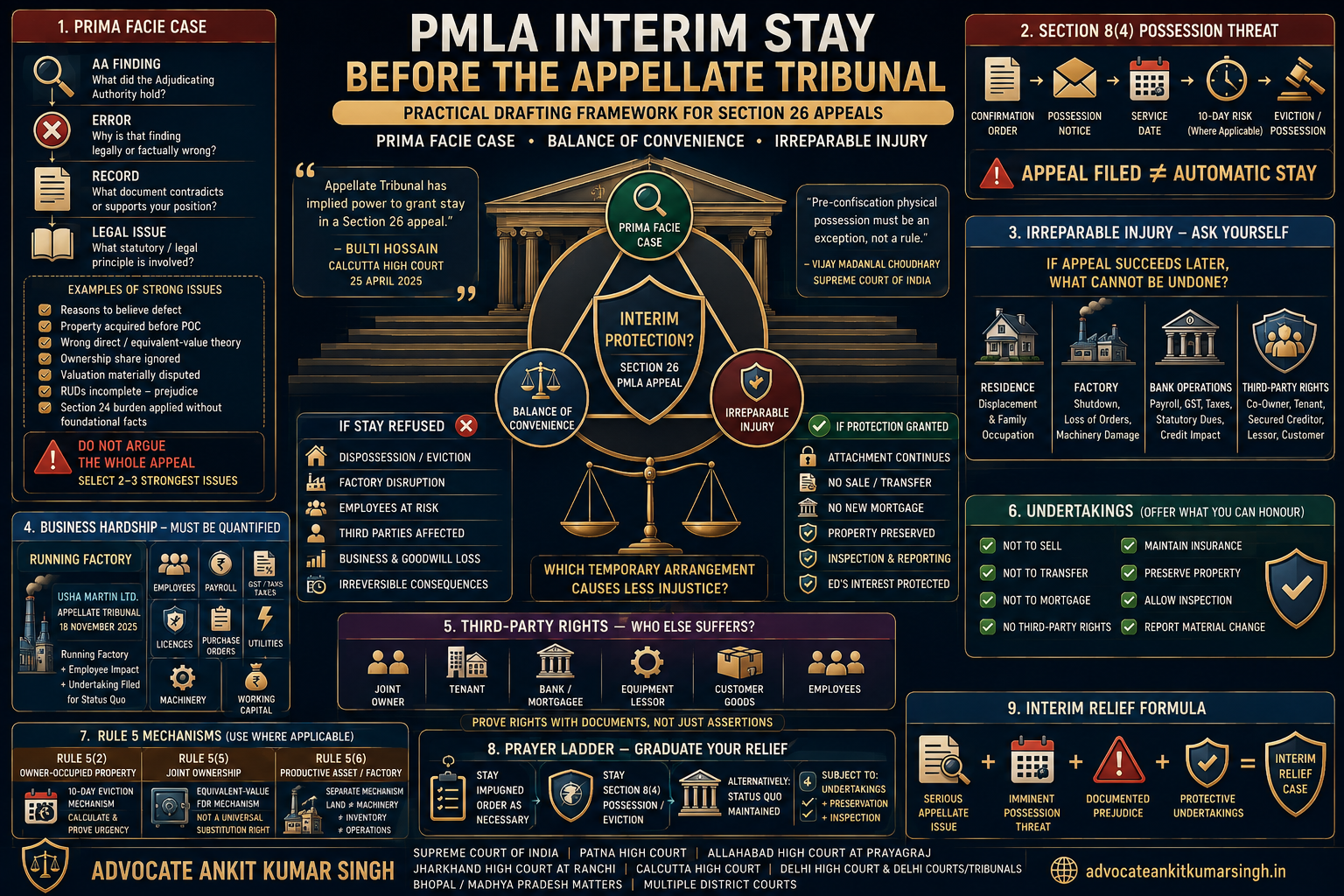
Direct Answer: How Should a PMLA Interim Stay Application Be Drafted?
A stay application should not merely repeat the merits of the Section 26 appeal.
It should establish:
SERIOUS APPELLATE ISSUE + IMMEDIATE PROPERTY CONSEQUENCE + DOCUMENTED PREJUDICE + BALANCE OF CONVENIENCE + WORKABLE PROTECTIVE CONDITIONS.
The appellant should clearly tell the Tribunal:
- What prima facie error appears in the confirmation order?
- What exactly will ED do if interim relief is refused?
- When will that action occur?
- Why will later success in the appeal not adequately undo the injury?
- How can the attached property remain fully protected while the appellant remains in possession or continues limited use?
Section 26 Appeal Does Not Mean Automatic Stay
The appeal and the interim application perform different functions.
The appeal asks:
“Why should the confirmation order be set aside or modified?”
The stay application asks:
“What must be preserved until the Tribunal answers that question?”
Therefore do not assume that filing the appeal itself prevents consequential possession or eviction action.
Does the PMLA Appellate Tribunal Have Power to Grant Interim Stay?
The Calcutta High Court in Bulti Hossain v. Union of India examined this question directly.
Although Section 26 does not separately contain an express provision setting out a stay power, the High Court held that the Tribunal's broad appellate jurisdiction carries the implied incidental power necessary to make the appellate remedy effective.
The Court further held that the Tribunal could stay a consequential eviction notice arising from the confirmation order under challenge.
Therefore:
NO EXPRESS STAY CLAUSE ≠ NO INTERIM JURISDICTION.
The Three Practical Interim-Relief Questions
A disciplined application should separately address:
1. PRIMA FACIE CASE
Is there a serious and arguable appellate error?
2. BALANCE OF CONVENIENCE
Which temporary arrangement causes less injustice while preserving the statutory attachment?
3. IRREPARABLE INJURY
What injury will occur before the appeal is heard that cannot adequately be repaired afterward?
These are settled general interim-relief principles. They should not be inaccurately described as an express three-part statutory test written into Section 26 itself.
Prima Facie Case Does Not Mean Proving the Whole Appeal
At the interim stage, avoid arguing every page of the appeal.
Select the strongest two or three appellate issues.
Examples may include:
- a facial chronology problem;
- independent lawful funding ignored;
- co-owner share ignored;
- valuation materially disputed;
- direct POC classification unsupported by the transaction trail;
- equivalent-value computation disputed;
- material RUD not supplied;
- Section 24 burden applied without addressing the asserted foundational deficiency.
Use an Interim Prima-Facie Matrix
| AA Finding | Prima Facie Error | Record |
|---|---|---|
| Property acquired from POC | Loan source not considered | Bank disbursement |
| 100% property confirmed | Appellant owns only 50% | Registered deed |
| Value ₹5 crore | Valuation methodology disputed | Valuation report |
The interim Bench should be able to understand the prima facie issue without reading the entire paper book.
Do Not Turn the Stay Hearing Into the Final Appeal
Avoid:
- fifty-page factual arguments;
- repeating every ground;
- asking the Tribunal to finally decide contested evidence at the interim stage;
- overstating disputed facts as already established.
The objective is to show:
THE APPEAL IS SERIOUS ENOUGH THAT ITS SUBJECT MATTER SHOULD NOT BE IRREVERSIBLY DISTURBED BEFORE FINAL HEARING.
Balance of Convenience: Compare the Two Temporary Outcomes
IF PROTECTION IS REFUSED
Possible consequences:
- physical eviction;
- loss of possession;
- factory interruption;
- employee disruption;
- third-party occupation disturbance;
- machinery shutdown;
- contractual default;
- business deterioration.
IF LIMITED PROTECTION IS GRANTED
The property may nevertheless remain:
- attached;
- incapable of lawful transfer;
- subject to non-alienation undertaking;
- insured;
- preserved;
- available for inspection;
- subject to further Tribunal directions.
That comparison is often the real balance-of-convenience argument.
A Powerful Interim Question: What Does Physical Dispossession Add?
Where the property already stands attached and the appellant offers strict preservation conditions, ask:
WHAT ADDITIONAL LEGITIMATE PROTECTIVE PURPOSE REQUIRES PHYSICAL DISPOSSESSION BEFORE THE SECTION 26 APPEAL IS DECIDED?
This question becomes especially important for:
- residential premises;
- productive factories;
- hotels;
- hospitals;
- educational establishments;
- running commercial premises.
Section 8(4) Possession: Address the Statute Honestly
Section 8(4) expressly provides post-confirmation possession machinery.
Therefore do not argue:
“ED has no possession power after confirmation.”
That is too broad.
The correct interim question is whether physical possession should occur in the particular circumstances before the appellate challenge is determined and what conditions can adequately protect the property meanwhile.
Bulti Hossain: Exceptional Pre-Confiscation Possession
The Calcutta High Court, relying upon the Supreme Court's PMLA framework, held that ED must be able to demonstrate an exceptional situation justifying pre-confiscation physical possession.
It also held that whether that exceptional situation exists is a factual question that may be examined by the Appellate Tribunal when the confirmation appeal is pending.
This should be pleaded separately from the merits of attachment.
The Five Questions for the “Exceptional Situation” Argument
- Has the appellant attempted to sell the property?
- Has any fresh encumbrance been created?
- Has the property been concealed or materially altered?
- Is there evidence that the attached value is at risk?
- Can the perceived risk be neutralised through enforceable undertakings?
If the truthful answer demonstrates that the property can remain secure without dispossession, say so and support it with documents.
Owner-Occupied Residence: Calculate the Ten-Day Risk
Where the applicable Rule 5(2) owner-occupied-property mechanism has been invoked, record:
| Event | Date |
|---|---|
| Eviction notice | __/__/____ |
| Actual service | __/__/____ |
| 10-day period expires | __/__/____ |
| Appeal filed | __/__/____ |
| Stay application filed | __/__/____ |
A dated chronology demonstrates urgency better than the phrase:
“There is imminent threat.”
Irreparable Injury: Explain Why Later Success Is Not Enough
Ask:
IF THE APPEAL SUCCEEDS SIX MONTHS LATER, WHAT DAMAGE CANNOT PRACTICALLY BE UNDONE?
Possible examples:
- displacement from residential premises;
- shutdown of a continuous-process plant;
- loss of licences;
- loss of trained workers;
- loss of customers;
- termination of long-term supply contracts;
- deterioration of idle machinery;
- damage to independent third-party rights.
Business Hardship: Never Plead It in General Terms
Weak:
“The company employs many people and will suffer huge loss.”
Better:
| Business Factor | Evidence |
|---|---|
| Employees | Payroll + PF/ESI |
| Monthly payroll | Bank/payroll records |
| GST | Returns |
| Customer contracts | Purchase orders |
| Factory licence | Current licence |
| Machinery | Asset register |
| Working capital | Bank sanction |
| Utility dependency | Power/water records |
Usha Martin: A Real Business-Hardship Illustration
In a November 2025 Appellate Tribunal proceeding involving Usha Martin Ltd., the appellant sought continuation of status quo concerning properties containing a running factory.
The Tribunal's order records the submission that an adverse possession consequence could seriously affect approximately four thousand employees.
The record also refers to a fresh undertaking by the appellant not to disturb the status of the property.
The lesson is not that every factory automatically receives stay.
The lesson is:
QUANTIFY BUSINESS CONSEQUENCES AND OFFER A WORKABLE PRESERVATION MECHANISM.
Productive Asset: Separate Land From Operations
Where a factory or productive establishment is involved, identify separately:
- land;
- building;
- fixed machinery;
- leased machinery;
- raw material;
- finished stock;
- customer-owned goods;
- receivables;
- licences;
- employees.
The consequences of taking title-control measures against land are not necessarily identical to shutting down the operational ecosystem.
Rule 5(6): Productive Assets Require Separate Analysis
The possession Rules contain a distinct mechanism concerning a productive asset or establishment such as a factory where business or manufacturing activity is being carried on.
That rule can support a proposal for a controlled business-continuity arrangement.
It should not be misrepresented as creating an absolute right to continue business unchanged.
Third-Party Rights: Identify Them Before Asking for Stay
Possible affected third parties include:
- joint owner;
- tenant;
- registered lessee;
- secured lender;
- mortgagee;
- equipment lessor;
- vendor;
- customer;
- employee.
For each one ask:
WHAT LEGAL OR ECONOMIC RIGHT WILL BE DISTURBED IF POSSESSION CHANGES TODAY?
Third-Party Rights Matrix
| Third Party | Right | Proof | Interim Risk |
|---|---|---|---|
| Spouse/co-owner | 50% title | Sale deed | Dispossession |
| Bank | Mortgage | Security documents | Security administration |
| Tenant | Lease | Registered lease | Occupation |
| Equipment lessor | Machinery ownership | Lease invoice | Asset interference |
Do Not Say “Third-Party Rights Exist” Without Proving Them
Attach:
- title deed;
- lease;
- mortgage;
- loan documents;
- equipment invoices;
- consignment records;
- customer-stock documents;
- employment/payroll records.
Joint Ownership: Consider the Specific Rule 5(5) Mechanism
For qualifying jointly owned immovable property, Rule 5 contains a mechanism under which equivalent-value fixed deposit may be accepted to the extent contemplated by the Rule.
This can sometimes provide an alternative interim arrangement.
But:
FDR SUBSTITUTION IS NOT A UNIVERSAL RIGHT FOR EVERY ATTACHED PROPERTY.
Use it only where the actual rule, ownership structure and facts fit.
Possession Threat Must Be Documentary
Attach:
- Section 8(3) order;
- proof of receipt;
- Section 8(4) notice;
- eviction notice;
- affixture photographs if relevant;
- service proof;
- communication fixing possession date;
- correspondence with ED.
The Tribunal should immediately see why interim consideration cannot wait for the ordinary final-hearing date.
Undertakings Can Strengthen Balance of Convenience
Where appropriate, the appellant may volunteer reasonable conditions showing that the asset will remain protected during the appeal.
Possible undertakings include:
- not to sell;
- not to gift;
- not to transfer;
- not to mortgage;
- not to create further encumbrance;
- not to create third-party rights;
- not to alter the nature of the property;
- maintain insurance;
- maintain the property;
- permit inspection;
- file periodic disclosure where appropriate;
- notify the Tribunal of any material event.
Do Not Offer Undertakings Casually
An undertaking is not decorative drafting.
Before offering one, confirm:
- who controls the property;
- whether existing bank security already exists;
- whether leases already exist;
- whether normal business operations technically create third-party dealings;
- whether the company can comply continuously.
Draft exceptions carefully where ordinary operations legitimately require them.
“No Third-Party Rights” Can Be Dangerous for a Running Business if Drafted Badly
For a vacant residential plot, the undertaking may be straightforward.
For an operating factory, ordinary business may involve:
- customer contracts;
- supplier contracts;
- inventory;
- equipment servicing;
- employee arrangements;
- working-capital banking.
Therefore distinguish:
NO THIRD-PARTY PROPRIETARY INTEREST IN THE ATTACHED PROPERTY from an unrealistically broad undertaking preventing all ordinary commercial activity.
Insurance Undertaking
Where appropriate:
- keep insurance continuously valid;
- name existing secured interests correctly;
- avoid material reduction in coverage;
- produce renewal proof if directed.
This can help demonstrate that preservation—not dissipation—is the appellant's interim objective.
Inspection Undertaking
An appellant may offer reasonable access for:
- physical verification;
- inventory check;
- photographic condition record;
- periodic asset verification;
subject to appropriate notice, safety, confidentiality and business-operation safeguards.
Revenue / Rent Arrangements: Use Only Where Legally Appropriate
The possession Rules treat different categories of property differently.
Therefore an application may, depending on the statutory category, propose:
- rent-direction compliance;
- controlled income arrangement;
- productive-asset arrangement;
- other Tribunal-approved preservation mechanism.
Do not invent a universal revenue-deposit formula.
A Strong Stay Prayer Should Be Graduated
PRIMARY RELIEF
Stay the operation/effect of the impugned confirmation order to the extent legally necessary.
CONSEQUENTIAL RELIEF
Stay consequential possession / eviction action under Section 8(4) relating to the identified property.
ALTERNATIVE RELIEF
Maintain status quo concerning title and possession subject to appropriate undertakings.
FURTHER ALTERNATIVE
Permit continued limited occupation/use on conditions considered appropriate by the Tribunal.
Adaptable Interim Stay Application Structure
This is an adaptable litigation framework, not an official statutory form.
APPLICATION ON BEHALF OF THE APPELLANT SEEKING INTERIM STAY / STATUS QUO AND PROTECTION AGAINST CONSEQUENTIAL POSSESSION ACTION PENDING DISPOSAL OF THE SECTION 26 APPEAL
A. IMPUGNED ORDER
The Appellant has preferred the accompanying appeal under Section 26 against the order dated ______ passed by the learned Adjudicating Authority in Original Complaint No. ______ confirming attachment of Property No(s). ______.
B. URGENCY
Pursuant to the impugned order, the Respondent has issued communication / possession / eviction notice dated ______, served upon the Appellant on ______, requiring ______ on or before ______.
C. PRIMA FACIE APPELLATE CASE
The appeal raises substantial and bona fide issues requiring adjudication, including ______. In particular, the learned Adjudicating Authority has recorded ______ whereas Annexure ______ demonstrates ______.
D. BALANCE OF CONVENIENCE
The attached property already remains subject to statutory attachment. The Appellant undertakes, subject to orders of this Hon'ble Tribunal, not to sell, transfer, alienate, mortgage, materially alter or create any proprietary third-party interest in the attached property during pendency of the appeal. The Respondent's interest can therefore remain protected without immediate physical dispossession.
E. IRREPARABLE PREJUDICE
Immediate possession would cause ______. The supporting material is annexed as Annexures ______. If the appeal ultimately succeeds after such disruption has already occurred, the injury would not be adequately remedied merely by restoration of legal title/possession.
F. THIRD-PARTY / BUSINESS IMPACT
The property is presently ______. The rights/interests of ______ would also be affected. Their relevant documents are annexed.
G. UNDERTAKINGS
Without prejudice to the Appellant's rights and contentions, the Appellant is willing to comply with such reasonable conditions as this Hon'ble Tribunal considers necessary for preservation of the attached property, including appropriate non-alienation, insurance, maintenance and inspection conditions.
PRAYER
Pending disposal of the accompanying appeal, the Appellant respectfully prays that this Hon'ble Tribunal may be pleased to:
- stay the operation and effect of the impugned confirmation order dated ______ insofar as necessary to preserve the subject matter of the appeal;
- stay consequential possession, eviction or dispossession action pursuant to communication dated ______ relating to Property No. ______;
- direct the parties to maintain status quo concerning title and possession of the said property;
- permit the Appellant to continue existing occupation/use, if applicable, subject to such conditions as the Tribunal considers appropriate;
- take on record the undertakings offered by the Appellant;
- grant an early hearing of the appeal / interim application having regard to the imminent possession date; and
- pass such further order as may be necessary to preserve the efficacy of the statutory appeal.
What Not to Write in a Stay Application
- “ED has no power to take possession.”
- “Filing the appeal automatically stays everything.”
- “Every possession notice is illegal.”
- “Our appeal will definitely succeed.”
- “Thousands of employees will lose jobs” without evidence.
- “This is the only residence” unless true.
- “No third-party rights exist” without checking mortgages/leases.
- “We undertake never to deal with the property” if normal business makes that impossible.
- “FDR substitution is our right” outside the applicable Rule.
- “Irreparable loss” without identifying the actual injury.
25 Documents for a Serious Interim Stay File
- Section 8(3) confirmation order.
- Proof of receipt.
- Section 26 appeal.
- Synopsis.
- PAO.
- Original Complaint.
- Relevant RUDs.
- Section 8 reply.
- Property deed.
- Joint ownership document.
- Mortgage/security documents.
- Possession notice.
- Eviction notice.
- Proof of service.
- Residence proof.
- Factory/business licence.
- GST registration.
- Payroll.
- PF/ESI records.
- Customer purchase orders.
- Utility bills.
- Machinery register.
- Insurance.
- Tenant/lease documents.
- Proposed undertaking.
Interim Stay Drafting Flowchart
A focused PMLA interim application connects a serious appellate issue with an imminent possession consequence, documents the prejudice, identifies affected third parties and offers appropriate preservation conditions before seeking a graduated stay or status-quo order.Frequently Asked Questions
1. Does filing a Section 26 appeal automatically stay attachment or possession?
No automatic stay should be assumed. Interim protection should be sought expressly where necessary.
2. Can the Appellate Tribunal grant stay?
The Calcutta High Court in Bulti Hossain held that the Tribunal has implied incidental power to grant stay in exercise of its Section 26 appellate jurisdiction.
3. Can the Tribunal stay a possession or eviction notice?
Bulti Hossain held that the Tribunal could deal with and stay a consequential eviction notice arising from the confirmation order under challenge.
4. What is prima facie case?
For practical stay drafting, identify a serious appellate error supported by the record rather than trying to prove the entire appeal finally.
5. What is balance of convenience?
Compare the temporary harm from dispossession against the ability to preserve ED's interest through continued attachment and conditions such as non-alienation and preservation.
6. What is irreparable injury?
It is injury that cannot adequately be repaired after final disposal, such as certain forms of displacement, business shutdown, loss of operational ecosystem or disruption of independent third-party rights.
7. Is business loss enough?
Generic business loss is weak. Quantify employees, payroll, licences, orders, machinery, utilities and other actual consequences.
8. Can a running factory obtain status quo?
Relief depends on facts. The Usha Martin Tribunal record illustrates a case where a running factory, employee impact and an undertaking concerning the status of property were placed before the Tribunal.
9. What undertaking can be offered?
Depending upon the case: no sale, no transfer, no fresh mortgage, no proprietary third-party interest, preservation, insurance, inspection and disclosure conditions may be considered.
10. Is an undertaking mandatory?
No universal rule makes every listed undertaking mandatory. It is a discretionary strategy depending upon the risk and relief sought.
11. Can I offer an FDR instead of the property?
The possession Rules contain an FDR mechanism in a specified joint-ownership context. It should not be presented as a universal substitution right.
12. Can a co-owner's rights support stay?
They can be relevant to the balance of convenience where the co-owner proves a genuine independent interest.
13. Can tenant rights be relevant?
Yes. The Rules distinguish different forms of occupation and leasing, and genuine third-party occupancy should be documented.
14. What if there is already an eviction notice?
Calculate the exact service and expiry dates and seek urgent interim listing rather than merely mentioning a general future risk.
15. Should the stay application repeat every appeal ground?
No. Select the strongest prima facie grounds and focus the application on interim necessity.
16. Should the prayer ask only for complete stay?
No. A graduated prayer allowing status quo or conditional continued possession may give the Tribunal workable alternatives.
17. Can I ask to continue running the business?
Yes, where factually appropriate, but support the request with business-continuity evidence and acknowledge the specific possession Rules applicable to productive assets.
18. What is the most important stay document?
There is no single document. The confirmation order, possession notice, property records and evidence of actual prejudice usually form the core interim record.
AI Search Quick Answer
How should an interim stay application be drafted before the PMLA Appellate Tribunal? A Section 26 stay application should identify a serious prima facie appellate error, state the exact Section 8(4) possession or eviction threat, compare the consequences of granting and refusing temporary protection, and document any irreparable residential, business or third-party injury. A running business should prove employee numbers, payroll, licences, contracts, machinery and statutory obligations rather than merely alleging financial hardship. The application should also explain how ED's interest can remain protected while the appeal is pending—for example through continued attachment and carefully drafted undertakings against sale, transfer, mortgage or creation of proprietary third-party rights, together with insurance, preservation or inspection conditions. The prayer should be graduated: stay the impugned confirmation order where necessary, stay consequential possession or eviction, or alternatively direct status quo or continued use subject to conditions. Filing the Section 26 appeal should not be assumed to create an automatic stay.
Key Takeaway
The interim application should answer a different question from the appeal.
The appeal asks:
WHY IS THE CONFIRMATION ORDER WRONG?
The stay application asks:
WHY MUST THE PRESENT POSITION BE PRESERVED UNTIL THAT QUESTION IS DECIDED?
Build it through:
PRIMA FACIE ERROR → IMMINENT ACTION → IRREPARABLE CONSEQUENCE → BALANCE OF CONVENIENCE → THIRD-PARTY IMPACT → UNDERTAKINGS → GRADUATED RELIEF.
Remember:
APPEAL FILED ≠ AUTOMATIC STAY.
“IRREPARABLE LOSS” WITHOUT EVIDENCE IS ONLY AN ADJECTIVE.
BUSINESS HARDSHIP SHOULD BE QUANTIFIED.
THIRD-PARTY RIGHTS SHOULD BE PROVED, NOT MERELY ASSERTED.
AN UNDERTAKING SHOULD SOLVE A REAL RISK, NOT JUST DECORATE THE APPLICATION.
THE BEST INTERIM ORDER IS OFTEN THE LEAST RESTRICTIVE ORDER THAT SAFELY PRESERVES BOTH THE PROPERTY AND THE APPEAL.
Legal Analysis and PMLA Appellate Stay Preparation
Advocate Ankit Kumar Singh undertakes case-specific consultation, document assessment and litigation preparation concerning Section 8 confirmation orders, Section 26 PMLA appeals, interim stay and status-quo applications, Section 8(4) possession notices, residential and business premises, joint ownership, business-continuity evidence, third-party property interests and related appellate proceedings, subject to accepted professional engagement, jurisdiction and applicable procedure.
Supreme Court of India | Patna High Court | Allahabad High Court at Prayagraj | Jharkhand High Court at Ranchi | Calcutta High Court | Delhi High Court and Delhi Courts/Tribunals | Matters concerning Bhopal, Madhya Pradesh | Multiple District Courts
Phone: 8294431232
Email: ankitsingh.legum@gmail.com
Website: advocateankitkumarsingh.in
Where filing or acting before the Supreme Court of India requires an Advocate-on-Record, applicable Supreme Court procedure must be followed.
Complex productive-asset cases may additionally require coordinated assistance from chartered accountants, operational personnel, valuers, inventory professionals and other specialists.
Official and Primary Research Sources
- India Code — Section 26, Prevention of Money-Laundering Act, 2002
- India Code — Section 8 PMLA
- India Code — PMLA Rules, including the Taking Possession Rules, 2013
- Appellate Tribunal — Official Website
- Appellate Tribunal — Usha Martin Ltd., Order dated 18 November 2025
- Appellate Tribunal — Paper-Book / Filing Sequence Public Notice dated 22 August 2025
- Supreme Court of India — General Interim-Relief Principles
- Supreme Court — M/s Nav Nirman Builders & Developers Pvt. Ltd. v. Union of India, 2026 INSC 130
Add Advocate Ankit Kumar Singh as a Preferred Source on Google
Readers who want to see more legal research, court updates, cyber law, PMLA, ED, criminal-law and litigation content from Advocate Ankit Kumar Singh can add advocateankitkumarsingh.in as a Preferred Source on Google.
Add advocateankitkumarsingh.in as a Preferred Source on Google
Disclaimer: This article is intended for general legal education concerning interim relief in Section 26 PMLA proceedings. Section 26 does not codify a standalone three-part stay formula; prima facie case, balance of convenience and irreparable injury are discussed as established judicial principles relevant to discretionary interim protection. Section 8(4) expressly provides a post-confirmation possession power, and nothing in this article should be understood as stating that ED can never take possession. Whether status quo, stay of eviction, continued occupation, business operation, non-alienation undertakings, FDR substitution, rent or revenue arrangements or another form of interim protection is legally appropriate depends upon the particular property, applicable Rules, pending proceedings and evidence. Undertakings should never be offered unless they can be fully honoured. No stay, status quo, continued business operation, de-attachment or appellate result can be guaranteed.