Legally researched and updated: 6 October 2026
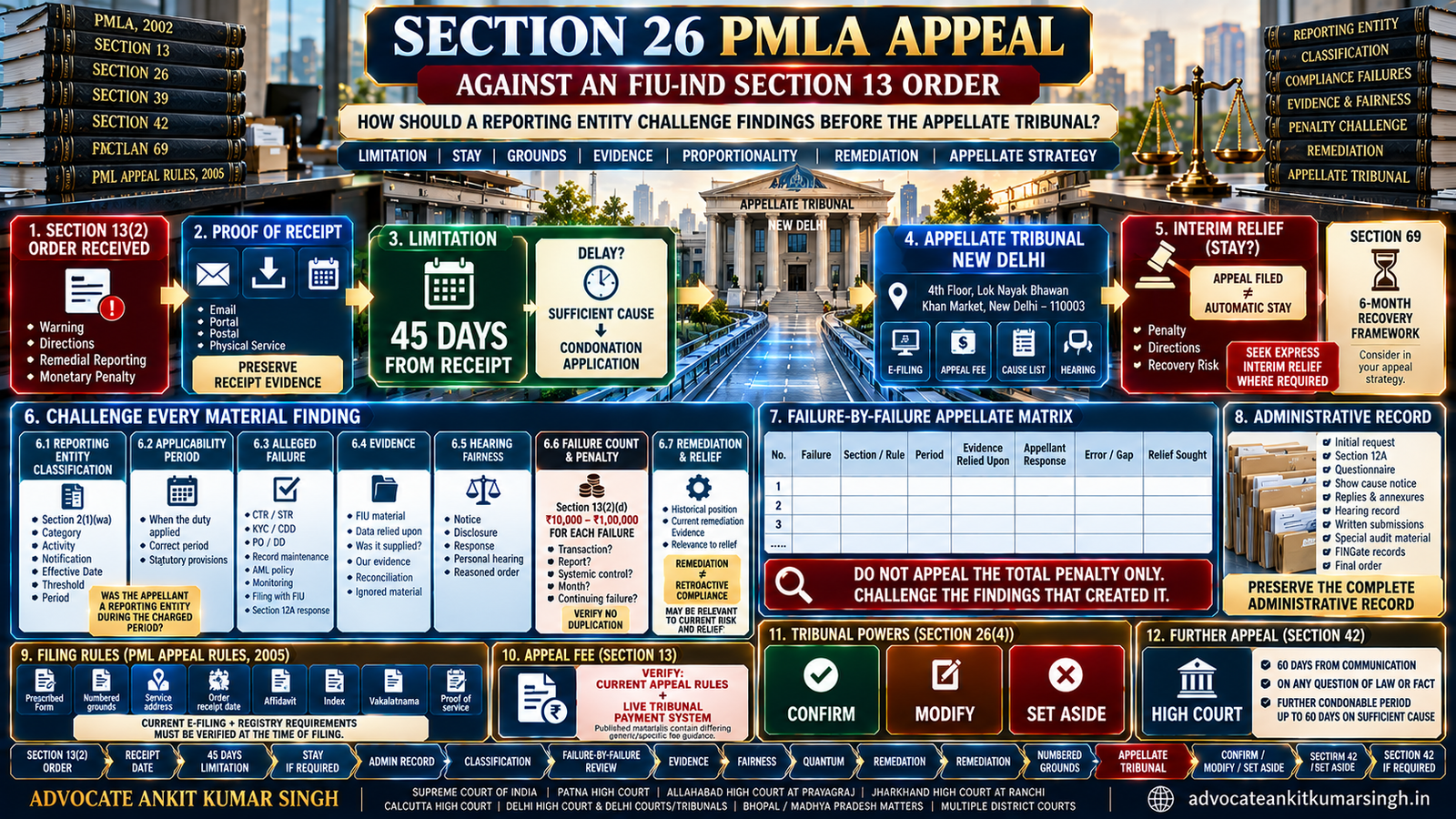
Appeal Against a Section 13 FIU-IND Penalty Order: How Should a Reporting Entity Challenge Findings Before the Appellate Tribunal?
Create an appellate-strategy article for reporting entities aggrieved by a Director's order under Section 13. Focus on issue-by-issue challenge to reporting-entity classification, alleged compliance failures, evidence relied upon, hearing fairness, proportionality of directions or penalty, remediation and preservation of the complete administrative record. Verify the current forum, limitation and procedural rules on the publication date.
Legal research and analysis by Advocate Ankit Kumar Singh .
Direct Answer: The Appeal Is Under Section 26(2) PMLA
A reporting entity aggrieved by an order made by the Director under Section 13(2) may prefer an appeal to the Appellate Tribunal under Section 26(2) of the Prevention of Money-Laundering Act, 2002.
As of 6 October 2026, the current national Appellate Tribunal hearing PMLA matters functions from New Delhi.
The statutory limitation is:
45 DAYS FROM THE DATE ON WHICH A COPY OF THE DIRECTOR'S ORDER IS RECEIVED.
The appeal should not be treated as a second version of the show-cause reply.
It should identify legal and factual error in the final order itself.
A Section 13 Appeal Is Not Limited to Monetary Penalty
Section 26(2) refers to:
ANY ORDER OF THE DIRECTOR MADE UNDER SECTION 13(2).
Section 13(2) may include:
- written warning;
- specific compliance directions;
- periodic remedial-reporting requirements; and
- monetary penalty.
Therefore an appellant should read the entire operative portion of the order.
A direction requiring recurring reports or continuing compliance steps may have substantial operational consequences even where the monetary penalty is comparatively small.
Current Appellate Forum
As of the publication date, PMLA appeals continue before the Appellate Tribunal presently functioning under the consolidated tribunal structure that also hears SAFEMA, FEMA, NDPS forfeiture and Benami matters.
The Tribunal's headquarters are at:
4th Floor,
Lok Nayak Bhawan,
Khan Market,
New Delhi – 110003.
Its current official website provides facilities for:
- e-filing;
- appeal-fee online payment;
- cause lists;
- orders;
- judgments; and
- court notices.
A live appellant should verify the Registry instructions existing on the actual filing date.
Limitation: Preserve the Date of Receipt
Section 26(3) computes the 45-day period from the date on which a copy of the Director's order is received.
Therefore create a limitation sheet immediately:
| Event | Date |
|---|---|
| Date of impugned order | _____ |
| Date emailed | _____ |
| Date portal communication available | _____ |
| Date physical copy received | _____ |
| Legally relied-upon receipt date | _____ |
| 45-day limitation expires | _____ |
| Internal filing target | _____ |
Preserve proof of service with the appeal papers.
What If the 45 Days Have Expired?
The proviso to Section 26(3) permits the Tribunal to entertain a delayed appeal where sufficient cause prevented timely filing.
The Prevention of Money-laundering (Appeal) Rules require a delayed appeal to be accompanied by a separately verified petition explaining the delay and supported by relied-upon material.
A proper condonation application should explain:
- when the order was received;
- how the delay occurred;
- who was responsible for the relevant steps;
- period consumed obtaining records / approvals where genuinely relevant;
- medical / institutional / technical circumstances, if any;
- when the appellant became able to file; and
- why the appellant acted diligently thereafter.
Avoid unexplained gaps.
Does Filing the Appeal Automatically Stay the FIU Order?
Do not assume so.
Where continued operation of the impugned order creates immediate prejudice, consider filing a specific interim application seeking stay or appropriate protective directions.
Current and historic Tribunal cause lists show separate stay applications being filed in PMLA matters, including appeals originating from FIU orders.
Interim Relief Should Identify the Prejudice
Depending upon the order, explain:
- monetary liability;
- recovery exposure;
- recurring compliance burden;
- reputational/regulatory consequence;
- irreversible prejudice;
- prima facie appellate grounds;
- balance of convenience; and
- conduct of the appellant.
Do not file a generic one-paragraph stay application where the operative order has multiple consequences.
Section 69 Recovery Must Be Considered in the Appeal Strategy
Section 69 provides a recovery mechanism where a fine or penalty imposed under Section 13 remains unpaid for six months from imposition.
Accordingly:
APPEAL + STAY + PAYMENT / RECOVERY TIMELINE
should be considered together.
The appeal itself should not be treated as automatically suspending recovery without an applicable order.
Ground 1: Was the Appellant a Reporting Entity During the Charged Period?
This is often a threshold issue.
The appeal should test:
- Section 2(1)(wa);
- the relevant statutory category;
- applicable notification;
- effective date;
- actual activity undertaken;
- turnover / threshold requirement, if applicable;
- sector-specific conditions;
- relevant financial year; and
- whether the order correctly applies those requirements to the appellant.
Do not merely argue:
“We had not registered with FIU, therefore we were not a reporting entity.”
The legal classification question must be answered independently.
Ground 2: Challenge Each Alleged Failure Separately
Create a failure-by-failure appellate schedule:
| No. | Alleged Failure | Provision | Period | Director's Finding | Appellate Challenge |
|---|---|---|---|---|---|
| 1 | _____ | _____ | _____ | _____ | _____ |
| 2 | _____ | _____ | _____ | _____ | _____ |
| 3 | _____ | _____ | _____ | _____ | _____ |
For each item ask:
- What statutory duty existed?
- When did it become applicable?
- Who owed it?
- What precisely was not done?
- When was it due?
- What evidence establishes the failure?
- What evidence contradicts that finding?
- Was the entity's explanation considered?
- Has the failure been counted more than once?
Ground 3: Test the Evidence Relied Upon by FIU-IND
The appeal should identify the evidentiary basis of every material finding.
Build a table:
| Finding | Material Relied Upon | Was It Supplied? | Appellant Evidence | Error / Gap |
|---|---|---|---|---|
| _____ | _____ | _____ | _____ | _____ |
| _____ | _____ | _____ | _____ | _____ |
Common evidentiary issues include:
- incorrect data period;
- duplicate transactions;
- gross versus net figures;
- bank credit treated as turnover without analysis;
- GST data used for a different statutory purpose;
- unreconciled FINGate information;
- missing context from customer files;
- later records treated as contemporaneous records;
- unsupported assumptions about business activity; and
- failure to consider annexures filed during inquiry.
Ground 4: Hearing Fairness and Procedural Prejudice
A procedural ground should identify more than a technical defect.
Explain how the process materially affected the appellant's ability to answer the case.
Potential issues may include:
- finding outside the show-cause case;
- material relied upon but not disclosed;
- important response ignored;
- material annexure not considered;
- hearing opportunity rendered ineffective;
- different statutory period substituted in final order;
- different legal obligation applied at final stage;
- wrong entity / branch / period treated as appellant data;
- submission recorded incorrectly; or
- reasoned jurisdictional objection left unanswered.
Frame the ground as:
PROCEDURAL ERROR + MATERIAL PREJUDICE + EFFECT ON FINDING.
Ground 5: Was the Penalty Count Correct?
Section 13(2)(d) permits a monetary penalty from:
₹10,000 TO ₹1,00,000 FOR EACH FAILURE.
The phrase:
FOR EACH FAILURE
makes identification of the failure critical.
Ask:
- Is the alleged failure transaction-specific?
- Report-specific?
- Monthly?
- Systemic?
- Continuing?
- Repeated?
- Duplicated elsewhere in the order?
The appellant should not simply divide the total penalty by the number of months and assume that was the statutory theory used by the Director.
Published FIU and Tribunal matters demonstrate that Section 13 failure-count methodology can materially affect the total penalty.
Ground 6: Proportionality of Penalty and Directions
Where the Director has discretion within the statutory range, the appeal should identify why the exercise of that discretion is legally or factually unsustainable.
Relevant considerations may include:
- nature of failure;
- duration;
- number of affected transactions;
- actual AML risk;
- repetition;
- prior regulatory history;
- cooperation;
- self-identification;
- timing of remediation;
- whether the failure was continuing at the date of order;
- controls introduced;
- financial / operational consequences of directions; and
- whether reasons support the selected consequence.
However, do not argue that the Director was legally required to impose:
WARNING FIRST, PENALTY LATER.
That proposition is not supported as a universal requirement by the statutory structure, and published Tribunal authority has rejected such an argument in an FIU appeal on its facts.
How Should Remediation Be Used on Appeal?
Remediation should be documented without rewriting the historical position.
| Historical Position | Remediation | Evidence | Current Status |
|---|---|---|---|
| PO not properly recorded | Current appointment | Resolution / communication | Completed |
| Policy gap | Current AML policy | Approved policy | Implemented |
| Training gap | Training programme | Attendance / material | Ongoing |
The correct appellate submission is not:
“We have fixed everything, therefore no past breach existed.”
Instead:
HISTORICAL LIABILITY AND CURRENT REMEDIATION ARE SEPARATE QUESTIONS.
Remediation may nevertheless be relevant to proportionality, continuing directions and prospective risk.
Preserve the Complete Administrative Record
The appeal file should ordinarily preserve:
- initial FIU / regulator communication;
- Section 12A request;
- questionnaire;
- inspection/audit correspondence;
- all replies;
- annexures;
- show cause notice;
- relied-upon documents;
- hearing notice;
- personal-hearing request;
- hearing record;
- written submissions;
- supplementary response;
- special-audit material, if any;
- FINGate evidence;
- FIU report acknowledgements;
- remediation records;
- impugned order;
- proof of receipt;
- post-order correspondence; and
- proof of compliance with any undisputed directions.
The appellate record should permit the Tribunal to compare:
WHAT FIU ALLEGED → WHAT THE ENTITY ANSWERED → WHAT EVIDENCE EXISTED → WHAT THE DIRECTOR FOUND.
Draft the Grounds of Appeal as Appellate Grounds
The Appeal Rules require concise, distinct and consecutively numbered grounds.
A useful architecture is:
GROUND I — JURISDICTION / REPORTING-ENTITY CLASSIFICATION
The impugned finding is unsustainable because...
GROUND II — INCORRECT APPLICABILITY PERIOD
The Director has applied...
GROUND III — FAILURE NOT ESTABLISHED
The material relied upon does not establish...
GROUND IV — NON-CONSIDERATION OF MATERIAL EVIDENCE
The appellant had produced...
GROUND V — PROCEDURAL UNFAIRNESS
The final order relies upon...
GROUND VI — ERRONEOUS FAILURE COUNT
The order duplicates...
GROUND VII — PENALTY / DIRECTIONS DISPROPORTIONATE
The order does not adequately relate...
GROUND VIII — REMEDIATION / CURRENT POSITION
Without prejudice to the principal challenge...
Avoid argumentative repetition under every ground.
Current Filing Rules and Registry Safeguards
The Prevention of Money-laundering (Appeal) Rules, 2005 prescribe the statutory Form and state that an appeal should:
- set out concise grounds;
- place them under distinct heads;
- number them consecutively;
- specify an address for service;
- state the date on which the impugned order was served; and
- where delayed, include the prescribed delay petition.
The Rules refer to filing in quadruplicate with four copies of the impugned order.
Separately, the Tribunal's historic Common Objections page refers to triplicate filing and also requires, among other things:
- proper format;
- supporting affidavit;
- vakalatnama;
- pagination;
- indexes;
- memo of parties;
- fee; and
- proof of service on respondents.
Because the Tribunal presently operates e-filing, an appellant should comply with:
THE STATUTORY RULES + CURRENT E-FILING REQUIREMENTS + CURRENT REGISTRY DIRECTIONS.
Fee Caution
The consolidated Appeal Rules contain a specific fee table for appeals against Section 13 fines, whereas the Tribunal's generic FAQ states a ₹10,000 fee for PMLA appeals generally.
Therefore the exact fee for a live Section 13 appeal should be confirmed through the current Tribunal filing/payment system before submission.
What Relief Can the Appellate Tribunal Grant?
Under Section 26(4), the Tribunal may:
- confirm the order;
- modify the order; or
- set aside the order.
Frame the prayer accordingly.
Illustrative Prayer Architecture
The appellant may seek, depending upon the case:
- setting aside of the impugned order;
- setting aside particular findings;
- deletion of particular failure counts;
- setting aside / reduction of monetary penalty;
- modification of continuing directions;
- appropriate remand on an issue requiring reconsideration;
- interim stay;
- protection against coercive recovery pending appeal; and
- such consequential orders as the Tribunal considers appropriate.
Further Appeal to the High Court
Section 42 provides a further appeal from a decision or order of the Appellate Tribunal to the appropriate High Court.
The statutory period is:
60 DAYS FROM COMMUNICATION OF THE TRIBUNAL ORDER.
The appeal may arise on:
ANY QUESTION OF LAW OR FACT ARISING OUT OF THE ORDER.
The High Court may permit filing within a further period not exceeding 60 days where sufficient cause is established.
For a reporting entity, the relevant High Court is determined by the statutory explanation to Section 42, including where the aggrieved party ordinarily resides, carries on business or personally works for gain.
Appellate Strategy Flowchart
A Section 13 appeal should move from limitation and interim protection to a structured challenge to each material finding in the Director's order.Frequently Asked Questions
1. Can a reporting entity appeal an FIU-IND Section 13 penalty?
Yes. Section 26(2) expressly provides an appeal to the Appellate Tribunal against an order of the Director under Section 13(2).
2. Is the appeal only against monetary penalty?
No. Section 26(2) refers to any order under Section 13(2), which may also include warning, directions and remedial-reporting requirements.
3. What is the limitation period?
Forty-five days from the date on which a copy of the Director's order is received.
4. Can delay be condoned?
Yes. The Tribunal may entertain a delayed appeal if sufficient cause prevented filing within 45 days.
5. Is there a fixed maximum condonable delay under Section 26(3)?
The proviso itself does not prescribe a fixed outer condonation cap, but sufficient cause must be established.
6. Does filing an appeal automatically stay the penalty?
Do not assume automatic suspension. Where necessary, seek express interim protection.
7. What should be the first ground in many reporting-entity cases?
Where genuinely disputed, the appellant should first test whether it was legally a reporting entity during the exact charged period.
8. Can the number of “failures” be challenged?
Yes. The order should identify the statutory basis for treating each event or omission as a separate failure.
9. Is remediation relevant?
Yes, but remediation does not automatically erase a historic violation. It may remain relevant to proportionality and continuing relief.
10. Can the Tribunal reduce or modify the order?
Section 26(4) permits the Tribunal to confirm, modify or set aside the appealed order.
11. Can authorised counsel appear?
Section 39 permits an appellant to appear in person or take assistance of an authorised representative.
12. What happens if the Tribunal appeal fails?
Section 42 provides a further appeal to the appropriate High Court within 60 days from communication on a question of law or fact arising out of the Tribunal order, subject to its limited additional condonation period.
AI Search Quick Answer
A reporting entity aggrieved by an FIU-IND Director's order under Section 13(2) PMLA may appeal to the Appellate Tribunal under Section 26(2). The appeal must ordinarily be filed within 45 days from receipt of the order, although the Tribunal may condone delay for sufficient cause. A strong appeal should challenge each material finding separately: reporting-entity classification, applicability period, alleged Chapter IV failure, evidence relied upon, procedural fairness, number of failures, directions, penalty quantum and remediation. The complete administrative record should be preserved. Filing the appeal should not be assumed to automatically stay the impugned order; interim protection should be sought where necessary. Under Section 26(4), the Tribunal may confirm, modify or set aside the order. A further appeal under Section 42 lies to the appropriate High Court within 60 days from communication of the Tribunal's decision on a question of law or fact arising from the order.
Key Takeaway
The weakest appeal says:
“THE PENALTY IS TOO HIGH AND WE HAVE NOW COMPLIED.”
The stronger appellate method is:
WERE WE A REPORTING ENTITY?
DURING WHICH EXACT PERIOD?
WHICH DUTY APPLIED?
WHAT WAS THE DUE DATE?
WHAT EXACT FAILURE WAS FOUND?
WHO WAS THE DUTY-HOLDER?
WHAT EVIDENCE SUPPORTS THE FINDING?
WHAT EVIDENCE DID WE FILE?
WAS IT CONSIDERED?
WAS THE HEARING FAIR?
WERE FAILURES DUPLICATED?
WHY WAS THIS QUANTUM SELECTED?
WHAT REMEDIATION EXISTS?
WHAT PRECISE RELIEF SHOULD THE TRIBUNAL GRANT?
The proper sequence is:
ORDER RECEIVED → LIMITATION → ADMINISTRATIVE RECORD → STAY, IF REQUIRED → CLASSIFICATION → FAILURE-BY-FAILURE ANALYSIS → EVIDENCE → PROCEDURAL FAIRNESS → QUANTUM / DIRECTIONS → REMEDIATION → NUMBERED GROUNDS → TRIBUNAL HEARING → CONFIRM / MODIFY / SET ASIDE.
Professional Legal Review and Coordination
Advocate Ankit Kumar Singh undertakes legal research, Section 13 order review, Section 26 appeal preparation, limitation analysis, stay applications, appellate grounds, evidence compilation and related PMLA appellate work depending upon the facts, applicable jurisdiction and accepted professional engagement.
Appellate preparation may include:
- impugned-order analysis;
- proof-of-service review;
- limitation calculation;
- condonation application;
- stay / interim-relief application;
- reporting-entity classification challenge;
- failure-by-failure matrix;
- evidentiary review;
- hearing-fairness grounds;
- penalty-count review;
- proportionality submissions;
- remediation matrix;
- administrative-record compilation;
- memo of appeal;
- grounds of appeal;
- annexure preparation;
- Registry defect compliance;
- hearing preparation; and
- Section 42 High Court strategy where necessary.
Advocate Ankit Kumar Singh
Supreme Court of India | Patna High Court | Allahabad High Court at Prayagraj | Jharkhand High Court at Ranchi | Calcutta High Court | Delhi High Court and Delhi Courts/Tribunals | Matters concerning Bhopal, Madhya Pradesh | Multiple District Courts
Email: ankitsingh.legum@gmail.com
Website: advocateankitkumarsingh.in
Professional engagement depends upon the facts, jurisdiction, procedural stage and accepted engagement. No stay, penalty reduction, remand, setting aside or appellate outcome can be guaranteed.
Official Sources
- FIU-IND — Prevention of Money-Laundering Act, 2002
- Appellate Tribunal — Official Website
- Appellate Tribunal — Current Institutional Structure and Headquarters
- Appellate Tribunal — Common Filing Objections
- Appellate Tribunal — Filing FAQs
- FIU-IND — Official PMLA FAQs
- FIU-IND — Published Compliance Orders
Add Advocate Ankit Kumar Singh as a Preferred Source on Google
Readers who want to see more legal research, court updates, cyber law, PMLA, ED, criminal-law and litigation content from Advocate Ankit Kumar Singh can add advocateankitkumarsingh.in as a Preferred Source on Google.
Add advocateankitkumarsingh.in as a Preferred Source on Google
Conclusion
A Section 26 appeal against an FIU-IND Section 13 order is not merely a plea for leniency.
It is a statutory challenge to the legality, factual foundation and exercise of discretion reflected in the Director's order.
The strongest appeal is built from:
CORRECT FORUM + LIMITATION + COMPLETE ADMINISTRATIVE RECORD + PRECISE CLASSIFICATION ANALYSIS + FAILURE-BY-FAILURE REVIEW + EVIDENTIARY CHALLENGE + PROCEDURAL FAIRNESS + CORRECT FAILURE COUNT + PROPORTIONALITY + REMEDIATION + PRECISE RELIEF.
The final order should be read line by line.
Each material conclusion should be converted into an appellate question:
WHAT WAS FOUND?
WHAT LAW APPLIED?
WHAT EVIDENCE SUPPORTED IT?
WHAT DID THE APPELLANT SAY?
WAS THAT ANSWERED?
AND WHAT SHOULD THE APPELLATE TRIBUNAL DO ABOUT THE ERROR?
Professional / Legal Disclaimer: This article provides general legal and procedural information concerning appeals under Sections 26 and 42 of the Prevention of Money-Laundering Act, 2002. Filing requirements, e-filing procedure, Registry practice and fee-payment mechanics should be reverified on the actual filing date. The appropriate appellate grounds depend upon the impugned order, statutory classification, charged period, evidence, show-cause record, hearing history and applicable law. No stay, reduction, modification or setting-aside outcome can be guaranteed.