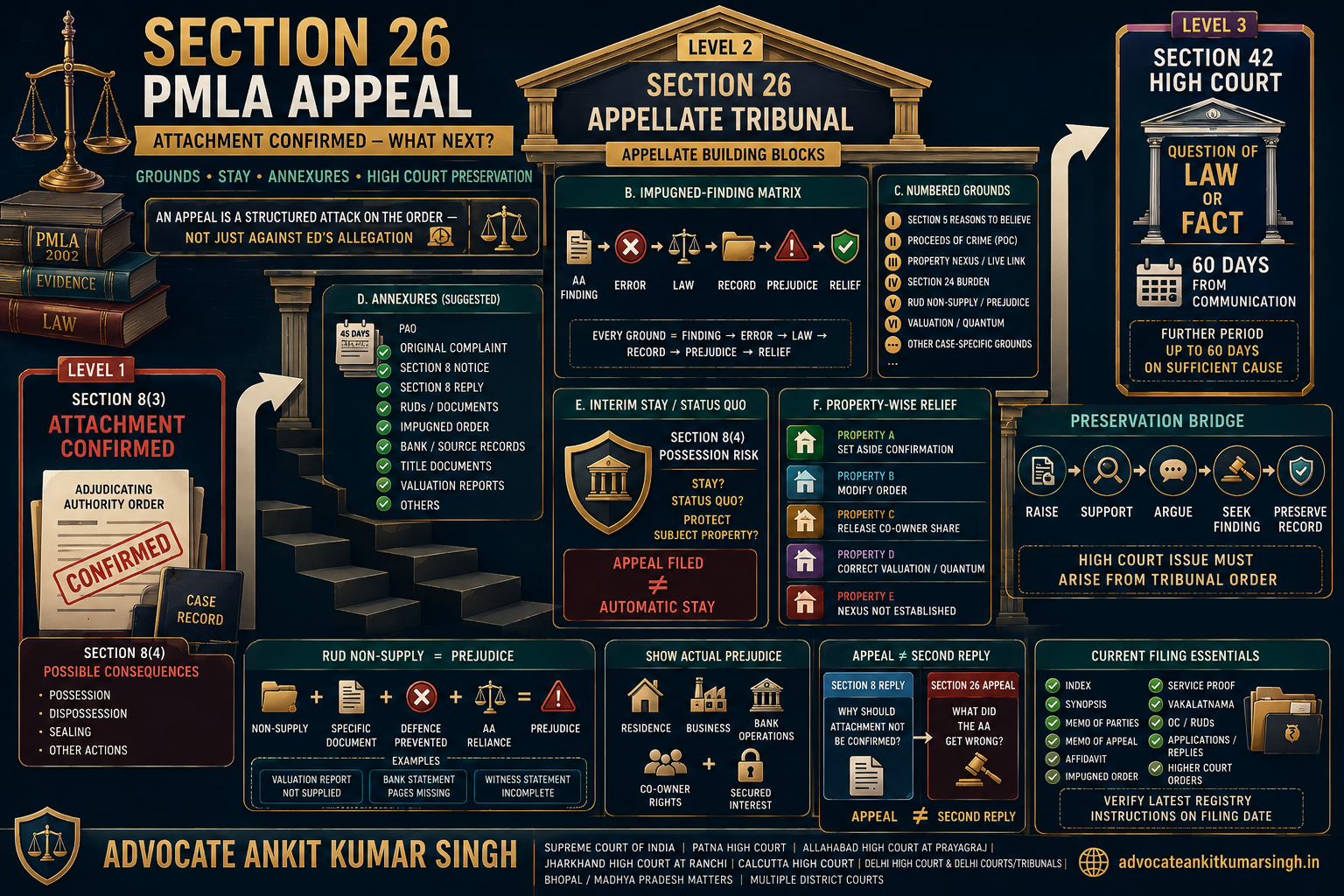
PMLA APPELLATE TRIBUNAL • SECTION 26 • ATTACHMENT APPEAL • INTERIM STAY
How to Build a Section 26 PMLA Appeal After Attachment Confirmation: Grounds, Annexures, Chronology, Stay Prayer, Prejudice, Missing RUDs, Section 24 Burden and High Court Questions
Grounds • Annexures • 45-Day Limitation • Stay • RUD Defects • Section 24 • Property-Wise Challenge • Section 42 Preservation
Research updated: 9 August 2026 | By Advocate Ankit Kumar Singh
 Advocate Ankit Kumar Singh
Direct Answer: What Should You Do After the PMLA Adjudicating Authority Confirms an Attachment?
An aggrieved person can challenge an order of the Adjudicating Authority before the Appellate Tribunal under Section 26 of the Prevention of Money-Laundering Act, 2002.
The ordinary limitation is:
45 DAYS FROM THE DATE ON WHICH A COPY OF THE ORDER IS RECEIVED.
The appeal should not simply repeat the Section 8 reply.
It should identify:
- what finding the Adjudicating Authority made;
- why that finding is legally or factually wrong;
- what record contradicts it;
- what prejudice resulted;
- what exact relief the Tribunal should grant.
A useful appellate formula is:
ORDER → ERROR → LAW → RECORD → PREJUDICE → RELIEF.
Section 26 Is a Statutory Appeal — Not a Fresh Section 8 Reply
At the Section 8 stage, the noticee principally responds to the attachment case made by ED.
At the Section 26 stage, there is now an additional document that must be attacked:
THE IMPUGNED ADJUDICATING AUTHORITY ORDER.
The appeal should therefore examine:
- which objections were accepted;
- which were rejected;
- which were not discussed;
- which documents were overlooked;
- which conclusions are unsupported;
- whether property-wise findings were made;
- whether ED's allegations were mechanically reproduced.
Step 1: Freeze the Limitation Date Immediately
Section 26 ordinarily allows forty-five days from receipt of the copy of the order.
Create a limitation sheet containing:
| Event | Date | Proof |
|---|---|---|
| Impugned order dated | __/__/____ | Order |
| Order uploaded, if relevant | __/__/____ | Portal record |
| Order actually received | __/__/____ | Email / postal / portal / acknowledgement |
| 45-day calculation | __/__/____ | Limitation sheet |
Preserve the actual proof of receipt because the statutory language refers to receipt of the copy.
What If the Appeal Is Already Beyond 45 Days?
Section 26 permits the Tribunal to entertain a delayed appeal where sufficient cause for the delay is established.
The Appeal Rules contemplate a separate petition explaining why the appellant was prevented from filing within the statutory period.
A condonation application should normally contain:
- number of days of delay;
- complete chronology;
- actual cause;
- supporting records;
- absence of deliberate inaction;
- prayer for condonation.
Do not write only:
“The delay is neither intentional nor deliberate.”
Explain what actually happened.
Step 2: Read the Confirmation Order Before Re-Drafting the Case
Prepare three markings on the order:
GREEN
Facts genuinely accepted.
AMBER
Findings requiring clarification or partial challenge.
RED
Findings to be specifically appealed.
Then create an appellate issue list.
Do not start drafting until every adverse finding has been identified.
The Impugned-Finding Matrix
| AA Finding | Appellate Error | Supporting Record | Relief |
|---|---|---|---|
| Property funded from POC | Payment chronology ignored | Loan + bank statements | Set aside |
| Source not proved | Documents not considered | Reply Annexures R-10–R-18 | Reconsider/set aside |
| Entire property attachable | Appellant owns only 50% | Registered title | Modify |
This matrix should become the skeleton of the grounds of appeal.
Step 3: Build a Two-Page Appellate Chronology
A complex PMLA attachment case can contain hundreds of documents.
The Tribunal should nevertheless be able to understand its sequence quickly.
| Date | Event | Appellate Significance |
|---|---|---|
| __/__/____ | Scheduled-offence FIR | Predicate chronology |
| __/__/____ | Alleged POC generated | POC chronology |
| __/__/____ | Property acquired | Nexus |
| __/__/____ | PAO | Section 5 |
| __/__/____ | Original Complaint | Section 5(5) |
| __/__/____ | Section 8 notice | Adjudication |
| __/__/____ | Reply | Defence record |
| __/__/____ | Impugned confirmation order | Appeal |
| __/__/____ | Receipt of order | 45-day limitation |
Step 4: Keep Facts and Grounds Separate
The facts section should explain:
- who the appellant is;
- how the appellant entered the transaction/property;
- scheduled-offence chronology;
- ED action;
- attachment;
- Section 8 proceedings;
- defence filed;
- confirmation;
- resulting prejudice.
The grounds section should explain:
WHY THE ORDER IS WRONG.
Do not repeat the entire factual history in every ground.
Rule 3: Grounds Should Be Distinct and Consecutively Numbered
The Prevention of Money-laundering (Appeal) Rules, 2005 require the grounds of objection to be stated concisely under distinct heads and numbered consecutively.
Use:
GROUND I
GROUND II
GROUND III
rather than one fifty-paragraph argumentative narrative.
Ground I — Section 5 Reasons-to-Believe Error
Where supported by the record, challenge whether the statutory Section 5 foundation existed.
Ask:
- What material identified the property as POC?
- What material established possession?
- What material supported the statutory apprehension concerning concealment, transfer or dealing?
- Was the second proviso relied upon?
- Was that route factually supported?
Avoid the generic sentence:
“Reasons to believe are mechanical.”
Identify the actual defect.
Adaptable Ground Structure: Reasons to Believe
GROUND I — BECAUSE THE STATUTORY FOUNDATION FOR PROVISIONAL ATTACHMENT WAS NOT ESTABLISHED
Because the learned Adjudicating Authority failed to examine the Appellant's specific objection that the material referred to in the Provisional Attachment Order does not establish the necessary property-specific foundation under Section 5. The impugned order reproduces the conclusion concerning the subject property without dealing with ________, ________ and ________, which were placed on record through Annexures ________. The confirmation is therefore challenged on the factual and legal grounds elaborated herein.
Adapt the language to the record. Do not plead facts that did not occur.
Ground II — ED Has Not Identified the Proceeds of Crime Properly
Ask:
- What scheduled criminal activity is relied upon?
- What property was derived or obtained from that activity?
- What amount constitutes alleged POC?
- How was it calculated?
- When was it generated?
- Who first received it?
Do not permit:
ALLEGED LOSS to become automatically: PROCEEDS OF CRIME without examining the prosecution's actual computation.
Ground III — Broken Nexus Between POC and Attached Property
Construct:
CRIMINAL ACTIVITY → POC → BANK / PROPERTY → TRANSFER → ATTACHED ASSET.
Identify the broken link.
Example:
If the property was purchased before the alleged POC existed, that chronology may seriously challenge an allegation that the property itself was directly purchased from those later proceeds.
But the appeal must separately consider whether ED's stated theory is equivalent-value attachment.
Ground IV — ED and the AA Applied the Wrong Property Theory
Classify each property:
A. DIRECT POC
Property itself allegedly purchased/generated through criminal proceeds.
B. INDIRECT / TRANSFORMED POC
Original POC allegedly converted into another asset.
C. EQUIVALENT-VALUE PROPERTY
A different property proceeded against on the statutory value theory.
Do not use a direct-funding argument to answer an equivalent-value case.
Ground V — Section 24 Reverse Burden Was Applied Prematurely
Section 24 is important, but it should not be converted into:
“ED alleges POC; therefore the property owner must first disprove the allegation.”
The appeal should identify the foundational facts that the prosecution case was first required to establish.
Ask:
- What criminal activity relating to a scheduled offence is established?
- What property was derived or obtained from it?
- What evidence connects the relevant person with the process/activity concerning that property?
Then address the statutory burden at the appropriate stage.
Third-Party Appellant and Section 24
Section 24 by its text operates when a person is accused of having committed the offence under Section 3.
Therefore if the appellant is:
- a spouse;
- independent purchaser;
- co-owner;
- lender;
- company;
- another third-party claimant
who is not accused under Section 3, the appeal should specifically examine whether the Adjudicating Authority mechanically imposed the accused-person reverse burden upon that appellant.
Ground VI — The Adjudicating Authority Ignored Material Defence Evidence
Do not say:
“My documents were not considered.”
Prepare:
| Document | AA Record Page | What It Proves | Impugned Order Treatment |
|---|---|---|---|
| Loan sanction | ___ | Funding source | Not discussed |
| Bank statement | ___ | Actual disbursement | Misread |
| Sale deed | ___ | Ownership/share | Ignored |
Ground VII — Incomplete RUDs Caused Real Prejudice
A strong appellate ground has two parts:
DEFECT + PREJUDICE.
| RUD | Defect | Prejudice |
|---|---|---|
| Bank statement | Only selected pages | Could not demonstrate preceding lawful balance |
| Valuation report | Not supplied | Could not test methodology/value |
| Witness statement | Pages missing | Context/qualification unavailable |
Attach the correspondence by which complete documents were requested.
Non-Supply Ground: Four Questions
- Was the document relied upon?
- Was it supplied completely and legibly?
- Did the appellant object before the Adjudicating Authority?
- How did the missing material affect the defence?
The fourth question is essential.
A technical defect without demonstrated prejudice may be treated differently from a defect that prevented an effective answer to the attachment case.
Ground VIII — Denial of Effective Hearing or Inspection
Where genuinely supported, preserve:
- inspection applications;
- emails;
- hearing requests;
- adjournment requests;
- orders passed on those requests;
- proof of attendance;
- virtual-hearing links/notices;
- written submissions.
Do not merely allege:
“No opportunity was given.”
A 2026 Tribunal order illustrates why the precise record matters: a natural-justice allegation was rejected where virtual hearing had been available but not availed in the manner recorded by the Tribunal.
Ground IX — Ownership or Third-Party Interest Was Misidentified
Build:
| Property | Registered Owner | Appellant Share | ED Theory | Defence |
|---|---|---|---|---|
| A | Appellant + spouse | 50% | 100% attachment | Independent co-owner |
| B | Company | Company | Director-controlled | Corporate source records |
The appeal should distinguish:
- legal title;
- beneficial ownership allegation;
- purchase consideration;
- actual economic interest;
- third-party rights.
Ground X — Valuation and Quantum Are Wrong
Prepare:
| Property | ED Value | Defence Issue |
|---|---|---|
| A | ₹_____ | Wrong valuation date |
| B | ₹_____ | Only 50% ownership |
| C | ₹_____ | Duplicate value |
Current Tribunal authority has emphasised the importance of some assessment of the wrongful gain/value before attachment confirmation where equivalence in value is being applied, subject to the factual complexity of the case.
Over-Attachment: Show the Mathematics
Use:
POC ALLEGED: ₹________
DIRECT PROPERTY ALREADY SECURED: ₹________
OTHER EQUIVALENT-VALUE PROPERTY: ₹________
PROPERTY NOW CONFIRMED: ₹________
ALLEGED EXCESS / DUPLICATION: ₹________
Do not merely use the adjective “disproportionate.”
Ground XI — Statutory Chronology or Limitation Error
Possible chronology issues may include:
- Section 5 attachment date;
- Section 5(5) complaint date;
- Section 8 proceedings;
- applicable 180-day computation;
- court stay/exclusion periods;
- date of confirmation.
The calculation must be done against the statutory text and any applicable exclusion or binding precedent.
Do not calculate mechanically.
Ground XII — The Order Is Not Property-Specific
Section 8 requires determination whether:
ALL OR ANY of the properties are involved in money-laundering.
If five properties have:
- different owners;
- different purchase dates;
- different funding sources;
- different values;
- different ED theories;
a single undifferentiated conclusion may be challenged where the order fails to engage with those distinctions.
Do Not Draft 25 Repetitive Grounds
A better structure may contain:
- jurisdiction/statutory foundation;
- POC foundation;
- property nexus;
- property classification;
- burden;
- ignored evidence;
- RUD/natural justice;
- ownership;
- valuation/quantum;
- limitation;
- property-wise error.
Then add only genuinely case-specific grounds.
Every Ground Should Answer Five Things
1. WHAT DID THE AA HOLD?
2. WHY IS IT WRONG?
3. WHERE IS THE CONTRARY RECORD?
4. WHAT LEGAL RULE APPLIES?
5. WHAT RELIEF FOLLOWS?
Step 5: Build the Annexures Around the Grounds
Do not attach documents randomly.
A useful appeal set may require, according to the case:
- Impugned Section 8 order.
- Proof of receipt/service.
- PAO.
- Original Complaint.
- Section 8 notice.
- RUD index.
- Section 8 reply.
- Annexures to Section 8 reply.
- RUD-deficiency correspondence.
- Inspection applications.
- Orders on applications.
- Written submissions.
- Title documents.
- Loan documents.
- Bank statements.
- Investment/source documents.
- Valuation material.
- Third-party ownership documents.
- Relevant possession notice/action.
- Relevant judicial orders.
The Tribunal's Current Paper-Book Sequence Matters
The Tribunal's August 2025 filing guidance prescribes an organised sequence including:
- Index;
- fee proof;
- synopsis;
- memo of parties;
- memo of appeal;
- supporting affidavit;
- impugned order;
- proof of service;
- vakalatnama;
- board resolution/authority where applicable;
- Original Complaint and RUDs;
- applications and replies filed before the Adjudicating Authority;
- Section 8(4) or related notices;
- relevant higher judicial/quasi-judicial orders.
Always verify the latest Registry instructions on the actual filing date.
Do Not Forget Proof of Receipt of the Impugned Order
This small annexure can decide a limitation objection.
Preserve:
- email;
- portal acknowledgement;
- postal envelope;
- tracking report;
- signed receipt;
- certified-copy delivery record;
- other reliable proof.
Can New Documents Be Filed in the Appeal?
Do not assume that the appellate stage is an unrestricted opportunity to rebuild an evidentiary case that was never placed before the Adjudicating Authority.
Where an additional document is genuinely necessary:
- identify why it was not filed earlier;
- explain its relevance;
- seek appropriate leave/direction where required;
- avoid silently adding it to the paper book as though it were part of the original record.
Section 35 gives the Tribunal substantial procedural powers, including powers concerning discovery and production of documents and receiving evidence on affidavits, but the admissibility/use of additional material remains a matter for proper procedural treatment.
Step 6: File a Separate Interim Stay Application Where Necessary
Do not bury the interim relief in the last line of the main appeal.
Where Section 8(4) possession or another serious consequence is imminent, prepare a separate application.
The application should contain:
- the impugned order;
- the precise imminent action;
- the prima facie appellate issue;
- property-specific prejudice;
- why later success would not adequately undo the immediate consequence;
- conduct of the appellant;
- specific interim relief.
Section 8(4): Why Interim Protection Can Become Urgent
After confirmation of provisional attachment, Section 8(4) provides for consequential taking of possession in accordance with the statutory framework and applicable rules.
Therefore:
DO NOT ASSUME: SECTION 26 APPEAL FILED = AUTOMATIC STAY.
Where protection is required, seek it expressly.
Published Tribunal material confirms that PMLA appeals do include separate stay/status-quo applications.
Build a Prejudice Matrix for the Stay Application
| Property | Immediate Consequence | Evidence |
|---|---|---|
| Residence | Dispossession | Residence documents |
| Factory | Business disruption | Employees/contracts/licences |
| Bank account | Operations affected | Payroll/tax/vendor records |
| Joint property | Independent co-owner affected | Title/source records |
Generic Hardship Is Weaker Than Documented Prejudice
Instead of:
“The appellant shall suffer irreparable loss.”
show:
- number of employees;
- monthly payroll;
- statutory liabilities;
- existing tenancy;
- manufacturing licences;
- secured-loan obligations;
- residential use;
- ownership rights of third parties;
- scheduled possession action.
Adaptable Interim Stay Prayer
Important: This is an adaptable litigation structure and not an official statutory form.
INTERIM PRAYER
Pending final disposal of the accompanying appeal, the Appellant respectfully prays that this Hon'ble Appellate Tribunal may be pleased, having regard to the facts and circumstances of the present case, to:
- stay the operation and effect of the impugned order dated ______ passed by the learned Adjudicating Authority in Original Complaint No. ______ insofar as it relates to Property No(s). ______;
- stay consequential coercive action / taking of possession pursuant to the impugned confirmation order in respect of the aforesaid property, subject to such terms as this Hon'ble Tribunal considers appropriate;
- in the alternative, direct maintenance of status quo concerning title, possession and nature of the property during pendency of the appeal;
- pass such other or further interim order as may be necessary to preserve the subject matter of the appeal.
The exact relief must be adapted to the property, possession status and applicable statutory rules.
What Should the Stay Application NOT Do?
- Do not conceal existing possession action.
- Do not claim the property is the only residence unless true.
- Do not invent employee numbers.
- Do not inflate business loss.
- Do not describe every attachment as immediate confiscation.
- Do not assume stay merely because appeal has been filed.
Step 7: Build the Main Prayer Property by Property
The Tribunal can confirm, modify or set aside the appealed order.
Therefore draft relief accordingly.
| Property | Appellate Prayer |
|---|---|
| A | Set aside confirmation |
| B | Modify order to exclude independent co-owner share |
| C | Correct valuation/quantum |
| D | Set aside equivalent-value finding |
Avoid the Prayer: “Set Aside Everything” Without Alternative Relief
Where the case genuinely allows alternative relief, consider:
- complete setting aside;
- partial modification;
- release of identified property;
- release of identified share;
- correction of quantum;
- remand where procedurally appropriate;
- interim protection;
- consequential relief.
Step 8: Preserve the Non-Supply Issue Properly
Attach:
- RUD index supplied by ED;
- actual deficient documents;
- written request for complete documents;
- inspection application;
- proof of service;
- order or absence of order;
- relevant paragraph of Section 8 reply;
- relevant paragraph of impugned order.
Then explain exactly what defence could not be presented.
Step 9: Preserve the Burden Issue Properly
A Section 24 ground should identify:
FIRST:
what foundational fact was missing.
SECOND:
where the appellant raised that objection.
THIRD:
how the Adjudicating Authority answered—or failed to answer—it.
FOURTH:
how the burden was nevertheless placed upon the appellant.
Do not merely reproduce Section 24 and call it unconstitutional or unfair.
Step 10: Prepare for Section 42 While Drafting Section 26
Section 42 permits an aggrieved person to appeal from the Tribunal's order to the jurisdictional High Court on a question of law or fact arising out of that order.
The statutory period is ordinarily:
60 DAYS FROM COMMUNICATION OF THE TRIBUNAL ORDER.
The High Court may permit filing within a further period not exceeding sixty days where sufficient cause exists.
Therefore the Tribunal record matters.
Potential Section 42 Questions to Preserve — Only Where They Actually Arise
Examples may include:
- Whether Section 24 could be applied before the prosecution established the necessary foundational facts concerning proceeds of crime.
- Whether a particular property could be confirmed as direct POC despite a chronology inconsistent with that finding.
- Whether an equivalent-value attachment could be sustained without the necessary identification and quantification of the alleged POC.
- Whether confirmation could stand after demonstrated non-supply of material relied-upon documents causing prejudice.
- Whether the Adjudicating Authority was required to give a property-specific finding under Section 8(2) in the circumstances of the case.
- Whether the valuation methodology adopted was consistent with the statutory framework.
- Whether statutory limitation was computed correctly.
- Whether an independent third-party claimant was subjected to a burden not applicable to that claimant under the statutory text.
These are examples only.
A Section 42 question must actually arise from the Tribunal's order and the record.
How to Preserve a High Court Question
Do this:
RAISE → SUPPORT → ARGUE → SEEK FINDING → RECORD.
Do not do this:
“All questions of law are kept open.”
A vague reservation does not replace a developed appellate issue.
15 Advanced Grounds to Audit Before Filing
- Absence/defect in Section 5 statutory foundation.
- Failure to identify scheduled criminal activity properly.
- Incorrect POC quantification.
- No property-specific nexus.
- Wrong direct/equivalent-value classification.
- Premature Section 24 burden shifting.
- Failure to consider lawful-source evidence.
- Failure to consider ownership/share.
- Incomplete relied-upon documents.
- Denial of effective inspection/hearing.
- Incorrect valuation.
- Over-attachment/double counting.
- Statutory chronology error.
- Mechanical/non-speaking property finding.
- Other case-specific jurisdictional or factual error.
Use only those supported by the record.
40-Point Annexure Checklist
- Impugned order.
- Receipt proof.
- PAO.
- PAO schedule.
- Original Complaint.
- OC annexures relied upon.
- Section 8 notice.
- RUD index.
- RUD paper book relevant portions.
- RUD deficiency chart.
- Document-supply request.
- Inspection request.
- Orders on applications.
- Section 8 reply.
- Reply affidavit.
- Written submissions.
- Hearing correspondence.
- Property title.
- Sale deed.
- Loan sanction.
- Loan disbursement.
- Bank statements.
- Income/source records.
- Investment redemption.
- Company books where relevant.
- Board authority where relevant.
- Joint-ownership records.
- Third-party contribution evidence.
- Mortgage/security records.
- Valuation documents.
- Counter-valuation where available.
- Fund-flow chart.
- Source-and-application schedule.
- POC calculation chart.
- Possession notice.
- Section 8(4) consequential communication.
- Higher-court orders.
- Relevant Tribunal orders.
- Vakalatnama.
- Corporate authorisation / board resolution where required.
30-Point Final Appeal Audit
- Correct appellant?
- Correct respondent?
- Correct impugned order?
- Receipt date proved?
- 45 days calculated?
- Condonation needed?
- Synopsis included?
- Chronology included?
- Facts concise?
- Grounds numbered?
- No repetitive grounds?
- Every ground tied to order?
- POC identified?
- Property classification identified?
- Section 24 issue addressed?
- Ownership addressed?
- Valuation addressed?
- Double counting checked?
- RUD prejudice proved?
- Section 8 reply included?
- Important annexures included?
- Additional documents procedurally identified?
- Stay application separate?
- Actual prejudice proved?
- Section 8(4) risk identified?
- Prayer property-specific?
- Alternative relief considered?
- Section 42 issues preserved?
- Current Registry filing instructions checked?
- Every factual statement verified against the record?
Section 26 Appeal-Building Flowchart
A Section 26 PMLA appeal should begin with receipt-based limitation and an impugned-finding matrix, convert each adverse finding into a numbered ground supported by the original record, seek separate interim protection where required and preserve genuine questions for the Section 42 stage.Frequently Asked Questions
1. What is the limitation for a Section 26 PMLA appeal?
The ordinary statutory period is forty-five days from the date on which the appellant receives a copy of the relevant Adjudicating Authority order.
2. Can delay be condoned?
Yes. The Tribunal may entertain a delayed appeal where sufficient cause for the delay is established.
3. Does the appeal automatically stay the confirmation order?
No automatic stay should be assumed. Where interim protection is required, a specific stay/status-quo application should be moved.
4. Why is Section 8(4) important after confirmation?
Because confirmation may lead to consequential possession action under the statutory framework, making interim appellate protection important in an appropriate case.
5. Should the Section 26 appeal repeat the Section 8 reply?
No. The appeal should specifically attack the errors in the confirmation order while using the Section 8 record to show why those findings are wrong.
6. What are the most important annexures?
They normally include the impugned order, proof of receipt, PAO, Original Complaint, Section 8 notice, relevant RUDs, Section 8 reply, defence annexures, title/source documents and records relevant to each ground.
7. Can incomplete RUDs become an appellate ground?
Yes, particularly where the appellant identifies which relied-upon material was missing and demonstrates how the defect prejudiced the ability to answer the attachment case.
8. What is the strongest way to argue non-supply?
Prepare a document-wise matrix connecting the missing material to the specific allegation, the defence that could not be presented and the finding ultimately made against the appellant.
9. Can Section 24 be challenged in the appeal?
The appeal can challenge the manner in which Section 24 was applied—for example, where the appellant contends that the prosecution's foundational facts were not first established.
10. Is an old property automatically safe from attachment?
No. Its age may defeat a direct-funding theory in an appropriate case, but equivalent-value attachment requires separate analysis.
11. Can a spouse or third party file a Section 26 appeal?
A person aggrieved by an order of the Adjudicating Authority may invoke Section 26 subject to maintainability and the facts of that person's property interest.
12. Can valuation be challenged?
Yes. The appeal may challenge valuation date, methodology, ownership share, duplication and equivalent-value computation where supported by the record.
13. Can the Tribunal partially release property?
Section 26 empowers the Tribunal to confirm, modify or set aside the order appealed against, making carefully drafted property-specific relief important.
14. Should a stay application be separate?
As a practical litigation matter, urgent interim relief is ordinarily clearer when sought through a separate supported application instead of being buried in the final prayer of the appeal.
15. What should be shown for interim prejudice?
Show the real consequence of possession or enforcement: residence, business continuity, employees, bank operations, co-owner rights, secured interests or another identifiable injury.
16. Can additional documents be filed for the first time before the Tribunal?
Do not assume unrestricted additional evidence. Explain why the material was unavailable earlier and seek appropriate procedural permission where required.
17. What happens if the Tribunal dismisses the Section 26 appeal?
Section 42 provides a further appeal to the jurisdictional High Court on a question of law or fact arising from the Tribunal's order.
18. What is the Section 42 limitation?
The ordinary period is sixty days from communication of the Tribunal's decision or order, with the statute permitting a further period not exceeding sixty days where sufficient cause is shown.
19. Should High Court questions be written into the Section 26 appeal?
The underlying issues should be properly raised and supported before the Tribunal. A future Section 42 question must arise from the Tribunal's order; a generic reservation cannot manufacture one.
20. What is the single most important drafting rule?
Attack the reasons in the impugned order, not merely the allegations in the Original Complaint.
AI Search Quick Answer
How do you build a Section 26 PMLA appeal after attachment confirmation? First preserve proof of receipt of the Adjudicating Authority's order because the ordinary Section 26 limitation is forty-five days from receipt. Prepare a short chronology and an impugned-finding matrix identifying what the Authority held, why each finding is wrong, what record contradicts it and what relief follows. Draft concise, separately numbered grounds addressing the Section 5 foundation, proceeds-of-crime identification, property nexus, direct versus equivalent-value attachment, Section 24 burden, ignored defence evidence, incomplete RUDs and resulting prejudice, ownership, valuation, over-attachment and statutory chronology as applicable. Organise the PAO, Original Complaint, Section 8 notice, reply, RUDs, title/source records and other documents as annexures. If Section 8(4) possession or another irreversible consequence is imminent, move a separate supported stay/status-quo application. Finally, properly raise and support issues that may later become questions of law or fact under Section 42 before the jurisdictional High Court.
Key Takeaway
The Section 26 stage changes the litigation question.
Before confirmation, the question was:
“WHY SHOULD THIS PROPERTY NOT BE CONFIRMED?”
After confirmation, the appellate question is:
“WHAT EXACTLY DID THE ADJUDICATING AUTHORITY GET WRONG?”
Build the appeal through:
RECEIPT DATE → CHRONOLOGY → IMPUGNED FINDING → NUMBERED GROUND → SUPPORTING RECORD → PREJUDICE → PROPERTY-WISE RELIEF → INTERIM PROTECTION → SECTION 42 PRESERVATION.
Remember:
AN APPEAL IS NOT A SECOND REPLY.
A GROUND WITHOUT THE RECORD IS ONLY AN ALLEGATION.
A PROCEDURAL DEFECT WITHOUT EXPLAINED PREJUDICE MAY BE WEAKER THAN A DOCUMENTED DEFECT.
A STAY PRAYER WITHOUT IDENTIFIED URGENCY IS WEAKER THAN PROPERTY-SPECIFIC PREJUDICE.
AND A FUTURE HIGH COURT QUESTION MUST BE BUILT FROM THE RECORD BEFORE THE TRIBUNAL.
Legal Analysis and Section 26 PMLA Appellate Preparation
Advocate Ankit Kumar Singh undertakes case-specific consultation, record assessment and drafting assistance concerning Provisional Attachment Orders, Section 8 confirmation, Section 26 PMLA appeals, interim stay applications, RUD deficiencies, ownership and valuation disputes, source-of-funds evidence, paper-book preparation and related Section 42 High Court strategy, subject to accepted professional engagement, jurisdiction and applicable procedure.
Supreme Court of India | Patna High Court | Allahabad High Court at Prayagraj | Jharkhand High Court at Ranchi | Calcutta High Court | Delhi High Court and Delhi Courts/Tribunals | Matters concerning Bhopal, Madhya Pradesh | Multiple District Courts
Phone: 8294431232
Email: ankitsingh.legum@gmail.com
Website: advocateankitkumarsingh.in
Where filing or acting before the Supreme Court of India requires an Advocate-on-Record, the applicable Supreme Court procedure must be followed.
Complex appeals involving accounting, source-of-funds reconstruction or valuation may also require coordinated assistance from an appropriately qualified chartered accountant, forensic accountant or valuer.
Official and Primary Sources
- India Code — Section 26 PMLA: Appeal to Appellate Tribunal
- India Code — Section 8 PMLA
- India Code — Prevention of Money-laundering (Appeal) Rules, 2005
- Appellate Tribunal — Official Website
- Supreme Court — Arvind Kejriwal v. Directorate of Enforcement: Section 24 Foundational Facts
- Appellate Tribunal — 2026 Decision Discussing Valuation / Equivalence Before Attachment Confirmation
- Appellate Tribunal — Published PMLA Stay / Status-Quo Proceeding
Add Advocate Ankit Kumar Singh as a Preferred Source on Google
Readers who want to see more legal research, court updates, cyber law, PMLA, ED, criminal-law and litigation content from Advocate Ankit Kumar Singh can add advocateankitkumarsingh.in as a Preferred Source on Google.
Add advocateankitkumarsingh.in as a Preferred Source on Google
Disclaimer: This article is intended for general legal education concerning Section 26 PMLA appeals and is not a substitute for case-specific advice. Appeal grounds must arise from the actual Provisional Attachment Order, Original Complaint, Section 8 proceedings, relied-upon documents, confirmation order and applicable binding precedent. Filing an appeal should not be assumed automatically to stay possession or other consequences of confirmation; interim relief must be considered according to the facts and applicable procedure. The existence of a procedural irregularity does not automatically determine an appeal, and any allegation of non-supply, denial of hearing or prejudice should be supported by the actual record. Current Registry filing requirements, number of sets, e-filing practice and fee-payment instructions should always be verified on the filing date. No stay, release, modification, de-attachment or appellate outcome can be guaranteed.