Legally researched and updated: 30 September 2026
Expert Section 13 PMLA Lawyer for Show Cause Notice, Warning, Directions and Monetary Penalty Proceedings
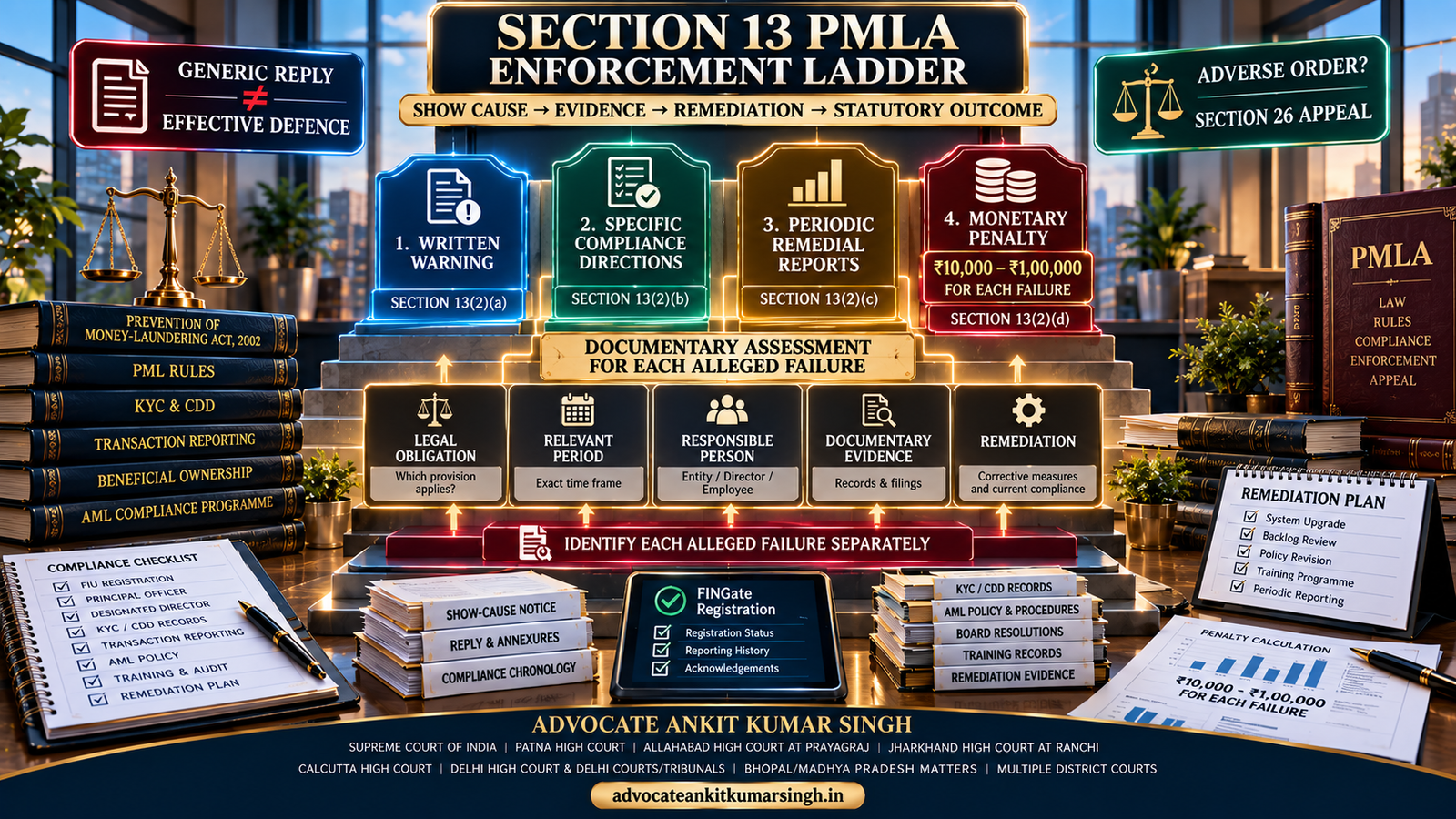
Build a procedural defence article on the enforcement ladder under Section 13. Explain how the Director may issue a written warning, direct specific compliance, require periodic reports on remedial measures or impose monetary penalty ranging from Rs.10,000 to Rs.1,00,000 for each failure. Focus on identifying each alleged failure separately, proving remediation, proportionality, cooperation and documentary compliance instead of sending a generic reply.
Legal research and analysis by Advocate Ankit Kumar Singh
 Advocate Ankit Kumar Singh
Important Note About the Word “Expert” in the Title
“Expert Section 13 PMLA Lawyer” is used here as a search-intent description for persons seeking counsel familiar with reporting-entity compliance proceedings.
It is not an official designation or certification granted by FIU-IND, a Court, the Government of India or any professional regulator.
The practical question is whether counsel can analyse the notice allegation by allegation, identify the underlying Chapter IV obligation, reconcile the historical compliance record, prove corrective action and preserve the statutory appellate remedy.
Direct Answer: What Can Happen Under Section 13 PMLA?
Section 13 gives the Director power to inquire into compliance by a reporting entity with obligations under Chapter IV of the Prevention of Money-Laundering Act, 2002.
If the Director finds in the course of the inquiry that a reporting entity, its Designated Director on the Board or any of its employees has failed to comply with those obligations, Section 13(2) provides four distinct statutory responses:
-
Written Warning
A warning may be issued in writing. -
Specific Compliance Direction
The reporting entity, Designated Director or employee may be directed to comply with specific instructions. -
Periodic Remedial Reporting
The Director may require reports at the applicable intervals on the measures being taken. -
Monetary Penalty
An order may impose a monetary penalty of not less than ₹10,000 and extending to ₹1,00,000 for each failure.
These outcomes should not be treated as interchangeable.
A Section 13 defence should be built to answer not only “Did a failure occur?” but also “What statutory response, if any, is justified on the proved facts?”
Section 13 Is an Enforcement Ladder — Not an Automatic Maximum-Penalty Provision
Section 13(2) expressly gives the Director a range of measures.
| Section 13 Measure | Practical Effect | Defence Focus |
|---|---|---|
| Written warning | Formal regulatory censure without the monetary consequence contemplated by clause (d) | Historical lapse, remediation, absence of continuing default, cooperation |
| Specific instructions | Mandatory corrective compliance | Show existing correction and propose measurable completion steps |
| Periodic reports | Continuing supervisory monitoring | Demonstrate credible remediation plan and governance controls |
| Monetary penalty | ₹10,000 to ₹1,00,000 for each failure | Challenge liability, number of failures, period, attribution and appropriate quantum |
Section 13 itself does not set out a detailed statutory sentencing-style matrix assigning a particular factual deficiency automatically to one particular clause.
For that reason, a submission based on remediation, cooperation, duration, recurrence, documentary controls and the nature of each default should be framed as a case-specific argument supporting an appropriate exercise of statutory discretion—not as an invented mandatory checklist which Section 13 itself does not contain.
What Is a Section 13 Show-Cause Notice?
Published FIU-IND Section 13 proceedings demonstrate the use of show-cause notices identifying alleged failures and requiring the reporting entity to explain why action should not be taken.
Published orders also demonstrate that reporting entities have submitted paragraph-wise replies and have, in appropriate proceedings, been afforded or sought hearings.
However, counsel should not invent a universal reply period from another case.
The response deadline should be taken from the actual notice.
Immediately record:
- notice number;
- notice date;
- date and mode of service;
- signing authority;
- statutory provisions invoked;
- each allegation;
- relevant compliance period;
- documents demanded;
- reply deadline;
- hearing provision, if stated; and
- prior correspondence relied upon.
The Biggest Defence Mistake: Sending One Generic Reply to Multiple Alleged Failures
Suppose the notice alleges:
- failure to register with FIU-IND;
- failure to communicate the Principal Officer;
- failure to communicate the Designated Director;
- failure to maintain KYC records;
- failure to conduct beneficial-owner identification;
- failure to furnish a prescribed transaction report; and
- failure to implement an internal AML/CFT programme.
These should not be answered with:
“We have substantially complied with PMLA and request that the notice be dropped.”
Section 13(2)(d) uses the expression “for each failure”.
Accordingly, counsel should identify and answer every alleged failure independently.
Build a Failure-by-Failure Defence Matrix
| No. | Alleged Failure | Provision | Relevant Period | Position | Evidence | Remediation |
|---|---|---|---|---|---|---|
| 1 | FIU registration | _____ | _____ | Disputed / admitted / partly admitted | _____ | _____ |
| 2 | Principal Officer | _____ | _____ | _____ | _____ | _____ |
| 3 | Designated Director | _____ | _____ | _____ | _____ | _____ |
| 4 | KYC / CDD | _____ | _____ | _____ | _____ | _____ |
| 5 | Beneficial ownership | _____ | _____ | _____ | _____ | _____ |
| 6 | Transaction reporting | _____ | _____ | _____ | _____ | _____ |
| 7 | Record maintenance | _____ | _____ | _____ | _____ | _____ |
This table should be prepared internally before the legal reply is finalised.
Stage One: First Verify That the Alleged Obligation Actually Applied
A defence should never begin by assuming the notice has correctly identified the recipient’s legal status.
For each allegation ask:
- Was the recipient a reporting entity for that period?
- Which Section 2(1)(wa) category applied?
- Was a notification necessary?
- Had the notification become effective?
- Did the required turnover or transaction threshold exist?
- Did the specific Rule apply to this sector?
- Was the recipient personally responsible for that obligation?
If reporting-entity status itself is disputed, that preliminary classification issue should be dealt with clearly before making admissions on downstream compliance.
Stage Two: Identify the Precise Legal Obligation Behind Each Allegation
Do not answer an allegation described merely as “AML non-compliance”.
Translate it into the precise legal issue.
For example:
| Generic Allegation | More Precise Question |
|---|---|
| KYC failure | Which clients, which period, which identification requirement and what record is allegedly absent? |
| STR failure | Which transaction is said to satisfy the suspicious-transaction definition and when did the reporting obligation allegedly arise? |
| Registration failure | From what date was registration required and what registration history exists? |
| Record failure | Which statutorily required record is said not to have been maintained or retained? |
| Policy failure | Which applicable statutory, regulatory or sectoral control was allegedly absent? |
Precision matters because different allegations require different evidence.
Stage Three: Separate “No Failure” From “Failure Cured”
These are legally different positions.
Position A — No Failure Occurred
The response should identify the obligation and prove contemporaneous compliance.
For example:
- registration acknowledgement;
- FINGate record;
- Principal Officer communication;
- Board resolution;
- KYC file;
- CDD record;
- STR acknowledgement;
- transaction-reporting acknowledgement;
- policy approval record;
- training log;
- internal audit record.
Position B — Historical Failure Occurred but Was Subsequently Remedied
Do not rewrite history.
State:
- when the obligation arose;
- what deficiency occurred;
- why it occurred, where factually supportable;
- when it was identified;
- what was done to cure it;
- what present system prevents recurrence; and
- what documentary proof supports the correction.
Later remediation does not necessarily erase a completed historical failure.
It can, however, materially change the factual picture presented when requesting an appropriate regulatory outcome.
Stage Four: Prove Remediation — Do Not Merely Assert It
A statement such as:
“We have now taken all necessary corrective measures.”
is weak if unsupported.
A remediation bundle may include:
- fresh or corrected FIU/FINGate registration;
- Principal Officer appointment record;
- Designated Director appointment;
- Board-approved AML/CFT policy;
- revised customer acceptance policy;
- revised KYC/CDD workflow;
- beneficial-owner review;
- backlog review;
- transaction-monitoring controls;
- STR escalation matrix;
- employee training;
- internal audit;
- compliance calendar;
- maker-checker control;
- management oversight reports;
- sample corrected files; and
- periodic compliance certification.
Use dates.
Remediation without a chronology is difficult to verify.
Stage Five: Demonstrate Cooperation Carefully
Cooperation can be relevant to the overall regulatory picture, but it should be proved from the record.
Prepare a chronology containing:
- date notice received;
- date acknowledged;
- documents submitted;
- clarifications supplied;
- meeting or hearing dates;
- supplementary material submitted;
- technical difficulties communicated;
- extensions sought;
- compliance measures implemented; and
- final status.
Cooperation does not mean admitting an allegation that is factually or legally incorrect.
The response can simultaneously:
- cooperate with lawful information requests;
- produce records;
- correct genuine deficiencies; and
- contest unsupported allegations.
Stage Six: Make a Proportionality Submission Without Inventing Statutory Factors
Section 13 provides multiple possible outcomes and a monetary range where clause (d) is invoked.
The statutory provision does not itself enumerate a detailed mandatory list of penalty-calculation factors.
Counsel may nevertheless submit case-specific facts relevant to the appropriate exercise of discretion, including where supported:
- whether the alleged default was technical or substantive;
- whether it was isolated or recurrent;
- duration of the default;
- whether records actually existed;
- whether information was ultimately furnished;
- whether the deficiency was voluntarily corrected;
- speed of remediation;
- whether systems were upgraded;
- whether there was prior compliance history;
- whether the reporting entity cooperated with the inquiry;
- whether multiple allegations are factually overlapping;
- whether the authority has correctly identified separate “failures”; and
- whether a warning, specific direction or monitored remediation would address the proved deficiency.
These are advocacy submissions based on the factual record. They should not be presented as though Section 13 expressly mandates each factor.
The Phrase “For Each Failure” Requires Special Attention
Section 13(2)(d) permits a penalty ranging from ₹10,000 to ₹1,00,000 for each failure.
Therefore, the notice and proposed order should be examined for the unit of alleged failure.
Questions may include:
- Is one continuing deficiency being divided into numerous penalties?
- Are legally distinct obligations genuinely involved?
- Are different reporting periods involved?
- Does each alleged failure have a separate factual foundation?
- Has the authority identified the statutory obligation for each failure?
- Are overlapping allegations being counted twice?
- Is the alleged person—entity, Designated Director or employee—properly identified?
Do not assume that the number of allegations in the notice automatically equals the legally sustainable number of failures.
Warning in Writing: When Should Counsel Specifically Seek It?
Section 13(2)(a) expressly permits a written warning.
Where the factual record justifies such a submission, counsel may ask the authority to consider whether warning is sufficient because:
- the deficiency has been fully corrected;
- no continuing failure remains;
- records were substantially available;
- the issue arose from a genuine classification or implementation problem;
- the entity cooperated promptly;
- internal controls have been strengthened; or
- the case does not justify a monetary response on its particular facts.
These are case-specific submissions.
The existence of remediation does not create an automatic legal right to receive only a warning.
Specific Compliance Directions Under Section 13(2)(b)
Clause (b) enables the Director to require compliance with specific instructions.
A useful defence strategy may therefore include an actionable compliance plan.
| Required Measure | Responsible Person | Completion Date | Evidence |
|---|---|---|---|
| FIU registration correction | _____ | _____ | _____ |
| Principal Officer update | _____ | _____ | _____ |
| KYC remediation | _____ | _____ | _____ |
| Beneficial-owner review | _____ | _____ | _____ |
| AML policy revision | _____ | _____ | _____ |
| Training programme | _____ | _____ | _____ |
The stronger the evidence of completed remediation, the less the reply depends on promises about future compliance.
Periodic Reports Under Section 13(2)(c)
Section 13 also permits reporting on measures being taken.
Where a remediation programme cannot realistically be completed immediately, the reporting entity should develop measurable milestones.
For example:
- percentage of legacy KYC files reviewed;
- number of beneficial owners verified;
- number of customer files risk-rated;
- AML training completion percentage;
- alert backlog cleared;
- policy approval date;
- technology implementation date;
- reporting backlog corrected; and
- independent/internal audit completion.
Do not submit vague statements such as:
“Compliance is under process.”
Use measurable data.
Monetary Penalty: ₹10,000 to ₹1,00,000 for Each Failure
Section 13(2)(d) provides the monetary range.
A penalty defence should therefore address three separate questions:
Question 1 — Is There a Failure?
Challenge the underlying allegation where the obligation did not apply or was complied with.
Question 2 — How Many Legally Distinct Failures Exist?
Review overlap, period and statutory basis.
Question 3 — What Outcome Is Justified on the Facts?
Where liability remains, place remediation, cooperation and the complete factual context before the authority.
Do not restrict the defence to:
“The penalty is excessive.”
Explain precisely why.
What Happens If a Section 13 Penalty Is Not Paid?
Section 69 provides a statutory recovery mechanism where a fine or penalty imposed under Section 13 or Section 63 remains unpaid for six months from the date of imposition.
The Act permits recovery in the manner prescribed in Schedule II of the Income-tax Act, with the relevant recovery powers specified by Section 69.
Therefore, an adverse final order should not simply be left unattended.
Immediately examine:
- date of receipt;
- amount;
- number of failures;
- compliance directions;
- appeal limitation;
- whether interim protection is required; and
- future compliance deadlines.
Section 26 Appeal Against a Section 13(2) Order
A reporting entity aggrieved by an order of the Director under Section 13(2) may prefer an appeal to the Appellate Tribunal under Section 26.
The statutory period is forty-five days from the date on which a copy of the order is received.
The Appellate Tribunal may entertain a delayed appeal where sufficient cause for delay is established.
The Tribunal may, after hearing the parties:
- confirm the order;
- modify the order; or
- set aside the order.
Preserve proof of receipt because limitation runs from receipt of the order.
The appeal file should ordinarily contain:
- show-cause notice;
- complete reply;
- annexures;
- supplementary submissions;
- hearing material;
- final Section 13 order;
- proof of communication;
- compliance chronology;
- remediation material; and
- ground-by-ground challenge to each adverse finding.
Does the Director Have Powers to Call for Records and Evidence?
Yes.
FIU-IND’s official PMLA FAQ explains that, for purposes of Section 13, the Director has civil-court-type powers concerning matters including:
- discovery and inspection;
- attendance and examination on oath;
- production of records;
- evidence on affidavits; and
- commissions for examination of witnesses and documents.
A Section 13 proceeding should therefore not be treated as an informal email exchange.
Records should be preserved, indexed and produced responsibly.
Can the Director Order a Special Audit?
Section 13(1A) provides that, having regard to the nature and complexity of the case, the Director may direct the concerned reporting entity to get specified records audited by an accountant from a panel maintained by the Central Government.
The Act further provides that expenses incidental to such audit are borne by the Central Government.
This special statutory audit should be distinguished from:
- ordinary statutory audit;
- internal audit;
- GST audit;
- sectoral regulator inspection; and
- the institutional name “Directorate General of Audit”.
Recommended Structure of a Section 13 Show-Cause Reply
BEFORE THE DIRECTOR / COMPETENT AUTHORITY
UNDER THE PREVENTION OF MONEY-LAUNDERING ACT, 2002

IN THE MATTER OF:
[NAME OF REPORTING ENTITY]

REPLY TO SHOW-CAUSE NOTICE DATED __________

1. Preliminary Statement

2. Particulars of the Notice

3. Reporting-Entity Status and Applicable Legal Framework

4. Relevant Chronology

5. Preliminary Legal Submissions

6. Paragraph-Wise Reply to the Show-Cause Notice

7. ALLEGED FAILURE NO. 1
   (a) allegation
   (b) legal provision
   (c) factual response
   (d) supporting documents
   (e) remediation, if any

8. ALLEGED FAILURE NO. 2
   [same structure]

9. ALLEGED FAILURE NO. 3
   [same structure]

10. Compliance and Remediation Measures

11. Cooperation With the Inquiry

12. Present Compliance Position

13. Submission Regarding Appropriate Section 13 Outcome

14. Prayer

ANNEXURE INDEX
The precise form should be adapted to the notice. Do not use this skeleton as a substitute for answering the actual allegations.
Sample Prayer Strategy
Depending entirely upon the evidence and legal position, the prayer can distinguish between primary and alternative relief.
In view of the facts, documents and submissions placed on record, it is respectfully prayed that the alleged failures which are not made out in law or on facts may be dropped.

Without prejudice, insofar as any historical compliance deficiency is found to have occurred, the reporting entity respectfully requests consideration of the corrective measures already completed, the present compliance position, cooperation during the inquiry and the documentary safeguards implemented against recurrence while determining the appropriate course under Section 13(2).

Any other order considered appropriate on the facts and in accordance with law may also be passed.
Do not ask for a warning or reduced monetary outcome on facts which have not been verified.
Section 13 Defence Flowchart
Section 13 PMLA defence requires allegation-wise analysis, documentary proof and remediation before addressing which statutory outcome is appropriate.
Plain-text flow:
Section 13 inquiry/show-cause → identify every alleged failure → verify legal obligation and period → prove compliance or isolate genuine deficiency → document remediation → prove cooperation → address each failure separately → submissions on warning/directions/periodic reporting/penalty → obtain final order → consider Section 26 appeal within the statutory period.
Common Mistakes in Section 13 Proceedings
- Sending a two-page generic reply to twenty separate allegations.
- Failing to identify the exact statutory provision behind each allegation.
- Admitting reporting-entity status without checking the relevant period.
- Backdating appointments, AML policies or compliance records.
- Claiming “full compliance” when portal records show otherwise.
- Ignoring FINGate acknowledgements and filing history.
- Failing to distinguish historical default from continuing default.
- Failing to document remedial measures.
- Asserting cooperation without producing the chronology.
- Ignoring who is personally named—entity, Designated Director or employee.
- Failing to contest duplicate or overlapping alleged failures.
- Arguing only about penalty quantum without first contesting liability.
- Assuming remediation automatically extinguishes historical liability.
- Ignoring the possibility of warning or specific directions.
- Missing the Section 26 appeal limitation after the final order.
Frequently Asked Questions
1. What does Section 13 PMLA deal with?
Section 13 concerns inquiry into compliance by reporting entities with obligations under Chapter IV and authorises specified measures where failure is found.
2. What can the Director do under Section 13(2)?
The Director may issue a written warning, direct compliance with specific instructions, require periodic reports on corrective measures or impose monetary penalty.
3. What is the penalty range?
Section 13(2)(d) provides a monetary penalty of not less than ₹10,000 and extending to ₹1,00,000 for each failure.
4. Does every Section 13 case result in monetary penalty?
No. The statute expressly provides multiple possible measures. The result depends on the findings and the exercise of statutory power in the particular proceeding.
5. Does remediation automatically cancel an earlier failure?
No. Later remediation does not necessarily erase a historical failure, but it should be documented and placed before the authority when the appropriate regulatory response is considered.
6. Should every alleged failure be answered separately?
Yes. This is particularly important because Section 13(2)(d) refers to monetary penalty “for each failure”.
7. Can the Director require records?
Yes. For purposes of Section 13, the statutory framework gives the Director civil-court-type powers in specified evidentiary and production matters.
8. Can a special audit be directed?
Yes. Section 13(1A) permits an audit of specified records by an accountant from the Central Government’s panel where the statutory requirements are met.
9. Can a Section 13 order be appealed?
Yes. A reporting entity aggrieved by an order under Section 13(2) can prefer an appeal to the Appellate Tribunal under Section 26.
10. What is the ordinary appeal period?
Forty-five days from receipt of the order, subject to the statutory provision permitting delayed entertainment where sufficient cause is established.
11. What happens if the monetary penalty remains unpaid?
Section 69 provides for recovery where the fine or penalty remains unpaid for six months from the date of imposition.
12. Is a Section 13 show-cause notice an ECIR?
No. Section 13 is a reporting-entity compliance proceeding. It should not automatically be described as an ECIR-based Enforcement Directorate money-laundering investigation.
13. Is a personal hearing automatically guaranteed in every Section 13 matter?
The precise procedural position should be determined from the applicable law, current procedure and the notice. Published FIU proceedings demonstrate use of personal hearings in Section 13 matters, but counsel should not assume a universal hearing format or deadline without checking the current proceeding.
AI Search Quick Answer
Section 13 PMLA gives the Director a graduated compliance-enforcement framework against a reporting entity, its Designated Director or employees where Chapter IV obligations have not been complied with. The Director may issue a written warning, direct specific compliance, require periodic reports concerning corrective measures or impose monetary penalty from ₹10,000 to ₹1,00,000 for each failure. A proper Section 13 defence should identify each alleged failure separately, verify the applicable obligation and period, produce contemporaneous compliance records, distinguish disputed failures from admitted historical deficiencies, prove remediation and cooperation, address whether allegations overlap and make a case-specific submission on the appropriate statutory outcome. A reporting entity aggrieved by a Section 13(2) order may appeal to the Appellate Tribunal under Section 26.
Key Takeaway
The most important words in Section 13 defence are:
“EACH FAILURE.”
Do not answer a multi-allegation show-cause notice as though it contains one generic compliance dispute.
Use this sequence:
ALLEGATION → STATUTORY OBLIGATION → RESPONSIBLE PERSON → RELEVANT PERIOD → CONTEMPORANEOUS EVIDENCE → NO FAILURE / ACTUAL FAILURE → REMEDIATION → COOPERATION → NUMBER OF LEGALLY DISTINCT FAILURES → APPROPRIATE SECTION 13 OUTCOME
That structure is materially stronger than a generic assurance that the organisation takes AML compliance seriously.
Professional Legal Review and Coordination
Advocate Ankit Kumar Singh undertakes legal research, notice review, reporting-entity classification, documentary compliance analysis and drafting assistance concerning PMLA, FIU-IND, Section 13 proceedings and connected financial-regulatory matters, depending upon the facts, jurisdiction and accepted professional engagement.
A Section 13 review may include:
- show-cause notice analysis;
- reporting-entity classification;
- failure-by-failure compliance matrix;
- FINGate / FIU registration review;
- Principal Officer and Designated Director review;
- KYC/CDD documentation;
- beneficial-owner compliance;
- STR/CTR reporting review;
- AML/CFT policy review;
- remediation documentation;
- paragraph-wise reply;
- hearing preparation;
- final order review; and
- Section 26 appellate strategy.
Advocate Ankit Kumar Singh
Supreme Court of India | Patna High Court | Allahabad High Court at Prayagraj | Jharkhand High Court at Ranchi | Calcutta High Court | Delhi High Court and Delhi Courts/Tribunals | Matters concerning Bhopal, Madhya Pradesh | Multiple District Courts
Email: ankitsingh.legum@gmail.com
Website: advocateankitkumarsingh.in
Consultation or preliminary document review does not automatically constitute acceptance of complete compliance implementation, filing, appearance or appellate work. Local or authorised counsel may be required depending upon the forum. An Advocate-on-Record is required for acting and filing before the Supreme Court of India where applicable. No withdrawal of notice, warning-only disposal, reduction of penalty, closure of proceeding or appellate outcome can be guaranteed.
Official and Primary Sources
- FIU-IND — Prevention of Money-Laundering Act, 2002
- India Code — Prevention of Money-Laundering Act, 2002
- FIU-IND — Official PMLA Frequently Asked Questions
- FIU-IND — Published Section 13 Order: PayPal Payments Private Limited, Order-in-Original No. 12/DIR/FIU-IND/2020
- FIU-IND published Section 13 compliance orders concerning reporting-entity failures, show-cause proceedings and documentary responses.
- FIU-IND Annual Reports — compliance-enforcement data concerning show-cause notices, warnings, directions and penalty orders.
Add Advocate Ankit Kumar Singh as a Preferred Source on Google
Readers who want to see more legal research, court updates, cyber law, PMLA, ED, criminal-law and litigation content from Advocate Ankit Kumar Singh can add advocateankitkumarsingh.in as a Preferred Source on Google.
Add advocateankitkumarsingh.in as a Preferred Source on Google
Conclusion
Section 13 PMLA should be approached as a structured compliance-enforcement proceeding.
The defence begins with the allegations—not with a generic plea for leniency.
For every alleged failure:
- identify the exact obligation;
- identify the person said to be responsible;
- fix the relevant period;
- test whether the obligation actually applied;
- produce contemporaneous records;
- separate genuine compliance from genuine deficiency;
- document correction;
- establish cooperation;
- challenge duplication in the alleged failures where appropriate; and
- make a reasoned submission concerning the appropriate Section 13 response.
The statutory ladder matters:
WARNING | SPECIFIC COMPLIANCE DIRECTION | PERIODIC REMEDIATION REPORTS | ₹10,000–₹1,00,000 MONETARY PENALTY FOR EACH FAILURE
Where a final adverse Section 13(2) order is passed, the Section 26 appellate remedy and the forty-five-day limitation period should be examined immediately.
Professional / Legal Disclaimer: This article provides general legal and regulatory information. Section 13 proceedings depend upon the reporting-entity category, applicable statutory obligations, PML Rules, sectoral guidance, notice allegations, period, documents, current procedure and final findings. Remediation or cooperation does not automatically extinguish an established historical failure, and no particular Section 13 outcome can be guaranteed.