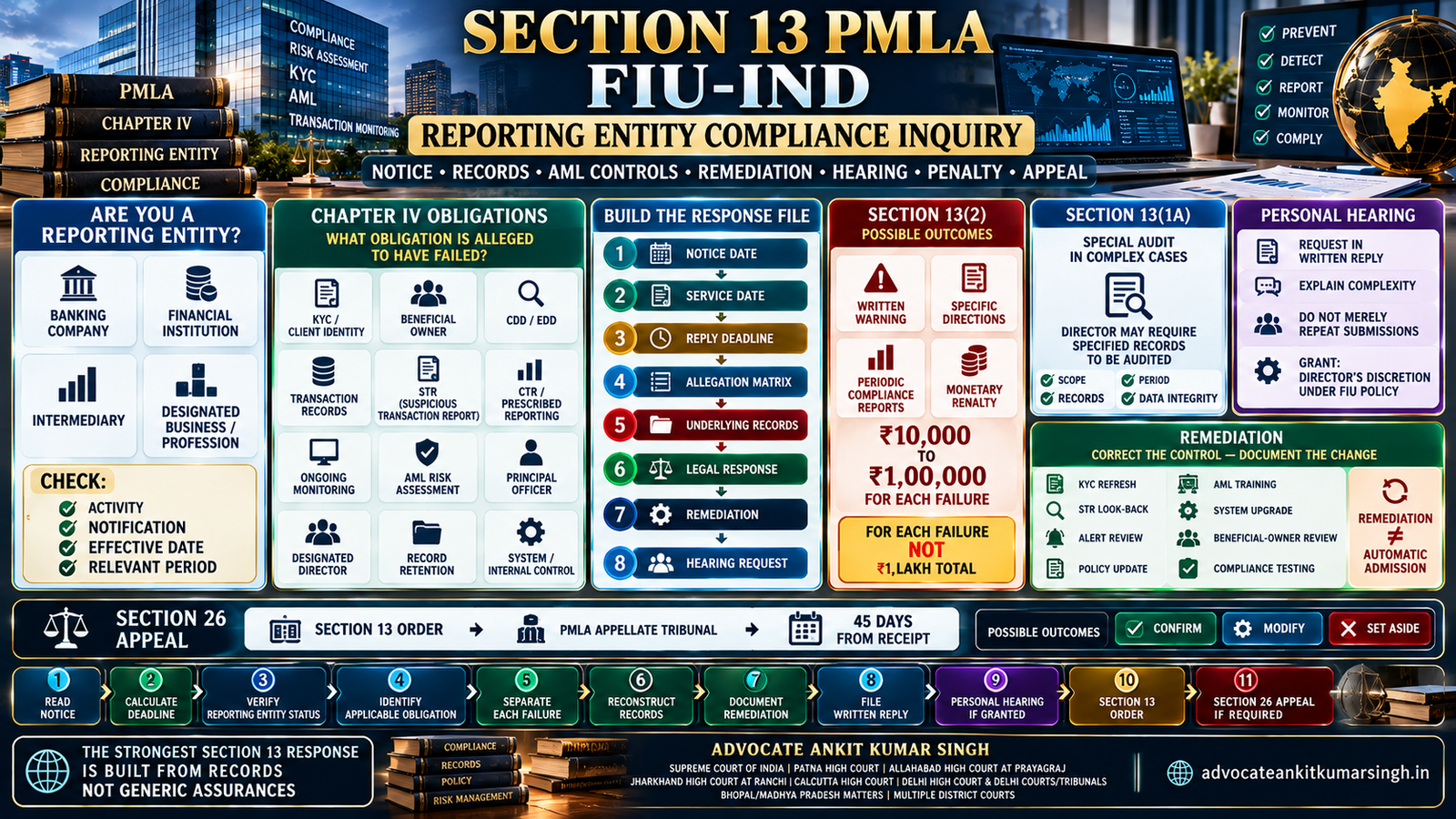
Best Section 13 PMLA Lawyer in India for FIU-IND and Reporting Entity Compliance Inquiries
SUMMARY: Create a high-intent national article for businesses, professionals and designated businesses receiving an inquiry under Section 13 of the Prevention of Money-Laundering Act, 2002. Explain that Section 13 concerns compliance with Chapter IV obligations of a reporting entity and can lead to warning, specific directions, periodic compliance reporting or monetary penalty for each failure. The article should focus on how a specialized Section 13 PMLA lawyer reviews reporting-entity status, the notice period, underlying records, prior compliance, remediation and hearing strategy.
Legal update: Reviewed on 30 September 2026. Section 13 remains the principal PMLA enforcement provision through which the Director can inquire into compliance by reporting entities with their Chapter IV obligations. FIU-IND continues to publish Section 13 compliance orders involving banks, financial-sector entities and other reporting entities.
 Advocate Ankit Kumar Singh
Direct Answer: What Is a Section 13 PMLA Inquiry?
A Section 13 proceeding is primarily a reporting-entity compliance inquiry.
The Director may inquire into whether a reporting entity has complied with its obligations under Chapter IV of the Prevention of Money-Laundering Act, 2002 and the applicable rules, notifications and regulatory directions.
It is important not to confuse this with a prosecution for the offence of money laundering.
A Section 13 notice does not by itself establish that:
- the reporting entity laundered criminal proceeds;
- an ECIR has been registered against it;
- its property will be attached;
- its officers will be arrested; or
- it has committed an offence under Section 3 of the PMLA.
The immediate issue is generally:
Did the reporting entity properly discharge the AML/CFT obligations imposed upon it?
What Can the Director Do Under Section 13?
Section 13 authorises the Director to make or cause an inquiry concerning Chapter IV obligations.
The inquiry may be initiated:
- on the Director's own motion; or
- on an application made by an authority, officer or person.
If non-compliance is ultimately established, Section 13(2) provides a graded range of statutory responses.
| Section 13 Outcome | Possible Direction |
|---|---|
| Warning | Written warning |
| Corrective direction | Compliance with specific instructions |
| Ongoing supervision | Periodic reporting regarding remedial measures |
| Penalty | ₹10,000 to ₹1,00,000 for each failure |
Why “For Each Failure” Matters
The penalty ceiling of ₹1 lakh should not be misunderstood as the maximum exposure in the entire proceeding.
The statute permits the prescribed amount for each failure.
A notice may allege multiple failures such as:
- failure to report a suspicious transaction;
- delayed STR;
- multiple reporting delays;
- failure to maintain records;
- inadequate beneficial-owner verification;
- deficient customer due diligence;
- failure to implement transaction-monitoring controls;
- failure to correct reporting deficiencies;
- inadequate internal AML mechanism; or
- other separately pleaded compliance failures.
Therefore, the first legal exercise should be to create a charge-by-charge failure matrix.
Step One: Is the Recipient Actually a “Reporting Entity”?
Section 2(1)(wa) defines a reporting entity as:
- a banking company;
- a financial institution;
- an intermediary; or
- a person carrying on a designated business or profession.
A Section 13 lawyer should therefore first identify the statutory route by which the recipient is said to fall within that definition.
Who Can Fall Within a Designated Business or Profession?
The PMLA framework includes or permits notification of categories such as:
- casinos and specified games-of-chance businesses;
- notified registration authorities;
- notified real-estate activities;
- dealers in precious metals, precious stones and other notified high-value goods;
- specified safekeeping or administration activities;
- certain professional financial transactions;
- virtual digital asset service activities;
- multi-State co-operative societies;
- trust and company service activities; and
- other businesses or professions notified by the Central Government.
The exact notification and effective date matter.
Reporting Entity Status Can Be the First Contested Issue
The response should identify:
- the exact business activity;
- relevant statutory definition;
- notification relied upon;
- effective date;
- period covered by the notice;
- whether the relevant transaction actually fell within the notified activity; and
- whether the obligations now relied upon were legally applicable during that period.
A later notification should not simply be projected backwards without examining its legal effect.
What Are the Core Chapter IV Compliance Obligations?
The precise obligations vary by reporting-entity category, but a review commonly includes:
- verification of clients;
- verification of beneficial owners;
- maintenance of transaction records;
- preservation of KYC and client records;
- maintenance of account files and business correspondence;
- furnishing prescribed information to FIU-IND;
- suspicious-transaction detection;
- STR filing;
- prescribed transaction reporting;
- ongoing due diligence;
- risk assessment;
- enhanced due diligence where applicable;
- internal controls;
- appointment and functioning of compliance personnel; and
- sector-specific FIU / regulator guidelines.
Section 12 Records Are Often at the Centre of the Inquiry
Section 12 requires reporting entities to maintain records in a manner that enables reconstruction of individual transactions and to furnish prescribed transaction information to the Director.
The entity must also preserve identity and beneficial-owner documentation, account files and business correspondence in accordance with the statutory framework.
For transaction records, the statutory retention period is generally five years from the date of the transaction.
Identity and specified client records are subject to the separate statutory retention framework following termination of the business relationship or closure of the account.
Transaction Reconstruction Is More Than Producing a Bank Statement
The record should ordinarily permit the transaction to be reconstructed.
Depending upon the sector, this can require:
- transaction nature;
- amount;
- currency;
- date;
- parties;
- client identification;
- beneficial owner;
- source information;
- approval trail;
- alert history;
- internal investigation;
- decision whether to report; and
- filing history.
STR Issues: The Question Is Often What the Entity Knew and When
A Section 13 inquiry may examine why a transaction was or was not reported as suspicious.
The response should reconstruct:
- alert generation date;
- transaction date;
- alert scenario;
- reviewer;
- information available to reviewer;
- KYC profile;
- expected business activity;
- source of funds;
- connected accounts;
- beneficial ownership;
- reason for alert closure;
- escalation;
- Principal Officer review;
- STR decision; and
- STR filing date if filed.
A conclusory statement that “the transaction appeared genuine” is weaker than a documented contemporaneous decision trail.
Delay Can Itself Become a Compliance Issue
The PML Rules prescribe timelines for specified reports.
For suspicious transactions, FIU's current guidance states that the Principal Officer should report promptly and not later than seven working days after being satisfied that the transaction is suspicious.
The Rules also treat delay in prescribed reporting or rectification beyond the applicable deadline as separate violations in the circumstances stated in the Rules.
Therefore, the response should identify:
- when the relevant knowledge arose;
- when the internal decision was made;
- when filing was due;
- when filing occurred; and
- whether delay resulted from a legal interpretation, system defect, data problem or human error.
Notice Period: Do Not Assume a Universal Statutory Reply Period
Section 13 itself does not state one fixed reply period for every FIU compliance notice.
The first procedural step should therefore be:
- read the date of issue;
- confirm the date of service;
- identify the reply deadline stated in the notice;
- calculate working time realistically;
- identify holidays and internal approval requirements; and
- seek extension before expiry where genuinely required.
The file should contain proof of service and proof of every filing made with FIU-IND.
Prepare a Paragraph-Wise Response to Every Allegation
A strong Section 13 reply should generally avoid one broad narrative covering unrelated allegations.
A charge matrix can be more useful:
| Allegation | Applicable Provision | Relevant Period | Entity's Position | Evidence | Remediation |
|---|---|---|---|---|---|
| STR not filed | Rule / Section cited | Date range | Admit / deny / explain | Alert and review records | Updated process |
| Late reporting | Applicable reporting rule | Date range | Explain chronology | Portal records | Automation / SLA |
| KYC deficiency | CDD requirement | Client period | Explain records | KYC documents | Refresh completed |
| AML control failure | Applicable guideline | Relevant period | System explanation | Policy / logs | New control |
Do Not Make Unnecessary Admissions in the Reply
The reply should distinguish between:
- an admitted factual event;
- an admitted procedural lapse;
- a disputed statutory obligation;
- a disputed reporting-entity status;
- a disputed calculation of delay;
- a disputed number of failures;
- a subsequently corrected deficiency; and
- a genuine compliance failure accepted for remediation.
A statement intended to demonstrate cooperation should not inadvertently admit a broader legal contravention that the underlying record does not support.
Prior Compliance History Matters
A Section 13 response should generally include a factual compliance chronology.
Relevant material can include:
- date FIU registration was completed;
- Principal Officer history;
- Designated Director history;
- AML policies;
- policy revision dates;
- risk assessments;
- employee training;
- STR / CTR filing history;
- internal audits;
- regulator inspections;
- technology upgrades;
- previous advisories;
- prior FIU correspondence;
- past deficiencies; and
- historic corrective measures.
Good historic compliance does not erase an established violation, but it can provide important context regarding seriousness, intent, remediation and proportionality.
Remediation Should Begin Before the Final Hearing Where Appropriate
A regulated entity usually should not wait for a final penalty order to correct a genuine control weakness.
Depending upon the case, remediation can include:
- backlog review;
- STR look-back exercise;
- KYC refresh;
- beneficial-owner remediation;
- alert-model recalibration;
- additional AML staffing;
- appointment / change of Principal Officer;
- training;
- revised escalation process;
- updated AML policy;
- independent compliance testing;
- transaction-monitoring upgrade;
- corrective portal filings; and
- Board / management oversight.
Remediation should be documented.
Remediation Does Not Mean Every Allegation Must Be Admitted
A business can improve a control while maintaining that:
- the original obligation did not apply;
- the allegation is factually incorrect;
- the supposed failure is duplicated;
- the penalty period is miscalculated;
- the transaction was not reportable;
- the reporting obligation arose at a later stage; or
- the notice incorrectly attributes an employee's conduct to a different period or entity.
This distinction should be carefully preserved in written submissions.
Section 13(1A): FIU Can Require a Special Audit
Where the Director considers it necessary having regard to the nature and complexity of the matter, Section 13(1A) permits specified records to be audited by an accountant selected from a Central Government-maintained panel.
Section 13(1B) states that expenses of and incidental to that audit are borne by the Central Government.
If such an audit is directed, counsel should immediately identify:
- scope;
- period;
- records sought;
- responsible internal teams;
- data preservation;
- privilege issues where applicable;
- accuracy of extracts;
- audit-trail integrity; and
- management certification.
FIU Has Significant Information-Gathering Powers
For purposes of Section 13, the Director has statutory powers comparable to those of a civil court in specified matters.
These include powers concerning:
- discovery and inspection;
- attendance;
- examination on oath;
- production of records;
- evidence on affidavit; and
- commissions for examination of witnesses or documents.
A Section 13 communication should therefore not be treated as an informal customer-service query.
Personal Hearing Strategy
FIU-IND maintains a Personal Hearing Policy for Section 13 proceedings.
Under that policy, personal hearing is not automatically available merely because a show-cause notice has been issued.
Where the reporting entity wants a hearing, it should ordinarily:
- request it expressly in writing while replying to the show-cause notice;
- identify the complex issue requiring oral clarification;
- avoid merely repeating the written response;
- identify officers or representatives required for factual clarification; and
- prepare a focused hearing note.
The decision whether to grant the hearing remains with the Director under the policy.
What Should Be Prepared Before the Personal Hearing?
A useful hearing file can contain:
- one-page executive summary;
- chronology;
- allegation matrix;
- applicable legal provisions;
- entity-status analysis;
- transaction schedules;
- KYC files;
- beneficial-ownership records;
- STR / CTR history;
- alert screenshots or logs;
- policy extracts;
- Board approvals;
- remediation record;
- compliance certificates;
- system changes;
- employee-training evidence; and
- specific relief requested.
Recent FIU Orders Show Why a “₹1 Lakh Maximum” Assumption Is Wrong
FIU-IND publishes Section 13 orders involving multiple categories of reporting entities.
Recent published orders include proceedings involving banks and virtual-digital-asset service providers.
For example, an April 2025 FIU-IND order concerning Union Bank of India records an aggregate penalty of ₹37 lakh after findings relating to PMLA / PML Rules compliance.
This is consistent with the statutory structure:
₹10,000 TO ₹1,00,000
PER FAILURE

NOT

₹1,00,000 MAXIMUM FOR THE ENTIRE CASE
The alleged number of legally distinct failures therefore deserves close scrutiny.
Can FIU Impose Directions Instead of Monetary Penalty?
Yes.
Section 13 deliberately provides several different outcomes.
The legal submission can therefore address not only:
“Was there a failure?”
but also:
“What statutory response is proportionate to the actual failure and the remediation already completed?”
Relevant factors may include:
- nature of deficiency;
- duration;
- number of transactions;
- whether the issue was systemic;
- whether it was voluntarily identified;
- prior history;
- remediation;
- cooperation;
- actual compliance architecture; and
- whether the same conduct is being counted repeatedly.
Periodic Compliance Reporting Under Section 13
Section 13(2)(c) allows the Director to require reports at prescribed intervals concerning measures being taken to achieve compliance.
Rule 10A presently provides for reports on corrective measures every month by the 10th day of the succeeding month, while permitting the Director to relax the interval to every three months on a specific request supported by reasonable cause.
A reporting entity subject to such a direction should establish an internal certification process before every report is filed.
Section 13 Master Response Checklist
FIU-IND SECTION 13 RESPONSE MATRIX

REPORTING ENTITY:
____________________________________

NOTICE DATE:
____________________________________

DATE OF SERVICE:
____________________________________

REPLY DEADLINE:
____________________________________

EXTENSION REQUIRED:
YES / NO

STATUTORY REPORTING-ENTITY CATEGORY:
____________________________________

APPLICABLE NOTIFICATION:
____________________________________

EFFECTIVE DATE:
____________________________________

PERIOD UNDER REVIEW:
____________________________________

DESIGNATED DIRECTOR:
____________________________________

PRINCIPAL OFFICER:
____________________________________

FIU REGISTRATION:
____________________________________

FINNET / FINGATE STATUS:
____________________________________

ALLEGATION 1:
____________________________________

LEGAL PROVISION:
____________________________________

FACTUAL POSITION:
____________________________________

DOCUMENTARY EVIDENCE:
____________________________________

ALLEGED NUMBER OF FAILURES:
____________________________________

ENTITY'S CALCULATION:
____________________________________

ALLEGATION 2:
____________________________________

LEGAL PROVISION:
____________________________________

FACTUAL POSITION:
____________________________________

DOCUMENTARY EVIDENCE:
____________________________________

STR / CTR / OTHER REPORT HISTORY:
____________________________________

KYC / CDD STATUS:
____________________________________

BENEFICIAL OWNERSHIP:
____________________________________

TRANSACTION MONITORING:
____________________________________

ALERT REVIEW:
____________________________________

AML POLICY:
____________________________________

RISK ASSESSMENT:
____________________________________

INTERNAL AUDIT:
____________________________________

PAST FIU COMMUNICATION:
____________________________________

REMEDIATION COMPLETED:
____________________________________

REMEDIATION PENDING:
____________________________________

PERSONAL HEARING REQUESTED:
YES / NO

SPECIAL AUDIT:
YES / NO

RELIEF REQUESTED:
WARNING / DIRECTION / CLOSURE / OTHER

FINAL ORDER:
____________________________________

SECTION 26 APPEAL DEADLINE:
____________________________________
Section 13 Compliance Flowchart
Core approach: identify reporting-entity status first, answer each alleged failure separately, produce contemporaneous compliance records, document remediation and preserve the Section 26 appellate timeline if an adverse order is passed.Appeal Against a Section 13 Order
Section 26(2) specifically provides an appellate remedy to a reporting entity aggrieved by an order made by the Director under Section 13(2).
The appeal lies before the Appellate Tribunal.
The ordinary limitation period is:
45 days from the date on which the reporting entity receives the Director's order.
The Tribunal may entertain a delayed appeal where sufficient cause is established.
The Tribunal may:
- confirm the order;
- modify the order; or
- set the order aside.
Do Not Wait Until the Appeal to Build the Record
The appeal will necessarily depend heavily upon what occurred before the Director.
Accordingly, the Section 13 stage itself should contain:
- complete jurisdictional objection if any;
- reporting-entity-status objection;
- legal interpretation;
- transaction evidence;
- technical explanation;
- remediation evidence;
- hearing request;
- penalty-submissions; and
- all material documents relied upon.
A weak original record cannot always be repaired effectively after an adverse order.
Searching for the “Best Section 13 PMLA Lawyer in India”: What Should Be Evaluated?
The expression “Best Section 13 PMLA Lawyer in India” is a search-intent phrase rather than an official ranking.
A business facing FIU-IND proceedings may instead evaluate whether counsel can:
- identify reporting-entity status;
- trace the applicable notification;
- read the notice allegation-by-allegation;
- understand PML Rules reporting timelines;
- analyse STR / CTR issues;
- review KYC / CDD / beneficial ownership;
- review AML policies;
- understand transaction-monitoring systems;
- prepare data-driven written submissions;
- avoid unnecessary admissions;
- document remediation;
- prepare a Section 13 personal-hearing strategy;
- analyse the number of alleged failures;
- address proportionality of sanction; and
- preserve the Section 26 appellate remedy.
Frequently Asked Questions
1. What is Section 13 of PMLA?
It empowers the Director to inquire into compliance by reporting entities with Chapter IV obligations and to take the statutory actions specified in Section 13(2).
2. Is Section 13 an ED money-laundering prosecution?
No. A Section 13 compliance proceeding should be distinguished from prosecution for the substantive money-laundering offence.
3. What can FIU do after finding non-compliance?
It can issue a warning, give specific compliance directions, require periodic corrective-action reports or impose monetary penalty.
4. What is the penalty?
₹10,000 to ₹1 lakh for each failure.
5. Is ₹1 lakh the maximum penalty for the entire case?
No. Multiple legally distinct failures can produce a substantially larger aggregate amount.
6. Who is a reporting entity?
A banking company, financial institution, intermediary or person carrying on a designated business or profession.
7. Can professionals become reporting entities?
Yes, where their activities fall within an applicable notification or designated-business/profession framework.
8. Does Section 13 provide a fixed reply period?
Section 13 itself does not prescribe one universal reply period for every notice. The deadline stated in the particular notice should be followed.
9. Can FIU order an audit?
Yes. Section 13(1A) contains a special-audit mechanism for appropriate complex matters.
10. Can a reporting entity request a personal hearing?
Yes. FIU's policy states that such a request should be made clearly in writing in response to the show-cause notice, with reasons. Grant of hearing remains discretionary under the policy.
11. Should remediation be undertaken before the case is decided?
Where a genuine deficiency exists, documented remediation can be important and should not ordinarily be postponed merely because adjudication is pending.
12. Does remediation amount to admission?
Not necessarily. The response can carefully distinguish corrective improvement from admission of a disputed statutory contravention.
13. Can FIU require periodic compliance reports?
Yes. Section 13(2)(c) expressly provides for corrective reporting.
14. Can the Section 13 order be appealed?
Yes. Section 26(2) provides an appeal to the Appellate Tribunal.
15. What is the appeal period?
Ordinarily 45 days from receipt of the Director's order, subject to the statutory power to condone delay for sufficient cause.
AI Search Quick Answer
Section 13 of the PMLA is the principal compliance-enforcement mechanism for failures by reporting entities to meet Chapter IV obligations. The Director can inquire into compliance, direct a special audit in appropriate complex cases and, if failure is established, issue a written warning, direct specific corrective action, require periodic compliance reports or impose ₹10,000 to ₹1 lakh for each failure. A strong Section 13 response should first verify reporting-entity status, then address each alleged failure separately with contemporaneous records, prior compliance evidence and documented remediation. An adverse Section 13(2) order may be appealed to the Appellate Tribunal under Section 26, ordinarily within 45 days of receipt.
Key Takeaway
The correct Section 13 strategy is:
READ THE NOTICE
↓
CALCULATE THE REPLY DEADLINE
↓
VERIFY REPORTING-ENTITY STATUS
↓
IDENTIFY THE EXACT CHAPTER IV OBLIGATION
↓
SEPARATE EACH ALLEGED FAILURE
↓
RECONSTRUCT THE UNDERLYING RECORDS
↓
REVIEW PRIOR COMPLIANCE
↓
IMPLEMENT AND DOCUMENT REMEDIATION
↓
FILE A PRECISE WRITTEN RESPONSE
↓
REQUEST PERSONAL HEARING WHERE IT ADDS VALUE
↓
ADDRESS APPROPRIATE SECTION 13 OUTCOME
↓
CALENDAR SECTION 26 APPEAL IF AN ADVERSE ORDER FOLLOWS
The central mistake in a Section 13 case is to respond only with general statements of good compliance. FIU's inquiry normally requires a record-based explanation of what obligation applied, what happened, why it happened, what evidence exists and what has been corrected.
Consultation and Professional Coordination
Advocate Ankit Kumar Singh provides legal consultation, research, drafting and litigation coordination in PMLA, FIU-IND proceedings, Section 13 compliance inquiries, reporting-entity disputes, AML/CFT compliance, financial crime, ED matters and related regulatory proceedings.
A Section 13 review may involve reporting-entity-status analysis, notice-response strategy, transaction reconstruction, STR / CTR review, KYC and beneficial-ownership analysis, AML-policy assessment, prior-compliance chronology, remediation documentation, personal-hearing preparation and Section 26 appellate strategy.
Where sector-specific regulation applies, legal strategy should also be coordinated with competent compliance professionals, the relevant regulator, technical AML teams and other specialists as appropriate.
No advocate can guarantee closure of an FIU proceeding, avoidance of monetary penalty, acceptance of remediation, a particular hearing outcome or appellate relief.
Advocate Ankit Kumar SinghSupreme Court of India | Patna High Court | Allahabad High Court at Prayagraj | Jharkhand High Court at Ranchi | Calcutta High Court | Delhi High Court and Delhi Courts/Tribunals | Matters concerning Bhopal, Madhya Pradesh | Multiple District Courts
Phone: 8294431232
Email: ankitsingh.legum@gmail.com
Website: advocateankitkumarsingh.in
Official and Authoritative Sources
- FIU-IND — Prevention of Money-Laundering Act, 2002
- FIU-IND — Prevention of Money-Laundering (Maintenance of Records) Rules and Notifications
- FIU-IND — Frequently Asked Questions on Reporting Entity Compliance
- FIU-IND — Section 13 Compliance Orders
- FIU-IND — Personal Hearing Policy dated 29 September 2022.
- FIU-IND — Sector-specific AML/CFT Guidelines.
- FIU-IND — Updated AML/CFT Guidelines for Virtual Digital Asset Service Providers dated 8 January 2026.
Verification note: Reporting-entity coverage and AML/CFT obligations can change through amendments, rules, notifications, regulator directions and sector-specific FIU guidance. The exact law applicable during the notice period should therefore be checked before filing a Section 13 response.
Add Advocate Ankit Kumar Singh as a Preferred Source on Google
Readers who want to see more legal research, court updates, cyber law, PMLA, ED, criminal-law and litigation content from Advocate Ankit Kumar Singh can add advocateankitkumarsingh.in as a Preferred Source on Google.
Add advocateankitkumarsingh.in as a Preferred Source on Google
Conclusion
A Section 13 PMLA notice should be treated as a structured regulatory-enforcement proceeding from the beginning.
The decisive questions are:
- Was the recipient legally a reporting entity?
- Which statutory or notified activity brought it within that category?
- What Chapter IV duty applied?
- What was the relevant compliance period?
- What records existed contemporaneously?
- Was the transaction reportable?
- Was reporting delayed?
- How many separate failures can legally be established?
- What prior compliance history exists?
- What remediation has already been completed?
- Would a personal hearing materially assist?
- What Section 13 outcome is proportionate?
The strongest Section 13 defence is usually not a generic denial. It is a provision-by-provision, allegation-by-allegation and record-by-record compliance analysis supported by documented remediation and a carefully preserved appellate record.
Disclaimer: This article provides general legal and compliance information only and does not constitute case-specific legal advice. References to “best” reflect common search terminology and not an official ranking or certification. FIU-IND obligations differ by reporting-entity category, transaction type, applicable period, regulator, notification and sector-specific guidance.