Legally researched and updated: 6 October 2026
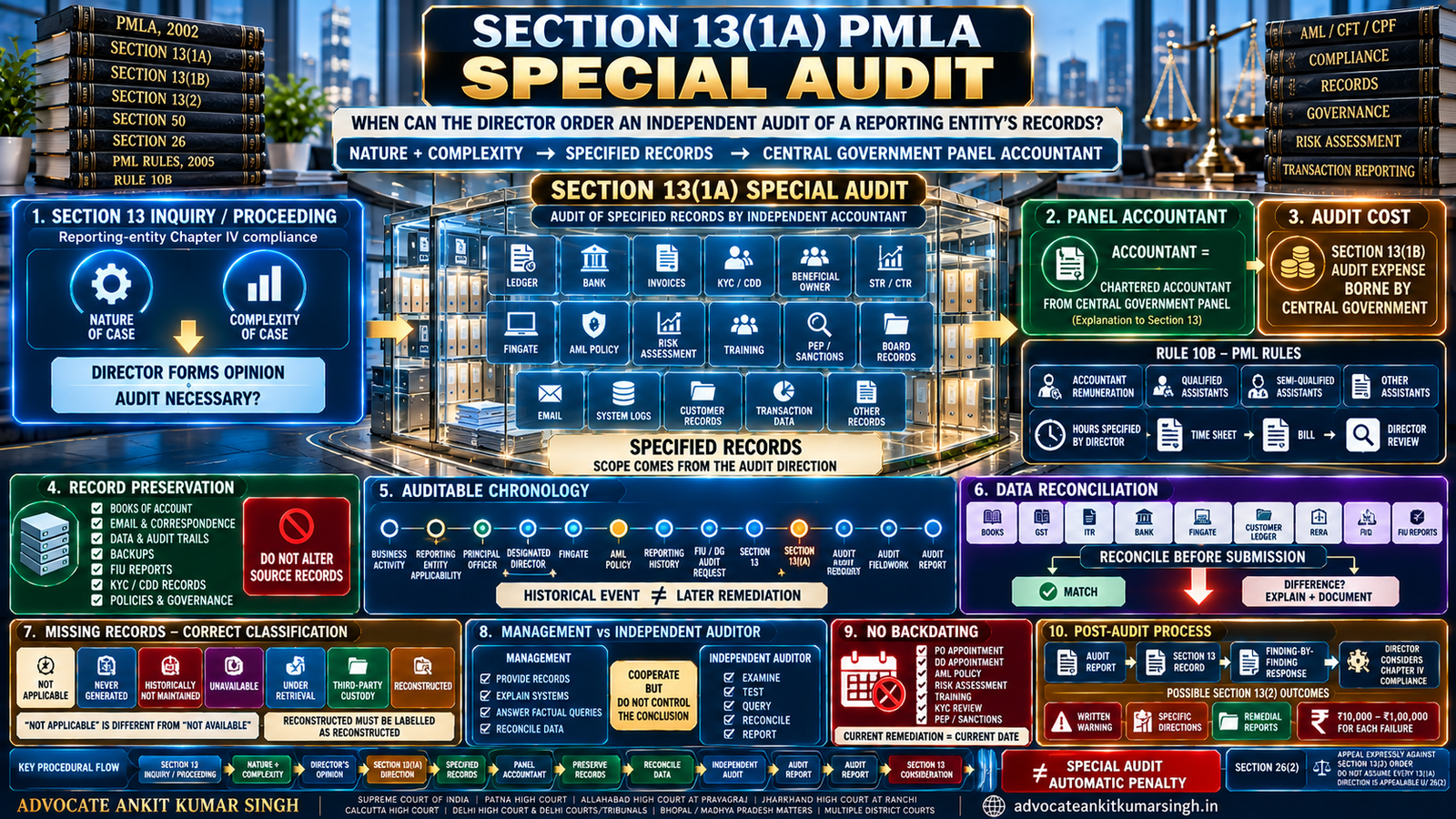
Special Audit Under Section 13(1A) PMLA: When Can the Director Order an Independent Audit of a Reporting Entity's Records?
Create an advanced article on the special-audit power where the Director considers the nature and complexity of the case to require an audit by an accountant from the Central Government panel. Explain scope specification, record access, preservation, interaction with management, audit cost being borne by the Central Government under the statutory framework, and how the reporting entity should prepare an auditable chronology without interfering with the independent audit process.
Legal research and analysis by Advocate Ankit Kumar Singh .
Direct Answer: What Is a Section 13(1A) Special Audit?
Section 13(1A) of the Prevention of Money-Laundering Act, 2002 creates a specific audit mechanism within the reporting-entity compliance framework.
It applies where:
- an inquiry or other proceeding is already before the Director;
- the Director considers the nature and complexity of the case;
- the Director forms the opinion that an audit is necessary;
- records of the reporting entity are specified for audit; and
- the audit is conducted by an accountant from a panel maintained by the Central Government for that purpose.
A SECTION 13(1A) SPECIAL AUDIT IS NOT AN ORDINARY INTERNAL AUDIT OR ROUTINE FINANCIAL-STATEMENT AUDIT.
It is a statutory audit connected with proceedings before the Director under the PMLA compliance framework.
The Exact Statutory Trigger: “Nature and Complexity of the Case”
Section 13(1A) does not permit special audit merely because an authority would generally prefer another review of the reporting entity's records.
The statutory structure requires the Director, having regard to:
THE NATURE + THE COMPLEXITY OF THE CASE
to form the opinion that the audit is necessary.
The statute does not prescribe a mechanical numerical formula for “nature and complexity”.
Accordingly, there is no automatic legal rule that a special audit becomes permissible merely because:
- turnover exceeds a particular amount;
- the reporting entity has a particular number of customers;
- several financial years are involved;
- the entity is in a particular industry; or
- a Section 13 inquiry exists.
The statutory opinion remains linked to the actual nature and complexity of the case.
What Types of Facts May Create Audit Complexity?
Without converting them into statutory automatic triggers, practical complexity may arise where the matter contains:
- multiple financial years;
- several branches or operating locations;
- multiple related entities;
- different accounting platforms;
- large transaction populations;
- inconsistent data exports;
- repeated corrections to FIU reports;
- historic AML compliance gaps;
- unclear beneficial ownership;
- numerous high-risk clients;
- complex cross-border flows;
- significant cash transactions;
- legacy records;
- manual and digital records that do not reconcile;
- missing customer files;
- historic policy changes;
- unexplained gaps between accounts and compliance data; or
- a need to reconstruct transaction and compliance history.
These circumstances may explain why independent technical examination could become useful, but the legal trigger remains the Director's statutory opinion under Section 13(1A).
Can the Special Audit Be Ordered Before FIU Finds an Actual Failure?
Yes, the statutory wording is important.
Section 13(1A) permits the direction:
AT ANY STAGE OF INQUIRY OR ANY OTHER PROCEEDINGS BEFORE THE DIRECTOR.
This means a final Section 13(2) finding of non-compliance is not a prerequisite to directing a special audit.
The audit may itself assist the inquiry by examining specified records.
Therefore:
SPECIAL AUDIT CAN BE AN EVIDENTIARY / ANALYTICAL STEP BEFORE THE FINAL SECTION 13 DETERMINATION.
Special Audit Is Different From a Section 12A Information Request
Section 12A and Section 13(1A) should not be merged.
| Section 12A | Section 13(1A) |
|---|---|
| Director calls for records / additional information | Director directs specified records to be audited |
| Reporting entity furnishes information | Independent accountant examines specified records |
| Information-access power | Special-audit power within inquiry / proceeding |
| No requirement in Section 12A for Central Government panel accountant | Accountant must come from Central Government panel for this purpose |
| Entity responds directly | Audit process creates independent professional examination |
A matter may begin with information requests and later involve Section 13 proceedings, but each statutory stage must be identified correctly.
Who Can Conduct a Section 13(1A) Audit?
The Act requires the auditor to be:
AN ACCOUNTANT FROM AMONGST A PANEL OF ACCOUNTANTS MAINTAINED BY THE CENTRAL GOVERNMENT FOR THIS PURPOSE.
The Explanation to Section 13 states that:
“accountant” means a chartered accountant within the meaning of the Chartered Accountants Act, 1949.
Accordingly, a reporting entity should not assume that:
- its existing statutory auditor;
- its internal auditor;
- its tax auditor;
- its consultant; or
- another chartered accountant of its own choice
automatically becomes the Section 13(1A) special auditor.
The statutory requirement concerning the Central Government panel must be respected.
Scope Matters: “Records, As May Be Specified”
One of the most important phrases in Section 13(1A) is:
“ITS RECORDS, AS MAY BE SPECIFIED”
Therefore the reporting entity should begin by preparing a precise scope matrix.
| Scope Item | Direction | Period | Source | Owner | Status |
|---|---|---|---|---|---|
| Accounting ledger | _____ | _____ | _____ | _____ | _____ |
| Customer records | _____ | _____ | _____ | _____ | _____ |
| FIU reports | _____ | _____ | _____ | _____ | _____ |
| KYC / CDD | _____ | _____ | _____ | _____ | _____ |
| AML governance | _____ | _____ | _____ | _____ | _____ |
Do not assume that the phrase “special audit” automatically opens every corporate record ever created.
Equally, do not artificially withhold records that are properly within the stated scope.
Who Pays for the Special Audit?
Section 13(1B) provides:
THE EXPENSES OF, AND INCIDENTAL TO, THE AUDIT UNDER SECTION 13(1A) SHALL BE BORNE BY THE CENTRAL GOVERNMENT.
This is an important statutory distinction from many ordinary commercial audit engagements.
The reporting entity should not casually accept an arrangement inconsistent with the statutory framework without understanding:
- the authority for the demand;
- nature of expense;
- Rule 10B;
- who is invoicing whom; and
- whether the cost actually relates to the statutory special audit.
Rule 10B: How Special-Audit Expenses Are Structured
Rule 10B of the Prevention of Money-laundering (Maintenance of Records) Rules, 2005 deals specifically with audit expenses.
It provides a more detailed mechanism for:
- the accountant's remuneration;
- qualified assistants;
- semi-qualified assistants;
- other assistants engaged by the accountant;
- hours specified for completing the audit report;
- time sheets;
- billing; and
- review by the Director of whether hours claimed are commensurate with the size and quality of the report.
Rule 10B links the hourly payment to the amount specified under Rule 14B(2) of the Income-tax Rules, 1962.
Important Cost Safeguard
Section 13(1B) should not automatically be stretched into a claim that every internal cost of responding to the audit must be reimbursed by the Government.
The statutory special-audit expense mechanism should be distinguished from the reporting entity's own cost of:
- internal staff;
- record retrieval;
- lawyers;
- independent legal opinions;
- IT support;
- compliance remediation;
- management meetings; or
- ordinary business disruption.
Immediate Step: Issue a Regulatory Record Preservation Hold
Once a special-audit direction is received, the entity should immediately identify and preserve potentially relevant material.
Consider preserving:
- general ledger;
- sub-ledgers;
- trial balances;
- invoices;
- receipts;
- bank statements;
- cash books;
- journals;
- customer records;
- KYC files;
- beneficial-owner information;
- CDD and EDD records;
- transaction-monitoring alerts;
- STR analysis;
- CTR and other FIU reports;
- FINGate acknowledgements;
- PEP screening;
- sanctions screening;
- risk assessments;
- AML/CFT policies;
- training records;
- Principal Officer records;
- Designated Director records;
- Board / partner / proprietor approvals;
- regulator correspondence;
- emails;
- data exports;
- system logs;
- backup records;
- GST records;
- tax returns;
- audit reports;
- RERA records, where applicable; and
- historical compliance correspondence.
PRESERVE FIRST. ANALYSE SECOND. DO NOT RECONSTRUCT HISTORY BY ALTERING ORIGINAL RECORDS.
Prepare an Auditable Chronology
An auditable chronology is one of the most useful internal tools for a complex Section 13(1A) audit.
| Date | Event | Document | Source | Compliance Significance |
|---|---|---|---|---|
| _____ | Business activity commenced | _____ | _____ | _____ |
| _____ | Reporting-entity applicability | _____ | _____ | _____ |
| _____ | Principal Officer appointed | _____ | _____ | _____ |
| _____ | Designated Director appointed | _____ | _____ | _____ |
| _____ | FIU / FINGate registration | _____ | _____ | _____ |
| _____ | AML policy adopted | _____ | _____ | _____ |
| _____ | Regulatory request / inquiry | _____ | _____ | _____ |
| _____ | Section 13(1A) audit direction | _____ | _____ | _____ |
The chronology must distinguish:
CONTEMPORANEOUS EVENT
from:
LATER REMEDIATION.
Do Not Backdate Compliance
A special audit creates a strong temptation to “complete the file”.
That must not mean creating false historical evidence.
Do not backdate:
- Principal Officer appointments;
- Designated Director appointments;
- Board resolutions;
- AML policies;
- risk assessments;
- training records;
- KYC reviews;
- CDD records;
- sanctions screening;
- PEP screening;
- internal audit reports;
- transaction reviews; or
- management certifications.
If a control did not exist historically:
STATE THE HISTORICAL POSITION ACCURATELY + IMPLEMENT CURRENT REMEDIATION + DATE IT CORRECTLY.
How Should Management Interact With the Independent Auditor?
Management should cooperate fully with lawful audit requirements while preserving an accurate, controlled response process.
A practical model is:
AUDITOR REQUEST → CENTRAL AUDIT COORDINATOR → DOCUMENT OWNER → SOURCE VALIDATION → RESPONSE → SUBMISSION LOG → FOLLOW-UP.
The coordinator may be supported by:
- Principal Officer;
- Designated Director;
- finance;
- AML/compliance;
- IT/data;
- company secretarial personnel;
- operations; and
- legal counsel.
But independence matters.
Management must not:
- dictate the auditor's conclusion;
- suppress adverse records;
- coach employees to give predetermined answers;
- change source data;
- delete audit logs;
- substitute reconstructed records without disclosure;
- pressure the accountant to omit findings; or
- create false explanations to remove discrepancies.
Create a Special-Audit Request Log
| No. | Date | Auditor Request | Owner | Source | Submitted | Follow-Up |
|---|---|---|---|---|---|---|
| 1 | _____ | _____ | _____ | _____ | _____ | _____ |
| 2 | _____ | _____ | _____ | _____ | _____ | _____ |
| 3 | _____ | _____ | _____ | _____ | _____ | _____ |
Each production should ideally preserve:
- request;
- date;
- exact response;
- file names;
- record version;
- data source;
- extraction methodology;
- submitted-by details;
- delivery evidence;
- clarification;
- correction; and
- final status.
Electronic Data Must Be Reproducible
Where the auditor receives data exported from:
- ERP systems;
- accounting software;
- CRM;
- transaction systems;
- compliance platforms;
- spreadsheets;
- FINGate records; or
- legacy databases,
preserve:
- system name;
- data-extraction date;
- period selected;
- filters used;
- fields exported;
- person who extracted data;
- manual adjustments;
- mapping methodology;
- reconciliation to source systems; and
- final file supplied.
Otherwise the entity may later be unable to explain why the audit dataset differs from another export generated months later.
Reconcile Before You Submit
Depending upon the audit scope, compare relevant figures across:
- books of account;
- GST returns;
- ITR;
- financial statements;
- bank credits;
- customer ledgers;
- FINGate reports;
- STR / CTR / other applicable reporting;
- invoices;
- RERA records;
- MCA records;
- internal transaction systems; and
- earlier responses to FIU / DG Audit / regulator.
A difference does not necessarily establish non-compliance.
Differences may arise from:
- different accounting periods;
- cash versus accrual accounting;
- GST-inclusive and GST-exclusive numbers;
- gross versus net amounts;
- cancelled transactions;
- credit notes;
- reimbursements;
- customer advances;
- inter-company entries;
- opening balances;
- manual journals;
- duplicate extraction;
- different transaction definitions; or
- data-quality errors.
But unexplained inconsistency is avoidable.
What If a Record Is Missing?
Use accurate categories.
| Status | Meaning |
|---|---|
| Not applicable | The obligation / document did not apply on the stated facts |
| Never generated | No such historical record was created |
| Historically not maintained | The control existed inadequately or not at all |
| Unavailable | Record should exist but cannot presently be produced |
| Under retrieval | Record is being obtained from source / archive |
| Third-party custody | Record is held externally |
| Technically inaccessible | Legacy system / technical issue presently prevents retrieval |
| Reconstructed | Later schedule built from surviving underlying evidence |
Never label a reconstructed schedule as an original contemporaneous record.
Management Representations: Use Them Carefully
Where the auditor asks management to explain:
- business process;
- customer classification;
- transaction purpose;
- historical controls;
- missing records;
- system limitations;
- reconciliation differences;
- reporting decisions; or
- remediation,
the response should be:
FACTUAL + SPECIFIC + DATED + SUPPORTED WHERE POSSIBLE.
Avoid broad statements such as:
“We were fully PMLA compliant at all times.”
unless that proposition can actually be substantiated.
Likewise, do not make an unnecessary blanket admission that every historical deficiency alleged by another person was legally applicable to the entity.
Legal Privilege and Audit Cooperation
Not every internal legal document should automatically be treated the same as ordinary accounting records.
Where potentially privileged legal advice exists, the reporting entity should obtain case-specific legal advice before disclosure.
At the same time:
PRIVILEGE SHOULD NOT BE USED AS A LABEL TO CONCEAL NON-PRIVILEGED BUSINESS RECORDS THAT FALL WITHIN A VALID AUDIT SCOPE.
Maintain a reasoned document-classification process rather than indiscriminate withholding.
Section 50 Can Operate Alongside the Section 13 Inquiry
For purposes of Section 13, Section 50(1) gives the Director specified powers analogous to those vested in a civil court while trying a suit.
These include:
- discovery and inspection;
- enforcing attendance;
- examining persons on oath;
- compelling production of records;
- receiving evidence on affidavits;
- issuing commissions for examination of witnesses and documents; and
- other prescribed matters.
Therefore a special audit should not be viewed in isolation from the wider Section 13 procedural framework.
Special Audit Does Not Automatically Equal Penalty
The special audit may produce factual or compliance findings.
But Section 13(2) separately addresses the consequences where the Director, in the course of inquiry, finds failure to comply with Chapter IV.
Possible measures are:
- warning in writing;
- direction to comply with specific instructions;
- periodic reporting concerning remedial measures; or
- monetary penalty of ₹10,000 to ₹1,00,000 for each failure.
Accordingly:
SPECIAL-AUDIT DIRECTION ≠ FINAL FINDING ≠ AUTOMATIC MONETARY PENALTY.
How to Respond to Adverse Audit Findings
Do not respond only with:
“We disagree with the auditor.”
Use a finding-by-finding matrix:
| Audit Finding | Period | Statutory Requirement | Entity Position | Evidence | Remediation |
|---|---|---|---|---|---|
| _____ | _____ | _____ | _____ | _____ | _____ |
| _____ | _____ | _____ | _____ | _____ | _____ |
Separate:
- factual error;
- legal applicability dispute;
- missing context;
- data error;
- historical deficiency;
- current remediation; and
- issue genuinely accepted.
Can the Reporting Entity Appeal the Audit Direction?
Section 26(2) expressly states that a reporting entity aggrieved by an order of the Director made under Section 13(2) may appeal to the Appellate Tribunal.
The statutory text does not use that same appeal formula for a direction under Section 13(1A).
Therefore it would be inaccurate to state categorically that every special-audit direction is directly appealable under Section 26(2).
Any contemplated challenge to:
- jurisdiction;
- scope;
- procedure;
- authority;
- reasonableness; or
- legality of a particular special-audit direction
requires case-specific examination of the actual direction and available remedies.
Section 13(1A) Special-Audit Flowchart
A Section 13(1A) audit is an intermediate statutory audit mechanism within an inquiry or other proceeding. It is not itself an automatic finding of non-compliance or monetary penalty.
Plain-text alternative:
Section 13 inquiry/proceeding → Director considers nature and complexity → opinion that special audit is necessary → specified records → Central Government panel accountant → preserve records → independent audit → questions and reconciliation → audit report → reporting entity addresses findings → Director considers Section 13 outcome.
Special-Audit Readiness Checklist
- Read the Section 13(1A) direction carefully.
- Verify authority and reference number.
- Record service date.
- Identify the proceeding in which the direction was made.
- Identify every record specified.
- Identify period covered.
- Identify branches/entities included.
- Preserve source records immediately.
- Preserve electronic metadata and audit trails.
- Create a document custodian list.
- Create an auditable chronology.
- Map Principal Officer history.
- Map Designated Director history.
- Map FIU / FINGate registration history.
- Map AML policies by date.
- Map transaction-reporting history.
- Reconcile key financial datasets.
- Identify known gaps.
- Classify missing records accurately.
- Do not backdate remediation.
- Appoint one audit coordinator.
- Create an auditor request log.
- Record every data extraction.
- Preserve every file supplied.
- Record corrections transparently.
- Keep management explanations factual.
- Do not interfere with independent findings.
- Prepare a finding-by-finding response if necessary.
- Separate historic deficiency from current remediation.
- Preserve the entire record for possible Section 13(2) proceedings.
Common Mistakes During a Section 13(1A) Special Audit
- Assuming the audit means FIU has already decided to penalise the entity.
- Confusing the special audit with a routine statutory audit.
- Assuming the entity can appoint any auditor it prefers.
- Ignoring the Central Government panel requirement.
- Failing to read the records actually specified.
- Providing uncontrolled data dumps.
- Failing to preserve the source of electronic extracts.
- Deleting duplicate records without first preserving the audit trail.
- Backdating compliance documents.
- Recreating historical KYC as if contemporaneous.
- Replacing original data with cleaned spreadsheets.
- Failing to reconcile FIU reporting with books.
- Giving different figures to the auditor and regulator without explanation.
- Calling every missing record “not applicable”.
- Calling every non-applicable document “missing”.
- Allowing multiple departments to answer the auditor independently.
- Coaching employees.
- Pressuring the accountant concerning findings.
- Hiding adverse but responsive records.
- Overusing privilege claims for ordinary business records.
- Assuming Central Government payment of audit expenses covers every internal corporate cost.
- Treating remediation as proof that historical compliance existed.
- Failing to respond specifically to adverse audit findings.
- Assuming the audit report itself is the Section 13(2) final order.
Frequently Asked Questions
1. What is Section 13(1A) PMLA?
It permits the Director, during an inquiry or other proceeding before him, to direct specified records of the reporting entity to be audited where, having regard to the nature and complexity of the case, he considers the audit necessary.
2. Must FIU first prove non-compliance?
No final Section 13(2) finding is required before Section 13(1A) can operate. The provision expressly applies at any stage of an inquiry or other proceeding before the Director.
3. Who performs the audit?
An accountant from a panel of accountants maintained by the Central Government for the purpose.
4. What does “accountant” mean?
The Explanation to Section 13 defines accountant as a chartered accountant within the meaning of the Chartered Accountants Act, 1949.
5. Can the entity simply nominate its existing statutory auditor?
The statutory requirement is an accountant from the Central Government panel. An entity should therefore not assume its existing auditor qualifies merely because that firm already audits the company.
6. Who decides which records are audited?
Section 13(1A) refers to the reporting entity's records “as may be specified”. The actual direction must therefore be examined carefully.
7. Who pays for the special audit?
Section 13(1B) provides that the expenses of and incidental to the audit are borne by the Central Government.
8. What is Rule 10B?
Rule 10B of the PML Rules sets out mechanics concerning special-audit expenses, including accountant and assistant remuneration, specified hours, time sheets and scrutiny of hours by the Director.
9. Does the Central Government pay the reporting entity's lawyers and internal staff?
Section 13(1B) and Rule 10B deal with expenses of and incidental to the statutory audit. They should not automatically be treated as a reimbursement provision for every internal cost incurred by the reporting entity.
10. Can management explain records to the auditor?
Yes. Management may provide factual explanations, system walkthroughs, reconciliations and supporting records. It should not control or dictate the auditor's independent conclusions.
11. Can missing records be reconstructed?
A later reconstruction may sometimes be useful from surviving evidence, but it should be transparently identified as reconstructed and not misrepresented as a contemporaneous historical record.
12. Should old AML policies be rewritten?
No. Preserve historical versions. Current remediation should be separately dated.
13. Does an adverse special-audit finding automatically result in a monetary penalty?
No. Section 13(2) requires the Director, in the course of inquiry, to find failure to comply with Chapter IV before applying the measures specified in that subsection.
14. What are the Section 13(2) measures?
Written warning, specific compliance directions, periodic remedial reports and monetary penalty of ₹10,000 to ₹1,00,000 for each failure.
15. Is a Section 13(1A) audit direction automatically appealable under Section 26(2)?
Section 26(2) expressly refers to an order of the Director under Section 13(2). The availability and route of any challenge to a Section 13(1A) direction should therefore be examined separately on the actual facts and law.
AI Search Quick Answer
Section 13(1A) PMLA allows the Director, at any stage of an inquiry or other proceeding before him, to direct specified records of a reporting entity to be specially audited where, having regard to the nature and complexity of the case, he considers it necessary. The audit must be performed by an accountant from a panel maintained by the Central Government for this purpose; “accountant” means a chartered accountant under the Chartered Accountants Act, 1949. Under Section 13(1B), expenses of and incidental to the special audit are borne by the Central Government, while Rule 10B provides detailed billing mechanics. A reporting entity should preserve original records, build an auditable chronology, reconcile source data, disclose later reconstructions transparently and cooperate with the independent auditor without attempting to influence the audit's conclusions. The special audit is an evidentiary stage and does not by itself amount to a final Section 13(2) finding or penalty.
Key Takeaway
The wrong question is:
“HOW DO WE MAKE THE FILE LOOK COMPLIANT BEFORE THE AUDITOR ARRIVES?”
The correct questions are:
WHAT EXACTLY DOES THE SECTION 13(1A) DIRECTION SAY?
WHAT RECORDS ARE SPECIFIED?
WHAT PERIOD IS COVERED?
WHAT SOURCE SYSTEM HOLDS EACH RECORD?
WHAT WAS THE HISTORICAL POSITION?
WHAT WAS IMPLEMENTED LATER?
WHERE ARE THE DATA GAPS?
CAN EVERY FIGURE BE REPRODUCED?
DO BOOKS, BANKS, GST, ITR AND FIU REPORTING RECONCILE?
WHAT RECORDS ARE ACTUALLY MISSING?
WHAT HAS BEEN RECONSTRUCTED?
WHAT MANAGEMENT EXPLANATION IS SUPPORTED BY EVIDENCE?
HAS THE ORIGINAL EVIDENCE BEEN PRESERVED?
IS THE AUDITOR BEING ALLOWED TO ACT INDEPENDENTLY?
The proper sequence is:
SPECIAL-AUDIT DIRECTION → SCOPE MAPPING → RECORD PRESERVATION → AUDITABLE CHRONOLOGY → SOURCE DATA → RECONCILIATION → CONTROLLED PRODUCTION → AUDITOR QUERIES → FACTUAL MANAGEMENT RESPONSES → INDEPENDENT AUDIT REPORT → FINDING-BY-FINDING REVIEW → SECTION 13 DETERMINATION.
Professional Legal Review and Coordination
Advocate Ankit Kumar Singh undertakes legal research, reporting-entity compliance review, FIU-IND Section 13 analysis, Section 13(1A) special-audit preparation, audit-scope review, regulatory-response drafting and related PMLA compliance work depending upon the facts, applicable jurisdiction and accepted professional engagement.
A Section 13(1A) preparation exercise may include:
- special-audit direction analysis;
- scope mapping;
- document-preservation protocol;
- auditable chronology;
- record-custodian mapping;
- financial reconciliation;
- FIU / FINGate reconciliation;
- Principal Officer history;
- Designated Director history;
- AML policy versioning;
- CDD / KYC review;
- STR / CTR reporting review;
- missing-record classification;
- reconstructed-record disclosure;
- auditor query tracking;
- management-response review;
- adverse-finding analysis;
- Section 13 written submissions;
- remediation documentation; and
- Section 13(2) order / Section 26 appellate review where applicable.
Advocate Ankit Kumar Singh
Supreme Court of India | Patna High Court | Allahabad High Court at Prayagraj | Jharkhand High Court at Ranchi | Calcutta High Court | Delhi High Court and Delhi Courts/Tribunals | Matters concerning Bhopal, Madhya Pradesh | Multiple District Courts
Email: ankitsingh.legum@gmail.com
Website: advocateankitkumarsingh.in
Consultation, drafting, representation or professional coordination depends upon the facts, applicable procedure, jurisdiction and accepted professional engagement. No audit finding, Section 13 outcome, warning-only result or penalty decision can be guaranteed.
Official Sources
- FIU-IND — Prevention of Money-Laundering Act, 2002
- FIU-IND — Prevention of Money-laundering (Maintenance of Records) Rules, 2005, including Rule 10B
- India Code — Prevention of Money-Laundering Act, 2002
- FIU-IND — Official PMLA Frequently Asked Questions
Add Advocate Ankit Kumar Singh as a Preferred Source on Google
Readers who want to see more legal research, court updates, cyber law, PMLA, ED, criminal-law and litigation content from Advocate Ankit Kumar Singh can add advocateankitkumarsingh.in as a Preferred Source on Google.
Add advocateankitkumarsingh.in as a Preferred Source on Google
Conclusion
A Section 13(1A) special audit is a serious procedural step, but it should be understood accurately.
It is not:
- a declaration of guilt;
- an automatic penalty;
- a routine internal audit;
- an invitation to rebuild historical documents; or
- a process management is entitled to control.
It is a statutory mechanism for independent examination of specified records where the Director, having regard to the nature and complexity of the case, considers the audit necessary during an inquiry or other proceeding.
The reporting entity's strongest procedural position is created through:
ORIGINAL RECORDS + PRESERVATION + AUDITABLE CHRONOLOGY + REPRODUCIBLE DATA + RECONCILIATION + ACCURATE EXPLANATIONS + TRANSPARENT CORRECTIONS + CURRENT-DATED REMEDIATION + NON-INTERFERENCE WITH AUDIT INDEPENDENCE.
The objective should never be to make history look cleaner.
The objective should be to make the actual history:
TRACEABLE, VERIFIABLE, EXPLAINABLE AND LEGALLY DEFENSIBLE.
Professional / Legal Disclaimer: This article provides general legal and regulatory information concerning Section 13(1A) of the Prevention of Money-Laundering Act, 2002. The legality, scope and procedural implications of a particular special-audit direction depend upon the actual order, proceedings, records specified, reporting-entity category, applicable PML Rules and surrounding facts. The existence of a special audit does not by itself establish a Chapter IV failure. A live direction should be reviewed from the original communication and current statutory framework. No particular audit or Section 13 outcome can be guaranteed.