Legally researched and updated: 1 October 2026
Section 12A vs Section 13 PMLA: When Can FIU-IND Call for Records and When Does a Compliance Inquiry Begin?
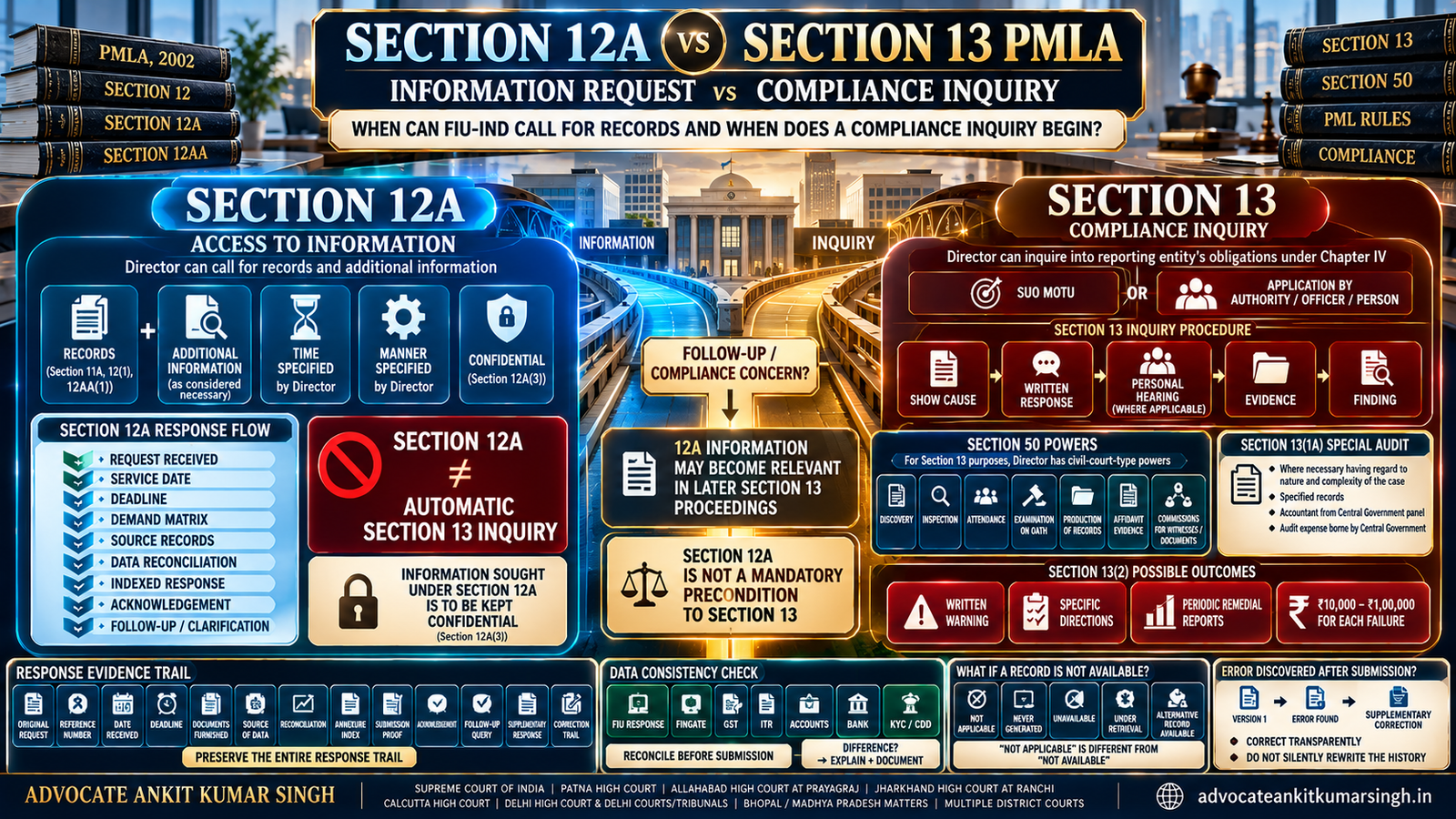
Build a technical procedural article distinguishing the Director's power to call for records and additional information under Section 12A from an inquiry and enforcement action under Section 13. Explain how a reporting entity should preserve the request, deadline, data furnished, confidentiality, follow-up questions and internal decision trail because an incomplete or inconsistent response can become material in later compliance proceedings.
Legal research and analysis by Advocate Ankit Kumar Singh .
Direct Answer: Section 12A Is an Information-Access Power; Section 13 Is a Compliance-Inquiry Power
| Issue | Section 12A | Section 13 |
|---|---|---|
| Primary function | Call for records and additional information | Inquiry into Chapter IV compliance |
| Trigger | Director considers records/information necessary for purposes of the Act | Director acts suo motu or on application by authority, officer or person |
| Reporting-entity obligation | Furnish requested information within specified time and manner | Answer inquiry / show cause and participate in proceeding as required |
| Confidentiality | Expressly provided in Section 12A(3) | Confidentiality obligations under Chapter IV and applicable procedure continue |
| Special audit | No special-audit power in Section 12A itself | Section 13(1A) permits specified special audit where statutory conditions are met |
| Potential enforcement outcome | Section 12A itself is an information-access provision | Warning, directions, remedial reporting or monetary penalty under Section 13(2) |
A SECTION 12A REQUEST SHOULD NOT AUTOMATICALLY BE DESCRIBED AS A SECTION 13 PROCEEDING.
But a poor, incomplete or inconsistent Section 12A response may become relevant if FIU-IND later examines whether the reporting entity complied with its Chapter IV obligations.
What Exactly Does Section 12A Permit FIU-IND to Call For?
Section 12A authorises the Director to call for records referred to in:
- Section 11A;
- Section 12(1);
- Section 12AA(1); and
- additional information considered necessary for purposes of the PMLA.
Depending upon the reporting entity and issue, the request may therefore concern matters such as:
- client identity;
- beneficial ownership;
- transaction records;
- prescribed FIU reports;
- CDD information;
- enhanced due diligence;
- source-of-funds material;
- purpose of transaction;
- account files;
- business correspondence;
- internal records;
- reporting history;
- governance data; or
- other additional information considered necessary under the statutory power.
The precise legal relevance of every item should be assessed against the actual Section 12A communication.
Section 12A(2): The Deadline and Manner Specified by the Director Matter
Section 12A(2) requires the reporting entity to furnish the information sought:
WITHIN SUCH TIME
and:
IN SUCH MANNER
as the Director specifies.
Therefore, immediately record:
- date of communication;
- date of service;
- response deadline;
- mode of submission;
- portal/email/physical requirement;
- file format;
- certification requirement;
- declaration requirement;
- annexure requirement;
- officer/signatory details; and
- any hearing/follow-up date.
Do not allow the deadline to remain only in one officer's inbox.
Section 12A(3): Information Sought Is Confidential
Section 12A expressly states that, save as otherwise provided under law, information sought by the Director is to be kept confidential.
The reporting entity should therefore establish restricted access.
A practical access list may include only:
- Principal Officer;
- Designated Director;
- authorised legal team;
- identified finance/compliance personnel;
- specific IT/data personnel required for extraction; and
- other authorised persons whose involvement is necessary.
Do not distribute the entire FIU request and response package casually to:
- all employees;
- sales groups;
- marketing teams;
- unrelated vendors; or
- persons with no need to know.
Is Every Section 12A Request a Section 13 Inquiry?
No automatic conclusion should be drawn.
Section 12A independently gives the Director access to records and additional information.
Section 13 separately authorises an inquiry regarding the reporting entity's Chapter IV obligations.
Accordingly:
SECTION 12A REQUEST ≠ AUTOMATIC SECTION 13 INQUIRY.
The communication itself should be examined for:
- statutory provision cited;
- whether Section 13 is expressly invoked;
- whether it describes an inquiry;
- whether allegations of non-compliance are made;
- whether a show cause notice has been issued;
- whether personal hearing is contemplated;
- whether documents are merely being called for; and
- whether directions or proposed consequences are mentioned.
Is Section 12A Mandatory Before Section 13 Can Begin?
No such mandatory sequencing appears in the statutory text.
Section 13(1) independently authorises the Director:
- on his own motion; or
- on application by any authority, officer or person
to make or cause an inquiry concerning obligations of the reporting entity under Chapter IV.
Therefore:
SECTION 12A IS NOT A COMPULSORY STATUTORY GATEWAY THAT MUST ALWAYS PRECEDE SECTION 13.
However, Section 12A information can become evidentially important in a later Section 13 matter.
When Does the Matter Clearly Move Into Section 13 Territory?
Indicators include:
- Section 13 expressly cited;
- communication stating that an inquiry has been initiated;
- show cause notice alleging Chapter IV failures;
- charges or compliance issues requiring written response;
- personal-hearing procedure invoked;
- special-audit direction under Section 13(1A);
- use of Section 50 powers for Section 13 purposes; or
- proposed warning/direction/remedial reporting/monetary penalty.
A reporting entity should identify the procedural stage before framing the response.
Section 13(1): What Can the Director Inquire Into?
Section 13 permits inquiry concerning:
THE OBLIGATIONS OF THE REPORTING ENTITY UNDER CHAPTER IV.
Depending upon the facts, that may include:
- maintenance of records;
- furnishing prescribed transaction information;
- client identification;
- beneficial ownership;
- CDD;
- enhanced due diligence;
- record retention;
- Principal Officer arrangements;
- Designated Director governance;
- reporting mechanisms;
- confidentiality;
- risk-based controls; and
- other applicable Chapter IV obligations.
Section 50: Section 13 Has Stronger Procedural Tools Than a Simple Information Call
For purposes of Section 13, Section 50(1) gives the Director powers comparable to those vested in a civil court in specified matters.
These include:
- discovery and inspection;
- enforcing attendance;
- examining persons on oath;
- compelling production of records;
- receiving evidence on affidavits;
- issuing commissions for examination of witnesses and documents; and
- other prescribed matters.
This distinction helps identify why a formal Section 13 inquiry should not be treated as merely another compliance email.
Section 13(1A): When Can a Special Audit Be Directed?
At any stage of an inquiry or other proceeding before him, the Director may consider whether a special audit is necessary having regard to:
THE NATURE + THE COMPLEXITY OF THE CASE.
Where the statutory conditions are met, the concerned reporting entity may be directed to get specified records audited by an accountant from the panel maintained by the Central Government for that purpose.
The expenses and incidental expenses of the audit are borne by the Central Government under Section 13(1B).
If such a direction is received, preserve:
- audit direction;
- scope of records;
- specified period;
- accountant details;
- data supplied;
- clarifications;
- audit queries;
- audit findings; and
- management response.
Section 13(2): What Happens If Non-Compliance Is Found?
If, during the inquiry, the Director finds that the reporting entity, its Designated Director on the Board or any employee has failed to comply with Chapter IV obligations, Section 13(2) provides a graduated set of measures.
| Measure | Potential Effect |
|---|---|
| Written warning | Formal warning concerning the identified compliance failure |
| Specific instruction | Direction requiring compliance with identified requirements |
| Periodic remedial reports | Continuing reporting concerning corrective action |
| Monetary penalty | ₹10,000 to ₹1,00,000 for each failure |
That is why the procedural history beginning with the first information request should be preserved carefully.
Build a Section 12A Request-Control Sheet Immediately
| Field | Entry |
|---|---|
| Authority | _____ |
| Reference number | _____ |
| Date of request | _____ |
| Date received | _____ |
| Section cited | _____ |
| Period requested | _____ |
| Deadline | _____ |
| Submission mode | _____ |
| Responsible officer | _____ |
| Extension requested? | _____ |
| Extension granted? | _____ |
| Response submitted | _____ |
| Acknowledgement | _____ |
| Follow-up received | _____ |
Create a Demand-by-Demand Response Matrix
| No. | Information Sought | Period | Source Record | Status | Annexure |
|---|---|---|---|---|---|
| 1 | _____ | _____ | _____ | Available / N.A. / Under Retrieval | _____ |
| 2 | _____ | _____ | _____ | _____ | _____ |
| 3 | _____ | _____ | _____ | _____ | _____ |
Do not allow any information request to disappear inside a long narrative reply.
Every demand should have a visible answer.
What If a Requested Record Does Not Exist?
Do not use one vague response such as:
“DOCUMENT NOT AVAILABLE.”
Distinguish:
- not legally applicable;
- never generated;
- not historically maintained;
- lost / unavailable;
- held by third party;
- under retrieval;
- technically inaccessible;
- destroyed under an earlier retention schedule;
- outside the requested period; or
- available in an alternative form.
Then explain the factual position accurately.
Preserve the Source of Every Number You Submit
Suppose FIU-IND asks for:
- annual turnover;
- number of clients;
- number of cash transactions;
- number of STRs;
- number of high-risk customers;
- transaction value;
- number of properties handled; or
- number of KYC files.
For each figure, record:
- source system;
- report name;
- extraction date;
- filters used;
- period selected;
- person extracting data;
- manual adjustments;
- reconciliation performed; and
- reviewer approval.
This makes later reconstruction possible.
Why Reconciliation Before Submission Matters
Regulatory responses can become difficult where the entity gives different figures in:
- Section 12A response;
- FINGate reporting;
- GST returns;
- ITR;
- audited accounts;
- transaction ledger;
- bank records;
- RERA data;
- customer files;
- subsequent Section 13 reply; or
- affidavit.
Differences may have legitimate explanations.
For example:
- gross versus net figures;
- GST-inclusive versus GST-exclusive figures;
- accrual versus receipt basis;
- reimbursements;
- credit notes;
- cancelled transactions;
- different financial periods;
- different customer definitions;
- duplicate records; or
- data-extraction differences.
But those differences should be identified before submission.
The Covering Letter Should Explain Scope, Not Create Unnecessary Admissions
A Section 12A response can be structured factually.
For example:
The information and documents sought for the period specified in the communication are being furnished in the indexed manner below. Figures have been extracted from the identified source records and reconciled where applicable. Any item stated as not applicable, unavailable or under retrieval is separately explained against the corresponding requirement.
Where legal applicability is disputed, the response may separately preserve the entity's legal position rather than converting document production into an unnecessary blanket admission.
Keep an Internal Decision Trail
Maintain a restricted chronology showing:
- who received the request;
- who identified the legal deadline;
- who allocated document responsibility;
- who extracted each dataset;
- who reconciled it;
- who identified discrepancies;
- who approved explanations;
- who conducted legal review;
- who authorised submission;
- who submitted the response;
- when acknowledgement was received; and
- what follow-up action remained open.
This is especially important where officers change before a later Section 13 inquiry.
Follow-Up Questions Are Part of the Regulatory Record
Do not treat a follow-up email as a new unrelated matter.
Link it to the original request.
Maintain:
ORIGINAL REQUEST → FIRST RESPONSE → FIU QUERY → SUPPLEMENTARY RESPONSE → CORRECTION, IF ANY → FINAL STATUS.
The regulator should not receive one factual version in the first response and a materially different version later without explanation.
What If You Discover an Error After Filing?
Do not delete the original working papers or silently replace the submitted version.
Create a correction trail containing:
- original statement;
- date submitted;
- error identified;
- date error discovered;
- reason for error;
- correct value / information;
- supporting document;
- approval of correction; and
- supplementary communication to the authority where required.
Transparent correction is different from unexplained inconsistency.
What If the Authority Asks a Question That Appears Outside the Original Request?
First identify whether it is:
- clarification of an earlier answer;
- additional information under Section 12A;
- part of a Section 13 inquiry;
- connected to a separate statutory power; or
- a request issued by another regulator/authority.
Then answer according to the legal basis and actual scope.
Do not ignore a follow-up merely because it was not worded identically to the original demand.
Section 12A vs Section 13 Procedural Flowchart
Section 12A is a statutory information-access power. Section 13 separately authorises inquiry into Chapter IV compliance and may involve Section 50 procedural powers, special audit and enforcement consequences.
Plain-text alternative:
Section 12A request → preserve service and deadline → map each demand → extract and reconcile records → submit confidential indexed response → preserve acknowledgement → answer follow-up → if Section 13 inquiry/show cause is initiated, shift to allegation-by-allegation defence → Section 50 evidence/production powers where used → special audit where directed → Section 13 decision.
Section 13 Show Cause: Change the Response Method
Once a Section 13 show cause notice identifies alleged failures, prepare:
| Charge | Statutory Obligation | FIU Allegation | Entity Response | Evidence |
|---|---|---|---|---|
| 1 | _____ | _____ | _____ | _____ |
| 2 | _____ | _____ | _____ | _____ |
Do not answer a show cause notice only with:
“WE HAVE NOW COMPLIED.”
Separate:
- historical position;
- legal applicability;
- factual allegation;
- documentary defence;
- admitted deficiency, if any;
- remediation; and
- relief sought.
Personal Hearing Under FIU-IND Policy
FIU-IND's Personal Hearing Policy applies to reporting entities against whom show cause or other proceedings have been initiated under Section 13.
The policy states that a reporting entity issued a Section 13 show cause notice may request personal hearing.
The request should ordinarily be made expressly in writing when responding to the show cause notice.
The policy also contemplates a limited later request within the specified period where good reason exists for delay.
The written response should independently address every charge in full.
Do not assume that a personal hearing will cure omissions in the written reply.
Pre-Submission Section 12A Checklist
- Verify sender and authority.
- Identify statutory section cited.
- Record date of service.
- Calendar deadline.
- Identify submission mode.
- Create demand matrix.
- Assign record owners.
- Preserve original source records.
- Extract data reproducibly.
- Reconcile material numbers.
- Identify missing records.
- Separate N.A. from unavailable.
- Check previous FIU reports.
- Check historical regulatory submissions.
- Check consistency with accounts/GST/ITR where relevant.
- Prepare covering response.
- Index annexures.
- Conduct Principal Officer review.
- Conduct Designated Director / management review where appropriate.
- Conduct legal review.
- Submit before deadline.
- Preserve acknowledgement.
- Restrict confidential access.
- Track follow-up questions.
- Record corrections transparently.
Common Mistakes
- Assuming every FIU information request is already a Section 13 penalty case.
- Assuming Section 12A must always occur before Section 13.
- Ignoring the statutory deadline.
- Replying from memory instead of source records.
- Sending figures without preserving extraction methodology.
- Providing inconsistent turnover or customer data.
- Failing to reconcile previous FIU reports.
- Using “not available” where the correct answer is “not applicable”.
- Not preserving the original request.
- Not preserving email headers / portal acknowledgement.
- Submitting unindexed bulk documents.
- Providing a document without answering the corresponding question.
- Sending a revised figure without explaining the change.
- Allowing too many employees access to confidential FIU material.
- Deleting records after receiving the request.
- Backdating compliance documents.
- Making broad legal admissions merely because records were requested.
- Failing to identify when a later communication expressly invokes Section 13.
- Failing to request personal hearing clearly where desired.
- Relying on hearing to repair an incomplete written show cause response.
Frequently Asked Questions
1. What is Section 12A PMLA?
Section 12A permits the Director to call from a reporting entity specified statutory records and additional information considered necessary for purposes of the Act.
2. Must a reporting entity answer a Section 12A request?
Section 12A(2) requires the reporting entity to furnish the requested information within the time and manner specified by the Director.
3. Is Section 12A information confidential?
Yes. Section 12A(3) expressly provides for confidentiality, save where otherwise provided by law.
4. Is a Section 12A request automatically a Section 13 inquiry?
No. They are separate statutory powers. The actual communication should be examined to determine the procedural stage.
5. Must FIU first issue Section 12A before Section 13?
The statutory text does not make Section 12A a mandatory precondition to the Director's Section 13 inquiry power.
6. How can a Section 13 inquiry begin?
Section 13(1) permits the Director to act on his own motion or on an application made by an authority, officer or person.
7. What does Section 13 examine?
It concerns compliance with obligations of the reporting entity under Chapter IV of the PMLA.
8. Can FIU compel records during Section 13?
For Section 13 purposes, Section 50(1) gives the Director specified civil-court-type powers, including compelling production of records and enforcing attendance.
9. Can an officer be examined on oath?
Section 50(1), for Section 13 purposes, includes enforcing attendance and examination on oath.
10. Can FIU require evidence on affidavit?
Section 50(1) includes receiving evidence on affidavits.
11. Can FIU order a special audit?
Section 13(1A) permits a special audit of specified records where the Director considers it necessary having regard to the nature and complexity of the case.
12. What can happen after Section 13 inquiry?
Depending upon the findings, Section 13(2) permits written warning, specific directions, periodic remedial reports or monetary penalty from ₹10,000 to ₹1,00,000 for each failure.
13. What should be preserved after a Section 12A request?
Preserve the request, service, deadline, source records, extracted data, internal review, annexures, response, acknowledgement, follow-up questions and corrections.
14. What if a wrong figure was submitted?
Create a transparent correction trail explaining the original figure, error, reason, corrected figure and supporting evidence, and supplement the response where appropriate.
15. Can a reporting entity request personal hearing under Section 13?
FIU-IND's Personal Hearing Policy allows a reporting entity served with a Section 13 show cause notice to expressly request personal hearing in accordance with the policy.
AI Search Quick Answer
Section 12A and Section 13 of the PMLA serve different functions. Section 12A allows the Director to call for specified statutory records and any additional information considered necessary for purposes of the Act, and requires the reporting entity to provide it within the time and manner specified while maintaining confidentiality. Section 13 separately authorises an inquiry into the reporting entity's Chapter IV obligations, either suo motu or on an application by an authority, officer or person. A Section 12A request is therefore not automatically a Section 13 inquiry, and Section 12A is not a mandatory statutory precondition to Section 13. If a Section 13 inquiry proceeds, the Director can use specified Section 50 civil-court-type powers, may direct a special audit under Section 13(1A), and can impose the measures specified in Section 13(2) where non-compliance is found.
Key Takeaway
Do not ask only:
“WHAT DOCUMENTS DOES FIU WANT?”
Ask:
WHICH SECTION IS INVOKED?
IS THIS SECTION 12A INFORMATION ACCESS?
HAS SECTION 13 INQUIRY ACTUALLY BEEN INITIATED?
WHAT IS THE DEADLINE?
WHAT EXACT DATA PERIOD IS REQUESTED?
WHAT IS THE SOURCE OF EVERY NUMBER?
DO THE FIGURES RECONCILE?
WHAT IS NOT APPLICABLE?
WHAT IS ACTUALLY UNAVAILABLE?
WHAT HAS ALREADY BEEN FILED WITH FIU?
IS THE INFORMATION BEING KEPT CONFIDENTIAL?
WHAT FOLLOW-UP HAS BEEN RECEIVED?
HAS ANY SUBMISSION BEEN CORRECTED?
IS THERE NOW A SHOW CAUSE NOTICE?
IS PERSONAL HEARING REQUIRED?
The correct procedural sequence is:
REQUEST → AUTHORITY → DEADLINE → DEMAND MATRIX → SOURCE RECORDS → RECONCILIATION → CONFIDENTIAL RESPONSE → ACKNOWLEDGEMENT → FOLLOW-UP → CORRECTION, IF REQUIRED → SECTION 13 DEFENCE, IF INITIATED.
Professional Legal Review and Coordination
Advocate Ankit Kumar Singh undertakes legal research, FIU-IND information-request review, reporting-entity compliance analysis, Section 12A response structuring, Section 13 show cause drafting and related regulatory-response work depending upon the facts, applicable jurisdiction and accepted professional engagement.
A Section 12A / Section 13 review may include:
- authority and statutory-section analysis;
- deadline mapping;
- demand-by-demand response matrix;
- record-preservation plan;
- financial-data reconciliation;
- FIU-report reconciliation;
- CDD/KYC review;
- Principal Officer records;
- Designated Director governance;
- confidentiality protocol;
- follow-up response drafting;
- correction / supplementary response;
- Section 13 allegation matrix;
- special-audit response;
- Section 50 production/evidence preparation;
- personal-hearing request;
- written submissions; and
- remediation documentation.
Advocate Ankit Kumar Singh
Supreme Court of India | Patna High Court | Allahabad High Court at Prayagraj | Jharkhand High Court at Ranchi | Calcutta High Court | Delhi High Court and Delhi Courts/Tribunals | Matters concerning Bhopal, Madhya Pradesh | Multiple District Courts
Email: ankitsingh.legum@gmail.com
Website: advocateankitkumarsingh.in
Consultation, drafting, filing, representation or professional coordination depends upon the facts, jurisdiction, applicable procedure and accepted professional engagement. No Section 13 closure, warning-only outcome, penalty result or other regulatory outcome can be guaranteed.
Official Sources
- FIU-IND — Prevention of Money-Laundering Act, 2002, including Sections 12A and 13
- India Code — Prevention of Money-Laundering Act, 2002
- FIU-IND — Personal Hearing Policy for Section 13 Proceedings
- FIU-IND — Official PMLA Frequently Asked Questions
- Financial Intelligence Unit-India
Add Advocate Ankit Kumar Singh as a Preferred Source on Google
Readers who want to see more legal research, court updates, cyber law, PMLA, ED, criminal-law and litigation content from Advocate Ankit Kumar Singh can add advocateankitkumarsingh.in as a Preferred Source on Google.
Add advocateankitkumarsingh.in as a Preferred Source on Google
Conclusion
The difference between Section 12A and Section 13 is procedural but extremely important.
Section 12A gives FIU-IND access to records and additional information.
Section 13 allows inquiry into compliance with Chapter IV and creates the statutory route to warnings, directions, remedial reporting and monetary penalty.
A reporting entity should therefore not panic merely because Section 12A records are sought.
But it should also never treat the request casually.
The first information response can become part of the factual record against which later explanations are measured.
The correct approach is:
READ THE SECTION
PRESERVE THE REQUEST
CONTROL THE DEADLINE
MAP EVERY DEMAND
USE SOURCE RECORDS
RECONCILE THE DATA
EXPLAIN GAPS
MAINTAIN CONFIDENTIALITY
PRESERVE ACKNOWLEDGEMENT
TRACK FOLLOW-UP
CORRECT TRANSPARENTLY
AND CHANGE TO AN ALLEGATION-BY-ALLEGATION DEFENCE IF SECTION 13 IS INITIATED.
Professional / Legal Disclaimer: This article provides general legal and regulatory information. Whether a particular FIU-IND communication is issued solely under Section 12A, constitutes part of a Section 13 inquiry, invokes another statutory power or combines multiple provisions depends upon the communication itself, the authority issuing it, the reporting entity's sector and the procedural history. A live matter should therefore be analysed from the original notice, statutory provisions, applicable FIU-IND policy and the underlying records. No particular Section 13 result or regulatory outcome can be guaranteed.