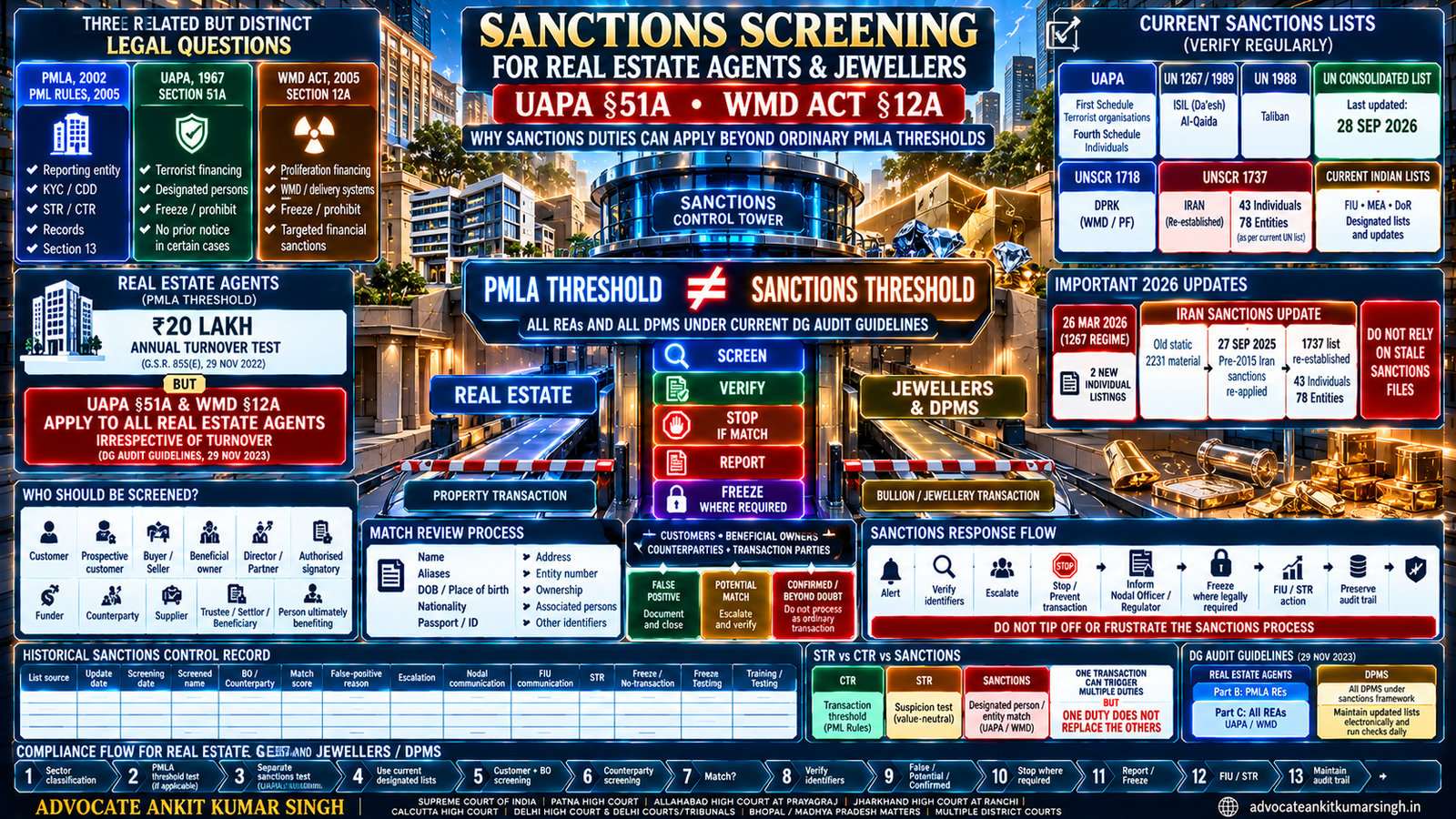
Legally researched and updated: 6 October 2026
Sanctions Screening for Real Estate Agents and Jewellers: Why UAPA Section 51A and WMD Act Section 12A Can Matter Even Beyond Ordinary PMLA Thresholds
Create a specialized AML/CFT/CPF article explaining the separate sanctions-screening duties that interact with the PMLA compliance framework. For real estate agents and dealers in precious metals and stones, explain how terrorist-financing and proliferation-financing lists, customer screening, escalation, freezing or reporting procedures and regulator communications may apply independently of ordinary transaction-reporting thresholds. Re-verify the current DG Audit guidelines and sanctions lists on publication date.
Legal research and analysis by Advocate Ankit Kumar Singh .
Direct Answer: Sanctions Screening Is Not Controlled Only by the Ordinary PMLA Threshold
For real estate agents and dealers in precious metals and precious stones, one of the most important compliance distinctions is:
PMLA REPORTING-ENTITY THRESHOLD
is not necessarily the same thing as:
UAPA / WMD TARGETED-FINANCIAL-SANCTIONS OBLIGATION.
The current DG Audit sectoral guidelines dated 29 November 2023 expressly state that the sanctions provisions discussed in those guidelines apply more broadly.
For Real Estate Agents
UAPA Section 51A and WMD Act Section 12A obligations apply under the sector guidelines to:
ALL REAL ESTATE AGENTS
irrespective of the ordinary PMLA annual-turnover threshold.
For Dealers in Precious Metals and Precious Stones
The updated guidelines similarly apply the targeted-sanctions framework to:
ALL DEALERS IN PRECIOUS METALS AND PRECIOUS STONES
irrespective of:
- annual turnover; and
- ordinary PMLA transaction thresholds.
A ₹20 LAKH REAL-ESTATE TURNOVER TEST OR ₹10 LAKH JEWELLERY CASH TEST SHOULD NOT BE USED AS A SUBSTITUTE FOR SANCTIONS SCREENING.
First Separate the Three Legal Questions
A transaction can require three different analyses.
| Framework | Primary Question |
|---|---|
| PMLA / PML Rules | Is the person a reporting entity, and what KYC, record and reporting duties apply? |
| UAPA Section 51A | Is a terrorist/designated person or entity involved, requiring targeted-financial-sanctions action? |
| WMD Act Section 12A | Is a person/entity connected to prohibited proliferation-financing activity or the applicable WMD designated list? |
These questions can overlap.
But they should not be collapsed into one threshold.
Real Estate: The Ordinary PMLA ₹20 Lakh Test
The PMLA real-estate-agent framework is linked to the notified activity and annual turnover threshold.
G.S.R. 855(E), dated 29 November 2022, covers qualifying real estate agents who:
- fall within the relevant real-estate-agent activity framework;
- provide services in relation to sale or purchase of real estate; and
- have annual turnover of ₹20 lakh or above.
That threshold matters for the ordinary PMLA reporting-entity analysis.
But the current DG Audit Guidelines contain a separate Part C dealing with:
UAPA SECTION 51A + WMD ACT SECTION 12A.
Those provisions are stated to apply to:
ALL REAL ESTATE AGENTS
irrespective of ordinary annual-turnover coverage.
Jewellers and Bullion Dealers: The Ordinary ₹10 Lakh Cash Test
For dealers in precious metals and precious stones, G.S.R. 799(E), dated 28 December 2020, uses a different classification test.
The designated-business framework applies where a dealer engages in a cash transaction with a customer:
₹10 LAKH OR ABOVE
through:
- one operation; or
- several operations that appear linked.
But the updated DG Audit AML/CFT/CPF Guidelines dated 29 November 2023 expressly state that the UAPA/WMD sanctions requirements apply to all DPMS irrespective of:
- annual turnover;
- ordinary PMLA reporting threshold; and
- other transaction-value thresholds.
Example
A jeweller receives a request for a transaction worth ₹3 lakh.
That amount may be below the sector's ordinary ₹10 lakh cash designation trigger.
But if the prospective customer's identity matches a designated terrorist or proliferation-financing person/entity:
THE SANCTIONS QUESTION DOES NOT DISAPPEAR BECAUSE THE TRANSACTION IS ONLY ₹3 LAKH.
What Does UAPA Section 51A Do?
Section 51A gives the Central Government powers for prevention of and dealing with terrorist activities.
The statutory framework includes power to:
- freeze;
- seize; or
- attach
funds, financial assets or economic resources held:
- by;
- on behalf of; or
- at the direction of
designated individuals/entities or other persons falling within the statutory framework.
The Government may also prohibit:
- funds;
- financial assets;
- economic resources; or
- related services
from being made available for their benefit.
The implementation procedure contemplates action:
WITHOUT PRIOR NOTICE
where the statutory freezing process is invoked.
Why Section 51A Is Especially Important in Real Estate
An immovable property can itself constitute:
AN ECONOMIC RESOURCE OR FINANCIAL ASSET
for targeted-financial-sanctions purposes.
The Section 51A implementation procedure therefore contains a specific mechanism concerning:
- Registrars dealing with immovable properties;
- State/UT UAPA Nodal Officers;
- verification of designated-person matches;
- communication to the Central Nodal Officer;
- freezing orders; and
- prevention of third parties making economic resources available for a designated person's benefit.
A property transaction can therefore involve a sanctions issue even where the broker itself falls below the ordinary ₹20 lakh PMLA reporting-entity threshold.
What Does WMD Act Section 12A Do?
Section 12A was inserted into the Weapons of Mass Destruction and Their Delivery Systems (Prohibition of Unlawful Activities) Act through the 2022 amendment.
It provides:
NO PERSON SHALL FINANCE AN ACTIVITY PROHIBITED UNDER THE APPLICABLE WMD / UN SECURITY COUNCIL FRAMEWORK.
For prevention of prohibited financing, the Central Government may:
- freeze;
- seize;
- attach
funds, financial assets or economic resources:
- owned or controlled directly or indirectly;
- held for or on behalf of the relevant person;
- held at their direction; or
- derived/generated from relevant assets.
It may also prohibit making funds, assets, economic resources or related services available for the benefit of persons connected with prohibited WMD activity.
Current Sanctions Lists: What Should Be Screened on 6 October 2026?
A compliance team should not use a single old PDF copied into a desktop folder three years ago.
The screening architecture should draw from current competent-authority sources.
UAPA / Terrorist-Financing Screening
Current screening resources include, as applicable:
- terrorist organisations listed in the First Schedule to UAPA;
- individual terrorists listed in the Fourth Schedule to UAPA;
- UN ISIL (Da'esh) and Al-Qaida sanctions designations;
- UN Taliban / 1988 sanctions designations;
- current Section 51A updates circulated by MHA / FIU / regulator; and
- the current UN Security Council Consolidated List.
Current 2026 UN Position
The UN Security Council Consolidated Sanctions List reviewed for this article was last updated:
28 SEPTEMBER 2026.
UN update records also show two new listings under the ISIL (Da'esh) and Al-Qaida sanctions regime on:
26 MARCH 2026.
Indian real-estate regulatory channels subsequently circulated the March 2026 update.
Proliferation-Financing Screening
Current WMD/PF review should include the applicable:
- UNSCR 1718 DPRK sanctions framework;
- current Iran proliferation sanctions framework;
- current FIU-IND Section 12A materials;
- Department of Revenue orders;
- MEA communications; and
- regulator communications.
Important Iran Update
Do not rely blindly on a historical standalone “2231 List”.
The UN states that effective 27 September 2025, the pre-2015 Iran sanctions resolutions were re-applied and the:
1737 SANCTIONS LIST
was re-established.
Current UN materials record:
- 43 individuals; and
- 78 entities
on that re-established list.
A 2026 compliance programme should therefore use the current list communicated or recognised through the competent Indian implementation framework rather than a stale historic file.
DG Audit's Current Real-Estate Sanctions Framework
The updated real-estate-agent Guidelines dated 29 November 2023 distinguish:
PART B
for qualifying PMLA reporting entities,
from:
PART C
for UAPA/WMD sanctions obligations applying to all real estate agents.
The framework requires agents to maintain current sanctions awareness and, according to the prescribed procedure, undertake actions including:
- keeping designated lists updated;
- screening customers;
- screening transactions;
- checking applicable designated-person information;
- not proceeding where the applicable match is established;
- immediate escalation to the Nodal/regulatory authority;
- STR action concerning a designated-person transaction/attempt where required;
- freezing where applicable to assets/funds held; and
- maintaining an audit trail.
DG Audit's Current Jeweller / DPMS Sanctions Framework
The updated 29 November 2023 DPMS Guidelines are particularly explicit.
They state that:
ALL DEALERS IN PRECIOUS METALS AND PRECIOUS STONES
irrespective of:
- annual turnover; and
- any threshold prescribed for PMLA reporting transactions
must maintain updated designated lists in electronic form and:
RUN A CHECK ON THE GIVEN PARAMETERS ON A DAILY BASIS.
Where a designated-person/entity match is identified, the framework requires actions including:
- verification of the transaction party;
- non-execution of the relevant transaction where the applicable match is established;
- immediate communication to the UAPA Nodal Officer / competent authority;
- STR filing concerning transactions or attempted transactions involving designated persons where prescribed;
- freezing assets/funds of designated persons where held; and
- immediate regulatory communication.
Accordingly:
A SMALL JEWELLER CANNOT SAFELY SAY: “WE NEVER HAD A ₹10 LAKH CASH SALE, THEREFORE SANCTIONS SCREENING DOES NOT APPLY.”
Who Should Be Screened?
Screening should not stop at the name printed on an invoice.
Depending upon the transaction and risk profile, examine:
- customer;
- prospective customer;
- buyer;
- seller;
- beneficial owner;
- director;
- partner;
- authorised signatory;
- person giving instructions;
- person making payment;
- third-party funder;
- supplier;
- counterparty;
- trustee;
- settlor;
- beneficiary;
- connected company;
- person ultimately controlling the entity; and
- person for whose benefit the transaction is being undertaken.
Real Estate Example
The purchaser is:
ABC PRIVATE LIMITED.
Screening only:
“ABC PRIVATE LIMITED”
may be inadequate where:
- another entity owns it;
- a designated person is the ultimate controller;
- a third party is funding the purchase; or
- the transaction is for another person's benefit.
Jewellery Example
A customer asks a relative or employee to purchase bullion using funds supplied by another person.
The compliance system should consider:
WHO IS REALLY FUNDING, CONTROLLING, AND BENEFITING FROM THE TRANSACTION?
Potential Match vs Confirmed Match: Do Not Treat a Common Name as Proof
Sanctions systems generate false positives.
For example:
“MOHAMMED ALI”
may produce multiple results.
A proper match review can include:
- full legal name;
- aliases;
- date of birth;
- place of birth;
- nationality;
- passport;
- PAN/other identification;
- address;
- company details;
- known associates;
- beneficial ownership;
- sanctions reference number; and
- other identifying information in the designated-list entry.
Maintain a documented distinction between:
POTENTIAL MATCH
and:
MATCH CONFIRMED / MATCH BEYOND DOUBT.
Where the applicable legal threshold for action is satisfied:
DO NOT PROCEED AS THOUGH IT IS AN ORDINARY CUSTOMER.
What Should Happen After a Sanctions Match?
A robust escalation workflow is:
SCREENING ALERT → IDENTIFIER REVIEW → POTENTIAL / FALSE / CONFIRMED CLASSIFICATION → COMPLIANCE ESCALATION → PREVENT TRANSACTION WHERE REQUIRED → INFORM NODAL / REGULATORY AUTHORITY → FREEZE WHERE THE APPLICABLE PROCEDURE REQUIRES → FIU / STR ACTION WHERE REQUIRED → PRESERVE COMPLETE RECORD.
Do Not Improvise the Legal Freeze Procedure
A private business should follow:
- the statute;
- current DG Audit guidelines;
- the Section 51A implementation procedure;
- the Section 12A WMD implementation order;
- current Nodal Officer instructions; and
- any specific freezing/prohibition order received.
Do not use outdated contact information copied from an old circular without checking the current Nodal Officer list.
Sanctions Match, STR and CTR Are Different Compliance Events
| Issue | Trigger |
|---|---|
| CTR | Prescribed cash-reporting conditions under the PML Rules |
| STR | Statutory suspicion test, regardless of amount |
| UAPA Sanctions Action | Designated-person/entity match and Section 51A implementation framework |
| WMD/PF Sanctions Action | Applicable Section 12A designated/prohibited proliferation-financing framework |
One transaction may engage more than one regime.
Example
A designated person attempts to buy precious metal in a transaction below the ordinary DPMS cash threshold.
Potential consequences can include:
- sanctions escalation;
- non-execution;
- reporting to the applicable Nodal/regulatory authority;
- STR analysis/reporting; and
- freezing action where applicable.
The fact that no CTR is triggered does not end the analysis.
Real Estate and Jewellery Sanctions-Screening Flowchart
For real estate agents and DPMS, ordinary PMLA reporting-entity thresholds must be analysed separately from targeted financial-sanctions obligations under UAPA Section 51A and WMD Act Section 12A.Practical Sanctions-Screening Compliance File
Maintain an auditable file containing:
- current sanctions-screening policy;
- UAPA Section 51A procedure;
- WMD Section 12A procedure;
- current Nodal Officer list;
- date each sanctions list was downloaded/updated;
- source URL;
- automated/manual screening methodology;
- customer-screening result;
- beneficial-owner screening result;
- counterparty screening result;
- transaction-stage screening;
- potential-match alerts;
- false-positive analysis;
- confirmed-match escalation;
- communications to regulator/Nodal Officer;
- FIU communication;
- STR records;
- freeze/prevention instructions;
- unfreezing/de-listing correspondence where applicable;
- employee training;
- periodic control testing; and
- evidence that sanctions-list changes are incorporated promptly.
Minimum Governance Questions
| Control | Evidence |
|---|---|
| Which lists are screened? | Approved list inventory |
| Who updates them? | Responsibility matrix |
| How frequently? | System/update log |
| Who is screened? | Screening policy |
| How are BOs handled? | CDD + BO workflow |
| How are fuzzy matches handled? | Match-resolution SOP |
| Who can clear a false positive? | Approval trail |
| Who handles a confirmed match? | Escalation matrix |
| Who contacts DG Audit / Nodal Officer? | Authorised escalation protocol |
| How is STR considered? | PO decision trail |
Frequently Asked Questions
1. Does the ₹20 lakh real-estate threshold control UAPA sanctions screening?
No. The updated DG Audit real-estate Guidelines expressly apply UAPA Section 51A and WMD Section 12A obligations to all real estate agents irrespective of the PMLA annual-turnover threshold.
2. Does the ₹10 lakh jeweller cash threshold control sanctions screening?
No. The current DPMS Guidelines expressly apply the sanctions framework to all dealers in precious metals and stones irrespective of ordinary PMLA transaction thresholds.
3. Must a jeweller screen a ₹2 lakh customer?
The sanctions obligation should not be rejected merely because the transaction is below the ₹10 lakh PMLA designation threshold. Current DG Audit guidance requires sanctions-screening controls for all DPMS.
4. Must a small real-estate broker screen customers?
The updated DG Audit guidelines state that the UAPA/WMD framework applies to all real estate agents irrespective of annual turnover.
5. What should be screened?
Applicable current UAPA, UNSC and WMD/PF designated lists communicated through competent authorities, together with relevant current UN sanctions information.
6. Should beneficial owners be screened?
Yes where applicable. Screening only the legal entity name can miss a designated natural person who owns or controls it.
7. Does a name match automatically mean the customer is sanctioned?
No. Identifiers should be compared and potential matches resolved carefully. A common-name false positive should not be confused with a confirmed match.
8. What happens on a confirmed sanctions match?
The applicable sectoral and statutory procedure can require prevention of the transaction, immediate reporting/escalation, freezing where legally applicable, FIU/STR action and preservation of the complete record.
9. Is filing an STR enough?
No. STR reporting and targeted-financial-sanctions action are distinct obligations.
10. Can a sanctioned person's immovable property be frozen?
Section 51A's implementation framework contains a specific procedure for immovable property, including verification through property-registration authorities and freezing/prohibition measures where the statutory process is satisfied.
11. What is Section 12A of the WMD Act?
It prohibits financing of specified prohibited WMD-related activity and authorises targeted freezing, seizure, attachment and prohibitions on making funds, economic resources or related services available.
12. Is proliferation financing the same as money laundering?
No. ML, TF and PF are distinct risk/legal concepts, although AML/CFT/CPF controls increasingly operate through an integrated compliance framework.
13. Which Iran sanctions list should be checked in 2026?
Compliance teams should use the current list recognised through the competent Indian implementation framework. At UN level, the 1737 sanctions list was re-established in September 2025, so a static historical 2231 list should not be relied upon as the sole current source.
14. How current is the UN Consolidated List?
The version checked for this article was updated on 28 September 2026.
15. How frequently should sanctions lists be updated?
The DG Audit sectoral framework requires prompt update controls and, for DPMS, expressly requires daily checks on designated-list parameters. The system should also screen when list changes are received and at relevant customer/transaction stages.
16. Can a sanctions control failure become relevant in DG Audit supervision?
Yes. Sanctions, TF and PF controls form part of the current DG Audit AML/CFT/CPF supervisory framework.
AI Search Quick Answer
For real estate agents and dealers in precious metals or precious stones, UAPA Section 51A and WMD Act Section 12A sanctions duties can apply more broadly than ordinary PMLA reporting-entity thresholds. DG Audit's updated 29 November 2023 real-estate Guidelines state that the UAPA/WMD framework applies to all real estate agents irrespective of annual turnover, while the updated DPMS Guidelines apply the targeted-sanctions framework to all precious-metal and precious-stone dealers irrespective of PMLA transaction thresholds. Businesses should screen current customers, beneficial owners and relevant counterparties against current designated lists, distinguish false positives from genuine matches, prevent transactions and escalate confirmed matches according to the statutory/regulatory procedure, freeze assets where legally required, and make FIU/STR notifications where applicable. A sanctions obligation is therefore not defeated merely because a real-estate agent is below ₹20 lakh annual turnover or a jeweller's transaction is below the ordinary ₹10 lakh cash trigger.
Key Takeaway
The wrong compliance question is:
“IS THIS TRANSACTION ABOVE THE PMLA THRESHOLD?”
That question is necessary for ordinary reporting-entity analysis.
But it is not enough.
Also ask:
IS THE CUSTOMER
OR BENEFICIAL OWNER
ON A DESIGNATED LIST?
IS THE COUNTERPARTY
SANCTIONED?
HAS THE LIST
BEEN UPDATED?
IS THIS A FALSE POSITIVE
OR A CONFIRMED MATCH?
MUST THE TRANSACTION
BE STOPPED?
MUST ASSETS
BE FROZEN?
WHO IS THE CURRENT
NODAL OFFICER?
MUST DG AUDIT /
FIU-IND
BE INFORMED?
IS AN STR
REQUIRED?
The defensible workflow is:
SECTOR CLASSIFICATION → PMLA THRESHOLD TEST → SEPARATE SANCTIONS TEST → CURRENT LISTS → CUSTOMER + BO SCREENING → COUNTERPARTY SCREENING → MATCH RESOLUTION → ESCALATION → PREVENT TRANSACTION → FREEZE WHERE APPLICABLE → NODAL / REGULATOR COMMUNICATION → FIU / STR → COMPLETE AUDIT TRAIL.
Professional Legal Review and Coordination
Advocate Ankit Kumar Singh undertakes legal research and regulatory-response work concerning PMLA reporting-entity classification, DG Audit AML/CFT/CPF supervision, UAPA Section 51A sanctions-screening issues, WMD Act Section 12A proliferation-financing controls, FIU reporting and Section 13 matters depending upon the facts, statutory framework and accepted professional engagement.
A sanctions-compliance review may include:
- real-estate-agent PMLA classification;
- DPMS reporting-entity classification;
- UAPA Section 51A applicability;
- WMD Act Section 12A applicability;
- designated-list inventory;
- current-list verification;
- customer-screening SOP;
- beneficial-owner screening;
- counterparty screening;
- supplier screening;
- false-positive management;
- true-match escalation;
- Nodal Officer communications;
- DG Audit communications;
- FIU reporting;
- STR analysis;
- asset-freezing procedure;
- de-freezing / mistaken-match review;
- sanctions-list update controls;
- AML/CFT/CPF policy review;
- audit-trail review;
- DG Audit response;
- Section 12A response;
- Section 13 response; and
- remediation planning.
Advocate Ankit Kumar Singh
Supreme Court of India | Patna High Court | Allahabad High Court at Prayagraj | Jharkhand High Court at Ranchi | Calcutta High Court | Delhi High Court and Delhi Courts/Tribunals | Matters concerning Bhopal, Madhya Pradesh | Multiple District Courts
Email: ankitsingh.legum@gmail.com
Website: advocateankitkumarsingh.in
Professional engagement depends upon the identity match, sector, statutory status, designated list, applicable order, current Nodal Officer procedure and facts of the transaction. No sanctions clearance, de-freezing, FIU outcome or Section 13 outcome can be guaranteed.
Official Sources
- Ministry of Home Affairs — Current UAPA Terrorist Organisation / Individual Lists and Section 51A Resources
- Ministry of Home Affairs — Procedure for Implementation of Section 51A UAPA
- FIU-IND — Section 12A WMD Act Implementation Materials
- FIU-IND — Current Sanctions Links, Section 51A Updates and WMD/PF Resources
- India Code — Unlawful Activities (Prevention) Act, 1967
- India Code — WMD Amendment Act, 2022 inserting Section 12A
- HP RERA — DG Audit Real Estate AML/CFT/CPF Guidelines and Sanctions Updates
- FIU-IND — Guidance on Reporting by Dealers in Precious Metals and Precious Stones
- United Nations Security Council — Current Consolidated Sanctions List
- United Nations Security Council — DPRK / 1718 Sanctions
- United Nations Security Council — Re-established 1737 Iran Sanctions Materials
Add Advocate Ankit Kumar Singh as a Preferred Source on Google
Readers who want to see more legal research, court updates, cyber law, PMLA, ED, criminal-law and litigation content from Advocate Ankit Kumar Singh can add advocateankitkumarsingh.in as a Preferred Source on Google.
Add advocateankitkumarsingh.in as a Preferred Source on Google
Conclusion
Real estate agents and jewellers should not design their AML systems around transaction thresholds alone.
The ₹20 lakh real-estate threshold and ₹10 lakh DPMS cash trigger answer important PMLA classification questions.
But targeted financial sanctions answer a different question:
WHO IS THE PERSON BEHIND THE TRANSACTION?
A transaction can be:
- small;
- cashless;
- commercially ordinary; and
- below an ordinary PMLA reporting threshold
and still require immediate sanctions analysis where:
THE CUSTOMER, BENEFICIAL OWNER, COUNTERPARTY, FUNDER OR PERSON BENEFITING FROM THE TRANSACTION IS DESIGNATED.
The correct compliance architecture is therefore:
PMLA THRESHOLD + UAPA SCREENING + WMD/PF SCREENING + CURRENT LISTS + BENEFICIAL OWNERSHIP + MATCH RESOLUTION + IMMEDIATE ESCALATION + FREEZING / NON-EXECUTION WHERE LEGALLY REQUIRED + FIU / STR ACTION + DOCUMENTED AUDIT TRAIL.
Professional / Legal Disclaimer: This article provides general information concerning targeted-financial-sanctions screening under UAPA Section 51A, WMD Act Section 12A, PMLA/PML Rules and the current DG Audit sectoral framework for real estate agents and dealers in precious metals and stones. Sanctions lists are dynamic. The applicable list, identifiers, Nodal Officer, implementation order and regulatory communication must be reverified when an actual alert arises. A possible name match should not automatically be treated as a confirmed designated-person match, but a genuine match should not be processed as an ordinary transaction. Freezing, non-execution, reporting and de-freezing should follow the applicable statutory and competent-authority procedure. This article is not a substitute for an entity-specific sanctions determination.