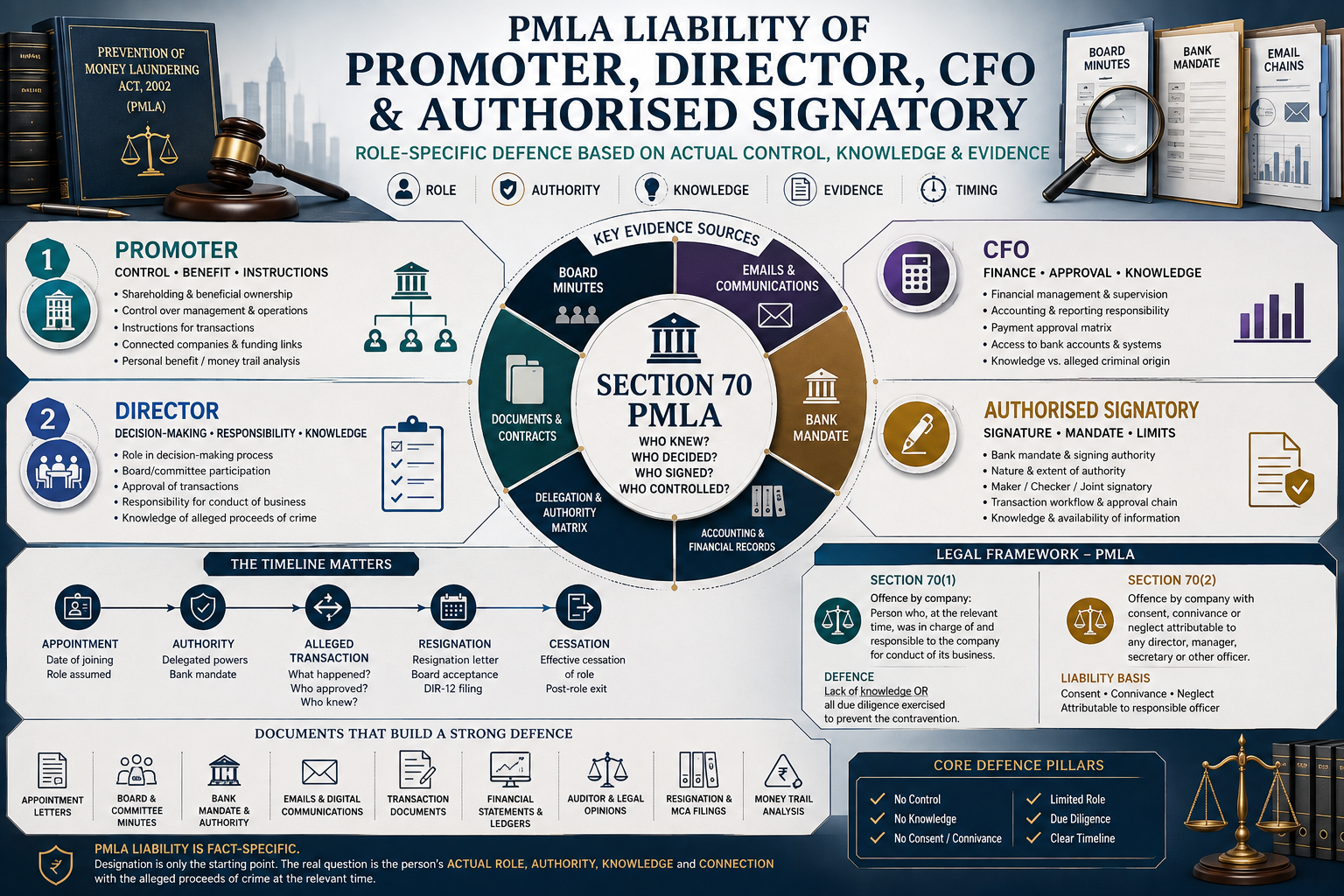
Promoter, Director, CFO and Authorised-Signatory Liability under PMLA: Role-Specific Defence, Knowledge, Authority and Documentary Evidence
Updated: 9 August 2026
Corporate investigations under the Prevention of Money Laundering Act, 2002 (“PMLA”) frequently expand beyond the company itself to include promoters, managing directors, executive directors, non-executive directors, independent directors, Chief Financial Officers (“CFOs”), finance personnel and authorised signatories.
A recurring mistake in such cases is to treat a person's designation as though it conclusively establishes criminal liability.
A director is not necessarily involved in every corporate transaction. A CFO may understand accounting treatment without knowing that a particular inflow is alleged to represent proceeds of crime. An authorised signatory may execute a payment without having selected the beneficiary or approved the commercial transaction. Conversely, a promoter without a formal operational title may exercise extensive control over transactions through instructions, funding or beneficial ownership.
The proper PMLA analysis is therefore:
ROLE-SPECIFIC + TRANSACTION-SPECIFIC + DOCUMENT-SPECIFIC + TIME-SPECIFIC.
This guide by Advocate Ankit Kumar Singh explains how liability and defence should be separately examined for promoters, directors, CFOs and authorised signatories by analysing decision-making power, signing authority, knowledge, board minutes, emails, bank mandates and resignation timelines.
1. Start With Section 3 PMLA: What Is the Individual Alleged to Have Done?
Before examining corporate designation, counsel should identify the prosecution's substantive allegation concerning the individual.
The question should be:
What process or activity connected with the alleged proceeds of crime is this particular person alleged to have participated in?
Depending upon the prosecution case, allegations may concern:
- concealment;
- possession;
- acquisition;
- use;
- projecting alleged proceeds as untainted;
- claiming alleged proceeds as untainted;
- fund transfers;
- layering;
- corporate routing;
- creation of documentation; or
- other alleged activity connected with proceeds of crime.
A role-specific defence begins only after this alleged act is clearly identified.
2. Section 70 PMLA: Offences by Companies
Section 70 provides the statutory framework for company-related contraventions.
Where a company has committed the relevant contravention, Section 70 requires examination of those persons who, at the relevant time, were in charge of and responsible to the company for conduct of its business.
The critical words are not merely:
“director”
or
“officer”.
The functional inquiry concerns responsibility for the conduct of the company's business at the relevant time.
3. Designation Alone Should Not Replace Role Attribution
Corporate structures may contain:
- promoters;
- executive directors;
- non-executive directors;
- independent directors;
- CFOs;
- company secretaries;
- vice-presidents;
- financial controllers;
- treasury personnel;
- authorised signatories; and
- nominee directors.
Their authority may be completely different.
A legally sound prosecution or defence must therefore connect the individual with the relevant conduct rather than treating the organisational chart itself as proof of money laundering.
4. Section 70(1): “In Charge” and “Responsible for Conduct of Business”
For Section 70(1), examine the person's actual functions at the time of the alleged contravention.
Questions should include:
- Did the person manage day-to-day operations?
- Could the person approve the transaction?
- Could the person instruct finance personnel?
- Could the person operate the relevant bank account?
- Did the person supervise the business division involved?
- Did the person control the counterparty relationship?
- Was the transaction within the person's delegated authority?
5. Section 70 Also Contains an Important Defence
The statute permits examination of whether the relevant person lacked knowledge of the contravention or exercised due diligence to prevent it.
Therefore, a serious defence should not stop at:
“I was not involved.”
It should produce contemporaneous evidence showing:
- what the person knew;
- what responsibilities the person held;
- what compliance information was available;
- what questions were asked;
- what approvals were refused;
- what controls were in place; and
- what steps were taken when concerns arose.
6. Section 70(2): Consent, Connivance and Neglect
Another layer arises where the prosecution alleges that the company's contravention occurred with the consent or connivance of, or due to neglect attributable to, a director, manager, secretary or other officer.
This means that merely proving that a person was not handling daily operations may not resolve every case.
Counsel must separately test whether there is evidence of:
- express approval;
- silent cooperation;
- intentional facilitation;
- deliberate disregard of warning signs;
- failure to discharge a relevant responsibility; or
- other conduct alleged to amount to consent, connivance or neglect.
7. Promoter Liability: Ownership Is Not the Same as Participation
A promoter may have significant ownership or control over a company.
But promoter status should still be separated from the precise alleged laundering activity.
Counsel should investigate:
- shareholding;
- beneficial ownership;
- appointment rights;
- board influence;
- instructions to management;
- financing arrangements;
- related-party entities;
- control over bank accounts;
- approval of transactions;
- communications with counterparties; and
- whether the promoter personally benefited from the alleged proceeds.
8. Build a Promoter Control Matrix
| Issue | Evidence |
|---|---|
| Equity ownership | Shareholding records |
| Beneficial ownership | Declarations and funding records |
| Board control | Appointment and voting rights |
| Operational instructions | Emails / messages |
| Bank control | Mandate / internet-banking authority |
| Transaction approval | Internal approval notes |
| Financial benefit | Money trail |
| Alleged PMLA role | Prosecution complaint / statements / documents |
This enables counsel to distinguish formal promoter status from actual transaction-level participation.
9. Managing and Executive Directors
Managing and executive directors may receive greater investigative scrutiny because their positions can involve daily operational control.
But even here, liability must be linked with the particular transaction.
The defence should investigate:
- division of managerial responsibilities;
- delegation of authority;
- financial approval limits;
- subject-matter responsibility;
- board resolutions;
- bank mandates;
- emails;
- contracts;
- ERP permissions; and
- whether the individual had knowledge of the alleged criminal source of funds.
10. Non-Executive Directors: Prove Functional Non-Involvement
Merely describing an accused as a “non-executive director” is not enough.
The defence should demonstrate the actual limits of the role.
Collect:
- appointment letter;
- board composition;
- committee membership;
- meeting attendance;
- delegation matrix;
- bank mandate;
- financial authority;
- email involvement;
- transaction documents; and
- Companies Act filings.
The objective is to answer:
What power did this director actually possess over the transaction alleged to constitute money laundering?
11. Independent Director Defence
An independent director's defence should be document-driven.
Potentially important material includes:
- terms of appointment;
- committee responsibilities;
- board attendance;
- board papers supplied;
- audit reports received;
- questions raised;
- dissent recorded;
- compliance reports;
- absence of banking authority;
- absence of transaction execution powers; and
- resignation records.
Where an independent director had no operational authority over the relevant transaction, the defence should make that factual separation visible rather than relying only upon the statutory label.
12. CFO Liability Requires a Different Analysis
The CFO is often one of the most document-intensive roles in a PMLA corporate investigation.
ED may examine:
- bank transactions;
- financial statements;
- ledger entries;
- cash-flow records;
- loan documentation;
- invoices;
- treasury instructions;
- related-party payments;
- auditor communications;
- financial approvals;
- accounting adjustments;
- shell-company transactions; and
- fund-flow statements.
But the defence should distinguish four very different propositions:
Knowledge of accounting ≠ commercial approval ≠ knowledge of criminal origin ≠ participation in money laundering.
13. CFO Defence: Map the Approval Hierarchy
A CFO may process or supervise financial transactions without being the person who commercially originated or ultimately approved them.
Prepare:
Transaction Initiator → Department Approval → Commercial Approval → Finance Verification → CFO Approval, if any → Bank Authorisation → Final Payment
This can reveal whether the CFO:
- created the transaction;
- verified documentation;
- approved accounting;
- approved payment;
- acted as checker;
- acted under board instructions; or
- had no role at the relevant stage.
14. CFO Knowledge: What Did the Finance Team Actually Know?
Investigators may attempt to infer knowledge from access to financial information.
Counsel should therefore analyse what information actually reached the CFO at the relevant time.
Important questions include:
- Did the invoice appear genuine?
- Was the transaction supported by a contract?
- Was legal/compliance approval available?
- Did the auditor flag the transaction?
- Was the counterparty disclosed as related?
- Were suspicious facts concealed from finance?
- Did business management certify performance?
- Did the CFO raise questions?
15. Authorised Signatory: A Signature Is Important, But What Does It Prove?
The appearance of a person's signature on a banking or corporate document can be important evidence.
But the precise evidentiary meaning must be examined.
A signature may demonstrate:
- execution;
- authentication;
- bank authority;
- acknowledgment;
- approval; or
- performance of an administrative function.
It does not automatically establish every other element of the prosecution case.
16. Questions to Ask About an Authorised Signatory
Counsel should ask:
- Who selected the beneficiary?
- Who negotiated the transaction?
- Who approved the commercial purpose?
- Who prepared the payment instruction?
- What was the signatory's monetary limit?
- Was joint signature mandatory?
- Was the person merely maker or checker?
- Could the signatory independently alter the transaction?
- What supporting material was provided?
- Was there any reason to know of an alleged proceeds-of-crime connection?
17. The Bank Mandate Can Become Critical Evidence
Do not rely upon memory regarding who operated the account.
Obtain the actual mandate from the bank.
The mandate may establish:
- authorised persons;
- effective dates;
- monetary limits;
- single or joint authority;
- maker-checker arrangements;
- internet-banking privileges;
- token authority;
- transaction limits; and
- changes in authority over time.
18. Board Minutes: Who Actually Took the Decision?
Board minutes can be among the most important defence documents in a corporate PMLA case.
They may show:
- who proposed a transaction;
- who attended;
- who was absent;
- what information was placed before directors;
- who approved;
- who abstained;
- who dissented;
- what authority was delegated;
- whether the matter was ever placed before the board.
However, minutes should never be read in isolation.
19. Read the Complete Board Record
Obtain:
- board agenda;
- notice;
- agenda notes;
- annexures;
- attendance register;
- minutes;
- committee papers;
- presentations;
- documents circulated before the meeting;
- emails after the meeting; and
- delegated-authority resolutions.
A sentence in the minutes can acquire a completely different meaning when read with the underlying board pack.
20. Email Evidence: “CC” Is Not Necessarily “Control”
Corporate investigations commonly involve thousands of emails.
A person may appear on an email merely because of:
- routine copying;
- hierarchical reporting;
- administrative circulation;
- departmental distribution lists;
- information-only communication.
Conversely, an email containing direct transactional instructions may be highly significant.
The defence must distinguish the two.
21. Build an Email Involvement Matrix
| Field | Question |
|---|---|
| Date | When was the communication sent? |
| Sender | Who initiated it? |
| Recipient | Was the accused directly addressed? |
| CC | Was the person only copied? |
| Subject | Which transaction? |
| Instruction | Was an action requested? |
| Response | What did the person actually say? |
| Knowledge | What information did the email disclose? |
22. WhatsApp and Digital Communications
Messages should be examined in their complete context.
Important questions include:
- Who authored the message?
- Was the device properly attributed?
- Was the conversation individual or group-based?
- What messages immediately preceded it?
- What followed?
- Did the accused reply?
- Was an instruction actually issued?
- Was it implemented?
- Does it concern the alleged proceeds of crime?
Selective excerpts should be compared with the complete communication chain.
23. Signing Authority Is Not Necessarily Decision-Making Authority
Corporate controls often deliberately divide functions.
For example:
Business Team → Initiates Transaction
Legal Team → Reviews Contract
Finance Team → Checks Documentation
Management → Approves Commercial Decision
Authorised Signatory → Executes Payment Instrument
The prosecution and defence should therefore identify precisely where the accused stood in this chain.
24. Resignation Timeline: One of the Most Important Defences for Former Directors
Section 70 expressly focuses upon responsibility at the time the relevant contravention occurred.
Therefore prepare a precise tenure chronology:
Appointment Date → Assumption of Role → Relevant Transactions → Resignation Letter → Board Recording → ROC / DIR-12 Filing → Effective Cessation → Subsequent Transactions
The alleged transaction dates should then be overlaid on this timeline.
25. Resignation Does Not Erase Earlier Conduct
A director who resigns after the alleged laundering transaction cannot ordinarily treat the later resignation as though it erased conduct allegedly committed during his or her tenure.
The relevant defence must instead address the person's actual role during the transaction period.
Conversely, if documentary evidence establishes that the individual ceased to hold the relevant office before the alleged conduct, that chronology may become highly significant.
26. Documents for a Resignation Defence
Collect:
- resignation letter;
- proof of delivery;
- board minutes;
- DIR-12;
- MCA master data;
- annual return;
- bank mandate amendment;
- email-account closure or transition;
- handover documents;
- employment separation records;
- removal from digital approvals;
- subsequent board records.
27. Appointment Date Is Equally Important
Do not examine resignation without checking appointment.
A person appointed after the alleged transactions may have a materially different defence from someone who controlled the company throughout the relevant period.
Prepare:
ALLEGED OFFENCE PERIOD versus ACTUAL TENURE.
28. Did the Individual Personally Receive Any Alleged Proceeds?
Personal receipt is not the only possible basis of a PMLA allegation, but the money trail remains highly important.
Examine:
- personal bank accounts;
- family accounts where legally relevant;
- shareholding entities;
- loans;
- related-party payments;
- property acquisitions;
- dividends;
- consultancy payments;
- cash withdrawals;
- beneficial interests.
Where there is no personal benefit, that fact should be documented—but the defence should still address the prosecution's allegation of participation, if any.
29. Knowledge Must Be Analysed at the Correct Time
A transaction may appear suspicious only after subsequent events become known.
The correct question is:
What information was available to this particular individual when he or she acted?
Do not reconstruct knowledge using facts discovered years later unless there is evidence that the individual possessed those facts at the relevant time.
30. Knowledge Matrix
| Evidence | Question |
|---|---|
| Contract | What did it disclose? |
| Invoice | Was there an apparent irregularity? |
| Legal opinion | What advice was provided? |
| Audit report | Was the transaction flagged? |
| What information reached the accused? | |
| Board paper | What was disclosed to directors? |
| Bank record | What transaction details were visible? |
| Statement | What did the accused contemporaneously know? |
31. Due-Diligence Defence
Where applicable, evidence that the officer exercised due diligence can be critical.
Potential documents include:
- compliance-policy implementation;
- legal advice sought;
- auditor confirmation;
- transaction queries;
- enhanced due-diligence requests;
- refusal to approve suspicious payment;
- internal escalation;
- whistleblower communication;
- risk-committee discussion;
- remedial action.
32. Do Not Create a False Due-Diligence Defence After the Event
Contemporaneous records are significantly more persuasive than documents created after investigation begins.
Counsel should therefore use genuine existing records and avoid reconstructing corporate documents in a manner that could create additional criminal exposure.
33. Role Attribution in the PMLA Prosecution Complaint
For every accused individual, read the prosecution complaint separately.
Create a chart containing:
- paragraph number;
- specific allegation;
- transaction;
- document relied upon;
- witness statement;
- bank evidence;
- digital evidence;
- alleged proceeds-of-crime connection;
- defence document.
Do not defend the entire complaint generically.
Attack the role attributed to each individual.
34. A Director-Specific Defence Matrix
| Prosecution Question | Defence Evidence |
|---|---|
| Was the person in charge? | Delegation matrix / job description |
| Responsible for business? | Organisation structure |
| Approved transaction? | Board/approval documents |
| Controlled account? | Bank mandate |
| Knew source of funds? | Contemporaneous information |
| Participated in transfer? | Transaction workflow |
| Received benefit? | Personal money trail |
| Still in office? | Appointment/resignation filings |
35. Section 50 Statements: Role Questions Must Be Prepared Carefully
An officer appearing before ED may be questioned regarding:
- corporate hierarchy;
- who approved payments;
- who controlled accounts;
- who selected vendors;
- who issued instructions;
- how books were maintained;
- relationship with promoters;
- specific emails;
- specific signatures;
- knowledge of counterparties.
Preparation should therefore be document-based rather than memory-based wherever records are available.
36. Never Guess During a Document-Heavy Corporate Examination
Where a witness genuinely does not remember a several-year-old transaction, guessing may create inconsistencies with:
- bank statements;
- emails;
- board records;
- ERP data;
- other witnesses;
- later statements.
Accuracy is more important than attempting to provide an immediate explanation for every historical document.
37. Arrest Is a Separate Question From Investigation
The fact that an individual is under investigation does not itself answer whether statutory arrest requirements are satisfied.
Where arrest under Section 19 is contemplated, the designated officer must comply with the statutory safeguards governing the formation and recording of the required opinion based upon material in possession.
Role-specific material therefore becomes relevant not only at trial but potentially when testing the foundation of coercive action.
38. Bail Strategy Must Also Be Role-Specific
Where bail under Section 45 becomes necessary, role attribution can be central.
Counsel should distinguish:
- mastermind allegations;
- beneficiary allegations;
- transaction approver;
- accounting officer;
- nominal director;
- authorised signatory;
- subordinate employee;
- post-transaction appointee.
The Supreme Court has recognised that the prosecution must establish foundational facts connecting the person with the alleged proceeds-of-crime activity before the statutory burden operates in the manner contemplated by PMLA.
39. Role-Specific Master Decision Tree
What is the person's designation?
↓
What was the tenure?
↓
What was the actual functional responsibility?
↓
Did the person control or approve the relevant transaction?
↓
Did the person have bank/signing authority?
↓
What information did the person know at the time?
↓
What communication links the person with the transaction?
↓
Was any alleged proceeds-of-crime benefit received?
↓
What precise Section 3 / Section 70 allegation is made?
↓
What contemporaneous document disproves or qualifies that allegation?
40. The Six-File Defence System
FILE 1 – CORPORATE ROLE
Appointment, job description, delegation, organisation chart.
FILE 2 – TRANSACTIONS
Contracts, invoices, approvals, ledger, bank trail.
FILE 3 – AUTHORITY
Bank mandates, board powers, signing limits, ERP rights.
FILE 4 – KNOWLEDGE
Emails, board papers, compliance reports, audit reports.
FILE 5 – TENURE
Appointment, resignation, DIR-12, handover.
FILE 6 – PROSECUTION ALLEGATION
ED statements, prosecution complaint, relied-upon documents, role attribution.
41. Common Defence Mistakes
- Saying “I was only a director” without proving actual responsibilities.
- Saying “I only signed” without producing the bank mandate.
- Ignoring Section 70(2) consent, connivance or neglect allegations.
- Failing to distinguish executive and non-executive functions.
- Failing to establish exact CFO approval limits.
- Ignoring board minutes.
- Ignoring emails where the accused gave actual instructions.
- Relying only upon resignation without comparing transaction dates.
- Ignoring personal benefit / money trail.
- Giving a generic defence instead of answering each prosecution allegation.
42. Essential Document Checklist
- appointment letter;
- employment agreement;
- job description;
- MCA records;
- DIR-12;
- shareholding records;
- beneficial ownership records;
- organisation chart;
- delegation-of-authority matrix;
- board minutes;
- committee minutes;
- board agenda papers;
- bank mandates;
- internet-banking authority;
- ERP permissions;
- payment approval matrix;
- contracts;
- invoices;
- purchase orders;
- ledger extracts;
- bank statements;
- auditor correspondence;
- legal opinions;
- compliance reports;
- emails;
- WhatsApp / digital communications;
- resignation letter;
- handover documents;
- ED summons;
- Section 50 statements;
- prosecution complaint;
- relied-upon documents;
- underlying scheduled-offence records; and
- a complete role-and-transaction chronology.
43. Frequently Asked Questions
Is every director automatically liable under PMLA?
Corporate designation alone should not substitute for examination of the statutory ingredients and the person's actual role.
Can a promoter be prosecuted even if he is not a director?
The decisive question is the person's alleged participation, control, knowledge and connection with the alleged proceeds-of-crime activity, not merely whether a formal director title existed.
Is a CFO automatically responsible for every suspicious company transaction?
No automatic conclusion should be drawn merely from the title. The CFO's actual financial authority, knowledge, approvals and alleged participation must be examined.
Does signing a cheque prove money laundering?
A signature may be relevant evidence, but its significance depends upon authority, transaction context, knowledge and the other elements of the alleged offence.
Can an authorised signatory defend the case by saying he only signed documents?
That assertion should be supported through the bank mandate, delegation matrix, approval workflow and evidence identifying who actually originated and approved the transaction.
Are board minutes important in a PMLA case?
Yes. They can help establish decision-making, attendance, delegation, dissent and the information actually available to directors.
Are emails enough to establish knowledge?
Their evidentiary value depends upon content and context. Being copied on an email is materially different from issuing transaction instructions.
Does resignation protect a former director?
The relevant issue is the timing of the alleged conduct in comparison with the person's actual tenure. Resignation does not erase conduct during tenure, while genuine cessation before the relevant transactions may be important.
What documents prove resignation?
Resignation letter, board records, DIR-12, MCA records, bank mandate changes, handover material and other contemporaneous records may be relevant.
What is the most important defence question?
What exactly did this individual do, know, approve or receive in relation to the alleged proceeds of crime?
44. Final Defence Principle
Corporate PMLA litigation should not be reduced to job titles.
The most useful defence question is not:
“Was this person a director, promoter, CFO or authorised signatory?”
It is:
“What decision-making power did this person actually possess, what did he or she know at the relevant time, what transaction did he or she approve or execute, and what evidence connects that conduct with alleged proceeds of crime?”
A strong role-specific defence therefore combines:
TENURE + FUNCTION + AUTHORITY + KNOWLEDGE + TRANSACTION + MONEY TRAIL + DOCUMENTARY EVIDENCE.
Conclusion
Promoters, directors, CFOs and authorised signatories occupy very different positions within a corporate structure, and their PMLA exposure should be analysed accordingly.
Promoter status may establish ownership or influence but does not by itself describe the alleged laundering activity.
A director's actual operational responsibilities, board role and transaction authority must be identified.
A CFO's knowledge of financial records must be separated from knowledge that funds were allegedly proceeds of crime.
An authorised signatory's execution of a banking instrument must be analysed alongside the mandate, monetary limits and underlying approval chain.
For former officers, the appointment and resignation chronology can be decisive in determining whether they were even in office during the relevant transactions.
The defence should therefore be built from contemporaneous records rather than generic statements of non-involvement.
The strongest corporate PMLA defence is ultimately:
role-specific, transaction-specific, evidence-specific and chronology-specific.
About the Author

Advocate Ankit Kumar Singh advises and represents clients in matters concerning the Prevention of Money Laundering Act (PMLA), Enforcement Directorate proceedings, corporate and financial crime, white-collar investigations and connected appellate and constitutional remedies.
Website: advocateankitkumarsingh.in
Email: ankitsingh.legum@gmail.com
Phone: 8294431232
Google Preferred Source
Add advocateankitkumarsingh.in as a Preferred Source on Google
Disclaimer: This article is intended solely for general legal information and educational purposes. Individual liability under PMLA is fact-specific and may depend upon the alleged offence, corporate structure, statutory role, actual responsibilities, transaction authority, knowledge, communications, money trail, appointment or resignation dates and evidence relied upon by investigating authorities. This article does not constitute legal advice for any particular investigation or proceeding.