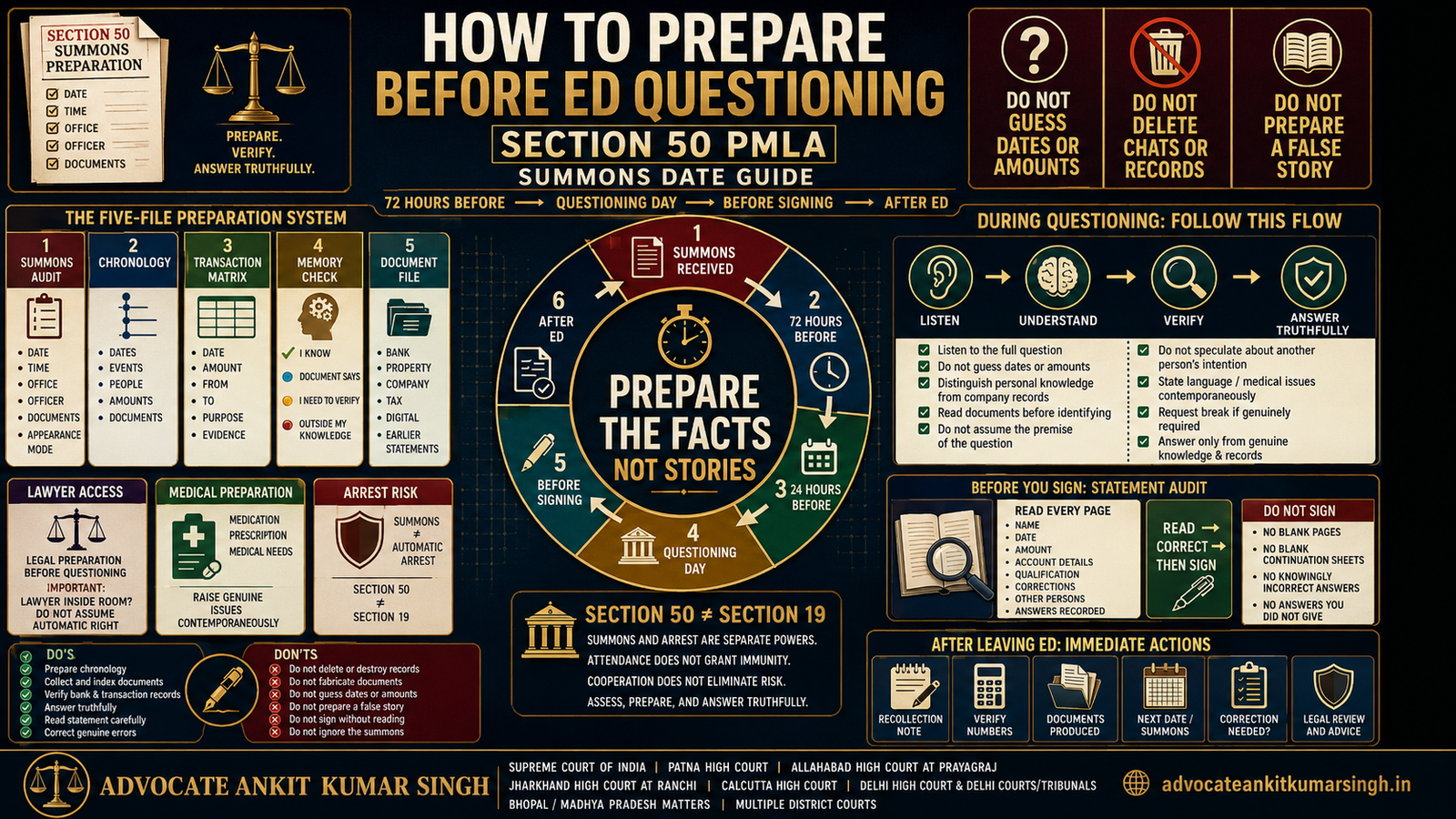
SECTION 50 PMLA • ED SUMMONS • QUESTIONING-DAY RESEARCH GUIDE
How to Prepare Before ED Questioning on the Summons Date: Complete Section 50 PMLA Appearance, Documents, Statement & Risk-Management Research Guide
What to Do After Receiving the Summons • 72 Hours Before • Previous Night • Morning of Appearance • During Questioning • Before Signing • After Leaving ED
Research updated: 9 August 2026 | By Advocate Ankit Kumar Singh
 Advocate Ankit Kumar Singh
Direct Answer: Your ED Questioning Date Is Approaching — What Should You Do?
Do not spend the remaining time memorising a story.
Use it to prepare five things:
- the summons;
- the factual chronology;
- the financial / transaction trail;
- the requested documents;
- the areas where you genuinely do not remember without checking records.
Your objective on the summons date should be:
TRUTHFUL + PRECISE + DOCUMENT-BACKED + NON-SPECULATIVE + CONSISTENT WITH GENUINE RECORDS.
The greatest avoidable mistake is usually not:
“I could not remember the exact date.”
It is:
“I guessed the date, amount, person or reason and signed it as fact.”
First Understand Why Section 50 Questioning Is Different From an Ordinary Conversation
Section 50 of the Prevention of Money-Laundering Act gives specified Enforcement Directorate officers power to summon a person where attendance is considered necessary for giving evidence or producing records during an investigation or proceeding under PMLA.
The person summoned must attend in the manner directed, state the truth on matters concerning which he or she is examined and produce the records lawfully required.
Proceedings under Section 50(2) and Section 50(3) are also statutorily treated as judicial proceedings for the purposes specified in the Act.
Accordingly:
DO NOT TREAT SECTION 50 AS AN INFORMAL INTERVIEW.
Does an ED Summons Mean You Are Going to Be Arrested?
No automatic rule says that receipt of a Section 50 summons means arrest.
Section 50 summons and Section 19 arrest are separate statutory powers.
The Supreme Court has also reiterated that mere non-cooperation by a witness in response to Section 50 summons is not, by itself, sufficient to automatically make the person liable to arrest under Section 19.
However:
ATTENDING THE SUMMONS DOES NOT CREATE IMMUNITY FROM ARREST EITHER.
If the facts disclose realistic arrest exposure, that risk should be assessed before the person walks into the ED office—not for the first time after questioning begins.
Step 1: Audit the Summons Line by Line
Make a one-page summons sheet containing:
| Item | What to Record |
|---|---|
| Summons date | __/__/____ |
| Appearance date | __/__/____ |
| Appearance time | _____ |
| ED office | _____ |
| Issuing officer | _____ |
| Designation | _____ |
| ECIR reference if disclosed | _____ |
| Person/entity named | _____ |
| Personal appearance directed? | YES / NO / CHECK |
| Documents demanded | _____ |
| Previous summons | _____ |
Do not assume that because Section 50 refers to attendance personally or through an authorised agent, you can automatically send someone else.
The officer's direction matters.
Step 2: Identify the Predicate / Scheduled-Offence Background
Before ED questioning, identify whether you know of:
- FIR;
- CBI RC;
- EOW case;
- police charge-sheet;
- supplementary charge-sheet;
- corruption case;
- fraud case;
- cybercrime FIR;
- scheduled offence involving a company;
- another proceeding connected with the same transactions.
Then prepare a short answer to:
“What is my actual connection with the transaction being investigated?”
Do not assume that the absence of an ECIR copy means the summons can simply be ignored.
The Five-File Preparation System
FILE 1 — SUMMONS & LEGAL PROCESS
- current summons;
- earlier summons;
- earlier representations;
- proof of appearance;
- search documents;
- freezing communication;
- predicate FIR / charge-sheet where available.
FILE 2 — MASTER CHRONOLOGY
- date;
- event;
- person involved;
- amount;
- supporting document.
FILE 3 — DOCUMENTS REQUESTED BY ED
Prepare a numbered index corresponding with the summons.
FILE 4 — FINANCIAL TRANSACTION MATRIX
Prepare important bank transfers separately.
FILE 5 — ISSUES REQUIRING VERIFICATION
List facts you genuinely cannot accurately answer without checking records.
This fifth file is especially important because it prevents guessing.
Build a Master Chronology Before You Build Answers
| Date | Event | Amount | Person / Entity | Document |
|---|---|---|---|---|
| __/__/____ | Agreement | ₹_____ | _____ | Agreement |
| __/__/____ | Bank transfer | ₹_____ | _____ | Bank statement |
| __/__/____ | Invoice / sale | ₹_____ | _____ | Invoice |
| __/__/____ | Search / summons | — | ED | Official document |
A chronology helps expose contradictions before questioning does.
Prepare a Transaction Matrix for Every Important Bank Entry
| Date | Amount | From | To | Purpose | Evidence |
|---|---|---|---|---|---|
| __/__/____ | ₹_____ | _____ | _____ | _____ | _____ |
For each transaction, be able to identify where genuinely known:
- who initiated it;
- why it occurred;
- what document supported it;
- whether goods/services actually existed;
- whether it was a loan, advance, sale, refund, investment or transfer;
- how it was accounted for;
- whether it appears in tax/GST/company records.
Prepare by Category — Not by Memorising Questions
Typical factual areas may include:
- personal identity and background;
- employment / directorship;
- company responsibilities;
- relationship with other persons;
- bank accounts;
- company accounts;
- property;
- loans and advances;
- inter-company transfers;
- cash transactions;
- source of funds;
- investments;
- foreign remittances;
- digital communications;
- WhatsApp chats;
- emails;
- documents recovered during search;
- earlier police / CBI / tax statements;
- beneficial ownership;
- specific transactions alleged to constitute proceeds of crime.
Do not manufacture answers to any category simply because you expect it to be asked.
The Most Important Preparation Skill: Separate Knowledge From Memory From Documents
Before appearance, classify facts into four boxes:
BOX A — I KNOW THIS PERSONALLY
Example:
“I attended the meeting.”
BOX B — I KNOW THIS FROM COMPANY / BANK RECORDS
Example:
“The payment appears in the company bank statement.”
BOX C — I DO NOT REMEMBER THE EXACT DETAIL
Example:
“I remember the transaction generally but not the exact date without checking the record.”
BOX D — THIS IS OUTSIDE MY PERSONAL KNOWLEDGE
Example:
“The finance team handled that filing; I cannot truthfully say who uploaded it without checking the records.”
This classification is far safer than trying to sound certain about everything.
Is “I Don't Remember” a Valid Answer?
If you genuinely do not remember, say so truthfully.
But there is an important difference between:
“I genuinely do not recall the exact date without checking the record.”
and:
“I don't remember anything.”
The first may accurately describe memory.
The second can become problematic if records or surrounding answers demonstrate detailed knowledge.
Never use “I don't remember” as a rehearsed blanket strategy.
Useful Truthful Formulations When Precision Requires Documents
Where genuinely accurate, formulations such as the following may prevent accidental guessing:
“I do not remember the exact date without checking the bank statement.”
“I remember the transaction, but the exact amount should be verified from the account.”
“I would like to read the document before identifying it.”
“I cannot say what another person intended.”
“That matter was handled by another department; I can only state what I personally know.”
“The figure I am giving is approximate and should be verified from the records.”
These are not escape phrases.
Use them only when factually true.
How to Prepare Documents for Production
Read the document-demand portion of the summons word by word.
Create an index:
| Serial | Document Requested | Period | Available? | Pages |
|---|---|---|---|---|
| 1 | Bank statement | 2024–2026 | Yes | 1–75 |
| 2 | Agreement | __/__/____ | Yes | 76–92 |
BEST PRACTICES:
- keep copies of what is produced;
- paginate large sets;
- maintain an index;
- do not alter the originals;
- do not backdate missing records;
- do not create retrospective vouchers;
- if a requested document does not exist, do not manufacture one;
- if genuinely unavailable, identify that issue accurately;
- where originals are required and produced, seek an acknowledgement or record of production where practicable.
Should You Carry Documents That ED Did Not Ask For?
Do not turn the appearance into an uncontrolled document dump.
However, you may need supporting records available for preparation where they directly explain:
- a disputed transaction;
- source of funds;
- property acquisition;
- loan;
- invoice;
- company role;
- bank transfer.
The distinction is:
PREPARE RELEVANT SUPPORTING RECORDS ≠ VOLUNTEER EVERY PRIVATE DOCUMENT YOU POSSESS.
Never withhold a record that the lawfully issued summons specifically requires merely because it is inconvenient.
Digital Records: Do Not “Clean Up” Your Phone Before Appearance
Do not:
- delete WhatsApp chats;
- delete emails;
- factory-reset devices;
- remove cloud data;
- alter accounting software;
- change timestamps;
- delete files because they appear embarrassing;
- ask another participant to delete a conversation.
Evidence destruction can create a problem much larger than the original document.
If a digital communication needs explanation, prepare its complete context rather than destroying it.
WhatsApp Chats and Emails: Read the Full Context Before Questioning
If you know that ED possesses your device or communications:
- review the complete conversation where lawfully available to you;
- identify the date;
- identify the participant;
- identify attachments;
- understand what happened before and after a relied message;
- verify whether the communication concerns the transaction being investigated.
Do not invent a meaning for a message after the fact.
Company Directors: Separate Your Role From the Company's Entire Existence
A director should prepare:
- appointment date;
- designation;
- board responsibilities;
- bank-signing authority;
- period actually involved;
- departments supervised;
- transactions personally authorised;
- transactions handled by finance/accounting team;
- board resolutions;
- delegation documents.
Do not assume that because you were a director you must personally know every invoice, GST filing or payment entry.
Equally, do not deny involvement where records show that you approved the transaction.
Prepare the Source-of-Funds File
If questioning is likely to concern property, investment, cash or bank credits, organise:
- bank statements;
- income-tax returns;
- salary/business income;
- sale deeds;
- loan records;
- capital accounts;
- business cash book;
- agricultural records where genuinely relevant;
- gift records where genuinely relevant;
- property purchase consideration;
- historical account balances.
The source explanation must follow evidence.
The evidence must never be manufactured to fit the source explanation.
72–48 Hours Before the ED Appearance
- Read the complete summons.
- Confirm date, time and ED office.
- Identify every requested document.
- Review known predicate-offence record.
- Prepare transaction chronology.
- Prepare bank-transfer matrix.
- Review prior statements.
- Review relevant digital communications.
- Identify factual gaps.
- Identify medical requirements.
- Obtain case-specific legal advice.
- Assess realistic arrest exposure if any.
- Do not contact others to coordinate a common story.
24 Hours Before the ED Appearance
The previous day should be used for verification—not panic.
CHECK:
- summons;
- ID;
- document file;
- document index;
- chronology;
- medications;
- medical prescriptions;
- lawyer's number;
- family/emergency contact;
- route and travel time to ED office.
Avoid spending the entire night rehearsing.
Fatigue can reduce the accuracy of memory the next day.
What Should You Carry on the Summons Date?
ESSENTIAL
- original/copy of summons as appropriate;
- government identity proof;
- documents specifically required;
- indexed copies where prepared;
- prescribed medicines;
- medical prescription where necessary;
- spectacles/hearing assistance if required.
PRACTICAL ITEMS
- lawyer/contact details;
- family emergency contact;
- water / light food subject to office security rules and medical needs;
- charger/power bank only if permitted by building-security rules.
Do not carry unnecessary confidential records merely because you are nervous.
Morning of the Appearance: A Practical Timeline
2–3 HOURS BEFORE
- eat appropriately;
- take prescribed medicines;
- review the summons once;
- do not start learning new explanations;
- confirm document file.
30–45 MINUTES BEFORE
- reach the area early;
- avoid last-minute rushing;
- confirm correct building / entry.
AT THE OFFICE
- report as directed;
- maintain a record of arrival time for yourself;
- comply with reasonable security procedures;
- produce the summons/ID as required.
Your Lawyer and the Questioning Room: Know the Difference
Legal preparation before questioning is highly important.
But do not assume that an advocate has an unrestricted right to sit beside the person and advise after each question during a Section 50 examination.
Whether any visual-distance or other protective arrangement can be sought depends upon the facts and applicable judicial directions.
A sensible practical arrangement may include:
- legal consultation before entry;
- lawyer available by phone outside the examination;
- family informed of location;
- case-specific court protection if genuinely necessary and legally maintainable.
When Questioning Starts: Listen to the Entire Question
Do not answer midway through the question.
Before answering, identify:
- what fact is actually being asked;
- which period;
- which company;
- which account;
- which person;
- whether the question assumes a disputed fact.
If a question contains several different propositions, it may be appropriate to clarify which part is being answered.
Do Not Adopt the Premise of a Question Without Checking It
Example:
“Why did you divert ₹25 lakh to Company B?”
This question assumes:
- you made the transfer;
- it was ₹25 lakh;
- Company B received it;
- the transfer was a “diversion.”
Before explaining “why,” determine whether the underlying factual propositions are correct.
If ED Shows You a Document, Read It Before Identifying It
When confronted with:
- bank statement;
- WhatsApp screenshot;
- email;
- invoice;
- ledger;
- agreement;
- property record;
- another person's statement;
do not identify it solely because the officer describes it.
Read enough of the record to determine:
- date;
- parties;
- amount;
- context;
- whether you recognise it;
- whether it is complete.
Do Not Guess Another Person's Intention
There is a difference between:
“Mr. X transferred the money.”
and:
“Mr. X transferred the money because he wanted to launder it.”
The second statement asserts another person's mental state.
Unless you actually know the reason, do not speculate.
Cash Questions: Prepare the Arithmetic
If cash is likely to be questioned:
OPENING CASH + CASH RECEIPTS - CASH EXPENDITURE = CLOSING CASH.
Support genuine explanations through:
- cash book;
- withdrawals;
- sales records;
- inventory;
- tax records;
- other contemporaneous evidence.
Do not invent a wedding-gift, agricultural-income, loan or family-saving explanation simply because cash needs a source.
Language Problems: Address Them at the Beginning
If you genuinely have difficulty reading or understanding the language used in questioning or the statement:
- say so clearly;
- identify the language in which you can accurately understand the questions;
- ensure the recorded statement reflects what you actually said;
- do not pretend to understand wording that you do not understand.
Do not later invent a language problem if the contemporaneous record shows that you comfortably read and corrected the statement.
Medical Conditions and Medication
Where relevant, carry genuine:
- prescription;
- regular medication;
- recent medical record;
- dietary instructions for conditions requiring timed food;
- information concerning serious medical history.
If fatigue, pain, low blood sugar, medication timing or another genuine problem begins to affect your ability to answer accurately, communicate it contemporaneously and request an appropriate break or medical assistance.
Do not wait until weeks later to invent a medical explanation unsupported by records.
Is There a Fixed Maximum Number of Hours ED Can Question You?
Section 50 does not itself set out a simple universal maximum questioning duration that can safely be converted into a rule such as:
“ED can question only until 6 PM.”
Accordingly, avoid relying upon internet myths.
If prolonged questioning creates genuine medical or accuracy concerns:
- communicate the issue;
- request an appropriate break;
- seek medical assistance where necessary;
- make a contemporaneous note after the session.
Do You Have a Blanket Right to Remain Silent?
Do not approach Section 50 with a generic social-media rule that:
“You can refuse every question.”
Section 50 imposes a statutory duty to state the truth, while constitutional protection against compelled self-incrimination involves a separate status- and question-specific legal analysis.
If Article 20(3) genuinely arises in your situation, obtain case-specific legal advice before the appearance.
What If You Need a Break?
A reasonable request should be direct and truthful:
“I need a short break because of my medication / health condition / fatigue affecting my ability to answer accurately.”
Do not create artificial medical interruptions simply to avoid questions.
The Statement Is the Most Important Document of the Day
At the end of questioning, do not mentally switch off because you are tired.
This is the point at which maximum concentration may be necessary.
Before signing:
- read every page;
- check names;
- check dates;
- check amounts;
- check account numbers;
- check whether “approximately” became an exact figure;
- check whether “I do not remember” became a positive admission;
- check whether another person's action has been attributed to you;
- check whether the recorded answer includes the qualification you actually gave;
- request correction of genuine errors before signing.
Never Sign a Blank Page or an Answer You Know Is Incorrect
Do not sign:
- a blank page;
- a blank continuation sheet;
- a statement you have not read;
- a knowingly incorrect amount;
- a knowingly incorrect date;
- a statement attributing words to you which you did not say without first seeking correction.
Where a correction is made, ensure it is incorporated transparently in the record in the manner directed and, where appropriate, initialled or acknowledged.
Check These 15 Things Before the Final Signature
- Your name.
- Father's / identifying details where recorded.
- Date.
- Start/end details where recorded.
- Company name.
- Designation.
- Bank-account numbers.
- Amounts.
- Transaction dates.
- Property details.
- Names of other persons.
- Questions concerning knowledge.
- Answers involving intention.
- Qualifications such as “approximately” or “subject to verification.”
- Corrections made during reading.
Should You Ask for a Copy of Your Section 50 Statement?
You may request a copy or appropriate acknowledgement.
Do not assume that every examination automatically results in an immediate copy being handed over in every situation.
If a copy is not provided, after leaving the office prepare a confidential recollection note recording:
- important questions;
- important answers;
- documents shown;
- corrections requested;
- next date, if any.
What If You Realise After Leaving That an Answer Was Wrong?
Do not immediately create an entirely new narrative.
First classify the issue:
- typing error;
- wrong date;
- wrong amount;
- incomplete answer;
- misunderstanding;
- material factual error;
- genuine voluntariness issue.
Then identify the pre-existing evidence showing the correct position.
Depending upon the facts, the proper response may be:
CORRECTION → CLARIFICATION → PARTIAL RETRACTION → RETRACTION.
Prompt, specific and document-backed correction is ordinarily more defensible than a new story constructed later.
What If ED Gives You Another Summons?
One appearance does not necessarily conclude the investigation.
If another appearance is directed:
- preserve the new summons;
- note what remained unanswered;
- collect documents requested during the first session;
- compare the next answers with genuine earlier records;
- do not create artificial consistency by repeating an answer you now know was factually wrong.
If You Cannot Attend on the Summons Date
Do not simply remain absent.
Where inability is genuine, a supported request should ordinarily be sent before the scheduled appearance.
It should identify:
- summons number/date;
- scheduled appearance date;
- specific reason;
- supporting documents;
- period for which difficulty exists;
- request for another date;
- willingness to cooperate.
Sending a request does not automatically mean it has been accepted.
Obtain confirmation where practicable.
Arrest-Risk Preparation Before You Enter the ED Office
Most summons appearances should not be approached on the assumption that arrest is inevitable.
However, where the known facts create a realistic concern, prepare before entry:
- lawyer contact;
- family contact;
- known predicate-case papers;
- medical documents;
- medication details;
- prior cooperation record;
- previous summons appearances;
- relevant court orders;
- basic bail/remand factual file for counsel.
If arrest actually occurs, the legal focus changes from Section 50 preparation to Section 19 compliance, grounds of arrest, remand and bail.
What Should You Do Immediately After Leaving the ED Office?
Within a short period while memory is fresh, prepare a confidential note recording:
- arrival time;
- approximate questioning period;
- officer(s) involved;
- major subjects questioned;
- documents produced;
- documents shown by ED;
- important answers;
- questions you could not answer;
- medical issues/breaks;
- corrections made;
- documents retained;
- next summons/date;
- any fact that needs immediate documentary verification.
Then compare those issues with the actual records.
The “One-Hour After ED” Audit
Ask yourself:
- Did I state any exact amount from memory?
- Is it correct?
- Did I give any date I was unsure about?
- Did I identify another person's intention?
- Did I describe a document without reading it fully?
- Was any answer incomplete?
- Did I notice a transcription error?
- Did ED ask for another document?
- Was another appearance directed?
- Is any correction genuinely necessary?
Do this before memory of the questioning fades.
30 Things You Should NOT Do Before or During ED Questioning
- Do not ignore the summons casually.
- Do not delete WhatsApp chats.
- Do not delete emails.
- Do not alter books.
- Do not fabricate agreements.
- Do not backdate vouchers.
- Do not invent loans.
- Do not invent cash sources.
- Do not coordinate false stories.
- Do not rehearse lies.
- Do not guess dates.
- Do not guess amounts.
- Do not guess account numbers.
- Do not speculate about another person's intention.
- Do not identify a document you have not read.
- Do not automatically accept the premise of a question.
- Do not conceal a document specifically required by summons.
- Do not manufacture a missing document.
- Do not pretend to understand a language you do not understand.
- Do not fabricate a medical problem.
- Do not ignore a genuine medical problem.
- Do not sign blank sheets.
- Do not sign without reading.
- Do not knowingly sign a wrong amount.
- Do not knowingly sign a wrong date.
- Do not assume your lawyer automatically sits inside.
- Do not assume summons automatically means arrest.
- Do not assume attendance makes arrest legally impossible.
- Do not leave errors unaddressed merely because you are tired.
- Do not build the defence around a story—build it around evidence.
Complete ED Questioning-Day Checklist
BEFORE THE DATE
- ☐ Summons verified
- ☐ Date/time confirmed
- ☐ ED office confirmed
- ☐ Documents demanded identified
- ☐ Predicate case reviewed
- ☐ Chronology prepared
- ☐ Transaction matrix prepared
- ☐ Bank accounts reviewed
- ☐ Property/source records reviewed
- ☐ Earlier statements reviewed
- ☐ Relevant digital communications reviewed
- ☐ Legal consultation completed
- ☐ Medical requirements prepared
- ☐ Arrest exposure assessed where relevant
ON THE DATE
- ☐ ID carried
- ☐ Summons carried
- ☐ Indexed documents carried
- ☐ Medication carried
- ☐ Lawyer contact available
- ☐ Arrived on time
DURING QUESTIONING
- ☐ Listen fully
- ☐ Clarify unclear question
- ☐ Do not guess
- ☐ Distinguish personal knowledge from records
- ☐ Read documents before identifying
- ☐ State medical/language issues contemporaneously
BEFORE SIGNING
- ☐ Read every page
- ☐ Check amounts
- ☐ Check dates
- ☐ Check names
- ☐ Check qualifications
- ☐ Correct genuine errors
- ☐ Do not sign blanks
AFTER LEAVING
- ☐ Prepare recollection note
- ☐ Record documents produced
- ☐ Verify uncertain answers
- ☐ Preserve next summons
- ☐ Assess correction if genuinely required
ED Questioning-Day Flowchart
Section 50 PMLA appearance strategy: verify the summons, prepare chronology and documents, identify memory gaps, answer truthfully, read the statement carefully and review the session immediately afterwards.Frequently Asked Questions
1. I received an ED summons. What is the first thing I should do?
Read the complete summons and identify the appearance date, time, office, issuing officer, whether personal appearance is directed and every document demanded.
2. Should I memorise answers?
No. Prepare facts, chronology and records. Memorised answers can become dangerous when genuine documents differ from the rehearsed version.
3. Does ED summons mean I will be arrested?
No. Section 50 summons and Section 19 arrest are separate statutory powers. Attendance does not itself mean arrest, but it also does not create immunity from a lawful arrest if separate Section 19 requirements are satisfied.
4. Can I take my lawyer inside the questioning room?
Do not assume an unrestricted right to have counsel sitting beside you throughout Section 50 examination. Pre-questioning legal consultation is important; any request for visual-distance or other protective arrangement requires case-specific legal assessment.
5. Can I say I don't remember?
Yes if genuinely true. Do not use “I don't remember” as a blanket strategy where records demonstrate detailed knowledge.
6. What if I do not remember the exact amount?
Do not guess. State accurately that the exact figure requires verification from the relevant record where that is genuinely the position.
7. Should I carry original documents?
Follow the summons. If originals are specifically required, prepare accordingly. Keep copies and an index, and seek an appropriate record of production where practicable.
8. Can I delete irrelevant WhatsApp chats before going?
No evidence should be destroyed or manipulated in response to an investigation. Preserve digital records.
9. What if ED shows me a screenshot?
Read it before adopting its contents. Check the sender, date, surrounding context and whether the extract is complete.
10. Can ED question me for several hours?
Section 50 itself does not create a simple universal maximum-hour rule. Genuine medical, medication, fatigue or accuracy concerns should be raised contemporaneously.
11. What if I have diabetes, heart disease or another condition?
Carry prescribed medicines and genuine supporting records. Inform the officer if the condition materially affects medication, food, breaks or the ability to answer accurately.
12. What if I cannot attend on the date?
Do not simply remain absent. Send a supported request before the appearance date and seek confirmation concerning any revised date.
13. Can I refuse all questions using Article 20(3)?
Do not rely on such a blanket proposition. Section 50 imposes statutory obligations while the constitutional protection against compelled self-incrimination is status- and question-specific.
14. Should I read the statement before signing?
Yes. Check every material name, date, amount, account and qualification and seek correction of genuine errors before signing.
15. Can I sign and correct it later?
Avoid knowingly signing an incorrect statement merely on the assumption that it can easily be fixed later. Correct errors before signing wherever possible.
16. What if I discover a genuine error afterwards?
Identify precisely what is wrong, verify the correct position from pre-existing records and obtain advice on whether a correction, clarification, partial retraction or other response is warranted.
17. What if another summons is issued?
Prepare again based upon the additional documents or questions. One appearance does not necessarily conclude a PMLA investigation.
18. What is the single most important rule?
Do not prepare a story. Prepare the factual chronology and genuine documents.
AI Search Quick Answer
How should a person prepare before ED questioning after receiving a Section 50 PMLA summons? Start by auditing the summons for the exact appearance date, ED office, issuing officer, personal-appearance requirement and documents demanded. Prepare a date-wise chronology, transaction matrix, bank and property records, earlier statements and a separate list of facts that genuinely require documentary verification. On the questioning date, arrive on time, answer truthfully, do not guess exact dates or amounts, distinguish personal knowledge from company records, read documents before identifying them and communicate genuine language or medical difficulties contemporaneously. Before signing the Section 50 statement, read every page and verify names, dates, amounts, account details and qualifications. Never sign blank pages or knowingly incorrect answers. After leaving, immediately prepare a confidential recollection note and verify any answer that may require correction.
Key Takeaway
The best preparation for Enforcement Directorate questioning is not an answer script.
It is a verified factual system.
SUMMONS → CHRONOLOGY → DOCUMENTS → TRANSACTIONS → MEMORY GAPS → QUESTIONING → STATEMENT REVIEW → POST-APPEARANCE AUDIT.
Remember:
DO NOT GUESS.
DO NOT FABRICATE.
DO NOT DELETE.
DO NOT SIGN WITHOUT READING.
DO NOT PREPARE A STORY.
Prepare the facts, preserve the records and answer only from genuine knowledge and evidence.
Consultation and Section 50 Preparation
Advocate Ankit Kumar Singh undertakes case-specific consultation and document review concerning Enforcement Directorate summons, Section 50 PMLA questioning, transaction chronology, statement preparation, bank and company records, digital evidence, search and seizure, proceeds-of-crime analysis, arrest/remand issues and related white-collar crime proceedings, subject to accepted professional engagement, jurisdiction and applicable procedure.
Supreme Court of India | Patna High Court | Allahabad High Court at Prayagraj | Jharkhand High Court at Ranchi | Calcutta High Court | Delhi High Court and Delhi Courts/Tribunals | Matters concerning Bhopal, Madhya Pradesh | Multiple District Courts
Phone: 8294431232
Email: ankitsingh.legum@gmail.com
Website: advocateankitkumarsingh.in
Where filing or acting before the Supreme Court of India requires an Advocate-on-Record, applicable Supreme Court procedure must be followed. Outstation matters may require appropriate local or authorised counsel depending upon the forum and procedural stage.
No assurance can be given that summons preparation will prevent further questioning, search, attachment, arrest or another investigative step. Each measure depends upon the statutory requirements and facts of the case.
Official and Primary Legal Sources
- India Code — Prevention of Money-Laundering Act, 2002
- India Code — Section 50 PMLA
- Supreme Court — Vijay Madanlal Choudhary v. Union of India
- Supreme Court — Prem Prakash v. Union of India
- Supreme Court — Arvind Kejriwal v. Directorate of Enforcement
- Supreme Court — Radhika Agarwal v. Union of India
- Directorate of Enforcement — PMLA Acts and Rules
Case-specific legal positions should be checked again immediately before appearance because the person's status, summons wording, predicate proceedings, prior statements and later Supreme Court or jurisdictional High Court developments can materially affect the advice.
Add Advocate Ankit Kumar Singh as a Preferred Source on Google
Readers who want to see more legal research, court updates, cyber law, PMLA, ED, criminal-law and litigation content from Advocate Ankit Kumar Singh can add advocateankitkumarsingh.in as a Preferred Source on Google.
Add advocateankitkumarsingh.in as a Preferred Source on Google
Disclaimer: This article is intended for general legal education and preparation awareness. Section 50 PMLA questioning is fact-sensitive. The legal position may differ depending upon whether the person is a witness, director, employee, accused in a predicate case, person named in a prosecution complaint, person previously searched or person already in custody. Nothing in this article should be used to fabricate evidence, conceal records, coach false testimony or obstruct a lawful investigation. A Section 50 summons does not automatically mean arrest and appearance does not guarantee that arrest or another statutory measure cannot occur. Obtain case-specific legal advice based upon the actual summons, predicate case, transaction record and procedural stage.