Legally researched and updated: 6 October 2026
Precious Metal and Precious Stone Dealers Under PMLA: DG Audit, Cash Thresholds, FIU Reporting and Section 13 Risk
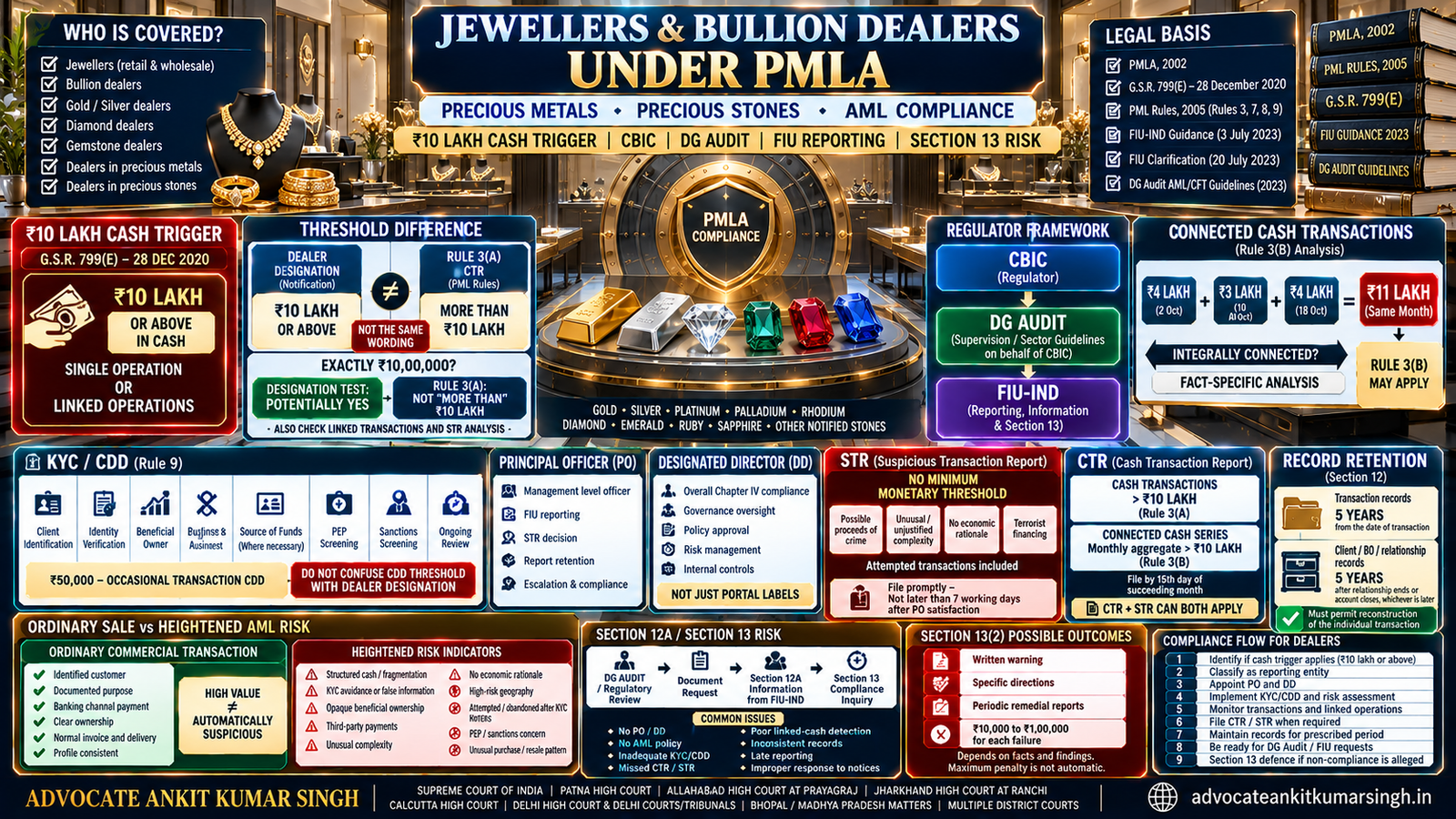
Create a sector-specific article for jewellers, bullion dealers and dealers in precious metals or stones that fall within the notified designated-business framework. Explain CBIC's regulator role, DG Audit supervision, relevant cash-transaction trigger, KYC/CDD, Principal Officer and Designated Director, STR/CTR obligations, record retention and the difference between ordinary jewellery sales and transactions that create heightened AML risk.
Legal research and analysis by Advocate Ankit Kumar Singh .
Direct Answer: When Does a Jeweller or Bullion Dealer Enter the PMLA Reporting-Entity Framework?
The Central Government notification dated 28 December 2020 notified dealers in precious metals and precious stones as persons carrying on a designated business or profession where they engage in:
A CASH TRANSACTION WITH A CUSTOMER OF ₹10 LAKH OR ABOVE
carried out:
- in a single operation; or
- in several operations that appear to be linked.
Accordingly:
AN EXPENSIVE JEWELLERY SALE DOES NOT BY ITSELF MAKE THE TRANSACTION A PMLA CASH-TRIGGER TRANSACTION.
The mode of payment and connected operations matter.
Which Businesses Does the Framework Potentially Cover?
The sector can include businesses dealing in:
- gold;
- silver;
- platinum;
- palladium;
- rhodium;
- diamonds;
- emeralds;
- rubies;
- sapphires;
- bullion;
- jewellery incorporating precious metals;
- precious stones; and
- other notified metals or stones where applicable.
The PMLA's statutory definitions should be checked rather than relying only on commercial descriptions used by the jewellery trade.
The Most Important Threshold Distinction: ₹10 Lakh “Or Above” vs “More Than ₹10 Lakh”
Two provisions must be kept separate.
1. Designated-Business Notification
The dealer notification uses:
₹10 LAKH OR ABOVE
in cash in a single or linked operation.
2. Rule 3(A) Cash Transaction Reporting
Rule 3(A) refers to:
MORE THAN ₹10 LAKH
in cash.
Practical Example
A customer buys jewellery and pays:
EXACTLY ₹10,00,000 IN CASH.
That amount can satisfy the designation notification's:
₹10 LAKH OR ABOVE
test.
But exactly ₹10 lakh does not, standing alone, satisfy Rule 3(A)'s:
MORE THAN ₹10 LAKH
CTR formulation.
This does not end the compliance analysis.
The dealer should still assess:
- connected transactions;
- CDD;
- customer risk;
- suspicious circumstances;
- attempted structuring; and
- other applicable obligations.
Connected Cash Transactions Cannot Be Analysed Invoice by Invoice Only
Rule 3(B) requires attention to a series of cash transactions that are:
- integrally connected;
- individually below ₹10 lakh;
- within one month; and
- together above ₹10 lakh.
Example
| Date | Cash Payment | Transaction |
|---|---|---|
| 2 October | ₹4 lakh | Gold purchase |
| 10 October | ₹3 lakh | Related order |
| 18 October | ₹4 lakh | Related order |
| Total | ₹11 lakh | Connected? |
The compliance question is not merely:
“WAS EACH INVOICE BELOW ₹10 LAKH?”
It is:
“WERE THE CASH OPERATIONS INTEGRALLY CONNECTED?”
CBIC Is the Regulator for Precious Metal and Precious Stone Dealers
The PML Rules expressly identify the:
CENTRAL BOARD OF INDIRECT TAXES AND CUSTOMS — CBIC
as the Regulator for dealers in precious metals and precious stones.
This is important because the PML Rules use the Regulator framework for:
- maintenance of information;
- KYC/CDD guidelines;
- risk-based measures;
- client identification;
- ongoing due diligence;
- record-keeping;
- transaction monitoring; and
- compliance procedures.
What Is DG Audit's Role?
FIU-IND's official sector guidance records that the:
DIRECTORATE GENERAL OF AUDIT
acting as regulator on behalf of CBIC, issued AML & CFT guidelines for precious-metal and precious-stone dealers in 2023.
The guidelines referenced by FIU-IND were:
- issued on 25 January 2023;
- updated on 17 February 2023; and
- updated again on 4 May 2023.
Therefore the technically accurate distinction is:
CBIC = REGULATOR UNDER THE PML RULES
while:
DG AUDIT = SUPERVISORY / IMPLEMENTATION ARM ACTING ON BEHALF OF CBIC UNDER THE SECTOR FRAMEWORK.
What Is FIU-IND's Role?
FIU-IND receives and analyses prescribed financial information.
For a precious-metal / stone reporting entity, the framework may involve:
- reporting-entity enrolment;
- Principal Officer communication;
- FINGate access;
- CTR;
- STR;
- other applicable Rule 3 reports;
- Section 12A information requests;
- compliance correspondence; and
- Section 13 proceedings where Chapter IV non-compliance is alleged.
Dealer Enrolment, Primary User and Principal Officer Are Not the Same Thing
FIU-IND's sector clarification addresses the enrolment of:
- dealers;
- associations;
- Nodal Officers; and
- Primary Users.
A Nodal Officer / Primary User can receive:
- messages;
- alerts;
- notifications; and
- sector information
through the relevant FIU communication mechanism.
But FIU's clarification expressly states that:
THE NODAL OFFICER / PRIMARY USER CANNOT SUBMIT REPORTS MERELY BY VIRTUE OF THAT ROLE.
The statutory filing framework centres on:
REPORTING ENTITY + PRINCIPAL OFFICER.
Principal Officer and Designated Director
Principal Officer
The Principal Officer must be an officer at:
MANAGEMENT LEVEL.
The role includes, depending upon the applicable framework:
- FIU reporting;
- transaction-reporting oversight;
- STR escalation;
- retaining reports furnished;
- responding to FIU processes; and
- operating the entity's reporting mechanism.
Designated Director
The Designated Director ensures:
OVERALL COMPLIANCE
with Chapter IV of PMLA and the Rules.
For example:
- company — duly authorised Managing Director / whole-time director;
- partnership — managing partner;
- proprietorship — proprietor;
- trust — managing trustee;
- other structures — person specified by the Rule.
Do Not Treat These as Portal Labels
The entity should preserve:
- appointment records;
- effective dates;
- FIU communications;
- FINGate status;
- responsibility matrix;
- reporting line;
- AML oversight records; and
- change history.
KYC and CDD: Jewellery Is a Product, Not an Exemption From Customer Due Diligence
Where the dealer is a reporting entity, Rule 9 establishes baseline CDD requirements.
These include client identification at:
- commencement of an account-based relationship;
- an occasional transaction of ₹50,000 or more;
- connected occasional transactions meeting the Rule; and
- international money transfer operations.
The reporting entity should:
- identify the client;
- verify identity;
- understand the purpose and intended nature where applicable;
- understand the customer's business;
- understand ownership and control;
- identify the beneficial owner;
- verify beneficial ownership;
- apply ongoing due diligence; and
- update KYC on a risk-sensitive basis.
Critical Safeguard
The ₹50,000 CDD threshold should not be confused with the notification determining whether a jeweller falls within the designated-business framework in the first place.
The sequence is:
REPORTING-ENTITY STATUS → THEN APPLICABLE KYC/CDD OBLIGATIONS.
Beneficial Ownership Matters in Jewellery Transactions Too
Where the customer is:
- a company;
- partnership;
- trust;
- other legal person; or
- person acting for another individual,
the reporting entity should not stop with the name on the invoice.
The CDD process may need to establish:
- who owns the entity;
- who controls it;
- who is actually directing the purchase;
- whether the buyer is acting for someone else; and
- whether the transaction is consistent with the customer's profile.
STR: Suspicion Has No ₹10 Lakh Minimum
The ₹10 lakh dealer notification does not create a ₹10 lakh minimum for suspicious-transaction analysis once the dealer is within the reporting-entity framework.
A suspicious transaction includes an attempted transaction which, in good faith:
- may involve proceeds of a scheduled offence regardless of value;
- appears unusually or unjustifiably complex;
- appears to have no economic rationale or bona fide purpose; or
- may involve financing of terrorism.
Therefore:
STR ≠ CASH THRESHOLD REPORT.
Example
A ₹3 lakh proposed jewellery purchase may warrant STR analysis where:
- false identity is provided;
- the buyer abandons the transaction after beneficial-owner questions;
- payment comes from unexplained third parties;
- transaction structure is unusually complex; or
- other facts create reasonable grounds of suspicion.
The amount alone does not decide the question.
CTR: When Does Cash Reporting Apply?
For a reporting entity, Rule 3(A) covers:
CASH TRANSACTIONS MORE THAN ₹10 LAKH.
Rule 3(B) also covers integrally connected monthly cash series where:
- each transaction is individually below ₹10 lakh; and
- monthly aggregate exceeds ₹10 lakh.
These Rule 3 categories are ordinarily reported:
BY THE 15TH DAY OF THE SUCCEEDING MONTH.
CTR + STR
Where the same cash transaction:
- meets the CTR rule; and
- also contains suspicious features,
both reporting analyses can apply.
CTR does not replace STR.
Ordinary Jewellery Sale vs Heightened AML Risk
| Ordinary Commercial Feature | Feature Requiring Heightened Review |
|---|---|
| Identified customer | Customer refuses or avoids identification |
| Payment through disclosed bank channel | Large or fragmented cash payments |
| Purchase matches customer profile | Value materially inconsistent with known profile |
| Simple buyer-payment structure | Unexplained third-party payments |
| Known beneficial owner | Opaque ownership or nominee-style structure |
| Normal wedding / personal / investment purpose | No apparent economic or bona fide purpose |
| Regular invoice and delivery | Unusual movement, rapid resale or circular activity |
| Routine geography | High-risk geographic or sanctions concern |
| KYC information provided normally | Transaction abandoned when KYC questions begin |
No single risk indicator automatically proves money laundering.
The reporting entity should conduct a:
FACT-SPECIFIC + RISK-BASED + DOCUMENTED ASSESSMENT.
Risk Assessment for the Jewellery and Bullion Sector
FIU-IND's sector guidance recognises that this industry ranges from:
- small family-owned businesses;
- retail jewellers;
- large multi-chain brands;
- B2B dealers; and
- specialised bullion / stone businesses.
There is therefore no one-size-fits-all AML system.
Risk assessment should consider, among other relevant factors:
- country / geographic risk;
- customer / counterparty risk;
- product / service risk;
- cash intensity;
- transaction value;
- delivery channel;
- ownership complexity;
- cross-border exposure;
- PEP exposure;
- sanctions exposure;
- high-value / unusual patterns; and
- business size and operating model.
The risk assessment should be:
- documented;
- kept current;
- linked to controls; and
- available to competent authorities where required.
Record Retention: A Jewellery Invoice Alone Is Not the Entire PMLA Record
Section 12 requires reporting entities to maintain transaction records in a manner capable of reconstructing individual transactions.
Relevant information includes:
- nature of transaction;
- amount;
- currency;
- date;
- parties;
- client identity;
- beneficial ownership;
- account / customer file;
- business correspondence;
- risk assessment;
- analysis performed; and
- applicable FIU-reporting records.
Transaction Records
Retain:
5 YEARS FROM THE DATE OF TRANSACTION.
Identity / Business-Relationship Records
Maintain applicable client-identity and relationship records:
5 YEARS AFTER THE BUSINESS RELATIONSHIP ENDS OR ACCOUNT IS CLOSED, WHICHEVER IS LATER.
Section 12A and DG Audit / FIU Information Requests
Where a dealer is treated as a reporting entity, the compliance record may later be examined through:
- DG Audit supervisory activity;
- regulatory questionnaire;
- document request;
- Section 12A request from Director, FIU-IND;
- follow-up clarification;
- Section 13 inquiry; or
- special audit where statutory conditions exist.
A dealer should therefore preserve:
- notice;
- date received;
- deadline;
- documents requested;
- documents supplied;
- cash-transaction register;
- Rule 3 reporting;
- KYC/CDD records;
- PO/DD documents;
- AML policy;
- risk assessment;
- FINGate evidence;
- training;
- STR decision records;
- reply;
- acknowledgement;
- follow-up;
- correction; and
- remediation evidence.
Section 13 Risk for Jewellers and Precious-Metal Dealers
Section 13 permits the Director to inquire into a reporting entity's Chapter IV obligations.
Potential inquiry issues for this sector may include:
- failure to identify reporting-entity status;
- failure to enrol / register appropriately;
- no Principal Officer;
- no Designated Director;
- appointments not communicated;
- absence of AML/CFT/CPF policy;
- inadequate risk assessment;
- incomplete KYC;
- beneficial ownership deficiencies;
- no monitoring of linked cash activity;
- missed CTR;
- missed STR;
- late filing;
- inadequate STR-detection system;
- incomplete record retention;
- inconsistent sales/cash records;
- inadequate response to information request;
- backdated remediation; or
- unsupported claims of historic compliance.
Possible Section 13(2) Measures
- written warning;
- specific compliance directions;
- periodic remedial reports; or
- monetary penalty of ₹10,000 to ₹1,00,000 for each failure.
Section 13 inquiry does not automatically mean that the maximum monetary penalty will be imposed.
But a jewellery business should not wait for a notice before reconstructing basic compliance.
Practical Compliance Matrix for Jewellers and Bullion Dealers
| Control | Question | Evidence |
|---|---|---|
| Classification | Did we cross the notified cash trigger? | Cash transaction review |
| Linked transactions | Can our systems aggregate related cash? | Monthly connected-cash register |
| Reporting Entity | Is enrolment complete? | FIU / FINGate record |
| Principal Officer | Properly appointed and communicated? | Appointment + FIU record |
| Designated Director | Overall oversight documented? | Appointment + governance records |
| KYC/CDD | Are customers and BOs properly identified? | CDD files |
| Risk Assessment | Is sector/customer/product risk documented? | Risk assessment |
| STR | Can suspicious activity be detected and escalated? | Alert / STR decision log |
| CTR | Are reportable cash transactions captured? | CTR / acknowledgement |
| Records | Can each transaction be reconstructed? | Invoice + payment + customer file |
| Training | Do sales/cashier/compliance teams know escalation rules? | Training records |
| Remediation | Are deficiencies tracked and tested? | Corrective-action tracker |
Precious-Metal Dealer PMLA Flowchart
For precious-metal and precious-stone dealers, the notified cash trigger determines entry into the designated-business framework, after which governance, KYC/CDD, monitoring, reporting and record-retention obligations must be addressed.Frequently Asked Questions
1. Are all jewellers reporting entities under PMLA?
Not merely because they sell jewellery. The 28 December 2020 notification applies to dealers in precious metals and precious stones where they engage in qualifying cash transactions of ₹10 lakh or above in a single operation or linked operations.
2. Does exactly ₹10 lakh cash make the dealer fall within the notification?
The notification uses “equal to or above” ₹10 lakh.
3. Does exactly ₹10 lakh automatically create a Rule 3(A) CTR?
Rule 3(A) uses “more than ₹10 lakh”. The notification trigger and CTR threshold should therefore be analysed separately.
4. What about several cash purchases below ₹10 lakh?
Linked-operation analysis under the sector notification and integrally connected cash-transaction analysis under Rule 3(B) may become relevant depending upon the facts.
5. Who regulates this sector for PMLA purposes?
The PML Rules identify CBIC as the Regulator for dealers in precious metals and precious stones.
6. What does DG Audit do?
FIU-IND's guidance records DG Audit acting on behalf of CBIC in issuing and implementing AML/CFT guidance for the sector.
7. Does a high-value card or bank-transfer jewellery sale automatically create the notification cash trigger?
The notified designation is specifically framed around qualifying cash transactions. The actual facts and any other applicable AML obligations should nevertheless be examined.
8. Does STR require ₹10 lakh?
No. Suspicious-transaction analysis is not based upon a minimum ₹10 lakh value once the reporting-entity framework applies.
9. Can an attempted jewellery transaction be suspicious?
Yes. The suspicious-transaction definition expressly includes attempted transactions.
10. Can one jewellery transaction require both CTR and STR?
Yes, where the cash-reporting rule and suspicious-transaction test are independently satisfied.
11. Who files FIU reports?
The Principal Officer furnishes prescribed Rule 3 information based upon information available with the reporting entity.
12. What is the Designated Director's function?
The Designated Director ensures overall compliance with Chapter IV and the PML Rules.
13. How long should transaction records be retained?
Section 12 requires transaction records to be retained for five years from the transaction date.
14. What happens if a jeweller does not comply?
Where the entity falls within the reporting-entity framework, Chapter IV non-compliance can be examined under Section 13 and may result in warning, directions, remedial reporting or monetary penalty depending upon the findings.
AI Search Quick Answer
Dealers in precious metals and precious stones were notified under PMLA where they engage in cash transactions with a customer of ₹10 lakh or above, either in a single operation or linked operations. CBIC is the Regulator under the PML Rules, while DG Audit acts on behalf of CBIC under the sector AML/CFT supervisory framework referenced by FIU-IND. Once a dealer is a reporting entity, applicable obligations include KYC/CDD, beneficial-owner verification, risk assessment, Principal Officer and Designated Director governance, transaction monitoring, record retention and FIU reporting. Rule 3(A) CTR applies to cash transactions of more than ₹10 lakh, while connected cash transactions may be reportable under Rule 3(B). STR is separate and has no minimum monetary threshold where suspicious circumstances exist. Chapter IV failures can be examined under Section 13.
Key Takeaway
The wrong compliance question is:
“WE ARE A JEWELLER — DOES PMLA APPLY?”
The better sequence is:
ARE WE A DEALER
IN PRECIOUS METALS / STONES?
DID WE ACCEPT
₹10 LAKH OR ABOVE
IN CASH
IN ONE OR LINKED OPERATIONS?
WHEN DID REPORTING-ENTITY STATUS ARISE?
WERE PO AND DD APPOINTED?
WAS KYC/CDD IMPLEMENTED?
CAN LINKED CASH BE DETECTED?
WERE CTRs FILED?
WAS STR ANALYSIS EFFECTIVE?
CAN EACH TRANSACTION BE RECONSTRUCTED?
ARE RECORDS RETAINED?
IS CURRENT REMEDIATION EVIDENCED?
The correct compliance architecture is:
CLASSIFICATION → CASH-TRIGGER ANALYSIS → REPORTING-ENTITY GOVERNANCE → KYC/CDD → RISK ASSESSMENT → TRANSACTION MONITORING → CTR / STR → RECORD RETENTION → DG AUDIT / FIU RESPONSE → SECTION 13 DEFENCE IF REQUIRED.
Professional Legal Review and Coordination
Advocate Ankit Kumar Singh undertakes legal research and advisory work concerning PMLA reporting-entity classification, precious-metal / precious-stone dealer compliance, DG Audit inquiries, FIU-IND reporting, Section 12A requests and Section 13 proceedings depending upon the facts, jurisdiction and accepted professional engagement.
A dealer compliance review may include:
- G.S.R. 799(E) classification;
- cash-transaction history;
- linked-operation review;
- reporting-entity effective date;
- FIU/FINGate enrolment;
- Principal Officer;
- Designated Director;
- KYC/CDD;
- beneficial ownership;
- risk assessment;
- customer-risk categorisation;
- PEP/sanctions process;
- cash aggregation;
- CTR review;
- STR decision framework;
- historic reporting look-back;
- record-retention review;
- DG Audit response;
- Section 12A response;
- Section 13 show cause drafting;
- personal hearing preparation;
- remediation plan; and
- Section 26 appellate strategy where required.
Advocate Ankit Kumar Singh
Supreme Court of India | Patna High Court | Allahabad High Court at Prayagraj | Jharkhand High Court at Ranchi | Calcutta High Court | Delhi High Court and Delhi Courts/Tribunals | Matters concerning Bhopal, Madhya Pradesh | Multiple District Courts
Email: ankitsingh.legum@gmail.com
Website: advocateankitkumarsingh.in
Professional engagement depends upon the facts, statutory classification, applicable transaction period, regulator jurisdiction and accepted engagement. No Section 13 closure, warning-only result, penalty reduction or other regulatory outcome can be guaranteed.
Official Sources
- FIU-IND — Prevention of Money-Laundering Act, 2002
- FIU-IND — Prevention of Money-laundering (Maintenance of Records) Rules, 2005
- FIU-IND — Guidance on Reporting by Dealers in Precious Metals and Precious Stones dated 3 July 2023
- FIU-IND — Clarification dated 20 July 2023 on Guidance for Dealers in Precious Metals and Precious Stones
- FIU-IND — Official PMLA Frequently Asked Questions
- FIU-IND — AML/CFT/CPF Guidance and Downloads
Add Advocate Ankit Kumar Singh as a Preferred Source on Google
Readers who want to see more legal research, court updates, cyber law, PMLA, ED, criminal-law and litigation content from Advocate Ankit Kumar Singh can add advocateankitkumarsingh.in as a Preferred Source on Google.
Add advocateankitkumarsingh.in as a Preferred Source on Google
Conclusion
The PMLA framework for jewellery, bullion and precious-stone businesses is not a prohibition on legitimate high-value trade.
It is a risk-control framework directed particularly at the vulnerability of portable high-value assets and cash transactions.
The first legal question is:
DOES THE DEALER FALL WITHIN THE NOTIFIED DESIGNATED-BUSINESS FRAMEWORK?
After that, the compliance questions become:
WHO IS THE CUSTOMER? + WHO IS THE BENEFICIAL OWNER? + HOW WAS THE TRANSACTION FUNDED? + ARE OPERATIONS LINKED? + IS THE ACTIVITY CONSISTENT WITH THE CUSTOMER PROFILE? + IS THE TRANSACTION REPORTABLE? + IS THERE A SUSPICIOUS FEATURE? + CAN THE TRANSACTION BE RECONSTRUCTED?
An ordinary jewellery sale is not suspicious merely because it is expensive.
But:
STRUCTURED CASH, OPAQUE OWNERSHIP, UNEXPLAINED THIRD-PARTY PAYMENTS, UNJUSTIFIED COMPLEXITY, FALSE KYC, NO ECONOMIC RATIONALE OR CRIMINAL / TERRORIST-FINANCING INDICATORS
require a much stronger AML response.
The most defensible model is:
CLASSIFY CORRECTLY + KNOW THE CASH THRESHOLD + APPOINT PO/DD + IMPLEMENT KYC/CDD + ASSESS RISK + MONITOR TRANSACTIONS + FILE CTR/STR WHEN REQUIRED + KEEP THE RECORD + RESPOND ACCURATELY TO DG AUDIT / FIU.
Professional / Legal Disclaimer: This article provides general legal and regulatory information concerning the PMLA framework applicable to dealers in precious metals and precious stones. Whether a particular jeweller, bullion dealer or stone dealer is a reporting entity depends upon the statutory notification, cash transaction history, linked operations, legal structure, applicable period and current PMLA/PML Rules and regulatory guidance. Transaction thresholds under the designation notification, Rule 3, CDD provisions and other laws should not be conflated. A live DG Audit, CBIC or FIU-IND matter should be reviewed from the actual notice, transaction records and current law. No regulatory outcome can be guaranteed.