PMLA • ED • Spouse Gifts • Gift Recipient • Source of Funds • Knowledge
Spouse / Gift Recipient Under PMLA: “My Spouse Gifted Me Money or Property — Am I Expected to Investigate Where My Spouse Got It From?”
Research and legal analysis by Advocate Ankit Kumar Singh
Research updated: 22 August 2026
Direct Answer
PMLA does not expressly impose a general rule that a husband or wife must conduct a formal source-of-funds investigation every time the other spouse gives an ordinary matrimonial gift.
Marriage itself does not create an express statutory presumption that one spouse knows the source of every rupee, investment or property owned by the other.
But that does not mean that every transfer described as a “gift” becomes legally irrelevant.
If Enforcement Directorate alleges that the gifted money or property represents proceeds of crime, the inquiry may focus upon:
- what was gifted;
- when it was gifted;
- how the donor acquired it;
- whether the donor had apparent financial capacity;
- what explanation was given to the recipient;
- what the recipient actually knew;
- whether obvious red flags existed;
- whether the recipient participated in routing or documentation;
- whether the donor retained real control after the gift;
- whether knowledge arose only later; and
- what the recipient did after acquiring such knowledge.
The correct legal inquiry is therefore not:
“You are married, therefore you must have known.”
It is:
“What did this recipient know, when did that knowledge arise, and what did the recipient actually do with the property?”
Contents
- Three questions that must remain separate
- Gift under property law
- Section 3 PMLA and gift recipients
- Marriage and knowledge
- Due-diligence spectrum
- Red-flag matrix
- Timing and chronology
- Later-acquired knowledge
- Beneficial control after gift
- Section 24 and presumptions
- Section 50 summons
- Bank freezing
- Attachment and adjudication
- Arrest and bail
- Evidence file
- Practical response strategy
- Frequently asked questions
1. Three Questions That Must Not Be Mixed Together
A spousal gift can produce three different legal inquiries.
| Question | What Must Be Examined? |
|---|---|
| Was there a genuine gift? | Donor, donee, voluntariness, acceptance, transfer, documentation and possession. |
| Is the gifted property alleged to be proceeds of crime? | Scheduled offence, criminal activity, source, acquisition history and fund trail. |
| Did the recipient personally commit Section 3 money-laundering? | Individual knowledge, assistance, possession, acquisition, use, concealment, projection, claiming and later conduct. |
The presence of one issue does not automatically resolve the others.
For example, a legally valid gift deed may prove that property was genuinely transferred from one spouse to another.
It does not automatically prove the source from which the donor originally acquired that property.
Similarly, if ED alleges that property is proceeds of crime, that does not automatically establish that the recipient spouse possessed the state of mind necessary for personal culpability under Section 3.
2. What Is a “Gift” Under the Transfer of Property Act?
Section 122 of the Transfer of Property Act, 1882 defines a gift as a voluntary transfer of certain existing movable or immovable property, without consideration, from the donor to the donee, accepted by or on behalf of the donee.
For immovable property, Section 123 requires the transfer to be effected by a registered instrument signed by or on behalf of the donor and attested by at least two witnesses.
For movable property, Section 123 recognises transfer through the methods stated in the provision, including delivery.
These provisions answer questions concerning the legal form and validity of the gift.
They do not automatically answer:
Where did the donor obtain the property being gifted?
3. A Valid Gift Is Not Automatically a Clean-Source Certificate
Consider the following allegation:
ALLEGED SCHEDULED OFFENCE
          ↓
ALLEGED PROCEEDS OF CRIME
          ↓
PROPERTY PURCHASED
          ↓
PROPERTY GIFTED TO SPOUSE
The gift may be legally valid as a transfer.
But if ED alleges that the donor purchased the property from proceeds of crime, execution of a gift deed does not itself change the alleged historical source.
Conversely:
PROPERTY ALLEGED TO BE TAINTED
        ≠
DONEE AUTOMATICALLY KNEW
THE PROPERTY WAS TAINTED
Source and recipient knowledge remain separate evidentiary questions.
4. Section 3 PMLA: Why a Gift Recipient Can Become Relevant
Section 3 applies where a person directly or indirectly attempts to indulge, knowingly assists, knowingly becomes a party or is actually involved in a process or activity connected with proceeds of crime.
The statutory explanation includes:
- concealment;
- possession;
- acquisition;
- use;
- projecting as untainted; and
- claiming as untainted.
A person who receives property may therefore become relevant to a PMLA investigation.
But receipt itself does not answer:
- whether the property was actually proceeds of crime;
- whether the recipient knew its alleged source;
- whether the recipient merely received it in ordinary family life; or
- whether the recipient participated in a scheme to acquire, use, conceal or project it.
5. Pavana Dibbur: A Gift Recipient Need Not Have Participated in the Predicate Offence
The Supreme Court in Pavana Dibbur v. Directorate of Enforcement, 2023 INSC 1029, clarified that a person accused under Section 3 PMLA need not necessarily also be an accused in the scheduled offence.
A person unconnected with the original predicate crime may, depending upon the facts, later become relevant under Section 3 if that person knowingly participates in a process concerning proceeds of crime.
For spouses, this creates a balanced principle.
The recipient cannot automatically say:
“I was never named in the original FIR, therefore PMLA can never apply to me.”
But ED also cannot logically complete the analysis merely by saying:
“You are the wife / husband of the accused, therefore you knew.”
The recipient's own role remains the central question.
6. Marriage Does Not Create One Shared Financial Mind
Marriage naturally involves trust, shared household arrangements and sometimes joint property.
But PMLA does not expressly create a rule stating that:
- a wife automatically knows every source of her husband's income;
- a husband automatically knows every source of his wife's property;
- joint residence proves shared criminal knowledge;
- joint household expenditure proves money-laundering; or
- every gift between spouses requires formal forensic due diligence.
Spouses may have entirely different financial arrangements.
One spouse may:
- run every business;
- manage investment accounts;
- control companies;
- operate all bank accounts; and
- take all financial decisions.
The other may:
- work in an unrelated profession;
- be financially dependent;
- manage only household expenditure;
- have no company role;
- have no access to business books; and
- receive periodic family gifts without knowing the underlying source of every asset.
Those situations should not be treated as evidentially identical.
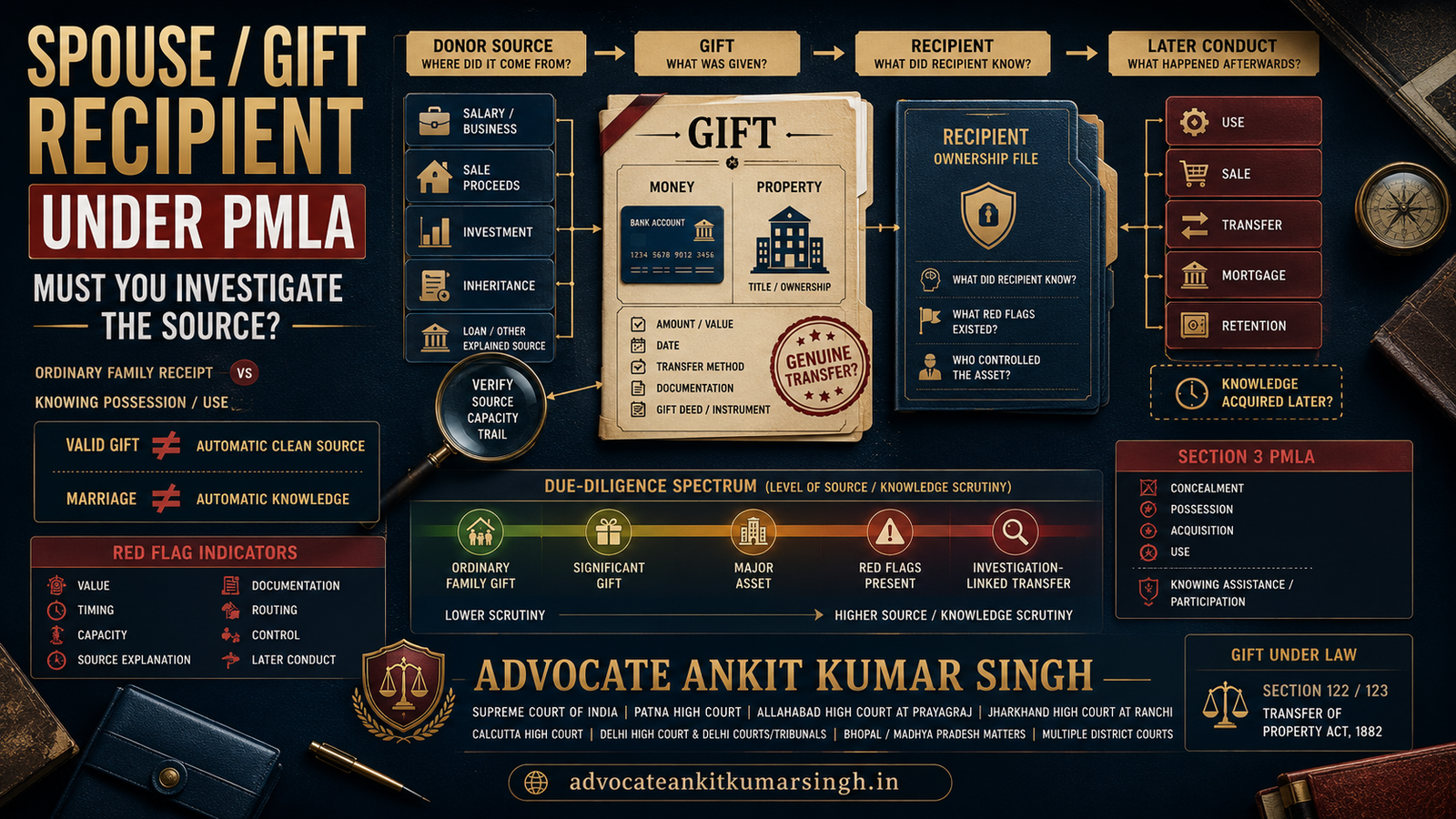
7. The Spousal Gift Due-Diligence Spectrum
PMLA does not prescribe a numerical spouse-KYC formula.
There is no statutory rule saying that a gift above a particular rupee amount creates automatic criminal knowledge.
But from an evidentiary perspective, the degree of source scrutiny naturally changes with circumstances.
| Level | Illustrative Situation | Practical Evidentiary Approach |
|---|---|---|
| Level 1 — Ordinary Family Receipt | Customary household transfer, modest jewellery or ordinary gift consistent with known family finances. | Weak basis by itself for inferring criminal knowledge. |
| Level 2 — Significant but Explainable Gift | Substantial bank transfer from a spouse with visible salary, business, property or investment capacity. | Basic source documentation and banking trail become useful. |
| Level 3 — Major Asset Gift | House, land, high-value securities, large capital transfer or major business interest. | Title history, donor acquisition records, bank trail, source documents and tax/accounting consistency become increasingly important. |
| Level 4 — Red-Flag Gift | Gift far beyond apparent donor capacity, unexplained cash, contradictory source explanation or unusual intermediary routing. | Recipient's knowledge, questions asked and surrounding circumstances receive closer scrutiny. |
| Level 5 — Investigation-Linked Transfer | Gift after search, freezing, attachment concerns, summons, FIR or specific knowledge that property is being investigated. | Timing, purpose, onward movement and recipient knowledge become highly significant. |
This spectrum is an analytical tool—not a statutory presumption of guilt.
8. Factor One: Amount and Nature of the Gift
A modest matrimonial gift and a multi-crore asset transfer may both legally be gifts, but they do not necessarily create the same factual questions.
Relevant considerations may include:
- value;
- nature of property;
- family's historical financial profile;
- frequency of similar gifts;
- whether the property dramatically increases the recipient's net worth;
- whether payment is through banking channels or unexplained cash;
- whether the recipient immediately transfers it onward; and
- whether the gift is linked to a particular business transaction.
Amount alone does not establish knowledge.
But amount can affect what explanation is objectively plausible.
9. Factor Two: Donor's Financial Capacity
A recipient spouse may not know the donor's exact balance sheet.
But apparent financial capacity can still become relevant.
Compare:
“A spouse with an established business gifts a property consistent with the family's known economic position.”
with:
“A spouse with modest known income unexpectedly gifts a ₹20 crore property and refuses to give any source explanation.”
Useful documents may include:
- salary records;
- business financial statements;
- property sale deeds;
- investment redemption records;
- inheritance records;
- bank statements;
- loan disbursement records;
- dividend or partnership income records;
- capital accounts; and
- income-tax filings.
10. Factor Three: Source Explanation
Consistency matters.
A straightforward source explanation may look like:
“I sold my pre-existing property and transferred part of the sale proceeds to you. Here is the sale deed and corresponding bank credit.”
A materially different situation may arise where the recipient is told:
“Do not ask where this came from. Put it in your account and we will prepare an explanation later.”
Changing explanations can become important:
BUSINESS PROFIT
      ↓
LOAN
      ↓
INHERITANCE
      ↓
OLD FAMILY GIFT
      ↓
CASH SAVINGS
Inconsistency alone does not prove laundering.
But repeated unexplained changes can affect credibility and knowledge analysis.
11. Factor Four: Timing Can Change the Entire Evidentiary Picture
Timing may be one of the strongest circumstantial factors.
A gift made in the ordinary course years before an alleged offence may present a very different issue from a transfer made:
- immediately after alleged criminal proceeds enter the donor's account;
- after a police FIR;
- after an ED search;
- after freezing of another account;
- after a Section 50 summons;
- after legal advice that assets are under scrutiny;
- shortly before anticipated attachment; or
- after specific notice that authorities are tracing the property.
Timing does not establish guilt by itself.
But it can materially strengthen or weaken competing explanations.
12. Factor Five: Documentation
For a substantial money gift, useful contemporaneous material may include:
- bank transfer;
- gift letter or declaration where appropriate;
- source document;
- donor bank statement;
- recipient bank statement;
- tax/accounting records; and
- communication explaining the transfer.
For immovable property:
- registered gift deed;
- donor title document;
- original acquisition documents;
- purchase payment trail;
- registration records;
- loan documents;
- possession records;
- mutation/property records where applicable; and
- later income or sale records.
Documentation created contemporaneously is generally easier to evaluate than material created only after investigation begins.
13. False or Backdated Gift Documents Are a Major Red Flag
A genuine family transfer does not require an invented history.
Potentially serious red flags include:
- backdated gift deed;
- false acknowledgement of cash;
- fabricated source documents;
- false recital about donor capacity;
- documents inconsistent with bank records;
- retrospective family resolutions;
- false tax entries;
- sham loan documentation replacing the original gift explanation;
- different source stories before different authorities; and
- digital metadata showing documents were created after scrutiny began.
If the recipient personally participates in creating a false explanation, the matter moves far beyond passive family receipt.
14. Spousal Gift Red-Flag Matrix
| Factor | Lower Concern | Higher Scrutiny |
|---|---|---|
| Value | Consistent with known finances | Exceptionally disproportionate |
| Source explanation | Simple and documented | Changing or objectively implausible |
| Transfer method | Direct bank transfer / valid title transfer | Multiple unexplained intermediary accounts |
| Timing | Ordinary family context | Immediately after investigation or tracing warning |
| Documentation | Contemporaneous | Retrospective / backdated / contradictory |
| Control | Donee genuinely controls gifted asset | Donor secretly retains complete control |
| Recipient conduct | Transparent, consistent conduct | False statement, concealment or onward layering |
| Knowledge | No specific warning known | Specific source warning ignored or concealed |
15. Who Controlled the Property After the Gift?
Legal ownership and beneficial control may diverge.
For immovable property, ask:
- Who has possession?
- Who receives rent?
- Who pays maintenance?
- Who pays property tax?
- Who retains the original title documents?
- Who chooses tenants?
- Who decides whether the property is sold?
- Who receives sale proceeds?
- Who pays the loan or mortgage?
For gifted money:
- Who controls internet banking?
- Who chooses investments?
- Can the donee use the funds independently?
- Was the money immediately transferred back?
- Did the donor continue to direct every movement?
If the donee is merely the recorded owner while the donor retains complete practical control, investigators may examine whether the gift reflects genuine transfer or nominal holding.
16. Ordinary Household Benefit Is Not the Same as Transaction Control
A spouse may benefit from:
- household expenses;
- medical costs;
- children's education;
- ordinary travel;
- family residence;
- insurance premiums; and
- routine matrimonial support.
That does not automatically show that the recipient spouse knew the source of every family rupee.
The evidentiary question becomes stronger where the spouse:
- controls the disputed asset;
- participated in acquiring it;
- made the source declaration;
- helped conceal ownership;
- participated in onward routing; or
- personally created the explanation presented as legitimate source.
17. Knowledge Must Be Dated: When Did the Recipient Actually Learn the Source?
A useful chronology should identify the recipient's state of knowledge at every stage.
| Stage | Event | Knowledge at That Time |
|---|---|---|
| D1 | Gift proposed | _____ |
| D2 | Gift received | _____ |
| D3 | First warning / red flag | _____ |
| D4 | Police / ED investigation becomes known | _____ |
| D5 | Later sale / use / transfer | _____ |
This prevents knowledge acquired later from being automatically backdated to the original receipt.
18. Later Knowledge Can Change the Analysis
Suppose a spouse receives a property gift believing that it was purchased from lawful business income.
Two years later, the recipient receives specific information that ED alleges the property was purchased from proceeds of crime.
The legal significance of what happens next may be very different.
Compare:
- preserving the records;
- not altering ownership;
- seeking legal advice;
- responding truthfully;
with:
- immediately transferring the property to a child;
- creating a backdated family arrangement;
- selling it and routing the proceeds through relatives;
- creating a false loan explanation;
- destroying source records;
- changing tax/accounting descriptions; or
- making false declarations about acquisition.
An initially innocent receipt does not logically mean that all subsequent conduct is irrelevant.
19. The Knowledge Timeline Test
GIFT RECEIVED
      ↓
WHAT DID RECIPIENT KNOW THEN?
      ↓
NO SPECIFIC RED FLAG?
      ↓
LATER WARNING / INVESTIGATION?
      ↓
WHAT NEW INFORMATION WAS LEARNED?
      ↓
WHAT DID RECIPIENT DO AFTERWARDS?
      ↓
PRESERVE / EXPLAIN
OR
TRANSFER / CONCEAL / FABRICATE?
The central principle is:
knowledge should be analysed at the time of the conduct alleged.
20. Section 24 PMLA Does Not Create a General “Marriage = Knowledge” Presumption
Section 24 creates a statutory burden framework in proceedings relating to proceeds of crime.
In the case of a person charged under Section 3, the Authority or Court shall, unless the contrary is proved, presume that such proceeds of crime are involved in money-laundering.
For another person, the Authority or Court may draw the presumption provided by the section.
But Section 24 does not expressly state:
“A husband is presumed to know the criminal source of his wife's property.”
or:
“A wife is presumed to know the criminal source of every asset held by her husband.”
The statutory burden should not be converted into a separate presumption of collective marital knowledge that the text itself does not create.
21. A Gift Recipient Can Still Need to Explain the Source Before the Adjudicating Authority
Where property has been attached, seized or frozen and proceedings reach the Adjudicating Authority, Section 8 may require the person concerned to indicate the sources of income, earnings or assets by means of which the property was acquired and to produce supporting evidence.
For a spouse/gift recipient, this may require reconstructing both:
- the donor's source of acquiring the asset; and
- the circumstances in which the recipient acquired the asset by gift.
The fact that the donee did not personally earn the purchase price does not make source documentation irrelevant.
The donee's explanation may be:
“I acquired this property by gift from my spouse.”
But the next question may still be:
“How did the donor acquire it?”
22. Section 50 Summons: Why ED May Call the Recipient Spouse
Section 50 gives specified ED authorities power to summon persons considered necessary to give evidence or produce records during an investigation or proceeding under PMLA.
A gift recipient may be asked about:
- relationship with donor;
- date of gift;
- nature and value of property;
- source explanation given by donor;
- bank transfers;
- gift deed;
- property possession;
- loan repayment;
- tax records;
- control after transfer;
- subsequent sale or investment;
- communications about source;
- knowledge of the predicate case; and
- later conduct after investigation began.
Receipt of a Section 50 summons does not itself establish that the spouse is accused of money-laundering.
The person may be called because he or she holds relevant records or is the recorded owner of questioned property.
23. Preparing for a Section 50 Examination: Build a Clean Gift Chronology
Before giving broad answers from memory, reconstruct:
- when the donor acquired the property;
- how it was acquired;
- when the gift was discussed;
- when documentation was prepared;
- when the gift became effective;
- when possession changed;
- when bank entries occurred;
- when the recipient first learned of any criminal allegation;
- when ED/police scrutiny became known; and
- what happened after that date.
The recipient should carefully distinguish:
WHAT I PERSONALLY KNEW

from

WHAT MY SPOUSE TOLD ME

from

WHAT I ASSUMED

from

WHAT I LEARNED ONLY AFTER THE INVESTIGATION
The difference can be crucial.
24. Do Not Invent Knowledge You Never Had — and Do Not Deny What Records Clearly Show
A spouse may create unnecessary difficulty by over-answering.
For example:
“I knew the entire business was lawful.”
may be an unsafe statement if the recipient had no knowledge of the business at all.
A more precise factual answer might be:
“I was not involved in the business. I understood from my spouse that the gift came from business income, but I did not examine the company's underlying accounts.”
Conversely, where records show that the recipient personally approved company transfers, signed source documents or participated in meetings, an unrealistic claim of complete ignorance can damage credibility.
25. Digital Evidence Can Individualise Knowledge
In modern family-finance investigations, electronic records may be highly relevant.
Examples include:
- WhatsApp messages;
- email;
- banking notifications;
- property documents shared electronically;
- accounting files;
- messages with accountants;
- messages with brokers or sellers;
- shared bank login records;
- device records;
- document metadata;
- cloud files; and
- digital signatures.
These records can help distinguish:
“Please sign the gift deed.”
from:
“We need to move this property into your name before ED traces it.”
The evidentiary character is obviously different.
26. What If ED or Another Agency Freezes the Recipient's Bank Account?
Where a questioned gift was received through a bank account, authorities may focus on that account or on the disputed amount.
The immediate factual questions should include:
- What exact credit is disputed?
- Who transferred it?
- What was the date?
- What explanation accompanied the transfer?
- Was the entire account frozen or only a specified amount?
- What unrelated lawful funds exist in the account?
- Was the gifted amount retained?
- Was it invested?
- Was it retransferred to the donor?
- Was it transferred to a third person?
A recipient should prepare a transaction-specific reconciliation rather than merely saying:
“This is my personal account, so ED cannot question it.”
27. Mixed Account: Gift Money and Independent Funds
The recipient's account may contain:
- salary;
- professional income;
- investment redemption;
- earlier savings;
- household transfers;
- the questioned gift; and
- other unrelated credits.
Create a chronological ledger:
| Date | Credit | Source | Gift? | Subsequent Use |
|---|---|---|---|---|
| _____ | ₹_____ | Salary | No | _____ |
| _____ | ₹_____ | Spouse | Yes | _____ |
| _____ | ₹_____ | Investment | No | _____ |
The aim is to avoid treating the entire account as one undifferentiated pool without examining individual transactions.
28. Gifted Property and Provisional Attachment
Where ED alleges that the property itself represents proceeds of crime, it may become the subject of attachment proceedings under the statutory PMLA framework.
The recipient spouse may need to address:
- whether the donor's acquisition money was actually proceeds of crime;
- whether the property identified by ED is the correct property;
- whether clean and allegedly tainted funds were mixed;
- whether the valuation is accurate;
- whether an independent lawful contribution exists;
- whether the recipient acquired any pre-existing independent interest;
- whether the fund trail is complete;
- whether the property falls within the statutory definition relied upon; and
- whether the statutory attachment requirements are satisfied.
Most importantly:
ATTACHABILITY OF PROPERTY
        ≠
AUTOMATIC PERSONAL GUILT
OF THE DONEE
29. Section 8 Adjudication: What the Donee Should Be Ready to Show
If proceedings reach the Adjudicating Authority, a gift recipient may require a structured source file including:
- gift deed or gift documentation;
- donor title history;
- donor purchase payment trail;
- donor financial capacity;
- bank statements;
- loan documents;
- sale proceeds, if relied upon;
- inheritance documents, if relied upon;
- business/salary records, if relied upon;
- tax records;
- proof of actual acceptance;
- proof of possession/control;
- chronology;
- recipient's independent source records, if relevant;
- subsequent income or expenditure from the property; and
- evidence concerning the recipient's knowledge.
30. Arrest Risk: Gift Recipient Status Alone Is Not the Test
Section 19 PMLA contains the power of arrest subject to the statutory conditions stated in that provision.
If ED seeks to treat the recipient as personally involved under Section 3, the important allegations should be identified precisely:
- What proceeds of crime are alleged?
- What did the recipient know?
- When was the knowledge acquired?
- What act constituted knowing assistance?
- Did the recipient participate in acquisition?
- Was there concealment?
- Was a false source projected?
- Was the property transferred after knowledge?
- Was the recipient merely the passive donee or an active participant?
Being the wife, husband or family member of another accused person is not, by itself, the complete Section 3 analysis.
31. Section 45 Bail: Build the Recipient-Specific Record
Where arrest occurs and Section 45 applies, a recipient spouse should not rely only upon:
“I am only the wife.”
or:
“I am only the husband.”
A stronger factual record may examine:
- absence from the scheduled offence;
- ordinary family context of the gift;
- documented gift chronology;
- lack of business involvement;
- lack of control over donor accounts;
- independent professional or financial identity;
- absence of false documentation;
- absence of onward layering;
- absence of hidden beneficial structures;
- date when knowledge first arose;
- conduct after knowledge arose;
- cooperation with investigation;
- documents already in ED custody; and
- person-specific legal authorities.
Bail remains case-specific, and no outcome can be guaranteed.
32. Stage-Wise Spouse / Gift Recipient PMLA Lifecycle
SCHEDULED OFFENCE ALLEGED
        ↓
PROCEEDS OF CRIME IDENTIFIED BY ED
        ↓
MONEY / PROPERTY TRACED TO SPOUSE
        ↓
QUESTION:
SALE / LOAN / GIFT / NOMINEE HOLDING?
        ↓
SECTION 50 SUMMONS / RECORDS
        ↓
SOURCE + GIFT + KNOWLEDGE CHRONOLOGY
        ↓
BANK / DIGITAL / TITLE EVIDENCE
        ↓
FREEZE / SEIZURE / ATTACHMENT IF INVOKED
        ↓
SECTION 8 ADJUDICATION
        ↓
PERSON-SPECIFIC SECTION 3 ANALYSIS
        ↓
ARREST / SECTION 45 BAIL IF APPLICABLE
        ↓
SPECIAL COURT / TRIAL
        ↓
APPELLATE / HIGH COURT REMEDIES
AS LEGALLY AVAILABLE
33. Spouse / Gift Recipient Evidence File
Depending upon the transaction, preserve:
- registered gift deed;
- gift declaration or contemporaneous correspondence;
- donor's title document;
- original purchase deed;
- donor bank statement;
- recipient bank statement;
- purchase payment trail;
- loan sanction and disbursement;
- EMI records;
- salary statements;
- business financials;
- income-tax returns;
- investment statements;
- property sale records;
- inheritance documents;
- capital accounts;
- tax and accounting treatment;
- mutation/property tax records;
- possession evidence;
- rent receipts;
- communications regarding source;
- communications regarding gift purpose;
- messages showing who controlled the asset;
- chronology of police/ED proceedings;
- records showing when recipient first learned of investigation;
- subsequent transfer records, if any;
- records proving independent recipient funds, if relevant;
- documents establishing donor's financial capacity; and
- complete source-of-funds reconciliation.
34. Practical Response Strategy
Step 1 — Identify the Exact Property
Do not answer a broad allegation about “family assets”. Identify the specific money, land, flat, securities, jewellery or company interest under scrutiny.
Step 2 — Establish the Gift
Identify when, how and on what terms the property was transferred.
Step 3 — Trace the Donor's Acquisition
A gift explanation is incomplete if the donor's own acquisition source is unknown and becomes the subject of ED's case.
Step 4 — Date Recipient Knowledge
Identify the exact point when source concerns became known.
Step 5 — Identify Red Flags Existing Before Receipt
Do not use hindsight to create red flags that the recipient did not possess at the time.
Step 6 — Examine Control
Determine whether the gift was genuine or whether the donor retained actual beneficial control.
Step 7 — Analyse Later Conduct
Later transfer, concealment or false documentation may have a separate evidentiary significance.
Step 8 — Separate Property Defence From Criminal Defence
The argument against attachment and the argument against personal Section 3 culpability may overlap, but they are not identical.
35. Recipient Knowledge Matrix
| Issue | Evidence Supporting Ordinary Receipt | Evidence Supporting Greater Knowledge |
|---|---|---|
| Financial capacity | Donor visibly capable | Gift wholly inconsistent with known capacity |
| Source explanation | Consistent documented explanation | Recipient helps create changing false explanation |
| Timing | Ordinary family chronology | Transfer after specific tracing warning |
| Recipient role | Passive donee | Recipient designed or negotiated transfer |
| Control | Donee genuinely controls property | Donor retains secret control |
| Later conduct | Records preserved | Asset retransferred / records fabricated after knowledge |
36. What Not to Do After an ED Issue Arises
- Do not backdate a gift deed.
- Do not create a fictitious loan.
- Do not invent a cash-gift story.
- Do not alter bank records.
- Do not change tax explanations merely to fit the investigation.
- Do not delete messages.
- Do not move property to another relative merely to defeat tracing.
- Do not create a false sale agreement.
- Do not fabricate donor financial capacity.
- Do not destroy title documents.
- Do not coach family members to repeat an artificial common explanation.
- Do not make statements inconsistent with documentary records.
A difficult but truthful chronology is generally more defensible than a perfect-looking history created after scrutiny begins.
37. The 12-Point Spouse / Gift Recipient Test
- Property Test: What exactly was gifted?
- Source Test: How did the donor acquire it?
- Capacity Test: Was the donor apparently capable of making the gift?
- Documentation Test: Was the gift contemporaneously documented?
- Timing Test: Did the gift precede or follow investigation-related events?
- Knowledge Test: What did the recipient know at receipt?
- Red-Flag Test: What objective warning signs existed?
- Control Test: Who actually controlled the property after transfer?
- Participation Test: Did the recipient merely accept or actively structure the transaction?
- Explanation Test: Did the recipient participate in a false source explanation?
- Later-Knowledge Test: Did knowledge arise only after receipt?
- Later-Conduct Test: What happened after that knowledge arose?
No single factor automatically determines culpability.
38. Visual Flowchart: Spouse / Gift Recipient Under PMLA
A transaction-specific framework for distinguishing an ordinary family gift from alleged knowing possession, use, concealment or participation under PMLA.Frequently Asked Questions
Am I legally required to investigate every gift received from my spouse?
PMLA does not expressly impose a general source-investigation requirement upon spouses merely because an ordinary matrimonial gift is