PMLA • Section 2(1)(u) • Composite FIR • Mixed Contracts • Proceeds Quantification
One Transaction Contains Scheduled and Non-Scheduled Allegations: How Should Alleged Proceeds of Crime Be Apportioned?
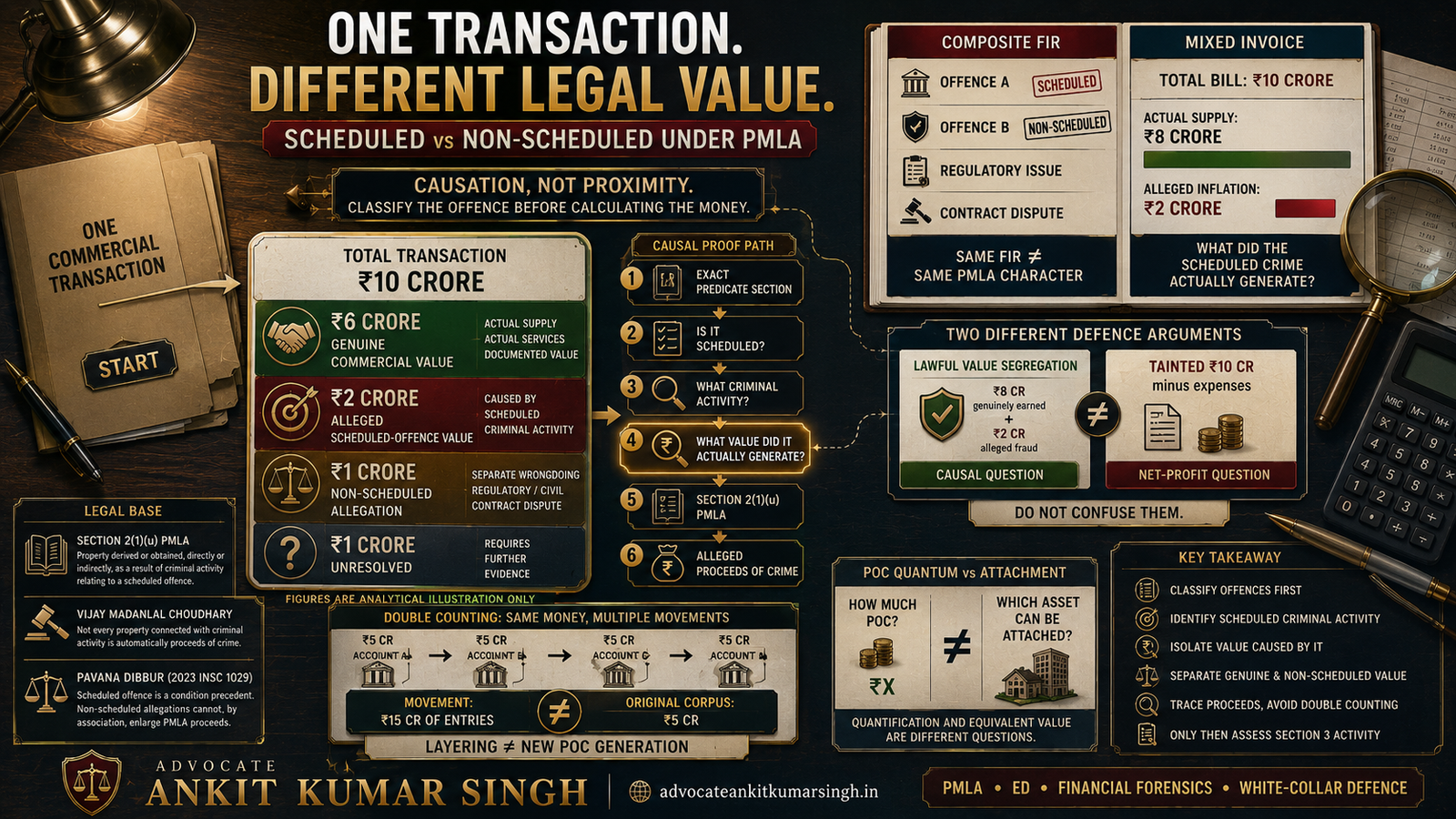
A single transaction does not necessarily have a single legal character. One contract may contain genuine consideration, alleged scheduled-offence proceeds, unrelated wrongdoing and disputed amounts. The PMLA question is therefore not simply how much money moved, but what identifiable property was actually derived or obtained as a result of criminal activity relating to a scheduled offence.

Current legal review: 18 August 2026
Direct Answer
If a single FIR, contract, invoice stream or business transaction contains both scheduled and non-scheduled allegations, the entire transaction value does not automatically become proceeds of crime merely because one scheduled offence appears somewhere in the case.
The starting point is Section 2(1)(u) PMLA. The prosecution must identify property derived or obtained, directly or indirectly, as a result of criminal activity relating to a scheduled offence.
The proper enquiry is therefore:
SCHEDULED CRIMINAL ACTIVITY → PROPERTY CAUSED BY THAT ACTIVITY → VALUE OF THAT PROPERTY → ALLEGED PROCEEDS OF CRIME.
Amounts independently earned through genuine contractual performance, unrelated commercial receipts or value attributable only to non-scheduled wrongdoing should not automatically enlarge the proceeds figure merely because they share the same invoice, company, bank account, accused or FIR.
At the same time, “apportionment” does not mean that an accused can always deduct business expenses and call only accounting profit proceeds of crime. Where the entire receipt itself is alleged and ultimately established to have been obtained as a result of scheduled criminal activity, the statutory analysis can potentially extend to that entire receipt.
The decisive distinction is:
SEGREGATING VALUE THAT WAS NEVER GENERATED BY THE SCHEDULED CRIME IS DIFFERENT FROM DEDUCTING EXPENSES AFTER TAINTED PROPERTY HAS ALREADY BEEN OBTAINED.
Quick Navigation
- Start with Section 2(1)(u), not the headline FIR amount
- Vijay Madanlal: crime-connected property is not automatically POC
- Composite FIR and multiple penal sections
- Pavana Dibbur and the limits of non-scheduled allegations
- Four-bucket causal attribution model
- Mixed invoices
- Partly genuine contracts
- Gross receipt vs net profit
- Mixed bank accounts
- Double counting and repeated movement
- Direct and indirect derivation
- POC quantum vs equivalent-value property
- Section 24 burden
- Section 5 and Section 8
- POC computation audit
- Document checklist
- Frequently asked questions
Start With Section 2(1)(u)—Not the Headline FIR Amount
Financial-crime cases generate many large numbers. The FIR may describe victim loss. The charge-sheet may refer to contract value. A forensic report may total bank credits. A company's books may show turnover. An ED complaint may state an alleged POC figure.
These figures perform different functions.
| Figure | What It May Describe | Why It Is Not Automatically POC |
|---|---|---|
| FIR loss | Loss alleged by complainant/investigator | The statutory property generated by scheduled criminal activity still has to be identified. |
| Contract value | Total contractual consideration | Part may represent genuine supply or performance. |
| Invoice value | Amount billed | An invoice can contain genuine and disputed components. |
| Turnover | Aggregate business receipts | Turnover may include hundreds of unrelated lawful transactions. |
| Bank credits | Money entering an account | A bank credit proves movement, not automatically criminal source. |
| Victim loss | Economic harm alleged | Loss and property actually derived by particular actors may require separate tracing. |
The Statutory Chain
SCHEDULED OFFENCE
↓
CRIMINAL ACTIVITY RELATING TO IT
↓
PROPERTY DERIVED OR OBTAINED
↓
PROCEEDS OF CRIME
↓
SECTION 3 PROCESS / ACTIVITY
If the causal chain breaks before the “property derived or obtained” stage, the size of the transaction cannot repair that defect by itself.
Vijay Madanlal: Not Every Property Connected With Criminal Activity Is Proceeds of Crime
A foundational proposition from Vijay Madanlal Choudhary v. Union of India is that the authorities cannot simply assume that property recovered or identified in connection with an accused must constitute proceeds of crime.
The property must answer the statutory description: it must be derived or obtained, directly or indirectly, as a result of criminal activity relating to a scheduled offence.
That distinction is especially powerful in a composite commercial case.
Consider a business receiving:
- genuine customer payments;
- security deposits;
- loans;
- tax refunds;
- capital contributions;
- payments under the disputed contract;
- an allegedly fraudulent invoice differential.
The fact that all of those amounts appear in the books or account of a person under investigation does not itself establish that every amount was generated by the scheduled criminal activity.
Composite FIR: Separate the Penal Sections Before Calculating the Money
A composite FIR may allege several offences arising from the same factual episode.
The PMLA analysis should begin with an offence-by-offence classification.
| Predicate Allegation | Scheduled Status | Factual Conduct | Economic Consequence | POC Question |
|---|---|---|---|---|
| Offence A | Scheduled | Alleged fraudulent inducement | ₹X allegedly obtained | Was ₹X caused by the scheduled fraud? |
| Offence B | Not scheduled / verify | Separate alleged wrongdoing | ₹Y disputed | What scheduled-crime nexus, if any, exists? |
| Regulatory allegation | Verify statute/Schedule | Compliance failure | ₹Z affected | Regulatory illegality is not itself sufficient without the required scheduled nexus. |
| Contractual dispute | Not automatically a predicate offence | Quality, delay, rate or quantity dispute | ₹A | Does scheduled criminal activity independently explain this value? |
The charge-sheet must then be checked again
The FIR is only the beginning of the predicate case. For PMLA analysis, examine whether the scheduled section actually survives investigation.
- Was a scheduled provision removed?
- Was another scheduled provision added?
- Was a closure report accepted?
- Was one allegation quashed?
- What offences were ultimately charge-sheeted?
- What offences did the competent court take cognizance of?
A POC computation based on the FIR should not be treated as immutable if the legal foundation of the predicate case materially changes.
Pavana Dibbur: Why Non-Scheduled Wrongdoing Cannot Simply Be Pulled Into PMLA
Pavana Dibbur v. Directorate of Enforcement is especially important for composite FIR analysis because the Supreme Court confronted multiple FIRs containing multiple penal provisions.
The Court emphasised that existence of a scheduled offence is a condition precedent for the existence of proceeds of crime.
It also rejected a construction of Section 120B IPC that would have effectively turned conspiracy to commit every non-scheduled crime into a PMLA scheduled offence.
The structural lesson extends beyond conspiracy:
THE PMLA SCHEDULE CANNOT BE RENDERED MEANINGLESS AT THE QUANTIFICATION STAGE.
Suppose the predicate case alleges:
- Scheduled Offence A generated ₹5 crore;
- Non-Scheduled Offence B caused another ₹3 crore dispute;
- ₹2 crore represents genuine contractual payment.
The presence of Scheduled Offence A does not automatically answer why the ₹3 crore connected only to Offence B or the genuine ₹2 crore should be treated as property derived from Scheduled Offence A.
The prosecution may have a wider factual theory—for example that the entire arrangement was one integrated scheduled fraud—but that causal theory has to be articulated and supported. It should not simply be presumed from coexistence.
The Four-Bucket Causal Attribution Model
Bucket A — Genuine Commercial Consideration
This covers value said to be independently earned through actual performance.
Typical evidence:
- purchase order;
- executed agreement;
- delivery challan;
- e-way bill;
- goods receipt;
- measurement book;
- completion certificate;
- GST invoice;
- customer confirmation;
- inventory records;
- independent valuation;
- market-rate material.
Bucket B — Value Allegedly Generated by Scheduled Criminal Activity
This is the direct proceeds candidate.
Examples may include:
- fraudulently inflated invoice amount;
- property obtained through scheduled cheating;
- illegal gratification where the relevant corruption offence is scheduled;
- funds diverted through conduct constituting the scheduled predicate;
- property indirectly purchased from identified proceeds.
Bucket C — Non-Scheduled / Civil / Regulatory Component
Bucket C does not mean “legal”.
Conduct may still expose the person to:
- criminal prosecution under another law;
- civil recovery;
- regulatory penalty;
- tax consequences;
- contractual damages;
- disciplinary action.
The narrower PMLA issue is whether the property was caused by criminal activity relating to a scheduled offence.
Bucket D — Unresolved
Some values cannot responsibly be classified immediately.
Examples:
- partly genuine and partly disputed quantities;
- ambiguous escalation claims;
- conflicting measurement records;
- one invoice funded from several sources;
- disputed valuation;
- incomplete bank trail.
Bucket D should trigger further evidence collection—not automatic classification as either lawful or tainted.
Mixed Invoices: Separate the Genuine Value From the Allegedly Criminal Differential
Invoice cases are particularly susceptible to gross-value inflation.
Illustration
Invoice face value: ₹10 crore.
Independent records establish:
Actual goods/services: ₹8 crore.
Allegedly fictitious/inflated component: ₹2 crore.
If the scheduled offence alleged by the predicate agency concerns only the fabricated ₹2 crore component, an important question arises:
WHY SHOULD THE ₹8 CRORE VALUE OF ACTUAL SUPPLY BE TREATED AS PROPERTY GENERATED BY THAT FRAUD?
Relevant evidence may include:
- quantity supplied;
- rate;
- market price;
- transport documentation;
- stock register;
- GST reporting;
- customer receipt confirmation;
- inspection report;
- payment certificate;
- independent expert measurement.
But change the facts and the result may change.
If the prosecution alleges that the invoice was wholly fictitious and no goods or services were supplied, the entire payment may potentially be alleged as property obtained through the scheduled fraud.
The face value of the invoice therefore does not answer the question. The factual theory does.
A Contract Can Be Partly Genuine—or the Entire Contract Can Be the Alleged Fraud
Mixed-contract cases require lawyers to identify the level at which the criminality allegedly operates.
Model 1 — Genuine Contract, Fraudulent Variation
Original contract legitimately awarded.
Original work performed.
Later variation order allegedly fabricated for ₹5 crore.
The potential POC enquiry may focus on the value generated by the alleged fraudulent variation.
Model 2 — Genuine Contract, Inflated Quantity
Work worth ₹70 crore genuinely performed.
₹10 crore additional quantity allegedly fabricated.
The alleged incremental fraudulent value requires specific quantification.
Model 3 — Entire Contract Allegedly Procured by Scheduled Fraud
Eligibility documents allegedly fabricated.
Tender allegedly obtained through scheduled cheating/corruption.
The prosecution alleges there was no lawful entitlement to receive the contract payments at all.
Here ED may advance the theory that a much larger portion—or on the particular prosecution case, potentially the whole receipt—was obtained as a result of scheduled criminal activity.
Causal Segregation Is Not the Same as a “Net Profit Only” Theory
| Argument | Character |
|---|---|
| ₹80 crore was independently earned through actual supply and ₹20 crore was allegedly generated through fraud. | Causal segregation of lawful and allegedly criminally generated consideration. |
| The entire ₹100 crore was fraudulently obtained, but ₹80 crore was spent later, therefore only ₹20 crore can ever be POC. | Net-profit deduction argument; no universal rule supports automatic deduction merely because expenses were incurred. |
This distinction is essential.
Section 2(1)(u) asks what property was derived or obtained as a result of the scheduled criminal activity.
It does not define POC as accounting profit.
Therefore:
GROSS TURNOVER IS NOT AUTOMATIC POC.
NET PROFIT IS NOT AUTOMATIC POC EITHER.
THE STATUTORY NEXUS CONTROLS.
One Bank Account Can Contain Lawful, Non-Scheduled and Allegedly Tainted Money
Suppose a company's account contains:
Opening lawful balance: ₹2 crore
Genuine customer receipts: ₹6 crore
Loan disbursement: ₹1 crore
Alleged scheduled-offence receipt: ₹1 crore
Total: ₹10 crore.
The existence of an allegedly tainted ₹1 crore credit does not logically erase the documented provenance of the remaining ₹9 crore.
Build an account-source table
| Date | Amount | Source | Legal Classification | Evidence | Subsequent Use |
|---|---|---|---|---|---|
| D1 | ₹2 crore | Opening balance | Claimed lawful | Previous-period bank statement | Trace |
| D2 | ₹6 crore | Customers | Commercial receipts | Invoices / supplies / GST | Trace |
| D3 | ₹1 crore | Bank | Loan | Sanction / disbursement | Trace |
| D4 | ₹1 crore | Disputed payer | Alleged POC | Predicate allegation / bank trail | Trace precisely |
Commingling can make tracing more difficult and later transfers may have relevance under Section 3. But difficulty of tracing should not itself become a rule that every independent source becomes criminally generated property.
Repeated Movement of One Corpus Should Not Automatically Multiply the POC Quantum
Suppose ₹5 crore of alleged proceeds moves:
Account A → Account B → Account C → Account D.
Each transfer is ₹5 crore.
Aggregate banking entries may therefore display ₹15 crore or more of movement.
That does not necessarily establish the generation of three independent ₹5 crore proceeds.
The later movements can be critically relevant to:
- concealment;
- possession;
- use;
- layering;
- Section 3 role attribution.
But the financial analyst should distinguish:
ORIGINAL GENERATION OF PROPERTY
from
LATER MOVEMENT OF THE SAME PROPERTY.
Double-counting audit
- Match UTRs.
- Match value dates.
- Identify same-day pass-through entries.
- Identify reversals.
- Identify own-account transfers.
- Identify circular entries.
- Separate conversion into a new asset from generation of fresh proceeds.
“Directly or Indirectly” Allows Tracing Beyond the First Receipt—but Causation Still Matters
Section 2(1)(u) does not stop at the first account.
Consider:
Scheduled-crime-generated ₹2 crore
↓
Account A
↓
Company B
↓
Asset C
Asset C may potentially represent property indirectly derived from the originally identified proceeds.
Therefore the defence cannot insist that only the original cash or first bank credit can ever matter.
But “directly or indirectly” still requires a traceable factual relationship.
It does not convert the concept into:
ANY PROPERTY BELONGING TO ANY PERSON CONNECTED WITH THE CASE.
Do Not Confuse the Amount of POC With the Property Chosen for Equivalent-Value Action
Two related but separate questions exist.
QUESTION 1
HOW MUCH PROCEEDS OF CRIME WERE GENERATED?
QUESTION 2
WHICH PROPERTY CAN LEGALLY BE PROCEEDED AGAINST AS THOSE PROCEEDS OR THEIR STATUTORY VALUE?
Suppose the established POC theory is ₹5 crore and the original property is no longer available.
A statutory value-based property question may arise in relation to other assets.
But that does not logically convert the underlying POC from ₹5 crore to ₹25 crore merely because the accused owns ₹25 crore of property.
The first calculation concerns the criminally generated corpus. The second concerns the reach of the property-restraint mechanism.
Section 24: Do Not Let the Reverse Burden Replace the Definition of POC
Section 24 creates a special statutory burden/presumption framework in proceedings relating to proceeds of crime.
But before asking whether the statutory presumption applies, the alleged proceeds must be identified.
The analytical sequence should therefore be:
- What property does ED call proceeds of crime?
- What scheduled offence is relied upon?
- What criminal activity generated the property?
- What is the transaction-by-transaction causal link?
- What factual material supports the classification?
- Only then examine the operation of Section 24 at the relevant stage.
Why POC Quantification Matters Under Sections 5 and 8
Section 5 attachment operates upon a statutory proceeds-of-crime/property theory. An inflated POC computation can therefore affect the number and value of properties selected for provisional attachment.
The Section 8 stage is the natural place for a property owner or noticee to place source evidence, transaction records and other material before the Adjudicating Authority.
A mixed-transaction Section 8 reply should use schedules
Schedule A — ED's alleged POC
Reproduce the exact figure and identify where it appears in the PAO/OA.
Schedule B — Scheduled-offence-linked disputed receipts
Identify the transactions actually alleged to have arisen from the scheduled conduct.
Schedule C — Genuine commercial receipts
Attach invoices, delivery records, GST, contracts and payment evidence.
Schedule D — Non-scheduled allegation amounts
Explain why those amounts do not automatically enlarge the Section 2(1)(u) figure.
Schedule E — Duplicate / recycled amounts
Identify same-corpus movements and reversals.
Schedule F — Property source
Establish the acquisition source of every attached asset.
The POC Computation Audit: Rebuild ED's Figure From Zero
Do not merely write:
“The alleged POC is arbitrary and excessive.”
Demonstrate where the calculation changes.
| Entry | Amount | Predicate Section | Scheduled? | Why ED Says POC | Defence Classification |
|---|---|---|---|---|---|
| Invoice A | ₹___ | ___ | Yes / No / Mixed | ___ | Genuine / scheduled-linked / unresolved |
| Credit B | ₹___ | ___ | ___ | ___ | Lawful source / disputed |
| Transfer C | ₹___ | Not fresh predicate act | — | Movement of alleged corpus | Check duplicate counting |
Twelve questions for the ED computation
- What exact scheduled offence generated this amount?
- Which paragraph of the FIR or charge-sheet explains the criminal activity?
- Is the stated amount victim loss, turnover, contract value or traced property?
- What amount was actually received?
- Was any part supported by genuine performance?
- Is any part attributable only to a non-scheduled allegation?
- Has the same corpus been counted at more than one layer?
- Have own-account transfers been included?
- Have reversals/refunds been removed?
- Is group-level turnover being attributed identically to every accused?
- Is the alleged original POC being confused with equivalent-value property?
- What primary document supports every component of the final number?
Document Checklist for a Mixed Scheduled / Non-Scheduled Transaction
Six Numerical Scenarios
Scenario 1 — Genuine Work + Inflated Billing
Contract receipt: ₹100 crore.
Documented genuine work: ₹92 crore.
Alleged scheduled fraudulent inflation: ₹8 crore.
The defence should require the prosecution to explain why the entire ₹100 crore, rather than the allegedly criminally generated differential, falls within Section 2(1)(u).
Scenario 2 — Entire Payment Obtained Through Fraud
Payment: ₹100 crore.
Prosecution theory: entire contractual entitlement was procured through scheduled fraud.
The prosecution may therefore assert that the entire receipt was property obtained as a result of the scheduled criminal activity. Subsequent expenditure does not automatically produce a net-profit deduction.
Scenario 3 — Composite FIR
₹5 crore generated by Scheduled Offence A.
₹3 crore connected only to alleged Non-Scheduled Offence B.
₹2 crore ordinary commercial revenue.
One ₹10 crore headline FIR figure does not itself explain how all three categories satisfy Section 2(1)(u).
Scenario 4 — Same Corpus Moves Repeatedly
₹5 crore A → B → C → D.
Aggregate transfers = ₹15 crore.
The money trail may strongly support an alleged laundering process, but the analyst must still decide whether ₹5 crore or ₹15 crore represents independently generated proceeds.
Scenario 5 — Pass-Through Account
Alleged tainted corpus handled: ₹25 crore.
Account holder's commission: ₹25 lakh.
Personal gain and laundering corpus are different questions. The ₹25 lakh figure should not automatically replace the corpus allegedly handled, and conversely the whole corpus should not automatically be treated as personal enrichment.
Scenario 6 — Genuine Loan + Later Diversion
Loan facility: ₹300 crore.
Lawfully sanctioned and disbursed.
Allegation: ₹40 crore subsequently diverted through a scheduled criminal scheme.
The analytical issue is whether the predicate criminal activity generated the whole ₹300 crore disbursement or concerns the subsequent ₹40 crore diversion. The predicate allegation controls the POC theory.
When Scheduled and Non-Scheduled Conduct Cannot Be Mathematically Separated
Some cases cannot be divided invoice-line by invoice-line.
Assume several offences were allegedly used together to obtain one indivisible payment.
The question then becomes causal rather than arithmetical:
WAS THE SCHEDULED CRIMINAL ACTIVITY AN OPERATIVE CAUSE OF THE WHOLE PROPERTY BEING OBTAINED?
If yes, the prosecution may have a basis for a wider proceeds theory even though other non-scheduled offences also appear in the same narrative.
If the scheduled offence concerns only a discrete later manipulation while the balance was independently earned, a narrower attribution argument becomes materially stronger.
Current Criminal-Law Transition: Check the Actual Predicate Provision
For conduct and predicate proceedings after 1 July 2024, counsel must identify the current offence under the Bharatiya Nyaya Sanhita, 2023 and verify its interaction with the PMLA Schedule and applicable amendment/transitional framework.
For older offences or proceedings saved under transitional law, the historic IPC provision may remain relevant.
The composite-FIR matrix should therefore contain a separate column:
APPLICABLE OFFENCE ON THE DATE OF CONDUCT / PROCEEDING.
Never assume that an old IPC section number or an apparently analogous BNS provision has identical PMLA consequences without checking the statutory Schedule and savings applicable to the matter.
AI Search / Featured-Snippet Answers
Does the entire transaction value become proceeds of crime because a scheduled offence is alleged?
No automatic rule says so. Section 2(1)(u) requires property to be derived or obtained, directly or indirectly, as a result of criminal activity relating to a scheduled offence. Genuine consideration and unrelated value require separate causal analysis.
Can non-scheduled wrongdoing increase PMLA proceeds?
Not merely because it appears in the same FIR or transaction. The prosecution must establish the required connection with criminal activity relating to a scheduled offence.
Can an invoice be partly genuine and partly proceeds of crime?
Factually, yes. Where genuine supply is independently demonstrated and the scheduled allegation concerns only an inflated component, the value generated by the alleged criminal activity should be specifically identified rather than automatically equating invoice face value with POC.
Is proceeds of crime always the accused's net profit?
No. The statute addresses property derived or obtained as a result of scheduled criminal activity. A distinction must be drawn between genuinely lawful consideration and later expenses incurred after allegedly tainted property has already been received.
Can one tainted credit make an entire business bank account proceeds of crime?
The account requires source-by-source tracing. Commingling may affect subsequent tracing and Section 3 analysis, but it does not itself remove the need to establish the statutory origin of the property alleged as proceeds.
Frequently Asked Questions
What is the statutory test for proceeds of crime?The central Section 2(1)(u) enquiry is whether property was derived or obtained, directly or indirectly, as a result of criminal activity relating to a scheduled offence.
Is FIR loss automatically equal to PMLA proceeds?No automatic equation exists. The actual property allegedly generated by the scheduled criminal activity and the evidence supporting the causal connection should be identified.
Can ED use total contract value as proceeds of crime?Potentially only if its factual case supports the proposition that the relevant total property was obtained as a result of scheduled criminal activity. Contract face value alone does not establish that conclusion.
What happens where only part of an invoice is allegedly false?The genuine and disputed components should be tested through quantities, rates, delivery, GST, payment and other contemporaneous records. The alleged scheduled-offence-generated differential becomes a central issue.
What if the whole contract itself was obtained by fraud?The prosecution may contend that a much wider portion of the contract receipts was generated by the scheduled criminal activity. Whether that theory succeeds depends upon the predicate allegation and evidence.
Can a non-scheduled offence generate PMLA proceeds by itself?The PMLA definition requires criminal activity relating to a scheduled offence. A separate non-scheduled wrong does not automatically satisfy that requirement merely because it shares an FIR or accused.
Can Section 120B make any non-scheduled offence a PMLA predicate?Pavana Dibbur rejected such a universal approach. The Supreme Court held in the statutory context before it that conspiracy under Section 120B was relevant as a scheduled offence where the conspiracy concerned an offence otherwise included in Parts A, B or C of the Schedule.
Is POC always net profit?No. There is no universal net-profit-only formula. The property actually generated by the scheduled criminal activity is the central question.
Can business expenses be deducted from POC?Not automatically. Expenses incurred after property was allegedly criminally obtained are conceptually different from proving that part of the original receipt was independently lawful consideration.
Does one allegedly tainted deposit contaminate every rupee in the account?No universal rule of that breadth should be assumed. Complete source and fund-flow analysis is necessary.
Can the same ₹5 crore become ₹15 crore POC because it passed through three accounts?Repeated transfers may be significant evidence of laundering activity, but movement of one corpus should be distinguished from generation of fresh independent proceeds.
What does “directly or indirectly” mean?It permits examination beyond the initial property to assets or value subsequently derived through a traceable chain. It does not dispense with the scheduled-crime causal nexus.
Is equivalent-value attachment the same as saying another asset is the original POC?No. Original proceeds quantification and the statutory reach of value-based attachment are related but distinct questions.
Does Section 24 allow ED to presume total turnover is proceeds?Section 24 creates a special burden framework concerning proceeds of crime; it does not remove the need to identify the property asserted to constitute such proceeds and the relevant statutory foundation.
What is the best document to challenge an inflated POC figure?A transaction-level Proceeds-of-Crime Reconciliation Statement supported by predicate papers, contracts, invoices, delivery records, bank statements, GST/accounting material and source documents is often the most useful starting tool.
What is the strongest question to ask about ED's POC calculation?“For every amount included in the alleged POC figure, identify the scheduled criminal activity said to have generated that amount and the primary evidence establishing the causal connection.”
Official Legal Sources
- India Code — Prevention of Money-Laundering Act, 2002
- Supreme Court of India — Pavana Dibbur v. Directorate of Enforcement, 2023 INSC 1029
- Supreme Court of India
Related Detailed Research on AdvocateAnkitKumarSingh.in
- Gross Transaction Value vs Real Illegal Gain under PMLA
- Tracing Legitimate and Allegedly Tainted Funds in One Account under PMLA
- Section 24 PMLA Presumption: What Must ED Prove Before the Reverse Burden Applies?
- Proceeds of Crime under PMLA 2026
Professional Consultation for PMLA, ED and Proceeds-of-Crime Quantification
Advocate Ankit Kumar Singh
Supreme Court of India | Patna High Court | Allahabad High Court at Prayagraj | Jharkhand High Court at Ranchi | Calcutta High Court | Delhi High Court and Delhi Courts/Tribunals | Matters concerning Bhopal, Madhya Pradesh | Multiple District Courts
Subject to the facts, jurisdiction and accepted professional engagement, professional analysis may include:
- scheduled vs non-scheduled offence classification;
- Section 2(1)(u) analysis;
- POC quantification;
- composite FIR audit;
- invoice and contract reconciliation;
- genuine commercial-receipt segregation;
- money-trail and bank analysis;
- double-counting objections;
- Section 3 ingredient analysis;
- Section 5 attachment;
- Section 8 adjudication;
- Section 24 issues;
- Appellate Tribunal and High Court remedies where maintainable.
Phone: 8294431232
Email: ankitsingh.legum@gmail.com
Website: advocateankitkumarsingh.in
Subject to accepted professional engagement, territorial jurisdiction, applicable procedure and local-counsel coordination where required.
Add AdvocateAnkitKumarSingh.in as a Google Preferred Source
For detailed PMLA, Enforcement Directorate, financial-crime and white-collar criminal-law research, readers may add advocateankitkumarsingh.in as a Preferred Source on Google.
Add as Google Preferred SourceLegal Disclaimer: This is a general legal research and awareness publication and is not case-specific legal advice. “Apportionment” and the four-bucket model are forensic and litigation-analysis tools, not statutory mathematical formulas. The legally relevant proceeds figure depends upon the exact scheduled offence, predicate charge-sheet, causal theory, contractual structure, invoice and performance evidence, money trail, applicable statutory version, attachment theory and current binding precedent. Non-scheduled wrongdoing may remain criminal, civilly actionable, regulatory or otherwise unlawful even where it does not independently satisfy the PMLA proceeds-of-crime requirement. No result concerning attachment, de-freezing, bail, discharge, quashing, trial or confiscation is guaranteed.