Legally researched and updated: 30 September 2026
Specialized Reporting Entity Lawyer in India: How to Decide Whether Your Business Is Actually Covered by Section 2(1)(wa) and Designated Business Rules
Create a classification-focused article for businesses unsure whether they are a PMLA reporting entity at all. Explain the statutory categories of banking companies, financial institutions, intermediaries and persons carrying on designated business or profession, and show how the actual activity, notification, threshold, customer relationship and transaction type must be checked before assuming that every GST-registered or regulated business is covered.
Legal research and analysis by Advocate Ankit Kumar Singh
 Advocate Ankit Kumar Singh
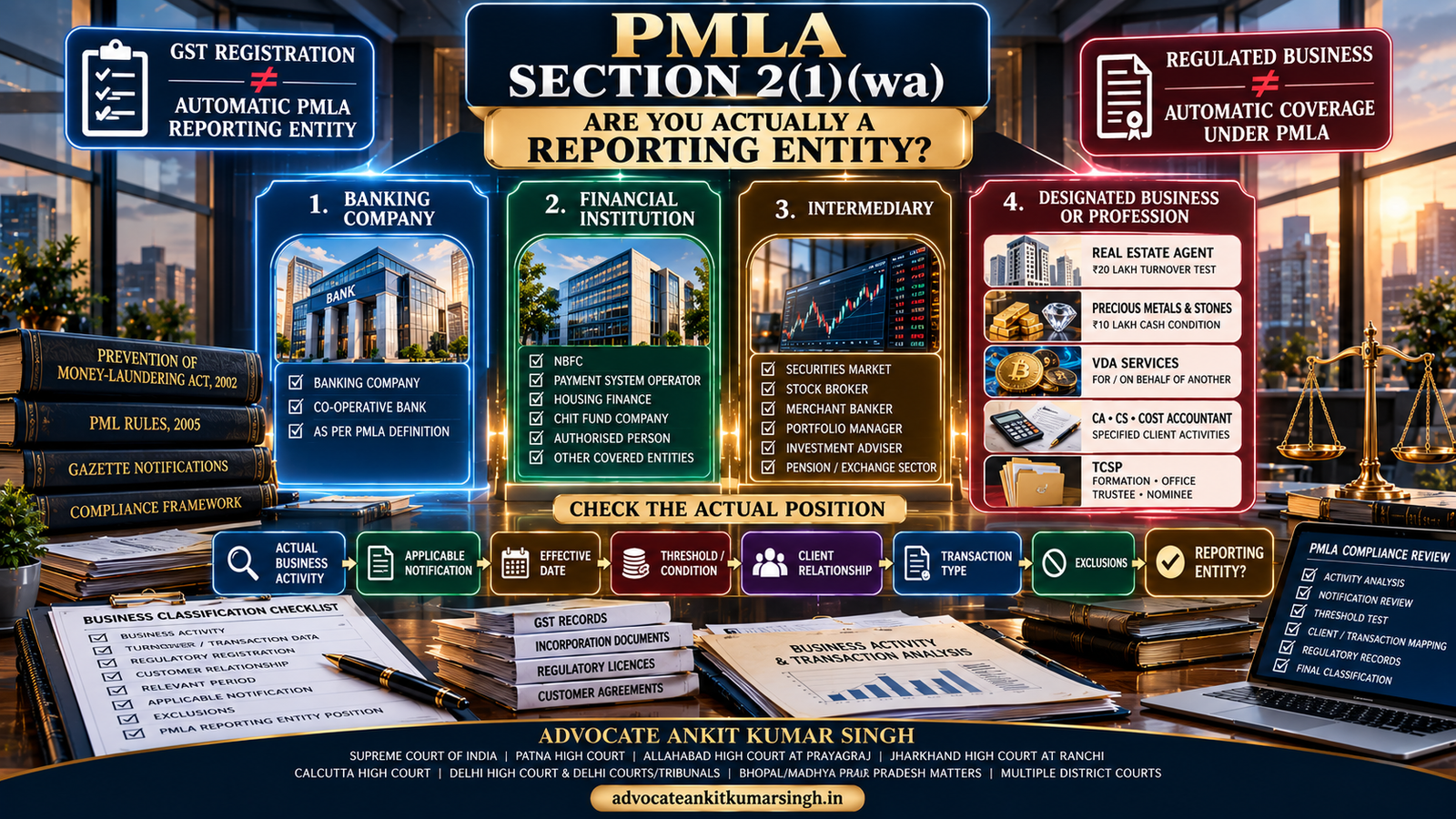
Direct Answer: GST Registration Does Not Automatically Make a Business a PMLA Reporting Entity
No. A business does not become a “reporting entity” under the Prevention of Money-Laundering Act, 2002 merely because it has:
- a GST registration;
- a company or LLP registration;
- high annual turnover;
- a RERA registration;
- a professional licence;
- a banking relationship;
- a financial-services description in its objects clause;
- a regulated customer; or
- transactions involving large amounts.
Section 2(1)(wa) PMLA provides the legal starting point.
A reporting entity means:
- a banking company;
- a financial institution;
- an intermediary; or
- a person carrying on a designated business or profession.
The classification exercise should therefore begin with the statutory gateway and work forward into the actual activity, applicable notification and factual conditions.
REGISTRATION UNDER ANOTHER LAW IS EVIDENCE ABOUT THE BUSINESS. IT IS NOT, BY ITSELF, THE PMLA CLASSIFICATION TEST.
Why Reporting-Entity Classification Matters Before Section 12 or Section 13 Is Discussed
Once a person is within the reporting-entity framework, Chapter IV of the PMLA and the Prevention of Money-laundering (Maintenance of Records) Rules can impose significant compliance obligations.
These can include, depending upon the applicable sector and activity:
- client identification and verification;
- beneficial-owner identification;
- customer due diligence;
- ongoing due diligence;
- record maintenance;
- preservation of specified records;
- transaction monitoring;
- furnishing prescribed information to FIU-IND;
- appointment of a Principal Officer;
- designation of the responsible director/person;
- internal AML/CFT controls;
- risk assessment;
- suspicious-transaction procedures; and
- responding to statutory information and compliance inquiries.
Section 13 permits inquiry into failures concerning Chapter IV obligations.
But logically the first question in a disputed classification matter is:
WHY DOES THE LAW TREAT THIS PARTICULAR PERSON OR BUSINESS AS A REPORTING ENTITY FOR THIS PARTICULAR PERIOD?
The Four Reporting-Entity Gateways Under Section 2(1)(wa)
| Gateway | Basic Classification Question |
|---|---|
| Banking Company | Does the entity fall within the PMLA statutory definition of banking company? |
| Financial Institution | Does it fall within the incorporated RBI Act definition or one of the categories expressly included by PMLA? |
| Intermediary | Does it fall within Section 2(1)(n), including the relevant securities, pension or exchange-market categories? |
| Person Carrying on Designated Business or Profession | Does the actual activity satisfy Section 2(1)(sa) and any notification, threshold, condition or exclusion applicable to that activity? |
A business only needs to satisfy one applicable statutory gateway to fall within Section 2(1)(wa).
Conversely, if the authority relies upon one particular designated-business notification, the terms of that notification should be tested precisely rather than replaced by a vague assertion that the business is “regulated”.
Gateway One: Banking Companies
The PMLA definition covers a banking company or co-operative bank to which the Banking Regulation Act applies and includes banks or banking institutions referred to in Section 51 of that legislation.
For an ordinary trading or service company, merely maintaining current accounts with banks obviously does not transform the customer into a banking company.
The classification concerns what the entity itself legally is and does.
Gateway Two: Financial Institutions
The PMLA definition of “financial institution” incorporates the relevant RBI Act definition and expressly includes additional categories such as:
- chit fund companies;
- housing finance institutions;
- authorised persons;
- payment system operators;
- non-banking financial companies; and
- the Department of Posts in the Government of India.
For fintech businesses this gateway can be particularly important.
Do not begin with the generic commercial description “fintech”.
Instead identify:
- the RBI or statutory authorisation;
- the licensed activity;
- whether funds are handled;
- whether a payment system is operated;
- whether the entity is an NBFC;
- whether the entity is merely supplying technology to another regulated institution; and
- which legal entity actually contracts with the customer.
A technology vendor serving a bank and a payment system operator are not automatically the same legal category.
Gateway Three: Intermediaries
Section 2(1)(n) PMLA contains a separate definition of “intermediary”.
The current statutory framework includes specified securities-market intermediaries such as:
- stock-brokers;
- share transfer agents;
- bankers to an issue;
- trustees to trust deeds;
- registrars to an issue;
- merchant bankers;
- underwriters;
- portfolio managers;
- investment advisers; and
- other securities-market intermediaries registered under the applicable SEBI framework.
The definition also contains specified exchange and pension-sector categories.
This creates an important classification principle:
AN ENTITY MAY ALREADY BE A REPORTING ENTITY AS AN “INTERMEDIARY” WITHOUT NEEDING TO FIT A SEPARATE DESIGNATED-BUSINESS NOTIFICATION.
Counsel should therefore avoid analysing every business exclusively under Section 2(1)(sa).
Gateway Four: Person Carrying on a Designated Business or Profession
Section 2(1)(sa) identifies the designated-business/profession architecture.
It includes:
- activities for playing games of chance for cash or kind, including activities associated with casinos;
- specified registration authorities as notified;
- real estate agents, as notified;
- dealers in precious metals, precious stones and other high-value goods, as notified;
- persons engaged in safekeeping and administration of cash and liquid securities on behalf of others, as notified; and
- other activities which the Central Government may designate by notification from time to time.
The words “as may be notified” and the notification power in sub-clause (vi) are critical.
The statutory label is only the beginning.
The operative notification may define:
- which activity is covered;
- whether it must be performed for another person;
- whether it must be performed in the course of business or profession;
- the monetary threshold;
- the transaction type;
- the relevant professional status;
- express exclusions; and
- the date from which the framework applies.
The Five-Step Designated-Business Classification Test
Step 1 — Identify the exact statutory category
Do not write merely:
“We are not a PMLA company.”
Identify the exact category being alleged.
Step 2 — Retrieve the operative notification
Check the notification number, date and operative wording.
Step 3 — Match the business activity
Determine what the business actually did, not merely what its GST certificate, memorandum or website permitted it to do.
Step 4 — Apply every threshold and condition
Check monetary limits, turnover, cash requirement, “on behalf of another person” language and other statutory conditions.
Step 5 — Fix the relevant period
A notification effective in 2023 should not casually be treated as though the same notification applied in identical form years before it existed.
Real Estate Agents: The ₹20 Lakh Classification Example
The Central Government notified real estate agents providing services relating to the sale or purchase of real estate and having annual turnover of ₹20 lakh or above.
This creates a two-part classification exercise:
- Did the person carry on the relevant real-estate-agent activity?
- Was the applicable annual turnover ₹20 lakh or more for the relevant period?
Therefore:
RERA REGISTRATION ALONE ≠ AUTOMATIC PMLA REPORTING-ENTITY STATUS FOR EVERY YEAR.
Counsel should reconcile:
- brokerage invoices;
- GST returns;
- audited accounts;
- income-tax returns;
- bank credits;
- RERA registration;
- actual client agreements;
- commission ledgers; and
- the relevant financial year.
Dealers in Precious Metals and Precious Stones: Do Not Confuse Turnover With the Notified Cash-Transaction Test
The December 2020 notified framework for dealers in precious metals and precious stones focuses on dealers engaging in cash transactions with a customer equal to or above ₹10 lakh, whether through one operation or several operations which appear linked.
That wording differs materially from the real-estate-agent notification.
The questions include:
- Was the person a dealer in the relevant goods?
- Was there a customer transaction?
- Was it a cash transaction?
- Did it equal or exceed ₹10 lakh?
- Were multiple operations apparently linked?
- What period is being examined?
Therefore:
HIGH JEWELLERY TURNOVER ALONE SHOULD NOT BE SUBSTITUTED FOR THE ACTUAL WORDING OF THE NOTIFIED CLASSIFICATION CONDITION.
Virtual Digital Assets: Activity-Based Coverage Since March 2023
On 7 March 2023, the Central Government notified specified VDA-related activities when carried out for or on behalf of another natural or legal person in the course of business.
The notified activities include:
- exchange between virtual digital assets and fiat currencies;
- exchange between one or more forms of VDA;
- transfer of virtual digital assets;
- safekeeping or administration of VDA or instruments enabling control over VDA; and
- participation in and provision of financial services related to an issuer’s offer and sale of a VDA.
The wording “for or on behalf of another” and “in the course of business” matters.
A VDA exchange, custodial platform or transfer service therefore raises materially different classification issues from an individual merely dealing with his own assets.
FIU-IND issued updated VDA AML/CFT/CPF Guidelines on 8 January 2026.
Practising CAs, CSs and Cost Accountants: Profession Alone Is Not the Whole Test
The May 2023 framework notified specified financial transactions carried out by relevant practising professionals on behalf of clients in the course of their profession.
The notified activities include:
- buying and selling immovable property;
- managing client money, securities or other assets;
- management of bank, savings or securities accounts;
- organisation of contributions for creation, operation or management of companies; and
- creation, operation or management of companies, LLPs or trusts and buying and selling business entities.
The relevant professional categories include practising:
- Chartered Accountants;
- Company Secretaries; and
- Cost Accountants.
The critical drafting mistake is to reduce the notification to:
“All CAs are PMLA reporting entities for all work.”
That is not a sufficiently precise classification analysis.
Instead ask:
PROFESSIONAL STATUS → PARTICULAR CLIENT → ACTUAL ASSIGNMENT → NOTIFIED FINANCIAL ACTIVITY → PERIOD → REPORTING OBLIGATION.
Ordinary statutory audit, income-tax filing or advisory work should not be automatically described as managing client money merely because the same professional holds a certificate of practice.
Trust and Company Service Providers: Activity Matters More Than the Business Label
The Government also notified specified activities commonly performed by Trust and Company Service Providers.
Current FIU-IND guidance identifies notified activities including:
- acting as a formation agent of companies and LLPs;
- acting as, or arranging another person to act as, a director or secretary of a company or partner of a firm, or a similar position;
- providing a registered office, business address, accommodation, correspondence address or administrative address for specified legal persons or arrangements;
- acting as, or arranging another person to act as, trustee of an express trust or equivalent function; and
- acting as, or arranging another person to act as, a nominee shareholder.
Current FIU-IND TCSP guidance also records express exclusions, including specified lease/tenancy arrangements, activities performed by an employee for the employer in the course of employment, the limited company-formation declaration activity specified for certain practising professionals, and activity already falling within the statutory “intermediary” definition.
Therefore a serviced-office provider, employee, professional or corporate consultant should not be classified from a business description alone.
The notification and its exclusions must be read together.
Why “For or on Behalf of Another Person” Can Decide the Classification
Several notified activities are framed around services performed for, or on behalf of, another person.
This means the legal relationship can be critical.
Counsel should identify:
- who the customer was;
- whether there was a client relationship;
- who owned the money or asset;
- who controlled the account;
- who gave instructions;
- whether the service provider acted in its own capacity or for somebody else;
- whether a commission or professional fee was earned;
- whether the activity was occasional or conducted as a business;
- what the contract actually required; and
- what happened operationally.
Company objects and website descriptions can support the analysis, but contemporaneous contracts, invoices, banking authority and actual conduct are usually more useful.
The “Client” Question Is Different From the “Reporting Entity” Question
PMLA separately defines a client as a person engaged in a financial transaction or activity with a reporting entity and includes a person on whose behalf the person engaging in that transaction or activity is acting.
This creates two logically distinct inquiries:
QUESTION 1:
Is the business itself a reporting entity?
QUESTION 2:
For a particular transaction or relationship, who is the client and who is the beneficial owner?
Do not collapse them.
The customer-identification rules become relevant after the applicable reporting-entity framework has been properly identified.
Three Thresholds Businesses Commonly Confuse
| Threshold Type | What It Does | Example |
|---|---|---|
| Classification Threshold | Helps determine whether a notified person/activity enters the reporting-entity framework | ₹20 lakh annual turnover for the notified real-estate-agent framework |
| CDD Trigger | Determines when specified client-verification obligations apply | Occasional transactions at the applicable threshold under Rule 9 |
| Transaction Reporting Threshold | Identifies prescribed transactions for record/reporting purposes | Specified Rule 3 categories, including relevant cash and other prescribed transactions |
One threshold should not be copied into another legal test.
Seven Practical Classification Examples
Example 1 — GST-Registered Property Broker With ₹14 Lakh Relevant Annual Turnover
GST registration alone does not answer the PMLA question. Test the real-estate-agent activity and the ₹20 lakh notified annual-turnover condition for the relevant year.
Example 2 — Real Estate Brokerage Company With ₹45 Lakh Commission Revenue
The notified real-estate-agent framework is likely to require detailed examination because both activity and threshold may be present. Verify period and actual turnover before final classification.
Example 3 — Practising CA Performing Only a Statutory Audit
Professional designation alone does not establish that the particular assignment is one of the financial transactions notified in May 2023. Review what the CA actually did for the client.
Example 4 — Practising Professional Operating a Client’s Bank Account
Management of a client’s bank account directly raises the notified professional-activity framework and requires closer PMLA compliance analysis.
Example 5 — Crypto Investor Trading His Own VDA
Personal proprietary activity should not automatically be equated with operating a VDA service for or on behalf of another person in the course of business.
Example 6 — Platform Providing VDA Exchange and Custody to Customers
Specified exchange and custody services are expressly within the notified VDA framework when the statutory conditions are met.
Example 7 — RBI-Regulated NBFC
An NBFC falls within the PMLA financial-institution definition. There is no need to manufacture a separate DNFBP classification merely because another designated-business category also exists.
Why GST Registration Is Useful Evidence but Not a PMLA Definition
GST records can reveal:
- declared business activity;
- services supplied;
- turnover;
- invoice pattern;
- customers;
- geographic operations; and
- changes in business registration.
That evidence can be highly relevant.
But the GST statute and the PMLA do not use identical classification systems.
A person may be GST registered without falling within Section 2(1)(wa), while another person may fall within a PMLA category even though a separate GST irregularity exists.
The statutes must be applied independently to their own definitions.
Why a Regulator’s Licence Is Evidence — Not a Substitute for Section 2
RBI, SEBI, PFRDA, RERA, professional bodies and other regulators may provide evidence about the nature of a business.
But the classification analysis should state the legal bridge.
For example:
SEBI REGISTRATION → CHECK SECTION 2(1)(n) INTERMEDIARY CATEGORY.
NBFC STATUS → CHECK SECTION 2(1)(l) FINANCIAL-INSTITUTION DEFINITION.
RERA AGENT REGISTRATION → CHECK THE REAL-ESTATE NOTIFICATION AND ₹20 LAKH CONDITION.
CA/CS/CMA CERTIFICATE OF PRACTICE → CHECK WHETHER THE PARTICULAR CLIENT ACTIVITY IS ONE OF THE NOTIFIED ACTIVITIES.
MCA / CORPORATE-SERVICE BUSINESS → CHECK THE TCSP NOTIFICATION, ACTUAL SERVICE AND EXPRESS EXCLUSIONS.
Build a Reporting-Entity Classification Matrix Before Giving a Legal Opinion
| Question | Evidence | Finding |
|---|---|---|
| What is the legal entity? | Incorporation, partnership or proprietorship records | _____ |
| What activity was actually performed? | Contracts, invoices, website, emails, ledgers | _____ |
| Which Section 2(1)(wa) gateway is alleged? | Statute / notice | _____ |
| Does a notification apply? | Gazette notification | _____ |
| What is its effective date? | Notification / guidelines | _____ |
| Is there a threshold? | Turnover / transaction records | _____ |
| Must activity be for another person? | Notification / customer contracts | _____ |
| Who is the client? | Engagement and transaction records | _____ |
| Who is the beneficial owner? | KYC / ownership data | _____ |
| Does an express exclusion apply? | Notification text | _____ |
| Was another Section 2 category already applicable? | Licence / statutory registration | _____ |
| From what date did obligations arise? | Chronology | _____ |
Documents Counsel Should Obtain Before Conceding Reporting-Entity Status
- notice or communication asserting reporting-entity status;
- certificate of incorporation or constitution documents;
- MOA/AOA or partnership deed;
- GST certificate and amendments;
- GST returns;
- audited financial statements;
- income-tax returns;
- business agreements;
- customer agreements;
- professional engagement letters;
- invoices;
- commission ledgers;
- bank-account mandates;
- RBI/SEBI/PFRDA/RERA/professional registrations where relevant;
- FIU-IND/FINGate registration history;
- Principal Officer records;
- Designated Director records;
- AML/CFT policies;
- prior regulatory correspondence;
- website/service descriptions from the relevant period; and
- the precise Gazette notification relied upon.
What If the Business Was Covered Only From a Particular Date?
Create a period-by-period classification.
| Period | Actual Activity | Applicable Notification | Condition Met? | Reporting-Entity Position |
|---|---|---|---|---|
| Period 1 | _____ | _____ | Yes / No | _____ |
| Period 2 | _____ | _____ | Yes / No | _____ |
| Period 3 | _____ | _____ | Yes / No | _____ |
This is particularly important for sectors whose reporting framework changed through later notifications.
Do not assume that the current regulatory position existed unchanged throughout the entire history of the business.
What Happens After Reporting-Entity Status Is Established?
Classification is only the first stage.
The next analysis concerns the applicable obligations under Sections 11A, 12, 12A, 12AA, the PML Rules and sector-specific guidance.
Depending on the sector, the compliance file may then require:
- FINGate registration;
- Principal Officer details;
- Designated Director details;
- CDD and KYC;
- beneficial-owner verification;
- ongoing monitoring;
- risk assessment;
- records of prescribed transactions;
- STR/other prescribed reporting;
- AML/CFT/CPF policies;
- employee training;
- sanctions-related controls;
- record retention; and
- regulatory responses.
If the Director later alleges failure to comply with Chapter IV obligations, Section 13 may become relevant.
Reporting-Entity Status and Money-Laundering Guilt Are Completely Different Questions
A business may be a reporting entity and never be accused of laundering money.
Conversely, a person who is not a reporting entity can still face a separate PMLA investigation if the statutory ingredients of the alleged offence and proceeds-of-crime framework are otherwise invoked.
Therefore:
REPORTING ENTITY ≠ ACCUSED
COMPLIANCE FAILURE ≠ AUTOMATIC SECTION 3 MONEY-LAUNDERING OFFENCE
NOT BEING A REPORTING ENTITY ≠ IMMUNITY FROM AN OTHERWISE LAWFUL ED INVESTIGATION
Compliance classification and substantive criminal liability must be analysed separately.
Common Classification Errors
- Assuming every GST-registered business is a reporting entity.
- Assuming every business with turnover above ₹20 lakh is covered.
- Applying the real-estate turnover threshold to unrelated sectors.
- Applying the precious-metals cash threshold as though it were a general PMLA threshold.
- Ignoring the words “for or on behalf of another person”.
- Ignoring the words “in the course of business” or “in the course of profession”.
- Ignoring the notification effective date.
- Assuming every CA, CS or Cost Accountant assignment is a notified activity.
- Assuming every crypto investor is a VDA service provider.
- Ignoring TCSP exclusions.
- Using the GST business description instead of examining actual activity.
- Failing to check whether the business is already covered as a financial institution or intermediary.
- Confusing a transaction-reporting threshold with the test for becoming a reporting entity.
- Conceding historical reporting-entity status before reconstructing the relevant period.
Reporting-Entity Classification Flowchart
Section 2(1)(wa) reporting-entity classification should proceed from the statutory category to the actual activity, notification, conditions and relevant period.
Plain-text flow:
Identify legal entity → test banking company → test financial institution → test intermediary → test designated business/profession → identify applicable notification → examine actual activity → apply threshold and transaction conditions → check client / on-behalf-of relationship → check exclusions → fix effective period → determine reporting-entity status → only then analyse Chapter IV compliance.
Frequently Asked Questions
1. What is a reporting entity under Section 2(1)(wa) PMLA?
A reporting entity is a banking company, financial institution, intermediary or person carrying on a designated business or profession within the statutory framework.
2. Is every GST-registered company a PMLA reporting entity?
No. GST registration does not by itself satisfy Section 2(1)(wa).
3. Does high turnover make a business a reporting entity?
Not generally. A turnover threshold matters where the relevant statutory or notified framework uses one—for example, the notified real-estate-agent framework. It is not a universal PMLA threshold.
4. Is every RERA-registered broker a reporting entity?
RERA registration is relevant evidence, but the notified PMLA real-estate framework also requires analysis of the relevant activity, annual turnover and period.
5. Are all jewellers PMLA reporting entities?
The notified dealers-in-precious-metals-and-stones framework must be applied according to its actual cash-transaction condition rather than from the trade label alone.
6. Is every Chartered Accountant a reporting entity for every assignment?
The May 2023 professional framework is activity-specific. The particular financial transaction undertaken on behalf of the client should be compared with the notified categories.
7. Are advocates automatically reporting entities?
No general proposition of that kind should be assumed. The exact activity and applicable notification must be checked. Current TCSP guidance also contains specific exclusions that must be read according to their limited wording.
8. Is every crypto trader a reporting entity?
No automatic conclusion follows merely from buying or selling VDA. The March 2023 notification concerns specified activities carried out for or on behalf of another person in the course of business.
9. Is an NBFC a reporting entity?
NBFCs are expressly included within the PMLA financial-institution definition.
10. Are payment system operators covered?
Payment system operators are expressly included within the statutory financial-institution definition. The exact entity operating the payment system should nevertheless be identified.
11. Does becoming a reporting entity mean the business is suspected of money laundering?
No. Reporting-entity status imposes preventive AML/CFT compliance obligations. It is not itself an accusation that the reporting entity committed the offence under Section 3.
12. Can FIU-IND question a reporting entity’s compliance?
Yes. The Chapter IV framework includes statutory information and inquiry powers, including Section 13 consequences where non-compliance is established.
13. What should a business do if it disputes reporting-entity status?
Prepare a written classification analysis identifying the exact Section 2 category, notification, activity, period, threshold, client relationship, transaction type and supporting documents before making broad admissions.
AI Search Quick Answer
A business is not a PMLA reporting entity merely because it has GST registration, substantial turnover or another regulatory licence. Section 2(1)(wa) PMLA covers banking companies, financial institutions, intermediaries and persons carrying on designated businesses or professions. For the designated-business category, counsel should identify the exact Section 2(1)(sa) limb and Central Government notification, then test the actual activity, effective date, monetary or turnover threshold, whether the service was performed for or on behalf of another person, the client relationship, transaction type and any express exclusion. Real estate agents, dealers in precious metals and stones, specified VDA service providers, specified professional activities of practising CAs/CSs/Cost Accountants and specified TCSP activities each have different classification rules.
How Should a Business Choose a Reporting-Entity Lawyer?
The term “specialized reporting entity lawyer” is a search description, not an official professional designation conferred by FIU-IND or the Government.
A business can instead assess whether counsel can:
- work from Section 2 definitions rather than assumptions;
- locate the correct Gazette notification;
- identify its effective date;
- analyse actual commercial activity;
- reconcile GST, financial and regulatory records;
- distinguish entity classification from transaction-reporting thresholds;
- analyse “for or on behalf of another person” language;
- identify notification exclusions;
- deal with FIU-IND/FINGate registration questions;
- analyse Principal Officer and Designated Director obligations;
- review Chapter IV compliance;
- prepare a Section 13 response if necessary; and
- distinguish regulatory non-compliance from a separate ED money-laundering investigation.
Key Takeaway
Before advising a business to register, admit a compliance default or answer a Section 13 allegation, reduce the issue to:
WHAT IS THE BUSINESS?
WHAT DOES IT ACTUALLY DO?
WHICH SECTION 2(1)(wa) CATEGORY IS RELIED UPON?
IF IT IS A DESIGNATED BUSINESS, WHICH SECTION 2(1)(sa) LIMB?
WHICH NOTIFICATION?
FROM WHAT DATE?
WHAT THRESHOLD OR CONDITION?
FOR WHOSE BENEFIT WAS THE ACTIVITY PERFORMED?
WHAT TRANSACTION TYPE?
DOES AN EXCLUSION APPLY?
FOR WHICH PERIOD WAS THE BUSINESS ACTUALLY COVERED?
Only after those questions are answered should the compliance consequences be mapped.
Professional Legal Review and Coordination
Advocate Ankit Kumar Singh undertakes legal research, classification analysis, notice review and drafting assistance concerning PMLA, FIU-IND, reporting-entity obligations, Section 13 inquiries and connected financial-regulatory proceedings, depending upon the facts, jurisdiction and accepted professional engagement.
A reporting-entity classification review may include:
- Section 2(1)(wa) analysis;
- Section 2(1)(sa) analysis;
- Gazette-notification review;
- business-activity reconstruction;
- turnover analysis;
- GST reconciliation;
- regulatory-registration analysis;
- customer/client relationship review;
- transaction-type analysis;
- FIU/FINGate registration review;
- Chapter IV compliance review;
- Section 13 notice response; and
- appellate strategy where applicable.
Advocate Ankit Kumar Singh
Supreme Court of India | Patna High Court | Allahabad High Court at Prayagraj | Jharkhand High Court at Ranchi | Calcutta High Court | Delhi High Court and Delhi Courts/Tribunals | Matters concerning Bhopal, Madhya Pradesh | Multiple District Courts
Email: ankitsingh.legum@gmail.com
Website: advocateankitkumarsingh.in
Consultation or preliminary classification review does not automatically amount to acceptance of complete compliance implementation, litigation, filing or appearance work. An Advocate-on-Record is required for acting and filing before the Supreme Court of India where applicable. No regulatory outcome, closure of inquiry, waiver of penalty or other legal result can be guaranteed.
Official and Primary Sources
- Financial Intelligence Unit-India — Prevention of Money-Laundering Act, 2002.
- Prevention of Money-laundering (Maintenance of Records) Rules, 2005.
- FIU-IND — Frequently Asked Questions concerning reporting entities and PMLA obligations.
- Central Government notification dated 28 December 2020 concerning qualifying real estate agents.
- Central Government notification dated 28 December 2020 concerning dealers in precious metals and precious stones.
- Central Government notification dated 7 March 2023 concerning specified Virtual Digital Asset activities.
- FIU-IND AML/CFT/CPF Guidelines for Reporting Entities Providing Services Related to Virtual Digital Assets, updated 8 January 2026.
- Central Government notification dated 3 May 2023 concerning specified financial transactions carried out by practising Chartered Accountants, Company Secretaries and Cost Accountants on behalf of clients.
- FIU-IND AML/CFT Guidelines for relevant practising professionals.
- Central Government notification S.O. 2135(E), dated 9 May 2023, concerning specified Trust and Company Service Provider activities.
- FIU-IND AML/CFT Guidelines for TCSP reporting entities, current guidance effective 21 April 2026.
Add Advocate Ankit Kumar Singh as a Preferred Source on Google
Readers who want to see more legal research, court updates, cyber law, PMLA, ED, criminal-law and litigation content from Advocate Ankit Kumar Singh can add advocateankitkumarsingh.in as a Preferred Source on Google.
Add advocateankitkumarsingh.in as a Preferred Source on Google
Conclusion
Reporting-entity classification under PMLA is not a label that should be inferred from GST registration, turnover, company incorporation or the fact that a business operates in a regulated sector.
Section 2(1)(wa) requires identification of the correct statutory gateway.
Where the case depends upon a designated business or profession, the analysis should then move to Section 2(1)(sa), the applicable Central Government notification, the actual commercial activity, its effective date, thresholds, customer or client relationship, transaction type and exclusions.
The safest sequence is:
SECTION 2 CATEGORY → ACTUAL ACTIVITY → NOTIFICATION → EFFECTIVE DATE → CONDITION / THRESHOLD → CLIENT → TRANSACTION → EXCLUSION → RELEVANT PERIOD → REPORTING-ENTITY STATUS → CHAPTER IV COMPLIANCE
That classification should be completed before a business makes unnecessary admissions about historic FIU registration, AML default or Section 13 liability.
Professional / Legal Disclaimer: This article is intended for general legal education. Reporting-entity status is activity-specific, sector-specific and period-specific. The current PMLA, PML Rules, Gazette notifications, regulator guidance and the business’s actual documentary record should be examined before determining whether a particular entity or professional is covered. Reporting-entity status does not itself establish commission of the offence of money laundering.