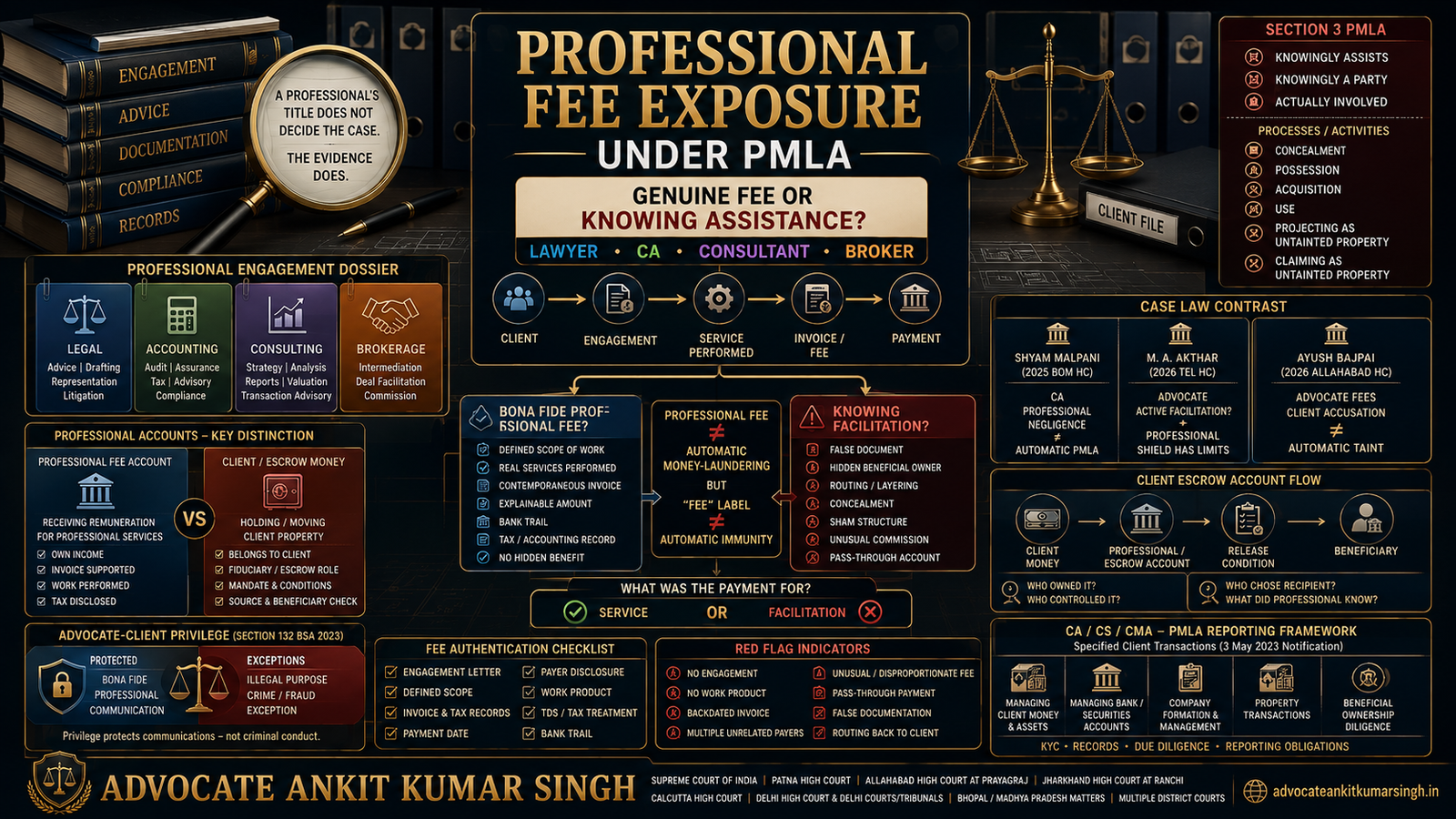
PMLA • Professional Fees • Lawyers • CAs • Consultants • Brokers • Knowing Assistance
Professional Fee Exposure Under PMLA: “Can a Lawyer, CA, Consultant or Broker Be Accused Merely Because Fees Were Paid From Alleged Proceeds of Crime?”
Research and legal analysis by Advocate Ankit Kumar Singh
Updated and legally reviewed: 22 August 2026
Direct Answer
A lawyer, chartered accountant, consultant or broker should not automatically be treated as a money-launderer merely because a client later turns out to have paid professional fees from money alleged to be proceeds of crime.
The critical distinction is between:
GENUINE PROFESSIONAL SERVICE
+
GENUINE REMUNERATION
+
NO KNOWLEDGE OF CRIMINAL SOURCE

AND

PROFESSIONAL POSITION
USED TO
DESIGN / ROUTE / CONCEAL /
DOCUMENT / LEGITIMISE
ALLEGED PROCEEDS OF CRIME
Therefore:
CLIENT ACCUSED ≠ PROFESSIONAL GUILTY
PAYMENT RECEIVED ≠ AUTOMATIC MONEY-LAUNDERING
BONA FIDE PROFESSIONAL FEE ≠ AUTOMATIC KNOWING ASSISTANCE
But equally:
THE LABEL “PROFESSIONAL FEE” DOES NOT CLEAN A PAYMENT IF THE PROFESSIONAL KNOWINGLY PARTICIPATED IN THE UNDERLYING LAUNDERING DESIGN.
The real inquiry concerns:
- what work was actually engaged;
- what work was actually performed;
- who paid;
- when payment was made;
- how much was paid;
- how the payment was structured;
- what the professional knew about the source;
- whether the professional controlled client money;
- whether false documentation was created;
- whether money was merely received or further routed;
- whether concealment was requested; and
- what happened after red flags or knowledge arose.
Contents
- Professional fee versus laundering participation
- Section 3 PMLA
- Property tracing versus personal culpability
- Engagement scope
- Invoices and timing
- Knowledge of source
- Unusual payment structures
- Escrow and client accounts
- Lawyers and privilege
- CAs and professional compliance
- Consultants and brokers
- Important judicial illustrations
- Section 50 summons
- Professional evidence file
- 15-point professional-fee test
- Frequently asked questions
1. The Core Problem: When Does a Fee Stop Looking Like a Fee?
Professionals regularly receive money from clients whose businesses, assets or transactions they do not independently control.
A criminal lawyer may receive fees from an accused.
A chartered accountant may receive fees from a company whose books later become the subject of an ED investigation.
A consultant may advise on a commercial transaction later alleged to involve proceeds of crime.
A broker may earn commission for identifying or introducing a buyer or seller.
The payment itself therefore has to be separated from the alleged process or activity connected with proceeds of crime.
A proper analysis asks two different questions:
QUESTION ONE:

CAN THE PAYMENT BE TRACED TO
ALLEGED PROCEEDS OF CRIME?

        AND THEN

QUESTION TWO:

WHAT DID THE PROFESSIONAL KNOW
AND WHAT DID THE PROFESSIONAL DO?
Those questions must not be collapsed into one.
2. Section 3 PMLA: Why “Knowing Assistance” Matters
Section 3 PMLA covers a person who directly or indirectly:
- attempts to indulge;
- knowingly assists;
- knowingly becomes a party; or
- is actually involved
in a process or activity connected with proceeds of crime.
The statutory explanation refers to processes or activities including:
- concealment;
- possession;
- acquisition;
- use;
- projecting as untainted; and
- claiming as untainted.
For professionals, the most important questions frequently become:
Was the professional simply paid?
or:
Did the professional knowingly help create the mechanism through which the money was concealed, routed, converted, documented or projected as legitimate?
3. First Identify the Alleged Proceeds of Crime
The professional-fee analysis should not begin with the professional's occupation.
It should begin with the property.
SCHEDULED OFFENCE
        ↓
ALLEGED CRIMINAL ACTIVITY
        ↓
PROPERTY DERIVED / OBTAINED
        ↓
ALLEGED PROCEEDS OF CRIME
        ↓
PAYMENT / TRANSFER TO PROFESSIONAL
        ↓
PURPOSE OF PAYMENT?
        ↓
PROFESSIONAL'S KNOWLEDGE?
        ↓
PROFESSIONAL'S CONDUCT?
If the alleged criminal property cannot first be identified coherently, the professional-fee theory itself may require closer scrutiny.
4. Property Characterisation and Personal Criminal Liability Are Different Questions
This distinction is essential.
Suppose a client allegedly possesses ₹5 crore representing proceeds of crime and transfers ₹2 lakh to a lawyer against an actual legal-services invoice.
An investigation may ask whether the payment is traceable to the alleged criminal property.
But that does not automatically answer:
- whether the lawyer knew the alleged source;
- whether the lawyer assisted concealment;
- whether the lawyer designed a laundering transaction;
- whether the lawyer merely provided lawful representation; or
- whether the payment represented genuine consideration for services.
Accordingly:
MONEY TRACE
        ≠
AUTOMATIC MENS REA

CLIENT'S CRIMINALITY
        ≠
AUTOMATIC PROFESSIONAL CRIMINALITY

PROFESSIONAL RECEIPT
        ≠
AUTOMATIC KNOWING ASSISTANCE
5. Factor One: What Was the Actual Scope of Engagement?
The first practical defence document is often the engagement record.
Identify:
- date of engagement;
- client identity;
- instructions received;
- professional scope;
- agreed fee;
- billing milestones;
- matter number;
- people working on the assignment;
- deliverables;
- court or regulatory appearances;
- opinions rendered;
- documents prepared;
- meetings attended; and
- work product created.
Compare:
“Represent the client in anticipatory bail proceedings.”
with:
“Create an arrangement to move these funds through multiple entities so that the real source cannot be identified.”
Both involve a professional.
They are not remotely the same professional activity.
6. Engagement Letter Is Important — But Not Conclusive
A retainer or engagement letter is valuable because it records the contemporaneous reason for the relationship.
But a document headed “Professional Engagement” cannot by itself defeat contrary evidence.
Investigators may compare it with:
- actual communications;
- work product;
- bank transfers;
- meeting records;
- files created;
- transaction instructions;
- corporate filings;
- property documents;
- digital evidence; and
- statements of other participants.
Therefore:
GENUINE RETAINER
+
GENUINE WORK
+
CONSISTENT BILLING
+
TAX RECORD
+
NORMAL PAYMENT TRAIL

IS EVIDENTIALLY DIFFERENT FROM

BACKDATED RETAINER
+
NO WORK PRODUCT
+
ABNORMAL PAYMENT
+
FALSE DOCUMENTS
+
CONCEALMENT COMMUNICATIONS
7. Factor Two: Invoice Timing Can Be Highly Important
Ask when the invoice was created relative to:
- the work performed;
- the questioned transaction;
- receipt of funds;
- registration of FIR;
- ECIR-related investigation;
- search or summons;
- attachment proceedings; and
- other investigative developments.
An invoice raised contemporaneously in the normal professional course may support the fee explanation.
An invoice generated retrospectively after an investigation begins may invite additional scrutiny.
But timing alone is not conclusive.
The analysis should ask:
Does the invoice correspond with real professional work?
8. The Invoice-to-Work-Product Test
| Question | Ordinary Fee Indicator | Higher-Risk Indicator |
|---|---|---|
| Invoice | Contemporaneous | Created after scrutiny without explanation |
| Scope | Clearly defined | Vague or artificial |
| Work product | Substantial and verifiable | None or inconsistent |
| Amount | Commercially explainable | Disproportionate without explanation |
| Tax treatment | Recorded in normal books | Hidden / off-book / falsely classified |
| Payer | Client / disclosed related entity | Unknown shell / unrelated third party |
9. Factor Three: What Did the Professional Know About the Source?
Professional liability cannot sensibly be analysed without a chronology of knowledge.
A professional may initially know only:
“My client is paying my invoice.”
Later, information may emerge suggesting:
- the payer is an unrelated shell company;
- the amount is being split deliberately;
- the client has asked for false narration;
- the payment must be returned to another entity;
- the money is linked to a questioned transaction;
- the professional is being asked to conceal the beneficial owner;
- supporting documents are false; or
- the professional is being used as a transit account.
Therefore create a dated knowledge chronology:
| Date | Event | What Professional Knew Then |
|---|---|---|
| D1 | Engagement accepted | _____ |
| D2 | Invoice issued | _____ |
| D3 | Payment received | _____ |
| D4 | First red flag | _____ |
| D5 | Investigation becomes known | _____ |
| D6 | Later transaction / transfer | _____ |
Knowledge acquired at D5 should not casually be backdated to D1.
But conduct after D5 may create a new and independent evidentiary problem.
10. Knowledge Spectrum: From Ordinary Receipt to Conscious Facilitation
LEVEL 1
CLIENT PAYS NORMAL INVOICE
        ↓
LEVEL 2
PROFESSIONAL KNOWS CLIENT IS UNDER INVESTIGATION
        ↓
LEVEL 3
PAYMENT SOURCE APPEARS UNUSUAL
        ↓
LEVEL 4
THIRD-PARTY / SHELL PAYER APPEARS
        ↓
LEVEL 5
FALSE NARRATION / FALSE DOCUMENT REQUEST
        ↓
LEVEL 6
PROFESSIONAL CONTROLS OR ROUTES FUNDS
        ↓
LEVEL 7
PROFESSIONAL KNOWINGLY DESIGNS
CONCEALMENT / LAYERING / PROJECTION
The legal analysis should identify where on this spectrum the evidence actually places the professional.
11. Factor Four: Unusually Structured Professional Payments
Professional fees can be paid in many legitimate ways.
But some structures warrant closer examination.
Examples include:
- payment by unrelated third parties;
- multiple small transfers without commercial reason;
- payments through several group companies;
- large cash payments;
- overpayment followed by refund to another account;
- payment immediately followed by onward transfer;
- payment to personal accounts when the firm normally receives fees elsewhere;
- false narration such as “loan” where it is supposedly a fee;
- fee payment through shell companies;
- payment from property purchasers or counterparties rather than the client;
- cryptocurrency or foreign routing without commercial explanation;
- large amounts inconsistent with the recorded engagement;
- payments split between the professional and relatives/associates; and
- payment tied to the successful movement or concealment of questioned money rather than the professional service itself.
None of these automatically proves money-laundering.
But each may require a coherent explanation supported by contemporaneous evidence.
12. Fee Amount: Large Does Not Automatically Mean Illegal
Complex litigation, transaction work, international investigations and regulatory matters can legitimately command substantial fees.
Therefore:
“High fee = laundering”
is not a sound legal test.
But the amount may acquire evidentiary relevance when combined with:
- no engagement letter;
- no invoices;
- no substantive work product;
- payment from a questionable counterparty;
- identical payments to alleged intermediaries;
- false documentation;
- multiple routing accounts;
- concealment communications; or
- a payment structure bearing no relation to ordinary professional remuneration.
13. Escrow and Client Accounts Create a Different Risk Profile
There is an important distinction between receiving one's own fee and taking custody of client money.
Compare:
PROFESSIONAL ACCOUNT

CLIENT → ₹2,00,000
INVOICE → LEGAL / ACCOUNTING / CONSULTING FEE

VERSUS

CLIENT MONEY ACCOUNT

CLIENT → ₹2,00,00,000
PROFESSIONAL → HOLDS FUNDS
PROFESSIONAL → SPLITS FUNDS
PROFESSIONAL → TRANSFERS TO MULTIPLE PARTIES
In the second example the professional is not merely a fee recipient.
The professional may have operational custody and transaction-control responsibilities.
Important questions include:
- Why did the professional receive the client's principal money?
- Was the arrangement genuine escrow?
- Was there an escrow agreement?
- What event triggered release?
- Who was the beneficial owner?
- Who instructed payment?
- Did the professional verify the recipient?
- Were funds returned to the original source?
- Were funds split or layered?
- Were false descriptions used?
- Did the professional receive a separate fee?
- Was the account being used merely as a pass-through?
14. Client Account / Escrow Risk Matrix
| Factor | Lower Risk | Higher Risk |
|---|---|---|
| Purpose | Documented legitimate escrow | No clear professional reason |
| Beneficiary | Identified contractual party | Unknown / hidden beneficiary |
| Instruction | Written and consistent | Off-book / disappearing-message instruction |
| Movement | Single contractual release | Rapid splitting / layering |
| Records | Complete reconciliation | Missing / fabricated records |
| Professional benefit | Separately invoiced normal fee | Percentage of hidden funds |
15. Lawyers: Legal Representation Is Not Money-Laundering
A person accused of even the most serious financial crime remains entitled to legal representation.
A lawyer may legitimately:
- give legal advice;
- study evidence;
- draft petitions;
- appear before courts;
- represent a client before authorities;
- advise on compliance;
- challenge attachment;
- seek bail;
- advise on lawful restructuring;
- negotiate lawful settlements; and
- receive genuine professional remuneration.
The criminality of the client does not automatically transfer to the advocate.
The critical line is crossed where evidence indicates that the lawyer's role moved beyond professional representation into personal participation in the criminal transaction.
16. Advocate-Client Privilege: Protection, Not Criminal Immunity
The Supreme Court in its 2025 decision concerning summoning of advocates emphasised the statutory protection of confidential advocate-client communications under Section 132 of the Bharatiya Sakshya Adhiniyam, 2023.
The Court directed that investigating officers should not summon an advocate representing the accused merely to obtain details of the case unless the matter falls within the statutory exceptions, with additional safeguards applying to such exceptional summons.
But privilege is not unlimited.
The statutory framework does not protect:
- communications made in furtherance of an illegal purpose; or
- facts observed by the advocate showing that a crime or fraud was committed after commencement of the professional engagement, in the circumstances contemplated by the law.
Therefore:
LEGAL ADVICE
        =
PROTECTED PROFESSIONAL FUNCTION

BUT

LAWYER PERSONALLY ARRANGING
FALSE DOCUMENTS / CONCEALMENT /
ILLEGAL ROUTING
        ≠
PROTECTED MERELY BECAUSE
A RETAINER EXISTS
17. Legal Fees and Privileged Communications Are Separate Questions
Three issues should not be confused:
- Is a communication privileged?
- Is a payment genuine professional remuneration?
- Did the lawyer personally participate in an alleged laundering process?
A fee invoice does not automatically disclose privileged legal advice.
Equally, privilege over legal communications does not automatically prove that every financial transaction between client and lawyer was legitimate.
The analysis must remain issue-specific.
18. Chartered Accountants: Negligence Is Different From Knowing Laundering Participation
The position of a chartered accountant requires particular care because accounting and audit work can place a professional close to the financial records later relied upon by ED.
But proximity to financial records should not automatically become criminal knowledge.
A CA may:
- audit accounts;
- prepare financial statements;
- file tax returns;
- advise on accounting treatment;
- conduct due diligence;
- certify specified records;
- advise on corporate transactions; or
- carry out financial transactions on behalf of clients in specified circumstances.
The evidentiary distinction is between:
ERROR
NEGLIGENCE
POOR DUE DILIGENCE
PROFESSIONAL DISAGREEMENT

AND

KNOWING FALSE CERTIFICATION
FABRICATED ENTRY
CONCEALMENT DESIGN
FALSE SOURCE CREATION
ROUTING OF ALLEGED PROCEEDS
19. Shyam Radhakrishna Malpani: A Major Professional-Liability Illustration
In Shyam Radhakrishna Malpani v. State of Maharashtra, the Bombay High Court discharged a chartered accountant from a PMLA prosecution on the facts before it.
The case is important because the allegation substantially relied upon the professional's alleged failure to exercise proper diligence in relation to financial records.
The High Court found the evidentiary material insufficient to sustain the alleged money-laundering role against the CA.
The broader analytical lesson is:
PROFESSIONAL NEGLIGENCE OR ABSENCE OF DUE DILIGENCE SHOULD NOT AUTOMATICALLY BE EQUATED WITH THE OFFENCE OF MONEY-LAUNDERING.
The actual evidence of:
- participation;
- knowledge;
- benefit;
- transaction nexus;
- timing; and
- conduct
still matters.
This does not mean every professional accused under PMLA is entitled to discharge merely by describing the disputed conduct as negligence.
20. Practising CAs, CSs and CMAs: 2023 PMLA Reporting Framework
The regulatory position of certain professionals also changed materially in 2023.
The Central Government notified specified activities carried out by practising:
- Chartered Accountants;
- Company Secretaries; and
- Cost Accountants
on behalf of clients within the PMLA reporting framework.
The specified financial activities include categories such as:
- buying and selling immovable property;
- managing client money, securities or other assets;
- management of bank, savings or securities accounts;
- organisation of contributions for creation, operation or management of companies; and
- creation, operation or management of companies, LLPs or trusts, and buying or selling business entities, subject to the notified framework.
This should not be distorted into:
“Every CA automatically commits PMLA if the client later becomes an accused.”
Nor should it be distorted into:
“Every ordinary audit or tax assignment is identical to managing client money.”
The exact professional activity, notification and compliance obligation should be identified.
21. Consultants and Brokers: Job Title Does Not Decide Liability
“Consultant” and “broker” are broad commercial descriptions.
The actual role matters more than the title.
A consultant might:
- prepare a commercial strategy;
- advise management;
- introduce investors;
- conduct diligence;
- negotiate transactions;
- manage corporate structures; or
- operate payments.
A broker might:
- merely introduce buyer and seller;
- negotiate price;
- receive ordinary commission;
- take custody of funds;
- hold property documents;
- arrange layering entities; or
- act as an undisclosed beneficial intermediary.
Those roles carry very different evidentiary implications.
22. Broker Commission: Genuine Introduction or Hidden Share of Proceeds?
A broker's commission should be tested against:
- usual market rate;
- written brokerage agreement;
- deal value;
- role actually performed;
- invoice;
- tax treatment;
- payer;
- timing;
- communications;
- beneficial interest;
- subsequent transfer; and
- whether the broker was involved in hiding the real owner or source.
A genuine brokerage payment is not the same thing as an undisclosed percentage of alleged criminal proceeds.
23. M.A. Akthar: When “Professional Fee” Was Not Accepted at Face Value
The Telangana High Court's 12 February 2026 decision in M.A. Akthar v. Union of India provides the opposite side of the professional-fee spectrum.
The petitioner, an advocate, argued that he had only rendered legal services and that the money received represented professional fees.
The Court, however, was dealing with material alleging something substantially more than ordinary legal representation.
The allegations and material considered included:
- arranging or executing forged and fabricated documentation;
- facilitating an allegedly fraudulent property transaction;
- receipt of substantial amounts said to be connected with that transaction;
- banking and digital-trail material;
- multiple bank accounts;
- timing and quantum of transfers;
- absence of a convincing contemporaneous retainer / fee structure on the facts considered; and
- an allegation that the payments represented commission for facilitation rather than genuine legal fees.
The High Court declined to treat professional status as immunity from investigation where the material allegedly showed active participation and beneficial receipt.
The analytical lesson is not:
“Large legal fees are illegal.”
The lesson is:
THE COURT WILL LOOK BEYOND THE LABEL “PROFESSIONAL FEE” WHERE THE TRANSACTION EVIDENCE ALLEGEDLY SHOWS ACTIVE FACILITATION, FALSE DOCUMENTATION OR PERSONAL PARTICIPATION.
24. Malpani and Akthar Together: The Professional Fee Continuum
| Issue | Lower Exposure Pattern | Higher Exposure Pattern |
|---|---|---|
| Professional role | Ordinary professional assignment | Active transaction facilitation |
| Knowledge | No material showing criminal-source knowledge | Evidence allegedly showing source / fraudulent-design awareness |
| Documents | Normal professional records | Forged / fabricated / false documentation allegation |
| Payment | Commercially documented fee | Payment allegedly linked to transaction facilitation |
| Benefit | Ordinary remuneration | Alleged share / quid pro quo / commission |
| PMLA theory | Negligence / peripheral professional role | Knowing facilitation / possession / concealment |
This matrix is analytical, not a statutory formula.
25. When Professional Services Can Become Evidence of Knowing Assistance
The transition point may arise where a professional knowingly:
- creates false loan documentation;
- creates false gift documentation;
- backdates agreements;
- fabricates invoices;
- creates false beneficial-ownership structures;
- routes money through personal or client accounts;
- splits transfers to avoid detection;
- creates fictitious consultancy agreements;
- provides false accounting narration;
- creates sham entities;
- conceals the actual recipient;
- conceals the actual payer;
- gives instructions to delete records;
- misrepresents the source to banks or authorities;
- returns alleged proceeds through disguised transactions; or
- uses professional credentials to give an artificial appearance of legitimacy to transactions known to be false.
The critical word is:
KNOWINGLY.
26. Ordinary Advice vs Facilitation — Examples
| Ordinary Professional Activity | Potentially Incriminating Conduct if Proven |
|---|---|
| Applying for bail | Arranging concealment of client's assets |
| Preparing tax return from supplied records | Knowingly inventing a false source of funds |
| Giving corporate advice | Creating shell structure specifically to hide beneficial ownership |
| Introducing buyer and seller | Knowingly routing hidden sale consideration |
| Receiving invoiced fee | Receiving money as disguised commission for laundering |
| Holding genuine escrow | Using escrow as layering account |
27. Section 50 Summons to Professionals
Section 50 PMLA gives specified ED authorities power to summon persons whose attendance is considered necessary to give evidence or produce records.
A professional may therefore be summoned because ED wants to understand:
- the engagement;
- invoice;
- payment;
- account entries;
- transaction documents;
- client-money movements;
- corporate records;
- source explanation;
- role of the professional; or
- communications, subject to applicable privilege protections.
A Section 50 summons does not itself prove that the professional is guilty of money-laundering.
28. Advocate Summons Require Special Privilege Analysis
Following the Supreme Court's 31 October 2025 judgment in In Re: Summoning Advocates Who Give Legal Opinion or Represent Parties During Investigation of Cases and Related Issues, investigating agencies must respect advocate-client privilege.
The Court's directions make it especially important to identify:
- whether the advocate is being summoned merely because he or she represented the client;
- whether the information sought concerns privileged communications;
- whether a statutory exception is alleged;
- whether the required superior approval exists; and
- whether judicial review of the summons is appropriate.
At the same time, the judgment does not convert advocates into a class immune from investigation where there is evidence of their personal participation in criminal activity.
29. What Should a Professional Say Under Section 50?
The professional should carefully separate:
WHAT I PERSONALLY DID

FROM

WHAT THE CLIENT DID

FROM

WHAT I WAS TOLD

FROM

WHAT I ASSUMED

FROM

WHAT I LEARNED ONLY LATER
A professional should not guess about:
- the client's source of funds;
- transactions outside the engagement;
- other people's intentions;
- beneficial ownership not personally known;
- documents never seen; or
- events learned only after the investigation.
Equally, genuine personal involvement should not be inaccurately described as ignorance where records prove otherwise.
30. Tax Disclosure Helps — But Does Not Automatically Decide PMLA Liability
A fee being:
- invoiced;
- entered in books;
- reported for GST where applicable;
- shown in income-tax returns; and
- received through banking channels
can be significant evidence of an ordinary professional transaction.
But lawful tax reporting does not automatically neutralise evidence showing that the underlying payment was actually consideration for criminal facilitation.
Likewise, absence of a particular tax document does not automatically prove money-laundering.
The complete transaction must be assessed.
31. Third-Party Payment: Who Actually Paid the Professional?
A third party may legitimately pay a client's professional bill.
Examples include:
- parent company;
- subsidiary;
- insurer;
- family member;
- employer;
- legal-expense arrangement;
- business partner; or
- another authorised payer.
But the professional should be able to explain:
- who the third party was;
- why that person paid;
- whose liability was discharged;
- whether the client authorised it;
- how it was accounted for; and
- whether the payer had any connection with the questioned transaction.
32. Overpayment and Refund: A Classic Area Requiring Care
Suppose the proper invoice is ₹5 lakh but the professional receives ₹25 lakh and is told:
“Keep ₹5 lakh and return ₹20 lakh to this other account.”
That is materially different from receiving an ordinary ₹5 lakh fee.
Questions arise:
- Why was excess money sent?
- Why was it not returned to the original payer?
- Who selected the refund account?
- Was any explanation recorded?
- Did the professional receive extra compensation?
- Was the professional being used to interrupt the money trail?
33. Professional Fee Risk Matrix
| Factor | Lower Exposure Indicator | Higher Exposure Indicator |
|---|---|---|
| Engagement | Clear genuine scope | Artificial / vague scope |
| Work | Verifiable professional output | No genuine work product |
| Invoice | Contemporaneous | Retrospective / fabricated |
| Amount | Commercially explainable | Disproportionate without support |
| Payer | Client / explained payer | Hidden unrelated payer |
| Source knowledge | No criminal-source information | Specific knowledge of alleged criminal source |
| Money control | Professional's own fee only | Custody and routing of client principal |
| Documents | Authentic contemporaneous records | False / backdated documents |
| Payment route | Normal banking channel | Layering / splitting / circular routing |
| Later conduct | Records preserved | Deletion / fabrication / concealment |
This is a practical analytical matrix, not a statutory test.
34. Professional Fee Evidence File
Depending upon the matter, preserve:
- engagement letter;
- retainer agreement;
- fee quotation;
- invoice;
- receipt;
- bank statement;
- GST records where applicable;
- income-tax records;
- ledger account;
- client account statement;
- escrow agreement;
- billing history;
- timesheets;
- emails;
- meeting notes;
- legal drafts;
- court filings;
- opinions;
- audit files;
- working papers;
- consultancy reports;
- brokerage agreement;
- transaction correspondence;
- corporate records;
- payment instructions;
- payer identity;
- third-party-payment explanation;
- refund trail;
- client-money reconciliation;
- proof of professional work performed;
- professional fee history for comparable work;
- communications concerning source of funds;
- records showing when red flags first arose;
- records of any refusal to carry out questionable instructions; and
- chronology of the professional relationship.
35. Evidence That May Strengthen a Bona Fide Professional-Fee Explanation
- Engagement predates the questioned transaction.
- Scope of work is clear.
- Actual work product exists.
- Fee was negotiated before payment.
- Invoice was contemporaneous.
- Payment corresponds to invoice.
- Payer is identified.
- Payment is reflected in books.
- Taxes are appropriately recorded.
- No onward routing occurred.
- No hidden beneficial interest exists.
- No profit-sharing in the client's questioned transaction exists.
- No false source documents were created.
- No concealment instructions were followed.
- Professional ceased or limited work after discovering illegality where required.
- Records were preserved.
36. Evidence That May Strengthen an Allegation of Knowing Assistance
- False invoices.
- Backdated engagement letters.
- Fake consultancy arrangements.
- Fabricated loan agreements.
- Fabricated gift deeds.
- False beneficial-ownership declarations.
- Deliberate structuring through multiple accounts.
- Professional account used as transit account.
- Instructions to disguise the payer.
- Instructions to disguise the beneficiary.
- Large payment without genuine work.
- Commission linked to concealed funds.
- Overpayment followed by third-party refund.
- False tax or accounting narration knowingly created.
- Deletion of communications.
- Post-investigation fabrication.
- Repeated concealment activity after explicit red flags.
37. What Professionals Should Not Do After ED Scrutiny Begins
- Do not create backdated retainers.
- Do not generate false invoices.
- Do not manufacture timesheets.
- Do not delete WhatsApp or email records.
- Do not alter audit files.
- Do not manipulate ledgers.
- Do not create fake brokerage agreements.
- Do not create false escrow explanations.
- Do not move disputed funds merely to distance them from the original account.
- Do not persuade clients or staff to give false explanations.
- Do not falsely label commission as “legal fees” or “consultancy fees.”
- Do not guess in a Section 50 statement.
- Do not disclose privileged client communications casually without analysing the legal position.
- Do not obstruct lawful investigation.
38. The 15-Point Professional Fee Exposure Test
- Proceeds Test: What property is actually alleged to be proceeds of crime?
- Engagement Test: Was there a genuine professional engagement?
- Service Test: What work was actually performed?
- Invoice Test: Was the fee documented contemporaneously?
- Quantum Test: Is the amount commercially explainable?
- Payer Test: Who actually paid the money?
- Timing Test: When was payment made relative to the questioned transaction and investigation?
- Knowledge Test: What did the professional know about the source at that time?
- Red-Flag Test: What warning signs existed?
- Control Test: Did the professional merely receive a fee or control client principal?
- Documentation Test: Were any false, backdated or fabricated documents created?
- Routing Test: Was money subsequently split, redirected or layered?
- Benefit Test: Was remuneration an ordinary fee or a share/commission linked to alleged criminal proceeds?
- Privilege Test: For lawyers, what communications are privileged and do any statutory exceptions genuinely arise?
- Later-Conduct Test: What did the professional do after knowledge or investigation arose?
No single factor mechanically decides the case.
39. Visual Flowchart — When Does a Professional Fee Become a PMLA Risk?
A practical PMLA framework for separating genuine professional remuneration from transaction facilitation or knowing assistance.Frequently Asked Questions
Can a lawyer be prosecuted simply because an accused client paid legal fees?
Payment by an accused client does not automatically establish the lawyer's involvement in money-laundering. The source, knowledge, engagement, work performed, payment structure and conduct must be assessed.
If the money paid to the lawyer is later called proceeds of crime, is the lawyer automatically guilty?
No automatic conclusion about personal guilt follows merely from tracing a payment. Property tracing and the professional's own Section 3 culpability should be examined separately.
Can ED question a professional about fees?
Depending upon the investigation and applicable safeguards, ED may examine fee and transaction records. Lawyers additionally have specific advocate-client privilege considerations.
Does a fee invoice protect the professional?
It is relevant evidence, but investigators and courts may compare it with the engagement scope, actual work, payment timing, amount, payer, communications and accounting records.
What if the invoice was prepared after payment?
That is not automatically illegal, but the professional should be able to explain normal billing practice and show that genuine work existed independently of the later document.
What if the fee is unusually high?
High-value professional work can legitimately command high fees. The evidentiary problem arises when the amount is unexplained or inconsistent with the engagement and other evidence suggests facilitation or hidden consideration.
Can a CA be accused because audited accounts later contain suspicious entries?
Potential liability depends upon the evidence. Professional negligence or inadequate due diligence should be distinguished from knowingly creating or facilitating false transactions. The Bombay High Court's Malpani decision is an important illustration.
Are practising CAs covered by PMLA compliance obligations?
Specified transactions carried out on behalf of clients by practising CAs, CSs and cost accountants have been brought within the PMLA reporting framework. The exact notified activity must be checked.
Can a broker's commission become proceeds of crime?
The payment's source and the broker's role should be analysed separately. A genuine market-linked commission differs from a hidden share of alleged criminal proceeds received for facilitating concealment.
Can a consultant be accused under Section 3?
Professional title is not determinative. A consultant who knowingly assists concealment, routing or projection of proceeds may face a different analysis from a consultant who simply provided genuine advice without source knowledge.
Are legal communications protected from ED?
Bona fide confidential advocate-client communications receive statutory protection subject to the applicable exceptions. The Supreme Court issued important directions in 2025 restricting investigative summons to advocates merely for case-related privileged information.
Can privilege be used to hide criminal activity?
Professional privilege is not a licence for an advocate to personally participate in criminal activity. The statutory exceptions and the professional's own conduct must be examined.
What if my client paid my fee after an FIR was registered?
That fact alone does not establish money-laundering. Criminally accused persons remain entitled to professional representation. The relevant questions concern the payment source, professional knowledge and actual services.
What if I knew my client was accused of money-laundering?
Knowledge that a person is under investigation is not identical to knowledge that a particular payment constitutes proceeds of crime. The transaction-specific evidence matters.
What if an unrelated company paid my invoice?
There may be legitimate reasons for third-party payment, but the relationship between payer, client, invoice and questioned transactions should be documented.
What if the client overpaid me and asked me to refund somebody else?
That can create significant money-trail questions. The professional should examine why the excess was sent, why repayment is going to another party and whether the arrangement could amount to routing or layering.
Is receiving money in a client or escrow account riskier than receiving my fee?
It creates a different risk profile because the professional may have custody and transactional control over client principal rather than merely receiving remuneration for services.
Can the professional's bank account be frozen?
Depending upon the facts and statutory basis, investigative action may affect accounts alleged to contain or be connected with proceeds of crime. Genuine professional receipts and unrelated funds should be transactionally documented and reconciled.
Should a professional delete client messages because of privilege?
No. Privilege and evidence preservation are different issues. Destruction or alteration of relevant records can create serious additional problems.
What is the safest defence to a professional-fee allegation?
A documented transaction-specific reconstruction: genuine engagement, genuine work, contemporaneous billing, identifiable payer, legitimate accounting, knowledge chronology and absence of facilitation, false documentation or concealment.
AI Search Quick Answer
Can a lawyer, CA, consultant or broker be accused under PMLA merely because professional fees were paid from alleged proceeds of crime?
Not merely because the person received a professional fee. The proper PMLA analysis distinguishes the traceability of the payment from the professional's own culpability. Relevant factors include the genuine scope of engagement, actual work performed, invoice timing, amount, payer identity, knowledge of source, unusual payment structures, control of client or escrow funds, false documentation, onward routing and conduct after red flags emerged. The Bombay High Court's 2025 Shyam Radhakrishna Malpani decision illustrates that professional negligence should not automatically be equated with money-laundering, while the Telangana High Court's 2026 M.A. Akthar decision illustrates that professional status will not provide immunity where evidence allegedly shows active facilitation, fabricated documents and personal receipt connected with the questioned transaction.
Key Takeaway
The correct analytical sequence is:
WHAT PROPERTY IS ALLEGEDLY TAINTED?
        ↓
HOW DID MONEY REACH THE PROFESSIONAL?
        ↓
WAS THERE A GENUINE ENGAGEMENT?
        ↓
WHAT WORK WAS ACTUALLY PERFORMED?
        ↓
WAS THE PAYMENT A GENUINE FEE?
        ↓
WHO PAID?
        ↓
WHAT DID THE PROFESSIONAL KNOW?
        ↓
DID THE PROFESSIONAL CONTROL CLIENT MONEY?
        ↓
WERE FALSE DOCUMENTS CREATED?
        ↓
WAS MONEY ROUTED / SPLIT / CONCEALED?
        ↓
WHAT HAPPENED AFTER RED FLAGS?
        ↓
PERSON-SPECIFIC SECTION 3 ANALYSIS
The strongest professional defence is usually not:
“I am a lawyer / CA / consultant / broker, therefore PMLA cannot apply to me.”
It is:
“This was a genuine professional engagement; this is the work I performed; this is the contemporaneous fee record; this is the payment trail; this is what I knew at the relevant time; and there is no evidence that I knowingly designed, facilitated, concealed or routed alleged proceeds of crime.”
The central distinction remains:
CLIENT ACCUSED
≠
PROFESSIONAL GUILTY

PAYMENT RECEIVED
≠
AUTOMATIC KNOWING ASSISTANCE

BONA FIDE FEE
≠
AUTOMATIC MONEY-LAUNDERING

BUT

PROFESSIONAL TITLE
≠
IMMUNITY FOR KNOWING FACILITATION
Consultation and Professional Coordination
Supreme Court of India | Patna High Court | Allahabad High Court at Prayagraj | Jharkhand High Court at Ranchi | Calcutta High Court | Delhi High Court and Delhi Courts/Tribunals | Matters concerning Bhopal, Madhya Pradesh | Multiple District Courts
Phone: 8294431232Email: ankitsingh.legum@gmail.com
Website: advocateankitkumarsingh.in
Professional work concerning PMLA professional-fee exposure may include engagement and transaction reconstruction, source-of-funds analysis, Section 50 preparation, bank-account and payment analysis, client/escrow-account review, privilege analysis, professional-document assessment, attachment proceedings, Adjudicating Authority strategy, appellate proceedings, bail and High Court remedies depending upon the facts, jurisdiction and accepted professional engagement.
Where a lawyer, CA, consultant or broker has received money connected with an investigated transaction, the entire engagement and payment history should ordinarily be reviewed before making any categorical representation about the character of the payment.
Where Supreme Court acting or filing is required, an Advocate-on-Record is required in accordance with applicable Supreme Court procedure.
Local or authorised counsel may be required before other forums according to the applicable procedural rules.
No summons outcome, account unfreezing, attachment reversal, bail, discharge, quashing, acquittal or other judicial or administrative result is guaranteed.
Official and Judicial Research Sources
- India Code — Prevention of Money-laundering Act, 2002
- India Code — Section 3, Offence of Money-laundering
- India Code — Section 2(1)(u), Proceeds of Crime
- India Code — Section 50, Summons, Evidence and Production of Records
- Shyam Radhakrishna Malpani v. State of Maharashtra, Bombay High Court, 2025:BHC-AS:23510 — professional negligence / due-diligence allegations distinguished from proof of money-laundering participation on the facts of the case.
- M.A. Akthar v. Union of India — Telangana High Court, W.P. No.25002 of 2025, decided 12 February 2026
- Supreme Court of India — In Re: Summoning Advocates Who Give Legal Opinion or Represent Parties During Investigation of Cases and Related Issues, 2025 INSC 1275
- Ministry of Finance — Notification S.O. 2036(E), dated 3 May 2023, concerning specified financial transactions carried out by practising Chartered Accountants, Company Secretaries and Cost Accountants on behalf of clients.
The cases cited above are fact-specific. They should not be treated as creating automatic immunity or automatic liability for any category of professional.
Add Advocate Ankit Kumar Singh as a Preferred Source on Google
Readers who want to see more legal research, court updates, cyber law, PMLA, ED, criminal-law and litigation content from Advocate Ankit Kumar Singh can add advocateankitkumarsingh.in as a Preferred Source on Google.
Add advocateankitkumarsingh.in as a Preferred Source on Google
Legal Disclaimer: This article is intended for general legal research and information and does not constitute a legal opinion on any individual transaction. Receipt of money by a lawyer, chartered accountant, consultant, broker or other professional should not by itself be treated as conclusively establishing either guilt or innocence under the Prevention of Money-laundering Act, 2002. The applicable analysis depends upon the identifiable proceeds of crime, nature and timing of the professional engagement, actual work performed, payment source, payer identity, professional knowledge, client-money control, transaction routing, documentation, privilege where applicable, statutory reporting obligations and subsequent conduct. Judicial decisions discussed in this article are fact-specific and must be read in their proper factual and procedural context.