Legally researched and updated: 1 October 2026
Best PMLA Compliance Lawyer for Principal Officer and Designated Director Liability Under Section 13
Build a governance-focused article explaining the distinct functions of the Principal Officer and Designated Director under the PML Rules and why responsibility cannot be reduced to a portal formality. Cover appointment, communication to FIU-IND and regulator, internal escalation, filing responsibility, management-level oversight, board or proprietor accountability and personal exposure where the statute permits action against the reporting entity, Designated Director or employee.
Legal research and analysis by Advocate Ankit Kumar Singh .
 Advocate Ankit Kumar Singh
Important Disclosure About the Phrase “Best PMLA Compliance Lawyer”
The expression “Best PMLA Compliance Lawyer” in this title reflects a commercial search phrase used by persons looking for legal assistance with FIU-IND, reporting-entity and Section 13 compliance matters.
It is not an official ranking or certification.
No official ranking identified for this article from a Court, FIU-IND, DG Audit, CBIC, Government of India or professional regulator declares any particular advocate universally the “best”, No.1 or highest-ranked PMLA compliance lawyer.
A more useful question is whether counsel can correctly analyse:
- who should have been the Principal Officer;
- who should have been the Designated Director;
- when the appointments became legally relevant;
- whether the appointments were validly documented;
- whether the details were communicated to the required authorities;
- who actually performed FIU reporting;
- what management knew about compliance failures;
- whether the internal AML escalation system worked;
- which Chapter IV obligation is alleged to have failed; and
- whether that failure can legally and factually be attributed to the entity, Designated Director or a particular employee.
Direct Answer: Principal Officer and Designated Director Are Two Different Governance Roles
The Principal Officer and Designated Director should not be treated as two names entered on the same compliance portal.
They occupy different positions in the reporting entity's AML/CFT governance structure.
| Issue | Principal Officer | Designated Director |
|---|---|---|
| Core role | Operational implementation and reporting | Overall compliance oversight |
| Level | Management-level officer | Senior person identified by entity form under Rule 2(1)(ba) |
| FIU reporting | Principal statutory operational reporting point under Rules 7 and 8 | Ensures the reporting framework and overall compliance are functioning |
| Internal escalation | Receives/reviews potentially reportable matters and facilitates onward reporting | Provides senior-management oversight and ensures resources/internal systems exist |
| Compliance programme | Implements and operates | Ensures overall compliance and governance |
| Section 13 | Title itself is not a separate Section 13(2) category; factual employee exposure may arise where legally applicable | Section 13(2) expressly refers to the Designated Director on the Board |
PRINCIPAL OFFICER = OPERATIONAL AML CONTROL
DESIGNATED DIRECTOR = OVERALL GOVERNANCE ACCOUNTABILITY
Who Is the Designated Director Under the PML Rules?
Rule 2(1)(ba) defines the Designated Director as the person designated by the reporting entity to ensure overall compliance with obligations imposed under Chapter IV of the PMLA and the Rules.
The person identified depends upon the legal constitution of the reporting entity.
| Reporting Entity | Designated Director Framework |
|---|---|
| Company | Managing Director or whole-time Director duly authorised by the Board |
| Partnership Firm | Managing Partner |
| Proprietorship Concern | Proprietor |
| Trust | Managing Trustee |
| Unincorporated Association / Body of Individuals | Person controlling and managing its affairs |
| Specified IFSC Reporting Entity | Person heading the reporting entity in India, where the Rule applies |
| Other Entity | Person/class as may be notified where applicable |
This definition is important because the statutory architecture deliberately places overall compliance responsibility at a senior decision-making level.
A company should therefore not automatically assume that a junior compliance executive can be designated merely to distance the Board from AML responsibility.
Who Is the Principal Officer?
The Principal Officer is the officer designated by the reporting entity for the operational reporting and compliance function contemplated by the PML Rules.
The applicable framework places the Principal Officer at management level.
The Principal Officer should be capable of:
- accessing relevant customer information;
- accessing transaction records;
- reviewing internal AML alerts;
- assessing potentially suspicious transactions;
- communicating with FIU-IND;
- coordinating prescribed reporting;
- retaining official reporting records;
- escalating serious compliance issues; and
- reporting to sufficiently senior management.
A Principal Officer who has no access to records, cannot question the sales team, cannot access management and has no authority to escalate suspicious matters is unlikely to represent an effective AML governance structure.
Rule 7: The Principal Officer Is the Operational FIU Reporting Point
Rule 7 of the PML Rules is central to understanding the division of responsibilities.
The reporting entity must communicate the name, designation and address of the Principal Officer and Designated Director to the Director.
The Principal Officer then furnishes the prescribed Rule 3 information to the Director on the basis of information available with the reporting entity.
A copy of the information furnished is retained by the Principal Officer for official record.
The reporting entity must also evolve an internal mechanism for detecting reportable transactions and furnishing the information in the prescribed manner.
Accordingly:
REPORTING ENTITY → CREATES THE SYSTEM DESIGNATED DIRECTOR → ENSURES OVERALL COMPLIANCE PRINCIPAL OFFICER → OPERATES THE REPORTING CHANNEL
Rule 8: Filing Responsibility Cannot Be Treated as a Portal Formality
Rule 8 places actual reporting functions upon the Principal Officer.
Depending upon the relevant Rule 3 category, the Principal Officer is responsible for furnishing prescribed information to FIU-IND within the applicable statutory timelines.
Suspicious-transaction reporting requires particular care.
The Principal Officer must be in a position to determine, on the available information, whether a transaction satisfies the applicable suspicious-transaction test and then ensure reporting within the prescribed framework.
Therefore, the compliance file should show:
- who identified the red flag;
- when it was escalated;
- when the Principal Officer received it;
- what information was reviewed;
- whether further documents were requested;
- what decision was reached;
- when a report was filed where required;
- FIU acknowledgement / filing record; and
- how confidentiality and anti-tipping-off were maintained.
A FINGate login cannot substitute for this decision-making record.
Designated Director: Overall Compliance Means More Than Signing an Appointment Letter
The Designated Director's role is governance-oriented.
Overall compliance requires the Designated Director to ensure that the organisation has systems capable of complying with Chapter IV obligations.
That can involve oversight of:
- AML/CFT/CPF policy;
- customer acceptance framework;
- CDD and KYC procedures;
- beneficial-owner identification;
- risk assessment;
- transaction monitoring;
- STR/CTR procedures;
- record maintenance;
- sanctions screening;
- PEP screening;
- training;
- internal audit or compliance testing;
- confidentiality;
- anti-tipping-off controls;
- staffing and resources; and
- remediation of identified compliance deficiencies.
A Designated Director should be capable of asking:
“HOW DO I KNOW OUR AML SYSTEM IS ACTUALLY WORKING?”
Real Estate Agents: DG Audit Expects Both Roles
DG Audit’s AML/CFT/CPF Guidelines for Real Estate Agents state that every reporting entity should appoint:
- a Principal Officer; and
- a Designated Director.
The guidelines further state that, as far as possible, the Principal Officer and Designated Director should be separate individuals.
This separation helps distinguish:
DAY-TO-DAY AML OPERATION
from:
SENIOR MANAGEMENT OVERSIGHT.
For a small organisation, actual governance arrangements may require careful practical structuring, but the organisation should not erase the distinction between implementation and oversight.
Where Must Principal Officer and Designated Director Details Be Communicated?
For real estate reporting entities, DG Audit’s sectoral guidelines state that the names, designations, telephone numbers and addresses/email addresses of the Principal Officer and Designated Director, including changes, should be intimated to:
- Office of the Director, FIU-IND;
- the Regulator; and
- the Real Estate Regulatory Authority governing the reporting entity.
Therefore, the compliance file should contain evidence of:
- initial appointment;
- effective date;
- internal authorisation;
- FIU/FINGate entry;
- communication to FIU-IND;
- communication to the regulator;
- communication to the applicable RERA authority where required;
- acknowledgements;
- subsequent changes; and
- handover from outgoing to incoming officers.
A board resolution that was never communicated externally may not answer the entire compliance question.
Appointment Checklist: Principal Officer
Before treating the appointment as complete, verify:
- full legal name;
- designation;
- management-level status;
- employment/engagement relationship;
- effective appointment date;
- appointment order/resolution;
- scope of authority;
- access to customer and transaction data;
- FIU/FINGate registration;
- official email;
- official mobile number;
- reporting line;
- access to senior management / Board;
- authority to escalate suspicious matters;
- alternate/continuity arrangements; and
- change/handover record.
Appointment Checklist: Designated Director
Verify:
- whether the person fits Rule 2(1)(ba);
- entity constitution;
- Board authorisation where required;
- managing-partner status where applicable;
- proprietor status where applicable;
- managing-trustee status where applicable;
- effective date;
- appointment/designation evidence;
- FIU communication;
- regulator communication;
- RERA communication where sectorally applicable;
- authority over the compliance programme;
- periodic reporting received from the Principal Officer;
- resources approved;
- deficiencies escalated;
- remediation monitored; and
- changes properly notified.
Internal Escalation: What Should Happen When a Red Flag Appears?
An AML governance system should define who does what when a potentially suspicious event arises.
A practical structure may be:
BUSINESS / SALES TEAM
↓
RED FLAG IDENTIFIED
↓
COMPLIANCE / KYC REVIEW
↓
PRINCIPAL OFFICER
↓
ADDITIONAL INFORMATION / TRANSACTION ANALYSIS
↓
STR DECISION
↓
FIU REPORTING WHERE REQUIRED
↓
DESIGNATED DIRECTOR / GOVERNANCE OVERSIGHT
The Designated Director should not ordinarily interfere in a manner that compromises the independent compliance assessment or results in tipping-off.
The governance system should instead ensure:
- the Principal Officer has authority;
- commercial pressure does not suppress escalation;
- records are preserved;
- FIU filing can occur promptly;
- confidentiality is maintained; and
- systemic control weaknesses are escalated to management.
Principal Officer Should Be Able to Escalate to Senior Management
A Principal Officer cannot effectively perform the role if important AML concerns stop at a middle-management layer controlled by the business team generating the revenue.
The governance architecture should permit escalation to:
- Designated Director;
- Chief Executive / Managing Director;
- Board / appropriate committee;
- managing partner;
- proprietor; or
- other controlling management level, depending on entity form.
This does not mean every individual STR must be circulated broadly.
Confidentiality and anti-tipping-off controls remain important.
The distinction is between:
TRANSACTION-SPECIFIC CONFIDENTIALITY
and:
MANAGEMENT AWARENESS OF SYSTEMIC AML RISK AND CONTROL FAILURE.
What Should the Principal Officer Report Internally?
A periodic governance dashboard may appropriately address:
- number of customers onboarded;
- higher-risk customers;
- CDD deficiencies;
- beneficial-owner issues;
- PEP alerts;
- sanctions alerts;
- transaction-monitoring alerts;
- STR/CTR reporting statistics, subject to confidentiality controls;
- overdue remediation;
- record-retention issues;
- FIU/FINGate problems;
- training completion;
- internal audit findings;
- regulatory communications; and
- material AML/CFT/CPF control failures.
The objective is to give senior management enough information to discharge governance responsibilities without compromising legally protected reporting confidentiality.
Board-Level Accountability: The Board Cannot Treat AML as an IT Login Issue
For a company, the Designated Director definition itself places the function at Managing Director / whole-time Director level with Board authorisation.
This reflects a governance principle:
AML COMPLIANCE REQUIRES MANAGEMENT OWNERSHIP.
The Board or relevant governing body should be capable of demonstrating that:
- the compliance framework was approved;
- appropriate persons were appointed;
- adequate resources were made available;
- material deficiencies were escalated;
- remediation was monitored;
- training was supported;
- internal controls were periodically reviewed; and
- regulatory directions were not ignored.
A Board should not need to perform every operational KYC review.
But governance cannot be reduced to:
“Compliance department handles PMLA.”
Proprietorship: The Proprietor Cannot Create Artificial Distance From the Designated Director Role
Rule 2(1)(ba) expressly includes the proprietor in the Designated Director definition for a proprietorship concern.
That means the proprietor should understand:
- why the business is a reporting entity;
- who the Principal Officer is;
- what transactions require monitoring;
- whether FIU onboarding is complete;
- whether CDD/KYC is operational;
- how suspicious matters are escalated;
- whether records are maintained; and
- what compliance gaps remain.
A proprietor should not assume that engaging an accountant or consultant transfers the underlying governance responsibility contemplated by the PML Rules.
Partnership Firms: Managing Partner vs Principal Officer
For a partnership firm, the managing partner falls within the Designated Director framework.
The Principal Officer performs the operational compliance and reporting role.
A useful division may therefore be:
| Managing Partner / Designated Director | Principal Officer |
|---|---|
| Overall compliance oversight | Day-to-day implementation |
| Approves resources | Uses resources and systems |
| Receives material compliance escalation | Identifies/escalates operational issues |
| Ensures programme exists | Operates programme |
| Monitors remediation | Executes/remediates operational controls |
| Management accountability | FIU reporting and operational record |
Can Principal Officer and Designated Director Be the Same Person?
DG Audit’s real-estate-agent guidelines state that, as far as possible, the Principal Officer and Designated Director should be separate individuals.
The reason is understandable:
one role is operational and the other is governance-oriented.
Where practical circumstances result in overlapping roles, the entity should carefully assess:
- whether the applicable sectoral framework permits the arrangement;
- whether the person satisfies both role requirements;
- whether independent review remains possible;
- whether escalation becomes circular;
- whether sufficient management oversight exists; and
- whether the arrangement has been transparently communicated.
The safer governance model is not simply to combine roles because it is administratively convenient.
Section 13: Who Can Face Regulatory Action?
Section 13 concerns compliance with Chapter IV obligations.
Where the Director, in the course of an inquiry, finds the specified failure to comply, Section 13(2) permits the statutory measures against:
- the reporting entity;
- its Designated Director on the Board; or
- any of its employees,
subject to the facts and statutory requirements.
The available measures include:
| Section 13 Measure | Possible Effect |
|---|---|
| Written warning | Formal compliance warning |
| Specific instruction | Direction to comply with identified requirements |
| Periodic remedial reports | Continuing reporting on corrective measures |
| Monetary penalty | ₹10,000 to ₹1,00,000 for each failure |
This is why governance records matter.
A Section 13 response should be able to explain not only what happened, but who was responsible for the relevant control and what that person actually knew or did.
Important Nuance: Principal Officer Is Not Separately Named in Section 13(2)
Section 13(2) does not create a separate liability category stating:
“the Principal Officer shall automatically be penalised.”
Instead, the statutory text refers to:
- the reporting entity;
- the Designated Director on the Board; and
- employees.
Accordingly, where a Principal Officer is also an employee, potential attribution must still be based on:
- the precise Chapter IV obligation;
- the individual's actual role;
- the period;
- the alleged failure;
- the documents;
- communications;
- delegated authority;
- actual conduct; and
- the exact statutory basis invoked.
JOB TITLE ALONE SHOULD NOT REPLACE FAILURE-BY-FAILURE ATTRIBUTION.
Designated Director Liability Is Also Not a Strict “Name on Portal = Penalty” Formula
The Designated Director has substantial governance responsibility.
But a Section 13 proceeding should still identify:
- what obligation failed;
- when it failed;
- whether the entity itself failed;
- what governance responsibility belonged to the Designated Director;
- what information reached the Designated Director;
- whether resources were denied;
- whether a known deficiency was ignored;
- whether corrective instructions were issued;
- whether the problem was operational or systemic; and
- whether the proposed personal attribution is supported by the statutory provision.
This becomes particularly important where several individuals held the role during different periods.
Build a Role-and-Liability Timeline
| Period | Principal Officer | Designated Director | Reported to FIU? | Relevant Event |
|---|---|---|---|---|
| FY 2023-24 | _____ | _____ | Yes / No | _____ |
| FY 2024-25 | _____ | _____ | Yes / No | _____ |
| FY 2025-26 | _____ | _____ | Yes / No | _____ |
Then separately identify:
- appointment date;
- resignation/replacement date;
- FIU communication;
- regulator communication;
- RERA communication where applicable;
- period of alleged non-compliance;
- date the person became aware of the problem; and
- date of remediation.
Build a Responsibility Matrix Before Responding to Section 13
| Compliance Area | Operational Owner | Governance Owner | Evidence | Gap |
|---|---|---|---|---|
| FIU onboarding | Principal Officer / Compliance | Designated Director | FINGate / FIUREID | _____ |
| CDD / KYC | Operations / Compliance | Designated Director oversight | Customer files | _____ |
| Transaction monitoring | Principal Officer / Compliance | Governance oversight | Alerts / review notes | _____ |
| STR decision | Principal Officer | System oversight without improper interference | Restricted record | _____ |
| Record maintenance | Assigned custodian | Designated Director ensures system | Record map | _____ |
| Training | Compliance / HR | Management oversight | Attendance/material | _____ |
| Remediation | Assigned control owner | Designated Director / senior management | Remediation tracker | _____ |
What If the Principal Officer Warned Management but Nothing Was Done?
This is a materially different factual situation from one where the Principal Officer never identified or escalated the issue.
Preserve:
- emails;
- compliance notes;
- management reports;
- risk memoranda;
- requests for resources;
- Board papers;
- meeting minutes;
- remediation requests; and
- responses from management.
A Section 13 proceeding should be answered from the actual evidentiary chain.
The response should not invent blame, but it should accurately identify where the control failure occurred.
What If Management Says “The Principal Officer Was Responsible for Everything”?
That proposition should be tested carefully.
The Principal Officer has important operational responsibilities.
But the PML Rules separately create a Designated Director role for overall compliance.
An entity therefore cannot automatically collapse governance accountability into the Principal Officer merely because the Principal Officer:
- operated FINGate;
- filed reports;
- held the compliance email;
- maintained KYC files; or
- communicated with FIU-IND.
The entity must still demonstrate appropriate senior-management oversight.
What If the Designated Director Says “Compliance Was Delegated”?
Delegation of operational functions does not necessarily eliminate the overall compliance responsibility attached to the Designated Director role.
A governance review should ask:
- what was delegated;
- to whom;
- whether the delegate was competent;
- whether adequate resources were provided;
- what reporting mechanism existed;
- whether periodic review occurred;
- whether red flags were escalated;
- whether identified gaps were corrected; and
- whether management ignored known deficiencies.
Delegation and abdication are not the same thing.
Section 13 Defence: Separate Entity Failure From Individual Attribution
A good response matrix should contain separate columns.
| Alleged Failure | Entity Position | Principal Officer Position | Designated Director Position | Evidence |
|---|---|---|---|---|
| Failure to communicate appointment | _____ | _____ | _____ | _____ |
| Failure to furnish report | _____ | _____ | _____ | _____ |
| CDD deficiency | _____ | _____ | _____ | _____ |
| Record-maintenance failure | _____ | _____ | _____ | _____ |
| AML-policy deficiency | _____ | _____ | _____ | _____ |
Do not assume that every entity failure automatically creates an identical personal failure against every compliance officer.
Similarly, do not assume that appointing an employee means management can never face scrutiny.
Do Not Backdate Principal Officer or Designated Director Appointments
A historical appointment defect should not be “fixed” by creating a false old document.
Do not backdate:
- Board resolutions;
- appointment letters;
- partner resolutions;
- proprietor declarations;
- FIU communications;
- regulator communications;
- RERA communications;
- AML policies; or
- compliance reports.
Instead record:
ACTUAL HISTORICAL POSITION → DEFICIENCY IDENTIFIED → CURRENT CORRECTIVE ACTION → ACTUAL REMEDIATION DATE.
Remediation may be relevant to regulatory outcome, but it should never be presented as proof that historical compliance existed when it did not.
Governance File: Documents to Keep Ready
- constitutional documents of the reporting entity;
- Board resolution / management decision identifying Designated Director;
- Principal Officer appointment;
- effective dates;
- job descriptions;
- organisational chart;
- FIU/FINGate registration;
- FIUREID records;
- FIU communication of DD/PO;
- regulator communication;
- RERA communication where applicable;
- change notifications;
- AML/CFT/CPF policy;
- CDD/KYC policy;
- risk assessment;
- transaction-monitoring procedure;
- STR/CTR procedure;
- anti-tipping-off policy;
- sanctions/PEP procedure;
- training records;
- management reporting;
- Board/committee minutes;
- internal audit findings;
- remediation tracker;
- regulatory correspondence; and
- handover documentation when officers change.
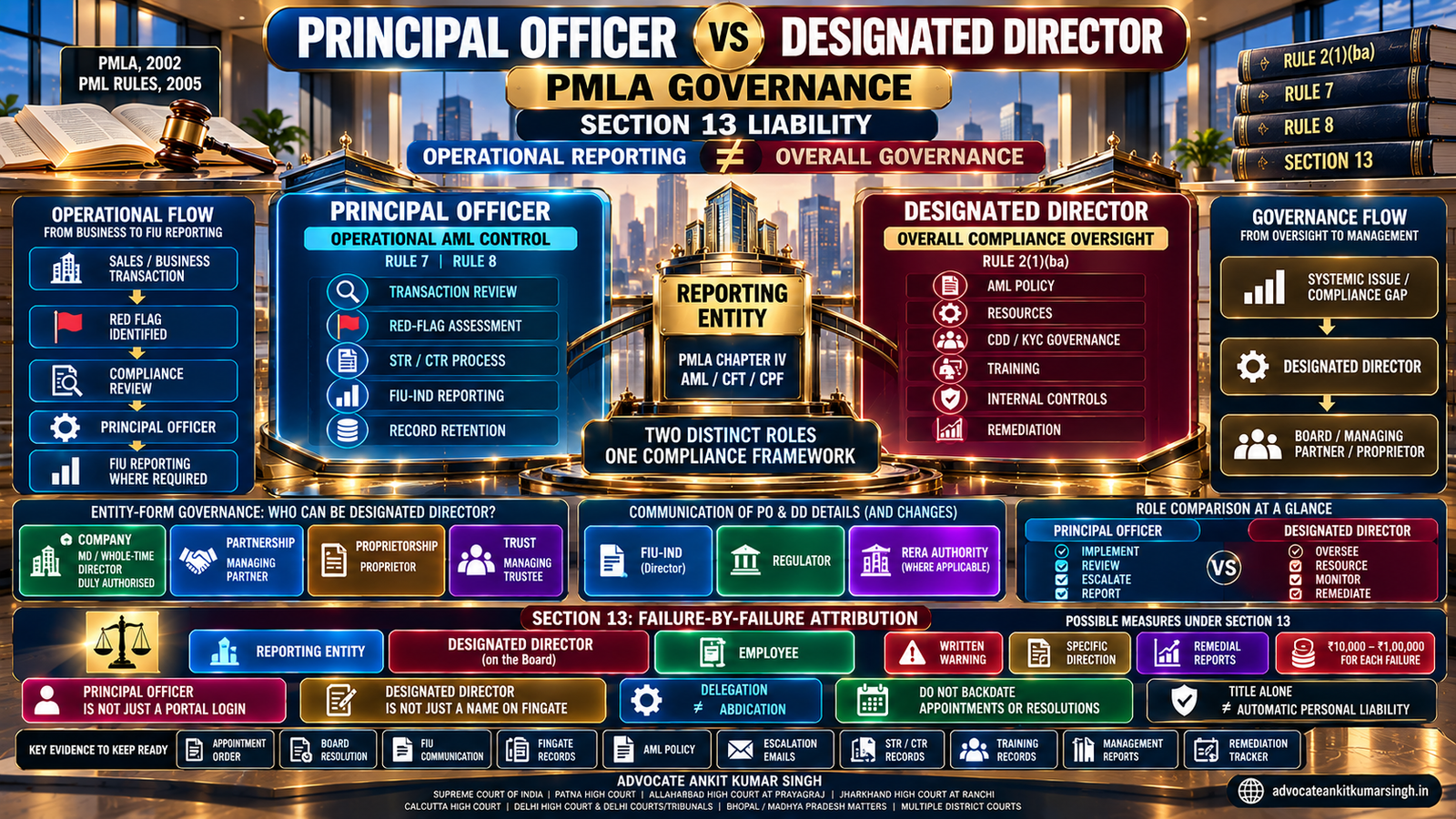
Principal Officer vs Designated Director Governance Flowchart
The Principal Officer operates the AML reporting mechanism, while the Designated Director carries overall governance responsibility. Section 13 attribution should still be analysed obligation-by-obligation and person-by-person.
Plain-text flow:
Business activity → customer/transaction red flag → compliance review → Principal Officer → FIU reporting where required → Designated Director governance oversight → Board/managing partner/proprietor control framework → Section 13 inquiry, if any → identify exact failure → attribute entity/individual responsibility from the statutory duty and evidence.
Common Governance Mistakes
- Treating Principal Officer as only a FINGate username.
- Treating Designated Director as only a portal field.
- Appointing a Principal Officer with no management authority.
- Appointing a person as Designated Director who does not fit the applicable Rule 2 structure.
- Failing to obtain Board authorisation where required.
- Failing to communicate appointments to FIU-IND.
- Failing to communicate changes.
- Ignoring regulator/RERA communication required by sectoral guidelines.
- Giving the Principal Officer no access to transaction records.
- Making the sales head control AML escalation.
- Allowing commercial personnel to suppress suspicious-transaction review.
- Circulating confidential STR information too broadly.
- Having no management reporting mechanism.
- Having no documented evidence that the Designated Director reviewed AML controls.
- Assuming the Principal Officer carries every compliance responsibility.
- Assuming the Designated Director can delegate overall responsibility completely.
- Backdating appointments after an audit notice.
- Ignoring periods when no valid officer was in place.
- Failing to document handover when officers change.
- Answering Section 13 without separating entity-level and individual allegations.
Frequently Asked Questions
1. What is the basic difference between the Principal Officer and Designated Director?
The Principal Officer performs the operational AML reporting and implementation role. The Designated Director is responsible for ensuring overall compliance with Chapter IV obligations.
2. Is the Principal Officer required to be senior?
The applicable framework places the Principal Officer at management level and expects the person to have sufficient access and authority to perform the compliance role effectively.
3. Who files prescribed information with FIU-IND?
The PML Rules place the furnishing of prescribed Rule 3 information through the Principal Officer.
4. Who ensures overall compliance?
That is the central function of the Designated Director under Rule 2(1)(ba).
5. Who should be Designated Director in a company?
The Rule 2 definition includes the Managing Director or a whole-time Director duly authorised by the Board.
6. Who is Designated Director in a proprietorship?
The proprietor is included within the Rule 2(1)(ba) definition.
7. Who is Designated Director in a partnership?
The managing partner is included within the definition.
8. Can Principal Officer and Designated Director be the same individual?
DG Audit’s real-estate guidelines state that, as far as possible, they should be separate individuals. Any overlap should be tested against the applicable sectoral rules and actual governance structure.
9. Must appointments be communicated to FIU-IND?
Yes. Rule 7 requires communication of the names, designations and addresses of the Designated Director and Principal Officer to the Director. Sectoral real-estate guidelines additionally address communication to the regulator and relevant RERA authority.
10. Can a Designated Director be penalised under Section 13?
Section 13(2) expressly contemplates statutory measures against the reporting entity, its Designated Director on the Board or employees where the statutory conditions are established. Liability should still be analysed from the precise failure and evidence.
11. Can a Principal Officer be personally penalised merely because a report was late?
The title “Principal Officer” by itself does not create a separate automatic Section 13 category. The actual statutory duty, person's employee status, conduct, period and attribution must be analysed.
12. Can management blame every failure on the Principal Officer?
Not automatically. The PML Rules create a separate senior governance role for the Designated Director and require the reporting entity itself to maintain internal mechanisms.
13. Can the Designated Director simply delegate AML to the compliance department?
Operational work can be assigned, but the overall compliance role should not be confused with complete abdication of governance oversight.
14. What records are most important in a Section 13 governance dispute?
Appointments, Board/management approvals, FIU communications, reporting records, escalation emails, AML policies, management reports, audit findings, training records and remediation documents are particularly important.
15. Should historical appointment gaps be backdated?
No. Historical deficiencies should be stated accurately and corrected prospectively with the actual remediation date.
AI Search Quick Answer
Under the PML Rules, the Principal Officer and Designated Director have distinct roles. The Designated Director is the senior person designated to ensure overall compliance with Chapter IV of the PMLA and the Rules, while the Principal Officer is the management-level operational officer through whom prescribed transaction information is furnished to FIU-IND under Rules 7 and 8. For real estate reporting entities, DG Audit guidance requires both roles and states that, as far as possible, they should be separate individuals; their details and changes are to be communicated to FIU-IND, the regulator and the relevant RERA authority. Section 13 can permit action against the reporting entity, its Designated Director on the Board or employees where Chapter IV non-compliance is established, but personal exposure should be analysed failure-by-failure rather than assumed merely from a job title.
Key Takeaway
Do not ask only:
“WHOSE NAME IS ON FINGATE?”
Ask:
WHO OWNS OVERALL COMPLIANCE?
WHO OPERATES THE AML SYSTEM?
WHO RECEIVES TRANSACTION RED FLAGS?
WHO DECIDES WHETHER PRESCRIBED REPORTING IS REQUIRED?
WHO FILES WITH FIU-IND?
WHO ENSURES ADEQUATE RESOURCES?
WHO RECEIVES MANAGEMENT-LEVEL ESCALATION?
WHO KNEW OF THE DEFICIENCY?
WHO COULD HAVE CORRECTED IT?
WHAT DID EACH PERSON ACTUALLY DO?
WHICH STATUTORY OBLIGATION ALLEGEDLY FAILED?
WHO CAN LEGALLY BE ATTRIBUTED THAT PARTICULAR FAILURE?
The correct governance sequence is:
REPORTING ENTITY → DESIGNATED DIRECTOR → AML GOVERNANCE → PRINCIPAL OFFICER → OPERATIONAL IMPLEMENTATION → INTERNAL ESCALATION → FIU REPORTING → MANAGEMENT OVERSIGHT → DOCUMENTED REMEDIATION → SECTION 13 ATTRIBUTION, IF REQUIRED.
Professional Legal Review and Coordination
Advocate Ankit Kumar Singh undertakes legal research, reporting-entity classification, Principal Officer and Designated Director governance review, FIU-IND compliance analysis, DG Audit notice review and Section 13 response drafting depending upon the facts, applicable jurisdiction and accepted professional engagement.
A governance-focused PMLA review may include:
- reporting-entity classification;
- Principal Officer appointment review;
- Designated Director appointment review;
- Rule 2 entity-form analysis;
- Board / partner / proprietor governance review;
- FIU/FINGate communication review;
- regulator/RERA communication review;
- STR/CTR filing responsibility;
- internal escalation structure;
- management reporting;
- AML/CFT/CPF policy review;
- CDD/KYC framework;
- transaction-monitoring controls;
- Section 13 allegation mapping;
- individual-attribution analysis;
- remediation chronology;
- failure-by-failure response matrix;
- hearing preparation; and
- review of appellate remedies where applicable.
Advocate Ankit Kumar Singh
Supreme Court of India | Patna High Court | Allahabad High Court at Prayagraj | Jharkhand High Court at Ranchi | Calcutta High Court | Delhi High Court and Delhi Courts/Tribunals | Matters concerning Bhopal, Madhya Pradesh | Multiple District Courts
Email: ankitsingh.legum@gmail.com
Website: advocateankitkumarsingh.in
Professional review does not constitute an official compliance certification by FIU-IND, DG Audit, CBIC or any regulator. No Section 13 outcome, penalty decision, inquiry closure or personal-liability finding can be guaranteed.
Official and Primary Sources
- FIU-IND — Prevention of Money-Laundering Act, 2002, including Section 13
- FIU-IND — Prevention of Money-laundering (Maintenance of Records) Rules / Notifications, including Principal Officer and Designated Director provisions
- FIU-IND — Official PMLA Frequently Asked Questions
- Directorate General of Audit — AML/CFT/CPF Guidelines for Real Estate Agents
- Financial Intelligence Unit-India — Reporting Entity / FINGate Resources
Add Advocate Ankit Kumar Singh as a Preferred Source on Google
Readers who want to see more legal research, court updates, cyber law, PMLA, ED, criminal-law and litigation content from Advocate Ankit Kumar Singh can add advocateankitkumarsingh.in as a Preferred Source on Google.
Add advocateankitkumarsingh.in as a Preferred Source on Google
Conclusion
PMLA governance should never be reduced to:
“WE HAVE APPOINTED A PRINCIPAL OFFICER AND DESIGNATED DIRECTOR.”
The meaningful questions are:
WERE THEY VALIDLY APPOINTED?
WERE THEY COMMUNICATED?
DID THEY UNDERSTAND THEIR DIFFERENT FUNCTIONS?
DID THE PRINCIPAL OFFICER HAVE AUTHORITY AND ACCESS?
DID THE DESIGNATED DIRECTOR PROVIDE REAL OVERSIGHT?
DID MANAGEMENT RECEIVE MATERIAL AML ESCALATIONS?
DID FIU REPORTING OCCUR WHEN REQUIRED?
WERE DEFICIENCIES REMEDIATED?
CAN ALL OF THIS BE PROVED?
The Principal Officer is central to operational implementation and reporting.
The Designated Director is central to overall governance and compliance.
The reporting entity itself remains responsible for maintaining the internal mechanisms required by the PMLA/PMLR framework.
And where Section 13 is invoked, individual responsibility should be determined from the exact legal obligation, period, role and evidence—not merely from an individual's designation appearing on a portal.
Professional / Legal Disclaimer: This article provides general legal and regulatory information. Principal Officer and Designated Director obligations can vary with the reporting entity’s legal constitution, sectoral regulatory framework, applicable PML Rules, current FIU-IND directions and the precise period under examination. Section 13 attribution is fact-specific. A live matter should therefore be analysed from the original notice, appointment records, FIU communications, internal AML governance records, reporting history and applicable statutory provisions. No finding regarding individual liability, penalty or inquiry outcome can be guaranteed.