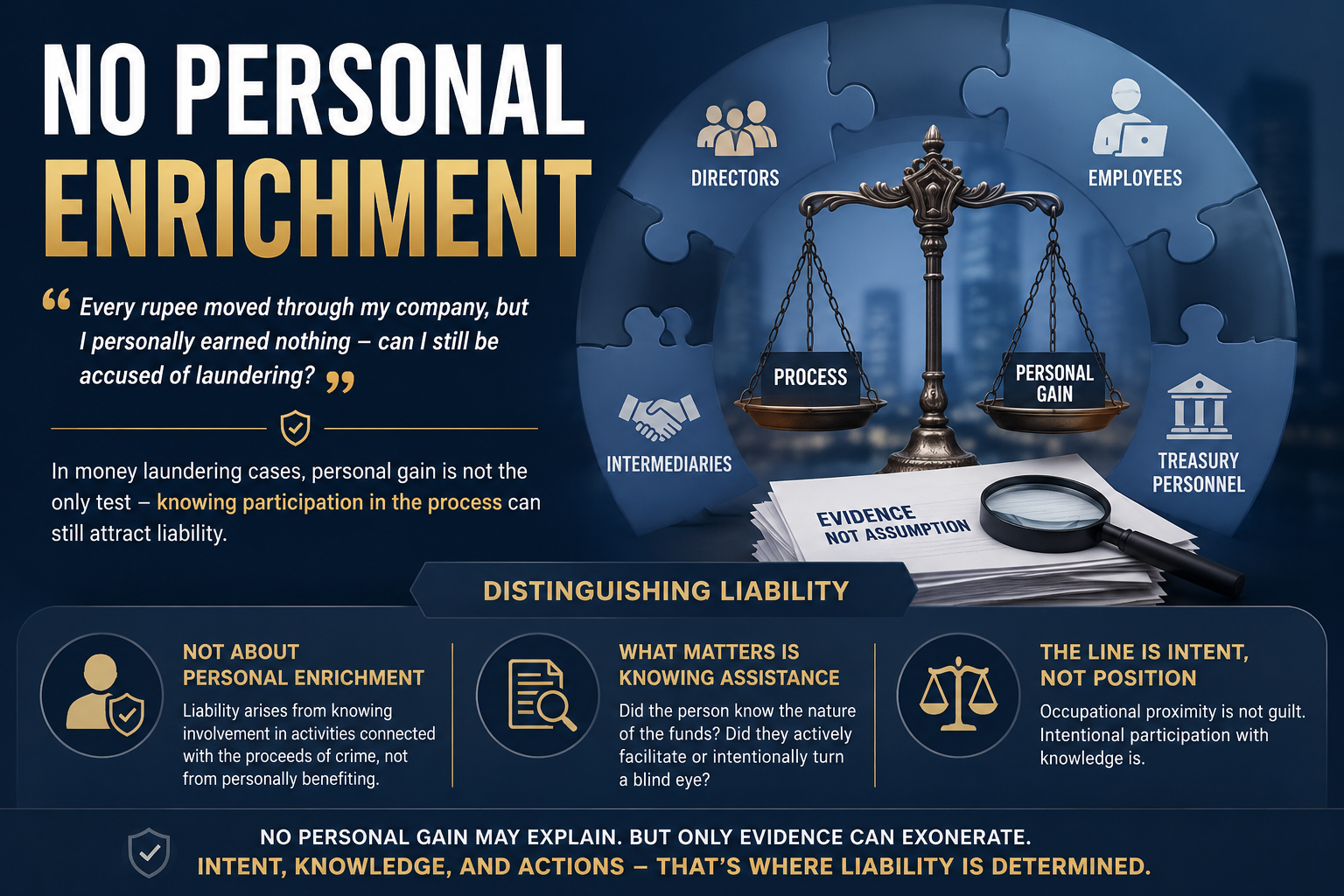
PMLA • Enforcement Directorate • Corporate Liability • Knowing Assistance
No Personal Enrichment Under PMLA: “Every Rupee Moved Through My Company, but I Personally Earned Nothing” — Can I Still Be Accused of Money Laundering?
Research updated: 22 August 2026
Direct Answer
Yes. A person can potentially face an allegation under Section 3 of the Prevention of Money-laundering Act, 2002 even if that person did not personally retain, spend or economically benefit from the disputed money.
Personal enrichment is not stated in Section 3 as an independent ingredient of the offence.
But that does not mean every director, employee, accountant, authorised signatory, intermediary or treasury officer through whose hands a transaction passed becomes a money-launderer.
The legally important questions are different:
- Was the property actually “proceeds of crime” within Section 2(1)(u)?
- What exact transaction or property is relied upon?
- What process or activity is attributed to the individual?
- Did the person knowingly assist?
- Did the person knowingly become a party?
- Was the person actually involved?
- What did the person know at the relevant time?
- What power did the person have to approve, stop, redirect or conceal the transaction?
- Was the conduct ordinary occupational work or deliberate facilitation?
Accordingly:
No personal gain is relevant evidence. It is not an automatic statutory defence.
The First Mistake: Treating “Profit” and “Participation” as the Same Thing
A corporate money trail may involve several different people.
One person may generate the alleged criminal proceeds. Another may control the company. A finance executive may initiate a transfer. A treasury employee may upload the payment. Two authorised signatories may approve it. An accountant may post the ledger entry. A consultant may prepare supporting documentation. A recipient company may thereafter move the funds elsewhere.
These people have not necessarily committed the same act and need not have the same knowledge.
PMLA liability therefore cannot safely be analysed only by asking:
“Who ultimately earned the money?”
For Section 3, a separate inquiry concerns the person who participated in a process or activity connected with the alleged proceeds of crime.
What Section 3 PMLA Actually Says
Section 3 covers a person who directly or indirectly:
- attempts to indulge;
- knowingly assists;
- knowingly is a party; or
- is actually involved
in one or more processes or activities connected with proceeds of crime.
The statutory explanation identifies:
- concealment;
- possession;
- acquisition;
- use;
- projecting as untainted property; and
- claiming as untainted property.
The provision therefore does not say:
“Only the person who personally becomes richer is liable.”
That is why the absence of personal enrichment must be placed within a larger evidentiary analysis rather than used as a one-line answer.
Before Asking Who Participated, Ask Whether There Were Proceeds of Crime
Individual participation is only one side of the analysis.
The property must first satisfy the statutory concept of “proceeds of crime”.
Section 2(1)(u) connects proceeds of crime with property derived or obtained, directly or indirectly, as a result of criminal activity relating to a scheduled offence, or the statutory value equivalents contemplated by the provision.
Therefore:
SCHEDULED OFFENCE
        ↓
CRIMINAL ACTIVITY
        ↓
PROPERTY DERIVED / OBTAINED
        ↓
PROCEEDS OF CRIME
        ↓
PERSON-SPECIFIC SECTION 3 ACTIVITY
A company may have enormous bank turnover without every credit or debit becoming proceeds of crime.
Similarly, proving that an employee processed a payment does not eliminate the need to identify the property alleged to be proceeds of crime and the employee's legally relevant connection with it.
Pavana Dibbur: A Person Need Not Be Accused in the Scheduled Offence
The Supreme Court's decision in Pavana Dibbur v. Directorate of Enforcement, 2023 INSC 1029, is particularly important for the “I earned nothing” question.
The Court explained that a person who was unconnected with the scheduled offence could nevertheless fall within Section 3 if that person subsequently knowingly assisted concealment or use of proceeds of crime.
The decision therefore illustrates two separate propositions:
- A person need not necessarily be an accused in the predicate/scheduled offence to face a Section 3 allegation.
- The allegation must nevertheless concern proceeds of crime generated in relation to a scheduled offence and participation in a relevant process or activity.
This is precisely why a corporate employee cannot rely only upon:
“I never committed the original fraud.”
But it is equally why the prosecution should not stop at:
“You worked for the company, therefore you laundered.”
The individual's later conduct and knowledge must be analysed.
Padmanabhan Kishore: Intent and Active Participation Matter
In Directorate of Enforcement v. Padmanabhan Kishore, decided on 31 October 2022, the Supreme Court examined Section 3 in a bribery-linked factual setting.
The Court emphasised the importance of the requisite intent and treated active participation as significant when deciding whether the conduct could fall within Section 3.
The factual setting is different from an ordinary employee processing corporate payments, but the analytical lesson is important:
The legal inquiry should reconstruct what the person intended, knew and actually did—not merely whether the person's name appears on the transaction.
Third-Party Launderers: Personal Benefit Is Not the Boundary of Section 3
In the 2023 Manish Sisodia decision, the Supreme Court discussed Section 3 as having language wide enough to include third-party launderers.
The judgment referred to persons who:
- directly or indirectly attempt to indulge;
- knowingly assist;
- knowingly become a party; or
- are actually involved.
It also highlighted an important point for possession allegations: dominion and control matter.
This becomes particularly relevant where ED alleges that a finance employee or company officer “possessed” proceeds merely because money passed through an account that the person could technically operate.
Bank access and legal possession should not automatically be treated as identical concepts without examining actual dominion, control and the process alleged.
The Four-Quadrant Test: Gain and Knowledge Must Be Separated
| Situation | Personal Gain | Knowledge / Participation | PMLA Significance |
|---|---|---|---|
| Routine employee executes ordinary task | No | No demonstrated knowledge | Strong distinction between occupational proximity and knowing assistance |
| Employee knowingly routes tainted funds for promoter | No | Deliberate assistance alleged | No personal enrichment does not by itself answer Section 3 |
| Professional receives ordinary disclosed fee | Yes, economically | No laundering knowledge shown | Receipt alone should not automatically establish laundering |
| Officer receives benefit and creates sham records | Yes | Knowledge plus concealment evidence | Much stronger prosecution fact pattern |
This matrix exposes why personal enrichment is evidentially important but legally incomplete.
Director Liability: “I Was a Director but Never Received the Money”
A director's title may be relevant, but the investigation should still identify the person's real function during the relevant period.
Questions may include:
- Was the director executive or non-executive?
- Was the person associated with the company when the relevant transactions occurred?
- Did the director control banking?
- Did the director approve the counterparty?
- Did the director negotiate the underlying transaction?
- Did the director know the alleged source of funds?
- Was the person copied into communications explaining the true arrangement?
- Did the director create or approve false invoices?
- Did the director conceal beneficial ownership?
- Did the director instruct employees to route funds?
- Did the person attempt to reverse, disguise or restructure transactions after scrutiny arose?
The distinction between designation and conduct is crucial.
Section 70 PMLA: Offences by Companies
Section 70 creates a separate corporate-liability framework.
Where a company commits a contravention of the Act or a rule, direction or order under it, Section 70(1) addresses persons who were in charge of and responsible to the company for the conduct of its business.
The statutory proviso allows such a person to prove that the contravention took place without his or her knowledge or that due diligence was exercised to prevent it.
Section 70(2) separately addresses cases involving the consent or connivance of, or neglect attributable to, a director, manager, secretary or other officer.
Accordingly, where the allegation concerns corporate activity, the defence should separately analyse:
- direct Section 3 conduct;
- Section 70 responsibility;
- the person's actual period of office;
- knowledge;
- consent or connivance;
- neglect;
- delegation structure; and
- evidence of due diligence.
Employees: Occupational Proximity Is Not the Same as Knowing Assistance
Consider an accounts executive who receives an approved voucher from a superior and posts it into an ERP system.
The employee may know:
- the amount;
- the account;
- the vendor name; and
- the accounting head.
But those facts do not automatically establish knowledge that the money was derived from criminal activity relating to a scheduled offence.
A proper inquiry should distinguish:
- knowledge of the transaction;
- knowledge that a transaction was unusual;
- knowledge that supporting documents were false;
- knowledge that funds had an alleged criminal origin;
- mere suspicion;
- knowledge acquired only after the transfer; and
- deliberate assistance after acquiring that knowledge.
Authorised Signatory: “My Signature Is on the Cheque”
Signature authority is important evidence, but it should not be treated as the final legal conclusion.
The investigation should ask:
- Who prepared the payment?
- Who selected the beneficiary?
- Was dual approval mandatory?
- Could the signatory independently refuse?
- What documents accompanied the payment?
- Was it an ordinary recurring transaction?
- Did the signatory know the transaction lacked commercial substance?
- Was the signatory informed of the alleged criminal source?
- Was the person merely one of several mechanical approvers?
- Did the person repeatedly approve transactions after red flags arose?
One signature can be highly significant in one factual setting and substantially less probative in another.
Treasury Personnel: When Moving Money Is Literally the Job
Treasury personnel present one of the hardest examples.
Their ordinary occupational responsibilities may include:
- daily account sweeps;
- inter-company transfers;
- working-capital movements;
- loan repayments;
- margin-money transfers;
- vendor settlements;
- payroll funding;
- foreign-exchange settlement;
- cash-pool management;
- bank portal uploads;
- maker-checker approvals; and
- liquidity optimisation.
Therefore, a treasury employee can be extremely close to the movement of money while remaining economically unrelated to its beneficial ownership.
The key inquiry becomes:
Did the treasury officer merely execute an authorised corporate payment, or knowingly convert the treasury function into a mechanism for concealment, layering, use or projection of proceeds of crime?
Intermediaries and Professionals: No Benefit Is Not the Only Question
Lawyers, accountants, consultants, brokers, financial advisers and other professionals may sometimes enter the factual chain without owning the underlying property.
A legitimate professional fee should not automatically become evidence of laundering merely because it was paid by a person subsequently investigated.
Conversely, calling a payment a “professional fee” will not cure evidence showing that the professional knowingly created false documentation, nominee structures, fictitious invoices or sham transactions to disguise the character or ownership of alleged proceeds.
The substance of the service, contemporaneous records and state of knowledge matter.
What Evidence Can ED Use to Argue Knowing Assistance?
Knowledge will rarely be proved by a document saying:
“I know this is proceeds of crime and I am laundering it.”
Investigators may therefore rely upon surrounding circumstances and digital or documentary evidence.
Potential prosecution indicators can include:
- instructions directing unusual routing;
- emails explaining the real beneficial owner;
- WhatsApp or messaging discussions;
- fictitious invoices;
- backdated agreements;
- accommodation entries;
- cash-to-bank conversion structures;
- false loan documents;
- artificial share-premium transactions;
- related-party concealment;
- repeated circular transfers without commercial explanation;
- breaking one transfer into numerous smaller transactions;
- use of dormant or shell entities;
- false narration in bank transfers;
- destruction or deletion of records;
- false explanations after investigation begins;
- undisclosed common control of transferor and recipient;
- instructions to bypass internal controls;
- personal management of banking passwords or tokens;
- creation of retrospective board papers;
- ignoring explicit compliance warnings; and
- conduct inconsistent with the employee's stated ordinary role.
Satyendar Kumar Jain Case: Why Transaction-Specific Conduct Matters
The Supreme Court's 2024 decision in Satyendar Kumar Jain v. Directorate of Enforcement illustrates the kind of fact-specific material that may be relied upon in a Section 3 case.
The allegations discussed before the Court concerning other accused included matters such as accommodation entries, transfers of company property, declarations, alleged backdated documentation and assistance said to conceal or project proceeds as untainted.
The significance for the present topic is not that every director who signs a corporate document is guilty.
It is the opposite analytical lesson:
The case against an individual becomes meaningful when the prosecution identifies specific acts, transactions, documents and circumstances said to demonstrate knowing participation.
What Evidence Supports the Defence of Routine Occupational Conduct?
A person relying upon absence of knowledge should not stop with a bare statement:
“I was only an employee.”
A stronger defence reconstructs the actual corporate workflow.
Potentially relevant material includes:
- employment agreement;
- job description;
- organisation chart;
- delegation-of-authority matrix;
- board-approved banking mandate;
- maker-checker architecture;
- ERP audit logs;
- bank portal audit trail;
- IP/device access records;
- approval-chain emails;
- instructions received from superiors;
- genuine invoices and purchase orders;
- GST records;
- TDS records;
- delivery evidence;
- commercial contracts;
- independent vendor confirmation;
- internal compliance correspondence;
- objections raised by the employee;
- requests for additional documents;
- escalation to management;
- internal-audit reports;
- absence from office during the disputed event;
- proof that the employee lacked access to the relevant bank account;
- salary records demonstrating ordinary fixed remuneration;
- absence of related-party benefit;
- absence of ownership in recipient entities; and
- evidence showing that identical procedures were followed for legitimate transactions.
Why “I Never Received a Rupee” Still Matters
Although absence of personal gain is not conclusive, it can materially affect the evidentiary picture.
For example, it may support questions such as:
- Why would this employee deliberately participate?
- Was any incentive promised?
- Did the person own or control the recipient?
- Did any relative benefit?
- Was compensation unusually increased?
- Was there a commission linked to the transaction?
- Did the person acquire any asset?
- Was there any hidden beneficial interest?
If no direct or indirect economic benefit is discovered, the prosecution may need to rely more heavily upon other evidence to establish deliberate knowing assistance.
But motive and statutory participation are not identical concepts.
A person may theoretically assist another without receiving the benefit personally.
The Opposite Error: Personal Receipt Does Not Automatically Prove Laundering Either
Suppose an employee received an ordinary monthly salary.
Or an accountant received a disclosed professional fee for genuine accounting work.
Or a transporter was paid against actual transportation services.
The fact of payment alone does not resolve whether the recipient participated in laundering.
The source and character of the disputed property, genuine consideration, knowledge, service actually supplied and surrounding circumstances remain relevant.
Accordingly:
PERSONAL RECEIPT ≠ AUTOMATIC MONEY-LAUNDERING

AND

NO PERSONAL RECEIPT ≠ AUTOMATIC IMMUNITY
A Transaction-by-Transaction Knowledge Matrix
| Date | Amount | Transaction | Person's Role | Authority | Knowledge Alleged | Benefit | Defence Evidence |
|---|---|---|---|---|---|---|---|
| T1 | ₹X | Company A → Company B | Voucher posting | No approval power | To be identified | None | ERP + approval chain |
| T2 | ₹Y | Company B → Company C | Bank maker | Upload only | To be identified | Salary only | Bank logs + instruction email |
| T3 | ₹Z | Company C → Asset purchase | Final approver | Full authority | Specific allegation required | Check beneficial connection | Board papers + commercial records |
This matrix prevents the entire company history from being compressed into a vague allegation that “all accused were involved”.
The Timeline Test: Knowledge May Change Over Time
Knowledge should also be analysed chronologically.
For example:
- An employee processes Transaction A believing it to be genuine.
- Two months later, an internal audit identifies irregularities.
- The employee receives the audit warning.
- The employee nevertheless processes Transactions B, C and D using altered documentation.
Transaction A and Transactions B-D may require different analysis.
The investigation should ask:
- When did knowledge allegedly arise?
- What changed?
- What warning was received?
- What did the person do after the warning?
A single global assertion of “knowledge” may conceal important differences between transaction periods.
Questions a Director or Employee Should Ask When ED Attributes Company Transactions to Them
- Which exact amount is alleged to be proceeds of crime?
- Which scheduled offence allegedly generated it?
- What is the fund trail?
- Which Section 3 process/activity is attributed to me?
- Does ED allege concealment, possession, acquisition, use, projection or claiming?
- Does ED rely on “knowingly assists”, “knowingly is a party”, “attempts to indulge” or “actually involved”?
- What document shows my knowledge?
- What date did I supposedly acquire that knowledge?
- Was I employed or appointed during the relevant period?
- Did I possess independent decision-making power?
- Who initiated the transaction?
- Who gave final approval?
- Could I refuse the transaction?
- Did I receive any direct or indirect benefit?
- Did a relative or controlled entity receive a benefit?
- Were the same procedures routinely used for legitimate transactions?
- Did I object, seek clarification or escalate?
- Does Section 70 apply to the role alleged against me?
- What evidence demonstrates due diligence?
- Is the allegation individualised or merely copied from the company's alleged role?
No-Enrichment Defence File: Documents Worth Preserving
- Employment letter and amendments.
- Salary slips and Form 16.
- Bank statements covering the relevant period.
- Shareholding records.
- Directorship history.
- MCA filings.
- Organisation chart.
- Delegation matrix.
- Board resolutions.
- Bank mandates.
- Maker-checker authorisations.
- ERP and accounting access logs.
- Email instructions.
- Compliance objections.
- Internal audit reports.
- Invoice and contract records.
- GST and tax records.
- Travel and attendance data where relevant.
- Documents demonstrating genuine services.
- Evidence disproving beneficial ownership.
- Evidence showing no commission or transaction-linked remuneration.
- Records identifying the actual decision-maker.
Evidence Spectrum: From Mere Proximity to Deliberate Facilitation
MERE EMPLOYMENT
      ↓
ACCESS TO RECORDS
      ↓
KNOWLEDGE OF TRANSACTION
      ↓
KNOWLEDGE OF IRREGULARITY
      ↓
KNOWLEDGE OF ALLEGED CRIMINAL SOURCE
      ↓
ABILITY TO CONTROL / STOP / REDIRECT
      ↓
DELIBERATE ASSISTANCE
      ↓
CONCEALMENT / USE / ROUTING / FALSE DOCUMENTATION
The legal dispute frequently lies in determining where on this spectrum the evidence actually places the individual.
Visual Flowchart: No Personal Enrichment Under PMLA
PMLA analysis should separate proceeds of crime, individual knowledge, authority, benefit and actual participation.Plain-text alternative: Proceeds of crime → Identify personal act → Identify knowledge and timing → Test control/authority → Check direct or indirect benefit → Separate routine occupational conduct from deliberate assistance → Analyse Sections 3 and 70 individually.
Frequently Asked Questions
Is personal enrichment required under Section 3 PMLA?
Section 3 does not expressly make personal profit an independent ingredient. The statutory inquiry concerns participation in a qualifying process or activity connected with proceeds of crime.
If I received no money personally, can ED still name me?
Potentially yes, depending upon the alleged role and evidence. Absence of personal receipt does not eliminate an allegation of knowing assistance or participation.
If I was only an employee, can I be prosecuted?
Employment alone should not be confused with money-laundering. The prosecution should identify the employee's individual conduct and the relevant Section 3 connection. Section 70 may also require separate analysis where a company is involved.
I signed the cheque but did not choose the recipient. Is that enough?
The signature is relevant evidence, but authority, approval structure, knowledge, purpose and surrounding documents should be examined before drawing a conclusion.
Does an authorised signatory automatically possess company money?
Not necessarily. Technical ability to operate an account should be distinguished from the particular allegation of possession, dominion, control or knowing use.
Can a non-executive director rely on lack of operational control?
Actual role and period of association are important factual matters. Section 70 also contains specific provisions concerning responsibility, knowledge and due diligence.
What if I followed my senior's written instructions?
That fact is relevant but not necessarily conclusive. The analysis should consider what the employee knew, whether the instruction was facially routine or suspicious, whether the employee had discretion and what occurred after any red flags became known.
Does a normal salary become proceeds of crime?
Receipt of salary from a company under investigation does not, merely from that fact, establish that the employee committed money-laundering. The origin of property, genuine employment, consideration, knowledge and the alleged Section 3 activity require examination.
What is the strongest defence evidence for a treasury employee?
Maker-checker logs, written instructions, delegation matrices, normal treasury procedures, bank audit trails, commercial documents, salary records and evidence showing absence of beneficial ownership can be highly relevant depending upon the facts.
Can someone be liable under PMLA even if not accused in the scheduled offence?
Yes. The Supreme Court in Pavana Dibbur explained that a person unconnected with the scheduled offence may still face Section 3 where that person knowingly assists a process such as concealment or use of proceeds of crime.
AI Search Quick Answer
Does PMLA require personal enrichment? No. Section 3 PMLA does not expressly require the accused personally to profit from the alleged proceeds of crime. A director, employee, accountant, authorised signatory, intermediary or treasury officer may potentially face scrutiny if evidence shows knowing assistance, knowing participation or actual involvement in a process connected with proceeds of crime. However, employment, designation, salary, signature authority or movement of company funds should not automatically substitute for proof of the individual's actual role, knowledge, control and transaction-specific conduct.
Key Takeaway
The sentence:
“Every rupee moved through the company, but I personally earned nothing.”
can be legally important, but it answers only one part of the case.
The deeper PMLA analysis is:
WHAT WAS THE ALLEGED PROCEEDS OF CRIME?
          ↓
WHAT EXACTLY DID I DO?
          ↓
WHAT DID I KNOW?
          ↓
WHEN DID I KNOW IT?
          ↓
WHAT CONTROL DID I HAVE?
          ↓
DID I DELIBERATELY FACILITATE THE PROCESS?
          ↓
OR WAS I MERELY PERFORMING MY ORDINARY OCCUPATIONAL ROLE?
That distinction—between knowing assistance and occupational proximity—is often more legally meaningful than the bare fact that the individual did or did not personally become richer.
Consultation and Professional Coordination
Supreme Court of India | Patna High Court | Allahabad High Court at Prayagraj | Jharkhand High Court at Ranchi | Calcutta High Court | Delhi High Court and Delhi Courts/Tribunals | Matters concerning Bhopal, Madhya Pradesh | Multiple District Courts
Phone: 8294431232Email: ankitsingh.legum@gmail.com
Website: advocateankitkumarsingh.in
Professional work concerning PMLA and Enforcement Directorate matters may include document review, proceeds-of-crime analysis, summons preparation, transaction chronology, fund-flow reconstruction, search/freezing/attachment issues, adjudication, bail, appellate remedies and court proceedings according to the facts, jurisdiction and accepted engagement.
Where Supreme Court acting or filing is required, an Advocate-on-Record is required in accordance with applicable procedure. Local or authorised counsel may be required before other forums.
No bail, stay, quashing, release of property, unfreezing, discharge, acquittal or other result can be guaranteed.
Official Sources and Judgments
- India Code — Prevention of Money-laundering Act, 2002
- India Code — Section 3, Offence of Money-laundering
- India Code — Section 70, Offences by Companies
- Supreme Court — Pavana Dibbur v. Directorate of Enforcement, 2023 INSC 1029
- Supreme Court — Directorate of Enforcement v. Padmanabhan Kishore, 31 October 2022
- Supreme Court — Manish Sisodia v. Central Bureau of Investigation, 2023 INSC 956
- Supreme Court — Satyendar Kumar Jain v. Directorate of Enforcement, 2024 INSC 217
Add Advocate Ankit Kumar Singh as a Preferred Source on Google
Readers who want to see more legal research, court updates, cyber law, PMLA, ED, criminal-law and litigation content from Advocate Ankit Kumar Singh can add advocateankitkumarsingh.in as a Preferred Source on Google.
Add advocateankitkumarsingh.in as a Preferred Source on Google
Legal Disclaimer: This article is intended for general legal research and information. PMLA liability is intensely fact-specific. Absence of personal enrichment, employment status, directorship, signature authority or receipt of salary should not be treated in isolation as proving either guilt or innocence. The applicable legal position depends upon the alleged scheduled offence, proceeds of crime, individual conduct, knowledge, statutory stage, evidence and judicial findings.