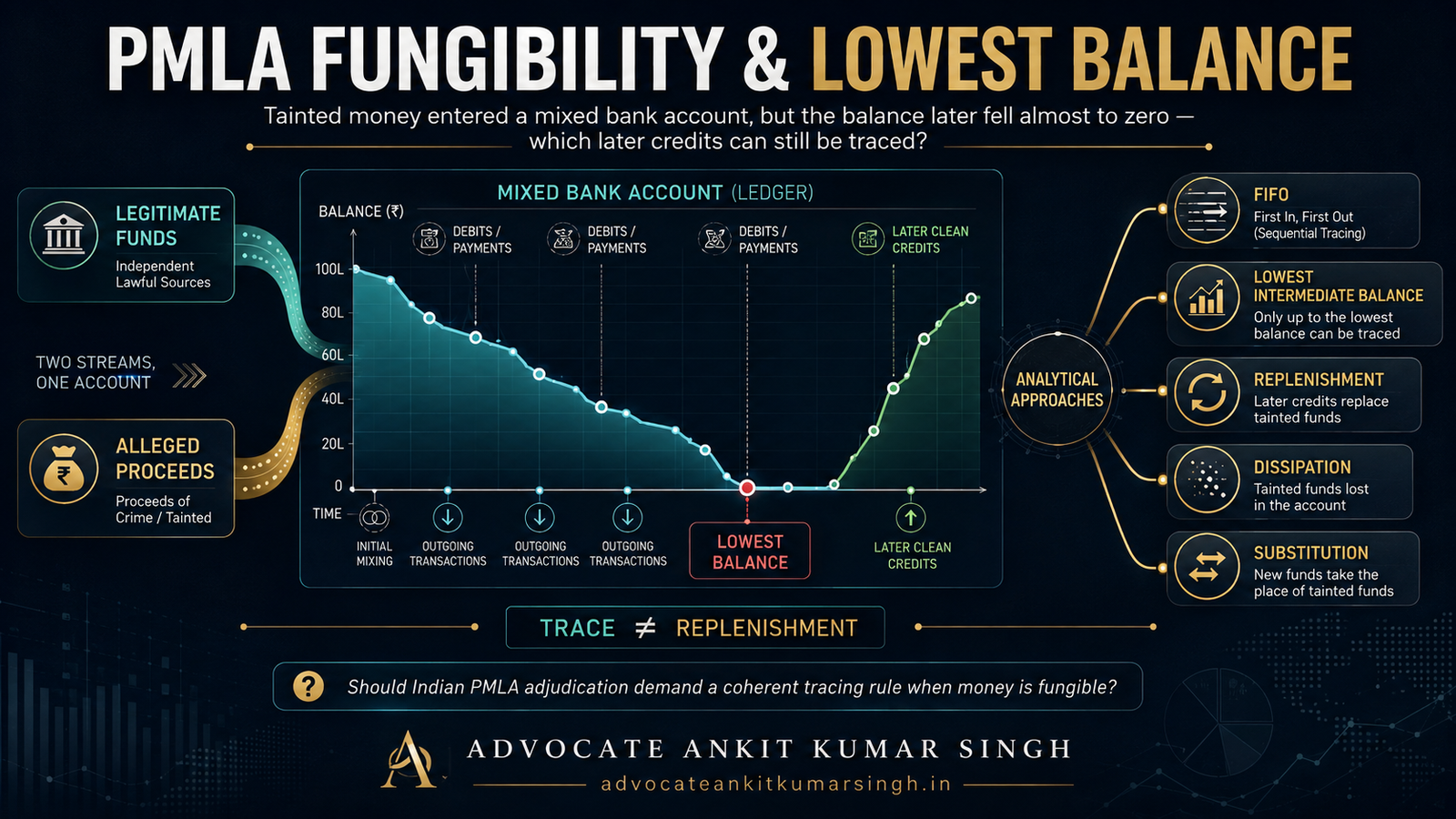
PMLA Fungibility & Lowest Balance: Tainted Money Entered a Mixed Bank Account, but the Balance Later Fell Almost to Zero — Which Later Credits Can Still Be Traced?
A forensic and doctrinal analysis of commingled money, account depletion, lowest intermediate balance, replenishment, substituted property and equivalent-value attachment under the Prevention of Money-Laundering Act, 2002.

Current legal review: 21 August 2026
Direct Answer
No automatic rule should be assumed that every future rupee entering a bank account remains tainted merely because alleged proceeds of crime once passed through that account.
If the disputed money was mixed with legitimate money and the account balance subsequently fell substantially below the alleged tainted amount, the legally important questions become:
- What exact amount allegedly constituted proceeds of crime?
- When did it enter the account?
- What legitimate balance already existed?
- What was the lowest balance reached after the disputed credit?
- Where did the withdrawn value go?
- Was it genuinely spent and dissipated?
- Was it transferred into another account?
- Was it used to acquire another identifiable asset?
- Did any part of the money subsequently return?
- What is the independent source of later credits?
- Is ED tracing the original proceeds, an indirectly derived substitute, or proceeding against equivalent-value property?
These are different inquiries.
Foreign trust and insolvency doctrines such as first-in-first-out, Re Hallett, Re Oatway and the lowest intermediate balance concept are useful comparative tools for analysing fungible money. They should not, however, be described as automatically binding rules under the Prevention of Money-Laundering Act, 2002.
The Indian statutory inquiry ultimately remains whether the presently affected property falls within Section 2(1)(u) PMLA and whether the statutory conditions for the particular freezing, attachment, adjudication or confiscation action have been satisfied.
Quick Navigation
- Why fungibility creates the problem
- Three property theories that must remain separate
- First-in-first-out
- Re Hallett
- Re Oatway
- Lowest intermediate balance
- What if the account reaches zero?
- Later clean credits and replenishment
- Substitution and returned proceeds
- Equivalent-value attachment
- Forensic tracing model
- Litigation strategy
- Frequently asked questions
1. A Bank Account Does Not Contain Labelled Rupees
Suppose a bank account already contains ₹10 lakh from documented legitimate sources.
An additional ₹20 lakh is then credited. ED alleges that this ₹20 lakh represents proceeds of crime.
The account balance becomes ₹30 lakh.
From that point, an ordinary banking ledger does not preserve ten lakh particular digital rupees labelled “clean” and twenty lakh separate digital rupees labelled “tainted”. Money in the account is economically fungible.
That creates a problem of attribution.
If ₹15 lakh is subsequently withdrawn, which component has been spent?
If another ₹12 lakh is later deposited from documented professional income, what is the legal character of the new balance?
The statement:
“Money is fungible.”
does not answer either question.
Fungibility explains why a tracing methodology is necessary. It does not itself determine that methodology.
Two extreme approaches should therefore be avoided.
The first is:
Once money is mixed, the alleged proceeds disappear and become impossible to trace.
Commingling cannot automatically cleanse property.
The opposite extreme is:
Once alleged proceeds enter an account, every later rupee entering that account becomes proceeds of crime forever.
That proposition also requires a statutory and evidentiary foundation.
2. Start With Section 2(1)(u) PMLA
The definition of “proceeds of crime” under Section 2(1)(u) is the starting point.
Its structure requires careful attention to property:
- property derived or obtained directly from relevant criminal activity;
- property derived or obtained indirectly from such activity;
- the value of such property; and
- the further equivalent-value language contained in the statutory definition.
This matters because a bank-account dispute may actually contain several different property theories.
For example:
₹20 lakh alleged proceeds enter Account A.
₹15 lakh is transferred to Account B.
Account B purchases securities.
The securities are later sold.
The sale proceeds return to Account A.
The fact that Account A temporarily fell almost to zero does not necessarily terminate the trail because the relevant value may have continued through Account B and the securities.
That is fundamentally different from:
Account A falling to zero, followed months later by a completely independent salary or commercial payment from an unrelated source.
3. Three Legal Theories Must Not Be Collapsed
| Theory | Core Question | Typical Evidence |
|---|---|---|
| Direct tracing | Does the original disputed value continue to exist in the present account? | Bank statements, running balance, debit trail |
| Indirect derivation / substitution | Was the original value exchanged for or converted into another asset? | Transfer chain, securities, property, redemption records |
| Equivalent-value theory | Can different property be proceeded against for the statutory value of unavailable proceeds? | POC quantification, ownership, valuation and statutory basis |
This distinction has major practical consequences.
A person may successfully demonstrate that the present bank balance cannot factually represent the surviving original money because the account earlier reached zero.
That does not automatically answer a legally distinct argument concerning substituted property or attachment of equivalent-value property.
4. Comparative Model One: First-In-First-Out
The rule historically associated with Clayton's Case uses a first-in-first-out approach to a running account.
On that model, the earliest money deposited is notionally treated as the earliest money withdrawn.
Example:
- Day 1 — ₹5 lakh legitimate funds.
- Day 2 — ₹5 lakh disputed funds.
- Day 3 — ₹5 lakh withdrawal.
A mechanical FIFO approach could treat the Day 1 legitimate money as having been withdrawn first, leaving the disputed ₹5 lakh notionally intact.
But chronology alone can produce arbitrary results when dealing with modern accounts containing hundreds or thousands of transactions.
Indian PMLA does not prescribe a universal FIFO tracing formula.
FIFO is therefore better treated as a comparative accounting model rather than an automatically applicable PMLA rule.
5. Comparative Model Two: Re Hallett — Own Money Spent First
The equitable reasoning associated with Re Hallett's Estate developed in circumstances where a fiduciary mixed another person's money with his own.
Its classic protective logic presumes that the wrongdoer spends his own money before spending the money belonging beneficially to another.
Consider:
- Legitimate balance: ₹6 lakh.
- Disputed credit: ₹4 lakh.
- Total balance: ₹10 lakh.
- Subsequent expenditure: ₹7 lakh.
- Balance remaining: ₹3 lakh.
Using a Hallett-type attribution solely as a comparative model, the first ₹6 lakh withdrawn could be treated as coming from the person's own money.
The additional ₹1 lakh withdrawal would then begin reducing the disputed component.
The maximum disputed component remaining would therefore be ₹3 lakh.
This illustrates why simply comparing the original disputed credit with the final balance may not adequately explain a mixed account.
But this equitable presumption should not be represented as a statutory Section 2(1)(u) rule.
6. Comparative Model Three: Re Oatway — Follow the Valuable Substitute
Re Oatway exposes an important weakness in mechanical tracing presumptions.
Assume mixed money is placed in an account.
A portion is withdrawn to purchase a valuable investment.
The remaining balance is subsequently dissipated.
It would be artificial to permit the person controlling the account to say:
“The money used to buy the valuable asset was my clean money, while the money later wasted was the disputed money.”
The comparative lesson for PMLA analysis is powerful:
A FALLING BANK BALANCE DOES NOT NECESSARILY MEAN THAT THE VALUE HAS BEEN DISSIPATED.
The value may instead have migrated into another identifiable asset.
Therefore, whenever a lowest-balance argument is raised, outgoing transactions must also be examined.
7. The Lowest Intermediate Balance Concept
The lowest-intermediate-balance approach addresses a specific problem:
Can unrelated money deposited later recreate previously depleted traceable money?
Consider the following example:
| Stage | Transaction | Balance | Possible Surviving Trace Under LIB Analysis |
|---|---|---|---|
| 1 | ₹6 lakh legitimate opening balance | ₹6 lakh | ₹0 |
| 2 | ₹4 lakh disputed credit | ₹10 lakh | ₹4 lakh |
| 3 | ₹7 lakh withdrawals | ₹3 lakh | ₹3 lakh |
| 4 | ₹5 lakh documented new business receipt | ₹8 lakh | ₹3 lakh under a strict no-replenishment model |
The conceptual point is that the new ₹5 lakh does not retrospectively become the missing ₹1 lakh of the old disputed ₹4 lakh merely because it enters the same bank account.
Under a conventional lowest-intermediate-balance methodology, once the traceable fund has fallen to a lower level, later unrelated deposits ordinarily do not increase the proprietary trace beyond that historical floor.
This is not stated as binding Indian PMLA law.
But it generates an important evidentiary question:
If ED says more than the historical lowest surviving amount is presently traceable as the original proceeds, what transaction caused that traceable value to increase again?
8. What If the Bank Account Actually Reached Zero?
This is the sharpest form of the tracing problem.
Assume:
- ₹10 lakh alleged proceeds enter the account;
- the money is subsequently withdrawn or spent;
- the balance reaches ₹0 on 15 January;
- no corresponding substitute asset is initially identified;
- on 1 February, a documented ₹20 lakh bank loan is credited.
A direct-tracing theory must confront the fact that no monetary balance survived continuously in that account through the zero point.
The February ₹20 lakh loan is factually generated by a new transaction.
But zero balance does not necessarily end the entire PMLA inquiry.
The next questions must be:
- Where did the original ₹10 lakh go?
- Was another property purchased?
- Was it transferred to another account?
- Was it parked with an intermediary?
- Did the same value subsequently return?
- Is ED relying upon indirect derivation?
- Is ED instead proceeding against equivalent-value property?
The correct proposition is therefore:
ZERO MAY BREAK ONE DIRECT BANK-ACCOUNT TRACE, WITHOUT NECESSARILY EXTINGUISHING EVERY OTHER STATUTORY PROPERTY THEORY.
9. “Almost Zero” Is Also Important
An account does not have to reach exactly ₹0 for depletion to become legally significant.
Suppose the alleged proceeds are ₹25 lakh.
The account later falls to ₹42,000.
After that point, ₹30 lakh of independently documented commercial receipts arrive.
A lowest-balance analysis would ask whether, before the later receipts arrived, the maximum surviving account-level trace of the historical proceeds had already contracted dramatically.
This can become important during:
- Section 5 attachment;
- Section 17 freezing;
- Section 8 adjudication;
- requests for operation or partial release of accounts;
- forensic accounting;
- quantification of alleged proceeds; and
- Section 26 appellate proceedings.
The forensic question is not simply:
“What is the balance today?”
It is also:
“What was the minimum balance at every point after the disputed credit and before the later credit now sought to be restrained?”
10. Replenishment: Can Fresh Clean Money Restore Historical Taint?
Consider:
- ₹25 lakh alleged proceeds enter on 1 January;
- the account balance falls to ₹50,000 by 15 February;
- ₹30 lakh of documented professional or commercial receipts arrive in March;
- ED freezes ₹25 lakh in April.
If ED's case is that the April ₹25 lakh balance is itself the surviving January proceeds, an obvious tracing question arises.
How did the historical trace rise from ₹50,000 back to ₹25 lakh?
The answer cannot be supplied merely by saying that money is fungible.
The later credits should be classified.
Were they:
- salary?
- professional fees?
- commercial receipts?
- rental income?
- bank borrowing?
- refunds?
- capital contribution?
- sale of independently acquired property?
- money returned from a connected entity?
- redemption proceeds of an asset bought using the disputed money?
The last two possibilities are conceptually different from genuinely independent new income.
11. Replenishment Is Different From Substitution
This distinction is fundamental.
Example A — Independent Replenishment
₹10 lakh alleged proceeds enter an account.
The balance eventually falls to ₹50,000.
An employer subsequently credits ₹8 lakh consisting of documented salary.
The new salary has a new factual source.
The increase from ₹50,000 to ₹8.5 lakh does not by itself establish that the salary was derived from the old ₹10 lakh.
Example B — Substitution
₹10 lakh alleged proceeds enter the account.
₹8 lakh is used to purchase securities.
The account later falls almost to zero.
The securities are sold for ₹11 lakh.
The ₹11 lakh redemption/sale proceeds return to the same account.
There is now an identifiable possible chain:
ALLEGED PROCEEDS → SECURITIES → SALE/REDEMPTION PROCEEDS → BANK ACCOUNT.
The fact that the bank account temporarily fell to almost zero does not necessarily destroy that separate chain.
This is why “replenishment” and “substitution” must never be used interchangeably.
12. Circular Return: Later Money May Actually Be Old Value Returning
Consider:
- ₹5 lakh disputed proceeds leave Account A;
- they move to Entity B;
- Account A falls almost to zero;
- three weeks later Entity B pays ₹4.8 lakh back to Account A under a narration such as “loan repayment”.
It would be unsafe to characterise that ₹4.8 lakh as an unrelated clean credit merely because it arrived on a later date.
The forensic inquiry should examine:
- Entity B's incoming funds;
- its account balance before repayment;
- intervening transfers;
- common management or control;
- loan documentation;
- commercial substance;
- timing;
- ledger entries;
- UTRs; and
- whether the transaction forms part of a circular movement or layering chain.
A low balance in the original account does not terminate tracing where the disputed value has simply travelled elsewhere and returned.
13. Multiple Accounts Must Sometimes Be Analysed as One Transaction Chain
A rigid account-by-account lowest-balance rule could also be manipulated.
Example:
Account A receives ₹1 crore.
₹1 crore is transferred to Account B.
Account A reaches zero.
Account B acquires securities.
The securities are sold.
₹1.2 crore subsequently returns to Account A.
It would be analytically artificial to focus only on Account A's temporary zero balance while ignoring Account B and the securities.
Therefore, where evidence establishes connected movement, the correct exercise is not simply:
ACCOUNT TRACING.
It is:
VALUE TRACING ACROSS THE RELEVANT TRANSACTION CHAIN.
This is particularly important in alleged layering structures involving:
- related companies;
- family accounts;
- partnership concerns;
- shell or accommodation entities;
- brokers;
- investment accounts;
- payment aggregators; and
- multiple own-account transfers.
14. Direct Tracing Is Not the Same as Equivalent-Value Attachment
This is one of the most important distinctions in the subject.
Assume alleged proceeds of crime are quantified at ₹1 crore.
The original bank account eventually reaches zero.
ED later seeks action against another property.
There are materially different possible theories.
Theory 1 — Direct Tracing
The second property was purchased directly using the ₹1 crore.
Theory 2 — Indirect Tracing
The ₹1 crore purchased Asset A, Asset A was sold, and its proceeds were used to purchase Asset B.
Theory 3 — Returned Proceeds
The money moved through another entity and later returned.
Theory 4 — Equivalent-Value Property
The original proceeds are unavailable and ED invokes the statutory “value of such property” dimension of Section 2(1)(u).
The Supreme Court's 2026 decision in M/s Nav Nirman Builders & Developers Pvt. Ltd. v. Union of India is particularly important on this distinction. The Court treated Section 2(1)(u) as wide enough to encompass property equivalent in value to property obtained directly or indirectly from relevant criminal activity when the proceeds themselves are not otherwise available.
This means a lowest-balance argument must be framed carefully.
A respondent may legitimately challenge the proposition:
“THE PRESENT LATER CREDIT IS ITSELF THE SURVIVING ORIGINAL PROCEEDS.”
But that is not necessarily identical to challenging a separately pleaded statutory equivalent-value attachment.
15. Vijay Madanlal: Property Must Still Satisfy the Proceeds-of-Crime Framework
The Supreme Court's decision in Vijay Madanlal Choudhary v. Union of India remains foundational.
An important principle emerging from the judgment is that not every property encountered in connection with a scheduled offence automatically becomes proceeds of crime.
The statutory relationship between criminal activity and the property remains crucial.
The judgment also recognises the breadth of direct and indirect derivation and the statutory treatment of the value of proceeds.
Applied to a mixed account, the useful analytical sequence is:
IDENTIFY THE ORIGINAL PROPERTY → TRACE ITS MOVEMENT → IDENTIFY ANY SUBSTITUTE → IDENTIFY THE CURRENT PROPERTY → STATE THE STATUTORY BASIS FOR PROCEEDING AGAINST IT.
That is more precise than simply declaring an entire account “tainted”.
16. Section 23 and Inter-Connected Transactions
Section 23 requires separate attention where ED alleges that a series of transactions is inter-connected.
For example:
Account A → Company B → Company C → Investment → Sale → Account A.
But the presence of one disputed transaction in an account does not logically establish that every independent transaction in that account belongs to the same laundering chain.
A forensic reply should therefore classify transactions into groups such as:
- alleged laundering cluster;
- independent commercial receipts;
- pre-existing legitimate money;
- salary or professional income;
- own-account transfers;
- bank borrowings;
- tax refunds;
- returns from connected entities; and
- transactions requiring separate explanation.
This enables the authority to consider the statutory presumption within a properly identified transaction structure rather than treating thousands of entries as one indivisible event.
17. Section 24: Foundational Facts Still Matter
Section 24 contains significant statutory presumptions.
But the Supreme Court has also emphasised the importance of foundational facts before the presumption concerning involvement of proceeds of crime is applied.
In a mixed-account dispute, this makes the precise identification of the property especially important.
A respondent should not merely assert:
“THESE CREDITS ARE CLEAN.”
The stronger response is documentary.
For every substantial later credit:
- identify the payer;
- identify the contractual or commercial basis;
- produce the invoice, agreement, salary record or loan document;
- match the bank narration;
- produce GST/TDS/tax material where relevant;
- show the counterparty's existence;
- show whether the counterparty is connected with any alleged laundering node;
- reconcile the entry with books of account; and
- explain any subsequent movement.
The best lowest-balance challenge is therefore a combination of law and forensic accounting.
18. A Proposed “Balance Floor” Method for PMLA Analysis
The PMLA does not expressly enact the lowest-intermediate-balance rule.
Nevertheless, authorities, lawyers and forensic accountants can use a disciplined transaction methodology to test an account.
Step 1 — Identify the Alleged Proceeds
Record:
- date;
- amount;
- originating account;
- counterparty;
- UTR/reference number;
- scheduled-offence nexus relied upon by ED.
Step 2 — Determine the Pre-Credit Balance
Establish the legitimate money already present immediately before the disputed credit.
Step 3 — Build a Running Balance
Reconstruct the account chronologically after every material debit and credit.
Step 4 — Determine the Lowest Intermediate Balance
Identify the minimum account balance before subsequent independent credits arrive.
Step 5 — Trace Major Withdrawals
Classify each as:
- ordinary expenditure;
- debt repayment;
- transfer to another account;
- property acquisition;
- investment;
- tax payment;
- payment to victim/complainant;
- related-party transfer;
- cash withdrawal; or
- unexplained destination.
Step 6 — Classify Later Credits
Determine whether the money represents:
- salary;
- business income;
- professional fees;
- rent;
- loan;
- capital contribution;
- refund;
- sale proceeds;
- redemption proceeds;
- money returned from another account;
- own-account transfer; or
- unexplained money.
Step 7 — State the Legal Bridge
For every presently affected amount, ask which description ED relies upon:
DIRECT PROCEEDS / INDIRECT PROCEEDS / SUBSTITUTED PROPERTY / RETURNED PROPERTY / INTER-CONNECTED TRANSACTION / EQUIVALENT-VALUE PROPERTY.
That classification can transform an abstract allegation into an auditable legal theory.
19. A Forensic Ledger for Lawyers and Accountants
| Date | Narration | Debit | Credit | Balance | Source | POC Nexus Alleged? | Supporting Document | Destination |
|---|---|---|---|---|---|---|---|---|
| DD/MM/YYYY | Opening balance | — | — | ₹_____ | Pre-existing | No | Prior statement/books | — |
| DD/MM/YYYY | Disputed credit | — | ₹_____ | ₹_____ | Disputed | ED allegation | UTR/OC/material | — |
| DD/MM/YYYY | Lowest balance | ₹_____ | — | ₹_____ | Depletion point | To be analysed | Complete statement | Various |
| DD/MM/YYYY | Later independent credit | — | ₹_____ | ₹_____ | Salary/business/loan/etc. | To be established | Invoice/payroll/agreement | — |
A particularly useful additional column is:
LOWEST BALANCE SINCE THE RELEVANT DISPUTED CREDIT.
This makes it difficult for either side to hide the actual transaction chronology behind aggregate figures.
20. Multiple Alleged Tainted Credits Require Tranche-by-Tranche Analysis
A further complication arises where several alleged proceeds-of-crime credits enter the same account at different times.
Example:
- 5 January — first disputed credit: ₹10 lakh;
- 20 January — account falls to ₹1 lakh;
- 1 February — documented business receipt: ₹15 lakh;
- 15 February — second disputed credit: ₹4 lakh;
- 1 March — account falls to ₹2 lakh.
It may be misleading to aggregate the disputed credits as ₹14 lakh and then compare ₹14 lakh only with the final account balance.
A more disciplined model is:
TRANCHE 1 → FIRST DEPLETION FLOOR → INTERVENING LAWFUL CREDIT → TRANCHE 2 → SECOND DEPLETION FLOOR.
This approach can identify:
- double counting;
- retrospective attribution;
- separate transaction chains;
- later independently generated property; and
- the actual maximum value that could remain traceable under a particular tracing hypothesis.
21. The Double-Counting Problem
Financial investigations involving multiple accounts can create a serious risk of counting the same economic corpus several times.
Example:
₹10 lakh enters Account A.
The same ₹10 lakh is transferred to Account B.
Account B transfers ₹9.8 lakh to Account C.
Account C purchases an asset for ₹9.5 lakh.
The economic trail may involve approximately one original corpus moving through several stages.
It would require careful justification to treat:
₹10 lakh + ₹10 lakh + ₹9.8 lakh + ₹9.5 lakh
as ₹39.3 lakh of distinct criminal value merely because the same corpus appears in four transaction entries.
A consolidated inter-account map is therefore essential.
22. What If Alleged Proceeds Were Used to Repay a Debt?
Debt repayment creates a distinct and difficult tracing issue.
Suppose alleged proceeds are used to discharge an existing loan.
The money may no longer remain in the account.
But the proprietary consequences depend upon what the payment achieved.
Examples differ materially:
- ordinary consumer debt paid and exhausted;
- unsecured commercial liability discharged;
- mortgage debt reduced;
- charge over an identifiable property released;
- loan used to finance a separately identifiable asset discharged.
It would be unsafe to treat every debt payment automatically as complete dissipation.
It would be equally unsafe to assume that payment of a debt automatically converts the entire underlying clean property into proceeds of crime.
The value consequence and statutory nexus require separate analysis.
23. Questions for a Section 8 PMLA Adjudication
- What exact amount is alleged to constitute proceeds of crime?
- Which transaction generated that property?
- On what date did it enter this account?
- What was the legitimate opening balance?
- What was the lowest subsequent balance?
- Did the account ever reach zero?
- Where did every material withdrawal go?
- Did any withdrawal acquire another identifiable asset?
- Did money move to another account?
- Did money subsequently return?
- What is the documented source of each later substantial credit?
- Are later credits independently alleged to constitute proceeds?
- Is ED relying upon direct tracing?
- Is ED relying upon indirect derivation?
- Is ED relying upon substitution?
- Is ED relying upon inter-connected transactions?
- Is ED relying upon equivalent-value property?
- Has the same corpus been counted several times?
- Does the present attachment exceed the relevant quantified value?
- Has the order actually addressed these transaction-level issues?
24. How the Defence Can Frame the Depletion Argument
Depending entirely upon the documents and facts, an argument can be structured as follows:
- The alleged disputed credit was ₹_____ received on _____.
- The account already contained ₹_____ from independently established legitimate sources.
- Thereafter the balance progressively declined.
- The lowest balance became ₹_____ on _____.
- The later credits presently forming a substantial portion of the balance were received from _____.
- Their independent source is demonstrated by _____.
- No identified transaction presently demonstrates that these particular later receipts represent the return, conversion, redemption or substitution of the earlier disputed amount.
- If ED alleges that the earlier money migrated into another property, the relevant asset and transaction chain should be identified.
- If ED relies upon an equivalent-value theory instead of direct tracing, that separate statutory basis should be identified and adjudicated as such.
- The historical presence of disputed money in the same account should not substitute for analysis of the presently affected property.
The formulation is deliberately narrower than saying:
“THE ACCOUNT REACHED ZERO, SO ED CAN NEVER ATTACH ANYTHING.”
That broader proposition would ignore the separate questions of indirect derivation, substitute property and equivalent-value attachment.
25. ED's Possible Counter-Case
A serious analysis must also consider the prosecution perspective.
ED may contend that:
- the apparent depletion was part of layering;
- withdrawals transferred the same value to controlled accounts;
- later money was a circular return;
- the supposedly clean payer was a connected entity;
- the money acquired securities or another property;
- the substituted property generated the later credit;
- several accounts must be analysed together;
- the value of proceeds remains statutorily reachable even though the precise original currency has disappeared.
These propositions may be legally material.
But they should be demonstrated through transaction evidence.
The phrase “money is fungible” should not substitute for the actual bank trail.
26. Documents Required for a Serious Lowest-Balance Analysis
- complete authenticated bank statements;
- statements beginning before the first disputed transaction;
- statements of every materially connected account;
- UTR/RRN/reference numbers;
- bank narration data;
- daily running-balance spreadsheet;
- general ledger;
- party ledgers;
- trial balance;
- audited financial statements;
- income-tax returns;
- GST returns where relevant;
- TDS material;
- salary records;
- professional invoices;
- commercial invoices;
- loan sanction letters;
- loan disbursement records;
- sale agreements;
- investment statements;
- demat statements;
- redemption records;
- property acquisition documents;
- related-party agreements;
- counterparty confirmations;
- Provisional Attachment Order;
- Original Complaint;
- Section 8 show-cause notice;
- relied-upon documents;
- Section 50 statements relevant to the transaction chain;
- Adjudicating Authority order; and
- Appellate Tribunal papers where applicable.
27. Common Errors in a Defence Tracing Argument
- Arguing that commingling automatically cleanses alleged proceeds.
- Relying only upon the present bank balance.
- Ignoring other linked accounts.
- Ignoring substitute assets acquired before depletion.
- Calling every subsequent credit clean without proving its source.
- Using only an income-tax return without transaction-level corroboration.
- Presenting FIFO as settled Indian PMLA law.
- Presenting lowest intermediate balance as a binding statutory formula.
- Ignoring Section 23.
- Ignoring Section 24.
- Conflating failure of direct tracing with failure of equivalent-value attachment.
28. Common Errors in an Overbroad Tracing Theory
- Treating the account as permanently contaminated.
- Ignoring the historical minimum balance.
- Ignoring independently proved later income.
- Treating every later deposit as replenishment.
- Calling replenishment substitution without showing a value chain.
- Using gross transaction turnover as the alleged proceeds amount.
- Counting the same corpus at every transfer layer.
- Moving between direct tracing and equivalent-value reasoning without identifying the distinction.
- Assuming every related-party transaction is necessarily laundering.
- Failing to distinguish retained value from dissipated value.
29. Practical Decision Tree
STEP 1 — Did alleged proceeds enter the account?
If NO → identify the alleged indirect connection.
If YES → continue.
STEP 2 — Was legitimate money already present?
If YES → reconstruct the mixed balance.
STEP 3 — Did the balance fall below the alleged proceeds amount?
If YES → identify the lowest balance.
STEP 4 — Did the account reach zero?
If YES → identify where the outgoing value went.
STEP 5 — Was another identifiable asset acquired?
If YES → investigate substitution/indirect derivation.
STEP 6 — Did money move to another account?
If YES → continue the tracing exercise across accounts.
STEP 7 — Did the value subsequently return?
If YES → investigate circular or returned proceeds.
STEP 8 — Are later credits independently sourced?
If YES → document those sources transaction-by-transaction.
STEP 9 — Is ED relying on a value-equivalent property theory?
If YES → analyse that statutory theory separately from direct tracing.
30. The Better Adjudicatory Question
The question should not simply be:
“Did tainted money ever enter this bank account?”
The more precise questions are:
WHAT PROPERTY ENTERED?
WHAT HAPPENED TO IT?
WHAT SURVIVED?
WHAT WAS CONVERTED?
WHAT WAS DISSIPATED?
WHAT CAME BACK?
WHAT NEW MONEY ARRIVED FROM AN INDEPENDENT SOURCE?
AND UNDER WHICH PART OF SECTION 2(1)(u) IS THE PROPERTY PRESENTLY AFFECTED?
That approach is capable of respecting both the breadth of PMLA and the requirement for property-specific adjudication.
Frequently Asked Questions
1. If alleged tainted money entered my account once, is my bank account permanently tainted?
No universal rule of permanent account contamination should be assumed. The particular property, transaction history, subsequent withdrawals, later credits, substitution and statutory basis relied upon by ED require examination.
2. What happens if the bank balance later became zero?
A zero balance can be highly relevant to the claim that the present balance itself represents continuously surviving original money. But the value may have moved into another property or ED may rely upon another statutorily permissible property theory.
3. Can salary credited after the account reached zero automatically become proceeds of crime?
The mere fact that salary enters the same account does not itself establish that it was derived from relevant criminal activity. Its independent source should be demonstrated with appropriate records. The legality of any attachment must nevertheless be assessed against the actual statutory basis invoked.
4. Does India apply the lowest intermediate balance rule under PMLA?
It should not presently be described as a generally codified or universally binding PMLA tracing rule. It is better used as a comparative analytical and forensic model.
5. Does PMLA use FIFO?
The PMLA itself does not prescribe a universal first-in-first-out rule for mixed bank accounts.
6. Can ED trace money into shares or property purchased from the account?
Potentially, depending upon the evidence. Property directly or indirectly derived from the relevant criminal activity can require examination under Section 2(1)(u).
7. Can ED proceed against another property when the original money is unavailable?
The “value of such property” limb of Section 2(1)(u), as interpreted by the Supreme Court, makes equivalent-value analysis legally significant. Whether a particular property can validly be proceeded against remains fact- and procedure-specific.
8. What is the strongest evidence in a lowest-balance dispute?
A complete bank statement converted into a transaction-level running-balance schedule, together with documentary proof of the independent source of later credits and the destination of major withdrawals.
AI-Search Quick Answer
If alleged proceeds of crime entered a mixed bank account and the account subsequently fell almost to zero, later independent lawful credits should not automatically be treated as the same surviving proceeds merely because money is fungible. The transaction history should distinguish surviving account-level value, substituted or returned property, genuinely new credits and any separate equivalent-value attachment theory. The lowest intermediate balance rule is useful as comparative tracing methodology but should not be described as a codified Indian PMLA rule.
Official and Comparative Sources for Further Research
- Prevention of Money-Laundering Act, 2002.
- Vijay Madanlal Choudhary & Others v. Union of India & Others, Supreme Court of India.
- Pavana Dibbur v. Directorate of Enforcement, Supreme Court of India.
- M/s Nav Nirman Builders & Developers Pvt. Ltd. v. Union of India, 2026 INSC 130.
- Devaynes v. Noble (Clayton's Case) — comparative tracing jurisprudence.
- Re Hallett's Estate — comparative tracing jurisprudence.
- Re Oatway — comparative tracing jurisprudence.
- Foskett v. McKeown — comparative tracing and substitution jurisprudence.
Professional Consultation
Advocate Ankit Kumar Singh
Supreme Court of India | Patna High Court | Allahabad High Court at Prayagraj | Jharkhand High Court at Ranchi | Calcutta High Court | Delhi High Court and Delhi Courts/Tribunals | Matters concerning Bhopal, Madhya Pradesh | Multiple District Courts
Phone: 8294431232
Email: ankitsingh.legum@gmail.com
Website: advocateankitkumarsingh.in
For PMLA attachment, freezing, proceeds-of-crime and financial-tracing disputes, actual strategy depends upon the predicate offence, transaction chronology, quantified alleged proceeds, ownership, stage of proceedings and documents relied upon by the Directorate of Enforcement.
Subject to accepted professional engagement, territorial jurisdiction, applicable procedure and local-counsel coordination where required.
Follow advocateankitkumarsingh.in as a Preferred Source on Google
Readers interested in detailed PMLA, ED, financial-crime and litigation research may add advocateankitkumarsingh.in as a Preferred Source on Google.
Add advocateankitkumarsingh.in as a Preferred Source
Disclaimer
This article is a general legal research guide and does not constitute case-specific legal advice. The trust and insolvency tracing doctrines discussed above are comparative analytical tools and should not be understood as automatically incorporated into the Prevention of Money-Laundering Act, 2002. The legal position in an actual matter depends upon the scheduled offence, alleged proceeds of crime, ownership, transaction trail, substitute assets, attachment or freezing order, evidence, jurisdiction, procedural stage and current law applicable to the particular case.