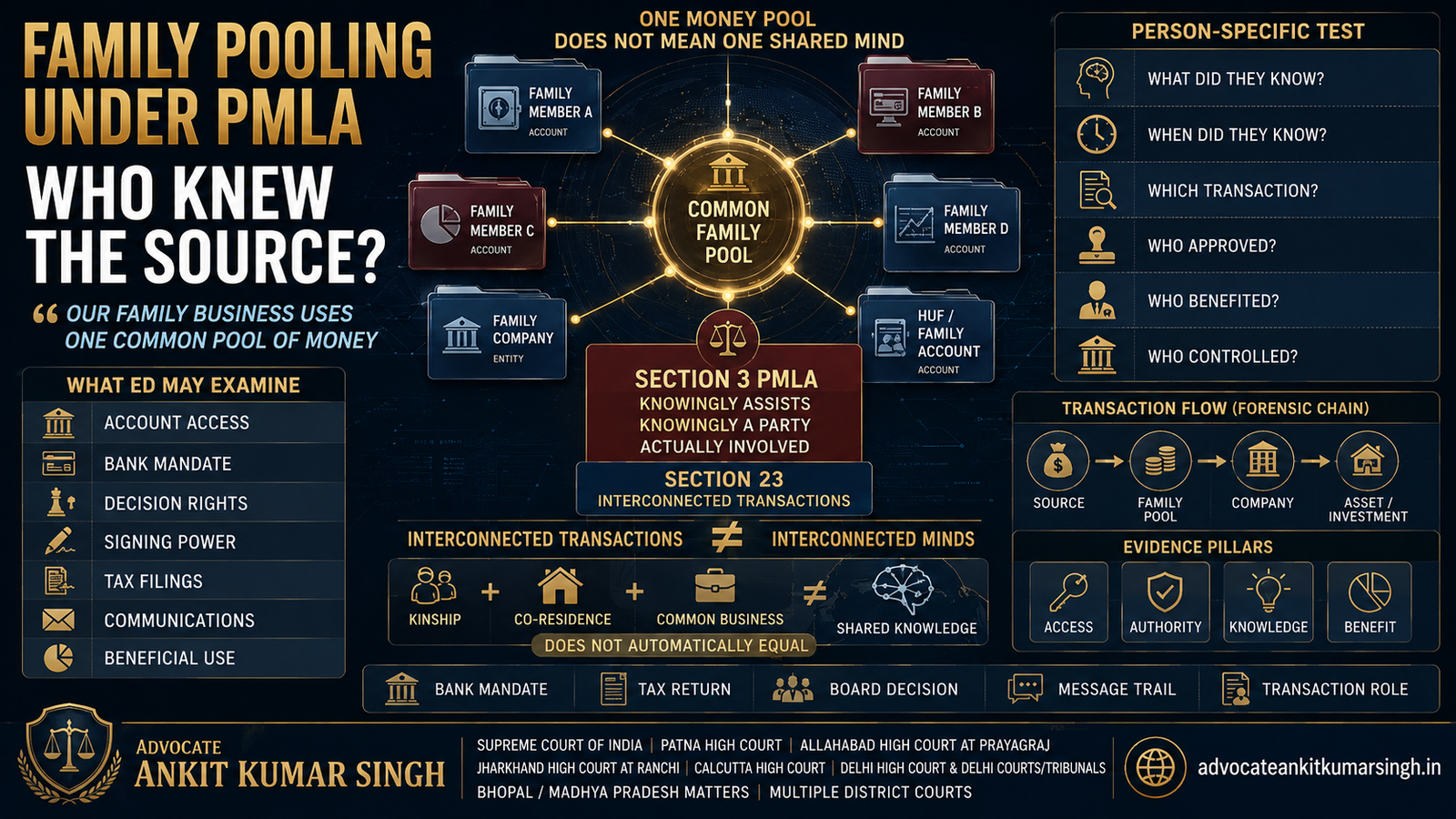
PMLA • ED • Family Pooling • Family Business • Knowledge Attribution • Common Funds
Family Pooling Under PMLA: “Our Family Business Uses One Common Pool of Money — How Can ED Decide Which Family Member Knew the Source?”
Research and legal analysis by Advocate Ankit Kumar Singh
Research updated: 22 August 2026
Direct Answer
A common family business account, common cash pool, common residence or family relationship does not automatically establish that every family member possessed the same knowledge about the source of the money.
The more reliable PMLA inquiry is individual and transaction-specific:
- Who had access to the money?
- Who could operate the account?
- Who approved the transaction?
- Who knew how the money was generated?
- Who dealt with the customer, borrower, vendor or counterparty?
- Who signed the source or tax declaration?
- Who received the economic benefit?
- Who gave instructions to accountants or bankers?
- Who participated in the particular transaction later alleged to involve proceeds of crime?
The central proposition is:
INTERCONNECTED TRANSACTIONS DO NOT AUTOMATICALLY MEAN INTERCONNECTED MINDS.
Similarly:
KINSHIP
+
CO-RESIDENCE
+
COMMON BUSINESS
+
COMMON MONEY POOL

DO NOT, BY THEMSELVES, ESTABLISH

IDENTICAL KNOWLEDGE
OR
IDENTICAL SECTION 3 LIABILITY
Contents
- The family-pooling problem
- Section 3 and person-specific conduct
- Section 23: transactions vs minds
- Section 24 and burden of proof
- Psychology of collective attribution
- Family knowledge-attribution matrix
- Access and bank mandates
- Decision rights
- Tax and accounting records
- Communications
- Lifestyle and beneficial enjoyment
- Board and family decisions
- Transaction-specific involvement
- Section 70 and family companies
- Section 50 summons
- Freezing and attachment
- Evidence file
- Frequently asked questions
1. The Family-Pooling Problem
Many Indian family businesses do not operate through perfectly separated economic compartments.
A family may use:
- one principal current account;
- multiple family-owned companies;
- partnership or proprietorship accounts;
- HUF funds;
- personal accounts used temporarily for business purposes;
- common property income;
- inter-family loans;
- cash contributions;
- joint investments;
- common household expenditure; and
- informal settlements between family members.
The result may look economically like:
BUSINESS A
     ↓
BUSINESS B
     ↓
FAMILY ACCOUNT
     ↓
HOUSEHOLD
     ↓
INVESTMENTS
     ↓
LOANS / PROPERTY / OTHER BUSINESS
If one part of that pool is later alleged to contain proceeds of crime, ED may legitimately investigate where the money travelled.
But tracing the money and attributing criminal knowledge are not the same exercise.
2. Money Can Be Common While Knowledge Is Unequal
A family may share financial benefits without every member understanding the source of every receipt.
For example:
- one sibling may manage the business;
- another may live abroad;
- one spouse may operate the family accounts;
- the other may only use a household card;
- an elderly parent may be a nominal partner;
- an adult child may receive education or travel expenses;
- one director may handle customers;
- another may handle compliance or administration.
A PMLA analysis should therefore distinguish:
COMMON ECONOMIC BENEFIT
        FROM
COMMON OPERATIONAL CONTROL
        FROM
COMMON SOURCE KNOWLEDGE
        FROM
COMMON CRIMINAL PARTICIPATION
They are not necessarily identical.
3. Section 3 PMLA Requires Attention to the Individual Person
Section 3 applies to a person who directly or indirectly attempts to indulge, knowingly assists, knowingly becomes a party or is actually involved in a process or activity connected with proceeds of crime.
The statutory explanation includes:
- concealment;
- possession;
- acquisition;
- use;
- projecting as untainted; and
- claiming as untainted.
The family-pooling inquiry should therefore identify the specific Section 3 allegation against each person.
For example:
| Family Member | Possible Factual Role | Question to Ask |
|---|---|---|
| Member A | Runs core business | What did A know about the source? |
| Member B | Bank signatory | What did B's signature actually authorise? |
| Member C | Receives household funds | Did C know the alleged criminal source? |
| Member D | Property holder | How was the property funded and who controlled it? |
4. First Identify the Alleged Proceeds of Crime
Before deciding which family member knew the source, identify what property ED says constitutes proceeds of crime.
The correct analytical chain is:
SCHEDULED OFFENCE
        ↓
ALLEGED CRIMINAL ACTIVITY
        ↓
PROPERTY DERIVED / OBTAINED
        ↓
ALLEGED PROCEEDS OF CRIME
        ↓
ENTRY INTO FAMILY ECONOMIC SYSTEM
        ↓
SUBSEQUENT FAMILY TRANSACTIONS
        ↓
PERSON-SPECIFIC ROLE
A family member should not be treated as possessing criminal knowledge merely because:
- the family is wealthy;
- the person shares a surname;
- the person lives in the same house;
- the person received household expenditure; or
- the person's name appears somewhere in the family business structure.
The money trail and the knowledge trail are related but distinct.
5. Section 23: Interconnected Transactions Are Not Interconnected Minds
Section 23 PMLA addresses interconnected transactions.
Where money-laundering involves two or more interconnected transactions and one or more transactions are proved to be involved in money-laundering, the statutory presumption concerning the remaining interconnected transactions may operate in the circumstances and for the purposes stated in the section, unless rebutted to the satisfaction of the competent forum.
But Section 23 speaks about:
transactions.
It does not expressly say:
“If family members participate in interconnected transactions, every family member is presumed to possess the same knowledge.”
Therefore:
INTERCONNECTED TRANSACTIONS
        ≠
INTERCONNECTED MINDS
A transaction may form part of a larger economic chain while different people in that chain possess different information and different states of knowledge.
6. Section 24 Does Not Expressly Create a Family-Knowledge Presumption
Section 24 provides a statutory burden framework in proceedings relating to proceeds of crime.
In the case of a person charged with the offence of money-laundering under Section 3, the Authority or Court shall, unless the contrary is proved, presume that such proceeds of crime are involved in money-laundering.
In the case of another person, the Authority or Court may draw the presumption contemplated by the provision.
But Section 24 does not expressly create a rule that:
- husband and wife possess common knowledge;
- siblings possess common knowledge;
- all directors in a family company know every source;
- co-residence creates constructive criminal knowledge; or
- family relationship itself proves mens rea.
The statutory burden should not silently be converted into a separate kinship presumption that Parliament did not expressly formulate.
7. The Psychological Risk: “They Are Family, So They Must All Know”
Family investigations create a natural cognitive shortcut.
When investigators, witnesses or outsiders observe:
- one surname;
- one residence;
- one business group;
- shared cars;
- shared accounts;
- joint property; and
- common expenditure,
there can be a psychological tendency to infer a single collective mind.
But social proximity is not necessarily informational equality.
A family system may contain:
- different authority levels;
- different generations;
- different professional roles;
- different bank access;
- different financial literacy;
- different geographic locations;
- different involvement in the business; and
- different knowledge of individual transactions.
The legally safer method is:
attribute knowledge from evidence, not merely from relationship.
8. Kinship, Co-Residence and Shared Business Are Circumstances — Not Conclusions
Each may be relevant.
None should automatically be treated as decisive.
For example:
| Fact | What It May Show | What It Does Not Automatically Show |
|---|---|---|
| Same residence | Close family association | Knowledge of every bank transaction |
| Same business group | Economic connection | Identical decision authority |
| Joint account | Potential access | Actual operation or source knowledge |
| Family property | Shared economic benefit | Knowledge of original acquisition source |
| Director designation | Formal corporate position | Actual control over every transaction |
9. Family Knowledge-Attribution Matrix
The following matrix is a practical evidentiary framework, not a statutory formula.
| Factor | Lower Attribution | Higher Attribution |
|---|---|---|
| Account access | No login / mandate / operational access | Regular operation and transaction control |
| Decision rights | No authority over payments/investments | Approves or chooses transactions |
| Bank mandate | Nominal / no operating rights | Signatory / maker / checker / approver |
| Source information | No involvement with generating transaction | Directly negotiated source transaction |
| Tax filings | Independent returns prepared from disclosed records | Personally signs or supplies false source explanation |
| Communications | No transaction-specific messages | Messages reveal source, concealment or routing knowledge |
| Lifestyle | Ordinary family benefit without control | Direct enjoyment linked to transactions personally controlled |
| Board / family decisions | Absent / uninvolved | Personally approves questioned arrangement |
| Transaction involvement | Passive recipient | Structures, transfers, conceals or documents transaction |
| Later conduct | Preserves records and explains consistently | Deletes, backdates, retransfers or fabricates after warning |
10. Factor One: Who Actually Had Access to the Money?
“Family money” is an economic description.
It is not a substitute for identifying account access.
For each account, identify:
- account holder;
- joint holder;
- authorised signatory;
- maker;
- checker;
- internet-banking user;
- registered mobile number;
- registered email;
- OTP recipient;
- debit-card holder;
- cheque-signing authority;
- transaction limits; and
- person who historically operated the account.
A person's name appearing on an account may be relevant.
But actual operational history can be much more informative.
11. Joint Account Does Not Automatically Mean Joint Source Knowledge
A joint account may be:
- either-or-survivor;
- jointly operated;
- primarily operated by one spouse;
- maintained for household expenses;
- used for a business purpose;
- used for property income; or
- operationally dormant for one holder.
The evidence should identify:
- who actually logged in;
- who instructed transfers;
- who deposited funds;
- who communicated with the bank;
- who knew the payer; and
- what the account was ordinarily used for.
12. Factor Two: Decision Rights May Matter More Than Family Rank
A senior family member may have social authority but no actual role in business transactions.
A younger family member may control the company's finance function.
Therefore ask:
- Who could approve payment?
- Who could add beneficiaries?
- Who could borrow money?
- Who could sell property?
- Who selected vendors?
- Who negotiated with customers?
- Who decided investments?
- Who controlled cash?
- Who instructed the accountant?
- Who decided inter-company transfers?
Authority should be reconstructed from actual conduct, not merely age, family status or title.
13. Formal Authority vs Actual Authority
A family business may have:
- a director on paper;
- a real decision-maker outside the board;
- nominal shareholders;
- family members holding shares for succession reasons;
- bank signatories acting mechanically; and
- informal decision-making outside formal minutes.
Therefore compare:
MOA / AOA
+
BOARD RECORDS
+
BANK MANDATE
+
SYSTEM RIGHTS
+
EMAILS / MESSAGES
+
ACTUAL TRANSACTION HISTORY
The purpose is to determine who exercised real decision rights.
14. Factor Three: Tax Filings and Accounting Records
Tax filings can be important because they may show:
- declared income;
- capital contribution;
- loans;
- gifts;
- property acquisition;
- business interest;
- dividend;
- partnership share;
- household drawings; and
- source explanations.
But tax records should not be over-read.
A return prepared by an accountant and electronically filed for one family member does not automatically prove that the person understood every underlying business transaction.
The stronger attribution may arise where the individual:
- personally supplied the false source;
- signed declarations;
- communicated with the accountant about disguising the source;
- created false loan/gift entries; or
- used tax records to project questioned property as legitimate.
15. Factor Four: Communications Can Individualise Knowledge
Digital communications can be particularly useful because they may show what a family member knew at a particular date.
Relevant records may include:
- WhatsApp;
- email;
- SMS;
- banking alerts;
- accountant communications;
- broker messages;
- family-group discussions;
- board communications;
- loan negotiations;
- property messages;
- cloud documents; and
- transaction instructions.
Compare:
“Please pay the electricity bill from the family account.”
with:
“Move the funds through the family company and show them as a loan before the account is examined.”
The two communications are not evidentially equivalent.
16. Knowledge Must Be Dated, Not Assumed Retrospectively
For every family member, create a chronology:
| Date | Transaction / Event | What This Person Knew Then |
|---|---|---|
| D1 | Money enters family business | _____ |
| D2 | Transfer to family account | _____ |
| D3 | Investment / property purchase | _____ |
| D4 | First warning / FIR / audit issue | _____ |
| D5 | ED investigation becomes known | _____ |
| D6 | Later movement of property | _____ |
Knowledge acquired at D5 should not automatically be backdated to D1.
But conduct after D5 may require its own analysis.
17. Factor Five: Lifestyle Is Circumstantial Evidence — Not a Substitute for Knowledge
ED may examine whether family members enjoyed:
- expensive property;
- luxury travel;
- high-value vehicles;
- private education;
- club expenditure;
- jewellery;
- foreign travel;
- large investments; or
- other lifestyle expenditure.
Lifestyle may be relevant to financial-capacity analysis.
But the inference:
“You benefited from an expensive lifestyle, therefore you necessarily knew the precise criminal source of the money”
should not automatically replace person-specific evidence.
The evidentiary value becomes stronger where lifestyle expenditure is directly linked with:
- accounts controlled by the individual;
- transactions arranged by the individual;
- false source declarations signed by the individual; or
- specific communications showing source knowledge.
18. Factor Six: Board Decisions and Family Decisions
Family businesses frequently operate through both formal and informal decisions.
Relevant records may include:
- board resolutions;
- shareholder records;
- partnership meetings;
- family settlement records;
- HUF records;
- internal emails;
- WhatsApp groups;
- accountant notes;
- loan proposals;
- property discussions;
- bank instructions; and
- investment decisions.
The important distinction is whether a family member merely attended a general discussion or specifically approved the questioned financial arrangement.
19. Factor Seven: Transaction-Specific Involvement Is Often the Most Important
Instead of asking:
“Who was part of the family?”
ask:
“Who did what in Transaction 17?”
For each transaction identify:
- source;
- payer;
- recipient;
- amount;
- date;
- purpose;
- documents;
- initiator;
- approver;
- bank operator;
- ultimate beneficiary;
- communications;
- tax/accounting treatment;
- later movement; and
- knowledge attributed to each family member.
20. Transaction-Specific Family Attribution Table
| Transaction | Family Member | Access | Decision Right | Source Knowledge | Benefit | Conduct |
|---|---|---|---|---|---|---|
| T-01 | Member A | Yes / No | _____ | _____ | _____ | _____ |
| T-01 | Member B | Yes / No | _____ | _____ | _____ | _____ |
| T-01 | Member C | Yes / No | _____ | _____ | _____ | _____ |
This prevents collective family allegations from replacing transaction-specific reconstruction.
21. Husband and Wife: Financial Partnership Does Not Automatically Equal Shared Mens Rea
Spouses may jointly:
- own property;
- maintain bank accounts;
- run businesses;
- pay household expenses;
- make investments; and
- benefit from family income.
But the PMLA inquiry should still ask:
- who controlled the business;
- who operated the account;
- who negotiated the questioned transaction;
- who knew the source;
- who prepared the explanation; and
- whether either spouse knowingly participated in concealment or projection.
22. Hari Shankar Gurjar: Marriage Plus Specific Evidence
Hari Shankar Gurjar v. Directorate of Enforcement, decided by the Madhya Pradesh High Court on 23 March 2023, is a useful factual illustration.
The allegation against the wife was not confined to:
“She was married to the accused.”
The Court referred to prima facie material alleging that she:
- had knowledge of disproportionate assets;
- held properties acquired from the questioned funds;
- claimed the money as earnings from her own business activities; and
- thereby allegedly assisted in projecting the questioned assets as legitimate income.
The evidentiary lesson is:
kinship plus specific acts is materially different from kinship alone.
23. Adult Children: Receipt of Family Support Does Not Automatically Establish Business Knowledge
An adult son or daughter may:
- study abroad;
- work independently;
- receive family maintenance;
- hold investments purchased by parents;
- be a shareholder for succession planning;
- receive a gift; or
- hold property in his or her name.
The relevant questions remain:
- Did the child operate the business?
- Did the child know the underlying source?
- Did the child sign financial or tax explanations?
- Did the child transfer money onward?
- Did the child exercise real control?
- Was the child merely a passive recipient or an active participant?
24. Siblings: Shared Business Does Not Mean Identical Roles
In one family business:
- one sibling may handle sales;
- another finance;
- another manufacturing;
- another may be an investor only; and
- another may have left the business years earlier.
A knowledge-attribution analysis should therefore map each sibling independently.
Avoid:
“They are brothers and directors, so they all knew.”
Instead ask:
“Which brother controlled this account, approved this transaction and knew this source?”
25. Elderly Parents and Nominal Family Participants
Family companies sometimes retain elderly parents as:
- shareholders;
- partners;
- directors;
- property owners;
- HUF members; or
- account holders.
Age or family status alone does not prove lack of knowledge.
But equally, formal status alone should not substitute for examining:
- actual participation;
- bank access;
- decision rights;
- communications;
- signatures;
- business understanding; and
- transaction history.
26. Pavana Dibbur: A Family Member Need Not Be Named in the Predicate FIR
In Pavana Dibbur v. Directorate of Enforcement, 2023 INSC 1029, the Supreme Court clarified that a person alleged to have committed the offence under Section 3 need not necessarily have been an accused in the scheduled offence.
The Court explained that a person initially unconnected with the scheduled offence may nevertheless become liable if that person subsequently knowingly assists concealment or use of proceeds of crime.
For family pooling, this means:
“I was not named in the original FIR.”
may be important, but does not automatically end the later PMLA inquiry.
Conversely:
“You are a family member of the predicate accused.”
does not itself establish knowing assistance.
27. Patna High Court 2026: Person-Specific Evidence Still Matters
In Sandip Kumar Singh v. Union of India, decided by the Patna High Court on 22 January 2026, the Court was dealing with a bail application arising from a PMLA prosecution rather than a family-pooling dispute.
The order is nevertheless useful as a local illustration of why the individual's own position matters.
The Court considered, among other circumstances, the petitioner's stated employee role, salary, absence of direct allegation in the predicate offence and the material concerning receipt of proceeds in his account while granting bail on the facts before it.
The case should not be treated as a universal family-knowledge ruling.
Its limited analytical relevance here is:
association with a wider transaction should still be examined through the individual's own role and evidence.
28. Section 70: Family Company Liability Requires a Separate Corporate Analysis
Where a family business operates through a company, firm or other qualifying organisation, Section 70 may become relevant.
Section 70 contains a framework concerning persons who were in charge of and responsible to the company for conduct of its business, together with its statutory proviso concerning lack of knowledge or due diligence.
It also separately addresses contraventions committed with:
- consent;
- connivance; or
- attributable neglect
of specified company officers.
This should not be reduced to:
“Every family shareholder is automatically guilty.”
The corporate role actually occupied by each person remains important.
29. HUF / Informal Family Pool: Do Not Mechanically Import Section 70
Section 70 defines “company” for its own purposes to include specified organisational forms, including a body corporate, firm or other association of individuals.
Whether a particular HUF, informal family pool or family arrangement falls within a particular statutory formulation should be examined from its legal character and facts.
Do not automatically assume that every informal family economic arrangement is legally identical to a company.
30. Section 50 Summons: ED May Call Different Family Members Separately
Section 50 allows specified ED authorities to summon persons considered necessary to give evidence or produce records.
In a family-pooling investigation, different family members may be asked different questions.
For example:
- Who operated the account?
- Who knew the payer?
- Who approved the transfer?
- Who decided the property purchase?
- Who handled tax filings?
- Who instructed the accountant?
- Who received the economic benefit?
- Who knew of the FIR or investigation?
- When was each person first informed?
Receipt of a summons does not itself establish that the summoned family member committed money-laundering.
31. Family Members Should Not Give a Manufactured “Common Story”
Where several family members are summoned, it can be tempting to prepare one uniform explanation.
That can be dangerous if the factual knowledge of each person was genuinely different.
Each person should distinguish:
WHAT I PERSONALLY KNEW

FROM

WHAT ANOTHER FAMILY MEMBER TOLD ME

FROM

WHAT I ASSUMED

FROM

WHAT I LEARNED AFTER INVESTIGATION BEGAN
Artificially identical answers may become difficult to maintain when confronted with:
- bank logs;
- emails;
- WhatsApp;
- tax records;
- digital signatures;
- accounting records;
- travel records; and
- independent witness statements.
32. Digital Evidence Can Separate One Family Member From Another
Electronic evidence may reveal:
- who operated internet banking;
- which device logged in;
- who received OTPs;
- who communicated with the accountant;
- who negotiated property;
- who sent source documents;
- who altered spreadsheets;
- who created a loan entry;
- who requested concealment; and
- who was entirely absent from the transaction.
This is important because digital evidence can convert a vague allegation about “the family” into a much more precise account of individual conduct.
33. Bank Mandates and Digital Access Are Not the Same Thing
A person may be an authorised signatory but never actually use the account.
Another person may not be the formal signatory but may possess practical access and instruct every payment.
Therefore examine both:
FORMAL AUTHORITY
+
ACTUAL OPERATION
Evidence may include:
- bank mandate;
- cheques;
- internet-banking logs;
- registered mobile number;
- OTP history;
- bank correspondence;
- transaction approval logs; and
- instructions to staff.
34. What If the Common Family Account Is Frozen?
If authorities freeze or restrain a family account, the response should begin with transaction-level segregation.
Identify:
- the questioned credits;
- the alleged proceeds-of-crime amount;
- salary credits;
- independent business income;
- investment receipts;
- loans;
- gifts;
- rent;
- household contributions;
- tax-paid savings; and
- other unrelated lawful credits.
The existence of common family money makes tracing more important, not less.
35. Family Pool Account Reconciliation
| Date | Credit / Debit | Source / Recipient | Who Instructed? | Who Knew Source? | Supporting Record |
|---|---|---|---|---|---|
| _____ | ₹_____ | _____ | _____ | _____ | _____ |
| _____ | ₹_____ | _____ | _____ | _____ | _____ |
36. Attachment of Family Property and Personal Criminal Liability Are Different Questions
A property may be challenged by ED as alleged proceeds of crime while the personal Section 3 liability of a particular family member remains a separate issue.
Therefore:
PROPERTY IN FAMILY MEMBER'S NAME
        ≠
AUTOMATIC SECTION 3 GUILT

AND

DISPUTE ABOUT PERSONAL KNOWLEDGE
        ≠
AUTOMATIC IMMUNITY OF PROPERTY
The property-source issue and the individual-culpability issue should both be addressed.
37. Section 8 Adjudication: Build a Person-Specific Source File
Where attachment proceedings reach the Adjudicating Authority, relevant evidence may include:
- source of acquisition;
- bank trail;
- income and earnings;
- business records;
- loan records;
- tax returns;
- capital accounts;
- gift documents;
- inheritance records;
- property title;
- account mandate;
- individual contribution;
- beneficial ownership;
- transaction chronology; and
- person-specific knowledge evidence.
38. Arrest and Bail: “Family Member” Is Not a Complete Legal Category
If ED seeks personal prosecution or arrest of a family member, the analysis should identify:
- what proceeds of crime are alleged;
- which transaction concerns that person;
- what the person knew;
- when that knowledge arose;
- what authority the person possessed;
- whether the person received or controlled the property;
- whether false documentation was created;
- whether the person participated in concealment or projection;
- what independent lawful source exists; and
- what role is actually alleged under Section 3.
Family association may be part of the factual background.
It should not replace those questions.
39. Family Pooling Evidence File
Depending upon the matter, preserve:
- bank statements for each relevant account;
- bank mandates;
- internet-banking access records;
- cheque-signing authority;
- OTP/mobile registration records;
- company board resolutions;
- shareholding records;
- partnership deed;
- HUF records where applicable;
- capital accounts;
- loan ledgers;
- tax returns of relevant members;
- GST/business records;
- accounting ledgers;
- audited financial statements;
- salary records;
- property purchase records;
- gift records;
- inheritance records;
- investment statements;
- emails;
- WhatsApp communications;
- accountant communications;
- board minutes;
- family decision records;
- business contracts;
- vendor/customer records;
- source declarations;
- digital signatures;
- ERP/accounting user logs;
- travel/location records where genuinely relevant;
- records identifying beneficial use;
- chronology of FIR/ED knowledge;
- documents showing independent financial capacity;
- proof of who actually controlled each asset; and
- transaction-specific reconciliation.
40. Evidence That May Support Individual Knowledge
Depending upon context, stronger evidence may include:
- direct communication discussing criminal source;
- personal negotiation of the underlying transaction;
- operation of the account receiving proceeds;
- false source declarations;
- fabricated loans or gifts;
- backdated documentation;
- instructions to conceal beneficial ownership;
- deliberate routing through family entities;
- personal approval of questioned transfers;
- continued transactions after specific warnings;
- significant personal benefit coupled with transaction control;
- destruction or alteration of records; and
- post-investigation transfers designed to disguise ownership.
41. Evidence That May Rebut Collective Attribution
Relevant material may include:
- no bank access;
- no signatory authority;
- independent employment elsewhere;
- separate residence or geography where relevant;
- no company role during the relevant period;
- limited or nominal shareholding;
- no communications concerning the transaction;
- independent source of acquired assets;
- ordinary household receipt only;
- records showing another family member exercised exclusive control;
- absence from board/family decision;
- consistent tax treatment based on disclosed information;
- contemporaneous objection;
- lack of onward routing;
- records showing knowledge arose only later; and
- preservation rather than concealment of records.
42. What Not to Do After the Investigation Begins
- Do not create one artificial family explanation.
- Do not backdate family resolutions.
- Do not manufacture loan agreements.
- Do not convert unexplained transfers retrospectively into gifts.
- Do not delete family-group messages.
- Do not alter books or ledgers.
- Do not shift property between relatives merely to defeat tracing.
- Do not create false tax entries.
- Do not coach elderly or uninvolved relatives to accept responsibility.
- Do not deny bank access where digital logs show actual operation.
- Do not exaggerate common knowledge merely to protect another person.
- Do not destroy title, banking or accounting records.
43. The 12-Point Family Knowledge Attribution Test
- Source Test: What money/property is alleged to be proceeds of crime?
- Entry Test: How did it enter the family economic pool?
- Access Test: Which family member could access it?
- Mandate Test: Who could legally or technically operate the account?
- Decision Test: Who authorised the transaction?
- Information Test: Who knew how the money was generated?
- Communication Test: What messages or documents prove knowledge?
- Tax Test: Who supplied or signed the source explanation?
- Benefit Test: Who economically enjoyed the property?
- Control Test: Who retained beneficial control?
- Transaction Test: What did each person do in the specific transfer?
- Later-Conduct Test: What did each person do after learning of the investigation?
No single factor should automatically determine liability.