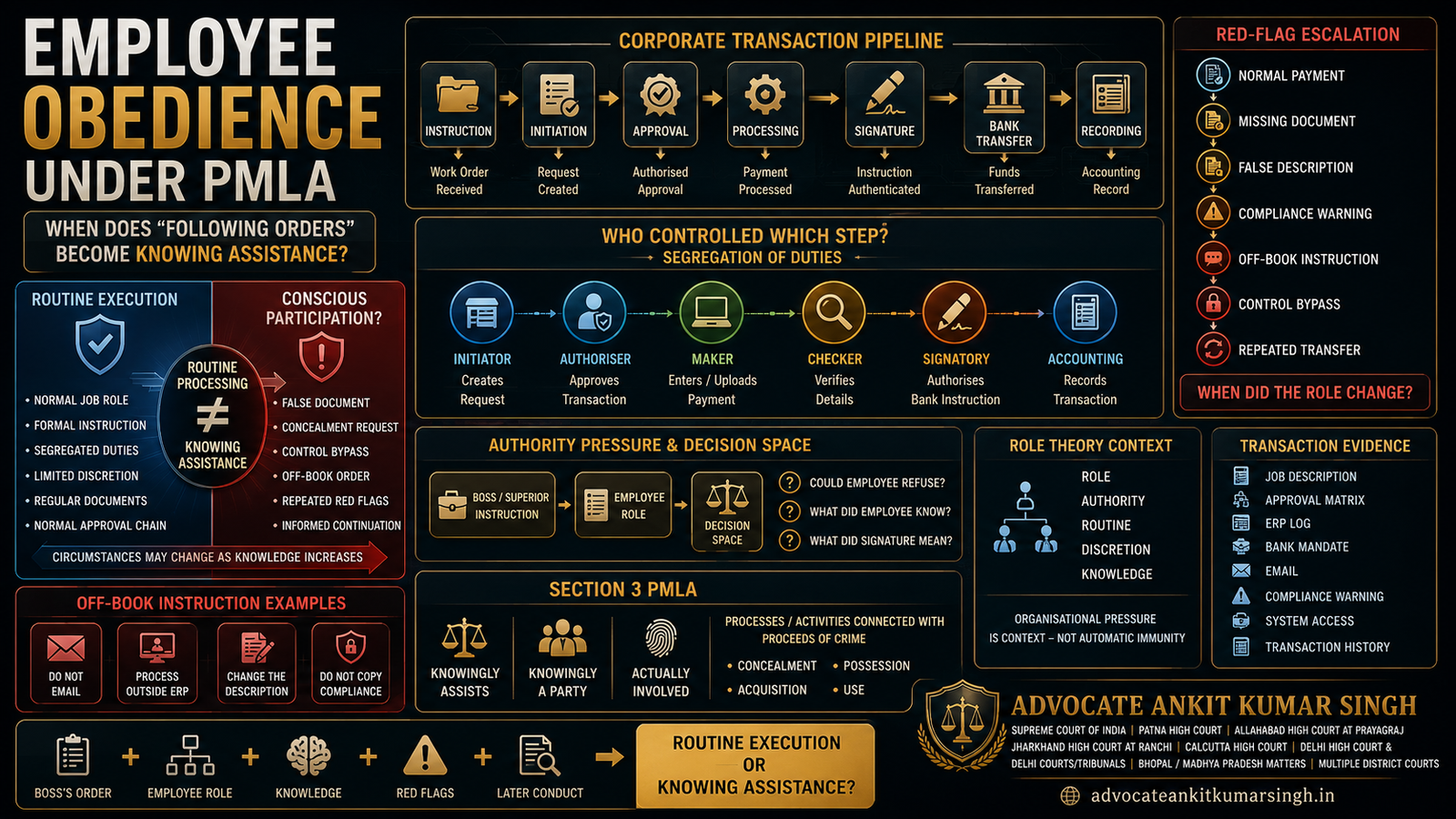
PMLA • Employee Liability • Knowing Assistance • Corporate Role • Organisational Psychology
Employee Obedience Under PMLA: “I Only Followed My Boss’s Instructions and Signed the Transfer” — When Does Obedience Become Knowing Assistance?
Research and legal analysis by Advocate Ankit Kumar Singh
Research updated: 22 August 2026
Direct Answer: Following Orders Is Neither Automatic Immunity Nor Automatic Guilt
An employee does not automatically commit money-laundering merely because a senior officer, director, promoter, CFO or manager instructed a transfer and the employee processed, uploaded, recorded or signed it.
But “my boss told me to do it” is not, by itself, a complete defence under Section 3 of the Prevention of Money-laundering Act, 2002.
The important distinction is between:
routine subordinate execution within a defined organisational role
and:
conscious assistance or participation in a process or activity connected with alleged proceeds of crime.
The correct inquiry therefore asks:
- What exactly was the employee instructed to do?
- Was that task ordinarily part of the employee’s job?
- Who initiated the transaction?
- Who selected the beneficiary?
- Who approved the commercial purpose?
- What authority did the employee actually possess?
- What information was available when the employee acted?
- Did the employee know the transaction was merely unusual, or know that supporting documents were false?
- Did the employee know the alleged criminal source of the property?
- Were ordinary internal controls followed or deliberately bypassed?
- Were concealment, false narration or off-book processing requested?
- Did the conduct continue after warnings or red flags became specific?
- Did the employee receive any unusual personal benefit?
- What did the employee do after learning of the alleged illegality?
A signature proves that an act occurred.
It does not automatically prove the employee’s state of mind.
Section 3 PMLA: Why the Employee’s Individual Role Matters
Section 3 applies to a person who directly or indirectly attempts to indulge, knowingly assists, knowingly becomes a party or is actually involved in a process or activity connected with proceeds of crime.
The statutory explanation includes:
- concealment;
- possession;
- acquisition;
- use;
- projecting as untainted property; and
- claiming as untainted property.
For an employee case, the key phrase may often be:
“knowingly assists”
The word “assists” identifies conduct.
The word “knowingly” raises the separate question of what the employee actually understood at the relevant time.
Accordingly, the allegation should not stop at:
“He processed the transaction.”
A complete allegation should identify:
“What did he process, what did he know, what role did he possess, and how did that act assist the alleged laundering process?”
Before Employee Liability: Identify the Alleged Proceeds of Crime
The employee’s act must be analysed against identifiable property alleged to constitute proceeds of crime.
The proper sequence is:
SCHEDULED OFFENCE
        ↓
ALLEGED CRIMINAL ACTIVITY
        ↓
PROPERTY DERIVED / OBTAINED
        ↓
ALLEGED PROCEEDS OF CRIME
        ↓
SPECIFIC COMPANY TRANSACTION
        ↓
SPECIFIC EMPLOYEE ROLE
        ↓
SECTION 3 PROCESS / ACTIVITY
If investigators rely only on:
“The company transferred ₹10 crore and this employee signed the document”
several additional questions still remain:
- Was the entire ₹10 crore alleged to be proceeds of crime?
- Which underlying scheduled offence generated it?
- Did the employee know that source?
- What did the employee’s signature authorise?
- Was the employee merely validating data already approved by others?
The Organisational Reality: One Transaction Can Be Split Across Many Employees
Corporate systems deliberately divide work.
A typical payment may involve:
BUSINESS TEAM
selects vendor
      ↓
PROCUREMENT
creates purchase order
      ↓
ACCOUNTS
checks invoice
      ↓
FINANCE MANAGER
approves payment
      ↓
TREASURY MAKER
uploads transaction
      ↓
CHECKER
verifies bank data
      ↓
AUTHORISED SIGNATORY
approves payment
      ↓
ACCOUNTING TEAM
records transaction
An employee positioned at one point in this chain may have no access to information held elsewhere.
That is precisely why an employee’s participation should be reconstructed through the actual organisational workflow rather than through designation alone.
Organisational Psychology: Why Employees Follow Authority
Organisational behaviour is heavily influenced by hierarchy.
Role theory provides a useful explanatory model: individuals frequently act according to the expectations attached to the organisational position they occupy.
For example, a treasury employee may understand the role as:
“My function begins only after finance approval. I upload the approved instruction into the bank portal.”
An accounts executive may understand:
“My job is to record the voucher once the authorised manager clears it.”
Organisational psychology also identifies factors that can affect subordinate behaviour, including:
- authority pressure;
- deference to seniority;
- assumption that management possesses superior information;
- fear of disciplinary consequences;
- fear of termination;
- diffusion of responsibility;
- routinisation;
- narrow task framing;
- incremental escalation; and
- role conformity.
These concepts may help explain why an employee acted.
They do not create a separate statutory exemption from Section 3 PMLA.
Role Theory Is Context — Not a Legal Excuse
Suppose an employee says:
“I did not analyse the commercial legitimacy because that was not my department.”
That explanation becomes stronger if the records genuinely show that:
- commercial approval belonged to another department;
- the employee had no authority to select the recipient;
- the employee saw only an approved voucher;
- the internal system prevented the employee from changing beneficiary details;
- the employee did not participate in the underlying transaction; and
- no suspicious warning had been communicated.
The same explanation becomes weaker if evidence shows that:
- the employee personally selected the beneficiary;
- the employee knew there was no underlying service;
- the employee created the invoice;
- the employee bypassed the prescribed approval system; and
- the employee later helped disguise the transaction.
Segregation of Duties: Who Controlled Which Step?
Internal-control systems commonly separate key transaction functions.
These may include:
- initiation;
- authorisation;
- approval;
- processing;
- recording;
- review; and
- custody or control over assets.
For PMLA analysis, this can help identify the difference between technical participation and substantive decision-making.
| Corporate Role | Typical Function | Critical PMLA Question |
|---|---|---|
| Initiator | Creates payment request | Why was this transaction initiated and what information was available? |
| Business Approver | Approves commercial purpose | Did this person know the underlying transaction was genuine? |
| Treasury Maker | Uploads bank transaction | Was the employee merely implementing independently approved instructions? |
| Checker | Checks payment details | Was review limited to data accuracy or did it include transaction legitimacy? |
| Authorised Signatory | Authenticates final payment | Was approval independent, discretionary or mechanical? |
| Accountant | Records the transaction | Did the accountant merely record supplied data or create a false accounting explanation? |
| CFO / Finance Head | Controls finance architecture | What substantive financial and approval authority existed? |
The Difference Between a Signature and a Decision
A signature does not have one universal meaning.
It may signify:
- independent commercial approval;
- verification of bank details;
- confirmation of previous approvals;
- mandatory dual-signature authentication;
- clerical acknowledgement;
- receipt of documents;
- confirmation of arithmetic accuracy; or
- final discretionary authorisation.
Therefore, if ED relies heavily on a signature, the document should be read together with:
- the company’s approval policy;
- delegation matrix;
- bank mandate;
- supporting documents;
- system permissions;
- earlier approvals;
- communications; and
- the employee’s actual historical role.
The Practical Test: Subordinate Execution vs Conscious Participation
| Factor | More Consistent With Subordinate Execution | More Consistent With Conscious Participation |
|---|---|---|
| Nature of task | Squarely within ordinary job | Employee steps outside normal function |
| Instruction channel | Formal ERP/email/approved workflow | Secret/off-book channel used to avoid controls |
| Discretion | Little or no independent discretion | Employee chooses beneficiary, amount or route |
| Information | Limited view of transaction | Employee knows true source/purpose |
| Documents | Facially regular documents supplied | Employee knows documents are false or fabricated |
| Internal controls | Normal workflow followed | Employee knowingly bypasses controls |
| Red flags | No specific warning | Repeated specific warnings ignored |
| Concealment | No request to hide purpose | Employee alters narration or hides beneficiary |
| Repetition | One isolated routine act | Repeated conduct after knowledge escalates |
| Benefit | Ordinary salary only | Unusual commission, bonus or hidden benefit |
| Later conduct | Records preserved; truthful explanation | Deletion, fabrication, concealment or false explanation |
This is an analytical test, not a statutory checklist.
The Employee Knowledge Ladder
All forms of awareness should not be treated as identical.
LEVEL 1
KNOWS A PAYMENT EXISTS
        ↓
LEVEL 2
KNOWS PAYMENT IS UNUSUAL
        ↓
LEVEL 3
KNOWS DOCUMENTATION IS INCOMPLETE
        ↓
LEVEL 4
KNOWS DOCUMENTATION IS FALSE
        ↓
LEVEL 5
KNOWS REAL BENEFICIARY / PURPOSE IS BEING HIDDEN
        ↓
LEVEL 6
KNOWS THE PROPERTY IS ALLEGEDLY CONNECTED
WITH CRIMINAL ACTIVITY
        ↓
LEVEL 7
CONTINUES / FACILITATES / CONCEALS
WITH THAT KNOWLEDGE
This ladder helps identify when the employee’s evidentiary position changed.
Red Flags: When a Payment Stops Looking Routine
A red flag is not itself proof of guilt.
But the cumulative effect of multiple specific red flags may become significant.
Examples include:
- no visible commercial relationship with the recipient;
- invoice inconsistent with goods or services actually supplied;
- payment materially exceeding contractual value;
- senior officer refusing to provide ordinary supporting documents;
- instructions to use a false transaction description;
- payments deliberately split into smaller amounts;
- funds repeatedly routed through connected entities;
- instructions not to involve compliance or internal audit;
- payment deliberately kept outside the ERP system;
- last-minute substitution of beneficiary details;
- company's own compliance department warning about the counterparty;
- knowledge that invoice or agreement is fabricated;
- use of a dormant or shell-like entity without apparent commercial purpose;
- request to delete correspondence after processing;
- retrospective creation of approval documents;
- cash conversion after banking transfer;
- personal account used to route corporate funds; and
- instructions to conceal the actual source or beneficiary.
Off-Book Instructions: Why the Communication Channel Can Matter
Not every instruction through WhatsApp, phone or personal email is criminal.
Commercial organisations frequently use multiple communication channels.
But an instruction may become more significant where the reason for using an off-book channel is itself concealment.
Examples include:
“Do not put this in official email.”
“Process the payment outside ERP.”
“Do not copy compliance.”
“Change the description before sending.”
“Delete the message after payment.”
“Create supporting documents later.”
The evidentiary question is not simply which application was used.
It is why normal organisational controls were avoided.
False Documents: A Critical Transition Point
Recording a transaction on the basis of apparently regular material is different from knowingly manufacturing the material itself.
For example:
“Enter this approved invoice in the books.”
is materially different from:
“Create an invoice for services that were never supplied.”
Similarly:
“Upload this approved payment.”
differs from:
“Backdate the agreement so the payment appears legitimate.”
Knowing participation in fabricated invoices, false loans, backdated agreements, false board resolutions or misleading transaction narrations can materially strengthen a prosecution allegation.
Repetition: When One Routine Act Becomes a Pattern
One of the most important questions is whether the employee’s knowledge changed over time.
Consider:
- Transaction 1 is processed under the normal approval chain.
- The employee has no known red flag.
- Internal compliance subsequently identifies the beneficiary as suspicious.
- The employee receives the warning.
- The superior directs the employee to continue.
- The employee processes Transactions 2 to 8.
- Invoices are later discovered to be fabricated.
- The employee helps create substitute documentation.
Transaction 1 and Transactions 2 to 8 should not automatically be treated as evidentially identical.
The important question is:
When did routine obedience become informed repetition?
Gradual Escalation: The “Next Small Step” Problem
Suspicious conduct may develop incrementally.
POST THE ENTRY
      ↓
PROCESS THE PAYMENT
      ↓
DO NOT ASK FOR THE PURCHASE ORDER
      ↓
CHANGE THE DESCRIPTION
      ↓
DO NOT INVOLVE COMPLIANCE
      ↓
PROCESS OUTSIDE THE SYSTEM
      ↓
CREATE THE DOCUMENT AFTERWARDS
      ↓
DELETE THE ORIGINAL MESSAGE
From a psychological perspective, each new act may initially appear only slightly different from the previous task.
Legally, however, the accumulation of these steps may alter the inference regarding knowledge and participation.
What If the Employee Objected?
A contemporaneous objection can be important evidence.
Examples include:
- email asking for missing invoice or purchase order;
- request for written approval;
- request for compliance clearance;
- refusal to alter transaction narration;
- message stating that amount exceeds employee authority;
- escalation to internal audit;
- refusal to use a personal bank account;
- complaint about bypassing maker-checker controls;
- preservation of the original records; and
- document showing that a superior formally overrode the objection.
An objection is not automatically decisive.
But it may help establish the employee’s actual state of mind.
What If the Employee Objected Once but Continued?
That requires a more detailed chronology.
Ask:
- What exactly was the objection?
- Was a plausible explanation given?
- Was new documentation supplied?
- What did the employee learn later?
- Was the employee required only to perform a technical step?
- Did the employee subsequently conceal information?
- How many further transactions occurred?
- Did warnings become progressively stronger?
- Did the employee personally benefit?
One early objection cannot automatically neutralise all later conduct.
Personal Benefit Is Relevant, but Not the Statutory Test
An employee may argue:
“I received only my normal salary.”
That fact can be important.
It may help rebut an allegation that the employee personally benefited from the questioned transaction.
But Section 3 does not expressly require personal enrichment as a separate ingredient of every form of money-laundering.
Therefore:
NO PERSONAL PROFIT
≠
AUTOMATIC IMMUNITY

BUT

NO PERSONAL PROFIT
+
NO CONTROL
+
NO SOURCE KNOWLEDGE
+
ROUTINE ROLE
+
NORMAL WORKFLOW

may create a materially different evidentiary picture.
Pavana Dibbur: Why an Employee Need Not Be Accused in the Predicate Offence
In Pavana Dibbur v. Directorate of Enforcement, 2023 INSC 1029, the Supreme Court explained that a person accused under Section 3 need not necessarily also be an accused in the scheduled offence.
The judgment illustrates that a person initially unconnected with the predicate offence may still potentially face Section 3 if that person later knowingly assists a qualifying process involving proceeds of crime.
For employees, this means:
“I had no role in the original fraud.”
may be important, but does not automatically end the later laundering inquiry.
At the same time:
“You were employed by the accused company.”
does not itself prove knowing assistance.
Satyendar Kumar Jain: Specific Conduct Matters
The Supreme Court’s 2024 decision in Satyendar Kumar Jain v. Directorate of Enforcement illustrates how a PMLA allegation may rely upon specific transactional acts and documents rather than mere association.
The factual material discussed before the Court included allegations concerning company transactions, accommodation-entry structures, declarations and alleged backdated material.
The broader lesson for employee cases is:
The stronger allegation identifies what the individual actually did.
A prosecutor should ideally be able to identify:
- which transaction;
- which document;
- which instruction;
- which communication;
- which approval; and
- what knowledge is alleged.
Section 70: Do Not Treat Every Employee Like a Controlling Director
Section 70 creates a separate company-related framework.
It addresses persons who were in charge of and responsible to the company for the conduct of its business, subject to its statutory provisions concerning lack of knowledge and due diligence.
It separately addresses consent, connivance or attributable neglect of directors, managers, secretaries and other officers.
This matters because a junior accounts employee should not automatically be placed in the same factual category as:
- promoter;
- managing director;
- whole-time executive;
- CFO;
- finance controller;
- treasury head; or
- person exercising de facto control over the business.
Direct Section 3 conduct and Section 70 company responsibility should therefore be analysed separately.
Section 50 Summons: Why Employees Frequently Become Important Witnesses
Under Section 50 PMLA, specified ED authorities have power to summon persons whose attendance is considered necessary to give evidence or produce records.
In a corporate investigation, employees may possess information regarding:
- approval systems;
- bank accounts;
- invoice processing;
- ERP records;
- vendor creation;
- director instructions;
- beneficiary details;
- email communications;
- transaction chronology;
- cash handling;
- company books; and
- actual decision-making structure.
Receipt of a Section 50 summons does not itself establish that the employee is guilty.
The employee may initially be called because he or she is a custodian of relevant information.
Preparing for a Section 50 Examination: Employee-Specific Discipline
An employee facing ED questioning should reconstruct the role accurately before giving broad answers from memory.
Useful preparation may include:
- job title during the relevant period;
- employment start and end dates;
- reporting hierarchy;
- written job description;
- system access rights;
- bank authorisation limits;
- delegation matrix;
- approval workflow;
- known transactions;
- documents actually seen by the employee;
- instructions received;
- objections raised;
- change in responsibilities over time; and
- dates when important information first became known.
The employee should distinguish:
WHAT I PERSONALLY KNOW

from

WHAT I ASSUME

from

WHAT ANOTHER PERSON TOLD ME

from

WHAT I LEARNED ONLY AFTER THE EVENT
Truthful precision is more useful than overbroad statements such as:
“I knew nothing about anything.”
or:
“I was responsible for the whole finance department.”
if neither statement accurately reflects the organisational reality.
Do Not Guess About Technical Matters You Did Not Control
Employees often create unnecessary problems by speculating.
For example:
“I think the director used that company because it was his own company.”
is different from:
“I personally received an email from the director stating that he controlled the company.”
Similarly:
“I believe the invoice was fake.”
is different from:
“I created the invoice after being told that no service had been supplied.”
The distinction between inference and direct knowledge should remain clear.
Search and Seizure: Digital Records Can Reconstruct the Real Workflow
Section 17 PMLA contains search-and-seizure powers subject to the statutory requirements.
In corporate employee cases, searches may reveal:
- email archives;
- laptops;
- mobile devices;
- ERP logs;
- accounting databases;
- banking tokens;
- WhatsApp communications;
- cloud-storage records;
- deleted-message remnants;
- approval logs;
- invoice metadata;
- document version history;
- IP logs; and
- access-control records.
Digital evidence may therefore show whether the employee:
- created the document;
- edited it;
- received it;
- merely forwarded it;
- approved it;
- used another person’s credentials;
- processed the transaction before or after a warning; or
- participated in deletion or concealment.
ERP and Bank Logs Can Be More Reliable Than Job Titles
An organisation chart may say:
“Employee X was Senior Manager — Finance.”
That label alone does not explain what X actually did.
System logs may show:
- who created the vendor;
- who changed bank details;
- who uploaded the payment;
- who approved it;
- who altered the narration;
- which user credentials were used;
- when each action occurred; and
- whether the employee’s access rights permitted independent action.
For this reason, a strong employee-role analysis should compare:
JOB DESCRIPTION
+
SYSTEM RIGHTS
+
ACTUAL LOGS
+
EMAILS
+
BANK APPROVALS
+
HISTORICAL PRACTICE
Employee Role-and-Knowledge Transaction Matrix
| Transaction | Instruction From | Employee Task | Decision Power | Documents Seen | Red Flags | Objection / Escalation | Knowledge Alleged |
|---|---|---|---|---|---|---|---|
| T-01 | Finance Manager | Upload bank payment | Limited | Approved voucher | To be identified | To be identified | To be identified |
| T-02 | Director | Approve transfer | Medium / High | Invoice + email | To be identified | To be identified | To be identified |
| T-03 | Promoter | Change transaction narration | Specific discretionary act | Full instruction trail | To be identified | To be identified | To be identified |
The objective is to prevent thousands of company transactions from being collapsed into a single allegation that:
“the finance team handled the money.”
Employee Evidence File: Documents Worth Preserving
Depending upon the case, relevant material may include:
- appointment letter;
- employment agreement;
- job description;
- promotion letters;
- resignation or cessation documents;
- organisation chart;
- reporting hierarchy;
- delegation-of-authority matrix;
- bank mandate;
- maker-checker authorisation;
- transaction limits;
- ERP user-access records;
- accounting-system permissions;
- approved SOPs;
- payment policy;
- vendor-onboarding policy;
- approved vouchers;
- invoices;
- purchase orders;
- contracts;
- superior’s written instructions;
- official emails;
- relevant messaging records;
- objection emails;
- compliance correspondence;
- internal-audit warnings;
- bank portal logs;
- system-generated timestamps;
- salary records;
- bonus/commission records;
- evidence identifying actual beneficiaries;
- attendance records where relevant;
- travel records where genuinely relevant;
- device/access logs;
- digital-signature logs;
- records showing change in role over time;
- records showing absence from the company when a transaction occurred; and
- documents identifying the real decision-maker.
Evidence That May Strengthen an Allegation of Knowing Assistance
- employee knew an invoice was fictitious;
- employee prepared a false invoice;
- employee backdated an agreement;
- employee concealed the true beneficiary;
- employee intentionally altered transaction narration;
- employee bypassed the prescribed workflow;
- employee processed payments through a personal account;
- employee repeatedly continued after compliance warnings;
- employee created sham loan documentation;
- employee split transactions to avoid scrutiny;
- employee instructed juniors to provide false explanations;
- employee deleted records after investigation began;
- employee knew of circular routing and continued;
- employee received unusual transaction-linked remuneration;
- employee controlled the recipient entity;
- employee participated in creating retrospective documentation;
- employee moved funds after learning of the alleged criminal source; and
- employee personally participated in concealment or projection as untainted.
What Not to Do After ED Scrutiny Begins
An employee should not attempt to create a better historical record after the event.
Potentially damaging conduct includes:
- deleting emails or messages;
- wiping a phone or laptop;
- creating a retrospective objection;
- manufacturing an SOP that never existed;
- backdating approvals;
- altering an invoice;
- changing accounting narration after investigation starts;
- coordinating false explanations with colleagues;
- concealing system credentials;
- destroying bank-token records;
- moving disputed funds merely to defeat tracing; and
- making broad statements inconsistent with digital records.
A defensible case should be built from the genuine contemporaneous record.
Can an Employee’s Bank Account Be Frozen?
Where investigators allege that an employee’s personal account received or routed property connected with the offence, banking transactions may become part of the investigation.
The factual questions should include:
- Was the account used only for salary?
- Did questioned corporate funds enter it?
- Was the employee asked to transfer money onward?
- Was the account acting as a temporary pass-through?
- Did the employee retain any amount?
- Was the transfer connected to ordinary reimbursement or legitimate expenses?
- Who instructed the movement?
- What was the recipient?
The entire personal account should not be conceptually treated as one undifferentiated transaction merely because one questioned credit exists.
From Witness to Accused: Why the Employee’s Position Can Change
An employee may initially appear in an investigation merely because he or she possesses records.
The position may change if later evidence indicates:
- personal transaction control;
- knowledge of false documents;
- hidden beneficial ownership;
- personal receipt of questioned funds;
- concealment instructions;
- false statements;
- continued assistance after specific knowledge arose; or
- participation extending beyond ordinary employment.
This is why role reconstruction should be conducted early.
Arrest Risk: Employee Status Alone Is Not the Test
Section 19 PMLA contains the statutory power of arrest subject to the conditions stated in that provision.
If an employee’s role becomes the subject of a serious Section 3 allegation, the relevant defence analysis should focus on:
- identified proceeds of crime;
- individual role;
- actual knowledge;
- control and discretion;
- documents relied upon;
- transaction chronology;
- personal benefit, if any;
- statements recorded;
- digital evidence;
- cooperation with investigation; and
- the exact process/activity alleged under Section 3.
A designation such as “accounts executive” or “manager” should not replace the evidence.
Practical Defence Structure for an Employee-Obedience Case
A role-specific defence can be organised in the following sequence:
- Identify the alleged proceeds of crime.
- Identify each disputed transaction.
- Identify the employee’s exact organisational role.
- Identify who initiated and approved each transaction.
- Identify what the employee’s signature or system action actually meant.
- Identify the documents available to the employee at that time.
- Date every alleged red flag.
- Date the employee’s first actual knowledge.
- Identify objections or requests for clarification.
- Analyse whether the employee crossed normal role boundaries.
- Check personal/indirect financial benefit.
- Compare written policies with actual system logs.
- Separate Section 3 conduct from Section 70 company responsibility.
- Preserve and reconcile digital evidence.
- Address later conduct separately from earlier conduct.
The 12-Point Employee Obedience Test
- Role Test: Was the act within the normal job description?
- Authority Test: Did the employee possess independent decision-making power?
- Information Test: What information was actually available?
- Source-Knowledge Test: Was the alleged criminal source known?
- Document Test: Did the employee know any document was false?
- Control Test: Who selected the beneficiary and route?
- Red-Flag Test: What warnings existed before the transaction?
- Concealment Test: Was the employee asked to hide purpose, ownership or source?
- System-Bypass Test: Were ordinary controls deliberately defeated?
- Repetition Test: Did similar conduct continue after knowledge increased?
- Benefit Test: Did the employee receive an unusual personal benefit?
- Later-Conduct Test: Did the employee preserve records or participate in concealment afterwards?
No single factor should automatically determine guilt or innocence.
Visual Flowchart: Employee Obedience Under PMLA
A transaction-specific framework for distinguishing subordinate execution from alleged knowing assistance under Section 3 PMLA.Common Analytical Mistakes
- Assuming every authorised signatory understands the underlying commercial source.
- Assuming a junior employee has the same knowledge as the promoter.
- Equating bank access with beneficial ownership.
- Equating accounting entry with transaction design.
- Ignoring segregation of duties.
- Ignoring chronology of knowledge.
- Treating suspicion and actual knowledge as identical.
- Ignoring evidence that the employee objected.
- Treating every oral instruction as inherently suspicious.
- Ignoring repeated transactions after a specific warning.
- Assuming no personal benefit means automatic innocence.
- Assuming salary from an accused company is itself proof of laundering.
- Failing to distinguish Section 3 from Section 70.
- Relying on designation rather than system and banking evidence.
Frequently Asked Questions
Is “I was only following orders” a defence under PMLA?
It is relevant to role, authority and knowledge, but it is not an automatic statutory defence. The transaction and the employee’s actual state of knowledge must be examined.
Can an employee be accused even if the boss planned everything?
Potentially yes if evidence shows that the employee knowingly assisted or knowingly became a party to a process connected with proceeds of crime.
Does signing the transfer make me guilty?
No automatic conclusion follows from the signature alone. The meaning of the signature, approval chain, supporting records and employee’s discretion are important.
I only uploaded the transaction. Is that different from approving it?
Potentially yes. A bank “maker” performing a technical upload may occupy a different role from the person who approved the commercial purpose or selected the beneficiary. Actual system rights must be examined.
What if my boss threatened to terminate me?
Employment pressure is relevant factual context, but it does not automatically create immunity under Section 3. Any separate legal defence based on coercion would require case-specific analysis.
What if I suspected the transaction but did not know the source?
Suspicion, awareness of irregularity, knowledge of false documentation and knowledge of an alleged criminal source are different states of awareness. The evidence should identify which one actually existed.
Can WhatsApp instructions from my boss be used as evidence?
They may be relevant where authenticity and context are established, particularly if they identify the beneficiary, purpose, concealment request, false narration or control bypass.
What if I received only salary?
Ordinary salary is materially different from an unusual commission or hidden transaction-linked benefit. But absence of personal gain is not, by itself, a complete Section 3 defence.
Why are repeated transactions important?
Because knowledge can change. A payment processed before any warning may be different from repeated transfers after the employee learns of false documents or suspected criminal source.
Can an employee rely on the company’s SOP?
Yes, the SOP can be relevant, but investigators may compare it with actual practice, system permissions, communications and transaction logs.
Can ED summon an employee who is not accused?
Yes. Section 50 permits specified authorities to summon persons considered necessary to give evidence or produce records. A summons does not itself establish criminal liability.
What if I was appointed after the disputed transactions?
Appointment chronology can be highly important. Conduct occurring before a person joined the company should not be mechanically attributed to that employee.
What if I resigned before the questioned transfers?
Resignation or cessation records can similarly be important, subject to whether the person continued to exercise any actual role afterwards.
What is the strongest evidence of routine subordinate execution?
Contemporaneous job descriptions, delegation matrices, superior approvals, maker-checker records, system permissions, bank mandates and evidence identifying the real decision-maker can be important.
What is the strongest evidence of knowing assistance?
Depending upon the case, knowing fabrication, concealment instructions, deliberate control bypasses, knowledge of the true beneficiary, repeated conduct after warnings, hidden personal benefit and post-event falsification may materially strengthen an allega