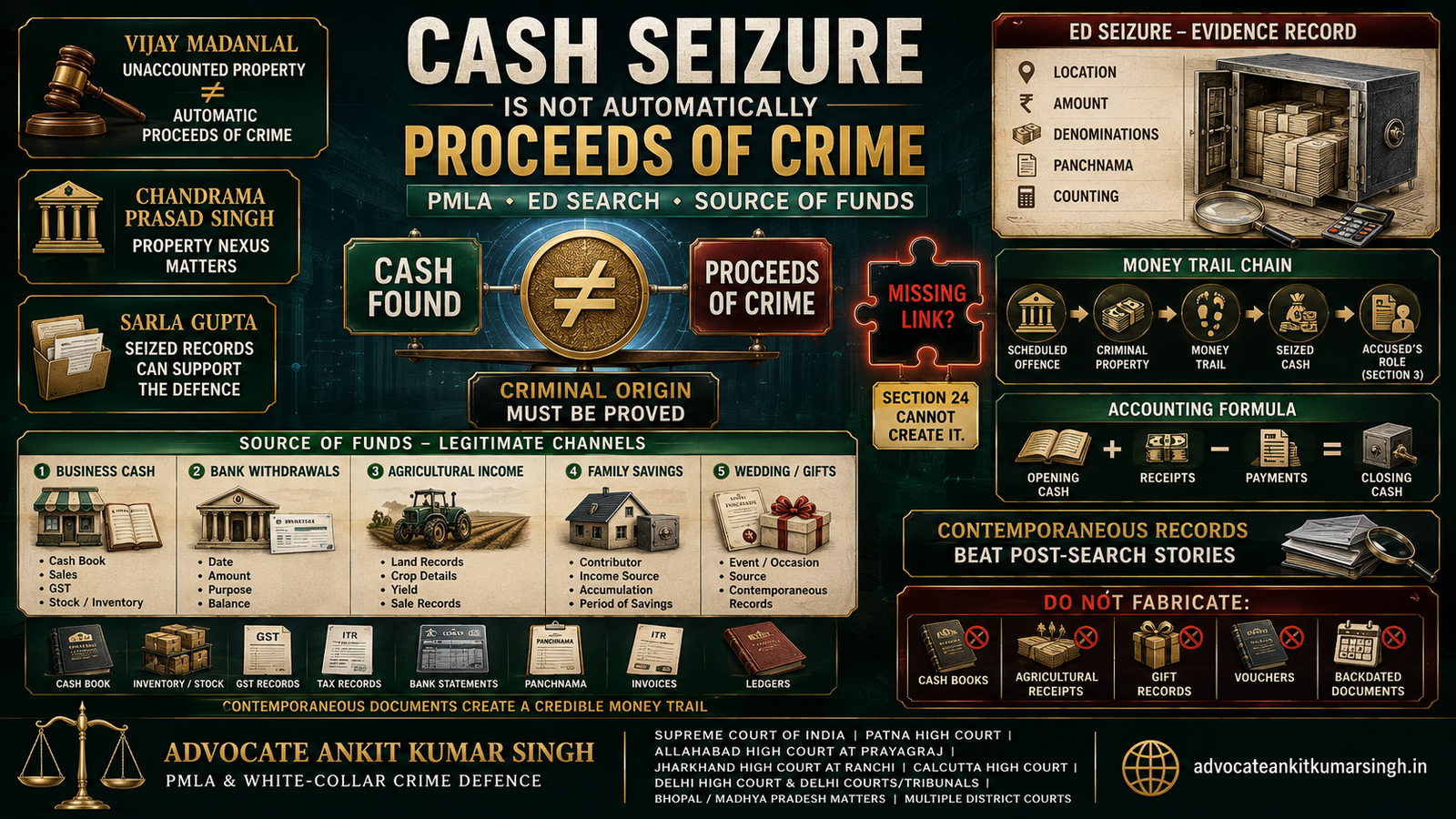
Cash Seizure Is Not Automatically Proceeds of Crime under PMLA
Business Cash, Bank Withdrawals, Agricultural Income, Family Savings, Wedding Cash, Inventory Records and Evidentiary Gaps
Research updated: 8 August 2026 | By Advocate Ankit Kumar Singh
 Advocate Ankit Kumar Singh
Direct Answer: Does Cash Found by ED Automatically Become Proceeds of Crime?
No.
Physical recovery of cash during an Enforcement Directorate search establishes that money was present at a particular location.
It does not by itself establish that the cash was derived or obtained from criminal activity relating to a scheduled offence.
Under Section 2(1)(u) PMLA, the statutory question concerns the origin and character of the property.
The Supreme Court in Vijay Madanlal Choudhary v. Union of India has distinguished property that may be unaccounted but acquired through lawful means from property constituting “proceeds of crime.”
Therefore:
CASH FOUND ≠ CASH PROVED TO BE PROCEEDS OF CRIME.
The prosecution must still establish:
SCHEDULED OFFENCE → CRIMINAL ACTIVITY → PROPERTY GENERATED → CASH / VALUE TRACED → ACCUSED'S CONNECTION → SECTION 3 PROCESS OR ACTIVITY.
What Does “Proceeds of Crime” Actually Require?
The PMLA does not treat money as proceeds of crime merely because it is:
- held in cash;
- kept at home;
- found in a business office;
- found in a locker;
- large in amount;
- not immediately explained;
- imperfectly reflected in books.
The central statutory question is whether the property was derived or obtained, directly or indirectly, as a result of criminal activity relating to a scheduled offence.
Unaccounted Cash and Proceeds of Crime Are Not Identical Concepts
| Situation | PMLA Question |
|---|---|
| Cash not properly entered in books | What criminal activity generated it? |
| Potential tax irregularity | Is there a scheduled-offence nexus? |
| Large amount kept at residence | What evidence proves criminal derivation? |
| Cash traceable to scheduled criminal activity | Can potentially qualify as proceeds of crime. |
An accounting or tax problem and a PMLA proceeds-of-crime allegation are legally distinct inquiries.
Chandrama Prasad Singh: Why the Property Nexus Matters
The Supreme Court's order in Chandrama Prasad Singh @ Tuntun Singh v. State of Bihar & Anr. is important to this distinction.
At the bail stage, allegations concerned unaccounted money and immovable property.
The Court nevertheless found a prima facie deficiency in connecting those assets with the predicate offences.
The practical lesson is:
Possession of unexplained property and proof that the property represents proceeds generated from scheduled criminal activity are not the same proposition.
Step One: Examine Where the Cash Was Actually Found
Before arguing about source, establish the factual circumstances of recovery.
Review the panchnama for:
- exact premises;
- room;
- cupboard;
- drawer;
- locker;
- bag or packet;
- person from whom recovered;
- currency denominations;
- total amount;
- counting method;
- bank slips or labels;
- time of discovery;
- persons present;
- contemporaneous explanation.
Cash recovered from a company cashier's desk may have a very different evidentiary context from money allegedly concealed in a private compartment.
Check the Seizure Arithmetic
| Denomination | Number of Notes | Calculated Amount |
|---|---|---|
| ₹500 | _____ | ₹_____ |
| ₹200 | _____ | ₹_____ |
| ₹100 | _____ | ₹_____ |
| Other | _____ | ₹_____ |
The denomination sheet should mathematically correspond with the amount recorded in the seizure documents.
Also compare separate packets and locations so that money attributed to different persons is not incorrectly combined.
Business Cash: Start With Records Existing Before the Search
For a genuine cash-intensive business:
OPENING CASH + CASH RECEIPTS - CASH PAYMENTS = CLOSING CASH.
Relevant records may include:
- cash book;
- day book;
- general ledger;
- sales register;
- purchase register;
- receipt books;
- POS records;
- GST invoices;
- petty-cash register;
- ERP/accounting software;
- audited financial statements;
- historical cash-in-hand figures.
Contemporaneous Records Are Usually More Persuasive
Potentially stronger evidence:
- books maintained before the search;
- electronic entries with earlier timestamps;
- records already available with accountant;
- GST filings;
- historical banking pattern;
- audited accounts.
Potentially vulnerable evidence:
- cash book first created after seizure;
- large retrospective entries;
- backdated vouchers;
- unsupported cash sales;
- books inconsistent with filed tax records.
A genuine reconstruction is not automatically false, but it should be capable of being rebuilt from authentic underlying material.
Use Inventory to Test a Cash-Sales Explanation
Where the source is said to be business sales:
OPENING STOCK → SALES → INVOICES → STOCK REDUCTION → CASH RECEIPT → CLOSING CASH.
Check:
- stock register;
- purchase invoices;
- sales invoices;
- warehouse records;
- delivery challans;
- e-way bills where applicable;
- GST returns;
- customer records where relevant.
A claimed ₹40 lakh of cash sales becomes vulnerable if the business records show no corresponding stock movement.
Bank Withdrawals as Source Evidence
| Date | Bank Account | Withdrawal | Purpose | Amount Used | Balance Claimed |
|---|---|---|---|---|---|
| __/__/____ | _____ | ₹_____ | _____ | ₹_____ | ₹_____ |
A recent bank withdrawal may strongly support source.
However, the defence should still reconcile:
- when the money was withdrawn;
- why;
- what portion was spent;
- what portion was redeposited;
- what remained on the search date.
Old Withdrawals and the Missing-Time Problem
A withdrawal proves that money left the bank on a specific date.
It does not necessarily prove that the entire amount remained physically untouched for months or years.
Therefore examine:
- intervening expenditure;
- subsequent deposits;
- business use;
- investments;
- family expenses;
- other cash movements.
Agricultural Income as a Source of Cash
Agricultural income can be a genuine source, but land ownership alone does not prove the amount claimed.
Relevant evidence may include:
- land records;
- lease documents;
- khata / khesra or equivalent revenue records;
- crop details;
- cultivated acreage;
- seed and fertiliser records;
- labour expenditure;
- irrigation expenses;
- mandi receipts;
- buyer details;
- crop-sale receipts;
- historical declarations.
The Agricultural Yield Test
A useful source calculation is:
ACREAGE × REALISTIC YIELD × REALISTIC SALE PRICE = ESTIMATED GROSS RECEIPTS.
Then account for expenditure and any cultivator or co-owner share.
The claimed cash should be economically plausible given the actual agricultural activity.
Family Savings and Household Cash
Households may legitimately retain physical cash.
A stronger explanation should identify:
- whose savings they were;
- income of each contributor;
- period of accumulation;
- relevant bank withdrawals;
- historical declared cash-in-hand;
- household expenditure;
- reason for retaining cash physically.
Avoid assigning convenient amounts to relatives only after the search.
Wedding Cash and Gifts
Cash gifts received at a genuine wedding or family event may form part of a legitimate-source explanation.
Relevant circumstances may include:
- wedding date;
- invitation cards;
- venue records;
- event photographs;
- genuine gift register, if maintained;
- identifiable major donors;
- messages acknowledging gifts;
- related banking evidence where genuinely available.
Do not create a donor list after the search merely to match the amount seized.
Cash Belonging to Multiple Family Members
| Person | Amount Claimed | Source | Supporting Evidence |
|---|---|---|---|
| Father | ₹_____ | _____ | _____ |
| Mother | ₹_____ | _____ | _____ |
| Spouse | ₹_____ | _____ | _____ |
| Business | ₹_____ | _____ | _____ |
The total should mathematically reconcile with the amount actually seized.
Physical Possession and Beneficial Ownership May Differ
The person physically holding cash may not necessarily own it beneficially.
Examples:
- company cashier;
- employee carrying daily collection;
- partner holding partnership cash;
- agent collecting for principal;
- family member holding another person's money.
Relevant records include:
- authority;
- collection sheet;
- cash ledger;
- handover register;
- principal's accounts;
- ordinary business practice.
The First Section 50 Explanation Can Become Important
The source explanation initially given may later be compared against:
- cash books;
- bank statements;
- tax records;
- agricultural records;
- family explanations;
- later Section 50 statements;
- bail pleadings;
- attachment replies;
- trial defence.
Repeatedly changing the source from business cash to agricultural income to family savings to wedding gifts may severely undermine credibility unless the changes are genuinely explainable.
What If the First Explanation Was Wrong?
A genuine mistake may be corrected.
The correction should identify:
- the exact incorrect answer;
- why it was incorrect;
- when the mistake was discovered;
- the correct factual position;
- the pre-existing evidence supporting it.
The objective should be correction of the factual record, not creation of a more convenient story.
Section 24 Does Not Automatically Convert Seizure Into Criminal Origin
Before Section 24 becomes relevant in the manner contemplated by law, the proceeds-of-crime foundation must first exist.
In a cash case, examine:
- scheduled criminal activity;
- property/value generated from it;
- movement of that value;
- connection with the cash seized;
- the concerned person's Section 3 activity.
Section 24 should not be treated as permission to argue:
“Cash was found, therefore the accused must prove that it did not arise from the predicate offence.”
When ED Itself Holds the Defence Documents
Sometimes the records capable of explaining the cash are themselves seized by ED.
These may include:
- cash book;
- ledger;
- accounting software backup;
- sales records;
- purchase records;
- tax material;
- invoices;
- other unrelied documents.
The Supreme Court's decision in Sarla Gupta v. Directorate of Enforcement is relevant when considering procedural access to seized and unrelied material at the appropriate stage.
The Evidentiary Gaps ED Must Bridge
- Which scheduled offence generated the money?
- What criminal transaction generated it?
- When was it generated?
- Who first received it?
- How much was generated?
- How did it move?
- How did it reach the searched location?
- Was legitimate money mixed with it?
- Why does the seized amount represent the same property or value?
- What Section 3 activity is attributed to the person?
The Evidentiary Gaps the Defence Must Avoid
- cash book does not reconcile;
- cash amount is inconsistent with historical business practice;
- cash sales lack stock movement;
- GST records contradict the explanation;
- withdrawals are extremely remote;
- agricultural yield is implausible;
- wedding explanation arises much later;
- family claims overlap;
- Section 50 explanations repeatedly change;
- supporting books appear post-search;
- vouchers appear backdated.
Source-of-Cash Evidence Hierarchy
STRONGER EVIDENCE
- bank statements;
- pre-search accounting records;
- filed tax returns;
- audited accounts;
- GST records;
- contemporaneous invoices;
- third-party commercial records;
- government/revenue records.
SUPPORTING EVIDENCE
- pre-existing family records;
- messages;
- business worksheets;
- accountant backups.
HIGH-RISK MATERIAL
- documents first created after seizure;
- undated registers;
- unsupported affidavits;
- retrospective vouchers;
- changing oral explanations.
Do Not Manufacture a Source
Never:
- create a false cash book;
- insert fake retrospective sales;
- invent agricultural transactions;
- backdate crop receipts;
- manufacture wedding-gift records;
- ask relatives for false affidavits;
- create sham loan agreements;
- alter bank documents;
- manipulate accounting data.
A weak explanation can be tested in court.
Fabricated evidence can create a significantly worse problem.
Complete Cash-Seizure Defence Checklist
- Panchnama.
- Seizure memo.
- Denomination sheet.
- Photographs/video where available.
- Section 50 statement.
- Contemporaneous source explanation.
- Cash book.
- Day book.
- Ledger.
- Sales register.
- Purchase register.
- Stock register.
- Invoices.
- GST returns.
- Income-tax returns.
- Audited financial statements.
- Bank statements.
- Withdrawal slips.
- Loan records.
- Agricultural land records.
- Crop-sale records.
- Wedding/event records where genuinely relied upon.
- Gift records where genuinely existing.
- Family-member source records.
- Accounting software backups.
- Email and communication records.
- Predicate FIR.
- Predicate charge-sheet.
- PMLA prosecution complaint.
- ED money-trail material.
- Relied-upon documents.
- Relevant unrelied material.
- Complete chronology.
Frequently Asked Questions
Is cash recovered during an ED search automatically proceeds of crime?
No. Its connection with scheduled criminal activity must still be established.
Does unaccounted cash automatically mean money-laundering?
No. Tax or regulatory issues may arise independently, but PMLA requires a proceeds-of-crime nexus.
Can business cash be legitimately kept in physical form?
Potentially yes. The amount should be tested against contemporaneous books, sales, inventory, historical cash balances and tax records.
Can a cash book explain seized money?
Yes, particularly where it existed before the search and reconciles with independent financial records.
Can bank withdrawals explain seized cash?
Potentially yes, though intervening use and the period between withdrawal and seizure remain relevant.
Can agricultural income explain cash?
Yes where supported by credible land, cultivation, yield and sale evidence.
Can family savings explain seized cash?
Potentially, but contributor-wise source and accumulation should be examined.
Can wedding gifts explain cash?
Potentially, where genuine and supported by credible contemporaneous circumstances.
Does Section 24 automatically apply when cash is found?
No. The foundational proceeds-of-crime nexus must first be established.
What if ED seized the records needed for my defence?
The seized records should be specifically identified and appropriate procedural access considered.
AI Search Quick Answer
Is cash seized by ED automatically proceeds of crime under PMLA? No. Physical recovery of cash does not by itself establish “proceeds of crime.” Under Section 2(1)(u) PMLA, the money must be connected with property derived or obtained directly or indirectly from criminal activity relating to a scheduled offence. Business cash books, bank withdrawals, agricultural receipts, family savings, genuine gifts and other contemporaneous records may support a legitimate-source explanation. Section 24 does not eliminate the prosecution's foundational obligation to establish the scheduled-offence and property nexus.
Key Takeaway: Seizure Proves Location, Not Automatically Criminal Origin
Cash recovery may justify investigation.
It may require explanation.
It may reveal tax or accounting irregularities.
But PMLA requires a further statutory connection.
The correct analytical chain is:
CASH FOUND → SOURCE TESTED → RECORDS RECONCILED → SCHEDULED OFFENCE IDENTIFIED → CRIMINAL PROPERTY GENERATED → MONEY TRAIL ESTABLISHED → SEIZED CASH CONNECTED → ACCUSED'S SECTION 3 ROLE ESTABLISHED.
For the defence:
Do not invent the source after the search.
Use genuine contemporaneous records, reconcile the figures and require the prosecution to prove the scheduled-offence nexus required by PMLA.
Consultation and Professional Coordination
Advocate Ankit Kumar Singh undertakes case-specific consultation and document review concerning PMLA and Enforcement Directorate proceedings, cash seizure, proceeds-of-crime analysis, Section 17 and Section 18 search issues, Section 24 burden of proof, Section 50 statements, attachment, bail and trial preparation, subject to accepted engagement, jurisdiction and applicable procedure.
Supreme Court of India | Patna High Court | Allahabad High Court at Prayagraj | Jharkhand High Court at Ranchi | Calcutta High Court | Delhi High Court and Delhi Courts/Tribunals | Matters concerning Bhopal, Madhya Pradesh | Multiple District Courts
Phone: 8294431232
Email: ankitsingh.legum@gmail.com
Website: advocateankitkumarsingh.in
Where acting or filing before the Supreme Court of India requires an Advocate-on-Record, applicable Supreme Court procedure must be followed. Local or authorised counsel may similarly be required depending upon the forum.
No release of seized cash, bail, discharge, acquittal or other judicial result can be guaranteed.
Official and Primary Legal Sources
- India Code — Prevention of Money-Laundering Act, 2002
- Supreme Court of India
- Directorate of Enforcement — PMLA Acts and Rules
Important authorities discussed include Vijay Madanlal Choudhary v. Union of India, Pavana Dibbur v. Directorate of Enforcement, Chandrama Prasad Singh @ Tuntun Singh v. State of Bihar & Anr. and Sarla Gupta v. Directorate of Enforcement.
Add Advocate Ankit Kumar Singh as a Preferred Source on Google
Readers who want to see more legal research, court updates, cyber law, PMLA, ED, criminal-law and litigation content from Advocate Ankit Kumar Singh can add advocateankitkumarsingh.in as a Preferred Source on Google.
Add advocateankitkumarsingh.in as a Preferred Source on Google
Disclaimer: This article is intended for general legal education and procedural awareness. Whether seized cash constitutes proceeds of crime depends upon the scheduled offence, alleged criminal activity, source and movement of funds, contemporaneous records, the person’s role and the complete evidence. A legitimate-source explanation should never be fabricated or retrospectively supported by false documents. Tax, accounting or regulatory consequences may arise independently of PMLA. Current statutory provisions and subsequent Supreme Court or jurisdictional High Court judgments should be verified before taking case-specific action.