PMLA DIGITAL EVIDENCE • MOBILE FORENSICS • EXTRACTION REPORT DEFENCE
Phone Extraction Reports in ED / PMLA Cases: How to Audit Hash Values, Chain of Custody, Cloned Images, Deleted Data, Passwords, Cloud Sync and Partial Forensic Extraction
Forensic Image • Hash Audit • Seizure Memo • Chain of Custody • Deleted Data • Cloud Sync • Partial Extraction • Independent Expert Review
Research updated: 9 August 2026 | By Advocate Ankit Kumar Singh
 Advocate Ankit Kumar Singh
Direct Answer: What Should the Defence Check in an ED Phone Extraction Report?
Do not begin by scrolling through thousands of WhatsApp messages.
Begin with the forensic foundation.
Ask:
- Which exact phone was seized?
- How is that phone identified in the seizure memo?
- Who had custody after seizure?
- What acquisition method was used?
- What forensic files were generated?
- What exact object was hashed?
- Did the hash remain identical where the same object was later copied or produced?
- Was the extraction complete or partial?
- Did applications fail to extract?
- Was cloud-synchronised information mixed with local-device data?
- How was deleted material supposedly recovered?
- Can an independent expert reproduce or verify the conclusions?
The central rule is:
DO NOT START WITH THE MESSAGE. START WITH THE DEVICE AND THE ACQUISITION.
A Forensic Extraction Report Is Not the Phone
A forensic report is an examiner's or forensic tool's representation of data acquired from a device or another digital source.
It may contain:
- messages;
- contacts;
- call logs;
- photographs;
- videos;
- location artefacts;
- application databases;
- browser history;
- email;
- deleted artefacts;
- cloud references;
- system metadata;
- parsed timelines.
But the rendered PDF is only one layer.
A serious defence distinguishes:
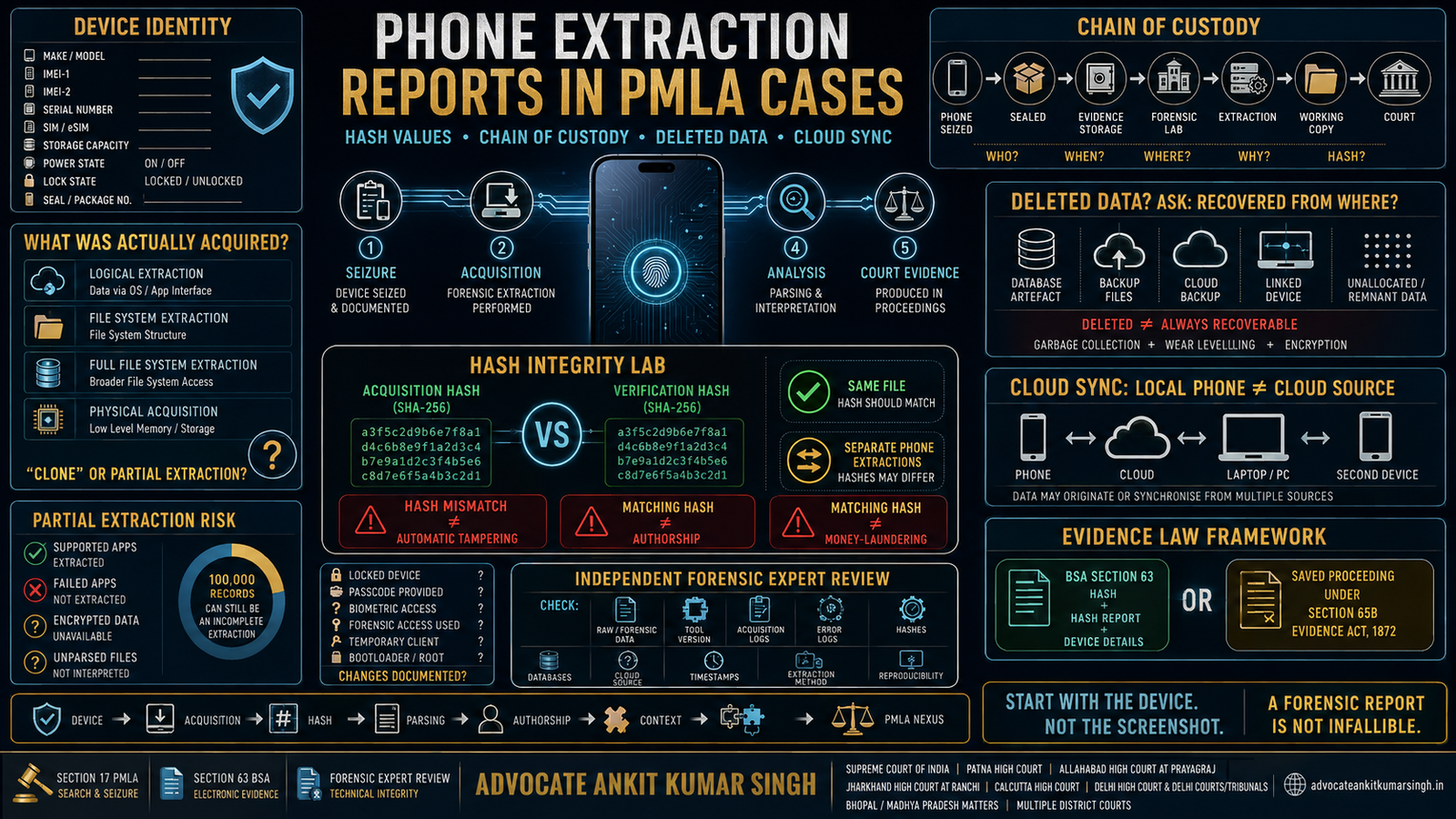
SOURCE DEVICE → ACQUIRED DATA → FORENSIC CONTAINER → TOOL PARSING → REPORT PDF → PROSECUTION EXHIBIT.
An error can arise at more than one stage.
What Does “Phone Clone” Actually Mean?
The expression “phone clone” is frequently used loosely in litigation.
Technically, counsel should ask what was actually created.
POSSIBILITIES INCLUDE:
- manual extraction;
- logical extraction;
- backup acquisition;
- file-system extraction;
- full-file-system extraction;
- physical memory acquisition;
- application-specific extraction;
- forensic container;
- selected export.
Modern mobile forensic acquisition does not always create a perfect bit-for-bit duplicate of every byte existing on the handset.
Therefore:
“CLONE CREATED”
should immediately lead to:
“WHAT EXACT ACQUISITION METHOD WAS USED?”
Logical Extraction Versus Deeper Acquisition
| Acquisition Type | General Character | Potential Limitation |
|---|---|---|
| Manual | Examiner views and records what the interface displays | Very limited underlying data |
| Logical | Acquires data exposed through OS/application interfaces | May miss deleted/system data |
| File-system | Obtains broader file/database structure | Still subject to encryption/tool support |
| Full-file-system | Broader accessible file-system acquisition | Not necessarily every physical byte |
| Physical | Attempts lower-level acquisition of memory/storage | Device/platform dependent |
The forensic report should tell the reader what method was actually used.
If it does not, the defence should ask.
The First Defence Document: The Seizure Memo / Panchnama
Before analysing forensic output, compare it against the document created when the phone was seized.
CHECK:
- date of seizure;
- time of seizure;
- location;
- person from whom recovered;
- manufacturer;
- model;
- colour;
- serial number;
- IMEI-1;
- IMEI-2;
- SIM;
- eSIM;
- storage capacity;
- memory card;
- physical condition;
- powered on/off state;
- locked/unlocked state;
- screen visible at seizure;
- account displayed;
- seal number;
- packaging;
- accessories;
- whether an on-site extraction occurred.
A forensic report concerning Device X cannot simply be assumed to concern the handset seized from Person Y.
The identifiers must connect.
Build a Device Identity Matrix
| Identifier | Seizure Memo | Lab Report | Extraction Report | Certificate |
|---|---|---|---|---|
| Make | _____ | _____ | _____ | _____ |
| Model | _____ | _____ | _____ | _____ |
| IMEI-1 | _____ | _____ | _____ | _____ |
| IMEI-2 | _____ | _____ | _____ | _____ |
| Serial Number | _____ | _____ | _____ | _____ |
Any inconsistency should be investigated before drawing conclusions about content.
What Is a Hash Value?
A cryptographic hash is a calculated digital value associated with a defined dataset.
Its important forensic use is integrity verification.
If an identical forensic file is later re-hashed and produces the same value under the same algorithm, that strongly supports the proposition that the file has remained unchanged.
But:
MATCHING HASH ≠ AUTHORSHIP.
MATCHING HASH ≠ TRUTH OF THE MESSAGE.
MATCHING HASH ≠ KNOWLEDGE.
MATCHING HASH ≠ PROCEEDS OF CRIME.
The Critical Question: What Exactly Was Hashed?
A report that says:
“SHA-256 hash: ABC123...”
is incomplete from a defence perspective unless the object to which that hash belongs is identified.
Was the hash calculated for:
- entire forensic extraction container?
- physical image?
- logical backup?
- database file?
- ZIP archive?
- individual WhatsApp database?
- exported chat?
- report PDF?
- pen-drive contents?
- court exhibit?
Two hash values cannot sensibly be compared unless they purport to represent the same underlying digital object.
The Four-Hash Audit
Where available, create a four-stage integrity table:
| Stage | Object | Algorithm | Hash |
|---|---|---|---|
| Acquisition | Original forensic output | SHA-256 | _____ |
| Lab preservation | Preserved master | SHA-256 | _____ |
| Defence / working copy | Permitted working copy | SHA-256 | _____ |
| Court production | Produced digital exhibit | SHA-256 | _____ |
If the same exact forensic container is represented at every stage, its hash should ordinarily remain stable.
Hash Mismatch: When Is It Serious?
SCENARIO A — SERIOUS
The prosecution says:
“This is the same acquisition container created on the extraction date.”
But:
Acquisition hash: ABC123
Court-produced copy: XYZ789
If both purport to be the identical file/container, the mismatch requires technical explanation.
SCENARIO B — NOT NECESSARILY SUSPICIOUS
Phone extraction conducted on Monday: ABC123
Second independent extraction of the same live handset on Friday: XYZ789
Modern phones are dynamic systems.
The two extracted datasets may legitimately differ.
SCENARIO C — DIFFERENT OBJECTS
Forensic container: ABC123
PDF report generated from it: XYZ789
Of course the hashes differ—the files are different.
Hash Mismatch Does Not Automatically Mean Tampering
This point is especially important in mobile forensics.
Mobile-device acquisition may require interaction with a live system.
Depending upon method, an examiner may have to:
- establish a connection;
- load a forensic client;
- use bootloader functionality;
- obtain elevated access;
- interact with application databases;
- perform more than one acquisition.
Such processes can affect the state of a dynamic handset.
Therefore the proper forensic argument is not:
“The hashes are different, therefore evidence was fabricated.”
It is:
“Identify the two objects compared, explain why they differ, and demonstrate continuity and integrity of the particular dataset relied upon.”
Chain of Custody: Reconstruct Every Transfer
Prepare a chronology from seizure to court.
| Date / Time | Person | Location | Action | Seal / Hash |
|---|---|---|---|---|
| __/__/____ | Seizing officer | Search premises | Phone seized | _____ |
| __/__/____ | Custodian | ED office | Stored | _____ |
| __/__/____ | Forensic examiner | Lab | Seal opened | _____ |
| __/__/____ | Examiner | Lab | Extraction | _____ |
| __/__/____ | Investigating officer | ED | Report received | _____ |
What Should Chain-of-Custody Documentation Answer?
- Who seized the device?
- Who received it?
- Who stored it?
- Where was it stored?
- Who opened the seal?
- When?
- Why?
- Who conducted extraction?
- Was the device resealed?
- Was a master extraction preserved?
- Who created working copies?
- Who supplied the report to the investigating officer?
- Which copy was supplied to court?
Every minor clerical omission does not automatically destroy admissibility.
But a material unexplained break may affect:
- integrity;
- authenticity;
- reliability;
- weight;
- ability of defence to independently verify the evidence.
Sealed Phone Versus Live Phone: Why Device State Matters
A powered-on smartphone is not static.
It may:
- receive messages;
- sync email;
- update databases;
- receive cloud changes;
- change logs;
- update application caches;
- receive notifications;
- alter timestamps.
Therefore the seizure record should ideally identify the state of the device.
Network isolation can become important because post-seizure traffic may otherwise modify the evidence state.
Passwords, Passcodes and Unlocking Procedures
A locked phone creates both technical and legal issues.
THE FORENSIC REPORT SHOULD DISCLOSE WHERE RELEVANT:
- whether device was already unlocked;
- whether passcode was provided;
- whether biometric access was used;
- whether a forensic unlocking solution was used;
- whether recovery keys were used;
- whether a temporary agent/client was installed;
- whether bootloader or elevated privileges were used;
- whether repeated passcode attempts occurred;
- whether those actions could modify evidence.
Incorrect passcode attempts on some devices can trigger additional security controls or data-loss risks.
For that reason, the examiner's methodology matters.
The legal question whether a person can be compelled in a particular case to disclose a password/passcode should not be reduced to a universal slogan. It requires case-specific constitutional and procedural analysis.
Forensic Unlocking Can Leave Artefacts
Mobile forensic acquisition differs from traditional hard-drive imaging because communication with the device may itself create or alter data.
Where the methodology required:
- agent installation;
- root access;
- bootloader modification;
- temporary application;
- special connection;
- system interaction;
the examiner should document what was done and what forensic artefacts the process may have created.
This does not automatically invalidate the acquisition.
It means the alteration should be known and explainable.
Partial Extraction: One of the Most Underused Defence Issues
A report containing 100,000 records can still be incomplete.
The number of pages says nothing about completeness.
Ask:
- Did every application extract successfully?
- Was WhatsApp fully decrypted?
- Was secure storage inaccessible?
- Were work-profile files excluded?
- Were hidden/locked folders inaccessible?
- Were deleted databases inaccessible?
- Did the forensic tool report errors?
- Was cloud content unavailable?
- Was an application unsupported?
- Were only selected date ranges extracted?
Extraction Summary: Demand the Failure Information Too
Do not review only:
“Extraction Successful.”
Look for:
- unsupported application;
- parsing error;
- decryption failure;
- permission failure;
- database corruption;
- timeout;
- partial filesystem;
- encrypted backup;
- missing key;
- tool warning;
- unparsed files.
Failure logs can sometimes be as important as the extracted messages.
A Tool May Extract Data Without Correctly Parsing It
Acquisition and interpretation are different stages.
A forensic tool may successfully obtain a database but incorrectly or incompletely interpret:
- message direction;
- participant identifier;
- deleted flag;
- timestamp;
- reaction;
- forwarded status;
- group membership;
- attachment path.
A forensic expert should therefore, where material, compare the rendered report against the underlying database or artefact.
Deleted Data: “Recovered” From Where?
Whenever a prosecution report says:
“Deleted WhatsApp messages recovered.”
ask:
“From which forensic artefact?”
Possible sources include:
- live application database;
- database remnants;
- journal/WAL files;
- local backup;
- cloud backup;
- notification artefact;
- another linked device;
- another participant's phone;
- unallocated memory where technically recoverable.
These sources carry different evidentiary implications.
Deleted Does Not Mean Recoverable Forever
Modern phones generally use flash storage.
Processes such as:
- garbage collection;
- wear levelling;
- encryption;
- database maintenance;
- application deletion behaviour
can make deleted information partly or completely unrecoverable.
Therefore:
NO DELETED MESSAGE RECOVERED ≠ MESSAGE NEVER EXISTED.
and:
DELETED MESSAGE RECOVERED ≠ PROOF THAT THE ACCUSED PERSONALLY DELETED IT.
Deletion Timestamp Versus Message Timestamp
Where deletion is alleged to show consciousness of guilt, ask:
- Can the examiner determine when the message was created?
- When it was delivered?
- When it was read?
- When it was deleted?
- By which account/device?
- Was deletion automatic under application settings?
- Was disappearing-message functionality enabled?
Do not allow these different events to be collapsed into one timestamp.
Cloud Sync: Was the Data Actually on the Seized Phone?
Modern phones interact continuously with remote services.
A record may originate from:
- handset storage;
- iCloud;
- Google account;
- email server;
- WhatsApp backup;
- linked computer;
- second phone;
- enterprise cloud;
- synced photo library.
Therefore the extraction report should identify whether an item is:
LOCAL
or:
CLOUD-DERIVED / SYNCED / CACHED.
Cloud Data Requires Its Own Provenance
If the examiner accessed a cloud account during or after handset examination, ask:
- what legal authority was relied upon;
- which account was accessed;
- how authentication occurred;
- which data was downloaded;
- date/time of download;
- whether provider metadata was preserved;
- whether a static copy was created;
- whether the downloaded dataset was hashed;
- whether local and cloud data were kept distinguishable.
A phone hash cannot automatically authenticate a separately downloaded cloud dataset.
Linked Devices Create an Authorship Problem
A communication associated with an account may potentially have been generated through:
- primary handset;
- linked desktop;
- web session;
- tablet;
- second synchronised device.
Therefore:
MESSAGE IN ACCOUNT ≠ AUTOMATIC PROOF OF WHICH DEVICE CREATED IT.
And:
DEVICE OWNERSHIP ≠ AUTOMATIC PROOF OF WHO TYPED EVERY MESSAGE.
Tool Name and Version Matter
The defence should identify:
- forensic product;
- software version;
- device profile;
- extraction module;
- parsing version;
- updates applied;
- error notices;
- known limitations documented by examiner.
Different tool versions may support different application versions or extraction methods.
The mere appearance of a professional-looking report should not substitute for methodological scrutiny.
Was a Second Forensic Tool Used?
Where an important artefact is disputed, cross-validation may become useful.
Questions include:
- Was the result reproduced by another forensic tool?
- Was raw database review performed?
- Did manual inspection confirm the parsed output?
- Did the second tool recover additional data?
- Did the tools disagree?
A single tool may not necessarily acquire or display every item available on a phone.
Time and Time-Zone Audit
A mobile timeline may combine:
- device local time;
- UTC;
- server time;
- application-specific epoch time;
- cloud timestamps;
- forensic-tool converted timestamps.
Ask:
- What timezone was the phone using?
- Was automatic network time enabled?
- Was clock offset recorded at seizure?
- What timezone did the forensic software use?
- Were timestamps converted to IST?
A five-hour-thirty-minute conversion mistake can completely alter an Indian transaction chronology.
The BSA Section 63 Certificate: What Should Be Compared?
Where the Bharatiya Sakshya Adhiniyam governs, compare the certificate against the forensic report.
VERIFY:
- device/source type;
- make/model;
- serial number;
- IMEI/UIN/UID/MAC/Cloud ID where applicable;
- hash;
- algorithm;
- hash report;
- date;
- time;
- place;
- expert details.
If the certificate hash refers to one file and the prosecution relies on another, that discrepancy should be understood rather than ignored.
Section 65B or Section 63? Check the Transition First
For proceedings governed by the Bharatiya Sakshya Adhiniyam:
Sections 61–63 provide the current electronic-record framework.
However, Section 170 BSA preserves the old Evidence Act for proceedings already pending immediately before commencement of the new enactment.
Therefore:
DO NOT OBJECT UNDER THE WRONG EVIDENCE STATUTE.
Expert Evidence Under Section 39(2) BSA
The Bharatiya Sakshya Adhiniyam recognises the relevance of the opinion of an Examiner of Electronic Evidence referred to in Section 79A of the Information Technology Act where the court must form an opinion on information transmitted or stored electronically.
This does not mean that every forensic controversy automatically requires only a Section 79A examiner.
But it reinforces the importance of properly qualified expert evidence where technical integrity, extraction methodology or interpretation is genuinely disputed.
PMLA Section 17: The Device Must First Enter the Evidence Chain Lawfully
In a PMLA search, Section 17 permits seizure of records/property subject to the statutory conditions.
Section 17(4) also requires the authority seizing a record or property to move the Adjudicating Authority for retention within the statutory period.
Sections 20 and 21 then govern retention of property and records.
Accordingly, a complete device review may need both:
FORENSIC CHAIN
and:
STATUTORY RETENTION CHAIN.
Do Not Confuse Device Possession With Message Authorship
The prosecution may establish that:
- the phone was found in A's possession;
- the SIM was registered to A;
- the account displayed A's name.
Those facts may be relevant.
But a separate question remains:
WHO ACTUALLY CREATED THE PARTICULAR COMMUNICATION?
Consider:
- shared phone;
- employee access;
- linked devices;
- WhatsApp Web;
- company phone;
- multiple user profiles;
- cloud sync;
- later admission or denial.
The Phone Extraction Report Does Not Prove the PMLA Offence By Itself
Even technically flawless digital evidence must still be connected with the statutory case.
Ask:
- What scheduled offence is alleged?
- What proceeds of crime are identified?
- What property was generated?
- What transaction does the phone evidence prove?
- Does it show possession?
- Concealment?
- Acquisition?
- Use?
- Projection or claiming as untainted?
- Knowing assistance or participation?
An authentic message can still be irrelevant to money-laundering.
What Should an Independent Forensic Expert Receive?
A meaningful defence review should not be limited to the prosecution's PDF report.
WHERE LAWFULLY AVAILABLE, SEEK:
- Seizure memo.
- Panchnama.
- Device inventory.
- IMEI/serial-number details.
- Seal documentation.
- Chain-of-custody record.
- Laboratory receipt.
- Acquisition notes.
- Tool name.
- Tool version.
- Extraction method.
- Acquisition logs.
- Error logs.
- Original forensic container / permitted forensic copy.
- Acquisition hash.
- Verification hash.
- Hash report.
- Extraction summary.
- Unparsed-file list.
- Application-support/failure list.
- Cloud acquisition records.
- Section 63 or Section 65B certificate as applicable.
- Prosecution-selected chats/files.
- Relevant raw databases.
The Forensic Expert Should Answer Questions, Not Merely Re-Run the Tool
A useful defence expert assignment may ask:
- Does the evidence copy match the documented hash?
- Can the seized device be linked to the acquisition?
- Was the acquisition complete?
- What data could not be acquired?
- Were forensic changes introduced?
- Are timestamps correctly interpreted?
- Were deleted records accurately classified?
- Does the rendered report match raw databases?
- Can cloud data be distinguished from local data?
- Are selected chats missing relevant context?
- Is authorship technically proved?
- Can the prosecution's result be reproduced?
Cross-Examination of the Forensic Examiner: Acquisition Questions
- What exact device did you receive?
- What identifiers did you record?
- Was the seal intact?
- What was the device power state?
- Was it network isolated?
- Was it locked?
- How was access obtained?
- What acquisition method was used?
- Why was that method selected?
- What tool and version?
- Was any client/agent installed?
- Was root or bootloader access used?
- Did the acquisition modify the device?
- Were contemporaneous notes maintained?
- Was a second extraction conducted?
Cross-Examination: Hash and Integrity Questions
- What exact file was hashed?
- Which algorithm was used?
- When was the hash generated?
- Was a verification hash generated?
- Does the master copy match?
- Does the court copy match?
- Were working copies created?
- What are their hashes?
- Who copied the forensic container?
- If hashes differ, why?
- Are you comparing the same file or different extraction outputs?
Cross-Examination: Deleted Data Questions
- What do you mean by “deleted”?
- From which artefact was it recovered?
- Was the text complete?
- Was the sender identifier present?
- Was the recipient identifier present?
- Was the deletion timestamp available?
- Can you identify who deleted it?
- Was disappearing-message functionality considered?
- Was cloud or linked-device recovery involved?
- Could garbage collection have affected recovery?
Cross-Examination: Partial Extraction Questions
- Were all applications successfully processed?
- Which failed?
- Were encrypted databases inaccessible?
- Were unparsed files retained?
- Was a second tool used?
- Were full chat databases obtained?
- Were attachments obtained?
- Were deleted artefacts available?
- Was cloud data separately acquired?
- Can you certify that the report contains every relevant record from the phone?
The final question can be particularly important because a massive report may still be incomplete.
50-Point Phone Extraction Defence Checklist
- Obtain seizure memo.
- Obtain panchnama.
- Identify device owner.
- Identify person from whom recovered.
- Check make.
- Check model.
- Check IMEI-1.
- Check IMEI-2.
- Check serial number.
- Check SIM/eSIM.
- Check power state.
- Check lock state.
- Check seal number.
- Build custody chronology.
- Identify laboratory receipt.
- Identify examiner.
- Identify tool.
- Identify tool version.
- Identify acquisition method.
- Determine whether “clone” is accurate terminology.
- Identify forensic container.
- Identify acquisition hash.
- Identify algorithm.
- Identify verification hash.
- Compare court copy.
- Identify working copies.
- Review acquisition logs.
- Review error logs.
- Review extraction summary.
- Identify failed applications.
- Identify encrypted data.
- Identify unparsed files.
- Review timestamps/timezone.
- Review device clock offset.
- Identify deleted-data source.
- Check deletion interpretation.
- Check cloud sync.
- Check linked devices.
- Separate local from cloud data.
- Review attachments.
- Review complete conversations.
- Check authorship.
- Check user/account attribution.
- Check Section 63 / Section 65B regime.
- Compare certificate identifiers.
- Compare certificate hash.
- Obtain independent expert review where material.
- Prepare technical cross-examination.
- Map digital evidence to actual PMLA transaction.
- Separate integrity from guilt.
Phone Extraction Defence Flowchart
A phone extraction report should be audited from device seizure and chain of custody through acquisition, hashing, deleted/cloud data, parsing, admissibility and finally its connection with the alleged PMLA offence.Frequently Asked Questions
1. What is a phone extraction report?
It is a forensic report presenting data obtained and interpreted from a mobile device or related digital source using a forensic acquisition and analysis process.
2. Is a phone clone always a complete copy?
No. “Clone” is often used loosely. The defence should identify whether the actual acquisition was logical, file-system, full-file-system, physical or another method.
3. What does a matching hash prove?
It principally helps demonstrate integrity of the particular digital object that was hashed. It does not by itself prove authorship, truth or criminal knowledge.
4. Does a hash mismatch prove tampering?
Not automatically. First determine whether the compared values relate to the same exact forensic file or to two separate mobile acquisitions. Separate extractions of a dynamic phone may differ.
5. When is a hash mismatch especially serious?
Where two files are represented as identical copies of the same preserved forensic container but produce different hashes without adequate explanation.
6. What is chain of custody?
It is the documented history of possession, transfer, storage, examination and production of the device and forensic data.
7. What should the seizure memo record?
Ideally the device should be identifiable through particulars such as make, model, serial number, IMEI, SIM/eSIM, device state and seal or inventory details.
8. Can a logical extraction recover everything?
No. Logical extraction may omit information unavailable through the operating-system interface and may not recover certain deleted or encrypted material.
9. Is a physical extraction always complete?
No universal rule guarantees complete recovery. Modern devices use encryption, secure hardware and flash-memory behaviour that can limit recovery.
10. Can deleted WhatsApp chats be recovered?
Sometimes, depending on device, database state, backups, other synced devices and acquisition method. Deleted data may also become irrecoverable.
11. Does recovered deleted data prove the accused deleted it?
Not automatically. The technical artefact must support the alleged deletion event and user attribution.
12. Can cloud data appear in a phone extraction?
Yes. Synced, cached or separately acquired cloud records may appear in a forensic workflow and should be distinguished from locally created handset data.
13. What if ED's extraction was partial?
Identify which applications/files could not be extracted, what errors occurred and whether the relied material may be contextually incomplete.
14. Can an independent forensic expert review the extraction?
Where legally and procedurally available, an appropriately qualified expert may examine the permitted forensic data, hashes, acquisition logs, underlying artefacts and prosecution interpretation.
15. Does an authentic WhatsApp message prove money-laundering?
No. It must still be connected with the scheduled offence, identified proceeds of crime and the accused-specific Section 3 process or activity alleged by the prosecution.
AI Search Quick Answer
How should an ED phone extraction report be challenged in a PMLA case? Start with the device rather than the messages. Compare the seizure memo, IMEI and serial number with the forensic report; reconstruct chain of custody; identify whether the acquisition was logical, file-system, full-file-system, physical or partial; determine exactly what file was hashed; compare acquisition and verification hashes only where the same digital object is being compared; review extraction and error logs; identify encrypted or unsupported applications; determine how allegedly deleted data was recovered; distinguish local handset data from cloud or linked-device data; check the applicable Section 63 BSA or saved Section 65B framework; and obtain qualified forensic review where authenticity, completeness or interpretation is materially disputed. A matching hash establishes integrity of a defined dataset, not authorship, truth or money-laundering.
Key Takeaway: Audit the Evidence Pipeline, Not Just the Screenshot
A sophisticated mobile-evidence defence proceeds in this order:
SEIZURE → DEVICE IDENTITY → CHAIN OF CUSTODY → ACQUISITION METHOD → FORENSIC CONTAINER → HASH → PARSING → DELETED / CLOUD DATA → AUTHORSHIP → CONTEXT → ADMISSIBILITY → PMLA NEXUS.
The four most important distinctions are:
MATCHING HASH ≠ AUTHORSHIP.
HASH MISMATCH ≠ AUTOMATIC TAMPERING.
MASSIVE REPORT ≠ COMPLETE EXTRACTION.
RECOVERED MESSAGE ≠ PROVED MONEY-LAUNDERING.
Consultation and Digital-Evidence Review
Advocate Ankit Kumar Singh undertakes case-specific legal consultation and document review concerning PMLA digital evidence, ED search and seizure, mobile-phone extraction reports, WhatsApp and email evidence, forensic hash and chain-of-custody issues, Section 50 statements, device-retention proceedings, bail and trial preparation, subject to accepted professional engagement, jurisdiction and applicable procedure.
Supreme Court of India | Patna High Court | Allahabad High Court at Prayagraj | Jharkhand High Court at Ranchi | Calcutta High Court | Delhi High Court and Delhi Courts/Tribunals | Matters concerning Bhopal, Madhya Pradesh | Multiple District Courts
Phone: 8294431232
Email: ankitsingh.legum@gmail.com
Website: advocateankitkumarsingh.in
Where acting or filing before the Supreme Court of India requires an Advocate-on-Record, applicable Supreme Court procedure must be followed.
Technical forensic examination should be undertaken by an appropriately competent examiner where specialist acquisition or laboratory conclusions are disputed.
No exclusion of electronic evidence, release of a device, bail, discharge or acquittal can be guaranteed.
Official and Technical Sources
- India Code — Prevention of Money-Laundering Act, 2002
- India Code — Bharatiya Sakshya Adhiniyam, 2023
- India Code — BSA Section 63(4)(c) Certificate Schedule
- NIST SP 800-101 Revision 1 — Guidelines on Mobile Device Forensics
- SWGDE — Best Practices for Mobile Device Evidence Collection, Preservation and Acquisition
- SWGDE 2026 — Best Practices for Mobile Device Forensic Analysis
- SWGDE 2026 — Best Practices Regarding Data Integrity Within Digital Forensics
Technical standards explain forensic methodology; they do not by themselves decide legal admissibility or guilt. The governing Indian evidence statute, procedural stage and case-specific judicial authorities must be applied to the actual record.
Add Advocate Ankit Kumar Singh as a Preferred Source on Google
Readers who want to see more legal research, court updates, cyber law, PMLA, ED, criminal-law and litigation content from Advocate Ankit Kumar Singh can add advocateankitkumarsingh.in as a Preferred Source on Google.
Add advocateankitkumarsingh.in as a Preferred Source on Google
Disclaimer: This article is intended for general legal and forensic-evidence education. Mobile forensic extraction is highly device-, operating-system-, application-, encryption- and tool-specific. A hash mismatch does not automatically prove tampering, just as a matching hash does not automatically prove authorship or criminal liability. Deleted-data recovery, cloud attribution and extraction completeness require examination of the actual forensic artefacts and methodology. Technical forensic conclusions should be reviewed by a suitably qualified examiner where genuinely disputed, and Indian evidentiary requirements should be applied according to the statute governing the particular proceeding.