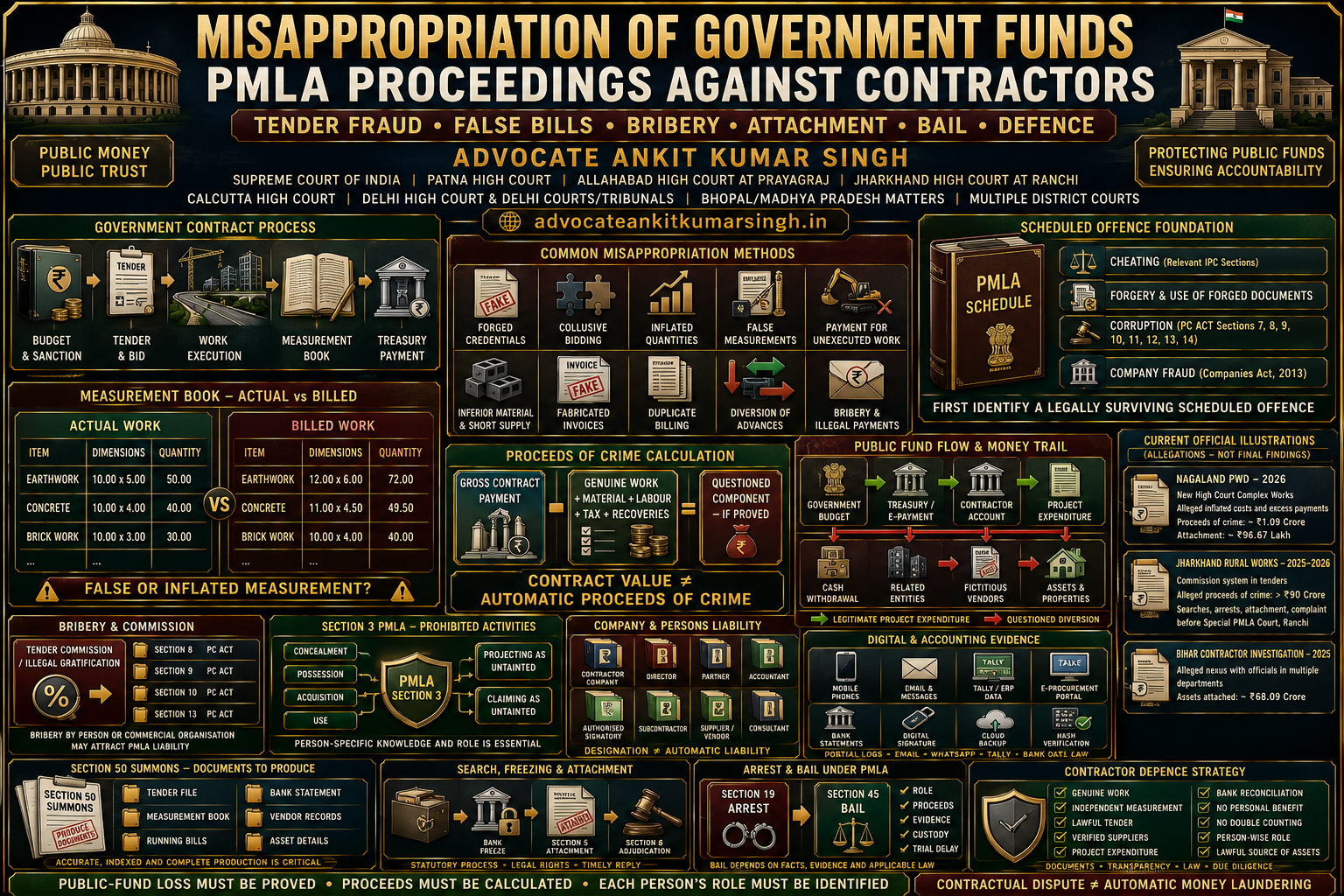
GOVERNMENT FUNDS | CONTRACTORS | TENDER FRAUD | FALSE BILLS | BRIBERY | PMLA | ATTACHMENT | BAIL
Misappropriation of Government Funds and PMLA Proceedings Against Contractors: Tender Fraud, False Bills, Bribery, Attachment, Bail and Defence
Detailed legal research by Advocate Ankit Kumar Singh
Supreme Court of India | Patna High Court | Allahabad High Court at Prayagraj | Jharkhand High Court at Ranchi | Calcutta High Court | Delhi High Court and Delhi Courts/Tribunals | Matters concerning Bhopal, Madhya Pradesh | Multiple District Courts
Researched and legally updated: 5 August 2026
Direct Answer: When Can a Government Contractor Face PMLA Proceedings?
A government contractor may face proceedings under the Prevention of Money-Laundering Act, 2002 where the investigating agency alleges that property was derived or obtained from criminal activity relating to a legally recognised scheduled offence and that the contractor knowingly handled, possessed, used, concealed, acquired, transferred, projected or claimed that property as untainted.
The existence of a government contract, audit objection, excess payment, defective work or departmental recovery does not by itself establish money laundering.
A legally sustainable PMLA case ordinarily requires identification of:
- the scheduled-offence FIR, complaint or charge sheet;
- the particular fraudulent or corrupt activity;
- the government payment or benefit allegedly generated through that activity;
- the amount constituting alleged proceeds of crime;
- the person who received or controlled it;
- the subsequent bank, cash, company or property trail; and
- the contractor’s individual knowledge and role under Section 3 PMLA.
The entire contract value must not automatically be treated as proceeds of crime. Where substantial work was genuinely executed, the investigation should ordinarily isolate the allegedly fraudulent component from legitimate contractual consideration.
Contract Dispute, Government Loss and Money Laundering Are Different
| Issue | Possible legal character | PMLA question |
|---|---|---|
| Delay in completing work | Contractual breach or liquidated-damages issue | Was any property generated from scheduled criminal activity? |
| Defective work | Engineering, contractual or negligence issue | Was the defect knowingly concealed through fraudulent billing? |
| Excess payment | Administrative error, recovery issue or fraud allegation | Was the excess deliberately obtained through a scheduled offence? |
| False measurement | Potential fraud, forgery or corruption allegation | Who created, knew of and benefited from the false entry? |
| Audit objection | Financial-control or compliance concern | Does the objection establish criminal generation of property? |
| Blacklisting | Administrative procurement consequence | Is there an independent scheduled-offence and proceeds case? |
| Bribe for tender allotment | Potential Prevention of Corruption Act offence | What benefit or proceeds arose and who handled them? |
| Payment for unexecuted work | Potential cheating, forgery or corruption case | What net amount was fraudulently received and subsequently used? |
Contents
- Scheduled-offence foundation
- Common misappropriation allegations
- Tender-to-payment investigation chain
- Calculation of proceeds of crime
- Personal liability of a contractor
- Bribery and commercial-organisation liability
- Company, director and partner liability
- Subcontractors, suppliers and consultants
- Essential defence documents
- Digital and accounting evidence
- Section 50 summons
- Search, seizure and freezing
- Property attachment
- Arrest and Section 45 bail
- Prosecution complaint and trial
- Current official illustrations
- Contractor defence strategy
- Adaptable preparation formats
- Frequently asked questions
Important Legal Verification Notice
The term “misappropriation of government funds” is descriptive. It is not by itself a separate automatic gateway to PMLA.
The applicable scheduled offence must be identified from:
- the FIR;
- criminal complaint;
- charge sheet;
- supplementary charge sheet;
- Prevention of Corruption Act proceeding;
- Companies Act proceeding; or
- another legally recognised predicate case.
For offences registered after the commencement of the Bharatiya Nyaya Sanhita, 2023, the precise statutory provision, transitional position and its relationship with the current PMLA Schedule must be verified from the actual record.
A general assumption that every allegation of breach of trust, cheating, conspiracy or forgery is automatically scheduled should be avoided.
Scheduled-Offence Foundation in a Government-Contract Case
Relevant PMLA Schedule Categories
Depending upon the facts and date, the predicate case may include scheduled allegations concerning:
- cheating and dishonest inducement;
- forgery of valuable-security or equivalent documents;
- use of forged documents or electronic records;
- criminal conspiracy to commit a scheduled offence;
- bribery of a public servant;
- bribery by a commercial organisation;
- criminal misconduct by a public servant;
- abetment of corruption offences;
- fraud under the Companies Act; or
- another offence included in the Schedule.
Section 120B Criminal Conspiracy
Criminal conspiracy should not be treated as an unlimited gateway to PMLA. The alleged conspiracy must concern commission of an offence otherwise included in the Schedule.
Survival of the Predicate Case
The defence should track whether the scheduled offence has been:
- quashed;
- closed;
- discharged;
- compounded, where legally permissible;
- resulted in acquittal;
- modified through a supplementary charge sheet;
- challenged in revision or appeal; or
- otherwise legally altered.
The PMLA prosecution is a separate offence concerning proceeds of crime, but it still requires property derived or obtained from criminal activity relating to a scheduled offence.
How Government Funds May Allegedly Be Misappropriated
Tender and Bid Stage
- Tailor-made eligibility conditions.
- Forged experience certificates.
- False turnover or solvency certificates.
- Fictitious equipment and personnel records.
- Collusive or cover bidding.
- Common control of competing bidders.
- Unauthorised disclosure of rival bids.
- Bribery for qualification or award.
- Manipulation of tender-committee records.
- Award to an ineligible bidder.
Estimate and Contract Stage
- Inflated project estimate.
- Unnecessary items included in the BOQ.
- Manipulated schedule of rates.
- Artificial urgency used to avoid competition.
- Splitting of work to avoid approval limits.
- Improper negotiated rates.
- Fraudulent mobilisation advance.
- False bank guarantee.
- Unauthorised subcontracting.
Execution and Measurement Stage
- Work shown as executed but not performed.
- Inflated dimensions or quantities.
- Duplicate measurement.
- Wrong higher-rate item applied.
- Inferior material substituted.
- Short supply concealed.
- Backdated measurement-book entry.
- Fabricated quality-test report.
- False geotagged photograph or completion record.
- Measurement copied from another project.
Billing and Payment Stage
- Running bill unsupported by measurement.
- Duplicate invoice or duplicate bill.
- Payment for rejected work.
- False completion certificate.
- Payment beyond agreement value without approval.
- Advance not recovered.
- Security or statutory deduction omitted.
- Payment to a substituted bank account.
- Fraudulent variation or extra-item billing.
- Payment after termination through fabricated records.
Post-Payment Stage
- Transfer to shell or controlled entities.
- Payments to fictitious vendors.
- Cash withdrawal for commission distribution.
- Round-tripping through related companies.
- Purchase of property in another person’s name.
- Use of accommodation entries.
- Conversion into jewellery, securities or luxury assets.
- Layering through loans, advances or share capital.
- False consultancy or subcontractor payments.
How ED Reconstructs a Government Contract
A government-contract investigation is ordinarily document-intensive because no single document proves the entire transaction.
| Stage | Important records | Principal question |
|---|---|---|
| Budget | Scheme guidelines, fund allotment and expenditure sanction | Was public money lawfully available for the project? |
| Estimate | DPR, design, quantities, rates and technical sanction | Was the project cost honestly calculated? |
| Tender | NIT, SBD, BOQ, eligibility and portal logs | Was competition genuine and transparent? |
| Award | Evaluation, approval, acceptance and agreement | Was the contractor eligible and properly selected? |
| Execution | Site diary, MB, quality tests and progress records | Was the work actually executed? |
| Bill | RA bill, quantity abstract, deductions and certification | Was the certified amount supported? |
| Payment | Treasury record, UTR and contractor bank statement | Who received the government money? |
| Use | Vendor, labour, tax, cash and asset records | Was the money used for the project or diverted? |
How Should Alleged Proceeds of Crime Be Calculated?
The calculation should begin with the particular alleged criminal act rather than the headline value of the project.
Illustrative False-Measurement Calculation
QUANTITY BILLED
MINUS QUANTITY GENUINELY EXECUTED
=
QUESTIONED QUANTITY

QUESTIONED QUANTITY
× APPLICABLE CONTRACT RATE
=
GROSS QUESTIONED VALUE

GROSS QUESTIONED VALUE
MINUS RECOVERIES, REVERSALS OR UNPAID AMOUNTS
=
POTENTIAL WRONGFUL RECEIPT
Illustrative Inflated-Invoice Calculation
AMOUNT REIMBURSED OR CERTIFIED
MINUS ACTUAL GENUINE PURCHASE COST
MINUS LEGITIMATE TAX, TRANSPORT AND CONTRACTUAL COMPONENT
=
ALLEGED INFLATED BENEFIT
Illustrative Unexecuted-Work Calculation
PAYMENT RECEIVED FOR UNEXECUTED WORK
MINUS AMOUNT ALREADY REFUNDED OR RECOVERED
=
NET QUESTIONED RECEIPT
Important Deductions and Adjustments
- Work genuinely executed.
- Materials genuinely supplied.
- Labour and machinery cost.
- GST, royalty, cess and tax deductions.
- Security retained by the department.
- Mobilisation advance already recovered.
- Payment not actually released.
- Recovery made from later bills.
- Amount refunded before or after detection.
- Legitimate contractor margin.
- Value already attached or seized elsewhere.
Double-Counting Risks
- The same government payment counted in the contractor account and vendor account.
- Cash withdrawal and asset purchase both counted as separate proceeds.
- Gross contract value counted despite substantial genuine work.
- Illegal commission and the same underlying excess payment counted twice.
- Direct proceeds and equivalent-value property cumulatively exceeding the alleged proceeds.
- The same transfer counted at every layer.
- Properties already seized or restored counted again.
When May a Contractor Be Personally Liable?
Liability may be alleged where evidence indicates that the contractor:
- knowingly used false eligibility documents;
- participated in collusive bidding;
- paid illegal gratification;
- knowingly claimed payment for work not executed;
- signed a false measurement or bill;
- created or procured fabricated invoices;
- received excess payment with knowledge of the falsity;
- diverted a government advance;
- used fictitious subcontractors;
- transferred questioned funds to related entities;
- converted cash into property or assets;
- helped conceal beneficial ownership; or
- projected a criminally generated receipt as legitimate contract income.
What Does Not Automatically Prove Contractor Knowledge?
- A departmental officer prepared the estimate.
- The contractor received a payment certified by several officials.
- An invoice later became disputed.
- A supplier failed to deposit tax.
- A measurement-book correction exists.
- The project deteriorated after completion.
- The contract was terminated.
- The department imposed liquidated damages.
- A competing bidder filed a complaint.
- The company’s accountant made an incorrect entry.
- A subcontractor defaulted.
- A related company received a commercially documented payment.
Each allegation requires examination of knowledge, control, communication, conduct, financial benefit and surrounding evidence.
Bribery, Tender Commissions and the Prevention of Corruption Act
The Prevention of Corruption Act provisions included in the PMLA Schedule cover offences concerning:
- a public servant being bribed;
- influencing a public servant through corrupt or illegal means;
- bribing a public servant;
- bribery by a commercial organisation;
- responsibility of persons in charge of the commercial organisation;
- public servants receiving an undue advantage;
- abetment;
- criminal misconduct; and
- habitual offending.
Contractor Bribery Allegations
Investigators may allege that a contractor paid a percentage of:
- the tender value;
- the bill amount;
- the mobilisation advance;
- the variation amount;
- the payment released;
- the security refund; or
- another financial benefit.
Evidence Commonly Examined
- WhatsApp or email communications.
- Diaries and handwritten percentage calculations.
- Cash withdrawals before tender or payment events.
- Statements of contractors, engineers and intermediaries.
- Vehicle, travel or hotel records.
- Payments to aides or related entities.
- Unexplained assets of officials.
- Common intermediaries.
- Entry-operator records.
- Digital spreadsheets and accounting data.
Defence Questions
- Was the payment actually made?
- Who made it?
- What was its source?
- Was the contractor personally aware?
- Was the amount a legitimate business payment?
- Does the alleged percentage match the tender or bill dates?
- Is the statement corroborated?
- Was the communication complete and authentic?
- Did the contractor receive any improper tender advantage?
- Was the contract independently won through a lawful bid?
Liability of the Contractor Company, Directors and Partners
Direct Liability under Section 3
A company, director or employee may face direct liability where the person is alleged to have knowingly participated in a process or activity connected with proceeds of crime.
Section 70 PMLA
Where a company is alleged to have committed a PMLA offence, the prosecution may also proceed against persons responsible for the conduct of its business, subject to the statutory defences and person-specific evidence.
Relevant Factors for Directors and Partners
- Period of directorship or partnership.
- Responsibility for the particular project.
- Signing authority.
- Bank-account authority.
- Tender and bid approval.
- Control over invoices and bills.
- Knowledge of measurement disputes.
- Communication with public officials.
- Approval of subcontractors and vendors.
- Receipt of personal benefit.
- Consent, connivance or neglect.
- Compliance and due-diligence systems.
Independent and Non-Executive Directors
Designation alone should not substitute for evidence concerning responsibility, knowledge or involvement in the questioned transaction.
Company Compliance Defence
Relevant preventive records may include:
- anti-bribery policy;
- vendor due diligence;
- approval matrix;
- segregation of duties;
- internal audit;
- whistleblower mechanism;
- cash-payment restrictions;
- gift and hospitality policy;
- tender-agent controls;
- employee training;
- investigation of red flags; and
- disciplinary records.
Subcontractors, Suppliers, Consultants and Other Recipients
Subcontractor
A genuine subcontractor should preserve:
- subcontract agreement;
- departmental approval, where required;
- scope of work;
- site records;
- measurement and bill records;
- labour and material evidence;
- GST invoices;
- bank receipts;
- tax deductions; and
- proof of actual execution.
Material Supplier
A supplier should establish:
- purchase order;
- stock availability;
- manufacturer or upstream supplier;
- delivery challan;
- weighment record;
- e-way bill;
- transport record;
- site receipt;
- bank payment; and
- GST reporting.
Consultant or Tender Agent
A consultant should identify:
- engagement scope;
- professional fee;
- actual services;
- communications;
- access to digital signatures;
- bid-document source;
- relationship with other bidders;
- authority to communicate with officials; and
- absence of success-linked illegal payments.
Receipt of contractor money does not automatically prove laundering. The legal question is whether the recipient knowingly handled property derived from scheduled criminal activity or supplied sham documentation to conceal it.
Essential Documents for Contractor Defence
Government Approval File
- Scheme guidelines.
- Budget provision.
- Administrative approval.
- Expenditure sanction.
- Technical sanction.
- Revised sanction.
- Competent-authority approval.
Tender File
- NIT and tender ID.
- Standard bidding document.
- BOQ.
- Pre-bid minutes.
- Corrigenda.
- Eligibility documents.
- Technical bid.
- Financial bid.
- Comparative statement.
- Evaluation and award records.
- Letter of acceptance.
Contract and Security File
- Agreement.
- Work order.
- Performance security.
- Bank guarantee.
- Insurance.
- Site-possession record.
- Approved programme.
- Advance agreement.
- Subcontract approval.
Execution File
- Site diary.
- Measurement book.
- Level book.
- Quantity sheets.
- Material register.
- Labour records.
- Machinery records.
- Quality tests.
- Inspection reports.
- Photographs and videos.
- Progress reports.
- Completion documents.
Billing and Payment File
- Running-account bills.
- Final bill.
- MB references.
- Quantity abstracts.
- Rate calculations.
- Deduction statements.
- Treasury payment record.
- UTR.
- Contractor bank statement.
- Departmental recovery.
Use-of-Funds File
- Material payments.
- Labour payments.
- Machinery-hire payments.
- Subcontractor payments.
- Tax payments.
- Loan repayments.
- Cash books.
- Related-party agreements.
- Asset-purchase documents.
Digital and Accounting Evidence
ED may examine:
- e-procurement portal logs;
- digital-signature certificates;
- bid-upload metadata;
- IP addresses;
- email communications;
- WhatsApp and messaging records;
- mobile-phone extractions;
- Tally and ERP data;
- spreadsheets;
- vendor master data;
- voucher and alteration history;
- cloud-storage records;
- banking credentials;
- scanned invoices;
- geotagged photographs; and
- document metadata.
Digital Evidence Does Not Interpret Itself
A message, spreadsheet or accounting entry should be examined for:
- source;
- completeness;
- user attribution;
- context;
- time zone;
- device custody;
- hash integrity;
- statutory electronic-record requirements;
- supporting bank transaction; and
- actual commercial implementation.
A payment mentioned in a chat does not establish that it occurred. A Tally entry does not automatically establish actual transfer. A file on a laptop does not automatically prove that the device owner created or approved it.
Section 50 PMLA Summons to a Contractor
A contractor, director, accountant, supplier or employee may be summoned to:
- give evidence;
- produce tender documents;
- explain measurements and bills;
- identify subcontractors;
- produce accounting data;
- explain cash withdrawals;
- identify property acquisitions;
- explain communications with officials; or
- reconcile the alleged money trail.
Preparation Before Appearance
- Verify the issuing office and summons reference.
- Read the precise document demand.
- Prepare a chronology of the project.
- Identify the witness’s actual role.
- Review earlier statements and correspondence.
- Prepare an indexed document production.
- Reconcile each questioned payment.
- Separate personal knowledge from company records.
- Do not guess when the record is unavailable.
- Preserve proof of appearance and production.
Common Statement Risks
- Accepting a departmental calculation without verification.
- Calling every cash withdrawal a commission.
- Giving an estimated answer as a confirmed fact.
- Assuming responsibility for records created by another employee.
- Using inconsistent explanations across ED, police, GST and arbitration proceedings.
- Failing to distinguish gross payment from net profit.
- Speculating about another contractor or official.
Search, Seizure, Digital Devices and Bank Freezing
A Section 17 search may involve:
- office and residence;
- project site;
- accounting records;
- mobile phones and laptops;
- servers and cloud accounts;
- bank lockers;
- cash and jewellery;
- property papers;
- company records; and
- vendor or subcontractor premises.
Immediate Search-Day Safeguards
- Do not destroy or remotely wipe records.
- Verify the search authority.
- Record every location searched.
- Check the description of seized devices and documents.
- Identify ownership and actual user of every device.
- Obtain the panchnama and inventory.
- Record third-party and privileged material appropriately.
- Identify business-critical records requiring copies.
- Do not sign a factually incorrect inventory without recording objection.
Bank-Account Freezing
A contractor should prepare:
- account-wise balance;
- source of every material credit;
- project-wise receipts;
- employee-salary obligations;
- tax and statutory liabilities;
- secured-creditor obligations;
- unrelated client or project funds;
- working-capital records;
- legitimate business-continuity requirements; and
- a proposed controlled-operation mechanism, where appropriate.
Provisional Attachment of Contractor and Family Property
ED may provisionally attach property where the statutory Section 5 conditions are considered satisfied.
The attachment may concern:
- contractor bank balances;
- land and buildings;
- company assets;
- vehicles and machinery;
- shares and investments;
- property held through related entities;
- assets held in family members’ names; or
- equivalent-value property where the original proceeds are allegedly unavailable.
Property-Wise Defence Questions
- When was the property acquired?
- Was it acquired before the alleged offence?
- Who paid the consideration?
- What was the lawful source?
- Does the alleged money trail reach this property?
- Is ED alleging direct proceeds or equivalent value?
- Was the property independently funded by a spouse or family member?
- Is the whole property attached despite partial ownership?
- Has ED exceeded the alleged proceeds amount?
- Has the same value been attached elsewhere?
The affected person should prepare a complete Section 8 reply supported by title, acquisition, bank, income, loan, contribution and valuation records.
Arrest Risk and Section 45 Bail
A contractor may face arrest allegations where ED claims evidence of:
- knowing participation in the scheduled criminal activity;
- handling substantial proceeds;
- false statements or concealed records;
- cash and property layering;
- influence over witnesses;
- destruction of evidence;
- continued use or enjoyment of proceeds;
- non-cooperation; or
- risk of abscondence.
Bail Preparation
A Section 45 bail application may require analysis of:
- scheduled-offence sustainability;
- proceeds-of-crime calculation;
- contractor’s actual role;
- genuine work and expenditure;
- absence of personal benefit;
- documentary nature of the investigation;
- completion of search and seizure;
- custody period;
- prosecution-complaint status;
- parity;
- medical and statutory provisos;
- trial delay;
- absence of tampering risk; and
- conditions securing attendance.
Bail cannot be evaluated merely from the total project value. The specific alleged proceeds, evidence and applicant’s role must be addressed.
Prosecution Complaint, Discharge and Trial
ED may file a prosecution complaint before the competent PMLA Special Court alleging commission of the offence under Section 3 punishable under Section 4.
Contractor-Specific Allegations Should Identify
- the tender or project;
- the scheduled offence;
- the fraudulent payment or benefit;
- the amount attributed to the contractor;
- the contractor’s knowledge;
- the Section 3 process or activity;
- the bank or cash trail;
- the property acquired;
- the evidence relied upon; and
- the role of the company and individual accused.
Possible Discharge Issues
- No legally sustainable scheduled offence.
- No identifiable proceeds of crime.
- Entire contract payment incorrectly treated as proceeds.
- Genuine work and expenditure ignored.
- No person-specific Section 3 activity.
- Reliance only on designation or association.
- Uncorroborated statement.
- Transaction predating the alleged criminal activity.
- No evidence of knowledge or benefit.
- Legitimate commercial transaction conclusively shown by admitted records.
- Jurisdictional or authorisation defect.
Discharge and charge hearings are prima facie stages and ordinarily do not become a complete trial of disputed evidence.
Current Official Contractor and Public-Fund Illustrations
Nagaland PWD and New High Court Complex Works
ED stated in January 2026 that its investigation concerned allegations of conspiracy between government officials and contractors in works connected with the New High Court Complex at Kohima.
ED alleged inflated costs, excess contractor payments and proceeds of crime of approximately ₹1.09 crore. It also reported provisional attachment of property valued at approximately ₹96.67 lakh.
Jharkhand Rural Works Department
ED’s official 2025 and 2026 releases described allegations concerning:
- commission collection from contractors;
- tender allotments;
- distribution through officials and intermediaries;
- cash seizures;
- property attachment;
- contractors allegedly providing money or vehicles; and
- prosecution complaints before the Special PMLA Court at Ranchi.
The Jharkhand High Court’s 2026 judgment arose at the discharge and charge stage, where the Court examined whether sufficient prima facie material existed to proceed.
Bihar Contractor Investigation
ED’s 2025 releases described searches in an investigation relating to allegations that a contractor working across several Bihar government departments had a nexus with officials for tender-related illicit gains.
ED reported seizure of cash and digital records and provisional attachment of assets valued at approximately ₹68.09 crore.
Every reference in this section concerns allegations reported by the investigating agency or a prima facie judicial stage. No person should be described as finally guilty unless a competent court records such a finding after trial.
Complete Contractor Defence Strategy
Stage 1 — Identify the Predicate Foundation
- Obtain the FIR and charge sheet.
- Identify the exact scheduled offence.
- Check the date and applicable penal statute.
- Examine the contractor’s status in the predicate case.
- Track discharge, quashing and trial status.
Stage 2 — Reconstruct the Contract
- Budget and sanction.
- Tender and bid.
- Award and agreement.
- Execution and measurement.
- Billing and certification.
- Payment and utilisation.
Stage 3 — Quantify the Disputed Component
- Separate genuine work.
- Separate actual cost.
- Identify excess or questioned amount.
- Deduct recoveries and reversals.
- Identify double counting.
- Compare attached value with alleged proceeds.
Stage 4 — Prepare a Person-Wise Role Chart
- Who prepared the bid?
- Who signed the agreement?
- Who supervised the site?
- Who submitted the bill?
- Who controlled the bank account?
- Who selected vendors?
- Who authorised cash withdrawals?
- Who acquired the questioned asset?
Stage 5 — Reconcile the Money Trail
- Government payment.
- Contractor receipt.
- Project expenditure.
- Vendor and labour payment.
- Tax payment.
- Cash withdrawal.
- Related-party transfer.
- Asset acquisition.
Stage 6 — Prepare for Each PMLA Proceeding
- Section 50 summons response.
- Search and seizure objections.
- Bank-freeze application.
- Section 5 attachment challenge.
- Section 8 adjudication reply.
- Arrest and bail preparation.
- Prosecution-complaint analysis.
- Discharge and trial strategy.
Government-Fund PMLA Investigation Workflow
A contractor PMLA case requires a scheduled offence, transaction-specific proceeds calculation and proof of the concerned person’s role.Adaptable Government-Contract PMLA Preparation Formats
Contract-to-Payment Reconciliation Chart
GOVERNMENT CONTRACT PMLA RECONCILIATION

A. PROJECT DETAILS

1. Department:
2. Scheme:
3. Tender ID:
4. Agreement number:
5. Contractor:
6. Project location:
7. Original contract value:
8. Revised value:
9. Work period:
10. Scheduled-offence FIR:

B. SANCTION AND TENDER

11. Administrative approval:
12. Technical sanction:
13. Estimated value:
14. Tender method:
15. Bid value:
16. Eligibility documents:
17. Evaluation:
18. Letter of acceptance:
19. Work order:

C. EXECUTION

20. Site-possession date:
21. Work actually performed:
22. MB numbers:
23. Quality-test reports:
24. Material purchased:
25. Labour employed:
26. Machinery deployed:
27. Approved variations:
28. Completion status:

D. BILLING

29. RA bill number:
30. Quantity billed:
31. Quantity measured:
32. Applicable rate:
33. Gross value:
34. Deductions:
35. Net certified amount:
36. Payment date:
37. UTR:

E. USE OF FUNDS

38. Material payments:
39. Labour payments:
40. Subcontractor payments:
41. Machinery payments:
42. Taxes:
43. Cash withdrawals:
44. Related-party transfers:
45. Asset acquisitions:

F. ED ALLEGATION

46. Alleged false document:
47. Alleged excess payment:
48. Alleged bribe:
49. Alleged proceeds amount:
50. Alleged money trail:
51. Property attached:
52. Person-specific role:

G. DEFENCE

53. Genuine execution evidence:
54. Independent measurement:
55. Supplier confirmation:
56. Bank reconciliation:
57. Lawful explanation:
58. Double counting:
59. Amount recovered:
60. Relief required:
Person-Wise Role Chart
PERSON-WISE CONTRACTOR LIABILITY CHART

1. Name:
2. Designation:
3. Relevant period:
4. Tender role:
5. Contract-signing role:
6. Site role:
7. MB role:
8. Billing role:
9. Bank authority:
10. Vendor authority:
11. Digital-signature access:
12. Communication with officials:
13. Cash-withdrawal authority:
14. Personal benefit alleged:
15. Property alleged:
16. Evidence relied upon:
17. Defence documents:
18. Lack-of-knowledge evidence:
19. Due-diligence evidence:
20. Relief required:
Section 50 Document-Production Index
DOCUMENT PRODUCTION INDEX

1. Summons reference:
2. Date of appearance:
3. Document serial number:
4. Description:
5. Period:
6. Original or copy:
7. Page range:
8. Source:
9. Custodian:
10. Confidentiality note:
11. Explanation:
12. Produced / unavailable / to follow:
13. Acknowledgement:
Common Mistakes That Weaken a Contractor’s Defence
- Treating the matter only as an arbitration dispute.
- Ignoring the predicate FIR.
- Failing to preserve the complete tender file.
- Producing bills without measurement and execution evidence.
- Relying only on departmental certification.
- Failing to verify supplier invoices.
- Not explaining cash withdrawals.
- Using inconsistent project-cost figures.
- Failing to separate gross receipts from profit.
- Not identifying legitimate project expenditure.
- Ignoring related-party transfers.
- Producing a reconstructed document without disclosure.
- Deleting chats or accounting data.
- Giving speculative answers under Section 50.
- Failing to distinguish company and individual roles.
- Ignoring attachment proceedings while focusing only on arrest.
- Waiting until prosecution complaint to prepare the money trail.
- Assuming every official statement is automatically admissible or conclusive.
- Failing to identify double counting in the alleged proceeds.
- Describing an agency allegation as a final judicial finding.
Frequently Asked Questions
1. Does misappropriation of government funds automatically attract PMLA?
No. A legally recognised scheduled offence, property derived from that criminal activity and the concerned person’s Section 3 involvement must be identified.
2. Is every government contractor payment proceeds of crime?
No. Genuine work, supplies, taxes, deductions and lawful contractual consideration must be distinguished from any allegedly fraudulent component.
3. Can defective work result in a PMLA case?
Defective work alone may remain contractual or administrative. PMLA requires a scheduled criminal foundation and criminally generated property.
4. Can a false measurement book lead to PMLA?
It may form part of a predicate fraud or corruption allegation, but authorship, knowledge, payment and financial benefit must be proved.
5. Is the contractor liable because an engineer certified the bill?
Certification does not automatically establish or exclude contractor liability. The contractor’s submission, knowledge, conduct and benefit require examination.
6. Can paying a bribe for a tender lead to PMLA proceedings?
Depending on the evidence and applicable Prevention of Corruption Act offences, bribery may form part of the scheduled-offence foundation. The proceeds and laundering activity must still be identified.
7. Can the entire tender value be called proceeds of crime?
Not automatically. The allegedly wrongful or criminally generated component should be calculated separately.
8. Can a subcontractor be summoned by ED?
Yes. A subcontractor may be summoned to produce execution, invoice, payment and banking records or explain the commercial relationship.
9. Can an innocent supplier’s account be frozen?
A supplier may face scrutiny where funds are traced to its account. It should establish genuine supply, delivery, tax reporting and use of funds.
10. Can a director be prosecuted merely because of designation?
No automatic liability follows. Responsibility, knowledge, authority, consent, connivance, neglect and due diligence must be examined.
11. Can family property be attached?
ED may attach property allegedly purchased from proceeds or representing equivalent value. The family member may prove independent title and lawful source.
12. What documents are most important?
The tender, agreement, measurement books, running bills, quality records, government payments, bank trail, vendor records and source of assets are central.
13. Can ED seize phones and Tally data?
Digital devices and accounting records may be searched or seized subject to the statutory framework. Their integrity, source, completeness and attribution remain relevant.
14. Should the contractor answer every question from memory?
No. The person should di