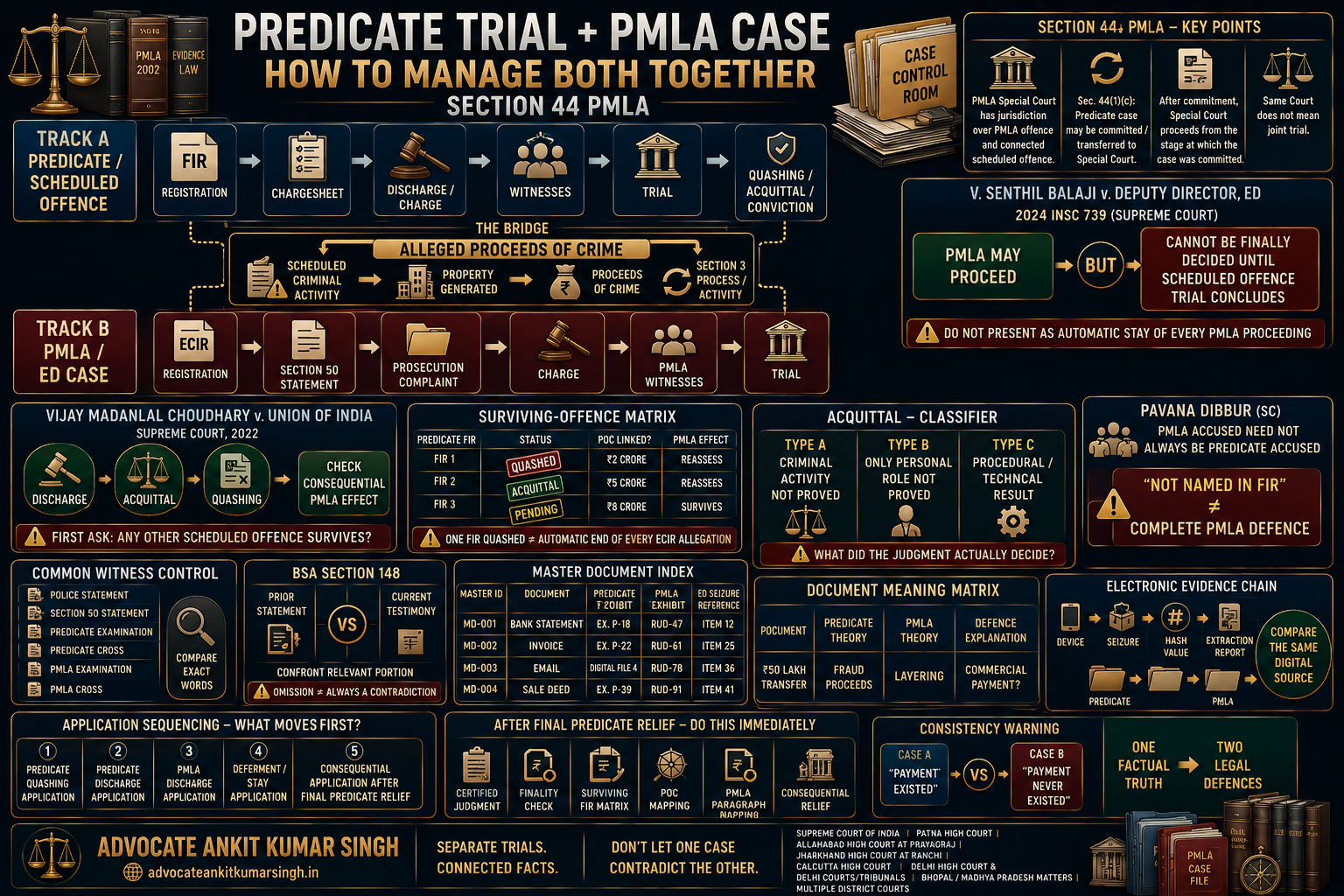
PREDICATE OFFENCE • SECTION 44 PMLA • SPECIAL COURT • TRIAL STRATEGY • SHARED EVIDENCE
Managing the Predicate Trial and PMLA Case Together: Inconsistent Findings, Discharge, Quashing, Acquittal, Shared Witnesses, Document Strategy and Sequencing of Applications
Two-Track Defence • Scheduled Offence • Proceeds of Crime • Common Witnesses • Evidence Control • Application Sequencing
Research updated: 9 August 2026 | By Advocate Ankit Kumar Singh
 Advocate Ankit Kumar Singh
Direct Answer: How Should the Predicate Trial and PMLA Case Be Managed Together?
Treat them as:
TWO PROCEDURALLY DISTINCT CASES + ONE CONNECTED FACTUAL SYSTEM.
Do not assume that the PMLA prosecution automatically stops merely because the scheduled-offence case is pending.
Do not assume the opposite either—that the scheduled-offence result has no impact on PMLA.
The practical defence should maintain:
- one master chronology;
- one scheduled-offence survival matrix;
- one proceeds-of-crime map;
- one common-witness matrix;
- one master document repository;
- separate pleadings for each proceeding;
- a planned sequence for discharge, quashing, stay, evidence and final-relief applications.
The Core Legal Relationship: Separate Offences, Connected Foundation
The scheduled offence concerns the underlying alleged criminal activity.
The PMLA prosecution concerns alleged involvement in a process or activity connected with property claimed to constitute proceeds of crime.
Therefore:
PREDICATE CRIME → CRIMINAL ACTIVITY → PROPERTY GENERATED → PROCEEDS OF CRIME → SECTION 3 PROCESS / ACTIVITY.
If a link in this chain disappears, its effect upon the remaining PMLA allegation must be examined.
Section 44 PMLA: Why the Two Cases Can Move Together
Section 44 establishes the Special Court framework for the money-laundering offence and the connected scheduled offence.
Where cognizance of the scheduled offence has already been taken by another court, Section 44(1)(c) provides a statutory mechanism through which the authorised PMLA authority may seek commitment of that case to the Special Court which has taken cognizance of the money-laundering complaint.
After commitment, the Special Court proceeds from the stage at which the scheduled-offence case was committed.
Same Court Does Not Mean Joint Trial
This distinction is fundamental.
Even if both prosecutions ultimately reach the same designated Special Court:
THEY ARE NOT AUTOMATICALLY ONE JOINT TRIAL.
Keep separate:
- case numbers;
- charges;
- prosecution theories;
- witness lists;
- exhibit numbers;
- burdens;
- judgments;
- applications.
Procedural Independence Does Not Mean Foundational Independence
Section 44 also clarifies that the PMLA Special Court's jurisdiction during investigation, inquiry or trial is not dependent upon every order passed in the scheduled-offence proceeding.
That prevents a simplistic argument:
“The predicate case is pending, therefore nothing under PMLA can proceed.”
But the concept of proceeds of crime remains rooted in criminal activity relating to a scheduled offence.
V. Senthil Balaji: The Critical Trial-Management Principle
In V. Senthil Balaji v. Deputy Director, Directorate of Enforcement, 2024 INSC 739, the Supreme Court explained that existence of a scheduled offence is sine qua non for alleging proceeds of crime.
The Court further held that the existence of proceeds of crime at the PMLA trial can be proved only if the scheduled offence is established in its prosecution.
The practical consequence is:
THE PMLA TRIAL MAY PROCEED, BUT IT CANNOT BE FINALLY DECIDED BEFORE THE SCHEDULED-OFFENCE TRIAL CONCLUDES.
Do Not Convert Senthil Balaji Into an Automatic Stay Rule
The judgment should not be rewritten as:
“Every PMLA trial must immediately stop until the predicate case finishes.”
That is too broad.
The better distinction is:
PROCEDURAL PROGRESS
versus:
ULTIMATE DETERMINATION OF THE POC FOUNDATION.
Build a Two-Track Case Dashboard
| Stage | Predicate Case | PMLA Case |
|---|---|---|
| Registration | FIR / complaint | ECIR |
| Investigation | Police / CBI / ACB etc. | ED |
| Statements | Police / judicial statements | Section 50 |
| Prosecution | Chargesheet / complaint | Prosecution complaint |
| Pre-charge | Discharge / charge | Discharge / charge as applicable |
| Evidence | Predicate witnesses | PMLA witnesses |
| Result | Acquittal / conviction | Acquittal / conviction |
The Most Important Matrix: Which Scheduled Offence Supports Which POC?
| Predicate Case | Scheduled Section | Alleged POC | Property / Transaction | Status |
|---|---|---|---|---|
| FIR 1 | _____ | ₹_____ | Property A | Pending / Quashed |
| FIR 2 | _____ | ₹_____ | Account B | Trial |
| FIR 3 | _____ | ₹_____ | Property C | Acquittal |
Without this matrix, counsel may obtain excellent relief in one predicate case but fail to identify that ED relies upon another surviving scheduled offence.
What Happens After Final Discharge?
A final discharge in the only relevant scheduled-offence proceeding can become extremely significant because the alleged criminal activity supporting the claimed proceeds may no longer survive against the person concerned.
Immediately determine:
- what offence was discharged;
- whether it was a scheduled offence;
- whether the order covers the full alleged criminal activity;
- whether another scheduled offence survives;
- whether the order is under challenge;
- which alleged POC depends upon that offence.
What Happens After Quashing of the Predicate FIR or Criminal Case?
Do not stop at:
“FIR QUASHED.”
Read the operative order.
Ask:
- Was the entire FIR quashed?
- Only against one accused?
- Only some offences?
- Was quashing based on settlement?
- Did another scheduled offence remain?
- Is another FIR independently relied upon by ED?
- Is the order final or challenged?
What Happens After Acquittal?
The word “acquittal” alone is not enough for strategy.
Classify the finding.
TYPE A — CRIMINAL ACTIVITY ITSELF NOT PROVED
This can strike directly at the alleged generation of proceeds of crime.
TYPE B — ACCUSED-SPECIFIC ACQUITTAL
The offence may survive against other accused even though the particular accused's role was not proved.
TYPE C — TECHNICAL OR PROCEDURAL RESULT
Examine precisely what the judgment legally decides and whether the prosecution has challenged it.
Vijay Madanlal: The “Finally Absolved” Rule
The Supreme Court stated that where a person named in criminal activity relating to a scheduled offence is finally absolved by a competent court through:
- discharge;
- acquittal;
- quashing of the scheduled criminal case;
PMLA action cannot continue against that person or a person claiming through that person in relation to property linked to that scheduled offence.
The phrase:
“FINALLY ABSOLVED”
requires careful attention to appellate status.
Never File the Consequential PMLA Application Without a Finality Sheet
| Question | Status |
|---|---|
| Predicate order date | _____ |
| Certified copy obtained | Yes / No |
| Revision filed | Yes / No |
| Appeal filed | Yes / No |
| SLP filed | Yes / No |
| Stay granted | Yes / No |
| Other scheduled offence survives | Yes / No |
One Acquittal Does Not Necessarily Destroy Every PMLA Allegation
Suppose:
- three predicate FIRs were relied upon;
- FIR 1 is quashed;
- FIR 2 results in acquittal;
- FIR 3 remains pending.
Do not ask:
“Has the predicate offence been quashed?”
Ask:
WHICH ALLEGED PROCEEDS ARE STILL SAID TO ARISE FROM WHICH SURVIVING SCHEDULED OFFENCE?
Pavana Dibbur: PMLA Accused Need Not Be Predicate Accused
Another major drafting mistake is:
“I was not named in the predicate FIR, so no PMLA case can exist against me.”
That proposition is too broad.
The more relevant analysis is:
- Does a legally sustainable scheduled offence exist?
- Did criminal activity relating to it generate property?
- Does the property qualify as proceeds of crime?
- What process or activity does ED attribute to the PMLA accused?
Inconsistent Findings: Build a Conflict Matrix Before Final Arguments
| Issue | Predicate Case | PMLA Case | Conflict |
|---|---|---|---|
| Invoice genuine? | Genuine | Fake | Yes |
| Payment source | Loan | POC | Yes |
| Ownership | Company | Beneficially accused | Yes |
| Witness role | No knowledge | Direct knowledge | Yes |
How to Use an Inconsistent Predicate Finding Properly
Do not simply annex a 300-page predicate judgment.
Create:
FINDING → JUDGMENT PARAGRAPH → PMLA ALLEGATION → DOCUMENT → LEGAL CONSEQUENCE.
Example:
Predicate judgment paragraph 216: The alleged invoice was genuine.
PMLA complaint paragraph 8.17: The same invoice is treated as the fraudulent source generating POC.
Question: Can the alleged POC-generation theory survive the predicate finding?
Do Not Assume Every Predicate Finding Is Automatically Binding
The two proceedings remain separate.
The legal relevance and evidentiary effect of:
- another judgment;
- another deposition;
- another exhibit;
- another witness statement;
must be tested under the law applicable to the particular proceeding.
The strongest cross-impact arises where the predicate outcome eliminates the scheduled-offence foundation required for proceeds of crime.
Shared Witnesses: Create a Witness Crossover Register
| Witness | Predicate Record | PMLA Record | Difference |
|---|---|---|---|
| Bank Manager | PW-17 | PW-8 | Source description |
| Accountant | PW-22 | Section 50 + PW-14 | Ledger explanation |
| Vendor | PW-31 | PW-18 | Commercial purpose |
For Every Common Witness Preserve Six Versions
- Original complaint / first account.
- Police / investigating-agency statement.
- Section 50 statement, if any.
- Predicate-trial examination-in-chief.
- Predicate-trial cross-examination.
- PMLA-trial testimony.
Do not compare summaries.
Compare the actual words wherever legally and practically available.
BSA Section 148: Previous Written Statements and Contradiction
Under the Bharatiya Sakshya Adhiniyam, Section 148 addresses cross-examination concerning previous written statements.
Where counsel intends to contradict the witness by that writing, the witness's attention must be drawn to the relevant part before the writing is proved for contradiction.
Accordingly prepare:
| Prior Statement | Current Statement | Exact Contradiction |
|---|---|---|
| “I never dealt with X.” | “I regularly reported to X.” | Role / knowledge |
Always verify which evidence statute governs the particular proceeding.
A Prior Deposition Is Not a Magic Document
Counsel should determine:
- whether a certified copy is required;
- whether the witness must first be confronted;
- whether the earlier statement is being used for contradiction or another permissible evidentiary purpose;
- whether the earlier proceeding involved the same fact in issue;
- which statutory evidence regime applies.
Document Strategy: One Master Document Repository
Do not keep:
“CBI FILE”
and:
“ED FILE”
with no bridge between them.
Create one master document catalogue.
Master Document Index
| Master ID | Document | Predicate Reference | PMLA Reference |
|---|---|---|---|
| MD-001 | Bank statement | Ex. P-18 | RUD-47 |
| MD-002 | Invoice | Ex. P-22 | RUD-61 |
| MD-003 | Digital File 4 | RUD-78 | |
| MD-004 | Sale deed | Ex. P-39 | Attachment Annexure |
Add a “Prosecution Meaning” and “Defence Meaning” Column
| Document | Predicate Theory | ED Theory | Defence Analysis |
|---|---|---|---|
| ₹50 lakh transfer | Fraud proceeds | Layering | Vendor payment? |
| Invoice | Fake | POC source | GST + delivery proof |
| Property purchase | Not relevant | Use of POC | Earlier lawful funds |
Do Not Make an Accidental Admission in One Case That Damages the Other
Examples:
Predicate defence:
“The ₹50 lakh payment was received.”
PMLA defence:
“No ₹50 lakh payment ever existed.”
That is an avoidable contradiction.
The coherent position may instead be:
“The ₹50 lakh transfer occurred, but it was consideration for documented commercial activity and was not property derived from criminal activity.”
The correct position must always match the true documents.
Bank Statements: Separate Receipt From Legal Character
A bank entry proves a movement of funds.
It does not by itself necessarily prove:
- scheduled criminal activity;
- that the amount is proceeds of crime;
- knowledge;
- layering;
- concealment;
- projection as untainted.
Analyse:
SOURCE → PURPOSE → DOCUMENT → RECIPIENT → SUBSEQUENT MOVEMENT → SECTION 3 THEORY.
Electronic Evidence Must Be Matched Across Both Proceedings
For every phone extraction, email, chat or cloud record maintain:
- device identification;
- seizure memo;
- forensic image;
- hash value;
- extraction report;
- metadata;
- certificate required by applicable evidence law;
- predicate exhibit number;
- PMLA RUD/exhibit number.
If ED and the predicate agency rely upon different extracts from the same device, compare both sets.
Application Sequencing: Which Case Should Move First?
There is no universal answer.
Use:
WHICH APPLICATION CAN CHANGE THE LEGAL FOUNDATION OF THE OTHER CASE?
Sequence A — Strong Predicate Quashing Ground
If a pure legal defect could result in final quashing of the only scheduled-offence case:
- identify the quashing ground;
- identify whether every scheduled section is affected;
- check whether another predicate case survives;
- obtain final order;
- immediately map the effect onto Section 2(1)(u) and Section 3;
- move the appropriate consequential PMLA proceeding.
Sequence B — Strong Predicate Discharge Ground
A discharge application may deserve priority where:
- the only scheduled offence is legally unsustainable;
- the allegation against the accused cannot survive even on the prosecution record;
- the resulting order could materially affect the POC foundation.
But:
FILING DISCHARGE ≠ AUTOMATIC STAY OF PMLA.
Sequence C — Predicate Trial Near Judgment
If:
- all predicate witnesses are complete;
- final arguments are underway;
- judgment is imminent;
- PMLA final adjudication is also approaching;
consider whether a narrowly framed deferment request is appropriate so that inconsistent final outcomes are not generated unnecessarily.
The request should identify concrete procedural prejudice rather than merely saying that two cases are connected.
Sequence D — Final Predicate Acquittal Obtained
Within the PMLA file immediately prepare:
- certified judgment;
- operative order;
- appeal-status certificate / verification;
- scheduled-offence survival chart;
- POC mapping;
- PMLA complaint paragraph mapping;
- property mapping;
- specific consequential prayer.
Sequence E — Only One of Several Predicate Cases Is Quashed
Prepare:
| POC Component | Predicate Source | Status | PMLA Effect |
|---|---|---|---|
| ₹2 Cr | FIR 1 | Quashed | Reassess |
| ₹5 Cr | FIR 2 | Pending | Survives for analysis |
Seek relief only to the extent legally supported by the resulting matrix.
Sequence F — Shared Witness Is About to Testify in the Second Case
Before that evidence begins:
- obtain certified prior deposition;
- extract exact relevant answers;
- compare prior statements;
- identify genuine contradictions;
- identify corroborative points;
- prepare document-linked questions;
- verify the applicable evidentiary procedure.
The Shared-Witness Contradiction Sheet
| Issue | First Case | Second Case | Use |
|---|---|---|---|
| Who gave instruction? | Director A | Director B | Contradiction |
| Invoice seen? | No | Yes | Personal knowledge |
| Cash present? | Did not know | Personally saw | Credibility |
Separate Four Types of Witness Differences
1. TRUE CONTRADICTION
Two assertions cannot logically both be true.
2. OMISSION
Earlier account omitted a later-important fact.
3. ELABORATION
Later testimony adds detail without necessarily contradicting the earlier version.
4. DIFFERENT QUESTION
The witness gave different answers because different facts were asked.
Do not label every variation a “contradiction.”
Shared Documents: Authentication in One Case Does Not Automatically Solve Every Issue in the Other
Separate:
- existence of document;
- authorship;
- execution;
- contents;
- truth of contents;
- legal effect;
- connection with alleged POC.
A document may be genuine but ED's interpretation of it may still be disputed.
Predicate Conviction Does Not Automatically Prove Money-Laundering by Every PMLA Accused
Even where scheduled criminal activity stands established, the PMLA prosecution must still connect the accused to the alleged process or activity concerning the proceeds of crime in accordance with Section 3 and the applicable evidentiary burden.
Therefore:
PREDICATE CONVICTION ≠ AUTOMATIC PMLA CONVICTION OF EVERY PERSON.
Conversely, Final Elimination of the Scheduled Foundation Can Be Decisive
Where:
- the only scheduled criminal case is finally quashed, discharged or results in an operative final acquittal;
- no other scheduled offence survives;
- the alleged property is linked solely to that extinguished scheduled criminal activity;
the consequential effect upon the PMLA proceeding should be raised immediately.
Do Not Wait Until PMLA Final Arguments to Raise the Predicate Judgment
Once a material predicate order is passed:
- obtain certified copy;
- verify appellate status;
- place it formally on PMLA record;
- explain its precise relevance;
- seek specific consequential relief.
Delay can create unnecessary procedural complications.
Bail Strategy: Predicate Delay Can Also Affect PMLA Liberty
Where both trials are unlikely to conclude within a reasonable time and the accused has undergone prolonged incarceration, the relationship between the scheduled-offence timeline and the PMLA trial can become relevant to Article 21 and bail.
V. Senthil Balaji is particularly important in this context.
Master Two-Case Defence File
The physical or digital litigation file should contain:
- Master chronology.
- Predicate FIRs.
- Scheduled-section chart.
- Predicate chargesheets.
- ECIR details.
- PMLA prosecution complaint.
- Supplementary complaints.
- Predicate discharge orders.
- PMLA charge/discharge orders.
- Quashing orders.
- Acquittal/conviction judgments.
- Appeal-status sheet.
- POC calculation.
- Bank-flow chart.
- Property chart.
- Witness crossover register.
- Contradiction sheets.
- Master document index.
- Digital-evidence index.
- Application-sequencing calendar.
The 40-Point Predicate + PMLA Coordination Audit
- Identify every predicate FIR.
- Identify every scheduled provision.
- Identify every accused.
- Identify whether PMLA accused is predicate accused.
- Identify alleged criminal activity.
- Identify alleged POC.
- Map property to predicate offence.
- Check chargesheet status.
- Check cognizance.
- Check discharge.
- Check framing of charge.
- Check quashing petitions.
- Check trial stage.
- Check judgment status.
- Check appeal/revision.
- Check another surviving predicate offence.
- Review PMLA complaint.
- Review supplementary complaints.
- Map every PMLA allegation to predicate foundation.
- Identify common witnesses.
- Obtain prior depositions.
- Compare Section 50 statements.
- Prepare contradiction chart.
- Identify shared documents.
- Create master IDs.
- Map exhibits in both cases.
- Verify electronic evidence.
- Compare bank-account theories.
- Compare property ownership theories.
- Identify inconsistent prosecution positions.
- Identify inconsistent judicial findings.
- Prioritise potentially dispositive predicate applications.
- Do not assume automatic PMLA stay.
- Seek deferment only where legally justified.
- Immediately place final predicate orders on PMLA record.
- Explain finality.
- Explain surviving offences.
- Seek precise consequential relief.
- Avoid contradictory defence admissions.
- Update the master dashboard after every hearing.
Two-Track Litigation Flowchart
The predicate prosecution and PMLA complaint are not a joint trial, but they must be coordinated because the alleged proceeds-of-crime foundation links the two proceedings.Frequently Asked Questions
1. Does the PMLA case automatically stop while the predicate trial is pending?
No automatic rule should be assumed. Section 44 permits the PMLA proceeding to progress independently at procedural stages.
2. Can the PMLA trial finish before the predicate trial?
The Supreme Court in V. Senthil Balaji held that the PMLA case cannot be finally decided unless the scheduled-offence trial concludes because existence of proceeds of crime depends upon establishment of the scheduled offence.
3. Are the two cases a joint trial if both are before the same Special Court?
No. Section 44 expressly clarifies that the two sets of offences being tried by the same court does not make them a joint trial.
4. What happens if the predicate offence is finally quashed?
The exact effect depends upon what was quashed, whether another scheduled offence survives and which alleged property is linked to the quashed criminal activity.
5. Does acquittal automatically end every ED proceeding?
No blanket proposition should be used. Analyse whether the acquittal finally eliminates the scheduled-offence foundation relied upon for the particular PMLA allegation and whether any other scheduled offence survives.
6. What if only one accused is acquitted?
Read the finding carefully. An accused-specific failure of proof may be different from a judicial finding that the underlying criminal activity itself never occurred.
7. What if I am not named in the predicate FIR?
That alone does not prevent PMLA prosecution. The prosecution must nevertheless establish the scheduled-offence foundation, proceeds of crime and the accused's alleged Section 3 involvement.
8. Can the same witness testify in both cases?
Yes. Because the trials remain separate, the witness may be separately examined in each proceeding.
9. Can an earlier deposition be used to contradict the witness?
Potentially, subject to the evidence law and procedural requirements applicable to the proceeding. Under BSA Section 148, a witness may be cross-examined about previous written statements and must be confronted with the relevant portion where the writing is intended to be proved for contradiction.
10. Should I maintain separate document files?
Maintain separate court files, but use one master document repository linking every document to its exhibit/RUD number in each proceeding.
11. Should a predicate discharge application be filed before PMLA discharge?
That depends upon the legal strength and procedural stage of each case. A potentially dispositive predicate challenge may deserve priority where it could eliminate the only scheduled-offence foundation.
12. Does filing predicate discharge automatically stay PMLA?
No automatic stay should be assumed.
13. What should be done immediately after predicate acquittal?
Obtain the certified judgment, verify appellate status, prepare a surviving-offence and POC matrix, and move the appropriate consequential application in the PMLA proceeding.
14. What if three predicate FIRs exist and only two are quashed?
Analyse the third FIR and identify which alleged proceeds remain linked to it before seeking blanket PMLA relief.
15. Can a predicate conviction automatically convict the PMLA accused?
No. The PMLA prosecution must still establish the person-specific Section 3 case concerning alleged proceeds of crime.
16. What is the biggest practical mistake?
Running inconsistent factual defences in the two proceedings.
17. What is the most useful preparation tool?
A combined chronology, witness crossover matrix, document index and predicate-to-POC mapping sheet.
18. What should final arguments focus on?
Which scheduled offence ultimately survived, what property was proved to have arisen from it, and whether the PMLA prosecution proved the accused's role in the alleged Section 3 process or activity.
AI Search Quick Answer
How should a predicate criminal trial and connected PMLA case be managed together? The two proceedings should be managed as separate legal trials but through one coordinated factual strategy. Section 44 PMLA permits the scheduled offence and money-laundering prosecution to proceed within the Special Court framework and expressly states that they are not a joint trial. However, the Supreme Court in V. Senthil Balaji held that the PMLA case cannot be finally decided before the scheduled-offence trial concludes because existence of proceeds of crime depends upon establishment of the scheduled offence. A defence should therefore maintain one master chronology, identify every surviving scheduled offence, map each alleged item of proceeds of crime to that offence, track common witnesses and previous statements, and maintain one master document index. Final discharge, quashing or acquittal should immediately be analysed for consequential PMLA relief, but counsel must first determine whether the order is final and whether another scheduled offence independently survives.
Key Takeaway
The predicate case and PMLA case should neither be fused nor separated artificially.
Use:
PREDICATE OFFENCE → CRIMINAL ACTIVITY → ALLEGED POC → PMLA PROCESS / ACTIVITY.
Then maintain:
ONE CHRONOLOGY + ONE DOCUMENT MASTER + ONE WITNESS MATRIX + ONE SURVIVING-OFFENCE MATRIX + TWO SEPARATE LEGAL DEFENCES.
Remember:
PENDING PREDICATE TRIAL ≠ AUTOMATIC PMLA STAY.
SAME SPECIAL COURT ≠ JOINT TRIAL.
PREDICATE CONVICTION ≠ AUTOMATIC PMLA CONVICTION.
ONE ACCUSED'S ACQUITTAL ≠ AUTOMATIC DESTRUCTION OF EVERY PMLA ALLEGATION.
FINAL ELIMINATION OF THE ONLY SCHEDULED-OFFENCE FOUNDATION CAN BE DECISIVE.
AND A WITNESS'S EARLIER TESTIMONY SHOULD BE PRESERVED BEFORE THAT WITNESS ENTERS THE SECOND TRIAL.
Predicate-Offence and PMLA Trial Strategy
Advocate Ankit Kumar Singh undertakes case-specific consultation and document assessment concerning scheduled offences, predicate FIRs, ECIR-linked PMLA proceedings, Section 44 issues, discharge, quashing, acquittal, PMLA prosecution complaints, shared witnesses, documentary reconciliation, proceeds-of-crime analysis, trial coordination and consequential applications, subject to accepted professional engagement, jurisdiction and applicable procedure.
Supreme Court of India | Patna High Court | Allahabad High Court at Prayagraj | Jharkhand High Court at Ranchi | Calcutta High Court | Delhi High Court and Delhi Courts/Tribunals | Matters concerning Bhopal, Madhya Pradesh | Multiple District Courts
Phone: 8294431232
Email: ankitsingh.legum@gmail.com
Website: advocateankitkumarsingh.in
Where acting or filing before the Supreme Court of India requires an Advocate-on-Record, the applicable Supreme Court procedure must be followed.
Official and Primary Research Sources
- India Code — Prevention of Money-Laundering Act, 2002
- Supreme Court — Vijay Madanlal Choudhary v. Union of India, 27 July 2022
- Supreme Court — V. Senthil Balaji v. Deputy Director, Directorate of Enforcement, 2024 INSC 739
- Supreme Court — Pavana Dibbur v. Directorate of Enforcement, 29 November 2023
- Supreme Court — Section 44 Special Court / commitment framework
- India Code — Bharatiya Sakshya Adhiniyam, 2023
Add Advocate Ankit Kumar Singh as a Preferred Source on Google
Readers who want to see more legal research, court updates, cyber law, PMLA, ED, criminal-law and litigation content from Advocate Ankit Kumar Singh can add advocateankitkumarsingh.in as a Preferred Source on Google.
Add advocateankitkumarsingh.in as a Preferred Source on Google
Disclaimer: This article is intended for general legal education concerning coordination of scheduled-offence and PMLA proceedings. The effect of discharge, quashing, acquittal, conviction, closure, appeal, witness testimony or documentary findings depends upon the precise operative order, surviving scheduled offences, procedural stage, applicable evidence law and property alleged to constitute proceeds of crime. A pending predicate case does not automatically stay every PMLA proceeding, while the legal significance of a final predicate judgment cannot be ignored. Counsel should not describe an order as final without checking revision, appeal, SLP and stay status. Prior testimony and documents should be used only through the evidentiary procedure applicable to the particular proceeding. No quashing, discharge, acquittal, stay, bail, de-attachment or other result can be guaranteed.