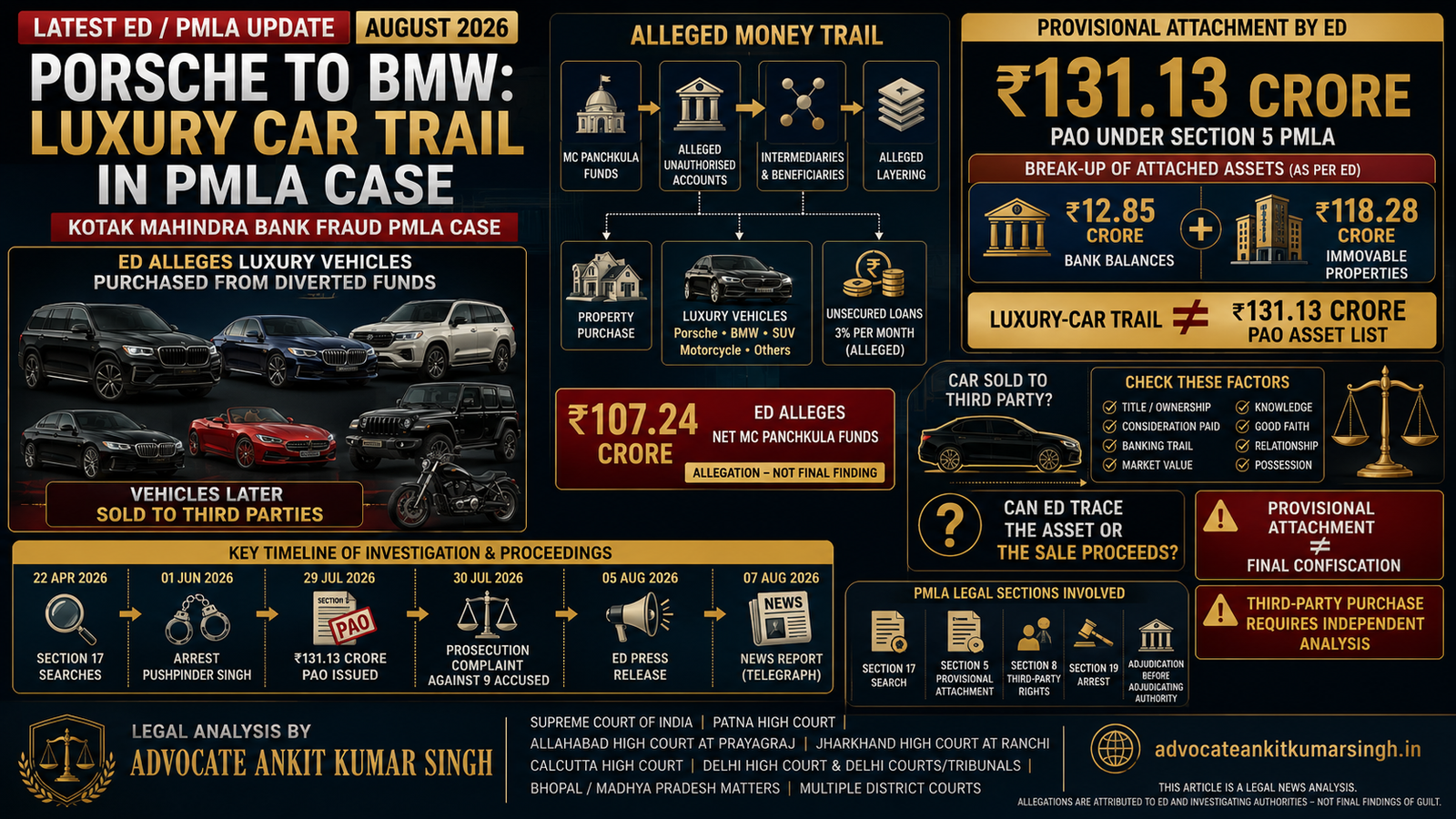
LATEST ED / PMLA LEGAL UPDATE • AUGUST 2026
Porsche to BMW in Kotak Mahindra Bank Fraud Case: ED Attaches ₹131.13 Crore, Traces Luxury Cars and Alleges Diversion of Panchkula Municipal Funds
Municipal Corporation Panchkula • ₹131.13 Crore PAO • Luxury-Car Trail • Third-Party Buyers • Section 5 PMLA • Proceeds of Crime
Research and legal update: 9 August 2026 | By Advocate Ankit Kumar Singh
 Advocate Ankit Kumar Singh
Breaking Legal Update
The Enforcement Directorate's Chandigarh Zonal Unit stated in its press release dated 5 August 2026 that it had issued a Provisional Attachment Order under Section 5(1) of the Prevention of Money-Laundering Act, 2002 in the Kotak Mahindra Bank Fraud Case concerning Municipal Corporation, Panchkula funds.
According to ED, the total value provisionally attached is:
₹131.13 crore
comprising:
- ₹12.85 crore in bank balances; and
- ₹118.28 crore in immovable properties.
ED has described these amounts as alleged proceeds of crime. The attachment remains a statutory provisional action and must not be confused with final confiscation or a final judicial determination of guilt.
Porsche to BMW: Why the Luxury-Car Trail Has Become Major News
The Telegraph reported the development under the headline:
“Porsche to BMW, luxury car trail surfaces in Kotak Mahindra Bank fraud case.”
The headline arises from a specific allegation in the Enforcement Directorate's official investigation.
ED says Pushpinder Singh purchased several premium vehicles from funds that the agency alleges were siphoned from Municipal Corporation, Panchkula.
The vehicles identified by ED include:
- Porsche Cayenne;
- BMW 740Li;
- BMW X7;
- BMW 749i;
- BMW Z4;
- Jeep Wrangler — 2021;
- Jeep Wrangler — 2024;
- Land Cruiser;
- Harley-Davidson motorcycle.
The significance of the story is not merely that expensive vehicles were purchased.
The legally significant question is whether the prosecution can establish the complete financial chain between the scheduled criminal activity, the allegedly diverted municipal funds and each asset said to have been purchased from those funds.
The Cars Were Allegedly Sold to Third Parties — Why That Changes the Legal Analysis
ED states that the luxury vehicles were sold to third parties after the alleged fraud had been detected.
That creates a fundamentally different PMLA question from a case where the vehicle remains registered in the name of the accused.
The analysis may now require examination of:
- who purchased the vehicle;
- date of purchase;
- sale consideration;
- whether consideration was paid through banking channels;
- fair market value;
- whether purchaser knew about the investigation;
- whether the transfer was commercially genuine;
- whether possession genuinely changed;
- whether the sale proceeds can themselves be traced;
- whether ED alleges a sham or collusive transfer.
A subsequent purchaser should therefore not be analysed merely by asking:
“Whose name is now on the registration certificate?”
The more complete enquiry is:
TITLE → CONSIDERATION → SOURCE → TIMING → KNOWLEDGE → POSSESSION → GOOD FAITH → CONNECTION OR ABSENCE OF CONNECTION WITH ALLEGED POC.
Important Clarification: The Luxury Cars Are Not the ₹131.13 Crore Attached Property Identified in the ED Release
This distinction should be maintained carefully.
ED states that the ₹131.13 crore PAO consists of:
- ₹12.85 crore of bank balances; and
- ₹118.28 crore of immovable properties.
Separately, ED says the luxury vehicles had already been sold to third parties.
Therefore, based on the public ED release alone, it would be inaccurate to write:
“ED attached Porsche and BMW cars worth ₹131.13 crore.”
The official material does not say that.
The more accurate formulation is:
“ED traced an alleged luxury-vehicle trail and separately provisionally attached ₹131.13 crore in bank balances and immovable properties.”
How Did the Alleged Panchkula Municipal Fund Diversion Work?
According to ED, its investigation originated from an FIR registered by the Anti-Corruption Bureau, Panchkula, Haryana.
ED alleges that Pushpinder Singh, then Deputy Vice President of Kotak Mahindra Bank, acted in connivance with Municipal Corporation official Vikas Kaushik and other persons.
The agency alleges that:
- two unauthorised accounts were opened in the name of Municipal Corporation, Panchkula;
- fake documents and purported municipal authorisations were used;
- genuine instructions from the municipal corporation were bypassed;
- funds were transferred from genuine municipal accounts to the allegedly unauthorised accounts;
- the money was thereafter transferred to intermediaries and beneficiaries;
- parts of those funds were allegedly layered and used for personal assets, loans and other purposes.
These remain allegations of the investigating agency and must be tested in the applicable adjudicatory and criminal proceedings.
Mobile Numbers and Email IDs: The Alleged Control Mechanism
One particularly important allegation concerns the electronic contact information connected with the bank accounts.
ED states that mobile numbers and email IDs associated with the allegedly unauthorised accounts — and certain genuine accounts — were updated with contact details under the effective control of persons allegedly involved in the scheme.
The agency alleges that this enabled banking confirmations to be routed away from the genuine municipal decision-making structure.
In a bank-fraud prosecution, this type of allegation should be tested through:
- account-opening documents;
- KYC material;
- mobile-number modification forms;
- email-change records;
- bank system logs;
- maker-checker approvals;
- OTP / alert history where available;
- internal bank audit trail;
- email metadata;
- device evidence;
- employee access logs.
The Alleged Layering Chain
ED identifies various persons and entities as alleged intermediaries or beneficiaries.
The prosecution theory can be visualised as:
GENUINE MUNICIPAL ACCOUNTS → ALLEGED UNAUTHORISED ACCOUNTS → INTERMEDIARY ACCOUNTS → PERSONAL / RELATED ACCOUNTS → PROPERTY / VEHICLES / LOANS / OTHER ASSETS.
A defence should convert this general narrative into an account-by-account transaction matrix.
| Stage | Question |
|---|---|
| Origin | Which municipal account? |
| Transfer | Who authorised it? |
| Recipient | Which alleged unauthorised account? |
| Layer | Which intermediary? |
| Further transfer | What amount and on what date? |
| Ultimate use | Vehicle, property, loan or another transaction? |
| Accused-specific role | Who controlled or benefited? |
₹107.24 Crore Versus ₹131.13 Crore: Why the Figures Differ
ED states that approximately ₹107.24 crore of net Municipal Corporation funds were retained in the allegedly unauthorised accounts and accounts of intermediaries and beneficiaries.
ED further alleges that part of the money was advanced as unsecured loans for unusually high interest payments in cash.
The agency states that the total value of alleged proceeds provisionally attached is therefore ₹131.13 crore.
The two figures should not be conflated.
A proper forensic review should identify:
- base allegedly embezzled amount;
- interest allegedly earned;
- cash-interest component;
- amount recovered or frozen;
- valuation of immovable assets;
- any duplication between direct funds and subsequent assets.
Unsecured Loans at 3% Per Month: The High-Interest Allegation
ED alleges that diverted funds were advanced to individuals and entities as unsecured loans at approximately:
3% per month / 36% per annum.
The agency says substantial interest was paid in cash.
Where such an allegation forms part of the proceeds-of-crime calculation, the evidence should be tested against:
- loan agreements;
- bank transfers;
- ledger accounts;
- interest calculations;
- income-tax records;
- cash books;
- borrower statements;
- WhatsApp / email communications;
- repayment trail.
Luxury Vehicles as Alleged Proceeds of Crime: What Must Be Proved?
The mere fact that an accused owned an expensive vehicle does not itself establish money-laundering.
The prosecution should establish the financial nexus.
For each vehicle, the evidentiary chain may include:
- purchase date;
- invoice value;
- seller / dealership;
- payment account;
- funding source;
- loan, if any;
- registration record;
- insurance record;
- beneficial user;
- subsequent sale;
- sale consideration;
- ultimate recipient of sale proceeds.
The critical question is:
CAN THE PURCHASE CONSIDERATION BE TRACED TO PROPERTY DERIVED OR OBTAINED FROM THE ALLEGED SCHEDULED CRIMINAL ACTIVITY?
Can ED Proceed Against a Luxury Car After It Has Been Sold?
A transfer does not automatically erase the historical proceeds-of-crime enquiry.
However, the rights of the present holder and the precise statutory theory relied upon by ED must be examined separately.
Relevant questions include:
- Was the car itself allegedly direct proceeds of crime?
- When was it sold?
- Was any PMLA restraint already operating?
- Was market-value consideration paid?
- Was payment genuine and traceable?
- Did the purchaser know about the alleged criminal origin?
- Was the purchaser connected with the accused?
- Was possession genuinely transferred?
- Did consideration return to the purchaser through another route?
- Where did the seller deploy the sale proceeds?
The answer cannot safely be determined merely from the fact of registration.
Does Buying a Used Porsche or BMW From an Accused Make the Buyer an Accused Under PMLA?
No automatic rule produces that result.
Criminal liability under Section 3 requires analysis of the person's own alleged conduct concerning proceeds of crime.
A purchaser's case should therefore be examined independently.
Potential purchaser evidence:
- sale agreement;
- invoice;
- RC transfer;
- banking trail;
- loan documents;
- independent source of funds;
- market valuation;
- vehicle inspection;
- insurance transfer;
- communications with seller/dealer;
- date purchaser learned of investigation;
- absence of relationship or collusion.
A genuine purchaser and a sham transferee used to park assets are factually different situations.
Section 8 Gives Third-Party Claimants an Opportunity to Be Heard
PMLA expressly recognises that a person other than the original notice recipient may claim an interest in property.
Where a third party claims property that forms part of attachment/adjudication proceedings, the claimant should consider placing independent title and source evidence before the Adjudicating Authority at the appropriate stage.
For a genuine purchaser, the defence file should ordinarily establish:
PURCHASE → CONSIDERATION → BANKING SOURCE → MARKET VALUE → POSSESSION → GOOD FAITH → ABSENCE OF COLLUSION.
What If the Vehicle Was Sold After the Fraud Was Detected?
Timing becomes particularly important because ED expressly alleges that the vehicles were sold after detection of the alleged fraud.
That fact does not by itself establish that every sale was sham.
But it can lead investigators to examine:
- whether the seller knew of the investigation;
- whether the purchaser was related or associated;
- whether the price was below market;
- whether money actually changed hands;
- whether sale proceeds were returned indirectly;
- whether the accused retained use or possession;
- whether documents were backdated;
- whether the sale was designed to place the asset beyond attachment.
The Alleged Sector 2 Panchkula Property Transfer and Round-Tripping
ED separately alleges that properties in Sector 2, Panchkula were transferred after detection of the alleged fraud to Pushpinder Singh's sister.
The agency further alleges that the consideration used for the purchase originated from a company associated with his wife and characterises the transaction as round-tripping intended to disguise ownership.
This is an allegation and remains subject to proof.
A round-tripping allegation should be analysed through:
- source account;
- recipient account;
- property consideration;
- funding of purchaser;
- corporate books;
- loan or gift documents;
- registered sale deed;
- market valuation;
- possession;
- beneficial ownership;
- subsequent fund movements.
₹131.13 Crore Provisional Attachment: What Does It Actually Mean?
The attachment was issued under Section 5(1) PMLA.
A Provisional Attachment Order is not equivalent to final confiscation.
The statutory process ordinarily proceeds through:
PROVISIONAL ATTACHMENT → COMPLAINT BEFORE ADJUDICATING AUTHORITY → SECTION 8 NOTICE → REPLY → HEARING → FINDING → CONFIRMATION / NON-CONFIRMATION → APPELLATE REMEDIES WHERE REQUIRED.
The Adjudicating Authority must consider the material and the affected person's response before recording the statutory finding concerning whether the property is involved in money-laundering.
Section 5 Does Not Equal Final Confiscation
This distinction is essential for accurate news reporting.
| Provisional Attachment | Final Confiscation |
|---|---|
| Interim statutory restraint | Final statutory consequence at the applicable later stage |
| ED action based on statutory satisfaction | Requires subsequent statutory adjudication/judicial process |
| Can be contested | Different later consequence after prescribed findings |
| Does not itself establish guilt | Operates within the later statutory framework |
Therefore, the correct headline is:
“ED provisionally attaches ₹131.13 crore.”
not:
“₹131.13 crore finally confiscated.”
What Should an Affected Property Holder Prepare?
For each attached or questioned asset, prepare a separate property file.
| Issue | Evidence |
|---|---|
| Ownership | Title / registration |
| Acquisition date | Sale deed / invoice |
| Consideration | Bank statement |
| Source of funds | Income / loan / sale proceeds |
| Market value | Independent valuation where relevant |
| Possession | Insurance / tax / usage records |
| Relationship | Explain connection or absence thereof |
| Knowledge | Chronology of investigation awareness |
Searches Under Section 17 PMLA
ED states that searches were conducted on 22 April 2026 at premises connected with several persons and entities.
In a bank-fraud investigation involving alleged false accounts and electronic instructions, seized material can potentially include:
- bank correspondence;
- account-opening documents;
- email records;
- mobile phones;
- WhatsApp chats;
- financial ledgers;
- property records;
- loan documentation;
- vehicle purchase and sale material.
The evidentiary value of each item depends upon authenticity, authorship, context, chain of custody and its connection with the alleged financial trail.
Pushpinder Singh's Arrest
According to ED, Pushpinder Singh was arrested on 1 June 2026.
ED states that the Special PMLA Court at Panchkula remanded him for nine days of custodial interrogation.
Arrest and property attachment remain distinct legal tracks.
An arrest relates principally to the criminal investigation and personal liberty.
A Section 5 attachment relates to identified property alleged to be involved in money-laundering.
Prosecution Complaint Against Nine Accused
ED states that it filed a prosecution complaint on 30 July 2026 against nine accused persons.
The prosecution complaint represents ED's formal criminal case before the competent PMLA court.
Its filing does not itself determine guilt.
The prosecution must still prove the case through admissible evidence and the accused persons retain their applicable statutory and constitutional defences.
Can the Purchaser Challenge an ED Attachment?
Where ED later proceeds against property claimed by a purchaser, the purchaser should not rely solely upon:
“My name is on the RC.”
A stronger purchaser file ordinarily includes:
- registered title / RC;
- purchase agreement;
- bank transfer;
- independent lawful source;
- market-value evidence;
- loan documents where applicable;
- insurance;
- physical possession;
- service records;
- communication showing ordinary commercial purchase;
- absence of hidden beneficial ownership;
- absence of return of consideration.
What If the Purchase Price Was Far Below Market Value?
An unusually low price can become a relevant investigative fact, although it is not by itself conclusive proof of money-laundering.
The purchaser should be ready to explain:
- vehicle condition;
- accident history;
- depreciation;
- mileage;
- urgent-sale circumstances;
- dealer valuation;
- comparable sale prices.
The commercial reality of the transaction matters.
Luxury Assets Do Not Prove Money-Laundering Merely Because They Are Expensive
A Porsche, BMW, luxury watch or expensive property may attract investigative attention.
But the statutory question remains source-based.
The relevant chain is:
SCHEDULED CRIMINAL ACTIVITY → PROPERTY GENERATED → MONEY TRAIL → LUXURY-ASSET PURCHASE → PERSON'S SECTION 3 ROLE.
Price, brand and lifestyle are not substitutes for proof of the proceeds-of-crime nexus.
Kotak Mahindra Bank Fraud Case: Key Timeline
| Date | Development |
|---|---|
| Predicate stage | Anti-Corruption Bureau, Panchkula registers FIR concerning alleged municipal-fund embezzlement. |
| 22 April 2026 | ED says Section 17(1) searches were conducted. |
| 01 June 2026 | ED says Pushpinder Singh was arrested. |
| 29 July 2026 | ED issues ₹131.13 crore Provisional Attachment Order. |
| 30 July 2026 | ED files Prosecution Complaint against nine accused. |
| 05 August 2026 | ED publishes official press release. |
| 07 August 2026 | Telegraph publishes Porsche-to-BMW luxury-car report. |
| 09 August 2026 | This legal analysis updated. |
25-Point Defence / Third-Party Review Checklist
- Obtain predicate FIR.
- Identify scheduled offences.
- Obtain relevant ED complaint/PAO if affected.
- Map original municipal accounts.
- Map allegedly unauthorised accounts.
- Review account-opening documents.
- Review mobile/email change records.
- Map each transfer.
- Identify each alleged intermediary.
- Quantify alleged proceeds.
- Separate principal and alleged interest.
- Identify luxury-asset purchase dates.
- Obtain vehicle invoices.
- Trace purchase consideration.
- Obtain RC history.
- Identify sale date to third party.
- Verify sale consideration.
- Compare market value.
- Trace seller's receipt of consideration.
- Review purchaser's source of funds.
- Examine purchaser's knowledge and relationship.
- Check whether possession genuinely changed.
- Review any Section 8 notice.
- Prepare independent third-party ownership claim.
- Preserve Tribunal appeal deadline after an adverse adjudication order.
Advanced PMLA Luxury-Asset Flowchart
Luxury-asset PMLA analysis: alleged public-fund diversion, layering, asset acquisition, later third-party transfer and the competing proceeds-of-crime and purchaser-rights questions.Frequently Asked Questions
1. What is the latest Kotak Mahindra Bank PMLA case?
ED states that its Chandigarh Zonal Unit has provisionally attached alleged proceeds of crime worth ₹131.13 crore in the case concerning Municipal Corporation, Panchkula funds.
2. Why are Porsche and BMW mentioned?
ED alleges that Pushpinder Singh used diverted municipal funds to acquire several luxury vehicles, including Porsche and BMW models.
3. Were those cars attached under the ₹131.13 crore PAO?
The public ED release states that the ₹131.13 crore consists of bank balances and immovable properties. It separately states that the luxury vehicles had been sold to third parties.
4. What is the ₹131.13 crore made up of?
According to ED, ₹12.85 crore in bank balances and ₹118.28 crore in immovable properties.
5. How much municipal money does ED say was diverted?
ED states that net Municipal Corporation funds of approximately ₹107.24 crore were retained in the allegedly unauthorised accounts and accounts of intermediaries and beneficiaries.
6. Why is the attachment larger than ₹107.24 crore?
ED also alleges that money was advanced as unsecured loans and generated high cash-interest payments, which forms part of its overall proceeds-of-crime theory.
7. Can ED attach a luxury car?
Property alleged to be proceeds of crime may become subject to PMLA proceedings where the statutory requirements are satisfied. The precise source, ownership and transaction history must be examined.
8. What if the car has already been sold?
The transfer does not automatically end the proceeds-of-crime enquiry. The sale, purchaser, consideration, knowledge, possession and subsequent movement of the sale proceeds may become relevant.
9. Does purchasing a used BMW from an accused make the purchaser guilty?
No automatic conclusion follows. The purchaser's own knowledge, conduct, consideration, source of funds and relationship with the transaction require independent analysis.
10. Can a genuine purchaser appear before the Adjudicating Authority?
PMLA provides an opportunity for a person claiming an interest in questioned property to be heard in the statutory adjudication process.
11. Is RC transfer enough to establish an innocent purchase?
Not necessarily. Banking trail, consideration, market value, source of funds, possession, good faith and absence of collusion can be important.
12. What is round-tripping?
In this case ED uses the expression in relation to an alleged property transfer where it says purchase funds ultimately came through a connected entity. Whether the allegation is established depends upon the complete fund trail and evidence.
13. Was Pushpinder Singh arrested?
ED states that he was arrested on 1 June 2026 and remanded for nine days of custodial interrogation.
14. Has ED filed its prosecution complaint?
Yes. ED states that it filed a prosecution complaint against nine accused persons on 30 July 2026.
15. Is the ₹131.13 crore attachment final confiscation?
No. It is described as a Provisional Attachment Order under Section 5 PMLA.
AI Search Quick Answer
What is the Porsche-BMW Kotak Mahindra Bank fraud PMLA case? The Enforcement Directorate stated on 5 August 2026 that it had provisionally attached alleged proceeds of crime worth ₹131.13 crore in an investigation concerning Municipal Corporation, Panchkula funds. ED alleges that two unauthorised bank accounts were opened using fake documents and that municipal funds were transferred through intermediaries and used for assets and loans. The agency says Pushpinder Singh purchased luxury vehicles including a Porsche Cayenne, multiple BMW models, Jeep Wranglers, a Land Cruiser and a Harley-Davidson, and that those vehicles were later sold to third parties after detection of the alleged fraud. The public ED release states that the ₹131.13 crore PAO itself comprises ₹12.85 crore in bank balances and ₹118.28 crore in immovable properties. The case raises important PMLA questions concerning tracing, subsequent purchasers, sale proceeds, Section 5 attachment and third-party rights before the Adjudicating Authority.
Key Takeaway: Follow the Asset After It Leaves the Accused's Name
The Porsche-to-BMW headline is visually striking, but the deeper legal issue is asset tracing.
The crucial chain is:
ALLEGED MUNICIPAL-FUND DIVERSION → ALLEGED UNAUTHORISED ACCOUNTS → INTERMEDIARIES → LUXURY-ASSET PURCHASE → THIRD-PARTY SALE → SALE CONSIDERATION → PRESENT PROPERTY / VALUE → PMLA ADJUDICATION.
For ED, the challenge is proving the proceeds-of-crime chain.
For a genuine subsequent purchaser, the challenge is establishing independent title, genuine consideration, lawful source, good faith and absence of collusion.
For the original accused, the dispute may extend to the alleged source of the asset, beneficial ownership, movement of sale proceeds and the attachment theory applied to other property.
Legal Analysis by Advocate Ankit Kumar Singh
Advocate Ankit Kumar Singh undertakes case-specific consultation and document review concerning Enforcement Directorate proceedings, PMLA bank-fraud investigations, public-fund diversion allegations, proceeds-of-crime tracing, luxury and movable assets, third-party purchaser claims, Section 5 provisional attachment, Section 8 adjudication, Section 17 searches, Section 19 arrest and related appellate proceedings, subject to professional engagement, jurisdiction and applicable procedure.
Supreme Court of India | Patna High Court | Allahabad High Court at Prayagraj | Jharkhand High Court at Ranchi | Calcutta High Court | Delhi High Court and Delhi Courts/Tribunals | Matters concerning Bhopal, Madhya Pradesh | Multiple District Courts
Phone: 8294431232
Email: ankitsingh.legum@gmail.com
Website: advocateankitkumarsingh.in
Where acting or filing before the Supreme Court of India requires an Advocate-on-Record, applicable Supreme Court procedure must be followed.
No release of property, exclusion of evidence, bail, discharge, acquittal or other judicial result can be guaranteed.
Official and News Sources
- Directorate of Enforcement — Kotak Mahindra Bank Fraud Case Press Release dated 05 August 2026
- The Telegraph — Porsche to BMW, luxury car trail surfaces in Kotak Mahindra Bank fraud case — 07 August 2026
- India Code — Prevention of Money-Laundering Act, 2002
The allegations described in this article are attributed to ED, the predicate investigation and the cited news report. They should not be treated as final findings of guilt.
Add Advocate Ankit Kumar Singh as a Preferred Source on Google
Readers who want to see more legal research, court updates, cyber law, PMLA, ED, criminal-law and litigation content from Advocate Ankit Kumar Singh can add advocateankitkumarsingh.in as a Preferred Source on Google.
Add advocateankitkumarsingh.in as a Preferred Source on Google
Disclaimer: This article is a legal-news analysis based primarily upon the Directorate of Enforcement press release dated 5 August 2026, the Telegraph report dated 7 August 2026 and the current PMLA framework. References to unauthorised accounts, fake documents, diversion, siphoning, layering, proceeds of crime, round-tripping and money-laundering are allegations attributed to investigating/prosecuting authorities and are not final findings of guilt. The ₹131.13 crore action is a Provisional Attachment Order and should not be described as final confiscation. The rights of any purchaser or other third party depend upon the actual title, consideration, source of funds, timing, knowledge, possession, statutory notices and complete evidentiary record.