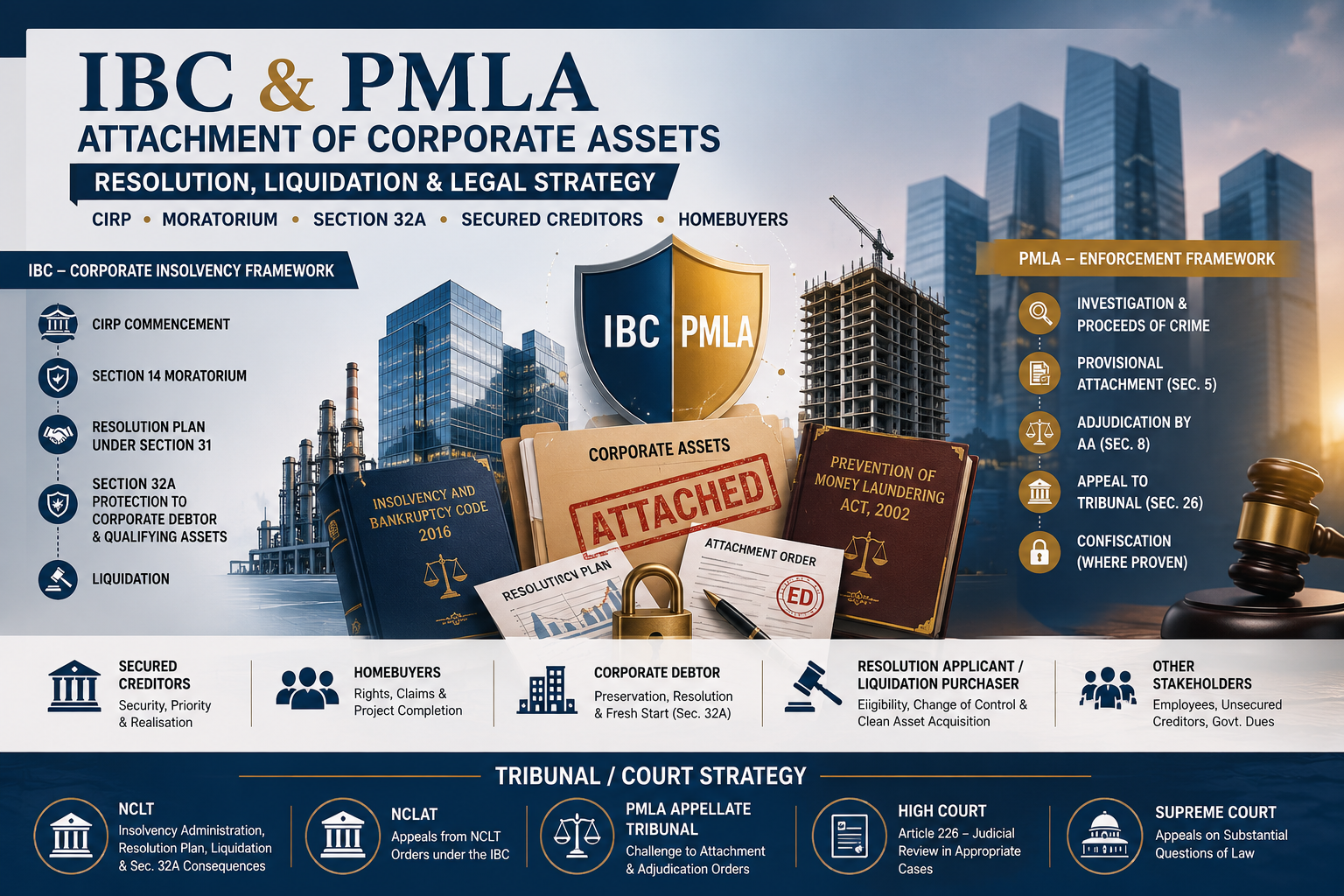
IBC Resolution, Liquidation and PMLA Attachment of Corporate Assets: CIRP, Moratorium, Section 32A, Secured Creditors, Homebuyers and Tribunal Strategy
Updated: 9 August 2026
When a company enters insolvency proceedings under the Insolvency and Bankruptcy Code, 2016 (“IBC”) while its land, factories, accounts, receivables, project assets or other properties are already attached by the Enforcement Directorate (“ED”) under the Prevention of Money Laundering Act, 2002 (“PMLA”), a difficult statutory conflict arises.
The IBC seeks to preserve enterprise value, reorganise a viable corporate debtor and maximise recovery through a collective insolvency process. The PMLA, on the other hand, allows attachment and eventual confiscation of property alleged to constitute or represent proceeds of crime.
The correct question is therefore not simply whether the IBC “overrides” PMLA or whether PMLA always prevails over the insolvency process.
The result depends heavily upon the stage of CIRP, stage of PMLA attachment, ownership and origin of the property, approval of the resolution plan, change of management, Section 32A conditions and, where liquidation begins, the identity of the purchaser.
This guide by Advocate Ankit Kumar Singh explains that interaction step-by-step.
1. Why IBC and PMLA Collide
The IBC and PMLA operate for different statutory purposes.
The IBC primarily deals with:
- corporate insolvency resolution;
- preservation of the corporate debtor as a going concern;
- maximisation of asset value;
- collective treatment of creditors;
- resolution plans;
- liquidation where resolution fails; and
- distribution according to the statutory waterfall.
The PMLA primarily concerns:
- investigation of money laundering;
- identification of proceeds of crime;
- provisional attachment;
- adjudication of attachment;
- retention or possession according to law;
- prosecution; and
- confiscation where statutory conditions are eventually established.
This distinction is crucial because ED is ordinarily not acting merely as another creditor attempting to recover a debt.
It asserts that the property itself has a statutory connection with alleged criminal proceeds.
2. CIRP Timeline: Understand the Stage Before Choosing the Remedy
A simplified Corporate Insolvency Resolution Process (“CIRP”) may be understood as:
Default → IBC Application → Admission by NCLT → CIRP Commencement → Section 14 Moratorium → IRP/RP → Claims → Committee of Creditors → Resolution Applicants → Resolution Plan → CoC Approval → NCLT Approval under Section 31 → Implementation
If resolution fails:
CIRP → Liquidation Order → Liquidator → Liquidation Estate → Asset Realisation → Distribution → Dissolution
An ED attachment may arise before CIRP, during CIRP, after submission of the resolution plan or before liquidation.
The legal strategy must therefore begin with a complete chronology.
3. Section 14 Moratorium: What Does It Do?
Once CIRP commences, Section 14 of the IBC provides a moratorium against specified proceedings and enforcement actions involving the corporate debtor.
Its commercial purpose is to prevent individual enforcement from dismantling the company while collective resolution is being attempted.
Without such protection, creditors could seize individual properties, leaving no functioning enterprise to resolve.
However, counsel should be cautious about stating that every ED action automatically becomes void merely because Section 14 has commenced.
PMLA attachment is exercised under a criminal and anti-money-laundering statutory framework and has been treated by courts and tribunals differently from ordinary debt recovery or contractual enforcement.
4. The First Question: What Stage Has the PMLA Attachment Reached?
A practitioner should separately identify whether the property is subject to:
- a provisional attachment order;
- pending confirmation proceedings;
- a confirmed attachment;
- possession or retention proceedings;
- a pending PMLA appellate challenge;
- confiscation proceedings; or
- a final order.
These stages cannot automatically be treated as legally identical.
The required relief may therefore be:
- setting aside attachment;
- de-freezing a bank account;
- release of corporate property;
- protection pending appeal;
- permission to implement a resolution plan;
- recognition of Section 32A protection; or
- protection of a bona fide purchaser.
5. Section 14 and Section 32A Are Not the Same
One of the most common mistakes in IBC–PMLA litigation is treating Section 14 and Section 32A as though they provide identical protection.
They do not.
Section 14 operates as the CIRP moratorium.
Section 32A addresses liability for pre-CIRP offences and protection of qualifying corporate property after its statutory requirements are satisfied.
Therefore, a case where CIRP has merely started must be analysed differently from a case where an independent resolution applicant has already taken control under an approved resolution plan.
6. Section 32A: The Major Turning Point
Section 32A was enacted to enable a genuine corporate debtor to obtain a fresh start where control passes to an independent and eligible person while preserving proceedings against those responsible for earlier criminal conduct.
The policy can broadly be understood as:
Save the viable enterprise.
Protect genuine new ownership.
Continue against the alleged wrongdoers.
7. Section 32A(1): Corporate Liability After a Qualifying Resolution
Subject to its statutory conditions, Section 32A may cause the corporate debtor's liability for an offence committed before CIRP to cease after approval of a qualifying resolution plan resulting in the required change in management or control.
But this does not mean former promoters, directors, officers or other individuals allegedly involved in the wrongdoing automatically obtain immunity.
Their personal criminal liability can continue in accordance with law.
8. Section 32A(2): Why It Matters for PMLA Attachment
Section 32A(2) is especially important for attached corporate assets.
Where its requirements are fulfilled, the provision protects qualifying corporate-debtor property against action relating to an offence committed before commencement of CIRP.
The statutory framework expressly brings within the concept of action against property matters such as:
- attachment;
- seizure;
- retention; and
- confiscation.
This is why Section 32A can become central once a qualifying resolution plan has been approved.
9. Section 32A Is Not Automatic on the First Day of CIRP
A company cannot simply say:
“CIRP has started, therefore Section 32A protects all assets.”
The statutory conditions must exist.
Counsel should investigate:
- whether the alleged offence predates CIRP;
- whether the property belongs to the corporate debtor;
- whether the resolution plan has been approved under Section 31;
- whether control has genuinely changed;
- whether the successful resolution applicant is connected with prior management;
- whether any disqualifying relationship exists; and
- whether investigation material links the new acquirer with the alleged offence.
10. What Changes After Section 31 Approval?
After NCLT approves the resolution plan, counsel should immediately ask:
- Was the alleged offence committed before CIRP?
- Is the attached property owned by the corporate debtor?
- Is the property included within the approved resolution structure?
- Has management or control genuinely changed?
- Does the successful resolution applicant satisfy Section 32A?
Where the statutory requirements are fulfilled, Section 32A becomes a significantly stronger basis for challenging continued attachment than an abstract Section 14 argument.
11. Why a Successful Resolution Applicant Needs Clean Corporate Assets
The commercial logic of resolution requires an incoming investor to receive a viable enterprise.
Suppose the resolution applicant values:
- factory land;
- plant and machinery;
- project property;
- operating bank accounts;
- receivables;
- licenses;
- inventory; and
- other essential corporate assets.
If these assets remain indefinitely unavailable because of alleged wrongdoing by former management, the commercial foundation of the resolution may collapse.
Section 32A therefore attempts to distinguish the future economic life of a rescued company from the personal liability of those allegedly responsible for its historical criminal conduct.
12. Important Judicial Approach: Post-Resolution Protection Is Different From CIRP Moratorium
Authorities dealing with Section 32A demonstrate why procedural stage matters.
For example, judicial decisions concerning attachment after approval of a resolution plan must not automatically be treated as though they decide every dispute arising during the earlier CIRP stage.
A proper pleading should therefore distinguish:
Before resolution plan approval:
- Section 14;
- PMLA appellate remedies;
- ownership;
- money trail;
- preservation of going-concern value;
- NCLT jurisdiction; and
- appropriate interim relief.
After qualifying Section 31 approval:
- Section 32A;
- new management/control;
- property protection;
- implementation of the approved plan; and
- consequential release of eligible corporate assets.
13. What Happens if CIRP Fails and Liquidation Starts?
If no resolution succeeds, liquidation may commence under the IBC.
The basic sequence becomes:
Liquidation Order → Liquidator → Identification of Liquidation Estate → Valuation → Sale / Realisation → Distribution → Dissolution
But an existing PMLA attachment may obstruct the liquidator's ability to sell an asset.
The liquidator should never assume that every asset appearing in the corporate debtor's balance sheet is immediately available for an unencumbered sale.
14. Section 32A and Sale of Liquidation Assets
Section 32A also addresses qualifying sales of liquidation assets.
Therefore, its property-protection architecture is not restricted only to successful resolution plans.
However, liquidation does not automatically cleanse every asset.
The purchaser must satisfy the applicable statutory requirements.
Before auctioning an ED-attached asset, the liquidator should investigate:
- ownership;
- PMLA attachment status;
- security interest;
- source of acquisition funds;
- proposed buyer;
- beneficial ownership;
- connection with former promoters; and
- Section 32A eligibility.
15. Liquidation Estate: Is the Property Really the Corporate Debtor's?
The first liquidation question is not priority.
It is ownership.
Counsel should determine:
- who holds legal title;
- who paid the purchase consideration;
- whether property is merely held for another person;
- whether a trust relationship exists;
- whether the corporate debtor is only a developer;
- whether another group company owns the asset;
- whether the property is mortgaged; and
- whether the asset can legally form part of the liquidation estate.
16. Secured Creditors: Does a Mortgage Automatically Defeat ED?
No.
A bank or financial institution should not rely merely upon the statement that it holds a mortgage.
A stronger case is built around:
Title + Security + Money Trail + Chronology.
The secured creditor should identify:
- date of acquisition of the property;
- source of acquisition funds;
- date of loan sanction;
- date of disbursement;
- date of mortgage;
- CERSAI/ROC registration;
- period of the alleged criminal activity;
- date alleged proceeds of crime were generated;
- date of ED attachment;
- date of confirmation;
- CIRP commencement date; and
- resolution or liquidation stage.
17. Secured Creditor Strategy in Liquidation
A secured creditor must analyse its rights under the liquidation framework while simultaneously confronting any PMLA restriction.
Depending upon the facts, the strategy may include:
- participating in liquidation;
- relinquishing security;
- realising security where legally permissible;
- challenging attachment;
- appearing before PMLA authorities;
- seeking recognition of bona fide pre-existing security;
- supporting a Section 32A-compliant sale; or
- seeking constitutional relief where warranted.
18. Homebuyers: Why Real-Estate Insolvency Is Different
Homebuyers may face severe consequences where ED attaches:
- project land;
- unsold flats;
- commercial portions;
- project bank accounts;
- receivables;
- development rights; or
- other assets necessary to complete construction.
For many homebuyers, the preferred outcome may not be a small liquidation distribution.
They may instead want:
completion of construction + possession + conveyance of their unit.
19. Homebuyer Rights Must Be Analysed Unit-by-Unit
Counsel should distinguish:
- already registered units;
- fully paid allotted units;
- partly paid units;
- completed but unregistered flats;
- unsold inventory;
- mortgaged units;
- project land;
- promoter-owned personal property; and
- development rights.
These assets do not necessarily have identical legal treatment.
20. Homebuyer Evidence Matrix
Each affected homebuyer should organise:
Allotment Letter → Builder-Buyer Agreement → Payment Receipts → Bank Trail → RERA Records → Unit Identification → Construction Status → Possession Status → Registration Status → Mortgage Position → ED Attachment Schedule → IBC Claim
This helps determine whether the buyer's primary claim concerns:
- creditor status;
- ownership;
- possession;
- completion;
- release from attachment;
- restitution; or
- a combination of remedies.
21. Can ED Continue Against Former Promoters?
Yes.
Section 32A should not be confused with personal immunity for alleged wrongdoers.
Former promoters, directors, officers and other persons allegedly involved in the offence may continue to face investigation, summons, prosecution or proceedings concerning their own property according to law.
Corporate rehabilitation does not automatically amount to personal absolution.
22. Which Forum Should Be Approached?
An IBC–PMLA matter may potentially involve:
- NCLT;
- NCLAT;
- PMLA Adjudicating Authority;
- PMLA Appellate Tribunal;
- High Court; and
- Supreme Court.
The correct forum depends upon the exact order and relief.
23. When NCLT Is Relevant
NCLT may become relevant for matters genuinely arising from insolvency or liquidation, including:
- implementation of a resolution plan;
- corporate-debtor asset treatment;
- Section 32A consequences;
- directions to the Resolution Professional;
- liquidation administration;
- questions concerning the liquidation estate; and
- other issues arising directly from CIRP.
However, insolvency jurisdiction should not automatically be treated as an unlimited appellate jurisdiction over every PMLA order.
24. NCLT Jurisdiction and Public-Law Limits
The Supreme Court's jurisprudence concerning NCLT jurisdiction makes it important to distinguish insolvency questions from independent public-law decisions taken by statutory authorities.
Counsel should ask:
Are we asking NCLT to administer the insolvency process?
or:
Are we asking NCLT to judicially review or set aside an independent PMLA decision?
The answer may determine the forum.
25. When the PMLA Appellate Tribunal Becomes Important
Where an attachment has been confirmed under the PMLA and the affected person seeks substantive reversal of that order, the statutory appellate framework becomes highly relevant.
A proper PMLA challenge should not rely exclusively on CIRP.
It should independently examine:
- whether property constitutes proceeds of crime;
- scheduled-offence nexus;
- ownership;
- acquisition money trail;
- valuation;
- tracing;
- bona fide third-party rights;
- pre-existing security;
- IBC chronology; and
- subsequent Section 32A developments.
26. When Article 226 Writ Jurisdiction May Be Considered
A High Court writ petition may become relevant where recognised judicial-review grounds exist, including in an appropriate case:
- jurisdictional error;
- patent lack of authority;
- breach of natural justice;
- failure to recognise an operative statutory protection;
- extraordinary urgency threatening implementation of an approved resolution plan;
- manifest procedural illegality; or
- absence of an efficacious alternative remedy in the particular circumstances.
However, the existence of an alternate statutory remedy must be directly addressed.
27. Alternate Remedy: The Question Every Writ Petition Must Answer
Where a PMLA appellate remedy exists, the High Court may ask:
Why should Article 226 jurisdiction be exercised?
The petition should therefore clearly plead the recognised reason for constitutional intervention rather than merely bypassing the Tribunal.
28. Strategy While CIRP Is Still Pending
Before approval of a resolution plan, counsel should ordinarily focus on:
- preserving going-concern value;
- mapping all attached assets;
- challenging attachment on PMLA merits where available;
- protecting ownership and possession;
- disclosing litigation risk to resolution applicants;
- pursuing appropriate statutory appeals;
- seeking insolvency directions where maintainable; and
- preparing for Section 32A consequences if a plan is ultimately approved.
29. Strategy Immediately After Resolution Plan Approval
Prepare a dedicated Section 32A dossier containing:
- CIRP admission order;
- Section 31 approval order;
- approved resolution plan;
- CoC approval records;
- successful resolution applicant's ownership information;
- Section 29A material;
- change-of-control records;
- new management details;
- ED attachment orders;
- PMLA adjudication orders;
- proof of corporate ownership of attached assets;
- proof that the alleged offence predates CIRP; and
- implementation documents.
30. Strategy During Liquidation
Prepare an asset-by-asset chart containing:
| Issue | Question |
|---|---|
| Ownership | Who legally owns the property? |
| PMLA | What is the present attachment stage? |
| Security | Is there a valid contractual mortgage or charge? |
| Liquidation | Does it form part of the liquidation estate? |
| Buyer | Who proposes to acquire the asset? |
| Section 32A | Does the purchaser qualify? |
| Litigation | What proceedings remain pending? |
| Relief | What order is required for usable title? |
31. Master Decision Tree
Is the asset attached by ED?
↓
Has CIRP commenced?
↓
Has the attachment been confirmed under PMLA?
↓
Has NCLT approved a resolution plan under Section 31?
↓
If No: analyse Section 14 + PMLA merits + jurisdiction + statutory appeal + interim protection.
If Yes: test Section 32A.
↓
Check:
- pre-CIRP offence;
- corporate ownership;
- approved plan;
- change in control;
- eligibility of new management.
↓
If satisfied: Section 32A property protection becomes central.
32. Separate Liquidation Decision Tree
Liquidation Order → Identify Liquidation Estate → Check ED Attachment → Check Security Interest → Establish Ownership and Money Trail → Identify Purchaser → Test Section 32A Eligibility → Obtain Necessary Orders → Complete Sale → Distribute According to the IBC
33. Ten Common Mistakes
- Assuming Section 14 automatically cancels every ED attachment.
- Treating Section 14 and Section 32A as identical.
- Ignoring whether attachment has already been confirmed.
- Ignoring PMLA statutory appellate remedies.
- Invoking Section 32A before its conditions exist.
- Failing to investigate connections between new purchaser and old promoters.
- Assuming every corporate asset forms part of the liquidation estate.
- Assuming a bank mortgage automatically defeats PMLA.
- Treating every homebuyer and every project asset identically.
- Choosing a forum before identifying the exact relief required.
34. The Most Important Working Document: A Chronology
Prepare:
Scheduled Offence → Alleged Proceeds of Crime → Property Acquisition → Mortgage → FIR / Charge-Sheet → ED Investigation → Provisional Attachment → Confirmation → IBC Application → CIRP Admission → Moratorium → Resolution Plan → Section 31 Approval → Change of Control → Section 32A → Liquidation, if any → Asset Sale
35. Documents to Collect
- CIRP admission order;
- Section 14 moratorium order;
- public announcement;
- information memorandum;
- CoC records;
- resolution plan;
- Section 31 approval order;
- liquidation order;
- liquidation-estate records;
- title deeds;
- bank statements;
- mortgage documents;
- CERSAI records;
- ROC charges;
- valuation reports;
- provisional attachment order;
- PMLA complaint;
- Adjudicating Authority order;
- scheduled-offence FIR;
- charge-sheet;
- prosecution complaint where available;
- resolution applicant eligibility documents;
- beneficial ownership records;
- homebuyer agreements;
- RERA records;
- payment receipts;
- possession documents; and
- pending appellate orders.
36. Important Statutory Provisions
IBC
- Section 7
- Section 9
- Section 10
- Section 12
- Section 14
- Section 29A
- Section 30
- Section 31
- Section 32A
- Section 33
- Section 35
- Section 36
- Section 52
- Section 53
- Section 60
- Section 61
- Section 62
- Section 238
PMLA
- Section 2(1)(u)
- Section 3
- Section 5
- Section 8
- Section 26
- Section 42
- Section 71
37. Important Judicial Authorities
Depending upon the facts, counsel should study:
- Manish Kumar v. Union of India – Section 32A and corporate fresh-start principles.
- Ghanshyam Mishra & Sons Pvt. Ltd. v. Edelweiss Asset Reconstruction Co. Ltd. – approved resolution plan and clean-slate consequences.
- Embassy Property Developments Pvt. Ltd. v. State of Karnataka – limits of NCLT jurisdiction in public-law disputes.
- Shiv Charan v. Adjudicating Authority under PMLA – attachment and Section 32A after resolution.
- Bhushan Power and Steel / JSW Steel litigation – corporate resolution, ED proceedings and treatment of corporate assets.
Each authority must be applied according to its exact procedural stage and facts.
38. Frequently Asked Questions
Does CIRP automatically cancel an ED attachment?
No. The stage and nature of the PMLA proceedings must be examined.
Does Section 14 automatically prohibit every PMLA action?
The interaction is more complex than ordinary creditor enforcement and should be analysed against current precedent.
When does Section 32A become most important?
After the statutory conditions associated with a qualifying resolution or liquidation sale are fulfilled.
Can old promoters still be prosecuted?
Yes. Protection of a qualifying corporate debtor does not automatically extinguish individual criminal liability.
Does a bank mortgage automatically defeat ED?
No. Ownership, money trail, acquisition date, security creation and alleged proceeds-of-crime nexus should be examined.
Can ED-attached assets be sold in liquidation?
The attachment status, title, purchaser eligibility and Section 32A framework must be examined before assuming that clean title can be conveyed.
What happens when project land is attached and homebuyers are involved?
Project completion, individual allotment rights, creditor claims, ownership, mortgage and PMLA attachment must be analysed together.
NCLT or PMLA Appellate Tribunal?
The forum depends upon whether the dispute concerns insolvency administration or substantive challenge to a PMLA order.
Can the High Court be approached?
Yes, in an appropriate case satisfying recognised grounds for Article 226 intervention, while addressing the statutory alternative remedy.
39. Final Litigation Principle
The strongest IBC–PMLA case is rarely built by asking:
“Which statute overrides the other?”
The more useful questions are:
- What exactly is the property?
- Who owns it?
- When was it acquired?
- What was the source of funds?
- When was it mortgaged?
- When did the alleged offence occur?
- When did ED attach it?
- Has attachment been confirmed?
- When did CIRP begin?
- Has a resolution plan been approved?
- Has management genuinely changed?
- Does Section 32A apply?
- Has liquidation commenced?
- Who proposes to purchase the property?
- Which forum can grant the exact relief?
The correct strategy is therefore:
Title + Money Trail + Chronology + Statutory Stage + Correct Forum + Precise Relief.
Conclusion
IBC resolution, liquidation and PMLA attachment disputes require considerably more than a simple priority argument.
During CIRP, the practitioner must examine the Section 14 moratorium, PMLA attachment stage, ownership of assets and the limits of insolvency jurisdiction.
After approval of a qualifying resolution plan, Section 32A may fundamentally alter the legal position of the corporate debtor and its eligible property.
During liquidation, the liquidator must identify what truly belongs to the liquidation estate, investigate secured interests and PMLA restrictions and ensure that any purchaser satisfies the applicable statutory framework.
For secured creditors and homebuyers, the outcome frequently depends upon evidence concerning title, payment, security, project status and money trail rather than abstract assertions of priority.
A sophisticated IBC–PMLA strategy is therefore always asset-specific, chronology-specific and forum-specific.
About the Author
Advocate Ankit Kumar Singh advises and represents clients in matters involving the Prevention of Money Laundering Act (PMLA), Enforcement Directorate proceedings, white-collar and financial crime, corporate disputes and connected appellate and constitutional remedies.
Website: advocateankitkumarsingh.in
Email: ankitsingh.legum@gmail.com
Phone: 8294431232
Google Preferred Source
Add advocateankitkumarsingh.in as a Preferred Source on Google
Disclaimer: This article is intended solely for general legal information and educational purposes. IBC and PMLA disputes are highly fact-specific. The legal position may depend upon title, source of funds, stage of attachment, CIRP status, resolution-plan terms, change in management or control, liquidation stage, purchaser eligibility and judicial orders applicable to the particular matter. This article does not constitute legal advice for any specific proceeding.