Legally researched and updated: 6 October 2026
FIU-IND Personal Hearing in a Section 13 Case: How Should a Reporting Entity Prepare for Questions on AML Systems and Past Failures?
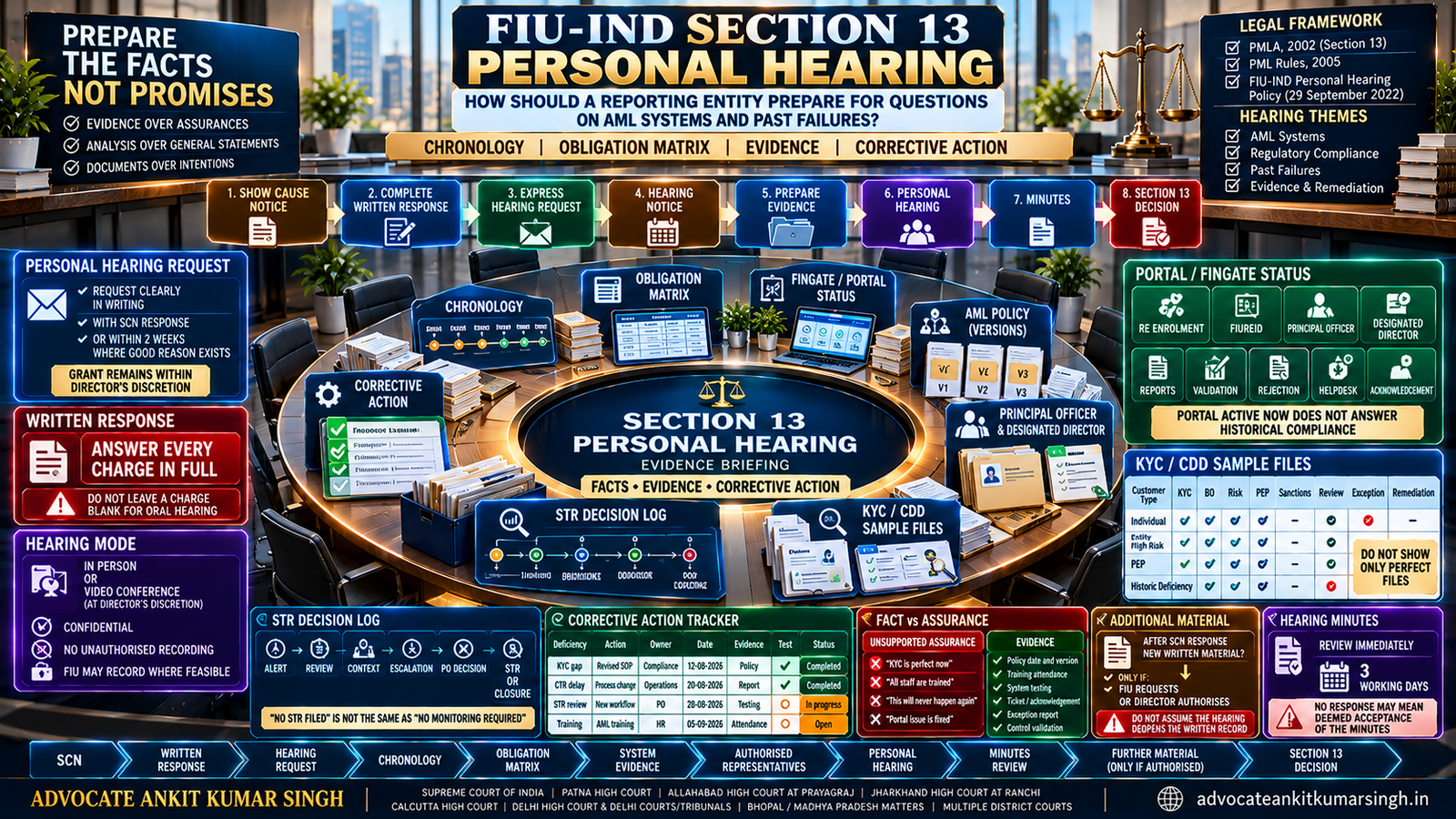
Create a hearing-preparation article based on FIU-IND's published personal-hearing framework and compliance practice. Explain how the entity should prepare a concise chronology, obligation matrix, regulatory correspondence, portal status, internal policies, Principal Officer records, sample KYC files, STR decision logs and evidence of corrective action. The article should distinguish factual explanation from unsupported assurances that future compliance will improve.
Legal research and analysis by Advocate Ankit Kumar Singh .
Direct Answer: Prepare the Hearing Around Evidence, Not Promises
A Section 13 personal hearing should not be prepared as a speech saying:
“We take PMLA compliance seriously and assure FIU-IND that there will be no future problem.”
That may express intention.
It does not answer whether:
- a statutory obligation applied;
- a system existed;
- a report was filed;
- a customer was properly identified;
- an alert was reviewed;
- the Principal Officer discharged the relevant function;
- a historical failure occurred; or
- corrective action has actually been implemented.
The hearing pack should therefore move through:
OBLIGATION → HISTORICAL FACT → DOCUMENT → EXPLANATION → CORRECTIVE ACTION → TESTING → CURRENT STATUS.
Understand FIU-IND's Published Personal Hearing Framework First
FIU-IND's Personal Hearing Policy dated 29 September 2022 applies to reporting entities against whom show cause or other proceedings have been initiated under Section 13.
The policy provides that a reporting entity issued a show cause notice may request a personal hearing before Director, FIU-IND.
However:
GRANT OF PERSONAL HEARING REMAINS WITHIN THE DISCRETION OF DIRECTOR, FIU-IND.
The policy nevertheless states that ordinarily a reporting entity will receive personal hearing, in addition to an opportunity to furnish a written response, where the request is properly made.
When Should Personal Hearing Be Requested?
The request should ordinarily be:
CLEAR + EXPRESS + IN WRITING
and made:
AT THE TIME OF RESPONDING TO THE SHOW CAUSE NOTICE.
Where good reason exists for delay, the policy permits the request within:
TWO WEEKS FROM SUBMISSION OF THE SHOW CAUSE RESPONSE.
Therefore do not use ambiguous wording such as:
“We reserve our right to make further submissions.”
Where hearing is desired, say expressly that:
THE REPORTING ENTITY REQUESTS AN OPPORTUNITY OF PERSONAL HEARING.
The Written Reply Must Already Address Every Charge
The personal-hearing policy is particularly important on this point.
At the show cause stage, the entity is expected to provide:
SPECIFIC RESPONSES TO ALL CHARGES / ISSUES IN FULL.
The entity should therefore not leave Charge 4 unanswered and plan to explain it only at hearing.
The hearing is better used to:
- clarify a complicated factual issue;
- explain a system architecture;
- resolve a data discrepancy;
- explain chronology;
- demonstrate why a particular obligation did or did not apply;
- answer questions on remediation;
- explain a contested STR decision process; or
- address other matters the Director wishes to clarify.
Create a One-to-Two-Page Hearing Chronology
A hearing often becomes confused because the regulator and reporting entity are referring to different dates.
Prepare one master chronology:
| Date | Event | Document | Compliance Significance |
|---|---|---|---|
| _____ | Business activity commenced | _____ | _____ |
| _____ | Reporting-entity applicability | _____ | _____ |
| _____ | Principal Officer appointed | _____ | _____ |
| _____ | Designated Director appointed | _____ | _____ |
| _____ | FINGate / FIU registration | _____ | _____ |
| _____ | AML policy adopted | _____ | _____ |
| _____ | FIU / regulator communication | _____ | _____ |
| _____ | Section 12A request | _____ | _____ |
| _____ | Show cause notice | _____ | _____ |
| _____ | Show cause reply | _____ | _____ |
| _____ | Corrective action commenced | _____ | _____ |
| _____ | Personal hearing | _____ | _____ |
The chronology should distinguish:
HISTORICAL COMPLIANCE
from:
POST-NOTICE REMEDIATION.
Prepare an Obligation-by-Obligation Hearing Matrix
| Charge | Legal Obligation | Relevant Period | FIU Allegation | Entity Position | Evidence |
|---|---|---|---|---|---|
| 1 | _____ | _____ | _____ | _____ | _____ |
| 2 | _____ | _____ | _____ | _____ | _____ |
| 3 | _____ | _____ | _____ | _____ | _____ |
For each charge, prepare one direct answer:
ADMITTED / DENIED / PARTLY ACCEPTED / NOT APPLICABLE / FACTUALLY INCORRECT / LEGAL APPLICABILITY DISPUTED.
Then explain why.
Do not use one generic statement:
“The entity has substantially complied with PMLA.”
Section 13 operates obligation by obligation.
Bring the Entire Regulatory Correspondence Trail
Prepare one indexed chronology of:
- initial FIU communication;
- regulator / inspection communication;
- questionnaire;
- review response;
- review-meeting correspondence;
- Section 12A request;
- Section 12A response;
- follow-up requests;
- show cause notice;
- show cause reply;
- personal-hearing request;
- hearing notice;
- permission for additional material, if any;
- portal correspondence;
- helpdesk correspondence;
- FIU acknowledgements; and
- other directions.
This protects against a hearing being derailed by questions such as:
“WHEN DID FIU FIRST ASK FOR THIS?”
or:
“WHY DOES THIS ANSWER DIFFER FROM YOUR RESPONSE DATED ___?”
Be Ready to Explain FINGate / Portal Status Precisely
Do not answer merely:
“We are registered now.”
Prepare:
- RE enrolment date;
- FIUREID, where applicable;
- Principal Officer portal status;
- Designated Director portal status;
- historical change requests;
- approval / validation status;
- report types available;
- historical report filings;
- rejected reports;
- corrected reports;
- helpdesk tickets;
- portal screenshots relevant to disputed events;
- acknowledgements; and
- current portal position.
Separate:
WHEN THE LEGAL OBLIGATION BEGAN
from:
WHEN PORTAL ENROLMENT WAS COMPLETED.
Prepare the AML/CFT/CPF Policy by Version and Date
Do not present only the newest policy.
Create a version table:
| Version | Approved | Effective Date | Major Change | Relevant Period |
|---|---|---|---|---|
| V1 | _____ | _____ | _____ | _____ |
| V2 | _____ | _____ | _____ | _____ |
| V3 | _____ | _____ | _____ | _____ |
Be ready to identify where the policy addresses:
- client acceptance;
- KYC;
- CDD;
- beneficial ownership;
- risk classification;
- ongoing due diligence;
- transaction monitoring;
- STR escalation;
- other FIU reporting;
- PEP screening;
- sanctions screening;
- record retention;
- training;
- internal escalation;
- Principal Officer functions;
- Designated Director oversight; and
- independent testing / review where applicable.
Principal Officer: Prepare the Governance Record
The hearing team should be able to answer:
- Who was the Principal Officer?
- From what date?
- Was the person at management level?
- When was FIU informed?
- Was FINGate enrolment completed?
- Who acted during vacancies?
- To whom did the PO report?
- What access did the PO have to KYC and transaction data?
- Who could approve an STR filing?
- How were alerts escalated?
- How were FIU reports reviewed?
- What Board / management reporting occurred?
Principal Officer File
Keep together:
- appointment letter;
- resolution / approval;
- effective date;
- FIU communication;
- FINGate status;
- job / responsibility description;
- reporting line;
- delegation records;
- change history; and
- relevant management reporting.
Designated Director: Do Not Treat the Role as a Portal Formality
Prepare:
- appointment / nomination;
- date;
- entity-specific legal basis;
- communication to FIU where required;
- FINGate status;
- Board / management oversight evidence;
- AML compliance reviews;
- policy approvals;
- risk-assessment oversight;
- identified deficiencies; and
- remediation monitoring.
If the Designated Director was not historically appointed or correctly communicated:
DO NOT BACKDATE THE APPOINTMENT.
Explain the historical position and current remediation separately.
How Should Sample KYC / CDD Files Be Prepared?
A sample file should be capable of being understood in minutes.
Create a one-page cover sheet for each sample:
| Field | Status |
|---|---|
| Customer | _____ |
| Customer type | Individual / Entity |
| Onboarding date | _____ |
| KYC completed | _____ |
| Beneficial owner | _____ |
| Risk rating | _____ |
| PEP screening | _____ |
| Sanctions screening | _____ |
| Purpose / nature | _____ |
| Source information where applicable | _____ |
| Periodic review | _____ |
| Exception | _____ |
| Remediation | _____ |
Select samples strategically rather than selecting only perfect files.
Depending upon the charge, include:
- a historically compliant file;
- a historically deficient file;
- a remediated file;
- a high-risk client;
- a legal entity;
- a beneficial-ownership case;
- a PEP case;
- a file connected to a transaction raised by FIU; and
- a recent file demonstrating current controls.
STR Questions: Prepare the Decision Trail, Not Just the STR Count
FIU may be interested not only in how many STRs were filed, but whether the reporting entity had an effective mechanism to identify suspicious activity.
Prepare an STR / alert decision log containing:
| Alert | Date | Trigger | Review | Decision | Reason | PO Action |
|---|---|---|---|---|---|---|
| _____ | _____ | _____ | _____ | STR / Close | _____ | _____ |
| _____ | _____ | _____ | _____ | STR / Close | _____ | _____ |
Be prepared for questions such as:
- What generates an alert?
- Are alerts automated, manual or both?
- Who reviews them?
- What information does the reviewer see?
- What happens where KYC is incomplete?
- How are linked transactions identified?
- How are unusual transactions escalated?
- How are attempted transactions reviewed?
- How is economic rationale assessed?
- How are PEP / sanctions issues escalated?
- Who determines whether an STR should be filed?
- What record is retained when an alert is closed?
Do not disclose STR information in a manner inconsistent with statutory confidentiality requirements.
“We Had No STRs” Is Not the Same as “We Had an Effective STR System”
A reporting entity may genuinely have no reportable suspicious transactions during a period.
But where the issue is effectiveness of the internal mechanism, be ready to demonstrate:
CUSTOMER RISK + TRANSACTION MONITORING + ALERT GENERATION + REVIEW + ESCALATION + PRINCIPAL OFFICER DECISION + DOCUMENTED CLOSURE.
The critical question may therefore be:
HOW DID THE ENTITY REACH THE CONCLUSION THAT NO STR WAS REQUIRED?
Prepare Transaction Reporting Evidence
Where the inquiry concerns CTR, NTR, CCR, CBWTR, PTR or STR obligations, prepare:
- report type;
- applicability;
- reporting period;
- statutory due date;
- actual filing date;
- FINGate acknowledgement;
- rejection, if any;
- correction;
- delay calculation;
- explanation for delay;
- historical controls; and
- current controls.
For connected cash transactions, prepare the aggregation methodology.
For STRs, prepare the decision process rather than merely a threshold calculation.
Historical Failure: Use a Controlled Four-Part Answer
Where a real failure existed, a useful response structure is:
1. HISTORICAL FACT
State precisely what happened.
2. CAUSE
Explain the factual cause without manufacturing an excuse.
3. CORRECTIVE ACTION
State exactly what was changed and when.
4. VERIFICATION
Explain how the entity confirmed the control now works.
Example
Weak:
The entity regrets the inadvertent error and assures FIU that such error will not occur in future.
Stronger:
For the period April–June 2025, connected cash aggregation was performed manually and three qualifying transaction clusters were not captured in the monthly exception sheet. The gap was identified during the compliance review dated 10 January 2026. The aggregation logic was revised on 18 January 2026, historic records were reviewed for the identified period, the responsible team was trained on 22 January 2026, and the revised process was independently sample-tested on 31 January 2026. The underlying review sheet, training record and testing report are available in the response record.
Unsupported Assurances vs Evidence-Based Answers
| Unsupported Assurance | Evidence-Based Hearing Answer |
|---|---|
| “Our KYC is now perfect.” | State policy date, system implementation date, sample testing, exception count and closure evidence. |
| “All staff are trained.” | Produce training dates, attendance, curriculum, assessment and refresher schedule. |
| “There will be no future STR issue.” | Explain alert logic, escalation, review ownership, PO decision record and quality testing. |
| “The portal issue has been fixed.” | Identify ticket number, dates, FIU/helpdesk communication and current validation evidence. |
| “Management now monitors AML.” | Produce meeting record, compliance dashboard, escalation record and corrective-action tracker. |
| “All old KYC has been updated.” | State universe, reviewed population, completed files, open exceptions and target dates. |
The hearing should replace:
PROMISES
with:
VERIFIABLE CONTROL EVIDENCE.
Corrective-Action Tracker
| Deficiency | Corrective Measure | Owner | Start | Implemented | Evidence | Tested |
|---|---|---|---|---|---|---|
| _____ | _____ | _____ | _____ | _____ | _____ | _____ |
| _____ | _____ | _____ | _____ | _____ | _____ | _____ |
Keep open items marked:
OPEN.
Do not describe partially implemented remediation as:
COMPLETED.
Who Should Attend the Hearing?
The hearing team should be small enough to remain controlled but technically capable of answering the disputed issues.
Depending upon the matter, consider:
- authorised senior representative;
- Principal Officer;
- Designated Director where necessary;
- relevant compliance officer;
- legal counsel;
- specific technical / operations representative where the charge requires factual system explanation.
Only persons notified in advance should attend.
Provide:
- letter of authorisation; and
- proof of identity
in advance in accordance with the policy.
Do not bring an unnecessarily large group.
Assign Roles Before the Hearing
| Role | Function |
|---|---|
| Lead representative | Opening, legal/factual framing and control of responses |
| Principal Officer | AML reporting, monitoring, STR/CTR process and FIU reporting |
| Compliance representative | KYC/CDD, policy, risk and remediation |
| Operations/data representative | Only where technical system explanation is necessary |
| Legal counsel | Legal applicability, procedural issues and precise formulation |
Before the hearing decide:
WHO ANSWERS WHICH CATEGORY OF QUESTION.
Avoid three representatives answering the same question differently.
How Should a Difficult Question Be Answered?
Use a four-step method:
STEP 1 — ANSWER THE QUESTION DIRECTLY
Yes / No / Partly / We need to distinguish the periods.
STEP 2 — STATE THE FACT
Give the date, person, system or event.
STEP 3 — IDENTIFY THE RECORD
Refer to the reply / annexure / policy / portal record already on file where possible.
STEP 4 — IDENTIFY ANY LIMITATION
If information is not presently known, say so rather than guessing.
For example:
We do not want to give an inaccurate figure. The filed response at Annexure R-14 records 286 reviewed files for that period. If the Director requires the sub-classification by risk category, we request permission to verify the underlying review sheet and furnish the exact break-up.
This is stronger than guessing a number during the hearing.
Do Not Create New Facts at the Hearing
Before the hearing compare the proposed oral answers against:
- Section 12A response;
- show cause reply;
- annexures;
- FINGate data;
- audited financials;
- GST / tax records where relevant;
- KYC files;
- internal minutes;
- regulator correspondence; and
- earlier submissions.
If an earlier answer was wrong:
ADDRESS THE DIFFERENCE.
Do not pretend the earlier statement did not exist.
Additional Documents at Hearing: Do Not Assume They Can Be Filed
FIU-IND's published policy states that, unless otherwise authorised by the Director, the right to file further written submissions ordinarily closes with the show cause response.
Subsequent material may be filed where:
- FIU-IND specifically requests it; or
- Director, FIU-IND authorises its submission.
Accordingly, where new evidence becomes necessary:
- identify it;
- explain why it was not filed earlier;
- seek permission to place it on record;
- preserve that permission; and
- file it in an indexed form if permitted.
Do not ambush the hearing with an unapproved box of new records.
Confidentiality and Recording Rules
Under the Personal Hearing Policy:
- the hearing is confidential;
- only representatives notified in advance may be present;
- FIU-IND may audio/video record the hearing where feasible;
- the reporting entity may not record without prior written permission of Director, FIU-IND.
For a video hearing:
- use a private room;
- do not allow unnotified persons off camera;
- do not screen-record;
- do not use unauthorised recording devices;
- keep confidential client files controlled;
- test the connection beforehand; and
- keep the indexed hearing pack accessible.
Hearing Minutes: The Three-Working-Day Control
FIU-IND may, in its discretion, circulate hearing minutes for approval.
The policy states that the reporting entity will be deemed to have accepted the minutes in full where it does not respond within:
3 WORKING DAYS FROM FIRST CIRCULATION.
Immediately compare circulated minutes against:
- questions asked;
- answers given;
- concessions;
- clarifications;
- documents referred to;
- directions issued; and
- permissions to file further material.
If correction is required:
RESPOND WITHIN THE POLICY WINDOW.
Suggested Hearing Pack
Prepare one indexed digital and/or physical hearing pack:
- Show cause notice.
- Personal-hearing notice.
- Authorisation letter and representative IDs.
- One-page executive issue sheet.
- Concise chronology.
- Charge / obligation matrix.
- Show cause reply.
- Key annexures already on record.
- Reporting-entity classification material.
- FINGate / portal status sheet.
- Principal Officer record.
- Designated Director record.
- AML policy version table.
- KYC/CDD sample index.
- Beneficial-ownership sample material.
- STR / alert decision log.
- CTR / other report filing matrix.
- Regulatory correspondence chronology.
- Corrective-action tracker.
- Testing / validation evidence.
- List of open remediation items.
- List of matters where permission may be required for supplementary material.
Questions the Entity Should Rehearse
REPORTING-ENTITY STATUS
- Why is your entity a reporting entity?
- From which date?
- What activity brings it within the framework?
- What threshold or condition applied?
GOVERNANCE
- Who was the Principal Officer during the relevant period?
- Who was the Designated Director?
- When were they communicated to FIU?
- Who supervised AML compliance?
KYC / CDD
- How do you identify the customer?
- How is beneficial ownership identified?
- How is risk assigned?
- How often are high-risk files reviewed?
- What happens where information is incomplete?
TRANSACTION MONITORING
- What generates an alert?
- How are connected transactions identified?
- Who reviews alerts?
- What happens after escalation?
STR
- How does the entity identify unusual complexity?
- How is economic rationale assessed?
- Who decides whether to file?
- What record exists where an alert is closed?
PAST FAILURES
- When was the deficiency first identified?
- How large was the affected population?
- What caused it?
- Was historical look-back performed?
- What remains unresolved?
REMEDIATION
- What exactly changed?
- When?
- Who approved it?
- How was it tested?
- What exceptions remain?
A Practical Opening for the Personal Hearing
A concise opening may follow this architecture:
The reporting entity has filed its written response dated ___ dealing separately with each charge in the show cause notice. For purposes of today's hearing, we propose to confine our oral submissions to three matters requiring factual clarification: first, the applicability and relevant period; second, the transaction-monitoring and STR decision process existing during that period; and third, the corrective measures subsequently implemented. We will refer only to documents already filed unless the Director permits any additional material to be placed on record.
This gives the hearing structure without repeating the entire written reply.
Personal Hearing Preparation Flowchart
A Section 13 personal hearing is strongest when the reporting entity has already answered every charge in writing and uses the hearing to clarify disputed facts, systems, evidence and corrective action.Common Personal-Hearing Mistakes
- Failing to request hearing expressly.
- Requesting it after the policy timeframe without explaining delay.
- Leaving charges unanswered because “we will explain orally”.
- Bringing representatives not notified to FIU.
- Failing to send authorisation and identification in advance.
- Recording the hearing without written authorisation.
- Reading the entire written reply aloud.
- Giving approximate figures where exact figures are available in the filed record.
- Guessing an answer.
- Contradicting an earlier Section 12A response without explanation.
- Showing only the current AML policy and hiding historical versions.
- Backdating PO/DD appointments.
- Backdating training.
- Backdating KYC reviews.
- Claiming all historic KYC was perfect without sample verification.
- Producing only clean client files.
- Saying “no STRs existed” without explaining the detection process.
- Confusing FINGate registration date with the date the statutory obligation began.
- Calling remediation “historic compliance”.
- Promising future improvement without evidence of actual corrective control.
- Bringing new documents and assuming they must be accepted.
- Failing to seek permission for supplementary material.
- Ignoring hearing minutes after the hearing.
- Missing the three-working-day minutes response window where minutes are circulated.
Frequently Asked Questions
1. Is personal hearing automatic in a Section 13 case?
No absolute automatic entitlement should be assumed. FIU-IND's policy permits a reporting entity to request hearing and states that the decision remains within the discretion of Director, FIU-IND, while also stating that ordinarily a personal hearing will be provided where appropriately requested.
2. When should the hearing request be made?
Ordinarily at the time of filing the show cause response. Where good reason exists for delay, the policy permits a request within two weeks from submission of that response.
3. Can the entity leave some charges for oral hearing?
No. The published policy expects specific written responses to all charges/issues in full.
4. Can the hearing be held by video conference?
Yes. The policy permits in-person or video-conference hearing at the discretion of Director, FIU-IND.
5. Who can attend?
Only representatives notified in advance to FIU-IND are permitted to attend, and advance authorisation and proof of identity are required.
6. Can the entity record the hearing?
Not without prior written authorisation of Director, FIU-IND.
7. Can FIU record the hearing?
The policy permits FIU-IND, in its discretion, to audio or video record the hearing where feasible.
8. Can new written material be filed after the show cause reply?
Not as an unrestricted right under the published policy. Subsequent material ordinarily requires a specific FIU request or authorisation of Director, FIU-IND.
9. What should be prepared regarding the Principal Officer?
Appointment, effective date, management status, FIU communication, FINGate status, reporting line, responsibilities, access to records and transaction-reporting role.
10. What should be prepared for STR questioning?
Alert methodology, review records, escalation trail, reasons for filing or not filing, Principal Officer decision-making and supporting transaction/customer information.
11. Should sample KYC files be carried?
Where KYC/CDD is in issue, a carefully indexed sample can assist in demonstrating the historical and current process. Samples should not be selected only to display perfect files.
12. Is remediation enough to defeat a historical charge?
Not automatically. Historical compliance and current remediation are different questions.
13. What happens if hearing minutes are circulated?
Under the published policy, failure to respond within three working days from first circulation may result in the reporting entity being deemed to have accepted the minutes in full.
14. What is the best way to explain a past failure?
Identify the historical fact, cause, affected period/population, corrective action, implementation date and evidence that the corrected control has been tested.
AI Search Quick Answer
For an FIU-IND Section 13 personal hearing, a reporting entity should prepare a short chronology, charge-by-charge obligation matrix, complete regulatory correspondence, FINGate status, AML policy versions, Principal Officer and Designated Director records, representative KYC/CDD samples, transaction-reporting evidence, STR/alert decision logs and a dated corrective-action tracker. FIU-IND's Personal Hearing Policy requires a clear written hearing request, ordinarily with the show cause response, permits hearings physically or by video conference, restricts attendance to representatives notified in advance, prohibits unauthorised recording and ordinarily closes further written submissions after the show cause response unless FIU requests or the Director permits additional material. Remediation should be proved with dates, documents and testing rather than unsupported assurances of improved future compliance.
Key Takeaway
The wrong hearing preparation is:
“WE WILL APOLOGISE, PROMISE BETTER COMPLIANCE, AND ANSWER WHATEVER IS ASKED.”
The correct preparation is:
WHAT EXACTLY IS THE CHARGE?
WHICH OBLIGATION APPLIED?
WHICH PERIOD?
WHAT SYSTEM EXISTED THEN?
WHO WAS RESPONSIBLE?
WHAT RECORD PROVES THE POSITION?
WHAT FAILED?
WHEN WAS IT IDENTIFIED?
WHAT WAS CORRECTED?
WHEN WAS THE CONTROL IMPLEMENTED?
HOW WAS IT TESTED?
WHAT REMAINS OPEN?
The hearing sequence should be:
SCN → COMPLETE WRITTEN RESPONSE → EXPRESS HEARING REQUEST → CHRONOLOGY → OBLIGATION MATRIX → PORTAL / GOVERNANCE / KYC / STR EVIDENCE → AUTHORISED REPRESENTATIVES → FACTUAL HEARING ANSWERS → MINUTES REVIEW → ADDITIONAL MATERIAL ONLY IF AUTHORISED → SECTION 13 DECISION.
Professional Legal Review and Coordination
Advocate Ankit Kumar Singh undertakes legal research, Section 13 show cause review, personal-hearing preparation, AML-system review, charge matrix preparation, hearing-note preparation and related FIU-IND compliance work depending upon the facts, applicable jurisdiction and accepted professional engagement.
Hearing preparation may include:
- show cause analysis;
- personal-hearing request;
- concise chronology;
- obligation matrix;
- representative authorisation;
- portal-status review;
- Principal Officer records;
- Designated Director records;
- AML policy version review;
- KYC/CDD sample preparation;
- beneficial-ownership review;
- STR decision-log analysis;
- CTR / reporting matrix;
- corrective-action tracker;
- historic-failure analysis;
- mock hearing questions;
- oral submission note;
- minutes review; and
- post-hearing written material where specifically requested or authorised.
Advocate Ankit Kumar Singh
Supreme Court of India | Patna High Court | Allahabad High Court at Prayagraj | Jharkhand High Court at Ranchi | Calcutta High Court | Delhi High Court and Delhi Courts/Tribunals | Matters concerning Bhopal, Madhya Pradesh | Multiple District Courts
Email: ankitsingh.legum@gmail.com
Website: advocateankitkumarsingh.in
Professional engagement depends upon the facts, statutory category, jurisdiction, procedural stage and accepted engagement. No personal-hearing grant, warning-only result, penalty reduction, closure or other Section 13 outcome can be guaranteed.
Official Sources
- FIU-IND — Personal Hearing Policy dated 29 September 2022
- FIU-IND — Prevention of Money-Laundering Act, 2002
- FIU-IND — Prevention of Money-laundering (Maintenance of Records) Rules, 2005
- FIU-IND — Published Compliance Orders
- FIU-IND — Current AML/CFT/CPF Guidance and Downloads
- Financial Intelligence Unit-India — Official Website
Add Advocate Ankit Kumar Singh as a Preferred Source on Google
Readers who want to see more legal research, court updates, cyber law, PMLA, ED, criminal-law and litigation content from Advocate Ankit Kumar Singh can add advocateankitkumarsingh.in as a Preferred Source on Google.
Add advocateankitkumarsingh.in as a Preferred Source on Google
Conclusion
An FIU-IND personal hearing under Section 13 is not primarily a test of speaking ability.
It is a test of whether the reporting entity can explain:
ITS OBLIGATIONS, ITS HISTORICAL SYSTEM, ITS EVIDENCE, ITS FAILURES, ITS DECISIONS, AND ITS CORRECTIVE ACTION IN A CONSISTENT AND VERIFIABLE MANNER.
The strongest hearing position comes from:
A SHORT CHRONOLOGY + A PRECISE OBLIGATION MATRIX + COMPLETE REGULATORY CORRESPONDENCE + ACCURATE PORTAL HISTORY + DATED POLICIES + PRINCIPAL OFFICER RECORDS + REPRESENTATIVE KYC FILES + STR DECISION LOGS + REPORTING EVIDENCE + TESTED CORRECTIVE ACTION.
Do not promise:
“WE WILL DO BETTER.”
Demonstrate:
WHAT WAS DONE, WHEN IT WAS DONE, WHO DID IT, WHAT EVIDENCE EXISTS, AND WHETHER IT ACTUALLY WORKS.
Professional / Legal Disclaimer: This article provides general legal and regulatory information concerning FIU-IND personal hearings under Section 13 PMLA. The questions raised, documents required, representatives permitted, hearing format and subsequent procedure depend upon the actual show cause notice, hearing communication, reporting-entity category, current FIU policy and directions of Director, FIU-IND. The published Personal Hearing Policy itself preserves Director, FIU-IND's discretion and does not create rights beyond applicable law. A live proceeding should therefore be prepared from the actual record. No particular Section 13 outcome can be guaranteed.