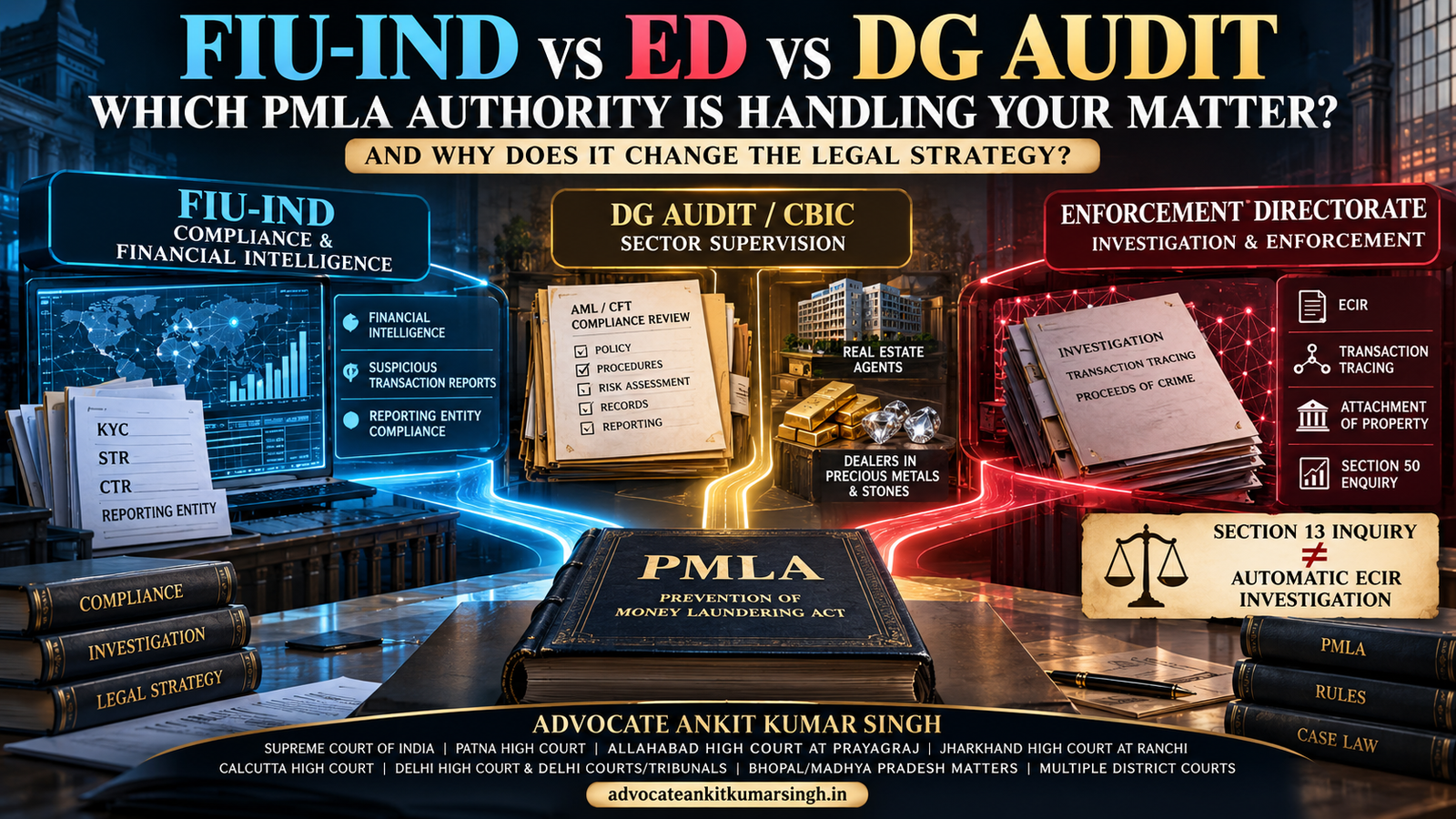
FIU-IND vs Enforcement Directorate vs DG Audit: Which Authority Is Handling My PMLA Matter and Why Does It Change the Legal Strategy?
SUMMARY: Build a foundational but non-generic authority-mapping article for clients who use 'ED notice', 'FIU notice' and 'DG Audit notice' interchangeably. Distinguish FIU-IND's financial-intelligence and reporting-entity compliance role, Enforcement Directorate's investigation and enforcement role, and CBIC/DG Audit's regulatory and supervisory role for specified sectors such as real estate agents and dealers in precious metals and stones. Explain why a Section 13 compliance inquiry is not automatically the same thing as an ECIR-based money-laundering investigation.
Legal update: Reviewed on 30 September 2026. FIU-IND, the Directorate of Enforcement and CBIC/DG Audit can all appear within India's AML/PMLA architecture, but they do not perform identical functions. The first legal task after receiving any communication is to identify the issuing authority, statutory provision, officer designation and exact stage of the proceeding.
 Advocate Ankit Kumar Singh
Direct Answer: FIU-IND, ED and DG Audit Are Not the Same Authority
A client may tell a lawyer:
“I have received an ED notice under PMLA.”
But the first page may actually show:
- Financial Intelligence Unit–India;
- Director, FIU-IND;
- Directorate of Enforcement;
- Assistant Director / Deputy Director, Enforcement Directorate;
- Directorate General of Audit, CBIC;
- Principal Additional Director General / Additional Director General, DG Audit;
- Central / State GST Audit formation; or
- another PMLA regulator.
Those distinctions are not cosmetic.
They determine:
- the statutory question being examined;
- what documents should be produced;
- whether the matter is compliance-oriented or investigative;
- whether criminal exposure is already being investigated;
- whether attachment or arrest powers may arise;
- which forum hears the next challenge; and
- what legal strategy should be adopted immediately.
The Simplest Authority Map
| Authority | Primary PMLA Function | Typical Immediate Question |
|---|---|---|
| FIU-IND | Financial intelligence + reporting-entity compliance | Did the reporting entity comply with Chapter IV? |
| Enforcement Directorate | Money-laundering investigation and enforcement | Is there proceeds of crime / money laundering requiring investigation or enforcement? |
| CBIC / DG Audit | Sectoral AML supervision for specified reporting-entity sectors | Does the supervised entity have legally compliant AML/CFT/CPF systems and records? |
What Is FIU-IND?
Financial Intelligence Unit–India is India's central national financial-intelligence agency.
Its core functions include:
- receiving statutory financial reports;
- processing them;
- analysing suspicious financial activity;
- identifying transaction patterns;
- maintaining financial-intelligence information;
- disseminating relevant intelligence to competent agencies;
- international FIU cooperation; and
- reporting-entity compliance supervision.
Reports received by FIU-IND can include prescribed reports such as:
- cash transaction reports;
- suspicious transaction reports;
- cross-border wire-transfer reports;
- specified immovable-property reports;
- non-profit organisation transaction reports; and
- other prescribed information.
FIU-IND Is Not the Same as the Enforcement Directorate
FIU-IND itself describes itself as an administrative FIU and states that it is not mandated for criminal investigations.
Its intelligence may nevertheless be disseminated to:
- law-enforcement agencies;
- intelligence agencies;
- regulators; and
- foreign FIUs
where the applicable law permits.
That distinction is fundamental.
FIU FINANCIAL INTELLIGENCE
MAY INFORM
LAW-ENFORCEMENT ACTION

BUT

FIU ANALYSIS
≠
ED MONEY-LAUNDERING INVESTIGATION
What Is a Section 13 FIU Compliance Proceeding?
Chapter IV of the PMLA imposes obligations upon reporting entities.
These can include:
- KYC / identity verification;
- beneficial-owner identification;
- transaction records;
- record retention;
- furnishing prescribed information;
- suspicious-transaction reporting;
- enhanced due diligence;
- risk-based monitoring; and
- other prescribed compliance duties.
Section 13 allows the competent Director to inquire into compliance with those obligations.
What Can Happen Under Section 13?
If a failure is established, Section 13 provides a range of possible outcomes.
- written warning;
- specific compliance directions;
- periodic corrective-action reporting; or
- monetary penalty.
The statutory monetary penalty is:
₹10,000 to ₹1,00,000 for each failure.
This is regulatory / compliance enforcement.
It should not automatically be described as prosecution for the substantive offence of money laundering.
Section 13 Inquiry Is Not Automatically an ECIR-Based ED Investigation
This is the most important distinction in the article.
Suppose FIU identifies that a reporting entity:
- failed to file an STR;
- filed reports late;
- did not perform adequate beneficial-owner verification;
- had an inadequate transaction-monitoring system; or
- failed to preserve prescribed records.
Those facts may justify a Section 13 compliance inquiry.
They do not by themselves establish:
- commission of the Section 3 money-laundering offence;
- existence of proceeds of crime;
- an ECIR against the entity;
- attachment of property;
- arrest exposure; or
- filing of a prosecution complaint.
A Reporting Failure and Money Laundering Are Legally Different Questions
Consider the distinction:
| Compliance Question | Money-Laundering Investigation Question |
|---|---|
| Was an STR filed? | Was property involved in money laundering? |
| Was KYC adequate? | What are the proceeds of crime? |
| Was beneficial ownership identified? | Who knowingly dealt with alleged proceeds? |
| Were records preserved? | What criminal transaction occurred? |
| Was reporting delayed? | Is an offence under Section 3 made out? |
The same transaction may later become relevant to both questions, but the legal tests remain different.
What Does the Enforcement Directorate Do?
The Directorate of Enforcement is India's principal agency responsible for investigation and enforcement under the PMLA.
An ED PMLA investigation may involve:
- identifying the scheduled / predicate offence;
- examining alleged proceeds of crime;
- recording an ECIR within ED's internal enforcement framework;
- Section 50 summons;
- calling for records;
- recording statements;
- search and seizure;
- freezing;
- provisional attachment;
- arrest;
- proceedings before the Adjudicating Authority;
- filing prosecution complaint; and
- Special Court proceedings.
ED's Enforcement Powers Can Directly Affect Liberty and Property
The legal risk profile changes significantly when the communication is genuinely from ED in a money-laundering investigation.
Depending upon the facts and statutory conditions, the PMLA framework includes powers concerning:
- provisional attachment under Section 5;
- search and seizure under Section 17;
- search of persons;
- arrest under Section 19;
- retention / freezing of property or records;
- Section 50 summons;
- prosecution complaint; and
- confiscation proceedings.
Accordingly, an ED notice may require a substantially different risk assessment from a routine reporting-entity audit.
What Is a Section 50 ED Summons?
Section 50 provides powers relating to summons, attendance, evidence and production of records.
An ED Section 50 summons should be read carefully to identify:
- issuing officer;
- ED zone / office;
- date and time;
- whether personal attendance is required;
- records demanded;
- period covered;
- capacity in which the person is being called;
- corporate documents requested; and
- connected proceedings if disclosed.
A Section 50 summons is different from a Section 13 reporting-entity compliance notice even though both can involve production of records.
Why Producing Documents to FIU Is Different From Producing Them to ED
FIU may request records to examine whether the reporting entity complied with Chapter IV obligations.
ED may request records to investigate alleged money laundering and proceeds of crime.
The same bank statement may therefore be relevant for completely different legal purposes.
For FIU:
DID THE ENTITY MONITOR THIS TRANSACTION?
DID IT IDENTIFY THE CLIENT?
DID IT FILE THE REQUIRED REPORT?
For ED:
WHERE DID THE MONEY COME FROM?
IS IT PROCEEDS OF CRIME?
WHO CONTROLLED IT?
WHERE WAS IT TRANSFERRED?
WHO BENEFITED?
What Is DG Audit in the PMLA Context?
The Directorate General of Audit operates under CBIC.
In the PMLA reporting-entity framework, CBIC has been assigned the role of Regulator for specified sectors including:
- dealers in precious metals and precious stones; and
- real estate agents,
subject to the statutory definitions, notifications and applicable thresholds.
DG Audit has been assigned the sectoral regulatory and supervisory role on behalf of CBIC for these categories.
What Does DG Audit Supervision Examine?
Sectoral supervision can examine whether the reporting entity has an effective AML/CFT/CPF compliance framework.
Areas can include:
- reporting-entity status;
- AML policy;
- risk assessment;
- appointment of Designated Director;
- appointment of Principal Officer;
- KYC;
- client due diligence;
- beneficial ownership;
- transaction records;
- suspicious-transaction controls;
- reporting to FIU-IND;
- record preservation;
- employee training;
- internal audit;
- sanctions screening;
- UAPA-related targeted financial sanctions; and
- proliferation-financing controls.
DG Audit as Regulator for Real Estate Agents
The real-estate-agent PMLA framework is sector specific.
A legal review should verify:
- whether the recipient actually falls within the notified definition of real-estate agent;
- the relevant turnover / applicability threshold;
- period in question;
- whether the activity involved covered transactions;
- RERA status where relevant;
- Principal Officer / Designated Director;
- FIU registration;
- KYC controls;
- beneficial ownership;
- transaction monitoring;
- STR procedures;
- sanctions screening; and
- records retained.
DG Audit as Regulator for Dealers in Precious Metals and Precious Stones
For dealers in precious metals and precious stones, the compliance review can involve:
- whether the entity falls within the applicable reporting-entity framework;
- covered transaction thresholds;
- cash transactions;
- KYC;
- beneficial ownership;
- customer risk classification;
- suspicious transactions;
- record keeping;
- sanctions screening;
- source-of-funds concerns;
- Principal Officer / Designated Director; and
- filings with FIU-IND.
DG Audit Is Not Merely “Another Name for ED”
This misconception can lead to an unnecessarily defensive or incorrectly framed response.
A DG Audit communication concerning:
- AML policy;
- KYC records;
- Designated Director;
- Principal Officer;
- risk assessment;
- STR process; or
- reporting-entity audit
is not automatically a criminal accusation that the business committed money laundering.
Its primary regulatory focus may be whether the entity has the required compliance architecture.
But a DG Audit Matter Should Not Be Treated Casually
The opposite mistake is also dangerous.
Regulatory findings may have consequences.
Depending upon the power being exercised and the stage of the matter, the process may lead to:
- audit findings;
- corrective directions;
- additional record demands;
- compliance remediation;
- Section 13 proceedings;
- monetary exposure;
- information being communicated to other competent authorities; or
- separate enforcement action where independently justified.
The notice must therefore be answered on its actual statutory terms.
Important Nuance: Who Is the “Director” Under Section 13?
The PMLA confers Section 13 power upon the statutory “Director”.
In many familiar FIU proceedings, this appears as an order of Director, FIU-IND.
However, in sector-specific supervisory frameworks, officers can be assigned or notified to exercise relevant statutory powers.
Published supervisory material relating to real estate agents and dealers in precious metals and precious stones describes specified DG Audit officers as exercising Section 13 Director-level supervisory functions.
Therefore, do not decide jurisdiction only from the agency name printed at the top.
Check:
- officer designation;
- delegation / notification;
- Section cited;
- scope of authority;
- sector;
- stage of proceedings; and
- proposed statutory consequence.
The Same Business May Deal With FIU-IND and DG Audit Simultaneously
This is not necessarily contradictory.
Consider a real estate reporting entity.
It may:
- be supervised by its PMLA sectoral regulator;
- be audited by DG Audit / designated audit authorities;
- submit prescribed information to FIU-IND;
- receive information requests concerning reporting compliance; and
- face a Section 13 proceeding if statutory failures are alleged.
Those processes form different parts of the same wider AML supervisory system.
Can an FIU Matter Later Reach ED?
Potentially, but it is not automatic.
FIU analyses suspicious financial information and can disseminate relevant intelligence to competent enforcement agencies in accordance with law.
A transaction may therefore move conceptually through:
REPORTING ENTITY
↓
STR / OTHER REPORT
↓
FIU ANALYSIS
↓
FINANCIAL INTELLIGENCE
↓
DISSEMINATION WHERE APPROPRIATE
↓
LAW-ENFORCEMENT AGENCY
↓
SEPARATE INVESTIGATIVE DECISION
The existence of that intelligence flow does not mean every STR results in an ED case.
Does Every FIU Section 13 Case Become an ED Investigation?
No.
A Section 13 proceeding can begin and end as a compliance matter.
The outcome may be:
- closure;
- warning;
- specific directions;
- periodic compliance reporting;
- monetary penalty; or
- other lawful follow-up.
Whether separate ED action arises depends upon an independent legal and factual basis.
Does an ED Case Automatically Mean FIU Found a Compliance Failure?
No.
An ED investigation may arise from:
- scheduled-offence FIR;
- CBI case;
- State Police case;
- tax or customs material where legally relevant;
- other law-enforcement intelligence;
- financial intelligence;
- foreign information; or
- other lawful sources.
An ED investigation does not automatically establish that a bank, intermediary or other reporting entity breached Chapter IV.
What Should I Look for on the First Page of the Notice?
Before drafting any reply, create an authority-identification sheet.
ISSUING AUTHORITY:
____________________________________

DEPARTMENT:
____________________________________

OFFICE / ZONE:
____________________________________

OFFICER NAME:
____________________________________

OFFICER DESIGNATION:
____________________________________

FILE NUMBER:
____________________________________

STATUTORY SECTION:
____________________________________

RULE / NOTIFICATION:
____________________________________

REPORTING ENTITY CATEGORY:
____________________________________

PERIOD UNDER REVIEW:
____________________________________

RECORDS SOUGHT:
____________________________________

PERSONAL APPEARANCE REQUIRED:
YES / NO

SHOW CAUSE:
YES / NO

AUDIT:
YES / NO

SECTION 13:
YES / NO

SECTION 50:
YES / NO

ECIR REFERRED TO:
YES / NO / NOT DISCLOSED

PROPERTY ACTION:
YES / NO

REPLY DEADLINE:
____________________________________

HEARING DATE:
____________________________________
If the Notice Is From FIU-IND: Immediate Legal Strategy
The review should usually begin with:
- confirm reporting-entity status;
- identify Chapter IV obligation;
- identify notice period;
- map each alleged failure;
- retrieve contemporaneous records;
- check STR / CTR / other reporting;
- review KYC and beneficial ownership;
- check prior FIU correspondence;
- document remediation;
- consider personal hearing;
- address proportional Section 13 outcome; and
- preserve Section 26 appeal rights.
If the Notice Is From ED: Immediate Legal Strategy
The review becomes different.
Counsel should ordinarily identify:
- underlying scheduled offence;
- FIR / RC / complaint;
- client's alleged role;
- possible proceeds-of-crime theory;
- transactions under investigation;
- Section 50 requirements;
- records demanded;
- previous statements;
- search history;
- freezing / seizure;
- attachment exposure;
- arrest considerations;
- connected company / family accounts;
- prosecution status; and
- appropriate court remedy.
If the Notice Is From DG Audit: Immediate Legal Strategy
The review should normally begin with:
- confirm the supervised sector;
- verify reporting-entity status;
- check regulatory notification / guidelines;
- identify audit authority;
- identify risk category where relevant;
- review audit period;
- preserve KYC / AML records;
- review Principal Officer and Designated Director appointments;
- retrieve FIU registration records;
- analyse STR procedure;
- review sanctions-screening controls;
- review audit checklist;
- correct genuine deficiencies;
- contest unsupported findings; and
- identify whether formal Section 13 adjudication has actually begun.
One Transaction Can Appear in All Three Systems
Example:
A real-estate agent facilitates a high-value transaction.
The same transaction might generate three separate questions:
DG Audit
Did the agent:
- perform proper KYC?
- identify beneficial ownership?
- maintain records?
- implement AML controls?
FIU-IND
Was the transaction properly reported, and did the entity comply with its reporting obligations?
ED
Was the property acquired, possessed, transferred, projected or dealt with as alleged proceeds of crime?
Same transaction.
Three different legal questions.
Why Clients Get Confused
All three authorities operate within the wider anti-money-laundering framework.
All can request records.
All can refer to PMLA.
All can examine transactions.
But:
SAME STATUTE
≠
SAME POWER

SAME TRANSACTION
≠
SAME PROCEEDING

SAME DOCUMENTS
≠
SAME LEGAL PURPOSE
Authority Comparison Table
| Issue | FIU-IND | ED | DG Audit / CBIC |
|---|---|---|---|
| Main role | Financial intelligence + compliance | Investigation + enforcement | Sectoral supervision / regulation |
| Primary subject | Reporting entity | Persons / property / transactions | Specified reporting entities |
| Core concern | Chapter IV obligations | Money laundering / proceeds of crime | AML systems and supervisory compliance |
| Typical records | STR, CTR, KYC, transaction records | Financial evidence, ownership, proceeds trail | AML policy, KYC, risk assessment, audit records |
| Section 13 | Common FIU compliance route | Not the ordinary ED investigation provision | Can arise within notified supervisory framework where competent officer exercises delegated Director powers |
| Section 50 | Director has civil-court-style powers for Section 13; broader statutory authorities also have summons powers | Frequently used investigative summons power | Depends on statutory designation / proceeding |
| Attachment | Not normal Section 13 remedy | Yes, subject to PMLA | Not ordinary sectoral audit remedy |
| Arrest | Not a Section 13 compliance remedy | Section 19 where statutory conditions exist | Not ordinary supervisory audit remedy |
| Typical immediate strategy | Compliance defence + remediation | Investigation / liberty / property defence | Jurisdiction + audit + AML remediation |
Authority-Mapping Flowchart
Core rule: FIU-IND, ED and DG Audit can all operate within the wider PMLA architecture, but the issuing authority, statutory provision and purpose of the proceeding determine the correct legal response.Authority Identification Checklist
PMLA AUTHORITY IDENTIFICATION SHEET

CLIENT:
____________________________________

DOCUMENT TITLE:
____________________________________

ISSUING AUTHORITY:
FIU-IND / ED / DG AUDIT / OTHER

OFFICE:
____________________________________

OFFICER:
____________________________________

DESIGNATION:
____________________________________

FILE NO.:
____________________________________

DATE:
____________________________________

DATE RECEIVED:
____________________________________

REPLY / APPEARANCE DATE:
____________________________________

SECTION CITED:
____________________________________

RULE CITED:
____________________________________

NOTIFICATION CITED:
____________________________________

REPORTING ENTITY STATUS:
____________________________________

SECTOR:
____________________________________

SECTION 13:
YES / NO

SECTION 50:
YES / NO

AUDIT:
YES / NO

SHOW CAUSE:
YES / NO

PERSONAL ATTENDANCE:
YES / NO

ECIR:
KNOWN / UNKNOWN / NOT RELEVANT

PREDICATE FIR / RC:
____________________________________

RECORDS SOUGHT:
____________________________________

TRANSACTION PERIOD:
____________________________________

PROPERTY IDENTIFIED:
____________________________________

SEARCH ALREADY CONDUCTED:
YES / NO

FREEZING / ATTACHMENT:
YES / NO

REMEDIATION REQUIRED:
____________________________________

NEXT LEGAL STEP:
____________________________________
Common Mistakes
- Calling every PMLA communication an ED notice.
- Calling every FIU inquiry a money-laundering investigation.
- Assuming a Section 13 matter means an ECIR exists.
- Assuming a DG Audit notice is a criminal prosecution.
- Ignoring the officer's statutory designation.
- Ignoring delegated Section 13 powers in sector-specific supervision.
- Failing to verify whether the client is a reporting entity.
- Answering an audit without reconstructing AML controls.
- Answering ED without understanding the alleged proceeds-of-crime theory.
- Making unnecessary admissions in an FIU response.
- Assuming an STR automatically triggers ED investigation.
- Assuming absence of an STR prevents ED investigation.
- Ignoring FIU information-sharing powers.
- Ignoring sectoral regulator guidelines.
- Mixing regulatory remediation with criminal defence admissions.
Frequently Asked Questions
1. Is FIU-IND the same as ED?
No. FIU-IND is India's financial-intelligence unit and performs financial-intelligence and reporting-entity compliance functions. ED is the principal money-laundering investigation and enforcement agency.
2. Is every FIU notice a criminal investigation?
No.
3. Is a Section 13 notice the same as an ECIR?
No. Section 13 primarily concerns Chapter IV reporting-entity compliance.
4. Can FIU information reach ED?
Financial intelligence can be disseminated to competent law-enforcement authorities under the applicable statutory framework, but separate enforcement action requires its own legal basis.
5. Does every STR lead to an ED case?
No.
6. What does ED investigate under PMLA?
Money laundering, alleged proceeds of crime and connected transactions under the statutory framework.
7. Can ED attach property?
Yes, where the statutory requirements for provisional attachment and subsequent proceedings are satisfied.
8. Can ED arrest?
Section 19 provides arrest power subject to its statutory conditions.
9. What is DG Audit doing under PMLA?
DG Audit acts within CBIC's regulatory framework for specified reporting-entity sectors, including relevant real estate agents and dealers in precious metals and precious stones.
10. Is DG Audit the same as ED?
No.
11. Can DG Audit examine AML compliance?
Yes, within its applicable sectoral supervisory framework.
12. Does a DG Audit deficiency mean the client committed money laundering?
No. A compliance deficiency and the substantive offence of money laundering are legally different issues.
13. Can Section 13 powers arise in DG Audit-supervised sectors?
Published sectoral supervisory material describes notified DG Audit officers exercising Section 13 functions. The exact notification and officer's authority should be verified in the individual proceeding.
14. What should I check first after receiving any PMLA communication?
The letterhead, officer designation, statutory section, file number, records sought, sector, deadline and exact relief or action proposed.
15. Why does identifying the authority matter?
Because a compliance response, regulatory audit response and criminal money-laundering investigation require materially different legal strategies.
AI Search Quick Answer
FIU-IND, Enforcement Directorate and DG Audit perform different functions within India's PMLA/AML framework. FIU-IND receives and analyses financial intelligence and supervises reporting-entity compliance, including Section 13 proceedings. ED investigates money laundering and can exercise statutory powers involving summons, search, seizure, attachment, arrest and prosecution where legal conditions are met. CBIC/DG Audit acts as a sectoral AML regulator and supervisor for specified sectors such as relevant real estate agents and dealers in precious metals and precious stones. A Section 13 compliance inquiry is therefore not automatically the same thing as an ECIR-based ED investigation.
Key Takeaway
When a client sends a PMLA notice, do not begin with:
“What should we reply to ED?”
Begin with:
WHO ISSUED IT?
↓
WHAT IS THE OFFICER'S DESIGNATION?
↓
WHAT SECTION IS CITED?
↓
IS THIS REPORTING-ENTITY COMPLIANCE?
↓
IS THIS SECTORAL REGULATORY SUPERVISION?
↓
OR IS THIS AN ED MONEY-LAUNDERING INVESTIGATION?
↓
WHAT RECORDS ARE BEING SOUGHT?
↓
WHAT IS THE IMMEDIATE LEGAL RISK?
↓
SELECT THE CORRECT RESPONSE STRATEGY
A PMLA notice cannot be understood only from the word “PMLA”. The issuing authority and statutory power determine what the notice actually means.
Consultation and Professional Coordination
Advocate Ankit Kumar Singh provides legal consultation, research, drafting and litigation coordination concerning PMLA, FIU-IND Section 13 proceedings, ED investigations, reporting-entity compliance, AML/CFT obligations, DG Audit supervisory inquiries and connected financial-crime matters.
A PMLA authority-mapping review may involve examination of the issuing officer's jurisdiction, statutory delegation, reporting-entity status, Chapter IV obligations, ECIR / predicate-offence context, Section 50 exposure, AML audit findings, FIU reporting history, KYC / beneficial ownership records and the appropriate appellate or court remedy.
Sector-specific regulatory issues should be reviewed together with the applicable PML Rules, notifications, regulator guidelines and the precise period covered by the inquiry.
No advocate can guarantee closure of a compliance inquiry, absence of an ED investigation, non-arrest, release of property, withdrawal of audit observations or any specific regulatory or judicial result.
Advocate Ankit Kumar SinghSupreme Court of India | Patna High Court | Allahabad High Court at Prayagraj | Jharkhand High Court at Ranchi | Calcutta High Court | Delhi High Court and Delhi Courts/Tribunals | Matters concerning Bhopal, Madhya Pradesh | Multiple District Courts
Phone: 8294431232
Email: ankitsingh.legum@gmail.com
Website: advocateankitkumarsingh.in
Official and Authoritative Sources
- Financial Intelligence Unit–India — About FIU-IND and Functions
- FIU-IND — Prevention of Money-Laundering Act, 2002
- FIU-IND — Reporting Entity and Section 13 FAQs
- FIU-IND — Section 13 Compliance Orders
- Directorate of Enforcement — What We Do
- Directorate of Enforcement — PMLA Acts and Rules
- Central Board of Indirect Taxes and Customs — Directorate General of Audit.
- Directorate General of Audit — AML/CFT/CPF Guidelines for Reporting Entities (Real Estate Agents).
- Directorate General of Audit — AML/CFT/CPF Guidelines for Dealers in Precious Metals and Precious Stones.
- Prevention of Money-Laundering (Maintenance of Records) Rules, 2005.
Verification note: Sectoral regulatory assignments, delegation of Director-level powers, reporting-entity thresholds and supervisory guidelines can be modified by notification or administrative order. In an active matter, the exact statutory provision, notification, officer designation and delegation relied upon in the notice should therefore be verified before jurisdiction is admitted or challenged.
Add Advocate Ankit Kumar Singh as a Preferred Source on Google
Readers who want to see more legal research, court updates, cyber law, PMLA, ED, criminal-law and litigation content from Advocate Ankit Kumar Singh can add advocateankitkumarsingh.in as a Preferred Source on Google.
Add advocateankitkumarsingh.in as a Preferred Source on Google
Conclusion
The words “PMLA notice” do not identify the legal problem.
A client can simultaneously or sequentially encounter:
- DG Audit regulatory supervision;
- FIU reporting obligations;
- Section 13 compliance proceedings;
- financial-intelligence dissemination;
- ED investigation;
- Section 50 summons;
- search or seizure;
- attachment;
- arrest; and
- Special Court proceedings.
These are connected parts of India's anti-money-laundering architecture, but they are not interchangeable.
FIU-IND principally asks whether reporting entities complied and converts statutory reports into financial intelligence.
DG Audit principally supervises specified sectors within CBIC's regulatory framework and examines whether applicable AML/CFT/CPF controls actually exist and function.
ED investigates alleged money laundering, traces proceeds of crime and exercises investigation and enforcement powers provided by the PMLA.
The practical rule is therefore:
Read the authority first. Read the statutory power second. Only then decide the legal strategy.
Disclaimer: This article provides general legal and compliance information only and does not constitute case-specific legal advice. The exact authority, statutory power, delegation, regulator, reporting-entity category and procedural remedy must be verified from the operative communication and law applicable during the relevant period.