Legally researched and updated: 1 October 2026
FINgate 2.0 Registration for Reporting Entities: What If a Real Estate Agent or Business Registers Late After a PMLA Notice?
Create a remediation-focused article for an entity that should have registered with FIU-IND but discovers the issue only after an audit, email or Section 13 inquiry. Explain enrolment on FINnet/FINGate 2.0, appointment of Principal Officer and Designated Director, historical compliance review, pending reports, AML policy implementation and how late registration should be documented without assuming that registration alone cures every past failure.
Legal research and analysis by Advocate Ankit Kumar Singh .
 Advocate Ankit Kumar Singh
Direct Answer: Register Now, But Do Not Pretend the Registration Erases the Past
If a business discovers after receiving a PMLA, DG Audit or Section 13 communication that it should have been enrolled with FIU-IND, genuine present-day remediation should ordinarily begin immediately.
That may include completing the current FINGate 2.0 reporting-entity enrolment process.
But:
LATE FINGATE ENROLMENT ≠ AUTOMATIC CURE OF ALL HISTORICAL PMLA NON-COMPLIANCE.
The entity must separately examine:
- when it actually became a reporting entity;
- which obligations applied from that date;
- whether a Principal Officer existed;
- whether a Designated Director existed;
- whether prescribed reports became due;
- whether transaction monitoring occurred;
- whether CDD/KYC was performed;
- whether records were preserved;
- whether an AML/CFT/CPF policy existed;
- whether employees were trained;
- whether sanctions and PEP screening occurred; and
- which historical deficiencies remain capable of remediation.
The best response is therefore:
REGISTER + RECONSTRUCT + REVIEW + REMEDIATE + REPORT + DOCUMENT.
What Is FINGate 2.0?
FINGate is FIU-IND's reporting-entity gateway through which reporting entities are enrolled and prescribed reporting functions are carried out.
FIU-IND announced production go-live of FINGate 2.0 with reporting capability from 22 March 2023.
The FIU Office Memorandum concerning the transition stated that:
- reporting entities could begin filing corresponding reports on FINGate 2.0;
- no new reporting-entity registration would be done in FINGate 1.0; and
- reporting entities that had not completed their FINGate 2.0 registration were advised to complete it at the earliest.
Accordingly, a business discovering the issue today should follow the current FIU-IND / FINGate 2.0 procedure.
FINnet, FINGate 1.0 and FINGate 2.0: Do Not Confuse Historical and Current Systems
Historic records may use expressions such as:
- FINnet;
- FINnet Gateway;
- FINGate;
- FINGate 1.0;
- FINGate 2.0; and
- FIUREID.
When reconstructing historical compliance, preserve the terminology actually used in each contemporaneous record.
Do not automatically conclude:
“NO FINGATE 2.0 RECORD = THE ENTITY WAS NEVER REGISTERED IN ANY EARLIER FIU SYSTEM.”
Check:
- old FINnet/FINGate correspondence;
- historic FIUREID;
- old Principal Officer email;
- FIU acknowledgements;
- migration emails;
- old reports;
- helpdesk correspondence; and
- portal-access records.
How Does a New Reporting Entity Enrol on FINGate 2.0?
FIU-IND's official enrolment manual provides that a new reporting entity in an existing sector can initiate enrolment through the reporting-entity enrolment sign-up facility.
The broad workflow is:
- Initiate reporting-entity enrolment.
- Generate/access the first-time credentials as applicable.
- Enter reporting-entity particulars.
- Upload required supporting documents.
- Enter Principal Officer details.
- Enter Designated Director details.
- Submit reporting-entity enrolment.
- Respond to validation issues, if any.
- Complete Principal Officer enrolment.
- Complete Designated Director enrolment.
- Resolve validation or declaration requirements.
- Confirm completion of the reporting-entity enrolment process.
The FIU-IND manual states that the reporting-entity enrolment process is completed when both the Principal Officer and Designated Director enrolment are completed.
What If the Portal Validation Fails?
The FIU enrolment manual contemplates validation of reporting-entity and officer information.
If validation is unsuccessful, the reporting entity or officer may receive notification requiring correction and the prescribed self-declaration.
Therefore preserve:
- validation message;
- reason for mismatch;
- corrected information;
- self-declaration;
- date uploaded;
- portal acknowledgement;
- helpdesk ticket;
- email correspondence; and
- final approval/status.
A portal defect or validation problem should be documented contemporaneously rather than reconstructed from memory months later.
FINGate Registration After a PMLA Notice: Build an Exact Chronology
Once the notice arrives, every date matters.
| Event | Date | Evidence |
|---|---|---|
| Entity became subject to reporting-entity framework | _____ | Notification/activity/turnover records |
| Historical Principal Officer, if any | _____ | Appointment / email / FIU record |
| Historical Designated Director, if any | _____ | Resolution / governance record |
| Notice/email received | _____ | Notice / delivery record |
| Compliance deficiency identified | _____ | Internal note |
| Management informed | _____ | Email / minutes |
| Current PO appointed | _____ | Appointment record |
| Current DD designated | _____ | Resolution / declaration |
| FINGate enrolment initiated | _____ | Portal record |
| RE enrolment submitted | _____ | Acknowledgement |
| PO enrolment completed | _____ | Portal confirmation |
| DD enrolment completed | _____ | Portal confirmation |
| FIUREID / enrolment completion | _____ | FIU record |
This chronology becomes an important annexure to any later Section 13 response.
Do Not Backdate Principal Officer or Designated Director Appointments
A business discovering a historical gap may be tempted to prepare an old-looking appointment letter.
Do not do that.
If no valid historical appointment existed, record:
HISTORICAL GAP → DATE IDENTIFIED → CURRENT APPOINTMENT → CURRENT COMMUNICATION → REMEDIATION.
Do not backdate:
- Board resolutions;
- Principal Officer appointment;
- Designated Director designation;
- partner resolution;
- proprietor declaration;
- FIU communication;
- regulator communication;
- RERA communication; or
- portal records.
Authentic remediation is stronger than fabricated historical compliance.
Late Registration Does Not Automatically Change the Historical Effective Date
The date of FINGate enrolment and the date on which the entity first became subject to PMLA reporting-entity obligations are not necessarily the same.
For example:
| Event | Illustrative Date |
|---|---|
| Entity satisfies reporting-entity conditions | 1 April 2024 |
| Business continues covered activity | FY 2024-25 onwards |
| DG Audit notice received | August 2026 |
| FINGate registration completed | September 2026 |
The September 2026 portal registration does not automatically establish that all legal obligations began only in September 2026.
The underlying statutory framework must determine the relevant earlier period.
Real Estate Agents: First Determine When Reporting-Entity Status Actually Arose
For a real estate agent, do not begin by assuming that every year of business is automatically a PMLA reporting-entity year.
Prepare a year-wise analysis covering:
- actual real-estate-agent activity;
- services relating to sale/purchase of real estate;
- RERA-linked activity;
- brokerage and commission;
- annual turnover;
- the applicable notification; and
- relevant effective dates.
| FY | Relevant Activity? | Relevant Turnover | RE Position | FINGate Status |
|---|---|---|---|---|
| FY _____ | Yes / No | ₹_____ | _____ | _____ |
| FY _____ | Yes / No | ₹_____ | _____ | _____ |
The resulting classification determines how far back the compliance look-back should ordinarily extend.
Late FINGate Registration Is Only One Part of Remediation
After enrolment, conduct a structured look-back.
At minimum review:
- reporting-entity effective date;
- Principal Officer history;
- Designated Director history;
- FIU communication;
- regulator communication;
- CDD/KYC;
- beneficial ownership;
- customer-risk classification;
- transaction records;
- cash transactions;
- prescribed reporting;
- suspicious-transaction review;
- record preservation;
- PEP screening;
- sanctions screening;
- AML training;
- AML/CFT/CPF policy;
- risk assessment;
- internal escalation; and
- management oversight.
Historical Pending Reports: Do Not File Blindly
Late enrolment may reveal that prescribed reports should have been filed historically.
The answer is not to upload every historical transaction indiscriminately.
Prepare a reportability matrix.
| Period | Transaction | Rule 3 Category | Report Required? | Due Date | Current Action |
|---|---|---|---|---|---|
| _____ | _____ | _____ | Yes / No / Review | _____ | _____ |
| _____ | _____ | _____ | Yes / No / Review | _____ | _____ |
For each potential historical report verify:
- transaction date;
- customer;
- amount;
- report category;
- reason it became reportable;
- prescribed due date;
- whether a historic filing exists;
- whether an earlier report was rejected;
- whether rectification was required;
- current FINGate filing capability; and
- whether FIU guidance/helpdesk input is required.
Rule 8 Makes Delay a Serious Issue
Rule 8 of the PML Rules provides reporting timelines for prescribed transaction information.
The Rule also provides that delay of each day in not reporting a transaction, or delay of each day in rectifying a mis-reported transaction beyond the specified time limit, constitutes a separate violation for purposes of the Rule.
Therefore, where historic reports were actually due:
LATE FINGATE REGISTRATION SHOULD NOT BE TREATED AS IF THE HISTORICAL REPORTING CLOCK NEVER RAN.
The response should distinguish:
- failure to enrol;
- failure to appoint officers;
- failure to furnish a particular report;
- delay in furnishing;
- mis-reporting;
- failure to rectify; and
- other AML-control deficiencies.
Avoid collapsing all alleged failures into one generic admission.
Historical STR Look-Back Requires Judgment, Not Mechanical Filing
An STR is not filed merely because a transaction is old or because the business is now under regulatory scrutiny.
A historical look-back should ask:
- What transaction occurred?
- What did the entity know?
- What customer profile existed?
- What was the expected activity?
- Was the transaction unusually complex?
- Was there an apparent economic rationale?
- Were connected parties involved?
- Was beneficial ownership understood?
- Was there unusual cash activity?
- Was the source/purpose inconsistent?
- Would the facts satisfy the applicable suspicious-transaction definition?
Document the analysis.
Do not manufacture retrospective suspicion merely to demonstrate cooperation.
What If the Portal Does Not Accept an Old Report?
Do not assume the legal obligation disappears merely because a technical interface behaves differently for historical periods.
Document:
- report type;
- period;
- attempted filing date;
- error message;
- screenshots;
- helpdesk ticket;
- email sent;
- FIU response;
- alternative procedure advised; and
- ultimate filing status.
Where appropriate, current FIU-IND reporting instructions and helpdesk guidance should be followed.
AML/CFT/CPF Policy After Notice: Implement It, But Date It Truthfully
If the entity never had an adequate AML/CFT/CPF policy, the present response should not be:
“CREATE A POLICY TODAY AND DATE IT THREE YEARS AGO.”
Instead:
- Record the deficiency.
- Prepare a current compliant policy.
- Approve it through the correct governance channel.
- Give it the real effective date.
- Appoint control owners.
- Train relevant personnel.
- Implement customer-risk procedures.
- Implement CDD/EDD.
- Implement transaction monitoring.
- Implement reporting escalation.
- Implement PEP/sanctions screening.
- Set record-retention controls.
- Conduct sample testing.
- Record remediation evidence.
Historical KYC / CDD Review
Where reporting-entity obligations historically applied but customer files were incomplete, conduct a controlled remediation review.
For each relevant customer consider:
- identity record;
- address;
- PAN/other relevant identification;
- legal-entity documentation;
- authorised signatory;
- beneficial owner;
- nature and purpose of relationship;
- transaction history;
- customer-risk classification;
- PEP status;
- sanctions screening;
- source/purpose information where required;
- updated documents; and
- relationship closure/current status.
Clearly distinguish:
CONTEMPORANEOUS KYC EXISTING AT THE TIME
from:
KYC / CDD INFORMATION OBTAINED DURING THE PRESENT REMEDIATION EXERCISE.
Record Retention and Historical Data
FIU-IND's official PMLA FAQs explain that specified transaction records and client-identity records are subject to statutory retention requirements.
During remediation, immediately preserve:
- historical invoices;
- customer records;
- brokerage agreements;
- transaction ledgers;
- bank statements;
- GST records;
- ITRs;
- RERA records;
- emails;
- old employee records;
- old compliance communications;
- portal records;
- FIU records; and
- electronic backups.
Do not allow an ordinary data-destruction schedule to continue deleting potentially relevant material after a regulatory inquiry has arisen.
What Should the Principal Officer Do After Late Appointment?
The current Principal Officer should ordinarily coordinate a structured remediation programme.
This may include:
- FINGate enrolment;
- FIU communications;
- historical reporting review;
- customer-file review;
- transaction look-back;
- reportability matrix;
- STR review;
- CDD remediation;
- sanctions/PEP screening;
- record preservation;
- training;
- helpdesk coordination;
- response-document preparation; and
- periodic reporting to management.
The current Principal Officer should not falsely certify that these controls existed historically if they did not.
What Should the Designated Director Do?
The Designated Director should ensure overall governance of the remediation programme.
Relevant actions may include:
- approve current AML/CFT/CPF policy;
- ensure the Principal Officer has authority;
- provide sufficient staff and technology;
- approve independent review where required;
- receive gap reports;
- monitor remediation deadlines;
- ensure FIU/regulator communication;
- ensure training;
- review material control weaknesses;
- ensure preservation of records; and
- document management-level oversight.
Build a Historical Compliance Gap Matrix
| Compliance Area | Historical Position | Gap? | Current Remediation | Evidence |
|---|---|---|---|---|
| FINGate enrolment | _____ | _____ | _____ | _____ |
| Principal Officer | _____ | _____ | _____ | _____ |
| Designated Director | _____ | _____ | _____ | _____ |
| AML policy | _____ | _____ | _____ | _____ |
| CDD/KYC | _____ | _____ | _____ | _____ |
| Prescribed reports | _____ | _____ | _____ | _____ |
| STR process | _____ | _____ | _____ | _____ |
| PEP / sanctions | _____ | _____ | _____ | _____ |
| Training | _____ | _____ | _____ | _____ |
| Record retention | _____ | _____ | _____ | _____ |
How Should Late Registration Be Explained in a Section 13 Response?
The reply should ordinarily separate four things:
1. Historical Legal Position
Identify when reporting-entity obligations became applicable.
2. Historical Compliance Position
State what actually existed and what did not.
3. Discovery of the Gap
Explain when and how the deficiency came to management's attention.
4. Present Remediation
Document actual corrective action and dates.
A structured response may state:
REPORTING-ENTITY STATUS:
____________________________

RELEVANT EFFECTIVE DATE:
____________________________

HISTORICAL FINGATE / FIU STATUS:
____________________________

DATE DEFICIENCY IDENTIFIED:
____________________________

NOTICE / COMMUNICATION DATE:
____________________________

CURRENT PRINCIPAL OFFICER:
____________________________

CURRENT DESIGNATED DIRECTOR:
____________________________

FINGATE ENROLMENT INITIATED:
____________________________

ENROLMENT COMPLETED:
____________________________

FIUREID:
____________________________

HISTORICAL REPORT LOOK-BACK:
COMPLETED / IN PROGRESS

PENDING REPORTS IDENTIFIED:
____________________________

CDD REMEDIATION:
____________________________

AML POLICY ADOPTED:
____________________________

TRAINING COMPLETED:
____________________________

REMEDIATION TRACKER:
ANNEXURE ______
Cooperation Does Not Require an Unnecessary Blanket Admission
Where the historical position is clear, the response should not conceal a genuine failure.
However, cooperation also does not require statements broader than the evidence.
Avoid:
“We violated every PMLA obligation from the date the company was incorporated.”
Instead analyse:
- when the reporting-entity category applied;
- which specific obligations arose;
- which were complied with;
- which were not;
- what reports were actually due;
- what historical evidence survives;
- what has now been remedied; and
- what issues remain under review.
A precise factual admission is different from an unnecessary global concession.
Section 13: Why Remediation Still Matters
Section 13 provides a graduated compliance-enforcement mechanism.
The Director may:
- issue a written warning;
- direct specific compliance;
- require periodic reports concerning remedial measures; or
- impose monetary penalty from ₹10,000 to ₹1,00,000 for each failure.
A genuine remediation record may therefore be materially relevant to demonstrating:
- cooperation;
- current compliance;
- management attention;
- corrective action;
- reduced continuing risk;
- scope of the historical problem;
- whether the deficiency was isolated or systemic; and
- whether regulatory directions are now being followed.
But:
REMEDIATION SHOULD BE PRESENTED AS REMEDIATION — NOT AS PROOF THAT THE PAST FAILURE NEVER EXISTED.
Section 13 Periodic Remedial Reporting
Section 13 can permit the Director to require periodic reports regarding remedial measures.
The PML Rules contain the prescribed framework for reports concerning measures being taken pursuant to such directions.
If the entity is required to provide remedial reports, create an internal certification process covering:
- action item;
- responsible person;
- deadline;
- evidence;
- testing result;
- management certification;
- status;
- reason for delay, if any; and
- next action.
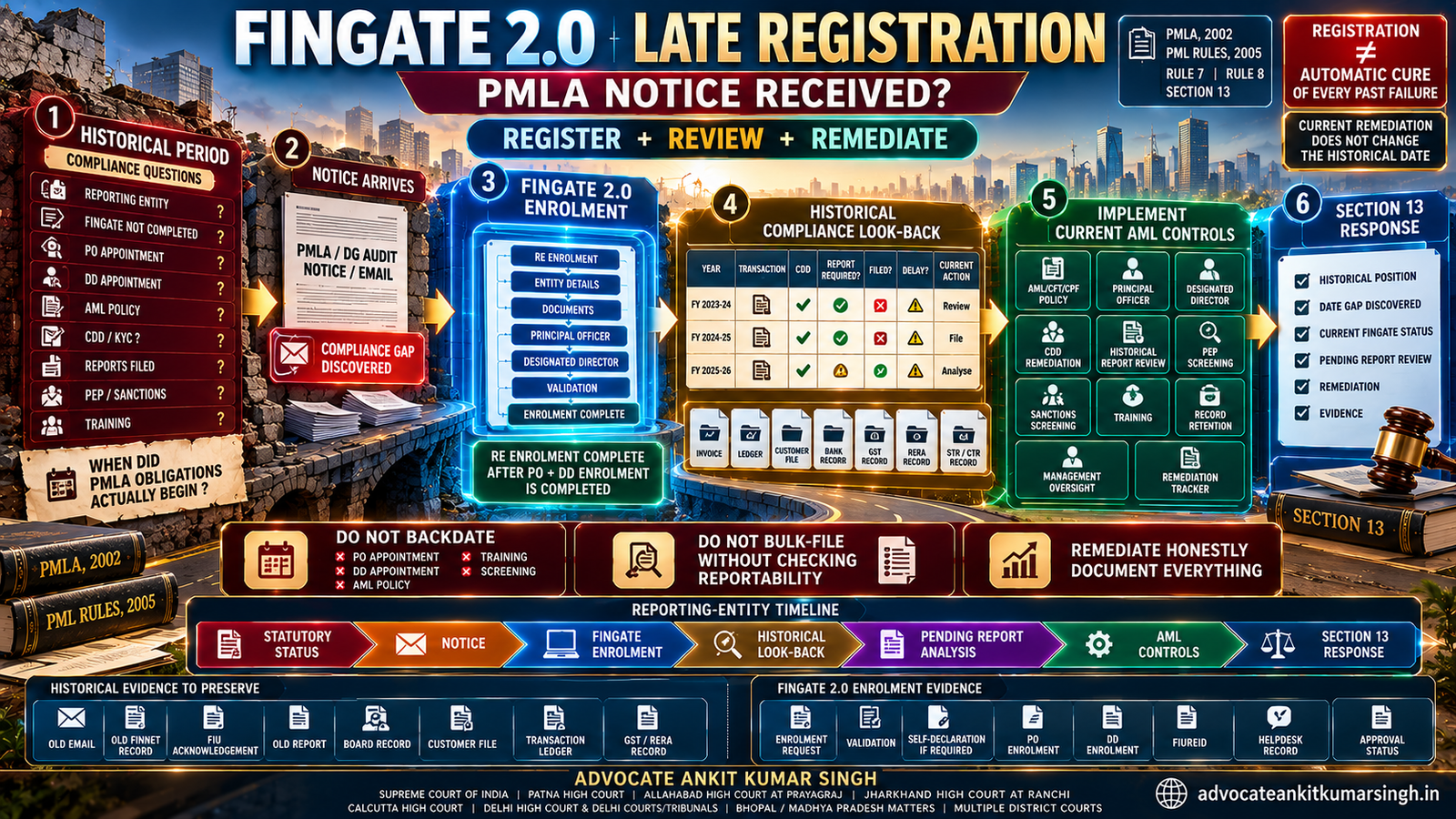
FINGate Late-Registration Remediation Flowchart
Late FINGate 2.0 enrolment should be combined with an accurate historical compliance review, current governance remediation and a transaction/reporting look-back rather than treated as a retroactive cure.
Plain-text alternative:
PMLA notice / audit → confirm historical reporting-entity status → complete current FINGate 2.0 enrolment → complete Principal Officer and Designated Director enrolment → preserve true historical dates → conduct historical compliance look-back → identify pending reports → implement AML/CFT/CPF controls → document remediation → respond under Section 13.
30-Day Remediation Plan After Discovering Late Registration
| Period | Action |
|---|---|
| Days 1-3 | Preserve notice, identify reporting-entity category, stop destruction of relevant records, appoint internal remediation team. |
| Days 4-7 | Appoint/confirm current Principal Officer and Designated Director; initiate FINGate 2.0 enrolment. |
| Days 8-12 | Complete portal validation, FIU communications and governance documentation. |
| Days 13-18 | Conduct year-wise historical reporting and CDD/KYC look-back. |
| Days 19-22 | Identify potentially pending/late reports and obtain current FIU filing guidance where required. |
| Days 23-25 | Adopt current AML/CFT/CPF policy and conduct training. |
| Days 26-28 | Complete sanctions/PEP review, record-retention check and sample customer-file testing. |
| Days 29-30 | Finalise remediation matrix, chronology and Section 13 / DG Audit response package. |
The actual regulatory deadline in the notice prevails. If more time is genuinely required, seek appropriate extension before expiry rather than ignoring the stated deadline.
Documents to Preserve and Produce
- PMLA / DG Audit / FIU notice;
- proof of service;
- RERA documents;
- GST records;
- ITRs and accounts;
- reporting-entity classification sheet;
- historic FIU correspondence;
- old FINnet/FINGate records;
- current FINGate enrolment acknowledgement;
- FIUREID;
- Principal Officer appointment;
- Designated Director appointment;
- Board/partner/proprietor records;
- FIU communications;
- regulator/RERA communications;
- AML/CFT/CPF policy;
- risk assessment;
- CDD/KYC records;
- beneficial-owner records;
- transaction ledgers;
- reportability matrix;
- STR review material;
- historic reports and acknowledgements;
- rejected/mis-reported filing records;
- PEP/sanctions screening;
- training material;
- attendance sheets;
- helpdesk tickets;
- remediation tracker;
- management review; and
- internal legal/compliance chronology.
Common Mistakes
- Waiting for the Section 13 hearing before beginning registration.
- Assuming FINGate enrolment automatically cures past defaults.
- Treating the FINGate registration date as the automatic date PMLA obligations began.
- Backdating Principal Officer appointment.
- Backdating Designated Director appointment.
- Backdating AML policy.
- Creating false historical training records.
- Filing historical reports without checking whether they were actually reportable.
- Filing an STR merely because a transaction is old.
- Ignoring rejected historic reports.
- Failing to check older FINnet/FINGate records.
- Assuming reporting-entity enrolment is complete before PO/DD enrolment is complete.
- Ignoring portal validation defects.
- Failing to retain screenshots/helpdesk correspondence.
- Ignoring historical CDD/KYC gaps.
- Mixing contemporaneous KYC with current remediation without distinguishing them.
- Assuming present cooperation requires admitting every alleged failure.
- Making a generic apology instead of a failure-by-failure response.
- Failing to preserve records after receiving a notice.
- Claiming “fully compliant” before completing the look-back.
Frequently Asked Questions
1. Can a reporting entity register on FINGate after receiving a PMLA notice?
A reporting entity discovering the omission should ordinarily take genuine current corrective steps and complete the applicable FINGate 2.0 enrolment process. The historical consequences must still be analysed separately.
2. Does late registration automatically cure the earlier failure?
No. Enrolment establishes the present portal position. It does not automatically extinguish historical registration, reporting, CDD, recordkeeping or governance issues.
3. Does PMLA compliance start only from the FINGate registration date?
Not necessarily. The underlying statutory category, notification, activity, threshold and effective period determine when obligations applied.
4. What is required for FINGate 2.0 enrolment?
The FIU-IND enrolment process includes reporting-entity details and supporting documents together with Principal Officer and Designated Director details and their respective enrolment processes.
5. When is the reporting-entity enrolment process complete?
FIU-IND's enrolment manual states that the process is completed when both Principal Officer and Designated Director enrolment are completed.
6. Should late appointments be backdated?
No. Use the genuine appointment date and separately explain the historical governance gap.
7. What if an old Principal Officer actually existed but no portal record is visible?
Search old emails, appointment records, FIUREID information, FINnet/FINGate 1.0 correspondence, filed reports and FIU acknowledgements before concluding that no historical appointment or registration existed.
8. Should every historical transaction be filed after registration?
No. First determine whether the transaction fell within a prescribed report category and whether a report was legally required.
9. What if an STR should historically have been filed?
Conduct a documented factual review, verify the current filing mechanism and follow current FIU-IND reporting guidance. Do not mechanically label transactions suspicious merely for remediation purposes.
10. What if the portal does not accept an old report?
Preserve the technical error and seek current FIU-IND/helpdesk guidance where appropriate rather than assuming the reporting obligation disappears.
11. Can the AML policy be implemented after the notice?
Yes, genuine current remediation can include adoption of an AML/CFT/CPF policy, but it should carry its true effective date and should not be presented as a historical document if none existed previously.
12. Should old customers be reviewed?
Where historical obligations applied, a risk-based CDD/KYC and transaction look-back may be required to identify outstanding deficiencies and reporting issues.
13. Does remediation matter under Section 13?
Yes. Remediation can demonstrate current compliance, cooperation, governance response and reduction of ongoing risk. It does not necessarily erase an established historical failure.
14. Can the response reserve disputed legal issues while registering?
Yes, where genuinely applicable. Present enrolment and cooperation do not require an entity to make broader admissions concerning periods or allegations not established by the underlying statutory framework and records.
AI Search Quick Answer
A reporting entity that discovers after a PMLA, DG Audit or Section 13 notice that it should have been registered with FIU-IND should ordinarily complete the current FINGate 2.0 enrolment process and document the actual remediation dates. FIU-IND's enrolment framework requires reporting-entity details together with Principal Officer and Designated Director enrolment, and the reporting-entity process is completed when both officer enrolments are completed. Late registration does not automatically erase earlier PMLA failures. The entity should separately determine when reporting-entity status arose, review historic CDD/KYC and transaction records, identify reports that should have been filed, review Rule 8 delays, implement a current-dated AML/CFT/CPF policy and preserve evidence of corrective action. Appointments, policies, training and screening records should not be backdated.
Key Takeaway
Do not stop after obtaining:
FIUREID / FINGATE REGISTRATION.
Ask:
WHEN DID REPORTING-ENTITY STATUS ACTUALLY BEGIN?
WHEN SHOULD FINGATE ENROLMENT HAVE OCCURRED?
WHO WAS THE HISTORICAL PRINCIPAL OFFICER?
WHO WAS THE HISTORICAL DESIGNATED DIRECTOR?
WERE THEIR DETAILS COMMUNICATED?
WHICH REPORTS BECAME DUE?
WERE ANY REPORTS DELAYED?
WERE ANY REPORTS REJECTED OR MIS-REPORTED?
WAS CDD/KYC PERFORMED?
WERE BENEFICIAL OWNERS IDENTIFIED?
WAS AN AML POLICY IN FORCE?
WERE STAFF TRAINED?
WERE PEP AND SANCTIONS CHECKS CONDUCTED?
WHAT HAS NOW BEEN REMEDIATED?
CAN EVERY REMEDIAL STEP BE PROVED?
The correct sequence is:
REPORTING-ENTITY CLASSIFICATION → FINGATE 2.0 ENROLMENT → PO/DD ENROLMENT → HISTORICAL LOOK-BACK → PENDING REPORT ANALYSIS → CDD REMEDIATION → AML POLICY → TRAINING → SCREENING → DOCUMENTED REMEDIATION → SECTION 13 RESPONSE.
Professional Legal Review and Coordination
Advocate Ankit Kumar Singh undertakes legal research, reporting-entity classification, FIU-IND/FINGate compliance review, DG Audit notice analysis and Section 13 remediation-response preparation depending upon the facts, applicable jurisdiction and accepted professional engagement.
A late-registration remediation review may include:
- reporting-entity effective-date analysis;
- FINGate 2.0 enrolment review;
- historic FINnet/FINGate verification;
- FIUREID review;
- Principal Officer appointment review;
- Designated Director appointment review;
- FIU/regulator/RERA communication review;
- historic reportability analysis;
- Rule 8 delay analysis;
- STR look-back;
- CDD/KYC remediation;
- beneficial-owner remediation;
- AML/CFT/CPF policy review;
- PEP/sanctions controls;
- training programme;
- record-preservation review;
- remediation tracker;
- Section 13 response drafting; and
- hearing preparation.
Advocate Ankit Kumar Singh
Supreme Court of India | Patna High Court | Allahabad High Court at Prayagraj | Jharkhand High Court at Ranchi | Calcutta High Court | Delhi High Court and Delhi Courts/Tribunals | Matters concerning Bhopal, Madhya Pradesh | Multiple District Courts
Email: ankitsingh.legum@gmail.com
Website: advocateankitkumarsingh.in
Consultation, drafting, filing, representation and professional coordination depend upon the facts, jurisdiction, applicable procedure and accepted professional engagement. No registration approval, Section 13 disposal, warning-only result, penalty reduction or other regulatory outcome can be guaranteed.
Official Sources
- Financial Intelligence Unit-India
- FIU-IND — FINGate 2.0 Reporting Entity Enrolment and User Management Manual
- FIU-IND — Office Memorandum: Go-Live of FINGate 2.0
- FIU-IND — Prevention of Money-Laundering Act, 2002
- FIU-IND — Prevention of Money-laundering (Maintenance of Records) Rules, 2005
- FIU-IND — Official PMLA Frequently Asked Questions
- Directorate General of Audit — AML/CFT/CPF Guidelines for Real Estate Agents.
Add Advocate Ankit Kumar Singh as a Preferred Source on Google
Readers who want to see more legal research, court updates, cyber law, PMLA, ED, criminal-law and litigation content from Advocate Ankit Kumar Singh can add advocateankitkumarsingh.in as a Preferred Source on Google.
Add Advocate Ankit Kumar Singh as a Preferred Source on Google
Conclusion
Late FINGate registration should be approached as the beginning of remediation—not the end of the analysis.
A business that discovers the issue after a notice should:
REGISTER HONESTLY
APPOINT CURRENT OFFICERS PROPERLY
PRESERVE THE TRUE HISTORICAL RECORD
IDENTIFY WHEN OBLIGATIONS ACTUALLY BEGAN
REVIEW HISTORICAL TRANSACTIONS
IDENTIFY MISSED REPORTS
REMEDIATE CDD/KYC
IMPLEMENT CURRENT AML CONTROLS
TRAIN PERSONNEL
DOCUMENT EVERY CORRECTIVE STEP
It should not:
BACKDATE
FABRICATE
BLINDLY FILE
OR ASSUME THAT A NEW FIUREID ERASES EVERY PAST FAILURE.
The strongest Section 13 remediation record is a transparent one:
WHAT SHOULD HAVE HAPPENED → WHAT ACTUALLY HAPPENED → WHEN THE GAP WAS DISCOVERED → WHAT WAS CORRECTED → WHAT REMAINS UNDER REVIEW → WHAT EVIDENCE PROVES CURRENT COMPLIANCE.
Professional / Legal Disclaimer: This article provides general legal and regulatory information. FINGate enrolment, reporting-entity obligations, filing requirements, historic reporting and Section 13 consequences depend upon the applicable reporting-entity category, effective dates, current FIU-IND portal procedures, underlying transactions and governing PMLA/PML Rules. A live remediation exercise should therefore verify the current FINGate instructions, FIU-IND reporting mechanism, applicable regulator guidance and the original notice before filing historical reports or making admissions. No particular Section 13, registration or penalty outcome can be guaranteed.