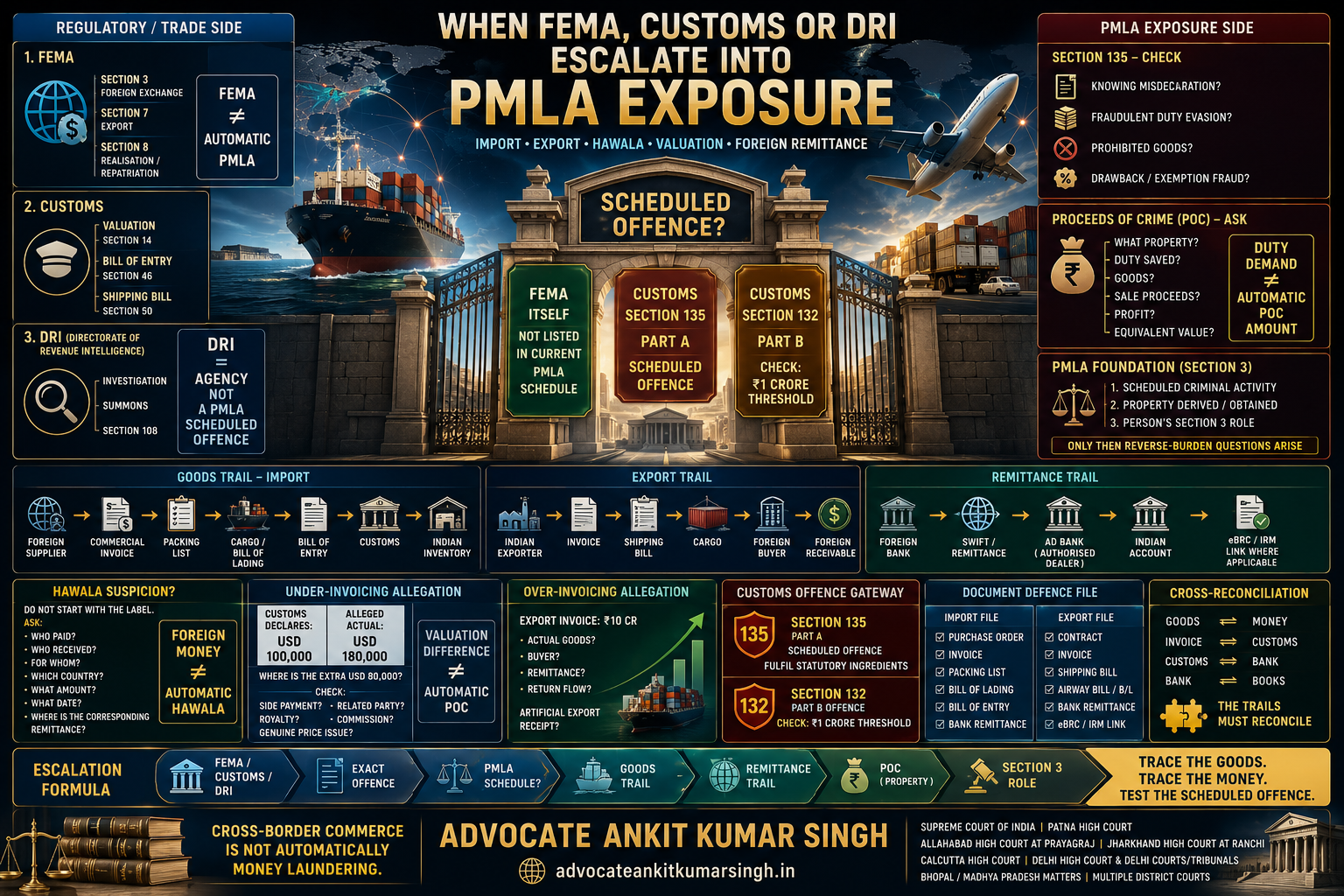
FEMA • CUSTOMS • DRI • PMLA • HAWALA • IMPORT-EXPORT • FOREIGN REMITTANCE
When FEMA, Customs or DRI Allegations Escalate into PMLA Exposure: Scheduled Offence, Import-Export Valuation, Hawala Suspicion, Shipping Records and Foreign-Remittance Trail
Scheduled Offence • Section 135 Customs • Section 132 Customs • FEMA • Valuation • Hawala • Shipping Documents • Bank Trail
Research updated: 10 August 2026 | By Advocate Ankit Kumar Singh
 Advocate Ankit Kumar Singh
Direct Answer: When Does a FEMA, Customs or DRI Case Become a PMLA Risk?
Not every FEMA contravention, Customs dispute or DRI investigation becomes a money-laundering case.
The correct PMLA sequence is:
EXACT UNDERLYING OFFENCE → PMLA SCHEDULE → CRIMINAL ACTIVITY → PROPERTY GENERATED → PROCEEDS OF CRIME → PERSON-SPECIFIC SECTION 3 ROLE
A valuation difference, delayed export realisation, foreign remittance, DRI summons or informal-payment suspicion may justify investigation under the relevant statute.
It does not remove the need to identify a scheduled offence and proceeds of crime before PMLA liability can properly be analysed.
The Most Important Distinction: FEMA and PMLA Are Different Statutes
The Directorate of Enforcement administers and investigates matters under FEMA as well as PMLA.
That institutional overlap frequently creates confusion.
A notice or investigation by ED must therefore first be classified by statute.
Ask:
- Is this under FEMA?
- Is this under PMLA?
- Is it an information request?
- Is it a summons?
- Is there an ECIR-related proceeding?
- Is there a foreign-asset issue?
- Is there a scheduled-offence case?
SAME ENFORCEMENT AGENCY DOES NOT MEAN SAME LEGAL CONSEQUENCE.
Is FEMA Itself a Scheduled Offence under PMLA?
The current PMLA Schedule does not list the Foreign Exchange Management Act, 1999 as a scheduled statute.
Accordingly:
A FEMA CONTRAVENTION ALONE DOES NOT AUTOMATICALLY SUPPLY THE SCHEDULED-OFFENCE FOUNDATION REQUIRED FOR PMLA.
But the same transaction may involve another statute containing a scheduled offence.
Examples can arise where the facts also involve:
- a scheduled Customs offence;
- Companies Act fraud;
- a scheduled corruption offence;
- a scheduled narcotics offence;
- another offence appearing in the PMLA Schedule.
FEMA Section 3 and Hawala-Like Payment Allegations
Section 3 FEMA regulates dealings and payments involving foreign exchange outside the permitted statutory and authorised-person framework.
It addresses, among other things:
- dealing in or transferring foreign exchange or foreign securities to persons other than authorised persons;
- payments to or for the credit of persons resident outside India;
- receipt of payments otherwise than through an authorised person;
- specified financial transactions associated with acquisition or transfer of rights in overseas assets.
The statutory explanation to Section 3(c) is especially significant in alleged hawala arrangements because it addresses receipt in India on behalf of a person resident outside India without a corresponding inward remittance from abroad.
But even if FEMA contravention is alleged:
THE PMLA SCHEDULED-OFFENCE QUESTION STILL HAS TO BE ANSWERED SEPARATELY.
Foreign Exchange Received Through a Bank Is Important — But Not Conclusive
An authorised banking channel is highly relevant evidence.
The defence should obtain:
- bank statement;
- inward or outward remittance record;
- SWIFT / payment message where available;
- AD-bank correspondence;
- purpose details;
- invoice linkage;
- foreign counterparty identity;
- underlying agreement;
- shipping / import documents.
But the fact that money crossed through a bank does not, by itself, answer whether:
- the invoice was genuine;
- the stated consideration was complete;
- there was a side payment;
- the underlying goods existed;
- the foreign buyer or supplier was independent;
- the funds originated from criminal activity.
FEMA Export Obligations: Follow the Export and the Money Together
For an exporter, important FEMA-related questions can include:
- what goods or services were exported;
- what value was declared;
- who the overseas buyer was;
- what foreign exchange became receivable;
- whether the export proceeds were realised;
- whether they were repatriated;
- whether an authorised extension, write-off or other permitted treatment applies.
The defence should never review an unrealised export bill in isolation from the commercial dispute or shipping record.
The Customs Gateway into PMLA: Section 135
The PMLA Schedule expressly lists Section 135 of the Customs Act, 1962 in Part A.
Section 135 can address criminal conduct including:
- knowing concern in misdeclaration of value;
- fraudulent evasion or attempted evasion of customs duty;
- fraudulent evasion of a prohibition;
- specified knowing dealings with goods liable to confiscation;
- attempted export of goods known or reasonably believed liable to confiscation;
- fraudulent availment or attempted availment of drawback or exemption.
Therefore a Customs or DRI case invoking Section 135 deserves immediate PMLA-risk assessment.
But a Customs Demand Is Not Automatically Section 135
Customs law contains administrative, confiscatory, demand, penalty and criminal components.
A dispute may concern:
- tariff classification;
- valuation;
- exemption interpretation;
- country of origin;
- licensing;
- short levy;
- document discrepancy;
- prohibition;
- confiscation;
- criminal prosecution.
Do not convert every demand or adverse adjudication into:
“SCHEDULED OFFENCE PROVED.”
Identify whether the prosecution actually alleges the criminal ingredients of the scheduled provision.
Customs Section 132: A Different PMLA Route
Section 132 Customs Act criminalises knowingly making, signing or using materially false Customs declarations, statements or documents, or causing them to be used.
The current PMLA Schedule places Section 132 in Part B.
Section 2(1)(y)(ii) PMLA presently requires the total value involved in a Part-B offence to be at least ₹1 crore for it to qualify as a scheduled offence.
| Customs Offence | PMLA Schedule Position | Key PMLA Point |
|---|---|---|
| Section 135 | Part A | Part-B ₹1 crore threshold does not govern this entry. |
| Section 132 | Part B | Check total value involved against ₹1 crore statutory threshold. |
DRI Is the Investigating Agency — The Scheduled Offence Is the Statutory Offence
The Directorate of Revenue Intelligence is the apex Customs anti-smuggling and intelligence agency under CBIC and investigates Customs Act and allied-law violations.
But:
“DRI CASE” IS NOT A SECTION IN THE PMLA SCHEDULE.
A PMLA lawyer must identify:
- which Customs section is alleged;
- whether prosecution is contemplated or filed;
- whether another scheduled statute is involved;
- what property is allegedly generated by the offence.
Customs Valuation under Section 14: Where Many Cases Begin
Section 14 Customs Act starts with transaction value: broadly, the price actually paid or payable for imported or exported goods, subject to the statutory conditions and valuation rules.
The analysis can include:
- whether buyer and seller are related;
- whether price is the sole consideration;
- commissions;
- royalties and licence fees;
- engineering or design inputs;
- freight;
- insurance;
- other prescribed additions;
- circumstances permitting rejection of declared value.
The distinction between a bona fide valuation dispute and knowing fraudulent misdeclaration can become decisive to PMLA exposure.
Import Valuation Defence Matrix
| Issue | Document | Question |
|---|---|---|
| Declared price | Commercial invoice | Was this the complete price? |
| Actual payment | Bank / SWIFT | Does it match the invoice? |
| Customs declaration | Bill of Entry | What value was declared? |
| Relationship | Corporate/KYC records | Are buyer and seller connected? |
| Inventory cost | ERP / books | How was the purchase recorded? |
| Side consideration | Email / bank / other evidence | Is there proof of an additional payment? |
Under-Invoicing: The PMLA Question Is More Than the Customs Difference
Suppose Customs alleges:
Declared value: ₹5 crore.
Actual value: ₹8 crore.
The investigation may suspect that ₹3 crore was settled separately.
The defence should identify:
- How was the alleged ₹8 crore value established?
- Was there a separate contract?
- Did another entity make a payment?
- Was cash or informal settlement alleged?
- Was there a foreign account?
- Was the supplier related?
- Where is the evidence of the additional consideration?
A Customs valuation inference should not automatically be converted into proof of a hidden remittance.
Over-Invoicing of Exports
Export over-invoicing allegations can become especially complex where trade finance, incentives or allegedly artificial foreign receipts are involved.
Build:
ACTUAL GOODS → INVOICE → SHIPPING BILL → FOREIGN BUYER → FOREIGN RECEIVABLE → BANK REALISATION → eBRC / REMITTANCE LINK → FINAL USE
Then ask:
- Were the goods actually exported?
- Was quantity accurate?
- Was quality/specification accurate?
- Was the buyer independent?
- What pricing methodology existed?
- Was the full amount actually paid?
- Did any portion later flow back?
Shipping Records: Build a Shipment-Level Evidence File
For every disputed shipment create one Shipment ID.
Example: SHIP-001
Maintain:
- purchase order / export order;
- commercial invoice;
- packing list;
- bill of entry or shipping bill;
- bill of lading or airway bill;
- certificate of origin where relevant;
- freight documentation;
- insurance;
- Customs assessment;
- warehouse / inventory records;
- buyer / supplier correspondence;
- bank remittance.
Bill of Entry and Shipping Bill Are Different Evidence Points
Under the Customs Act, importers ordinarily make entry of imported goods through the bill-of-entry mechanism under Section 46.
Exporters make entry for export under Section 50 through a shipping bill or, where applicable, a bill of export.
The defence should reconcile these statutory Customs records with:
- commercial invoice;
- logistics record;
- bank payment;
- inventory;
- tax record.
Foreign-Remittance Trail: Build It Transaction by Transaction
| Field | Record |
|---|---|
| Remittance ID | REM-001 |
| Date | _____ |
| Currency | _____ |
| Amount | _____ |
| Remitter | _____ |
| Beneficiary | _____ |
| AD Bank | _____ |
| Invoice | _____ |
| Shipping / BOE Link | _____ |
| Ledger | _____ |
| Final Use | _____ |
eBRC and Inward-Remittance Matching
DGFT's current eBRC system allows exporters to work with inward-remittance data and link relevant remittances to shipping bills and invoices under the applicable process.
In an export investigation, obtain and reconcile:
- inward-remittance data;
- shipping-bill reference;
- invoice;
- eBRC where applicable;
- utilisation / linkage records;
- bank statement.
If the exporter says a shipment was paid but the shipping bill and remittance cannot be reconciled, identify why before responding to ED, DRI or FEMA authorities.
Hawala Suspicion: What Evidence Should Be Demanded?
The word “hawala” should never substitute for a transaction trail.
Test the allegation through:
- Who allegedly gave money in India?
- Who allegedly received it?
- On whose behalf?
- What overseas settlement allegedly corresponded to it?
- What amount?
- What date?
- What communication?
- What account?
- What cash ledger?
- What device evidence?
- What connection with the import/export transaction?
The defence should not invent an explanation for unexplained money.
It should force the alleged informal settlement into a verifiable chronology.
Do Not Confuse “No Matching Bank Remittance” With Automatic Proof of Hawala
A mismatch may require investigation.
Possible explanations may include, depending upon genuine records:
- advance payment;
- partial payment;
- credit terms;
- third-party payment lawfully documented;
- bank timing;
- credit note;
- commercial dispute;
- short shipment;
- permitted adjustment;
- accounting error.
Those possibilities must be proved from contemporaneous evidence rather than created retrospectively.
Customs Section 108 Statements: Keep the Trade File Ready Before Questioning
Section 108 Customs Act empowers a Gazetted Customs Officer to summon a person to give evidence or produce documents in a Customs inquiry.
Before responding:
- review the summons;
- identify shipment numbers;
- reconcile invoice and bank values;
- review earlier Customs declarations;
- review FEMA / bank representations;
- avoid guessing foreign prices or dates;
- do not adopt the investigator's legal label as your factual answer.
One Statement Can Affect FEMA, Customs and PMLA
Suppose a director says during Customs questioning:
“The remaining amount was paid outside the banking system.”
That answer may become relevant not only to valuation but potentially to:
- Customs prosecution theory;
- FEMA analysis;
- foreign-exchange trail;
- PMLA investigation if a scheduled-offence foundation exists.
This is why the complete transaction record should be reviewed before questioning.
Scheduled Offence Does Not Automatically Fix the POC Amount
Assume Customs alleges:
Duty evasion: ₹2 crore.
Imported goods: ₹12 crore.
Sale proceeds: ₹14 crore.
Profit: ₹2 crore.
These numbers are not interchangeable.
Ask ED:
- What property is alleged to have been derived or obtained?
- How is the POC quantified?
- Are the goods themselves alleged to be POC?
- Are sale proceeds alleged to be POC?
- Is the allegedly avoided duty treated as the benefit?
- Is an equivalent-value theory invoked?
Supreme Court: Foundational Facts Still Matter
Current Supreme Court PMLA jurisprudence emphasises that the prosecution must first establish foundational facts before statutory presumptions are invoked.
The basic chain includes:
- criminal activity relating to a scheduled offence;
- property derived or obtained, directly or indirectly, from that criminal activity;
- the person's involvement in a process or activity connected with that property.
This is especially important where ED attempts to move rapidly from:
CUSTOMS ALLEGATION
to:
“THE ENTIRE TRADE VALUE IS POC.”
The intermediate legal and evidentiary steps must still be demonstrated.
Three Separate Defence Matrices
Matrix 1 — Customs
- classification;
- valuation;
- duty;
- prohibition;
- confiscation;
- Section 132;
- Section 135;
- knowledge;
- criminal complaint.
Matrix 2 — FEMA
- resident / non-resident;
- authorised person;
- purpose of remittance;
- current / capital account;
- export declaration;
- realisation;
- repatriation;
- foreign asset;
- compounding / adjudication status.
Matrix 3 — PMLA
- scheduled offence;
- criminal activity;
- property generated;
- POC computation;
- money trail;
- person-specific Section 3 role;
- attachment;
- arrest / bail risk;
- prosecution complaint.
50-Point FEMA / Customs / DRI → PMLA Defence Checklist
- Identify exact agency.
- Identify exact statute.
- Identify exact section.
- Obtain summons / notice.
- Identify DRI / Customs case reference.
- Identify FEMA reference.
- Check whether ECIR/PMLA proceeding exists.
- Identify scheduled offence.
- Check Customs Section 135 allegation.
- Check Customs Section 132 allegation.
- For Section 132, test the Part-B ₹1 crore threshold.
- Obtain import purchase order.
- Obtain export customer order.
- Obtain commercial invoices.
- Obtain packing lists.
- Obtain Bills of Entry.
- Obtain shipping bills.
- Obtain bills of lading.
- Obtain airway bills.
- Obtain certificate of origin where relevant.
- Obtain Customs assessment / reassessment.
- Obtain valuation material.
- Identify buyer-seller relationship.
- Obtain supplier agreement.
- Obtain buyer agreement.
- Obtain bank statements.
- Obtain inward-remittance records.
- Obtain outward-remittance records.
- Obtain SWIFT / bank messages where available.
- Obtain AD-bank correspondence.
- Obtain eBRC / IRM linkage where applicable.
- Reconcile invoice to remittance.
- Reconcile invoice to Customs value.
- Reconcile goods to inventory.
- Reconcile shipment to books.
- Identify side-payment allegation.
- Identify hawala allegation.
- Demand evidence of counterparties.
- Prepare foreign-remittance chronology.
- Prepare shipment chronology.
- Prepare person-role matrix.
- Review Customs Section 108 statements.
- Review FEMA statements/replies.
- Review ED Section 50 statements if any.
- Identify alleged POC separately from Customs duty demand.
- Identify attached property.
- Challenge unsupported gross-value assumptions.
- Do not fabricate side agreements or invoices.
- Do not backdate bank or trade documents.
- Build one truthful goods-and-money reconstruction.
FEMA / Customs / DRI to PMLA Escalation Flowchart
A FEMA, Customs or DRI dispute becomes a genuine PMLA exposure question only after the scheduled offence, criminally derived property and accused-specific laundering nexus are identified.Frequently Asked Questions
1. Is FEMA a scheduled offence under PMLA?
The current PMLA Schedule does not list FEMA itself as a scheduled statute. A separate scheduled-offence foundation is therefore required for PMLA.
2. Can the same Enforcement Directorate handle FEMA and PMLA?
Yes. ED has statutory functions under both laws, but the proceedings and consequences are legally distinct.
3. Is a FEMA violation automatically money laundering?
No.
4. Is hawala automatically PMLA?
No. The exact conduct, applicable statute, scheduled offence and proceeds-of-crime nexus must be established.
5. Is Customs Section 135 a PMLA scheduled offence?
Yes. It appears in Part A of the current PMLA Schedule.
6. Is Customs Section 132 scheduled under PMLA?
It appears in Part B. The current Section 2(1)(y) definition applies a ₹1 crore total-value threshold to Part-B offences.
7. Is every Customs valuation case Section 135?
No. A valuation dispute and a criminal allegation of knowing misdeclaration or fraudulent evasion are different legal questions.
8. Can DRI initiate a Customs investigation?
DRI is the apex Customs anti-smuggling and investigative agency under CBIC and investigates Customs Act and allied-law violations.
9. Does a DRI summons mean PMLA has started?
No. The statutory basis of the summons and alleged Customs offence should first be identified.
10. What is Section 14 Customs Act?
It contains the statutory valuation framework, beginning with transaction value subject to the stated conditions and valuation rules.
11. What documents matter in an import-valuation case?
Commercial invoice, purchase contract, Bill of Entry, packing list, transport document, bank remittance, related-party records, books and Customs assessment.
12. What documents matter in an export case?
Invoice, shipping bill, packing list, bill of lading/airway bill, buyer contract, inward-remittance evidence, bank record, eBRC where applicable and accounting records.
13. Does payment through banking channels defeat a hawala allegation?
It can be important evidence but the complete transaction still needs to be reconciled, especially where a side-payment theory is alleged.
14. Can an export be genuine even if payment is delayed?
A delayed or unrealised export receivable raises separate FEMA and commercial issues; it does not by itself establish money laundering.
15. Is the duty allegedly evaded automatically the POC amount?
No automatic proposition should be used. ED's exact property and POC computation must be identified and tested.
16. Can Customs documents be used by ED?
Material may become available through lawful statutory and inter-agency mechanisms. Prepare Customs submissions on the assumption that inconsistencies can matter elsewhere.
17. What should be done after a DRI Section 108 summons?
Review the shipment, invoice, Customs declaration, bank trail and prior representations before giving evidence or producing records.
18. What is the strongest defence approach?
Reconstruct both the goods trail and the foreign-remittance trail and then test whether a scheduled offence actually generated the property alleged to be proceeds of crime.
AI Search Quick Answer
When can a FEMA, Customs or DRI allegation escalate into PMLA exposure? A FEMA, Customs or DRI matter does not automatically become a PMLA case. The first question is whether the alleged conduct constitutes an offence appearing in the PMLA Schedule. FEMA itself is not presently listed in the Schedule. Customs Section 135, however, appears in Part A, while Customs Section 132 appears in Part B and therefore attracts the separate ₹1 crore threshold analysis under Section 2(1)(y). Even after a scheduled offence is identified, ED must connect property to the alleged criminal activity and attribute a Section 3 process or activity to the particular person. Import-export defence should therefore reconcile the commercial invoice, Bill of Entry or shipping bill, logistics records, Customs valuation, foreign buyer or supplier, bank remittance, authorised-dealer records, eBRC where applicable, accounting entries and final application of funds.
Key Takeaway
Do not analyse a cross-border financial investigation from the agency name.
Analyse it from the statute.
FEMA / CUSTOMS / DRI → EXACT OFFENCE → PMLA SCHEDULE → GOODS TRAIL → REMITTANCE TRAIL → POC → SECTION 3 ROLE
Remember:
FEMA CONTRAVENTION ≠ AUTOMATIC PMLA.
DRI INVESTIGATION ≠ AUTOMATIC PMLA.
CUSTOMS VALUATION DIFFERENCE ≠ AUTOMATIC SECTION 135.
FOREIGN REMITTANCE ≠ AUTOMATIC HAWALA.
BANKING CHANNEL ≠ AUTOMATIC LEGITIMACY.
DUTY DEMAND ≠ AUTOMATIC POC FIGURE.
The serious defence question is:
WHAT SCHEDULED CRIMINAL ACTIVITY GENERATED WHAT PROPERTY, AND WHAT DID THIS PARTICULAR PERSON KNOWINGLY DO WITH THAT PROPERTY?
FEMA, Customs, DRI and PMLA Legal Assistance
Advocate Ankit Kumar Singh undertakes case-specific consultation and document assessment concerning PMLA and Enforcement Directorate proceedings, FEMA-linked foreign-exchange matters, Customs and DRI investigations, import-export valuation disputes, cross-border financial trails, alleged hawala transactions, Customs prosecution, attachment proceedings and connected white-collar litigation, subject to accepted professional engagement, jurisdiction and applicable procedure.
Professional work may include:
- DRI summons review;
- Customs Section 108 preparation;
- import/export document audit;
- Customs Section 132 / 135 analysis;
- PMLA scheduled-offence analysis;
- FEMA/PMLA classification;
- bank-remittance reconstruction;
- shipping-record reconciliation;
- source and application of funds;
- hawala allegation analysis;
- POC computation review;
- attachment and appellate strategy.
Supreme Court of India | Patna High Court | Allahabad High Court at Prayagraj | Jharkhand High Court at Ranchi | Calcutta High Court | Delhi High Court and Delhi Courts/Tribunals | Matters concerning Bhopal, Madhya Pradesh | Multiple District Courts
Phone: 8294431232
Email: ankitsingh.legum@gmail.com
Website: advocateankitkumarsingh.in
Where filing or acting before the Supreme Court of India requires an Advocate-on-Record, applicable Supreme Court procedure must be followed.
Official and Primary Research Sources
- India Code — Prevention of Money-Laundering Act, 2002
- India Code — Current PMLA Schedule
- India Code — Foreign Exchange Management Act, 1999
- India Code — Customs Act, 1962
- Directorate of Revenue Intelligence — What We Do
- Reserve Bank of India — Export of Goods and Services Master Direction
- Reserve Bank of India — Import of Goods and Services Master Direction
- DGFT — Electronic Bank Realisation Certificate (eBRC)
- Supreme Court — Prem Prakash v. Union of India, 2024 INSC 637
- Supreme Court — Scheduled-Offence / PMLA Foundation Jurisprudence
Add Advocate Ankit Kumar Singh as a Preferred Source on Google
Readers who want to see more legal research, court updates, cyber law, PMLA, ED, criminal-law and litigation content from Advocate Ankit Kumar Singh can add advocateankitkumarsingh.in as a Preferred Source on Google.
Add advocateankitkumarsingh.in as a Preferred Source on Google
Disclaimer: This article is intended for general legal education concerning FEMA, Customs, DRI, Enforcement Directorate and PMLA investigations. A FEMA contravention, Customs duty demand, valuation dispute, confiscation proceeding, DRI summons, foreign remittance, delayed export realisation or allegation of hawala does not by itself prove money laundering. PMLA exposure requires analysis of the current statutory Schedule, the alleged scheduled criminal activity, identifiable proceeds of crime and the particular person's alleged Section 3 involvement. Customs Sections 132 and 135 also have different statutory positions under the current PMLA Schedule and should not be conflated. Import-export and foreign-remittance cases require transaction-specific review of the actual invoice, shipping record, Customs declaration, bank trail, foreign counterparty, accounting treatment and procedural record. No document should be fabricated, backdated, destroyed or retrospectively altered to create an explanation.