Legally researched and updated: 30 September 2026
RERA Registration Expired or Not Renewed: Does the Person Still Remain a PMLA Reporting Entity for Real Estate Transactions?
Create a high-value article separating State RERA registration status from the federal PMLA reporting-entity analysis. Explain why expiry or non-renewal of a RERA registration does not by itself answer whether the person continued to perform notified real-estate-agent services during the relevant period. The article should compare actual transactions, commission or consultancy receipts, project-linked activity, turnover and dates against the applicable PMLA notification.
Legal research and analysis by Advocate Ankit Kumar Singh.
Direct Answer: Expiry of RERA Registration Does Not, By Itself, Answer the PMLA Question
An expired, lapsed or non-renewed RERA registration is highly relevant evidence—but it is not necessarily the end of the PMLA analysis.
The legal questions are different.
Under RERA, a real estate agent is required to obtain registration before facilitating specified transactions in registered real estate projects.
The registration remains valid for the period prescribed under the relevant State or Union Territory rules and is renewable in the prescribed manner.
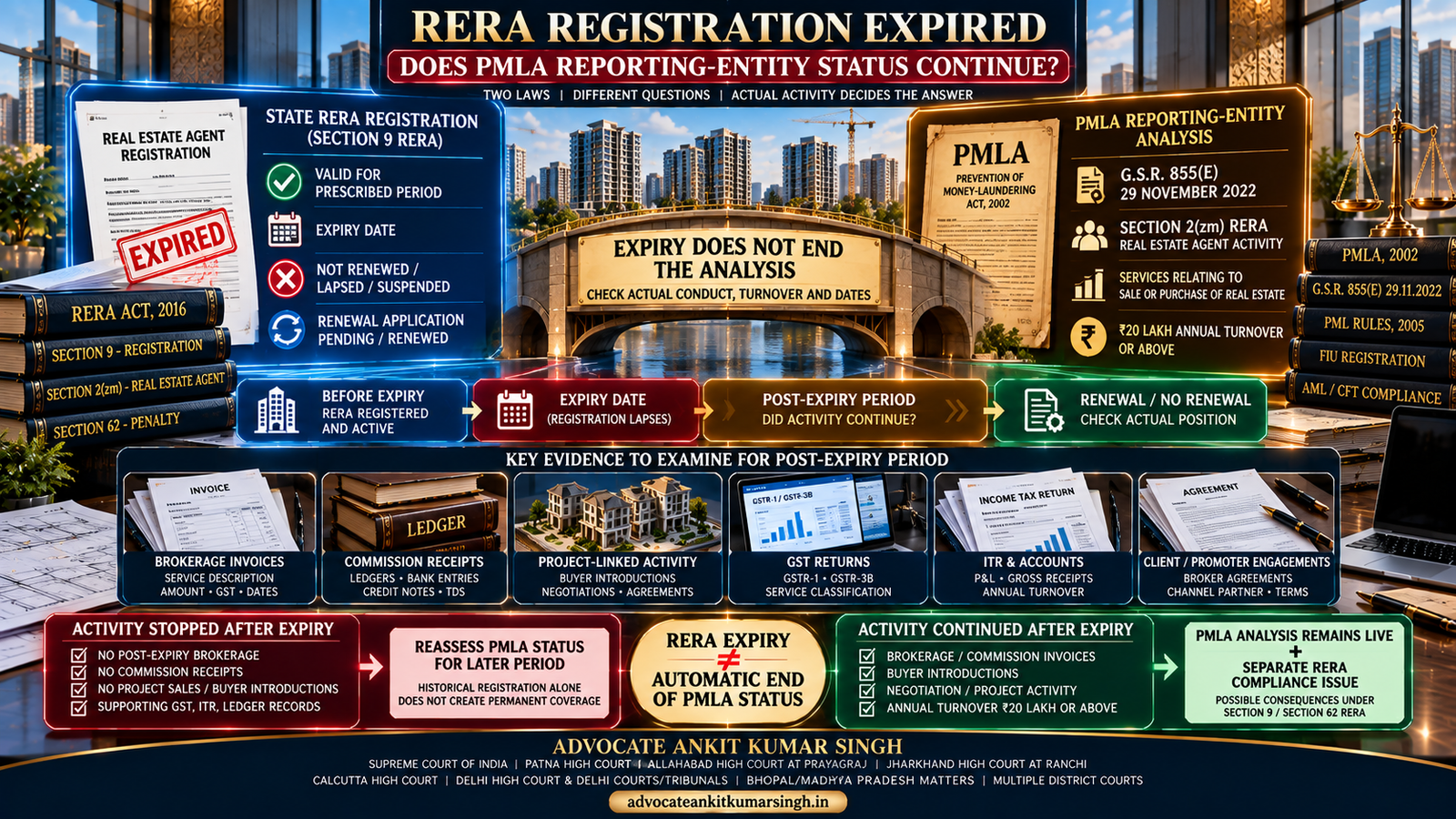
Under the PMLA framework, however, G.S.R. 855(E), dated 29 November 2022, identifies real estate agents by incorporating the activity-based definition in Section 2(zm) RERA and applying an annual-turnover threshold of ₹20 lakh or above.
Therefore:
RERA CERTIFICATE EXPIRED ≠ AUTOMATIC END OF PMLA REPORTING-ENTITY ANALYSIS
The question becomes:
DID THE PERSON CONTINUE TO PERFORM THE NOTIFIED REAL-ESTATE-AGENT ACTIVITY DURING THE RELEVANT PERIOD, AND DID THE APPLICABLE ANNUAL-TURNOVER CONDITION CONTINUE TO BE SATISFIED?
Why the Two Statutes Must Be Analysed Separately
RERA and PMLA address different statutory objectives.
RERA regulates the real-estate market, including registration and conduct of promoters and real estate agents.
PMLA creates a wider anti-money-laundering framework and imposes preventive compliance obligations upon reporting entities.
The PMLA question is therefore not simply:
“Was the RERA certificate alive?”
It is:
“Was the person carrying on the notified activity which brings the person within the designated-business/reporting-entity framework?”
Registration status may strongly support or contradict the answer, but it should not replace the factual activity analysis.
What Does Section 2(zm) RERA Actually Define?
Section 2(zm) defines a real estate agent in functional terms.
It broadly covers a person who:
- negotiates or acts on behalf of one person;
- in a transaction concerning transfer of a plot, apartment or building in a real estate project;
- deals with another person in relation to that transfer;
- receives remuneration, fees or other charges for the service, whether as commission or otherwise; or
- introduces prospective buyers and sellers for negotiations.
The definition also encompasses property dealers, brokers and middlemen by whatever name called.
Notice what the definition describes:
CONDUCT.
It does not define the expression merely as:
“A person holding a currently valid RERA certificate.”
That distinction becomes central when registration has expired but business conduct allegedly continued.
Section 9 RERA Is the Separate Registration Requirement
Section 9 performs a different function.
It prohibits a real estate agent from facilitating specified sale or purchase transactions or acting on behalf of another person to facilitate those transactions without obtaining registration.
It further provides:
- for an application for registration;
- for grant or rejection by the Authority;
- for a registration number;
- for the period of validity to be prescribed; and
- for renewal in the prescribed manner and on payment of the prescribed fee.
Accordingly:
SECTION 2(zm) → WHO / WHAT IS A REAL ESTATE AGENT?
SECTION 9 → WHEN MUST THAT AGENT BE REGISTERED TO FACILITATE COVERED TRANSACTIONS?
These provisions operate together under RERA but perform different legal functions.
What Happens If Registration Expires but the Agent Keeps Doing Brokerage?
Consider this chronology:
| Date | Event |
|---|---|
| 1 January 2024 | RERA registration valid |
| 31 March 2025 | Registration expires |
| April–December 2025 | Agent continues introducing buyers, negotiating sales and invoicing brokerage |
| FY 2025–26 | Commission / brokerage receipts exceed the relevant ₹20 lakh threshold |
A simplistic argument would say:
“The certificate expired on 31 March, therefore I was not a real estate agent after that date.”
That does not necessarily answer what actually happened.
If documents show that the person continued:
- introducing purchasers;
- working with promoters;
- negotiating apartment sales;
- raising brokerage invoices;
- receiving commission;
- advertising itself as a property broker;
- operating project-linked customer pipelines; and
- earning qualifying annual turnover,
the PMLA classification issue remains live.
Separately, continuing such activity without the required RERA registration may raise a RERA compliance issue.
Expiry Does Not Legalise or Erase Post-Expiry Conduct
This point should be expressed carefully.
If a statutory licence expires, the person cannot normally defeat every consequence of the underlying conduct merely by saying:
“I was technically unregistered, therefore the transactions should be ignored.”
For PMLA classification purposes, the authority can still examine objective evidence of the actual activity.
Likewise, the business is entitled to show that post-expiry receipts were not brokerage at all.
The classification should follow the evidence.
RERA Non-Renewal Can Create a Separate RERA Exposure
Section 62 RERA provides for consequences where a real estate agent fails to comply with or contravenes Sections 9 or 10.
The statutory penalty can run at ₹10,000 for every day during which the default continues, subject to the cumulative statutory ceiling specified in Section 62.
Therefore, if an agent continued facilitating covered sales after expiry without renewal, counsel should not blur together:
- the possible RERA registration contravention; and
- the separate PMLA reporting-entity/compliance question.
One statute does not automatically cancel the other.
The Most Important PMLA Source: G.S.R. 855(E)
G.S.R. 855(E), dated 29 November 2022, notified qualifying real estate agents as persons carrying on designated business or profession for PMLA purposes.
The notification combines:
- the Section 2(zm) RERA definition;
- services in relation to sale or purchase of real estate; and
- annual turnover of ₹20 lakh or above.
The notification does not expressly say:
“Only a person holding a currently valid RERA registration certificate is a PMLA reporting entity.”
This is why expiry/non-renewal should not be treated as an automatic answer.
DG Audit Guidance Supports an Activity-and-Threshold Analysis
The Directorate General of Audit’s real-estate AML/CFT/CPF Guidelines define the real estate agent reporting entity through the RERA Section 2(zm) definition together with the ₹20 lakh annual-turnover threshold.
The same guidelines separately recognise that certain anti-terrorism/proliferation-financing requirements apply to real estate agents irrespective of whether they are RERA-registered, while PMLA/PMLR obligations apply to those satisfying the reporting-entity framework.
This is important because it demonstrates that:
REGISTRATION STATUS
and
THE ACTUAL LEGAL CATEGORY OF THE BUSINESS
are capable of being separate inquiries.
What If the Agent Stopped All Real Estate Activity When Registration Expired?
That is a materially different case.
Suppose:
- registration expired on 31 March;
- no brokerage agreement existed thereafter;
- no buyer was introduced;
- no project was marketed;
- no commission invoice was raised;
- no commission was received;
- GST returns show no real-estate brokerage supply; and
- website/social media stopped advertising agent services.
Those facts may strongly support the position that the notified real-estate-agent activity did not continue in the later period.
The authority should not assume permanent PMLA coverage merely because the person was historically registered.
Reporting-entity analysis should remain period-specific.
What If the Person Calls the Post-Expiry Income “Consultancy Fees”?
The description on an invoice is relevant but not conclusive.
A regulator or counsel should ask:
- What was the engagement?
- Who engaged the person?
- Was there a promoter or buyer mandate?
- Was the fee linked to successful property sales?
- Was the payment calculated as a percentage of property consideration?
- Were prospective purchasers introduced?
- Did the person negotiate prices or booking terms?
- Did the person maintain lead/customer data?
- Was the person identified as channel partner or broker?
- What does the GST invoice describe?
- What do emails and WhatsApp communications show?
Calling brokerage “consultancy” does not necessarily change its legal substance.
Equally, genuine independent consultancy should not automatically be reclassified as brokerage simply because the consultant previously held RERA registration.
Commission and Consultancy Receipts Must Be Classified Transaction by Transaction
| Receipt | Description | Project-Linked? | Sale-Linked? | Agent Activity? |
|---|---|---|---|---|
| ₹_____ | Brokerage | Yes | Yes | Likely relevant |
| ₹_____ | Marketing retainer | Yes / No | Yes / No | Requires analysis |
| ₹_____ | General consultancy | No | No | Potentially unrelated |
| ₹_____ | Success fee | Yes | Yes | Requires close review |
| ₹_____ | Property management | Yes | No | Separate service analysis |
The label should be tested against actual conduct.
Build a Pre-Expiry and Post-Expiry Transaction Matrix
| Transaction | Date | RERA Status | Project | Service | Commission/Fee | PMLA Relevance |
|---|---|---|---|---|---|---|
| 1 | _____ | Valid | _____ | _____ | ₹_____ | _____ |
| 2 | _____ | Expired | _____ | _____ | ₹_____ | _____ |
| 3 | _____ | Expired / renewal pending | _____ | _____ | ₹_____ | _____ |
| 4 | _____ | Renewed | _____ | _____ | ₹_____ | _____ |
This is substantially more useful than arguing from the certificate alone.
Annual Turnover Must Also Be Mapped to the Relevant Period
Registration expiry is a date question.
The PMLA notification adds an annual-turnover question.
The file should therefore compare:
- date of initial RERA registration;
- expiry date;
- renewal application date;
- renewal grant date;
- financial-year boundaries;
- brokerage earned before expiry;
- brokerage earned after expiry;
- other business income;
- total relevant annual turnover; and
- the date on which reporting obligations are asserted.
Do not analyse a certificate expiring in September using only one full-year turnover number without identifying when the underlying revenue arose.
GST Returns Can Reveal Continued Activity After RERA Expiry
If a person says:
“I stopped acting as an agent after expiry,”
but post-expiry GST records contain:
- brokerage invoices;
- real-estate agency service descriptions;
- commission supplies;
- project-linked customer entries; or
- consistent brokerage turnover,
the factual position needs explanation.
Review:
- GSTR-1;
- GSTR-3B;
- sales register;
- SAC descriptions;
- invoice dates;
- credit notes;
- cancelled invoices; and
- customer GSTINs.
ITRs and Ledgers Can Be Even More Important
Financial statements and tax returns may reveal:
- commission income;
- brokerage income;
- consultancy income;
- marketing revenue;
- other business receipts;
- gross receipts;
- segment information;
- project-wise commissions; and
- related-party income.
The ledger should identify whether purported consultancy payments were actually connected to property sale facilitation.
Project-Linked Evidence Is Often Decisive
In a disputed post-expiry case, collect:
- channel-partner agreements;
- broker agreements;
- promoter appointment letters;
- project allotment/booking records;
- lead sheets;
- CRM exports;
- commission statements;
- sale-linked incentive calculations;
- buyer introductions;
- email correspondence;
- WhatsApp communications;
- marketing brochures;
- website pages;
- social-media advertisements;
- bank credits; and
- TDS certificates where commission/brokerage treatment is reflected.
Objective commercial evidence is usually more useful than a retrospective description written only after the compliance notice arrives.
What If Renewal Was Applied for Before Expiry but Granted Later?
Do not assume the legal consequence.
Check the applicable State/UT RERA rules and the actual renewal order.
Important questions include:
- Was the renewal application timely?
- Was there a statutory grace mechanism?
- Did the authority treat renewal as continuous?
- Was the registration shown as expired pending decision?
- Was the renewed certificate effective prospectively or from the prior expiry date?
- Were transactions facilitated in the gap period?
Because Section 9 leaves the registration period and renewal manner to prescription, State/UT rules and the particular renewal record matter.
What If the RERA Registration Was Revoked or Suspended Rather Than Merely Expired?
Expiry, non-renewal, suspension and revocation should not be treated as identical facts.
For PMLA analysis, still identify what activity actually continued.
But the underlying RERA position may be materially more serious where the Authority expressly suspended or revoked registration after statutory proceedings.
Counsel should obtain:
- revocation/suspension order;
- date of operation;
- reason;
- appeal status;
- stay, if any;
- transactions after the order; and
- correspondence with promoters and clients.
Does Expired RERA Registration Automatically Cancel FIU-IND Registration?
Do not assume so.
RERA registration and FIU/FINGate reporting-entity enrolment arise under different statutory systems.
If a business was enrolled as a reporting entity and later claims that its underlying qualifying activity ceased, the file should contain a clear chronology and current regulatory correspondence rather than simply allowing FIU details to remain inconsistent with the business position.
Review:
- FIUREID;
- FINGate enrolment;
- Principal Officer details;
- Designated Director details;
- historical STR/CTR/reporting records;
- change-of-business communication;
- DG Audit correspondence; and
- current activity status.
What If the Business Says: “We Were Not Allowed to Work, Therefore PMLA Cannot Apply”?
That argument confuses legality of conduct with existence of conduct.
For example, if a statute says a person must hold a registration before providing a service, performing the service without the registration may constitute a contravention.
It does not automatically mean the activity factually never occurred.
For PMLA purposes, the relevant question may still be whether the person:
- actually negotiated transactions;
- actually introduced buyers and sellers;
- actually received commission or other charges;
- actually operated as a broker/middleman; and
- met the applicable annual-turnover threshold.
The legal consequence under RERA should then be analysed separately.
What If the Authority Says: “You Were RERA Registered Once, So You Remain Covered”?
That is also too broad.
Historic registration is evidence of past business status.
It does not establish that the person continued the same activity indefinitely.
If the business ceased brokerage activity, counsel should prove cessation through:
- final brokerage invoice;
- closing ledger;
- termination of channel-partner contracts;
- GST supply history;
- website changes;
- staff changes;
- bank entries;
- RERA non-renewal explanation;
- ITR treatment; and
- subsequent unrelated business activities.
Four Practical Examples
Example 1 — Registration Expired, Business Stopped
RERA registration expires on 31 March. No brokerage invoices, commissions or project engagements occur thereafter.
This fact pattern supports a genuine argument that later PMLA classification requires fresh factual analysis rather than automatic continuation.
Example 2 — Registration Expired, Brokerage Continued
Registration expires, but the person continues earning ₹35 lakh from buyer introductions and project sales.
Expiry alone should not be treated as eliminating the PMLA issue. Separate RERA exposure may also arise.
Example 3 — Registration Expired, Only Unrelated Consultancy Continued
Post-expiry income is ₹40 lakh, but documentary evidence establishes that it relates to unrelated corporate consultancy rather than sale/purchase facilitation.
The nature of the service—not merely gross receipts—requires examination.
Example 4 — Renewal Pending During Brokerage Activity
The agent applies for renewal before expiry, renewal is granted months later and commissions continue during the gap.
The State renewal rules, renewal order, activity evidence and PMLA turnover period all require simultaneous review.
Recommended Legal Classification Matrix
| Issue | Evidence | Finding |
|---|---|---|
| RERA registration valid until | Certificate | _____ |
| Renewal applied | Application / receipt | _____ |
| Renewal effective date | Renewal order | _____ |
| Post-expiry transactions | Contracts / invoices | _____ |
| Buyer/seller introductions | CRM / correspondence | _____ |
| Project-linked engagements | Broker/channel agreements | _____ |
| Brokerage/commission receipts | Ledger / bank | ₹_____ |
| Other consultancy receipts | Invoices / engagement letters | ₹_____ |
| Annual turnover relevant to G.S.R. 855(E) | GST / accounts / ITR | ₹_____ |
| PMLA reporting-entity position | Legal analysis | _____ |
| Separate RERA compliance issue | Section 9 / rules / order | _____ |
What Should Be Filed in a DG Audit or FIU Compliance Response?
Where expiry is relevant to a live inquiry, consider preparing:
- RERA registration certificate;
- renewal application and acknowledgement;
- renewal order, rejection or correspondence;
- year-wise transaction schedule;
- project-wise engagement schedule;
- brokerage agreements;
- consultancy agreements;
- invoices;
- credit notes;
- commission ledger;
- GSTR-1;
- GSTR-3B;
- audited financial statements;
- ITRs;
- bank statements;
- TDS certificates;
- FIU/FINGate records;
- Principal Officer records;
- Designated Director records;
- AML/CFT records; and
- a legal note separating the RERA and PMLA questions.
RERA Expiry vs PMLA Reporting-Entity Flowchart
Expiry of a RERA registration is relevant, but the PMLA question still requires examination of actual post-expiry agency activity, remuneration, annual turnover and the operative notification.
Plain-text flow:
RERA registration expires → examine renewal and State RERA consequences → separately check whether brokerage/agency activity continued → identify project-linked transactions → classify commission and consultancy receipts → reconcile GST, ITR, ledgers and bank records → apply ₹20 lakh annual-turnover threshold under G.S.R. 855(E) → determine PMLA reporting-entity position for the relevant period.
Common Mistakes
- Assuming expired RERA registration automatically ends PMLA coverage.
- Assuming historic RERA registration creates permanent PMLA coverage.
- Ignoring actual post-expiry brokerage activity.
- Calling brokerage “consultancy” without checking economic substance.
- Ignoring project-linked success fees.
- Failing to separate pre-expiry and post-expiry invoices.
- Using one annual turnover figure without a date-wise analysis.
- Ignoring a pending renewal application.
- Treating expiry, suspension and revocation as identical.
- Ignoring RERA Section 62 exposure.
- Failing to reconcile GST returns with the claim that business stopped.
- Ignoring ITR commission income.
- Ignoring FIU/FINGate status after claimed cessation of activity.
- Assuming illegality under one statute means the underlying conduct cannot be considered under another.
Frequently Asked Questions
1. Does RERA registration expiry automatically end PMLA reporting-entity status?
No automatic conclusion follows. The relevant PMLA analysis should examine actual real-estate-agent activity, annual turnover and the relevant period under G.S.R. 855(E).
2. Can a person still be treated as carrying on real-estate-agent activity after RERA expiry?
If the factual record shows continued negotiations, buyer introductions, project-linked brokerage or commission activity, those facts remain relevant to the PMLA classification even though a separate RERA registration problem may exist.
3. Is working after expiry permissible under RERA?
Section 9 requires registration for the covered facilitation activity. Continued activity without required registration can create separate RERA exposure, including the consequences provided by Section 62.
4. What if no transaction occurred after expiry?
That can materially support a cessation argument. The claim should be verified from invoices, GST returns, ledgers, bank statements, contracts and project records.
5. What if the person received “consultancy fees” after expiry?
The engagement should be classified by substance. Genuine unrelated consultancy and disguised brokerage should not be treated identically.
6. What if renewal was pending?
Check the applicable State/UT RERA rules and the renewal order. Whether the later renewal operated continuously or prospectively should not be assumed without examining the governing record.
7. Does the ₹20 lakh turnover threshold still matter after RERA expiry?
Yes, where the PMLA reporting-entity question remains live. G.S.R. 855(E) combines the real-estate-agent activity with an annual-turnover threshold of ₹20 lakh or above.
8. Is RERA registration status irrelevant to PMLA?
No. It is important evidence of business history and activity. The point is that it is not necessarily the sole or conclusive test.
9. Can DG Audit check post-expiry transactions?
Where those transactions are relevant to determining whether the person continued as a reporting entity or complied with applicable PMLA obligations, transaction, turnover and business records can become relevant to the inquiry.
10. What documents matter most?
The RERA certificate and renewal history, brokerage and consultancy agreements, invoices, commission ledgers, GST returns, ITRs, financial statements, bank records, project details and FIU/FINGate records.
11. Does expired RERA registration cancel FIUREID automatically?
The two arise under different regulatory systems. Any change in reporting-entity status should be analysed and handled through the applicable FIU/DG Audit framework rather than assumed from RERA expiry alone.
12. Can Section 13 proceedings arise?
If the authority concludes that the person remained a reporting entity and failed to comply with Chapter IV obligations, Section 13 issues may arise. The reporting-entity classification should therefore be tested before responding to the alleged failures.
AI Search Quick Answer
Expiry or non-renewal of a State RERA real-estate-agent registration does not, by itself, conclusively determine PMLA reporting-entity status. G.S.R. 855(E), dated 29 November 2022, identifies qualifying real estate agents by reference to the activity-based Section 2(zm) RERA definition and an annual-turnover threshold of ₹20 lakh or above. If the person continued after expiry to introduce buyers and sellers, negotiate project sales or receive brokerage/commission for qualifying activity, those facts remain relevant to PMLA classification, even though continuing without the required RERA registration may separately raise a RERA contravention. Conversely, where the person genuinely ceased the notified real-estate-agent activity, historic RERA registration alone should not automatically establish indefinite PMLA coverage.
Key Takeaway
Do not ask only:
“WHEN DID THE RERA CERTIFICATE EXPIRE?”
Ask:
WHEN DID RERA REGISTRATION EXPIRE?
WAS RENEWAL APPLIED FOR?
WHAT DOES THE RENEWAL ORDER SAY?
DID THE PERSON CONTINUE BROKERAGE?
WERE BUYERS AND SELLERS INTRODUCED?
WERE PROJECT SALES NEGOTIATED?
WAS COMMISSION OR SUCCESS FEE RECEIVED?
WERE THE RECEIPTS REALLY CONSULTANCY OR AGENCY REMUNERATION?
WHAT DO GST / ITR / LEDGERS SHOW?
WAS THE ₹20 LAKH ANNUAL-TURNOVER CONDITION SATISFIED?
WHAT IS THE CORRECT PMLA POSITION FOR EACH PERIOD?
RERA validity is one part of the evidence.
Actual business conduct remains central.
Professional Legal Review and Coordination
Advocate Ankit Kumar Singh undertakes legal research, document review, reporting-entity classification, RERA/PMLA overlap analysis, DG Audit notice review and Section 13 drafting assistance depending upon the facts, jurisdiction and accepted professional engagement.
A RERA-expiry / PMLA review may include:
- RERA registration chronology;
- renewal-status analysis;
- G.S.R. 855(E) analysis;
- Section 2(zm) activity mapping;
- post-expiry transaction reconstruction;
- project-wise activity review;
- commission / consultancy classification;
- GST reconciliation;
- ITR and ledger analysis;
- annual-turnover computation;
- FIU/FINGate status;
- DG Audit correspondence;
- Section 13 exposure; and
- paragraph-wise response strategy.
Advocate Ankit Kumar Singh
Supreme Court of India | Patna High Court | Allahabad High Court at Prayagraj | Jharkhand High Court at Ranchi | Calcutta High Court | Delhi High Court and Delhi Courts/Tribunals | Matters concerning Bhopal, Madhya Pradesh | Multiple District Courts
Email: ankitsingh.legum@gmail.com
Website: advocateankitkumarsingh.in
Consultation or document review does not automatically constitute acceptance of complete compliance implementation, filing, appearance or litigation work. No finding on reporting-entity status, closure of inquiry, penalty outcome or RERA result can be guaranteed.
Official and Primary Sources
- Gazette of India — G.S.R. 855(E), dated 29 November 2022.
- Real Estate (Regulation and Development) Act, 2016 — Section 2(zm).
- Real Estate (Regulation and Development) Act, 2016 — Section 9, registration of real estate agents.
- Real Estate (Regulation and Development) Act, 2016 — Section 62, penalty for contravention of Sections 9 and 10.
- Directorate General of Audit — AML/CFT/CPF Guidelines for Real Estate Agents, 2023.
- Prevention of Money-Laundering Act, 2002 — reporting-entity and designated-business framework.
- Prevention of Money-laundering (Maintenance of Records) Rules, 2005.
- Applicable State/UT RERA Rules concerning duration and renewal of real-estate-agent registration.
Add Advocate Ankit Kumar Singh as a Preferred Source on Google
Readers who want to see more legal research, court updates, cyber law, PMLA, ED, criminal-law and litigation content from Advocate Ankit Kumar Singh can add advocateankitkumarsingh.in as a Preferred Source on Google.
Add advocateankitkumarsingh.in as a Preferred Source on Google
Conclusion
RERA expiry and PMLA reporting-entity status should not be collapsed into one yes-or-no question.
A valid RERA certificate is relevant evidence.
Its expiry is relevant evidence.
But the PMLA analysis must still examine what the person actually did during the period under scrutiny.
The correct sequence is:
RERA VALIDITY → RENEWAL POSITION → ACTUAL POST-EXPIRY ACTIVITY → PROJECT CONNECTION → BROKERAGE / COMMISSION / CONSULTANCY → GST + ITR + LEDGER → ANNUAL TURNOVER → G.S.R. 855(E) → PMLA REPORTING-ENTITY POSITION
If brokerage activity stopped when registration expired, prove it.
If activity continued, expiry of the certificate should not be used to pretend that the transactions did not occur.
And where unregistered activity continued, the possible RERA consequence and the PMLA reporting-entity consequence should be analysed separately.
Professional / Legal Disclaimer: This article is for general legal research and education. RERA registration validity and renewal procedure depend partly on the applicable State/UT rules. PMLA reporting-entity classification depends on the operative notification, actual business activity, annual turnover and the relevant period. A live matter should therefore be analysed from the RERA certificate, renewal record, transaction history, accounts, GST/ITR material and current DG Audit/FIU requirements.