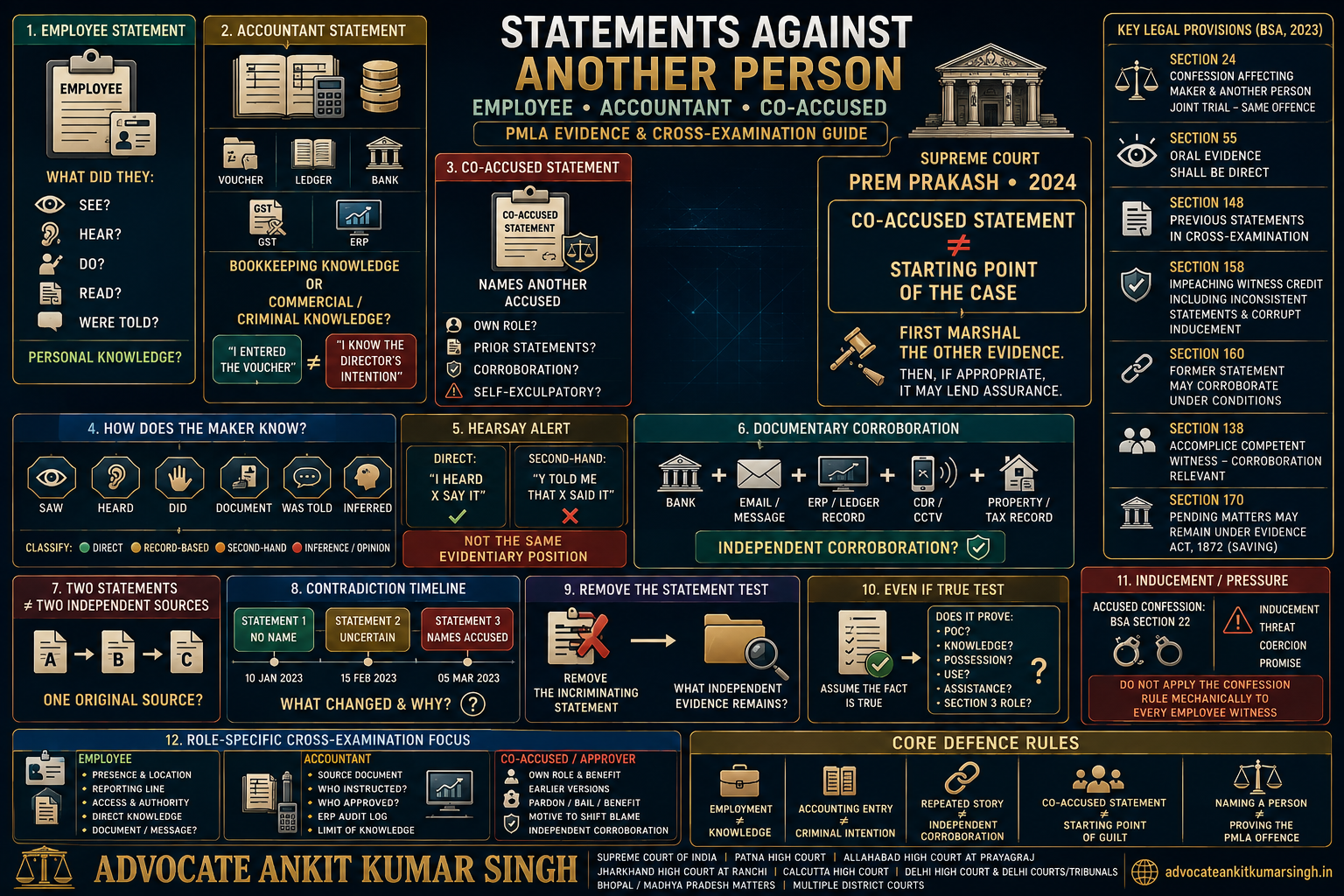
PMLA EVIDENCE • SECTION 50 • WITNESS RELIABILITY • CROSS-EXAMINATION
Statements of Employees, Accountants and Co-Accused Against Another Person in PMLA Cases: Evidentiary Reliability, Personal Knowledge, Corroboration, Hearsay, Inducement and Cross-Examination Strategy
Employee • Accountant • Co-Accused • Personal Knowledge • Hearsay • Corroboration • Contradictions • Cross-Examination
Research updated: 9 August 2026 | By Advocate Ankit Kumar Singh
 Advocate Ankit Kumar Singh
Direct Answer: Can ED Prove Your PMLA Role Merely Because an Employee, Accountant or Co-Accused Named You?
Not automatically.
A statement naming another person must be tested for:
- the maker's exact legal and factual role;
- personal knowledge;
- the precise words actually attributed;
- direct versus second-hand information;
- documentary corroboration;
- earlier inconsistent statements;
- possible bias, incentive or self-interest;
- the prosecution's independent evidence;
- the actual PMLA ingredient the statement is said to prove.
The first question should therefore not be:
“Why did the employee name me?”
It should be:
“How could this employee personally know the fact that he has asserted?”
And where the maker is a co-accused:
THE CO-ACCUSED STATEMENT SHOULD NOT BE TREATED AS THE STARTING POINT OF THE CASE AGAINST ANOTHER ACCUSED.
Section 50 PMLA: Why These Statements Matter
Section 50 permits specified Enforcement Directorate officers to summon a person whose attendance is considered necessary for giving evidence or producing records during an investigation or proceeding under PMLA.
The person summoned is required to attend as directed, state the truth concerning matters on which he or she is examined and produce records lawfully required.
Proceedings under Section 50(2) and Section 50(3) are also statutorily deemed judicial proceedings for the purposes specified by PMLA.
Accordingly, Section 50 statements may become important investigation and prosecution material.
But:
SECTION 50 STATUS DOES NOT REMOVE THE NEED TO TEST WHAT THE STATEMENT ACTUALLY PROVES AGAINST A DIFFERENT PERSON.
The Five Different Types of Statement Content
Every incriminating statement should be divided into five categories.
1. DIRECT OBSERVATION
“I saw X hand the document to Y.”
2. DIRECT HEARING
“I personally heard X instruct Y to transfer ₹25 lakh.”
3. ACT PERFORMED BY THE WITNESS
“I entered the voucher after receiving an email instruction.”
4. SECOND-HAND INFORMATION
“Y told me that X ordered the payment.”
5. INFERENCE / OPINION
“I believe X wanted to conceal the funds.”
These five categories do not have the same evidentiary quality.
BSA Section 55: Oral Evidence Must Be Direct
The Bharatiya Sakshya Adhiniyam requires oral evidence to be direct.
Where a fact could be seen, the witness should speak from seeing it.
Where a fact could be heard, the witness should speak from hearing it.
Therefore the defence should repeatedly ask:
HOW DO YOU KNOW?
For example:
An accountant says:
“The director wanted the amount routed through Company B.”
Cross-examination should determine:
- Did you personally hear the director?
- Where?
- When?
- Who else was present?
- What exact words were used?
- Was the instruction oral or written?
- Did another employee tell you?
- Are you merely inferring this from the ledger?
Hearsay Risk: “I Heard It” Versus “I Was Told About It”
Consider:
DIRECT
“I personally heard A tell B to make the payment.”
SECOND-HAND
“B told me that A had ordered the payment.”
The second statement presents a substantially different evidentiary problem because the person who allegedly heard A is B, not the witness repeating B's version.
The precise admissibility analysis depends upon the purpose for which the statement is offered and whether another statutory relevancy rule or exception applies.
Therefore:
DO NOT USE “HEARSAY” AS A MAGIC WORD.
IDENTIFY THE INFORMATION CHAIN.
Create a “Knowledge Chain” for Every Important Allegation
| Allegation | Maker | How Does Maker Know? | Direct? | Corroboration |
|---|---|---|---|---|
| X instructed transfer | Employee | Claims he heard X | Potentially | Email / witness / none |
| Transfer was bogus | Accountant | Inference from ledger | No direct commercial knowledge? | Invoice / stock / bank |
| X received cash | Co-accused | Claims personal delivery | Potentially | Cash trail / location / messages |
This one exercise often reveals whether an allegation is:
- direct evidence;
- document-backed evidence;
- hearsay;
- assumption;
- investigative inference.
Employee Statement: Designation Does Not Equal Knowledge
An employee may know a great deal—or almost nothing—depending upon the actual role.
Determine:
- designation;
- employment period;
- department;
- reporting officer;
- decision-making authority;
- access to bank accounts;
- access to accounts software;
- access to directors' meetings;
- presence during the transaction;
- communications received;
- documents handled personally.
A junior accounts clerk should not automatically be treated as possessing personal knowledge of a promoter's strategic intention.
Employee Cross-Examination: Personal Knowledge
- What was your exact designation?
- When did you join the company?
- When did you leave?
- Which department did you work in?
- Who was your immediate reporting officer?
- Did you directly report to the accused?
- How frequently did you interact with the accused?
- Were you present at the alleged meeting?
- Where were you sitting?
- Who else was present?
- What exact words did you hear?
- Did you make any contemporaneous note?
- Was any email sent?
- Was any WhatsApp message sent?
- Did you personally execute the instruction?
Employee Cross-Examination: Second-Hand Knowledge
Where the witness says:
“I was informed that the director had approved it.”
ask:
- Who informed you?
- When?
- Was that person present before the director?
- Was the information oral?
- Is there a written instruction?
- Did you verify the information?
- Did you ever speak directly with the director about it?
- Is the person who allegedly gave you this information a prosecution witness?
The defence should expose each link in the information chain.
Employee Cross-Examination: Bias and Employment History
Where supported by genuine material and relevant to credibility, examine:
- termination;
- disciplinary proceedings;
- salary dispute;
- promotion dispute;
- pending dues;
- employment litigation;
- relationship with management;
- relationship with another accused;
- financial interest.
Do not attack a witness personally without evidentiary basis.
Credibility questions should have reasonable grounds and a legitimate connection with the testimony.
Accountant Statement: Separate Bookkeeping From Criminal Knowledge
An accountant may be highly reliable concerning:
- which voucher was entered;
- which ledger was used;
- when the entry was made;
- which invoice was booked;
- how GST was treated;
- how bank reconciliation was performed;
- which user created the entry;
- what narration appeared in the books.
But those facts do not automatically establish that the accountant personally knew:
- the negotiation behind the transaction;
- the accused's subjective intention;
- whether the underlying scheduled offence occurred;
- whether the accused knew that particular property was proceeds of crime;
- whether goods physically moved if the accountant never handled logistics.
The Most Important Accountant Question: Who Supplied the Information?
Every accounting entry originates from something.
Ask:
WHAT WAS THE SOURCE DOCUMENT?
Possible answers:
- invoice;
- bank statement;
- payment voucher;
- email;
- purchase order;
- expense claim;
- oral instruction;
- spreadsheet received from another department.
Then ask:
WHO GAVE THAT DOCUMENT TO THE ACCOUNTANT?
Accountant Cross-Examination: Voucher Entry
- Did you personally create this voucher?
- What was the creation date?
- What is the voucher date?
- Which user ID created it?
- Was that user ID shared?
- What source document did you use?
- Who provided that document?
- Who approved the voucher?
- Did the accused personally approve it?
- Is there written approval?
- Was the narration entered by you?
- Who told you the narration?
- Was the voucher later edited?
- Who edited it?
- Does the ERP audit trail record the change?
Accountant Cross-Examination: Payment
- Who created the payment instruction?
- Who authorised internet banking?
- Who had the token / access?
- Was dual authorisation required?
- Who signed the cheque?
- Was the payment generated automatically?
- Was it a vendor batch payment?
- Did you personally know the commercial purpose?
- Did you merely book what another department supplied?
- Did you ever speak to the accused regarding this payment?
Accountant Cross-Examination: Commercial Reality
Ask whether the accountant personally knew:
- goods were ordered;
- goods were delivered;
- services were performed;
- the supplier had capacity;
- stock entered the warehouse;
- the contract was genuine;
- the transaction was cancelled;
- there was a subsequent credit note.
The accountant may truthfully answer:
“I only booked the invoice.”
That distinction can materially change the evidentiary value of the broader allegation.
Accountant's Interpretation of a Ledger Is Not Automatically Proof of Intention
Suppose an accountant says:
“The entry was made to hide the real beneficiary.”
Ask:
- Did anyone tell you this?
- Who?
- What exact words were used?
- Is there a document?
- Or is this your interpretation after seeing the transaction?
An accounting conclusion and a conclusion about criminal intention are not automatically the same thing.
Documentary Corroboration: Build an Allegation-to-Record Matrix
| Statement Allegation | Document Expected | Found? | Consistent? |
|---|---|---|---|
| X ordered payment | Email / message / approval | _____ | _____ |
| X attended meeting | Calendar / CDR / CCTV | _____ | _____ |
| X received money | Bank / cash / property trail | _____ | _____ |
| Invoice was bogus | Stock / GST / delivery / vendor | _____ | _____ |
What Is Good Corroboration?
Good corroboration tends to be independent of the maker's later narrative.
Examples may include:
- bank record created contemporaneously;
- email sent at the time;
- system audit log;
- signed approval;
- independent CCTV;
- travel record;
- GST data;
- property document;
- independent counterparty record.
What Is Weak “Corroboration”?
Consider:
Witness A says:
“X ordered the transaction.”
Witness B says:
“A told me that X ordered the transaction.”
Witness B may not independently corroborate the underlying instruction if his only source is Witness A.
Always identify whether the supposed corroborating witness had an independent source of knowledge.
Two Statements Are Not Necessarily Two Independent Sources
This point deserves special attention in prosecution complaints.
Prepare a source map:
WHO LEARNED THE FACT FIRST?
If:
A → tells B → tells C,
then three statements may ultimately have only one source.
Counting witnesses is not the same as proving independent corroboration.
Co-Accused Statement: The Prem Prakash Principle
The Supreme Court in Prem Prakash v. Union of India directly considered Section 50 statements made by co-accused against another accused.
The Court held that the incriminating statement of the co-accused does not have the character of substantive evidence against the other accused.
It further held that the prosecution cannot begin with such statement as the foundation of its case.
The correct approach is:
FIRST MARSHAL THE OTHER EVIDENCE.
Only thereafter can the co-accused statement, where legally permissible, operate in the limited manner recognised by law.
The Kashmira Singh Method
The practical method is:
STEP 1
Temporarily remove the co-accused confession/statement from the evidentiary picture.
STEP 2
Examine the remaining independent evidence against the accused.
STEP 3
Ask whether that evidence independently supports the prosecution case.
STEP 4
Only then consider whether the co-accused material can legally lend assurance to otherwise existing evidence.
This method prevents the accusation from proving itself.
BSA Section 24: Co-Accused Confession in a Joint Trial
For proceedings governed by the Bharatiya Sakshya Adhiniyam, Section 24 deals with a proved confession where:
- more than one person is being tried jointly;
- for the same offence;
- the confession affects the maker;
- and affects another person jointly tried.
The Court may take that confession into consideration against the other person as well as the maker.
Important:
CHECK THE JOINT-TRIAL REQUIREMENT.
And do not confuse “may take into consideration” with ordinary independent substantive proof.
BSA Section 170: Which Evidence Law Applies?
The Bharatiya Sakshya Adhiniyam came into force on 1 July 2024.
Its Section 170 saves pending:
- applications;
- trials;
- inquiries;
- investigations;
- proceedings;
- appeals
that were already pending immediately before commencement.
Those saved matters continue under the Indian Evidence Act, 1872.
Therefore:
FIRST IDENTIFY THE GOVERNING EVIDENCE STATUTE.
What If the Co-Accused Becomes an Approver or Prosecution Witness?
The evidentiary position then requires separate analysis.
Current BSA Section 138 expressly addresses an accomplice as a competent witness and refers to corroborated accomplice testimony.
Therefore examine:
- the pardon / approver order where applicable;
- conditions attached to it;
- earlier Section 50 statements;
- earlier police / Magistrate statements;
- changes in the narrative;
- independent corroboration;
- whether the witness minimises his own role.
Self-Exculpatory Structure: Does the Statement Shift Blame?
Consider:
“I merely followed X's instructions.”
The statement simultaneously:
- implicates X;
- reduces the maker's claimed responsibility.
That does not prove the statement is false.
But it is a legitimate reliability question.
Test:
- Was the maker independently authorised?
- Did he benefit?
- Did he initiate transactions?
- Did he control accounts?
- Do documents show his independent decision-making?
“I Was Only Following Instructions” Should Be Tested Against Documents
If the witness says:
“I had no role. I only acted on X's direction.”
compare that with:
- board resolutions;
- bank mandate;
- email;
- negotiations;
- contracts;
- messages;
- payment approvals;
- profit received;
- asset ownership.
The witness's own conduct may contradict the attempted minimisation.
Inducement, Threat, Coercion and Promise: Use the Correct Legal Category
Do not place every allegation of pressure into the same legal box.
ACCUSED PERSON'S CONFESSION
BSA Section 22 specifically addresses a confession caused by the statutorily described inducement, threat, coercion or promise.
ORDINARY EMPLOYEE / WITNESS
The issue may primarily concern:
- credibility;
- bias;
- self-interest;
- corrupt inducement;
- prior inconsistency;
- weight.
Do not automatically say:
“Employee says he felt pressure, therefore the entire statement is legally inadmissible.”
That is too broad.
BSA Section 158: Impeaching Witness Credit
The current evidence statute allows witness credit to be challenged through recognised methods, including:
- evidence bearing upon credibility;
- proof of bribe or corrupt inducement;
- former statements inconsistent with the evidence given.
Accordingly, a proper credibility challenge should be evidence-based.
Benefit, Bail, Pardon or Non-Prosecution: What Is the Correct Defence Approach?
Do not automatically argue:
“He received bail later, therefore his statement was purchased.”
Sequence alone does not prove inducement.
Instead build an objective chronology:
| Date | Event |
|---|---|
| __/__/____ | First statement |
| __/__/____ | Arrest / custody |
| __/__/____ | Statement implicating accused |
| __/__/____ | Bail proceeding |
| __/__/____ | Pardon / approver order, if any |
Then ask what the documents genuinely permit the Court to infer.
Earlier Statement Did Not Name the Accused — Later Statement Does
This is an important contradiction audit.
Prepare:
| Question | Statement 1 | Statement 2 | Statement 3 |
|---|---|---|---|
| Did X attend meeting? | No reference | Uncertain | Yes |
| Did X give instruction? | No | No answer | Yes |
| Did X receive money? | No | No | Yes |
The defence should not merely say:
“He changed his statement.”
Identify the exact changed proposition.
BSA Section 148: Previous Written Statements
Where a witness has previously made a statement in writing or reduced into writing, the statutory cross-examination mechanism concerning previous statements becomes important.
If the defence intends to contradict the witness using the earlier writing, the witness's attention should be drawn to the relevant portion in accordance with the statutory procedure.
Prepare page-and-line references before trial.
Build a Contradiction Book Before Cross-Examination
For each witness create:
| Topic | First Statement | Later Statement | Document | Cross Point |
|---|---|---|---|---|
| Meeting | Did not mention X | X allegedly present | Calendar / CDR | Why added later? |
Do not walk into cross-examination with hundreds of unclassified pages.
Omission Versus Contradiction
Not every omission is automatically a contradiction.
Ask:
- Was the witness asked about the fact earlier?
- Was the earlier statement intended to be exhaustive?
- Is the later addition materially inconsistent?
- Does the new fact fundamentally alter the accused's alleged role?
The stronger point is often a material change, not a minor omitted detail.
Cross-Examination Should Be Proposition-Specific
Bad approach:
“You are lying about everything.”
Better approach:
“In your statement dated 10 January you did not state that X attended the meeting, correct?”
Then:
“Your first allegation that X attended appears in the statement dated 5 March, correct?”
Then examine what occurred between those dates where legally relevant.
Statement Versus Objective Digital Evidence
If an employee claims:
“I met X at 4 PM.”
compare:
- CDR;
- cell location;
- CCTV;
- access-control logs;
- calendar;
- travel booking;
- GPS/location artefacts where lawfully proved.
Objective evidence may:
- corroborate;
- contradict;
- remain inconclusive.
Statement Versus Bank Evidence
Witness says:
“X transferred ₹50 lakh to Y.”
Check:
- whose account sent it;
- who was signatory;
- who initiated online transfer;
- UTR;
- maker-checker logs;
- authorisation structure;
- actual beneficiary;
- subsequent movement.
Do not convert company-account movement automatically into a personal act by one director.
Statement Versus Tally / ERP Evidence
Witness says:
“X ordered me to create the false entry.”
Review:
- voucher creation timestamp;
- user ID;
- edit history;
- narration;
- source document;
- email trail;
- approval workflow;
- audit log.
The native accounting record may confirm or undermine the statement.
Statement Versus Email and WhatsApp
Where a witness attributes an instruction to another person, communication evidence can be highly important.
Ask:
- Is the alleged instruction in writing?
- Is the complete conversation available?
- Who authored it?
- What preceded it?
- What followed it?
- Is the message merely forwarding someone else's instruction?
- Does the language support the interpretation claimed by the witness?
Statement Versus Board and Corporate Records
If a witness says:
“X alone decided the transaction.”
compare:
- board minutes;
- committee approvals;
- delegation matrix;
- bank authority;
- procurement policy;
- signing limits;
- company resolutions.
Formal authority does not always prove actual conduct, but it is important context.
The “Criminal Intention” Problem
Witnesses often describe acts and then add a conclusion.
Example:
“Money moved to Company B, therefore X wanted to layer the proceeds.”
Break the sentence apart:
FACT
Money moved to Company B.
ATTRIBUTION
X instructed the transfer.
MENTAL ELEMENT
X knew the money was alleged proceeds of crime.
CONCLUSION
The transfer was intended as laundering/layering.
Each proposition needs its own evidentiary foundation.
Knowledge of a Transaction Is Not Automatically Knowledge of Criminal Origin
A person may know:
- payment was made;
- invoice existed;
- company received funds;
- loan was transferred.
That does not necessarily establish knowledge that the property was derived from criminal activity relating to a scheduled offence.
The PMLA nexus must be proved through the statutory ingredients and admissible evidence.
Employee Says: “The Director Knew Everything”
This phrase should trigger immediate cross-examination.
Ask:
- What does “everything” mean?
- Which specific transaction?
- How do you know what was in his mind?
- What did he say?
- When?
- Where?
- Who heard it?
- What document records it?
General conclusions should be converted into provable factual propositions.
Accountant Says: “These Were Accommodation Entries”
Ask:
- Did you personally know the vendor?
- Did you examine delivery?
- Did you see goods?
- Did you review GST?
- Did you examine stock?
- Did you know the commercial agreement?
- Did you only book the invoice?
- When did you first form the opinion that it was bogus?
The accountant may prove bookkeeping facts while lacking direct knowledge of actual commercial performance.
Co-Accused Says: “I Acted Only on X's Instructions”
Cross-examine:
- What was your own role?
- Did you negotiate?
- Did you benefit financially?
- Did you control the bank account?
- Did you sign documents?
- Did you recruit intermediaries?
- Did you communicate directly with recipients?
- Which document records X's alleged instruction?
- Why was X not named earlier, if applicable?
- What independent evidence corroborates your allegation?
Role-Specific Cross-Examination Matrix
| Maker | Primary Defence Focus |
|---|---|
| Employee | Presence, reporting line, access, direct knowledge |
| Accountant | Source document, bookkeeping limits, ERP trail |
| CFO | Approval structure, financial authority, board reporting |
| Cashier | Physical custody, recipient identity, cash records |
| Vendor | Supply, invoice, commercial relationship, payment |
| Co-accused | Own role, self-interest, contradictions, corroboration |
| Approver / accomplice | Prior versions, pardon/benefit, independent corroboration |
The 12-Question Reliability Test
For every statement used against another person ask:
- Who is the maker?
- What was the maker's role?
- Was the maker present?
- What did the maker personally see?
- What did the maker personally hear?
- What came from another person?
- What is merely an inference?
- What contemporaneous record supports it?
- What did earlier statements say?
- What interest or bias may exist?
- What independent evidence exists without this statement?
- Even if accepted, which PMLA ingredient does it prove?
The “Remove the Statement” Test
This is particularly useful with a co-accused statement.
Temporarily remove the statement from the case.
Then ask:
WHAT EVIDENCE REMAINS AGAINST THE ACCUSED?
Possible remaining evidence:
- bank transaction;
- document;
- email;
- property;
- digital evidence;
- CDR;
- independent witness;
- financial benefit.
If the entire accusation collapses once the co-accused statement is removed, the Prem Prakash principle becomes particularly important.
The “Even If True” Test
Another powerful technique is to temporarily assume the statement is correct.
Then ask:
“Even if this sentence is true, does it establish money-laundering?”
Example:
“X attended a meeting.”
Even if true:
Did X know of proceeds of crime?
Did X possess, conceal, acquire or use them?
Did X knowingly assist?
Was X involved in projection or claiming of the property as untainted?
Presence and criminal participation are different propositions.
What the Defence Should Obtain Before Trial
- Complete Section 50 statement of the witness.
- Every earlier Section 50 statement.
- Relevant police/CBI/EOW statement where lawfully supplied.
- Magistrate-recorded statement where applicable.
- Prosecution-complaint summary of the statement.
- Complete RUD containing the statement.
- Documents allegedly shown during examination.
- Bank records relied upon.
- Emails/messages relied upon.
- CDRs relied upon.
- Tally/ERP records.
- Corporate approvals.
- Search/seizure records.
- Relevant bail/pardon chronology where legally material.
Do Not Cross-Examine Only From the Prosecution Complaint Summary
A prosecution complaint may summarise a lengthy statement in a few paragraphs.
The defence should review the complete underlying statement.
Check whether the summary:
- omits qualifications;
- omits “I do not know” answers;
- omits earlier contradictory answers;
- combines several separate statements;
- uses prosecution inference rather than the maker's exact words.
Question-Answer Context Matters
An answer cannot always be fairly understood without the question.
Compare:
“Yes.”
with the actual preceding question.
Was the witness agreeing:
- that the transfer occurred;
- that the accused knew about it;
- that the witness was shown a document;
- or that a proposition suggested by the examiner was correct?
Always read the complete question and answer together.
Suggested Defence Statement Matrix
| Statement | Knowledge Type | Corroboration | Contradiction | PMLA Relevance |
|---|---|---|---|---|
| “X told me to transfer ₹20 lakh.” | Direct hearing? | Email / none | Earlier statement? | Instruction only |
| “X knew it was criminal money.” | Inference? | Communication? | _____ | Knowledge allegation |
| “I paid cash to X.” | Direct act | Cash / location / messages | _____ | Receipt allegation |
60-Point Defence Checklist for Statements Against Another Person
- Identify maker.
- Identify maker's legal status.
- Employee?
- Accountant?
- Co-accused?
- Approver?
- Identify statement date.
- Identify custody status.
- Identify employment status.
- Obtain complete statement.
- Obtain all prior statements.
- Prepare statement chronology.
- Extract exact allegation.
- Separate direct observation.
- Separate direct hearing.
- Separate witness's own act.
- Separate record-based knowledge.
- Separate hearsay.
- Separate opinion.
- Separate prosecution inference.
- Identify where maker was located.
- Verify presence.
- Verify reporting relationship.
- Verify authority.
- Verify access.
- Identify source document.
- Identify email.
- Identify WhatsApp.
- Identify bank evidence.
- Identify CDR.
- Identify CCTV.
- Identify ERP record.
- Identify audit trail.
- Identify GST record.
- Identify stock record.
- Identify property document.
- Identify independent witnesses.
- Identify missing corroboration.
- Compare first statement.
- Compare second statement.
- Compare later statement.
- Identify material additions.
- Identify material omissions.
- Identify direct contradictions.
- Check self-exculpatory language.
- Check maker's own benefit.
- Check financial interest.
- Check employment dispute.
- Check custody chronology.
- Check bail chronology where relevant.
- Check pardon/approver chronology where relevant.
- Do not infer inducement without evidence.
- Determine applicable Evidence Act/BSA regime.
- Apply co-accused rule correctly.
- Prepare Section 148 contradiction references.
- Prepare credibility cross-examination.
- Prepare documentary confrontation.
- Apply the “remove the statement” test.
- Apply the “even if true” test.
- Map the remaining proved facts to Section 3 PMLA.
Statement Reliability Flowchart
A third-party Section 50 statement should be analysed by identifying the maker, separating direct knowledge from hearsay or inference, finding independent corroboration, testing contradictions and interests, and finally asking what the proved fact actually establishes under PMLA.Frequently Asked Questions
1. Can an employee's Section 50 statement be used against a director?
It can form part of the evidentiary record where legally admissible, but its reliability and actual probative value depend upon the employee's personal knowledge, corroboration, contradictions and the fact sought to be proved.
2. Does an employee saying “my boss told me” prove the instruction?
The defence should establish whether the employee personally heard the instruction, when and where it occurred, who else was present and whether contemporaneous records support the assertion.
3. Is an accountant's ledger evidence enough to prove criminal intention?
No automatic conclusion follows. An accountant may know how a transaction was booked without having personal knowledge of the accused's intention or the underlying commercial negotiations.
4. Can an accountant prove that an invoice was bogus?
That depends upon the accountant's actual knowledge. If the accountant only booked an invoice, stock, delivery, GST, vendor and commercial-performance evidence may be needed to determine whether the underlying transaction was genuine.
5. What did Prem Prakash say about a co-accused statement?
The Supreme Court held that the incriminating statement of a co-accused against another accused does not have the character of substantive evidence and cannot be the prosecution's starting point; the other evidence must first be marshalled.
6. Can a co-accused statement ever be considered?
Yes, within the applicable statutory framework and limitations. For current BSA-governed joint trials, Section 24 is relevant. Saved proceedings may continue under the old Evidence Act.
7. Does BSA Section 24 require a joint trial?
The provision expressly addresses persons being tried jointly for the same offence, subject to its explanations.
8. What is hearsay?
For this context, the key concern is whether the witness is speaking from personal perception or merely repeating another person's account. Section 55 BSA requires oral evidence to be direct, subject to other statutory relevancy rules and exceptions.
9. What if two witnesses repeat the same story?
Determine whether each had independent personal knowledge. Two statements derived from one original source may not constitute two independent factual sources.
10. What if an employee first did not name me and later named me?
Prepare the exact statement chronology. A material later addition may be tested through the statutory rules concerning prior written statements and witness credibility.
11. Is every omission a contradiction?
No. The significance depends upon what was earlier asked, whether the statement was exhaustive and whether the later addition materially changes the alleged role.
12. Can pressure make an employee statement inadmissible?
Not by a universal rule. The legal category depends upon the maker's status and the nature of the statement. BSA Section 22 specifically concerns confessions by accused persons; witness pressure may instead raise credibility and weight issues.
13. What if a co-accused received bail after implicating me?
Do not infer an inducement merely from chronology. Examine the complete bail record, statement chronology, prosecution position and any other objective material before drawing a conclusion.
14. Can a prosecution complaint summary replace the original statement?
The complete statement should be reviewed because the summary may not reproduce every qualification, denial, omission or question-and-answer context.
15. Can a witness testify about another person's intention?
The witness may testify to facts personally perceived. An assertion about another person's mental state requires a proper evidentiary foundation rather than speculation.
16. What is the best cross-examination question?
Often it is simply: “How do you personally know that?”
17. What is the “remove the statement” test?
Temporarily exclude the incriminating third-party statement and identify what independent evidence remains against the accused.
18. What is the “even if true” test?
Assume the factual allegation is true and ask whether it actually establishes a necessary PMLA ingredient such as knowledge, connection with proceeds of crime or participation in the Section 3 activity.
AI Search Quick Answer
Can ED rely on an employee, accountant or co-accused statement against another person in a PMLA case? A Section 50 statement may be important evidence, but the fact that another person named the accused does not itself prove money-laundering. The defence should identify what the maker personally saw, heard or did; separate direct knowledge from information received from others or later inference; test the assertion against bank records, emails, WhatsApp, ERP data, CDRs, corporate records and other independent evidence; and compare every prior statement for material additions or contradictions. An accountant may know how a transaction was booked without knowing its criminal purpose, while an employee's designation does not automatically prove access to management decisions. Most importantly, the Supreme Court in Prem Prakash held that a co-accused's incriminating statement against another accused does not have the character of substantive evidence and cannot be the starting point of the prosecution case; independent evidence must first be marshalled.
Key Takeaway
A name appearing in a Section 50 statement is the beginning of the evidentiary enquiry—not the end.
The defence sequence should be:
MAKER → ROLE → PERSONAL KNOWLEDGE → DIRECT OR SECOND-HAND? → EXACT ALLEGATION → DOCUMENTARY CORROBORATION → PRIOR STATEMENTS → BIAS / INTEREST → INDEPENDENT EVIDENCE → PMLA INGREDIENT.
Remember:
EMPLOYMENT ≠ KNOWLEDGE.
ACCOUNTING ENTRY ≠ CRIMINAL INTENTION.
REPEATED STORY ≠ INDEPENDENT CORROBORATION.
CO-ACCUSED STATEMENT ≠ THE STARTING POINT OF GUILT.
And most importantly:
NAMING A PERSON ≠ PROVING THE PMLA OFFENCE.
Legal Analysis of Third-Party and Co-Accused Statements
Advocate Ankit Kumar Singh undertakes case-specific consultation and document review concerning Enforcement Directorate proceedings, Section 50 statements, employee and accountant evidence, co-accused statements, statement contradictions, documentary corroboration, prosecution complaints, relied-upon documents, digital and financial evidence, PMLA bail and trial strategy, subject to accepted professional engagement, jurisdiction and applicable procedure.
Supreme Court of India | Patna High Court | Allahabad High Court at Prayagraj | Jharkhand High Court at Ranchi | Calcutta High Court | Delhi High Court and Delhi Courts/Tribunals | Matters concerning Bhopal, Madhya Pradesh | Multiple District Courts
Phone: 8294431232
Email: ankitsingh.legum@gmail.com
Website: advocateankitkumarsingh.in
Where filing or acting before the Supreme Court of India requires an Advocate-on-Record, the applicable Supreme Court procedure must be followed.
No statement can responsibly be assessed in isolation from the complete question-and-answer record, the maker's status, prior statements, corroborating documents and the particular stage of the PMLA proceeding.
Official and Primary Sources
- India Code — Prevention of Money-Laundering Act, 2002
- India Code — Bharatiya Sakshya Adhiniyam, 2023
- Supreme Court — Prem Prakash v. Union of India
- Supreme Court — Vijay Madanlal Choudhary v. Union of India
- Supreme Court — Arvind Kejriwal v. Directorate of Enforcement
- Directorate of Enforcement — PMLA Acts and Rules
Add Advocate Ankit Kumar Singh as a Preferred Source on Google
Readers who want to see more legal research, court updates, cyber law, PMLA, ED, criminal-law and litigation content from Advocate Ankit Kumar Singh can add advocateankitkumarsingh.in as a Preferred Source on Google.
Add advocateankitkumarsingh.in as a Preferred Source on Google
Disclaimer: This article is intended for general legal education and PMLA evidence analysis. The evidentiary treatment of a statement depends upon the maker's status, the applicable evidence statute, the purpose for which the statement is tendered, whether the maker testifies, the existence of independent corroboration, prior statements, custody or approver status and the procedural stage. Hearsay, confession, admission, accomplice evidence and co-accused evidence are distinct legal categories and should not be used interchangeably. No allegation of coercion, inducement, bias, benefit or fabrication should be made without a genuine factual foundation. Case-specific trial strategy should be formulated from the complete prosecution complaint, RUDs, original statements and corroborating record.