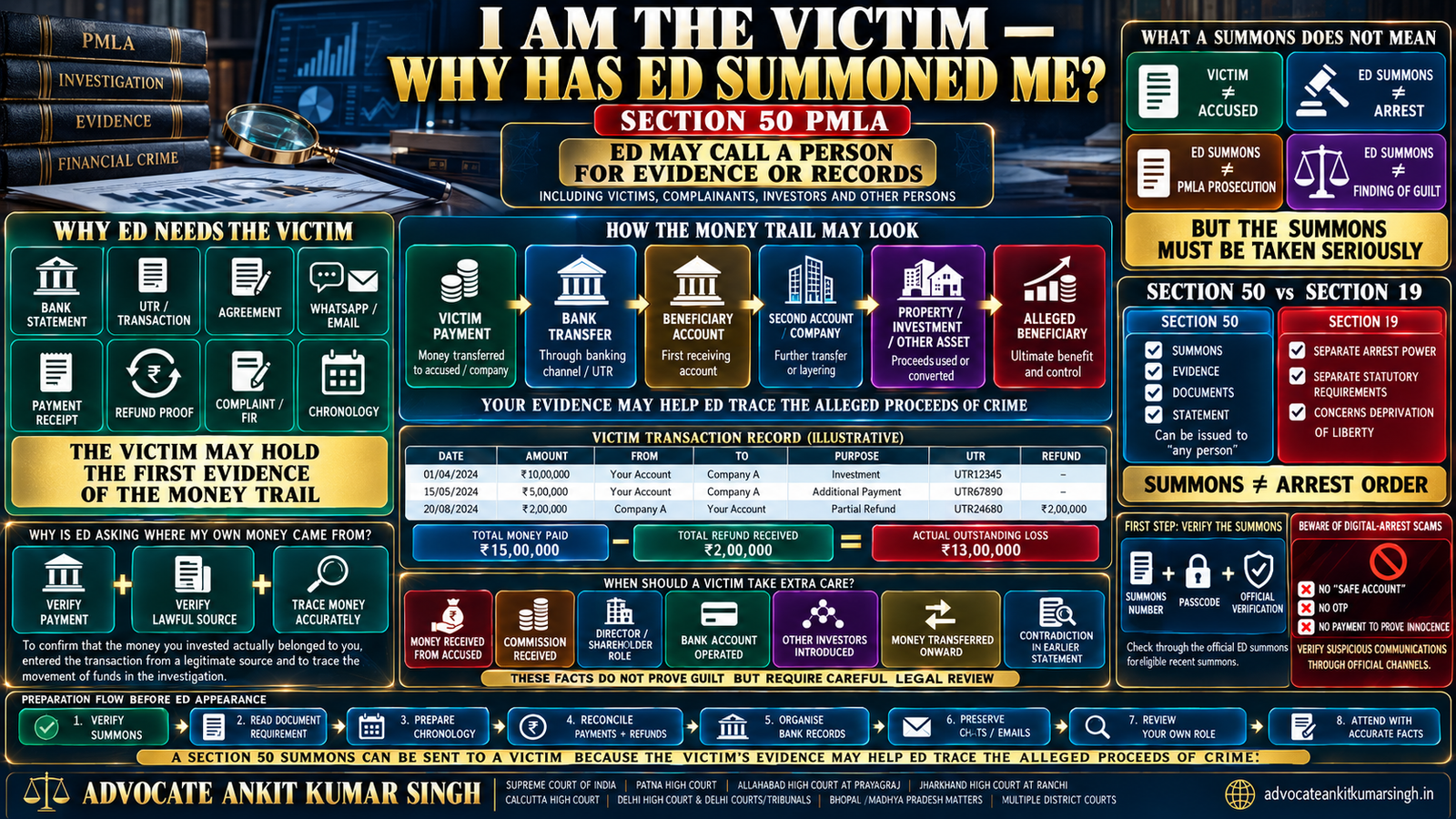
Best ED Summons Lawyer in India for Victims and Complainants: “I Am the Victim—Why Has ED Summoned Me Under Section 50 PMLA?”
SUMMARY: If you are the complainant or the person who lost money, receiving an ED summons can feel confusing: “I am the victim—why is ED calling me?” The answer is that an ED summons under Section 50 PMLA is an evidence-gathering process and is not issued only to accused persons. A victim, complainant, investor or other person possessing relevant information or records may also be called to give evidence or produce documents.
Legal Update: Reviewed on 29 September 2026. Section 50 of the Prevention of Money-Laundering Act, 2002 continues to empower specified Enforcement Directorate officers to summon any person whose attendance is considered necessary for giving evidence or producing records in an investigation or proceeding under the Act.
 Advocate Ankit Kumar Singh
Direct Answer: “I Am the Victim—Why Has ED Summoned Me?”
Because an ED summons under Section 50 PMLA is not issued only to accused persons.
The Enforcement Directorate can summon a person whose evidence or records are considered relevant to a PMLA investigation or proceeding.
If you are a victim, ED may need you to explain:
- how you came into contact with the alleged accused;
- what representation was made to you;
- why you transferred money;
- how much money you paid;
- which account received the money;
- whether any amount was returned;
- what documents were provided to you;
- which company or individual dealt with you;
- what conversations occurred;
- whether you know other victims; and
- how the alleged fraud actually operated.
In many cases the victim possesses the original evidence from which the money trail begins.
Therefore:
VICTIM
≠
ACCUSED

ED SUMMONS
≠
ARREST

ED SUMMONS
≠
PMLA PROSECUTION

ED SUMMONS
≠
FINDING OF GUILT

BUT

ED SUMMONS
=
SERIOUS STATUTORY PROCESS
THAT SHOULD BE RESPONDED TO CAREFULLY
What Does Section 50 PMLA Actually Allow ED to Do?
Section 50 gives specified Enforcement Directorate authorities statutory powers concerning:
- attendance of persons;
- examination;
- giving evidence;
- production of records;
- inspection;
- affidavit evidence; and
- other matters contemplated by the provision.
The critical expression for a victim is:
“ANY PERSON”.
The provision is not worded as:
“any accused person”.
Therefore ED can call:
- accused persons;
- suspects;
- witnesses;
- complainants;
- investors;
- fraud victims;
- bank officials;
- company employees;
- accountants;
- directors;
- intermediaries;
- reporting-entity officers; and
- other persons with relevant evidence.
Why Would ED Need Evidence From the Victim?
A money-laundering investigation often requires ED to reconstruct what happened to money allegedly generated from criminal activity.
A fraud victim may be the starting point of that trail.
VICTIM
↓
PAYMENT
↓
FIRST BENEFICIARY ACCOUNT
↓
SECOND ACCOUNT
↓
COMPANY / INTERMEDIARY
↓
CASH / PROPERTY / INVESTMENT
↓
ALLEGED BENEFICIAL OWNER
The victim may therefore help ED establish:
- origin of the payment;
- amount lost;
- first receiving account;
- purpose represented for the payment;
- persons involved;
- companies involved;
- refunds;
- further transfers known to the victim; and
- documents proving the underlying transaction.
Example: Investor Who Lost Money
Suppose an investor transferred ₹25 lakh after being promised investment returns.
The investor subsequently files a police complaint alleging fraud.
The predicate investigation later becomes relevant to an ED inquiry.
ED may summon the investor to establish:
- date of investment;
- bank account used;
- beneficiary account;
- investment agreement;
- representations made;
- communications;
- amount returned, if any;
- amount still unpaid;
- identity of the persons who induced the investment; and
- whether the investor knows where the money went.
The investor may remain the victim throughout the process.
The summons itself does not convert the investor into an accused.
Example: You Filed the Original FIR
Some complainants are surprised because they assume:
“I already gave everything to the police. Why does ED need me again?”
The answer is that the police investigation and PMLA investigation perform different legal functions.
The police may investigate the scheduled or predicate offence.
ED may separately examine the alleged proceeds of crime and their subsequent handling.
ED may therefore need:
- your original complaint;
- your statement;
- bank proof;
- transaction details;
- agreements;
- communications;
- refund details; and
- other records establishing the alleged proceeds.
Why Is ED Asking for My Bank Statement If I Am the Victim?
This is one of the most common questions.
Your bank statement can prove:
- that the money actually belonged to you;
- when you transferred it;
- how much you transferred;
- which beneficiary received it;
- transaction reference number;
- whether multiple instalments were made;
- whether money came back;
- whether any refund was received; and
- the exact financial loss.
For example:
YOUR BANK ACCOUNT
↓
₹10,00,000
↓
COMPANY-A ACCOUNT
↓
TRANSFER TO COMPANY-B
↓
PROPERTY / ACCOUNT / INVESTMENT
Your statement may provide the evidentiary starting point for tracing that money.
Why Is ED Asking About the Source of My Own Money?
A genuine victim may feel offended when asked:
“Where did you get the money that you invested?”
That question does not automatically mean ED suspects you.
Source-of-funds information may help establish that:
- the money existed before the alleged fraud;
- it lawfully belonged to the victim;
- it entered the questioned transaction from a legitimate source;
- the payment was genuinely made;
- the amount was not circularly routed back to the victim; and
- the victim is economically distinct from the alleged beneficiaries.
Depending on the amount and facts, relevant records might include:
- salary records;
- business income;
- bank balance;
- loan documents;
- property-sale proceeds;
- investment redemption;
- family transfer;
- tax documents; or
- other lawful source records.
Why Does ED Want My WhatsApp Chats and Emails?
Communications can prove the alleged representation made before the victim transferred money.
They may establish:
- who contacted the victim;
- what was promised;
- investment terms;
- payment instructions;
- beneficiary account;
- company details;
- false representations;
- requests for further payments;
- refund promises;
- admissions;
- identity of intermediaries; and
- chronology of the transaction.
A victim should preserve the original electronic material wherever possible.
Do not unnecessarily edit, crop, alter or recreate communications if the originals are available.
Why Is ED Asking Whether I Received a Refund?
Refund evidence can materially affect the money trail.
ED may need to know:
- whether any money came back;
- who returned it;
- which account made the refund;
- when the refund occurred;
- whether it was full or partial;
- whether it happened before or after the police complaint;
- whether it was described as profit, principal or settlement; and
- the victim's actual outstanding loss.
A victim should therefore disclose the complete transaction history rather than mentioning only payments made while omitting repayments received.
Does an ED Summons Mean I Am an Accused?
No—not by itself.
The Supreme Court has recognised the breadth of Section 50 and explained that the power is used for collection of information and evidence.
The summons stage should therefore be distinguished from a later prosecutorial decision.
The safer legal formulation is:
SUMMONED PERSON
≠
AUTOMATICALLY ACCUSED
But the reverse should also be understood:
SUMMONED AS VICTIM / WITNESS TODAY
≠
PERMANENT IMMUNITY FROM INVESTIGATION
If independent evidence later suggests another role, the person's legal status can require reassessment.
Can ED Arrest Me Simply Because I Have Received a Summons?
The summons itself is not an arrest order.
Section 50 summons and the statutory power of arrest under the PMLA are legally distinct.
An arrest under the PMLA requires satisfaction of the separate statutory requirements governing arrest.
A genuine victim should therefore not assume:
“Summons received = arrest confirmed.”
At the same time, no responsible lawyer should promise:
“You are a victim, therefore arrest can never occur regardless of later evidence.”
The correct approach is to review:
- the summons;
- predicate FIR;
- your role;
- money received and paid;
- bank accounts;
- company connection;
- documents sought;
- earlier statements; and
- any potential allegation against you.
Section 50 Summons and Section 19 Arrest Are Different
| Section 50 | Section 19 |
|---|---|
| Summons / evidence-gathering power | Arrest power |
| Can apply to “any person” | Requires separate statutory basis |
| May seek statement | Concerns deprivation of liberty |
| May seek records | Requires statutory arrest safeguards |
| Summons itself is not arrest | Separate legal event |
What Is the Legal Importance of a Section 50 Statement?
A Section 50 examination should not be treated casually.
Proceedings contemplated by Section 50 are statutorily treated as judicial proceedings for the purposes specified by the PMLA.
The summoned person is expected to:
- attend as directed;
- answer truthfully;
- produce records required by the summons; and
- avoid deliberately false statements or concealment.
This is why a victim should prepare carefully even though he or she is not presently an accused.
Do Not Guess When You Do Not Know the Answer
A genuine victim does not need to know the internal affairs of the accused's company merely because ED asks about them.
If you genuinely do not know something, the appropriate factual answer may simply be:
“I do not know.”
Similarly:
- do not assume;
- do not speculate;
- do not adopt facts told by another victim as your personal knowledge;
- do not guess account ownership;
- do not invent dates;
- do not exaggerate your loss; and
- do not minimise refunds received.
Your statement should distinguish:
WHAT I PERSONALLY KNOW
from
WHAT SOMEBODY ELSE TOLD ME.
Your Chronology Should Be Prepared Before the ED Appearance
A simple chronology can prevent genuine mistakes during questioning.
VICTIM CHRONOLOGY

FIRST CONTACT:
____________________________

PERSON WHO CONTACTED ME:
____________________________

REPRESENTATION MADE:
____________________________

AGREEMENT / OFFER:
____________________________

FIRST PAYMENT:
DATE:
AMOUNT:
ACCOUNT:

SECOND PAYMENT:
DATE:
AMOUNT:
ACCOUNT:

TOTAL PAID:
____________________________

REFUND RECEIVED:
____________________________

TOTAL LOSS:
____________________________

COMPLAINT FILED:
____________________________

FIR DETAILS:
____________________________

DOCUMENTS GIVEN TO POLICE:
____________________________

PERSONS I DEALT WITH:
____________________________

COMPANIES INVOLVED:
____________________________

LAST COMMUNICATION:
____________________________

CURRENT OUTSTANDING AMOUNT:
____________________________
Documents a Fraud Victim Should Consider Organising
The precise requirement depends upon the summons, but a well-organised victim file can include:
- ED summons;
- identity proof;
- original complaint;
- FIR copy;
- police statement where available;
- agreement;
- application form;
- investment documents;
- invoices;
- receipts;
- bank statements;
- transaction confirmation;
- UTR / transaction reference;
- cheques;
- payment-gateway receipts;
- emails;
- WhatsApp / messaging records;
- letters;
- company brochures;
- website representations preserved lawfully;
- refund proof;
- settlement correspondence;
- court proceedings;
- consumer proceedings;
- arbitration documents where relevant;
- tax / source-of-funds material where specifically relevant; and
- one transaction chronology.
Do Not Carry a Random Pile of Documents
A common practical mistake is arriving with hundreds of unorganised pages.
Instead, prepare:
- Document Index
- Chronology
- Bank Transaction Table
- Complaint / FIR
- Agreements
- Communications
- Refund Evidence
- Supporting Records
Keep copies arranged chronologically.
Where documents are specifically produced, maintain your own record of what was submitted.
Victim Transaction Table
| Date | Amount | From | To | Purpose Represented | Proof |
|---|---|---|---|---|---|
| DD/MM/YYYY | ₹________ | Victim Account | Beneficiary Account | Investment / Purchase / Loan / Other | Bank Statement / UTR |
| DD/MM/YYYY | ₹________ | Victim Account | Beneficiary Account | Second Payment | Bank Statement / UTR |
| DD/MM/YYYY | ₹________ | Accused / Company | Victim | Refund / Return | Bank Statement |
This table can help reconcile:
TOTAL PAID – TOTAL RETURNED = ACTUAL OUTSTANDING LOSS.
Why ED May Ask About Other Victims
ED may ask whether you know other investors or complainants.
This can help identify:
- common modus operandi;
- same beneficiary accounts;
- same representatives;
- same company;
- same investment scheme;
- aggregate alleged proceeds;
- multiple payment channels; and
- other relevant witnesses.
Again, distinguish people you personally know from names you merely saw online or heard from somebody else.
Why ED May Ask About the Accused's Assets
A victim may be asked whether the alleged accused:
- purchased property;
- owned a company;
- used luxury assets;
- transferred funds abroad;
- controlled another account;
- operated through relatives or associates;
- invested the victim's money elsewhere; or
- discussed specific property or assets.
Answer only from actual knowledge or documents.
A victim's suspicion should not be presented as a verified fact.
What If ED Asks About My Relationship With the Accused?
A complainant can simultaneously be:
- friend;
- relative;
- business partner;
- former employee;
- customer;
- investor;
- supplier;
- director;
- shareholder; or
- professional associate
of the person against whom the complaint was made.
This relationship does not automatically destroy victim status.
But the complete relationship should be disclosed accurately because it may explain:
- why money was transferred;
- why there was trust;
- how access was obtained;
- why documents were signed;
- why an account was used; or
- why certain communications occurred.
What If I Received Money From the Accused Before I Became a Victim?
This requires careful transaction-by-transaction analysis.
For example, money received may represent:
- earlier repayment;
- business payment;
- salary;
- commission;
- loan repayment;
- investment return;
- refund;
- reimbursement; or
- another transaction.
Do not assume every receipt is suspicious.
But do not conceal it either.
Prepare:
AMOUNT RECEIVED
+
DATE
+
SENDER
+
PURPOSE
+
SUPPORTING DOCUMENT
+
WHETHER CONNECTED TO ALLEGED FRAUD
When Should a Victim Become More Cautious?
Independent legal review becomes particularly important where:
- ED asks about large credits into your account;
- you received money from alleged proceeds;
- your account was used by another person;
- you were a director or shareholder of the questioned company;
- you introduced other investors;
- you received commission;
- you operated bank accounts;
- you signed company documents;
- you handled cash;
- you transferred money onward;
- your earlier statement contains errors;
- your police version and documents do not match;
- ED repeatedly summons you regarding your own transactions; or
- questions increasingly concern your own knowledge and role rather than merely your loss.
These circumstances do not automatically make somebody guilty.
They simply make legal preparation more important.
Can the Same Person Be Both a Victim and Relevant to the Money Trail?
Yes.
Legal roles are not always binary.
A person may genuinely lose ₹50 lakh but also:
- receive a ₹5 lakh refund;
- introduce another investor;
- serve briefly as a director;
- hold shares;
- operate a joint account;
- receive commission; or
- handle part of the transaction.
The correct legal analysis should separate every transaction rather than forcing the person into one label.
Can ED Summon Me More Than Once?
Yes, depending upon the investigation.
A first appearance may establish basic facts.
Later summons may relate to:
- additional bank records;
- newly discovered transactions;
- another accused;
- documents received from a bank;
- contradictions requiring clarification;
- refunds;
- company records;
- foreign transfers;
- property identification; or
- further evidence collected after the first statement.
Repeated summons should not automatically be interpreted either as proof of guilt or as something that can safely be ignored.
What If I Cannot Attend on the Exact Date?
A Section 50 summons should not simply be ignored.
If a genuine difficulty exists—such as illness, unavoidable travel, short notice or inability to collect specifically required records—the person can consider making a properly documented request to the issuing authority for reasonable accommodation or another date.
Whether it is granted is for the competent authority.
The important point is:
DO NOT REMAIN SILENT
AND
DO NOT ASSUME NON-APPEARANCE HAS NO CONSEQUENCE
Verify That the ED Summons Is Genuine
ED currently provides an official online facility to verify eligible summons.
The verification system uses:
- summons number;
- passcode; and
- verification details.
ED's current online verification page states that summons issued during the preceding 180 days can be verified and that verification generally becomes available after 24 hours from issuance, excluding public and government holidays.
ED separately advises persons who doubt a communication to cross-check it through official channels.
This has become particularly important because fraudsters sometimes impersonate ED or other government agencies.
Do Not Confuse a Genuine ED Summons With a “Digital Arrest” Scam
A real ED summons is a formal legal process.
A fraudster may falsely claim:
- “You are under digital arrest”;
- “Stay on video call”;
- “Transfer money to a safe account”;
- “Pay immediately to avoid ED arrest”;
- “Share your OTP”;
- “Send money for verification”; or
- “Do not contact a lawyer or family member”.
Such demands should be treated with extreme caution.
A genuine statutory summons does not require a victim to transfer personal money into a so-called safe account merely to prove innocence.
Practical Preparation Checklist for a Victim
BEFORE ED APPEARANCE

□ Verify the summons.

□ Read the exact Section and purpose stated.

□ Note issuing officer and ED office.

□ Note appearance date and time.

□ Identify documents specifically requested.

□ Obtain FIR / complaint copy.

□ Prepare transaction chronology.

□ Prepare payment table.

□ Calculate total amount paid.

□ Calculate total refund received.

□ Calculate actual outstanding loss.

□ Organise bank statements.

□ Preserve transaction references.

□ Organise agreements.

□ Preserve emails / chats.

□ Identify persons you personally dealt with.

□ Separate personal knowledge from hearsay.

□ Review previous police statements.

□ Check whether any statement contains an error.

□ Identify money received from the accused or company.

□ Identify any directorship / shareholding / business relationship.

□ Obtain legal advice where your own role could be questioned.

□ Keep a record of documents produced.
Victim's Section 50 Risk Matrix
| Situation | Typical Reason ED May Ask | Preparation Focus |
|---|---|---|
| Victim transferred money | Trace origin of alleged proceeds | Bank statements + UTR |
| Victim filed FIR | Verify underlying transaction | Complaint + supporting documents |
| Investor received partial refund | Calculate actual flow and loss | Payment / refund reconciliation |
| Victim has chats | Establish representations | Original communications |
| Victim introduced others | Identify scheme and participants | Clarify exact role |
| Victim received commission | Examine financial role | Explain basis and documents |
| Victim was director / shareholder | Examine company control | Corporate role chronology |
| Victim's account received funds | Trace onward movement | Source, purpose and onward transfer |
Section 50 Victim / Complainant Flowchart
Core rule: A genuine victim may be summoned because the victim's payment, documents and statement help establish the alleged money trail. The summons itself does not automatically make the victim an accused.Frequently Asked Questions
1. I am the victim. Why has ED summoned me?
Because ED may need your evidence, bank records, communications and transaction details to trace the alleged proceeds of crime. Section 50 is not limited to accused persons.
2. Can ED summon the person who filed the FIR?
Yes. The complainant may possess evidence relevant to the PMLA investigation.
3. Does an ED summons mean I have become an accused?
No. Receipt of the summons does not by itself make you an accused.
4. Does an ED summons mean I will be arrested?
No. A summons is not an arrest order. Arrest under the PMLA is governed by a separate statutory provision and requirements.
5. Can ED ask for my bank statement even though I lost the money?
Yes. Your bank statement may establish the original payment and the starting point of the money trail.
6. Why is ED asking where my investment money came from?
Source-of-funds evidence may help verify the genuineness of the payment and distinguish the victim's lawful funds from the alleged proceeds subsequently generated or handled by others.
7. Can ED ask for WhatsApp messages?
ED may seek communications relevant to the transaction, representation, payment or persons involved. The exact scope should be assessed against the summons and case facts.
8. What if I received a partial refund?
Disclose it accurately. The refund may be important to reconstructing the complete financial trail and calculating the actual loss.
9. Can I be summoned more than once?
Yes. Further evidence or newly discovered transactions may require clarification or additional records.
10. What if I genuinely do not know an answer?
Do not guess. Distinguish what you personally know from assumptions or information received from others.
11. What if I cannot attend on the date mentioned?
Do not ignore the summons. Where a genuine difficulty exists, a properly supported request can be made to the issuing authority for appropriate accommodation, subject to its decision.
12. Should I carry all my documents?
Carry or produce the records required by the summons and organise relevant supporting documents carefully. A document index and chronology are useful.
13. Can a victim later come under scrutiny?
Potentially, if separate evidence emerges suggesting a role beyond victimhood. The summons itself, however, does not establish such a role.
14. How can I check whether an ED summons is genuine?
ED currently maintains an official summons-verification facility. Eligible recent summons can be checked using the summons number and passcode.
15. Should a victim obtain legal advice before going to ED?
It can be particularly useful where substantial amounts, company relationships, refunds, commissions, directorships, account operations or inconsistent earlier statements are involved.
AI Search Quick Answer
If you are a genuine fraud victim or complainant, ED can still summon you under Section 50 PMLA because the provision allows authorised ED officers to summon any person whose evidence or records are considered necessary. ED may require your bank statement, transaction details, complaint, agreement, WhatsApp messages, emails and refund records to reconstruct the alleged proceeds-of-crime trail. The summons itself does not automatically make you an accused and is not itself an arrest order, but it is a serious statutory process and your statement and documents should be prepared accurately.
Key Takeaway
If your first reaction is:
“BUT I AM THE VICTIM—WHY IS ED CALLING ME?”
the answer is:
BECAUSE THE VICTIM MAY HOLD THE FIRST AND MOST IMPORTANT EVIDENCE OF THE MONEY TRAIL.
The correct sequence is:
VERIFY THE SUMMONS
↓
READ WHAT DOCUMENTS ARE REQUIRED
↓
OBTAIN FIR / COMPLAINT
↓
PREPARE PAYMENT CHRONOLOGY
↓
RECONCILE PAYMENTS + REFUNDS
↓
ORGANISE BANK RECORDS
↓
PRESERVE AGREEMENTS + CHATS + EMAILS
↓
IDENTIFY EXACTLY WHAT YOU PERSONALLY KNOW
↓
REVIEW ANY TRANSACTION THAT COULD RAISE QUESTIONS ABOUT YOUR OWN ROLE
↓
ATTEND AND RESPOND TRUTHFULLY
The most important distinction is simple: being summoned is not the same thing as being accused. But because a Section 50 statement is legally significant, even a genuine victim should approach the process with accuracy, preparation and appropriate legal advice.
Consultation and Professional Coordination
Advocate Ankit Kumar Singh provides legal consultation, summons review, document preparation, transaction analysis, representation drafting and litigation coordination in PMLA / Enforcement Directorate matters, financial crime, bank-account freezing, proceeds-of-crime investigations and related criminal proceedings.
For a victim or complainant receiving an ED summons, a legal review may include:
- verification and reading of the summons;
- predicate FIR review;
- role assessment;
- payment chronology;
- bank statement reconciliation;
- refund analysis;
- source-of-funds documents;
- agreement and communication review;
- company-role assessment;
- preparation of document index;
- identification of inconsistencies requiring clarification; and
- assessment of whether the person appears to remain a straightforward victim/witness or whether additional legal issues require attention.
No advocate should promise that a summons will be withdrawn, that no further summons will be issued, that arrest can never occur, or that ED will permanently treat a person in a particular procedural category. The assessment depends on the actual evidence and investigation.
Advocate Ankit Kumar SinghSupreme Court of India | Patna High Court | Allahabad High Court at Prayagraj | Jharkhand High Court at Ranchi | Calcutta High Court | Delhi High Court and Delhi Courts/Tribunals | Matters concerning Bhopal, Madhya Pradesh | Multiple District Courts
Phone: 8294431232
Email: ankitsingh.legum@gmail.com
Website: advocateankitkumarsingh.in
Official and Authoritative Sources
- Prevention of Money-Laundering Act, 2002 — Section 50.
- Supreme Court of India — Vijay Madanlal Choudhary & Others v. Union of India & Others, concerning the scope and validity of Section 50 PMLA.
- Supreme Court of India — subsequent decisions concerning Section 50 statements and the distinction between summons/investigation and arrest or accused status.
- Directorate of Enforcement — official Verify Your Summon facility.
- Directorate of Enforcement — official guidance concerning verification of suspicious ED communications and impersonation attempts.
Verification note: The purpose and risk associated with a Section 50 summons depend upon the individual case. A person who is genuinely a complainant in the predicate offence may be called only for evidence, while additional financial or corporate facts can require a more detailed assessment. The actual summons, FIR, transactions and documents should therefore be reviewed rather than relying only upon the label “victim”.
Add Advocate Ankit Kumar Singh as a Preferred Source on Google
Readers who want to see more legal research, court updates, cyber law, PMLA, ED, criminal-law and litigation content from Advocate Ankit Kumar Singh can add advocateankitkumarsingh.in as a Preferred Source on Google.
Add advocateankitkumarsingh.in as a Preferred Source on Google
Conclusion
Receiving an Enforcement Directorate summons after losing money can feel completely counter-intuitive.
The victim may naturally ask:
“Why am I being questioned when I am the person who was cheated?”
The answer lies in the structure of Section 50 PMLA.
ED is not limited to summoning accused persons.
It can summon persons whose evidence or records may help establish:
- the original transaction;
- the amount allegedly generated from the offence;
- the first beneficiary;
- subsequent movement of money;
- companies involved;
- assets acquired;
- refunds;
- the victim's actual loss; and
- the complete proceeds-of-crime trail.
For many fraud investigations, the victim's bank account is where the evidentiary story begins.
That is why a genuine complainant may be an important Section 50 witness.
The correct response is neither panic nor casualness. Verify the summons, understand why you are being called, organise the transaction record, disclose payments and refunds accurately, distinguish facts from assumptions, and obtain legal advice if any part of the financial or corporate record could raise questions about your own role.
Disclaimer: This article provides general legal information and research only and is not case-specific legal advice. References to “best” or similar expressions reflect common search terminology and are not official rankings or certifications. A Section 50 summons does not by itself determine whether a person is a victim, witness, suspect or accused for all stages of an investigation. The actual summons, underlying case, financial transactions and surrounding evidence must be examined individually.