Legal Research Update: 1 October 2026
ED Search Under Section 17 PMLA: Why Can ED Search Your House, Seize Your Mobile Phone and Record Your Statement Even If You Are Not an Accused?
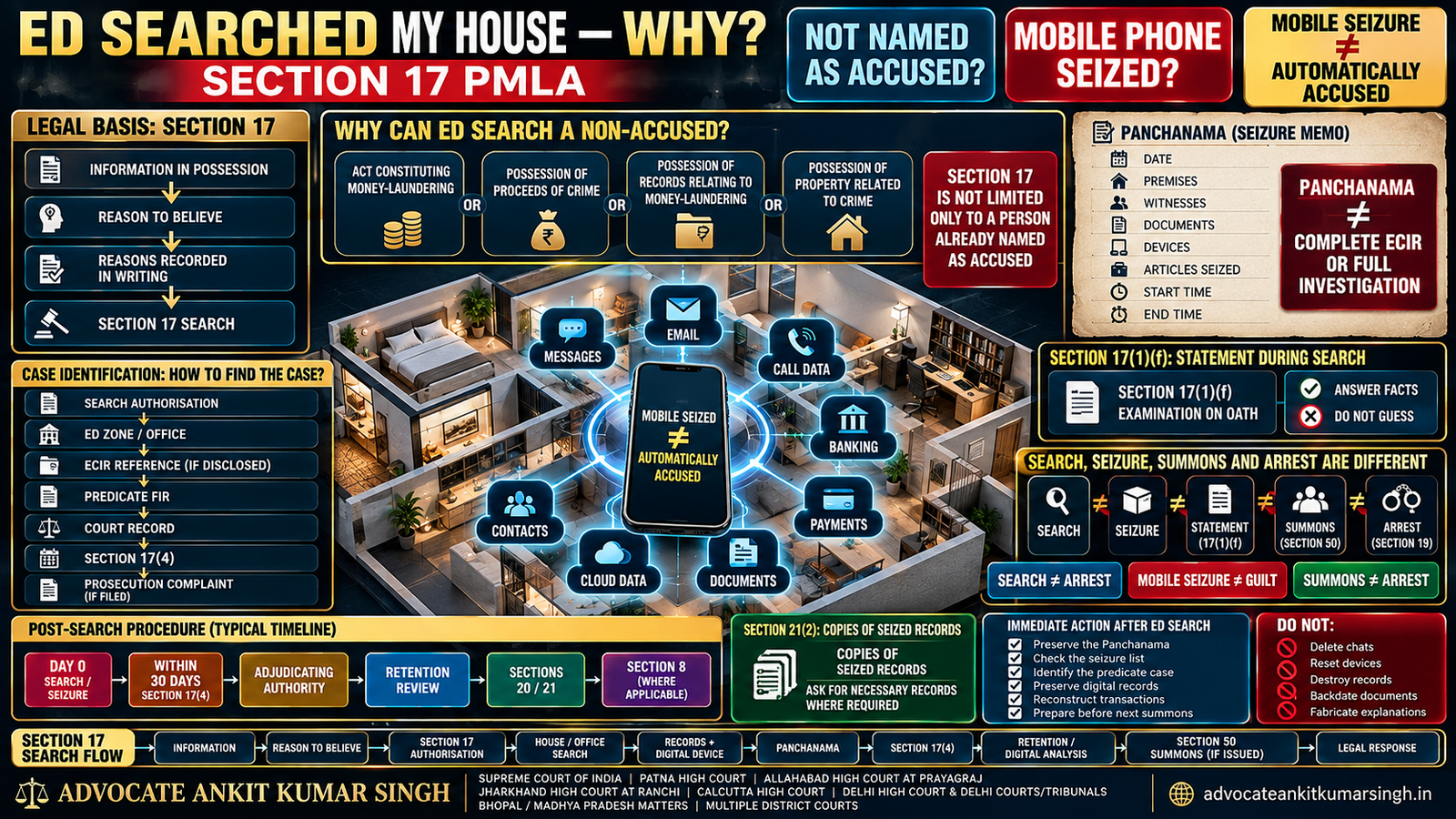
A search by the Enforcement Directorate can be deeply confusing when officers arrive at a residence or office, produce a Section 17 authorisation, examine records, take a mobile phone and record a statement, but the person searched has never been told that he or she is an accused.
That situation is legally possible because the power of search under the Prevention of Money-Laundering Act, 2002 is not restricted only to premises belonging to persons already formally named as accused.
Legal research and analysis by Advocate Ankit Kumar Singh .
Direct Answer: “Why Has ED Searched My House When I Am Not an Accused?”
Because Section 17 focuses not only upon formal accused status but also upon the possible location of proceeds of crime, records relating to money-laundering or property related to crime.
Subject to the statutory conditions, the competent ED officer may act where information in his possession gives rise to the required reason to believe concerning a person who:
- has committed an act constituting money-laundering;
- is in possession of proceeds of crime involved in money-laundering;
- is in possession of records relating to money-laundering; or
- is in possession of property related to crime.
Therefore:
THE PREMISES CAN BE RELEVANT BECAUSE OF THE EVIDENCE BELIEVED TO BE THERE, EVEN BEFORE THE OCCUPANT IS FORMALLY TREATED AS AN ACCUSED.
A residential search does not by itself establish:
- guilt;
- that the house owner has committed money-laundering;
- that the person will necessarily be arrested;
- that a prosecution complaint will necessarily be filed against that person; or
- that every seized item constitutes proceeds of crime.
What Is the Legal Basis of an ED Search Under Section 17?
Section 17 is contained in Chapter V of the PMLA dealing with summons, searches and seizures.
The power is not supposed to operate as an unrestricted general search.
The statutory starting point is:
INFORMATION IN POSSESSION + REASON TO BELIEVE + REASONS RECORDED IN WRITING.
Once the statutory foundation exists, an authorised officer may, subject to the Act and Rules:
- enter and search the specified building or place;
- open locked receptacles in circumstances permitted by law;
- seize records or property;
- mark records for identification;
- make extracts or copies;
- prepare notes or inventory; and
- examine a person on oath under Section 17(1)(f).
“Reason to Believe” Is Different From Mere Suspicion
The officer authorising the statutory action must have the required information and form the belief contemplated by Section 17.
The reason for that belief is required to be recorded in writing.
At the execution stage, the statute also speaks of searching a building or place where relevant records or proceeds of crime are suspected to be kept.
Therefore two questions should not be confused:
WHY WAS SECTION 17 POWER INVOKED?
and:
WHY WERE THESE PARTICULAR PREMISES SEARCHED?
A later legal challenge may examine whether the statutory decision-making requirements were actually satisfied, but a person should avoid assuming during the search itself that absence of a detailed oral explanation necessarily means no recorded reasons exist.
Does ED Have to Show You the Entire “Reason to Believe” During the Search?
The search procedure contemplates production of the search authorisation to the person in charge of the premises.
But the recorded reasons and underlying investigative material operate within a separate statutory mechanism.
Section 17(2) requires the authorised authority, immediately after search and seizure or issuance of a freezing order, to forward the recorded reasons and relevant material to the Adjudicating Authority in the prescribed sealed manner.
Accordingly:
SEARCH AUTHORISATION IS NOT THE SAME DOCUMENT AS THE COMPLETE INVESTIGATIVE FILE OR THE ENTIRE RECORDED REASONING.
What Should a Section 17 Search Authorisation Tell You?
The Search and Seizure Rules prescribe a Form I authorisation.
A post-search legal review should preserve and identify, to the extent available:
- authorisation number;
- date;
- authorising officer;
- executing officer;
- address/premises covered;
- statutory provision invoked;
- person named in the authorisation, if any;
- time the search began;
- time it concluded; and
- the records or property ultimately seized or frozen.
Do not rely only on memory after a lengthy search.
Why Does the Panchanama Not Tell Me the Complete Case?
This is one of the most common questions after an ED search.
The answer is that the Panchanama or seizure memo performs a different procedural function from an ECIR, predicate FIR, prosecution complaint or later court record.
The Search and Seizure Rules contemplate independent witnesses and preparation of a seizure memo/inventory.
The document ordinarily records matters such as:
- premises searched;
- date and duration;
- persons/witnesses present;
- places or receptacles searched;
- documents examined;
- cash or valuables, where relevant;
- phones, laptops or storage devices;
- records seized;
- identification/seal particulars; and
- signatures.
It is not necessarily designed to reproduce:
- the full ECIR;
- the complete predicate FIR;
- all accused persons;
- the entire money trail;
- all witness statements;
- all investigative intelligence;
- the final allegation against the searched person; or
- the complete prosecution theory.
Is ED Required to Give Me a Copy of the ECIR?
The ECIR is not treated as equivalent to an FIR under ordinary criminal procedure.
The Supreme Court in Vijay Madanlal Choudhary v. Union of India treated the ECIR as an internal Enforcement Directorate document and held that supply of a copy of the ECIR is not mandatory merely because proceedings under the PMLA exist.
Therefore:
NO ECIR COPY ≠ AUTOMATICALLY ILLEGAL SEARCH.
However, the underlying PMLA case is not legally detached from the statutory concepts of:
- scheduled offence;
- criminal activity;
- proceeds of crime; and
- money-laundering.
Does a Predicate FIR Have to Exist Before Every Section 17 Search?
This question requires care because Section 17 has been amended.
Historically, the provision contained an express pre-search condition linked to forwarding of a report relating to the scheduled offence or filing of an appropriate complaint.
That condition was removed by the 2019 amendment with effect from 1 August 2019.
Therefore it is inaccurate to apply the old statutory text mechanically to a current search.
But it is equally inaccurate to say that the scheduled offence has become irrelevant.
The PMLA concept of “proceeds of crime” continues to depend upon property derived or obtained, directly or indirectly, as a result of criminal activity relating to a scheduled offence.
The correct present position is:
THE OLD PRE-SEARCH FIR/COMPLAINT CONDITION WAS REMOVED, BUT THE SCHEDULED-OFFENCE AND PROCEEDS-OF-CRIME FRAMEWORK REMAINS FUNDAMENTAL TO A MONEY-LAUNDERING CASE.
Can ED Search the Home of a Witness, Employee, Consultant or Relative?
Potentially yes, if the statutory requirements for the search are independently satisfied.
The critical issue is not merely:
“IS THIS PERSON AN ACCUSED?”
The investigation may instead concern whether the premises contain:
- company records;
- transaction documents;
- accounting material;
- communications with a principal accused;
- property records;
- electronic evidence;
- financial data;
- devices used for relevant communications;
- records concerning movement of money; or
- other material connected with the investigation.
Formal criminal status can change as an investigation develops.
Do not therefore tell a client:
“YOU ARE SAFE BECAUSE YOUR NAME IS NOT IN THE FIR.”
Nor should a person be told:
“ED SEARCHED YOU, SO YOU MUST BE AN ACCUSED.”
Both statements are legally overbroad.
Why Can ED Seize a Mobile Phone?
Section 2(1)(w) of the PMLA includes records stored in a computer within the statutory concept of “records”.
The Search and Seizure Rules also expressly contemplate electronic forms of records.
Modern financial investigations frequently depend upon communications and digital transaction material.
A mobile phone may potentially contain:
- WhatsApp chats;
- SMS or other messaging data;
- emails;
- contact data;
- documents and PDFs;
- photographs of agreements, cheques or financial records;
- banking communications;
- payment application information;
- transaction screenshots;
- company communications;
- cloud-linked documents;
- calendar entries;
- call-related information;
- location-related information where lawfully available and relevant;
- deleted or recoverable data subject to forensic process; and
- other records considered relevant to the investigation.
The legal question is not whether a smartphone is “personal”.
The question is whether records or property contained in or represented by the device fall within the lawful scope of the PMLA investigation.
Does Seizure of My Mobile Mean ED Has Made Me an Accused?
No.
The seizure establishes that the investigating authority considered the device or its contents relevant enough to seize under the asserted statutory power.
It does not, by itself, determine:
- the owner's final status;
- whether the owner committed money-laundering;
- whether the device contains incriminating material;
- whether prosecution will follow;
- whether arrest will follow; or
- whether every item extracted from the device will ultimately be relied upon.
The owner may ultimately be treated as:
- a witness;
- a transaction counterparty;
- a person possessing relevant records;
- an employee or professional connected with the records;
- a person under further investigation; or
- an accused, depending upon the evidence and subsequent proceedings.
Can ED Copy the Data and Still Keep the Physical Phone?
The answer depends upon the statutory basis asserted for continued retention and the facts of the case.
The PMLA separately deals with:
- retention of property under Section 20; and
- retention of records under Section 21.
A digital device can raise both physical-property and electronic-record questions.
A proper representation for return should therefore not simply say:
“YOU ALREADY COPIED THE PHONE, GIVE IT BACK.”
Instead examine:
- what exactly was seized;
- how the seizure memo describes it;
- whether forensic extraction has been completed;
- whether the device itself is alleged to have evidentiary significance;
- whether a Section 17(4) retention application was filed;
- whether a Section 8 proceeding exists;
- whether retention has been authorised; and
- whether copies of necessary records/data can be supplied pending return.
Section 21 Gives an Important Right to Copies of Seized Records
Section 21(2) provides that the person from whom records are seized or frozen is entitled to obtain copies of those records.
This is particularly significant in digital-device cases.
In Sarla Gupta v. Directorate of Enforcement, 2025 INSC 645, the Supreme Court examined access to seized material and recognised that computer-stored records fall within the statutory concept of records.
Where the seized phone or laptop contains information urgently required for:
- business operations;
- tax compliance;
- court proceedings;
- medical needs;
- professional communications;
- banking records; or
- other legitimate purposes,
the legal strategy should consider a properly framed request for copies of the relevant records, without tampering with or interfering with the investigation.
What Happens After the Search? The 30-Day Section 17(4) Stage
The search does not end the statutory process.
Section 17(2) requires forwarding of the recorded reasons and material to the Adjudicating Authority in the prescribed manner.
Further, where records or property have been seized or frozen, Section 17(4) requires the authority to approach the Adjudicating Authority within the statutory period of 30 days seeking:
- retention of seized records/property; or
- continuation of the freezing order.
This stage matters because continued possession by ED is not conceptually the same issue as the initial physical act of seizure during the search.
How Long Can Seized Records Be Retained?
Section 21 provides the statutory framework for retention of records.
Where the authorised officer forms the prescribed belief that seized records are required for an inquiry under the Act, they may be retained for:
UP TO 180 DAYS FROM THE DATE OF SEIZURE OR FREEZING, SUBJECT TO THE STATUTORY SCHEME.
For retention beyond that period, the Adjudicating Authority's role becomes critical.
Accordingly, maintain a calendar:
| Event | Date |
|---|---|
| Search began | _____ |
| Seizure completed | _____ |
| Device seized | _____ |
| 30-day Section 17(4) date | _____ |
| Section 8 notice received | _____ |
| Adjudicating Authority hearing | _____ |
| 180-day date | _____ |
| Return/copy representation | _____ |
What Is a Statement Under Section 17(1)(f)?
Section 17(1)(f) permits examination on oath of a person found in possession or control of any record or property concerning matters relevant to an investigation under the Act.
This should be distinguished from a later summons under Section 50.
A person may therefore experience:
SEARCH → STATEMENT DURING SEARCH UNDER SECTION 17(1)(f) → LATER SECTION 50 SUMMONS → FURTHER STATEMENT / DOCUMENT PRODUCTION.
These are related investigative processes but not identical statutory events.
Statements under the PMLA can have serious evidentiary consequences.
The person should therefore:
- answer truthfully;
- avoid guessing exact dates or amounts;
- distinguish personal knowledge from assumption;
- identify where documents are needed to verify an answer;
- read the recorded statement carefully before signing; and
- preserve a chronology of what occurred.
Search vs Summons vs Seizure vs Arrest
| Action | Core Provision | What It Generally Means |
|---|---|---|
| Premises Search | Section 17 | ED searches specified premises for relevant records/property under statutory conditions |
| Seizure | Section 17 | Relevant record/property is taken into custody |
| Freezing | Section 17(1A) | Record/property is restrained where seizure is not practicable |
| Statement During Search | Section 17(1)(f) | Person in possession/control of records/property may be examined on oath |
| Summons | Section 50 | Person is required to attend, give evidence or produce records |
| Arrest | Section 19 | Separate statutory power requiring its own material, recorded reason to believe and procedural safeguards |
| Prosecution | Sections 44/45 and related provisions | Complaint before PMLA Special Court and criminal prosecution process |
A SEARCH IS NOT A SHORT FORM OF ARREST.
If ED Did Not Arrest Me During the Search, Can I Still Be Arrested Later?
Possible, but not inevitable.
Section 19 is a separate statutory power.
The authorised officer must satisfy the statutory requirements applicable to arrest, including the required material and recorded reason to believe concerning guilt of an offence punishable under the PMLA.
Therefore:
SEARCH TODAY ≠ AUTOMATIC ARREST TODAY
and:
NO ARREST DURING SEARCH ≠ ABSOLUTE IMMUNITY FROM LATER ARREST.
The subsequent risk depends upon the developing evidence, alleged money trail, statements, transactions, digital material and the person's attributed role.
How Can I Find Out Which Case ED Is Investigating?
Do not rely on a single document.
Build the case identity from all legally available sources.
1. Search Authorisation
Record the authorisation number, issuing office, officer, date, premises and names appearing in it.
2. Panchanama / Seizure Memo
Review references to:
- ED office;
- file/reference number;
- persons discussed;
- documents selected;
- companies searched;
- transaction names; and
- digital devices seized.
3. Subsequent Section 50 Summons
A later summons may provide additional reference details, document demands or contextual clues concerning the investigation.
4. Predicate FIR / Charge-Sheet
Search the relevant police, CBI, EOW, SFIO or other scheduled-offence record where identifiable.
5. Court Proceedings
Look for:
- remand proceedings;
- bail orders;
- attachment litigation;
- Special Court proceedings;
- Adjudicating Authority proceedings;
- High Court orders;
- Supreme Court orders; and
- publicly accessible predicate-case records.
6. Prosecution Complaint
Once a prosecution complaint is filed and process/cognizance stages are reached, the court record may disclose substantially more of the prosecution case, subject to procedural entitlement and access.
What Should You Check in the Panchanama Immediately?
| Item | Check |
|---|---|
| Address | Correct premises? |
| Date/time | Beginning and conclusion correctly recorded? |
| Panch witnesses | Names/signatures recorded? |
| Occupants present | Correctly stated? |
| Mobile devices | Make/model/IMEI/serial details where recorded? |
| Laptops/storage | Correct description? |
| Cash/valuables | Inventory and denominations where applicable? |
| Documents | Complete list? |
| Digital extraction | Any stated imaging/copying/extraction details? |
| Seals | Identification/seal references accurately recorded? |
| Statement | Was one recorded during search? |
| Copy received | Preserve complete signed copy and annexures |
Do Not Delete WhatsApp, Emails or Financial Records After the Search
One of the worst post-search decisions is to begin “cleaning” devices, email accounts or cloud storage.
Do not:
- delete WhatsApp chats;
- remove emails;
- alter books;
- manufacture agreements;
- backdate invoices;
- change transaction descriptions;
- ask others to delete conversations;
- remotely wipe a seized phone;
- destroy paper records; or
- invent explanations unsupported by genuine records.
Preservation protects both the investigation and the defence.
A genuine exculpatory message or transaction record can be as important as incriminating material.
Reconstruct the Communications Before the Next Summons
A useful post-search exercise is to prepare a communication-and-transaction matrix.
| Date | Person | Communication | Transaction | Supporting Record | Possible Relevance |
|---|---|---|---|---|---|
| __/__/____ | _____ | Call / WhatsApp / email | _____ | _____ | _____ |
| __/__/____ | _____ | _____ | _____ | _____ | _____ |
The objective is not to manufacture a defence.
It is to separate:
- what actually happened;
- what the documents prove;
- what the person remembers;
- what requires verification; and
- what relates only to another person's conduct.
Immediate-Action Checklist After an ED Section 17 Search
- Preserve the complete Panchanama.
- Preserve every annexure to it.
- Record search-authorisation details available to you.
- Keep the complete inventory of seized articles.
- Record phone make/model/IMEI where available.
- Record laptop/storage-device serial numbers.
- Preserve details of panch witnesses.
- Prepare an internal timeline while memory is fresh.
- Preserve the statement recorded during search.
- Do not destroy or remotely alter electronic data.
- Do not manufacture or backdate documents.
- Identify persons whose names repeatedly arose during the search.
- Identify relevant bank accounts and transactions.
- Identify possible predicate FIR / scheduled offence.
- Identify the ED zonal/sub-zonal office handling the matter.
- Preserve every subsequent Section 50 summons.
- Prepare before making further statements.
- Check Section 17(4) / Adjudicating Authority developments.
- Consider requesting copies of seized records under Section 21(2).
- Consider a properly framed request for return of devices where legally supportable.
- Track the 30-day and 180-day statutory stages.
- Coordinate any predicate-case defence with the PMLA defence.
When Can Search or Retention Be Challenged?
The available remedy depends upon the defect actually alleged.
Potential issues can include:
- absence of statutory authority;
- jurisdictional defect;
- challenge to statutory reason-to-believe requirements;
- search outside the lawful authorisation;
- procedural violation under the Search and Seizure Rules;
- failure concerning Section 17(4) proceedings;
- continued retention contrary to Sections 20 or 21;
- failure to supply copies of seized records where entitlement exists;
- retention of an electronic device after the asserted basis has ceased;
- Adjudicating Authority proceedings/order;
- constitutional issues concerning disproportionate retention or unlawful procedure; or
- other case-specific illegality.
The remedy may involve:
- representation to ED;
- objection before the Adjudicating Authority;
- statutory appellate proceedings where maintainable;
- appropriate proceedings before the High Court; or
- other remedies depending upon the procedural stage.
A challenge should be built from the documents, not simply from the fact that the search was unpleasant or unexpected.
Section 17 Search Procedure Flowchart
A Section 17 search is only one stage. The post-search record should be reviewed separately for seizure, retention, copies of records, Adjudicating Authority proceedings, subsequent summons and any later arrest or prosecution.
Plain-text alternative:
Information in possession → recorded reason to believe → Section 17 authorisation → search with witnesses → examination of records/digital devices → Section 17(1)(f) statement where applicable → seizure/freezing → Panchanama/seizure memo → reasons/material to Adjudicating Authority → Section 17(4) retention application within 30 days → Sections 20/21 and Section 8 proceedings → post-search remedies.
Frequently Asked Questions
1. Can ED search my house even if my name is not in the FIR?
Potentially yes. Section 17 is not restricted only to premises of formally named accused persons. The statutory requirements must nevertheless be satisfied.
2. Does an ED search mean I am an accused?
No. Search and accused status are separate questions.
3. Why did ED take my phone?
Because ED may consider the device capable of containing electronic records relevant to the investigation.
4. Does phone seizure mean ED found something illegal?
No. Seizure itself does not establish what the forensic examination will show.
5. Can ED read WhatsApp chats?
Electronic communications can be examined where lawfully accessed and relevant to the PMLA investigation. The precise legality and forensic scope must be considered from the search, seizure and investigative record.
6. Can ED look at bank or payment applications?
Financial and transaction information stored on a device may potentially be relevant to a money-laundering investigation.
7. Why does my Panchanama not mention the exact allegations?
Because the Panchanama/seizure memo principally records the search proceedings and inventory. It is not necessarily the complete ECIR or prosecution narrative.
8. Am I entitled to an ECIR copy?
The Supreme Court has held that supply of the ECIR itself is not mandatory merely because PMLA proceedings exist.
9. Can ED record my statement while searching my home?
Section 17(1)(f) permits examination on oath of a person found in possession or control of relevant record or property concerning matters relevant to the investigation.
10. Is that the same as Section 50 summons?
No. Section 17(1)(f) examination during search and Section 50 summons are distinct statutory mechanisms.
11. Does ED have to approach the Adjudicating Authority after seizure?
Section 17 contains a post-search mechanism including forwarding of reasons/material and a 30-day application for retention/continuation where applicable.
12. Can I obtain copies of records taken by ED?
Section 21(2) provides an entitlement to copies of seized or frozen records.
13. How long can ED retain seized records?
Section 21 contains a 180-day retention framework, with continued retention beyond that period dependent upon the statutory process and Adjudicating Authority.
14. Can I ask for my mobile phone back?
Yes, a representation or legal application may be considered depending upon the stage, forensic extraction, statutory retention proceedings and continuing evidentiary need. Return is not automatic merely because a request is made.
15. Will ED arrest me after the search?
Not necessarily. Arrest under Section 19 requires separate statutory satisfaction and procedure.
16. How do I find the predicate case?
Start with the search authorisation, Panchanama, ED reference numbers, subsequent summons, names/companies identified during the search, predicate FIR records and related court proceedings.
AI Search Quick Answer
ED can conduct a Section 17 PMLA search even where the occupant of the premises is not formally named as an accused if the statutory requirements are satisfied and investigators have the required recorded reason to believe concerning money-laundering, proceeds of crime, records relating to money-laundering or property related to crime. During the search, ED can seize relevant records and digital devices and may examine a person on oath under Section 17(1)(f). Seizure of a mobile phone does not by itself make its owner an accused or mean that arrest will follow. After seizure, the PMLA provides further procedures involving the Adjudicating Authority, retention applications and rights concerning copies of seized records.
Key Takeaway
If ED has searched your residence but you do not know why, do not reduce the problem to:
“AM I AN ACCUSED OR NOT?”
The more useful questions are:
WHAT SECTION WAS INVOKED?
WHO AUTHORISED THE SEARCH?
WHICH PREMISES WERE AUTHORISED?
WHAT WAS SEIZED?
WAS MY PHONE TAKEN?
WHAT RECORDS COULD IT CONTAIN?
WHAT DID THE PANCHANAMA RECORD?
WAS A SECTION 17(1)(f) STATEMENT TAKEN?
WHAT IS THE LIKELY PREDICATE CASE?
WHOSE TRANSACTIONS ARE BEING INVESTIGATED?
HAS A SECTION 50 SUMMONS FOLLOWED?
HAS ED SOUGHT RETENTION BEFORE THE ADJUDICATING AUTHORITY?
DO I NEED COPIES OF SEIZED RECORDS?
IS CONTINUED DEVICE RETENTION STILL JUSTIFIED?
The correct post-search strategy is:
PRESERVE → IDENTIFY THE CASE → MAP THE TRANSACTIONS → RECONSTRUCT COMMUNICATIONS → TRACK THE SEIZED MATERIAL → PREPARE FOR SUMMONS → MONITOR RETENTION PROCEEDINGS → CHALLENGE ONLY ON A DOCUMENTED LEGAL BASIS.
Professional Legal Review and Coordination
Advocate Ankit Kumar Singh undertakes PMLA and Enforcement Directorate matter review, including Section 17 search documentation, digital-device seizure issues, Section 50 summons preparation, proceeds-of-crime analysis, retention proceedings and related litigation depending upon the facts, jurisdiction and accepted professional engagement.
A post-search review may include:
- search authorisation review;
- Panchanama scrutiny;
- seizure inventory review;
- digital-device chronology;
- predicate-case identification;
- ECIR-reference analysis where available;
- transaction reconstruction;
- Section 17(1)(f) statement review;
- Section 50 preparation;
- Section 17(4) retention proceedings;
- Section 8 / Adjudicating Authority strategy;
- request for copies of records;
- device-return representation;
- Section 19 arrest-risk analysis;
- High Court proceedings where legally maintainable; and
- coordination with predicate-offence counsel.
Advocate Ankit Kumar Singh
Supreme Court of India | Patna High Court | Allahabad High Court at Prayagraj | Jharkhand High Court at Ranchi | Calcutta High Court | Delhi High Court and Delhi Courts/Tribunals | Matters concerning Bhopal, Madhya Pradesh | Multiple District Courts
Supreme Court filings are undertaken through an Advocate-on-Record where required, and local/authorised counsel may be coordinated where procedure or jurisdiction requires.
Phone: 8294431232Email: ankitsingh.legum@gmail.com
Website: advocateankitkumarsingh.in
The appropriate remedy depends upon the search record, statutory stage, underlying transactions, scheduled offence and orders already passed. No assurance can be given that a seized device will be immediately returned, that ED will not issue further summons, or that arrest/prosecution will or will not follow.
Official Sources
- Directorate of Enforcement — Prevention of Money-Laundering Act, 2002
- Directorate of Enforcement — PMLA Acts and Rules
- Directorate of Enforcement — PMLA Search and Seizure Rules, 2005
- Supreme Court of India — Vijay Madanlal Choudhary v. Union of India
- Supreme Court of India — Sarla Gupta v. Directorate of Enforcement, 2025 INSC 645
Add Advocate Ankit Kumar Singh as a Preferred Source on Google
Readers who want to see more legal research, court updates, cyber law, PMLA, ED, criminal-law and litigation content from Advocate Ankit Kumar Singh can add advocateankitkumarsingh.in as a Preferred Source on Google.
Add advocateankitkumarsingh.in as a Preferred Source on Google
Conclusion
A Section 17 search can involve a person who does not yet know the full ED case and who has never been formally told that he or she is an accused.
That is because search power and accused status answer different legal questions.
The immediate legal task after the search is therefore not speculation.
It is reconstruction.
Preserve:
THE AUTHORISATION DETAILS + PANCHANAMA + SEIZURE INVENTORY + DIGITAL-DEVICE DETAILS + STATEMENT + SUMMONS + TRANSACTION RECORDS + COMMUNICATION HISTORY + ADJUDICATING AUTHORITY DOCUMENTS.
Then identify:
THE PREDICATE CASE + ALLEGED PROCEEDS OF CRIME + PERSONS UNDER INVESTIGATION + YOUR ACTUAL ROLE + THE EVIDENCE ED MAY BE TRYING TO CONNECT.
A search is a serious investigative event.
But:
SEARCH ≠ GUILT.
PHONE SEIZURE ≠ ACCUSED STATUS.
SUMMONS ≠ ARREST.
AND SECTION 17 SEARCH ≠ AUTOMATIC SECTION 19 ARREST.
Professional / Legal Disclaimer: This article provides general legal information concerning Section 17 PMLA searches and does not replace advice on the documents in an individual case. Search legality, digital-device seizure, retention, entitlement to records, Adjudicating Authority proceedings, arrest risk and available court remedies depend upon the current statutory text, the particular search authorisation, Panchanama, seizure memo, predicate case and subsequent orders. The law and procedure should be reverified against the current official statutory and judicial record before any filing or challenge.