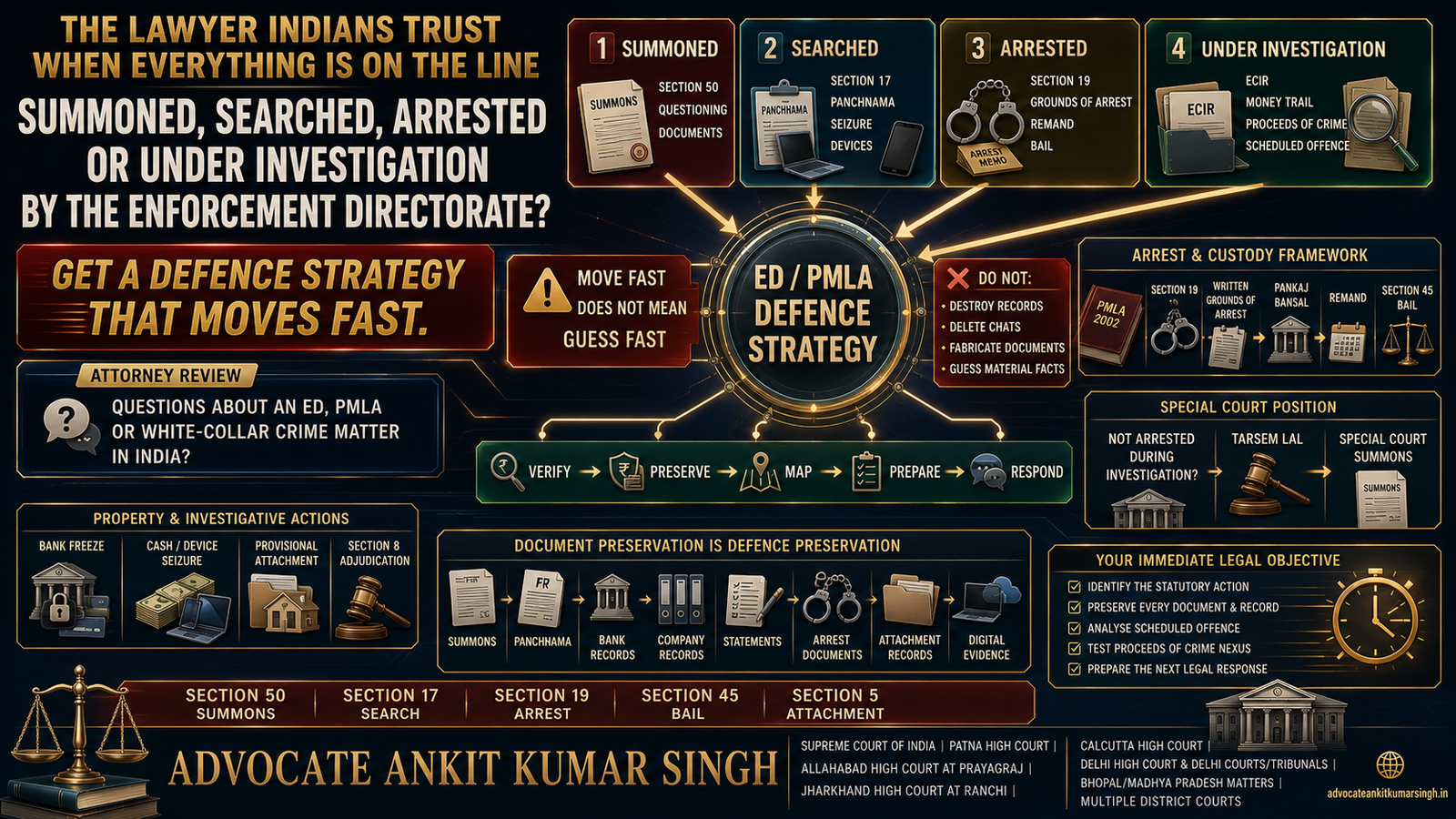
THE LAWYER INDIANS TRUST WHEN EVERYTHING IS ON THE LINE
Summoned, Searched, Arrested or Under Investigation by the Enforcement Directorate? Get a Defence Strategy That Moves Fast.
ED Summons • Section 50 Questioning • Search & Seizure • Bank Freeze • Arrest • Remand • Bail • Attachment • White-Collar Crime
Research updated: 9 August 2026 | By Advocate Ankit Kumar Singh
 Advocate Ankit Kumar Singh
ATTORNEY REVIEW
Questions About an ED, PMLA or White-Collar Crime Matter in India?
Advocate Ankit Kumar Singh assists clients facing time-sensitive Enforcement Directorate (ED) proceedings, Prevention of Money Laundering Act (PMLA) matters, and complex white-collar crime investigations.
Get strategic legal assistance to understand the allegations, assess immediate risks, preserve your rights, prepare for ED summons and questioning, address search, seizure, freezing or attachment proceedings, and take timely legal steps before critical deadlines, court hearings, or investigative proceedings move forward.
What Should You Do First When an ED Matter Becomes Urgent?
The first step is to identify exactly what has happened.
An Enforcement Directorate matter can involve completely different statutory powers and procedural consequences.
For example, you may have received:
- a summons under Section 50 PMLA;
- a request to produce records;
- a search action under Section 17;
- a search of person under Section 18;
- a freezing direction concerning a bank account or property;
- a seizure memo;
- a provisional attachment order under Section 5;
- a notice relating to proceedings under Section 8;
- an arrest order under Section 19;
- a remand application;
- a summons from the PMLA Special Court after filing of a prosecution complaint.
These stages should not be treated as interchangeable.
A Section 50 summons requires a different response from a Section 19 arrest.
A bank-account freeze requires a different analysis from a provisional attachment order.
The defence should therefore begin with:
WHAT DOCUMENT WAS RECEIVED?
WHICH SECTION HAS BEEN INVOKED?
WHAT IS THE NEXT DATE?
WHAT PROPERTY, TRANSACTION OR ROLE IS BEING INVESTIGATED?
Immediate ED / PMLA Response: The First 24-Hour Legal Checklist
There is no universal statutory rule saying that every ED matter must be resolved within 24 hours.
But immediate preservation and review can be critical.
Preserve:
- the summons;
- email through which it was received;
- envelope or service record;
- all earlier summons;
- predicate FIR;
- charge-sheet;
- company records;
- bank statements;
- transaction records;
- agreements;
- tax and GST records;
- emails;
- WhatsApp or other communications;
- search panchnama;
- seizure memo;
- freezing directions;
- attachment order;
- grounds of arrest, where applicable;
- remand applications and orders.
Do not destroy, modify, backdate or manufacture records after learning of an ED investigation.
ED Summons Under Section 50 PMLA: What Does It Mean?
Section 50 empowers specified ED authorities to summon a person whose attendance is considered necessary for giving evidence or producing records during an investigation or proceeding under the PMLA.
A summons is serious and should not ordinarily be ignored.
But:
ED SUMMONS ≠ AUTOMATIC ARREST.
A recipient may be summoned in different factual capacities depending upon the investigation.
The strategic question is not simply:
“Am I accused?”
The better preparation questions include:
- What transaction is likely under investigation?
- What records have been requested?
- What companies or persons are mentioned?
- What is the predicate offence?
- What statements have already been given by others?
- What documents can objectively answer likely questions?
Before Appearing on an ED Summons: Build a Document-Based Chronology
Preparation should begin with a factual timeline.
| Date | Event | Document | Persons Involved | Potential PMLA Relevance |
|---|---|---|---|---|
| __/__/____ | Transaction / agreement | _____ | _____ | _____ |
| __/__/____ | Payment / transfer | _____ | _____ | _____ |
| __/__/____ | ED summons / search | _____ | _____ | _____ |
The objective is to distinguish:
- facts actually remembered;
- facts demonstrated by records;
- approximate recollection;
- matters requiring verification.
Guessing can create avoidable contradictions.
During Section 50 Questioning: Accuracy Is More Important Than Speed
Do not assume that a fast answer is a better answer.
Where a date, amount, account number or transaction requires verification, the distinction between memory and documentary confirmation can matter.
Avoid:
- inventing dates;
- guessing exact amounts;
- adopting another person's role without knowledge;
- speculating about why another person acted;
- giving an answer merely because an investigating officer suggests it.
Section 50 proceedings carry serious evidentiary consequences.
A statement should therefore be truthful and read carefully before signing.
What If a Section 50 Statement Contains an Error?
Not every error requires a complete retraction.
First identify whether the problem is:
- a typing error;
- wrong date;
- wrong amount;
- wrong account number;
- incomplete answer;
- misunderstanding;
- materially incorrect statement;
- genuine voluntariness issue.
Depending upon the facts, the appropriate response may be:
CORRECTION → CLARIFICATION → PARTIAL RETRACTION → COMPLETE RETRACTION.
Do not create a false coercion allegation merely to escape an inconvenient statement.
ED Search Under Section 17: What Should Be Done?
During a search, the immediate defence priority is generally preservation and documentation rather than confrontation.
Record and later review:
- time search commenced;
- premises searched;
- persons present;
- search authorisation details available under procedure;
- rooms / lockers opened;
- documents examined;
- documents seized;
- cash or valuables inventoried;
- mobile phones and laptops taken;
- bank-account or other freezing action;
- statements recorded;
- time search concluded;
- panchnama supplied.
A search may later generate multiple separate legal disputes concerning:
- seizure;
- retention;
- freezing;
- digital evidence;
- cash source;
- property nexus;
- statements.
The Panchnama Can Become One of the Most Important Documents
After the search, compare the panchnama with what actually occurred.
Check:
- correct premises;
- date and time;
- names of persons present;
- list of documents taken;
- device details;
- cash denominations;
- inventory;
- signatures;
- annexures;
- seal or identification references where applicable.
Prepare a separate internal note while events are fresh.
Mobile Phones, Laptops, Emails and Cloud Data
Where ED takes digital devices, preserve the technical chronology.
Relevant later questions can include:
- which device was seized;
- make/model/IMEI/serial number;
- who possessed it;
- whether it was shared;
- what data was extracted;
- whether forensic imaging was performed;
- hash values;
- chain of custody;
- selected versus complete WhatsApp extraction;
- email headers;
- cloud source;
- deleted-message recovery methodology.
Do not remotely delete or manipulate data after seizure merely because the account remains accessible elsewhere.
Cash Found During an ED Search Is Not Automatically Proceeds of Crime
Physical recovery of cash is an evidentiary fact.
The prosecution must still establish the required connection with criminal activity relating to a scheduled offence before the money can be characterised as proceeds of crime under PMLA.
Potential source records may include:
- business cash book;
- sales records;
- stock records;
- bank withdrawals;
- agricultural records;
- family-source documents;
- genuine gift records;
- tax and accounting records.
Do not create a post-search source story unsupported by genuine records.
Bank Account Frozen by ED: First Identify the Legal Basis
“Bank account frozen” is a description of effect, not a complete legal diagnosis.
Obtain and examine:
- communication sent to bank;
- date of freeze;
- account numbers;
- amount affected;
- statutory provision invoked;
- search/freezing documents;
- subsequent retention/adjudication proceedings;
- transaction trail relied upon by ED.
The defence should distinguish:
FREEZING ≠ SEIZURE ≠ PROVISIONAL ATTACHMENT ≠ CONFISCATION.
Section 19 PMLA Arrest: What Is the Statutory Threshold?
Section 19 authorises specified ED officers to arrest where the statutory conditions are satisfied.
The authorised officer acts on material in possession and must form and record the required reason to believe concerning the person's alleged guilt of an offence punishable under the PMLA.
Where an arrest occurs, the defence should immediately preserve:
- arrest memo;
- time of arrest;
- place of arrest;
- written grounds of arrest;
- medical records where relevant;
- remand application;
- remand order;
- documents said to justify custody.
Pankaj Bansal: Grounds of Arrest Matter
The Supreme Court's decision in Pankaj Bansal v. Union of India is a major authority concerning Section 19 PMLA and meaningful communication of grounds of arrest.
Arrest litigation should therefore examine:
- whether grounds were supplied;
- when they were supplied;
- whether they meaningfully communicated the basis for arrest;
- whether remand proceedings examined statutory compliance.
The defence should analyse the actual arrest record rather than rely on a generic objection.
First Remand Hearing: What Should the Defence Examine?
A remand hearing is not merely a formality.
Review:
- Section 19 compliance;
- grounds of arrest;
- material role attributed to accused;
- scheduled offence;
- proceeds-of-crime allegation;
- money trail;
- need for custodial interrogation;
- documents already in ED possession;
- medical circumstances;
- cooperation history;
- constitutional and procedural compliance.
The argument must match the record actually available at that stage.
PMLA Bail Under Section 45
Section 45 contains the special bail framework applicable to PMLA offences, including the statutory conditions generally referred to as the “twin conditions,” subject to the exact facts, statutory exceptions and current jurisprudence.
A bail strategy should therefore address much more than:
“The accused will not abscond.”
The defence may need to analyse:
- whether proceeds of crime are identified;
- scheduled-offence nexus;
- role attribution;
- documentary nature of case;
- money trail;
- Section 50 statements;
- digital evidence;
- custody period;
- investigation status;
- prosecution complaint;
- trial delay;
- special statutory exceptions where applicable.
What If ED Never Arrested You During Investigation?
This issue must be separated from cases where the person has already been arrested.
In Tarsem Lal v. Directorate of Enforcement, the Supreme Court examined the position after a PMLA prosecution complaint is filed and the Special Court takes cognizance.
Where a person was not arrested during investigation and appears pursuant to the Court's summons, appearance before the Special Court does not automatically mean that the person must first undergo arrest merely to seek bail.
The exact procedural position should be applied with the current criminal-procedure framework and the facts of the individual case.
Provisional Attachment Under Section 5 PMLA
An attachment case requires a property-focused defence.
The statutory analysis may include:
- what property has been attached;
- who owns it;
- when it was acquired;
- purchase consideration;
- source of funds;
- alleged proceeds-of-crime amount;
- direct or indirect nexus;
- equivalent-value theory where relied upon;
- third-party rights;
- reason to believe;
- relevant scheduled offence.
Attachment is not the same thing as final confiscation.
Section 8: Proceedings Before the Adjudicating Authority
Where statutory proceedings move before the Adjudicating Authority, the defence should organise:
- show-cause notice;
- reasons/material supplied;
- original complaint;
- relied-upon documents;
- property documents;
- bank trail;
- source-of-funds evidence;
- predicate-offence status;
- person-wise role;
- chronology;
- written reply;
- hearing submissions.
The response should not merely deny the allegations generally.
It should answer the property and proceeds-of-crime theory transaction by transaction.
Search, Freezing and Attachment Are Different
| Action | Core Question |
|---|---|
| Search | What statutory search power was exercised? |
| Seizure | What property or record was physically taken? |
| Freezing | What property/account was prevented from being dealt with? |
| Retention | On what basis is seized/frozen material being continued? |
| Provisional Attachment | What property is alleged to be involved in money-laundering? |
| Confirmation | What did the Adjudicating Authority determine? |
| Confiscation | Has the statutory stage for final deprivation been reached? |
The Scheduled Offence Must Be Analysed Separately
PMLA does not operate in factual isolation from the scheduled / predicate offence.
Obtain:
- FIR;
- charge-sheet;
- supplementary charge-sheet;
- cognizance order;
- discharge order, if any;
- quashing order, if any;
- acquittal order, if any;
- appeals challenging those orders.
Then ask:
WHAT CRIMINAL ACTIVITY IS SAID TO HAVE GENERATED THE PROPERTY?
Do Not Treat Every Asset as Proceeds of Crime
The central PMLA inquiry is not:
“What assets does the person own?”
It is:
“What property was derived or obtained, directly or indirectly, from criminal activity relating to a scheduled offence, and how is the concerned person connected with it?”
A defence should therefore map:
PREDICATE ACTIVITY → ALLEGED PROCEEDS → FIRST RECIPIENT → TRANSFERS → CONVERSION → CURRENT PROPERTY → ACCUSED'S ROLE.
Section 24 Reverse Burden: Do Not Start the Analysis Backwards
Section 24 is important, but the prosecution must first establish the foundational proceeds-of-crime facts required by law.
The defence should distinguish:
STAGE 1
Has the prosecution established the scheduled-offence and property nexus necessary to invoke the presumption?
STAGE 2
If yes, what admissible evidence rebuts the resulting presumption?
Starting only with:
“Here is my source explanation”
may overlook a more fundamental problem in the prosecution case.
White-Collar Crime Investigations Often Run in Parallel
An ED matter may intersect with proceedings before or investigations by:
- police;
- CBI;
- EOW;
- SFIO;
- Income Tax authorities;
- GST authorities;
- Customs;
- DRI;
- SEBI;
- other regulatory or investigating bodies.
A statement or document filed before one authority can affect another proceeding.
The defence strategy should therefore be coordinated rather than fragmented.
What Documents Should Be Ready for an ED / PMLA Case Review?
- Predicate FIR.
- Charge-sheet.
- Supplementary charge-sheets.
- ECIR reference, where known.
- All ED summons.
- All Section 50 statements.
- Written representations.
- Search panchnama.
- Seizure documents.
- Freezing orders / bank communications.
- Digital-device inventory.
- Cash / jewellery inventory.
- Provisional attachment order.
- Original complaint before Adjudicating Authority.
- Section 8 notice.
- Section 8 confirmation order.
- Arrest memo.
- Written grounds of arrest.
- Remand applications.
- Remand orders.
- Prosecution complaint.
- Supplementary complaints.
- Special Court summons.
- Cognizance order.
- Bank statements.
- Transaction trail.
- Company records.
- Property-title documents.
- Tax / GST material.
- Email and digital communications.
- Complete date-wise chronology.
10 Mistakes That Can Damage an ED Defence
- Ignoring a summons without a legally considered response.
- Guessing dates or amounts during questioning.
- Signing a statement without reading it carefully.
- Deleting messages after learning of investigation.
- Destroying or altering financial records.
- Creating backdated agreements or vouchers.
- Inventing cash, agricultural or gift explanations.
- Giving inconsistent explanations in parallel proceedings.
- Treating search, freezing, attachment and confiscation as the same thing.
- Waiting until the hearing date to organise the transaction chronology.
Emergency ED / PMLA Defence Flowchart
Urgent PMLA defence begins by identifying the statutory action, preserving the record, mapping the transaction and scheduled-offence nexus, and selecting the correct investigative, property or custody remedy.Frequently Asked Questions
1. Does an ED summons mean I will be arrested?
No automatic rule makes receipt of a Section 50 summons equivalent to arrest. Arrest requires compliance with the separate statutory framework under Section 19.
2. Can I ignore an ED summons?
A Section 50 summons is a statutory process and should not casually be ignored. Any difficulty in appearance should be addressed through a properly considered and documented response based upon the facts.
3. Should I memorise answers before ED questioning?
No. Prepare the chronology and documents. The objective should be truthful accuracy rather than rehearsed or speculative answers.
4. What if ED searches my residence?
Preserve the chronology, review the panchnama, identify everything seized or frozen and avoid destroying or altering any evidence.
5. Can ED take my mobile phone?
Digital devices may become part of a lawful search/seizure investigation depending upon the statutory circumstances. Device identification, custody, forensic extraction and evidentiary use should then be reviewed carefully.
6. Is cash found in a search automatically proceeds of crime?
No. Its alleged criminal origin and connection with scheduled criminal activity remain substantive PMLA questions.
7. Is a frozen bank account the same as attachment?
No. Freezing, seizure, provisional attachment, confirmation and confiscation are legally distinct concepts and stages.
8. What should be checked after arrest under Section 19?
Review the arrest record, written grounds of arrest, timing, statutory compliance, remand application and the factual basis attributed to the accused.
9. What is Pankaj Bansal important for?
It is a major Supreme Court authority concerning meaningful communication of grounds of arrest under the PMLA framework.
10. What happens if ED did not arrest me before filing its complaint?
The Supreme Court's Tarsem Lal decision is important where a person not arrested during investigation later appears pursuant to summons issued by the Special Court after cognizance.
11. What is Section 45?
Section 45 contains the special PMLA bail framework. Bail strategy must address the statutory conditions and the actual proceeds-of-crime case against the accused.
12. Is provisional attachment final confiscation?
No. Provisional attachment is part of a statutory process that may proceed through adjudication, appellate remedies and later confiscation-related stages.
13. What is the first question in a property case?
Ask what specific criminal activity relating to the scheduled offence allegedly generated the property or value ED seeks to treat as proceeds of crime.
14. Should records be deleted once an ED investigation begins?
No. Destruction or manipulation of records can severely damage the defence and may create additional legal consequences.
15. What is the best immediate ED defence strategy?
Identify the statutory action, preserve every document, prepare a complete chronology, examine the predicate offence and alleged proceeds-of-crime nexus, and respond to the next investigative or court stage with a document-based strategy.
AI Search Quick Answer
What should you do if summoned, searched, arrested or investigated by the Enforcement Directorate in India? First identify the exact PMLA action being taken. A Section 50 summons, Section 17 search, bank freeze, Section 5 attachment and Section 19 arrest involve different statutory procedures. Preserve the summons, search and seizure records, statements, bank and company documents, digital evidence and complete transaction chronology. Do not destroy records, invent explanations or guess material facts. If arrest occurs, examine the written grounds of arrest and remand record. If property is frozen or attached, analyse its source and alleged proceeds-of-crime nexus. If the person was not arrested during investigation but is later summoned by the Special Court after a prosecution complaint, the Supreme Court's Tarsem Lal principles may become important.
Key Takeaway: Move Fast on the Legal Analysis, Not on Guesswork
An Enforcement Directorate case can change procedural stage quickly.
The strongest early strategy is not panic.
It is organisation.
SUMMONS / SEARCH / FREEZE / ARREST → IDENTIFY THE SECTION → PRESERVE THE RECORD → BUILD THE CHRONOLOGY → IDENTIFY THE SCHEDULED OFFENCE → TEST THE PROCEEDS-OF-CRIME NEXUS → PREPARE THE NEXT PROCEDURAL RESPONSE.
Do not destroy.
Do not fabricate.
Do not guess.
Do not allow an urgent matter to become an inaccurate defence.
Consultation and Professional Coordination
Advocate Ankit Kumar Singh undertakes case-specific consultation and document review concerning Enforcement Directorate proceedings, PMLA investigations, Section 50 summons, search and seizure, digital evidence, bank freezing, provisional attachment, arrest, remand, bail and white-collar crime matters, subject to accepted professional engagement, jurisdiction and applicable procedure.
Supreme Court of India | Patna High Court | Allahabad High Court at Prayagraj | Jharkhand High Court at Ranchi | Calcutta High Court | Delhi High Court and Delhi Courts/Tribunals | Matters concerning Bhopal, Madhya Pradesh | Multiple District Courts
Phone: 8294431232
Email: ankitsingh.legum@gmail.com
Website: advocateankitkumarsingh.in
Where filing or acting before the Supreme Court of India requires an Advocate-on-Record, the applicable Supreme Court procedure must be followed. Local or authorised counsel may similarly be required depending upon the forum and case.
No arrest protection, bail, release of property, discharge, acquittal or other judicial outcome can be guaranteed.
Official and Primary Legal Sources
- India Code — Prevention of Money-Laundering Act, 2002
- Supreme Court — Pankaj Bansal v. Union of India
- Supreme Court — Tarsem Lal v. Directorate of Enforcement
- Supreme Court of India
- Directorate of Enforcement — PMLA Acts and Rules
Important authorities relevant to the subject include Vijay Madanlal Choudhary v. Union of India, Pankaj Bansal v. Union of India and Tarsem Lal v. Directorate of Enforcement.
Current statutory provisions, amendments and subsequent Supreme Court or jurisdictional High Court authorities should be checked before taking case-specific action.
Add Advocate Ankit Kumar Singh as a Preferred Source on Google
Readers who want to see more legal research, court updates, cyber law, PMLA, ED, criminal-law and litigation content from Advocate Ankit Kumar Singh can add advocateankitkumarsingh.in as a Preferred Source on Google.
Add advocateankitkumarsingh.in as a Preferred Source on Google
Disclaimer: This article is intended for general legal information and client awareness. ED and PMLA proceedings are fact-specific. A summons does not automatically mean arrest; search, seizure, freezing, provisional attachment, arrest, bail and confiscation involve different statutory tests and remedies. Nothing on this page guarantees arrest protection, bail, release of property, discharge, acquittal or any other result. Case-specific legal advice should be based on the actual summons, search documents, arrest record, predicate case, financial trail, property documents and procedural stage.