Legally researched and updated: 1 October 2026
DG Audit Asked for ITR, Form 3CB/3CD, GST Certificate and Invoices in a Section 13 PMLA Inquiry: How Should the Response Be Structured?
Create a document-response guide for real estate agents and other reporting-entity inquiries where the authority asks for tax returns, audit forms, GST records, invoices and a declaration or affidavit. Explain how to build a year-wise evidence table, identify the activity covered by each receipt, reconcile turnover across ITR/GST/books, explain missing records and avoid unnecessary admissions about reporting-entity status. The focus should be a defensible factual record before legal submissions are made.
Legal research and analysis by Advocate Ankit Kumar Singh .
Direct Answer: Build the Evidence Record Before Writing the Legal Defence
Where DG Audit or another competent authority conducting a Section 13 PMLA inquiry asks for ITRs, Form 3CB/3CD, GST records, invoices, accounts and a declaration or affidavit, the safest response is not to begin with a long legal argument.
First build a defensible factual record.
The response should ordinarily proceed in this order:
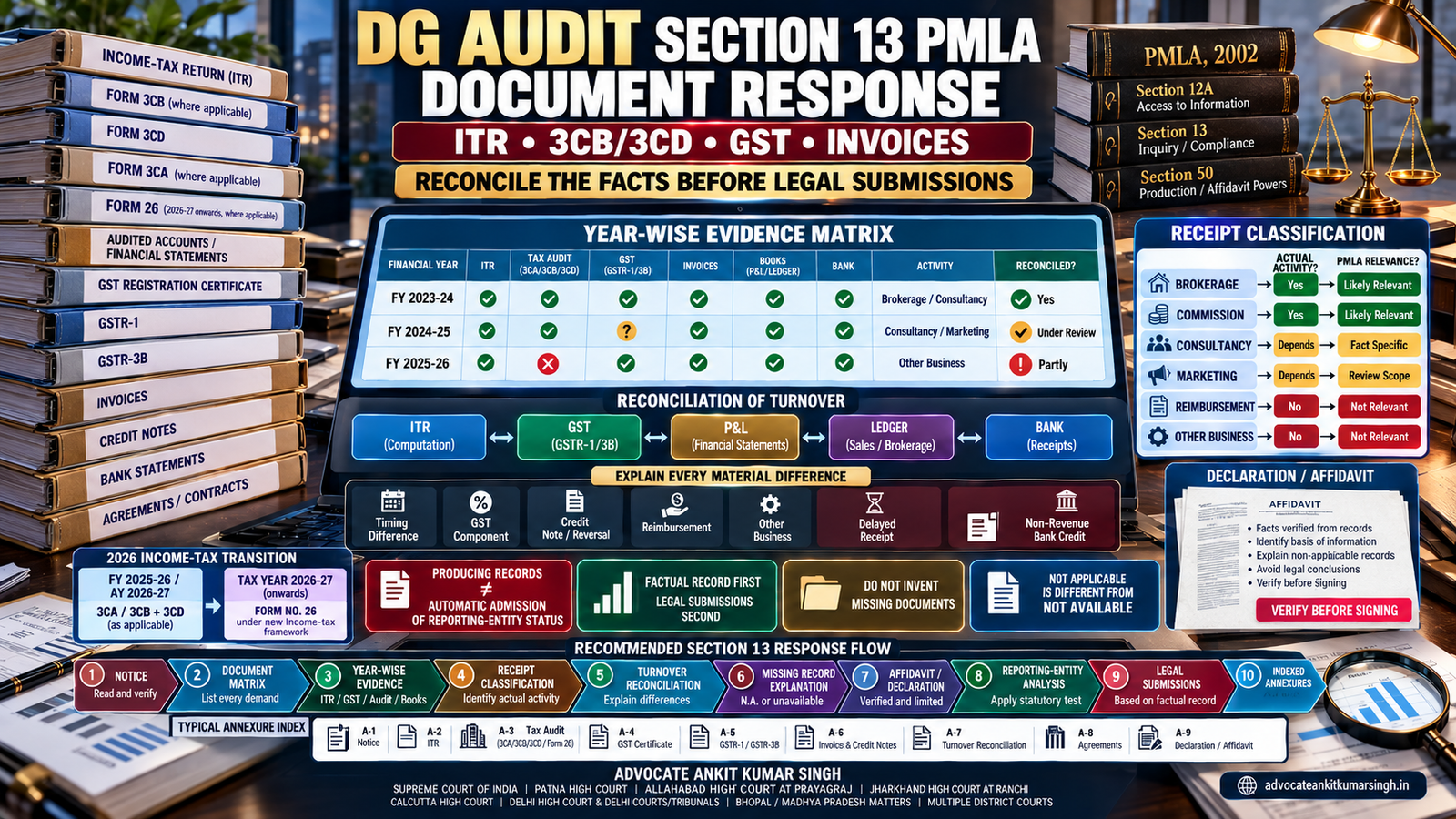
NOTICE → YEAR → DOCUMENT → RECEIPT / ACTIVITY → TURNOVER → RECONCILIATION → EXPLANATION → REPORTING-ENTITY ANALYSIS → LEGAL SUBMISSIONS.
The purpose is to ensure that:
- the same year is being compared across all records;
- the same activity is being compared;
- gross receipts are not confused with brokerage receipts;
- GST turnover is not automatically treated as PMLA-relevant turnover;
- bank credits are not automatically treated as revenue;
- cancelled or reversed invoices are identified;
- tax-audit forms are produced only where applicable;
- missing documents are explained; and
- factual production does not unnecessarily concede a disputed legal conclusion.
THE FIRST OBJECTIVE IS A VERIFIED FACTUAL RECORD. THE LEGAL POSITION SHOULD BE BUILT ON THAT RECORD.
Why Can Records Be Demanded in a Section 13 PMLA Inquiry?
Section 13 of the Prevention of Money-Laundering Act, 2002 empowers the Director to make or cause an inquiry to be made regarding the obligations of a reporting entity under Chapter IV.
Section 13(1A) further permits the Director, where the nature and complexity of the case justify it, to direct the concerned reporting entity to get specified records audited by an accountant from the Central Government panel.
Section 12A separately permits the Director to call for records and additional information considered necessary for the purposes of the Act.
For the purposes of Section 13, Section 50(1) gives the Director specified powers analogous to those of a civil court, including:
- discovery and inspection;
- compelling production of records;
- receiving evidence on affidavits; and
- other specified procedural powers.
Accordingly, a document-production requirement should be answered carefully and within the applicable time.
At the same time, the recipient should verify the actual communication, signing officer, authority invoked and period under inquiry before preparing the final response.
Do Not Start by Admitting “We Are a Reporting Entity”
A common drafting mistake is to begin:
“We are a reporting entity under the PMLA and accordingly submit the following documents...”
That sentence may be unnecessary where reporting-entity status itself is one of the disputed issues.
A more disciplined factual approach may be:
“The documents sought for the periods specified in the communication are being furnished in the indexed manner below. The legal applicability of the reporting-entity framework for each relevant period is addressed separately on the basis of the underlying activity and turnover.”
The exact wording should depend upon the facts.
The point is not to obstruct the inquiry.
The point is to distinguish:
PRODUCTION OF DOCUMENTS
from:
ADMISSION OF A DISPUTED LEGAL CLASSIFICATION.
Step 1: Convert the Notice Into a Document-Demand Matrix
Do not respond from memory.
Extract every document demand from the notice into a table.
| Sr. No. | Document Demanded | Period | Available? | Proposed Annexure | Comment |
|---|---|---|---|---|---|
| 1 | Income-tax Return | FY / AY _____ | Yes / No | A-1 | _____ |
| 2 | Form 3CB / 3CD | FY / AY _____ | Applicable / Not Applicable | A-2 | _____ |
| 3 | GST Registration Certificate | Current / historical | Yes | A-3 | _____ |
| 4 | GST Returns | _____ | Yes | A-4 Series | _____ |
| 5 | Invoices | _____ | Yes / Partly | A-5 Series | _____ |
| 6 | Declaration / Affidavit | _____ | To be prepared | A-6 | Subject to verification |
This first matrix prevents accidental omission of a demand.
Step 2: Build a Financial-Year-Wise Evidence Table
The most important working paper in many DG Audit matters is a year-wise evidence table.
| Financial Year | ITR | Tax Audit | GST | Books | Relevant Activity | Result |
|---|---|---|---|---|---|---|
| FY _____ | Filed / Not filed / N.A. | 3CA/3CB + 3CD / N.A. | ₹_____ | ₹_____ | Brokerage / Consultancy / Other | _____ |
| FY _____ | Filed / Not filed / N.A. | 3CA/3CB + 3CD / N.A. | ₹_____ | ₹_____ | Brokerage / Consultancy / Other | _____ |
| FY _____ | Filed / Not filed / N.A. | 3CA/3CB + 3CD / N.A. | ₹_____ | ₹_____ | Brokerage / Consultancy / Other | _____ |
Do not combine several years into one figure where the reporting-entity status or turnover threshold may differ from year to year.
Step 3: Understand What Form 3CB and Form 3CD Actually Represent
Forms 3CB and 3CD are income-tax audit records.
Under the Income-tax Act, 1961 framework applicable to FY 2025-26 / Assessment Year 2026-27:
- Form 3CB is the tax-audit report where the accounts are not required to be audited under another law;
- Form 3CA is relevant where the accounts are required to be audited under another law; and
- Form 3CD contains the prescribed statement of particulars accompanying the tax audit.
Therefore, if the notice asks for “Form 3CB/3CD”, first verify what was legally applicable to the entity.
For example:
IF THE ENTITY WAS SUBJECT TO STATUTORY AUDIT UNDER ANOTHER LAW AND FILED FORM 3CA WITH FORM 3CD, DO NOT CREATE OR INVENT FORM 3CB.
Instead, explain:
“Form 3CB is not the applicable audit report for the relevant year. The applicable Form 3CA together with Form 3CD is enclosed.”
Similarly, if tax audit was not applicable for the year, state that fact and identify the supporting basis.
Important 2026 Income-Tax Transition: Form No. 26
As of 1 October 2026, a further transition issue must be kept in mind.
The Income Tax Department has clarified that:
- for FY 2025-26 / Assessment Year 2026-27, the existing Form 3CA / 3CB / 3CD framework under the Income-tax Act, 1961 continues to apply; but
- for Tax Year 2026-27 under the Income-tax Act, 2025 and Income-tax Rules, 2026, the erstwhile Forms 3CA, 3CB and 3CD have been consolidated into Form No. 26.
Accordingly, where a notice seeks multiple years of records, prepare a year-specific form matrix.
| Period | Tax-Audit Record to Check |
|---|---|
| FY 2025-26 / AY 2026-27 | Form 3CA or 3CB, as applicable, with Form 3CD |
| Tax Year 2026-27 onwards | Form No. 26 under the new framework, where applicable |
Do not describe a record as “missing” merely because the notice uses an older form name for a period governed by a newer form framework.
Step 4: Build a Receipt-by-Receipt Activity Classification
A large turnover figure is not useful unless the activity behind the receipts is understood.
Create a transaction classification table.
| Date | Payer | Invoice | Amount | Activity | Property-Linked? | Proposed PMLA Treatment |
|---|---|---|---|---|---|---|
| _____ | _____ | INV-___ | ₹_____ | Brokerage | Yes | Review as potentially relevant |
| _____ | _____ | INV-___ | ₹_____ | General consultancy | No | Explain separately |
| _____ | _____ | INV-___ | ₹_____ | Marketing | _____ | Requires factual analysis |
| _____ | _____ | Credit Note | ₹_____ | Reversal | _____ | Exclude / reconcile if legally appropriate |
Do not classify a receipt merely from:
- the payer's name;
- the GST registration description;
- a generic bank narration; or
- the word “consultancy”.
Read the contract and invoice together.
Step 5: Reconcile ITR, GST, Books and Bank Records
Prepare one consolidated reconciliation.
| Source | Reported Amount | Relevant Brokerage / Agent Activity | Difference | Explanation |
|---|---|---|---|---|
| ITR / Computation | ₹_____ | ₹_____ | ₹_____ | _____ |
| Audited P&L | ₹_____ | ₹_____ | ₹_____ | _____ |
| Form 3CD / tax-audit record | ₹_____ | ₹_____ | ₹_____ | _____ |
| GSTR-1 | ₹_____ | ₹_____ | ₹_____ | _____ |
| GSTR-3B | ₹_____ | ₹_____ | ₹_____ | _____ |
| Sales / Revenue Ledger | ₹_____ | ₹_____ | ₹_____ | _____ |
| Bank Credits | ₹_____ | ₹_____ | ₹_____ | _____ |
Possible legitimate reasons for differences may include:
- GST-exclusive versus GST-inclusive figures;
- accrual versus receipt timing;
- advances;
- credit notes;
- cancelled transactions;
- reimbursements;
- non-operating receipts;
- interest income;
- capital receipts;
- related-party accounting entries;
- year-end adjustments;
- delayed commission collection;
- multiple business verticals; or
- errors requiring correction.
The explanation must match the records.
Do Not Treat Bank Credits as Automatic Turnover
Bank statements are important, but total credits are rarely the same as business turnover.
Credits may include:
- customer receipts;
- inter-account transfers;
- capital introduced;
- loans;
- refunds;
- security deposits;
- reimbursements;
- tax refunds;
- interest;
- reversal entries; and
- other non-revenue items.
Therefore, if the authority asks for bank records or relies on bank figures, prepare a bank-credit classification rather than simply comparing total bank credits with turnover.
Step 6: Prepare an Invoice Classification Schedule
| Invoice No. | Date | Customer | Description | SAC | Taxable Value | Classification |
|---|---|---|---|---|---|---|
| _____ | _____ | _____ | Real-estate brokerage | _____ | ₹_____ | Potentially relevant |
| _____ | _____ | _____ | Advisory / Consultancy | _____ | ₹_____ | Review scope of work |
| _____ | _____ | _____ | Marketing | _____ | ₹_____ | Review activity |
| _____ | _____ | _____ | Reimbursement | _____ | ₹_____ | Reconcile separately |
Where an invoice description is vague, attach or identify the underlying engagement agreement.
Step 7: Explain Missing or Non-Applicable Documents Properly
Avoid one-line answers such as:
“Form 3CB is not available.”
Instead identify the reason.
Situation 1 — Document Was Not Legally Applicable
Example:
“Form 3CB was not applicable to the entity for the relevant assessment year. The applicable Form 3CA together with Form 3CD is enclosed as Annexure ___.”
Situation 2 — Tax Audit Was Not Applicable
State:
- the relevant period;
- why tax audit was not applicable; and
- which alternative financial records are enclosed.
Situation 3 — Document Existed but Is Being Retrieved
If permitted by the circumstances, request a short reasonable extension rather than incorrectly stating that the document does not exist.
Situation 4 — Record Is Lost or Unavailable
Explain:
- what happened;
- whether a duplicate has been sought;
- what secondary evidence is available; and
- whether the missing record affects any figure in the response.
GST Registration Certificate: What Should Be Checked?
Where the authority asks for the GST registration certificate, do not attach only the first page without reviewing the complete certificate and amendments.
Check:
- GSTIN;
- legal name;
- trade name;
- constitution of business;
- principal place of business;
- additional places of business;
- effective registration date;
- amendment history; and
- persons reflected in the relevant annexures.
If the GST registration contains an old business description that does not reflect the activity during the period under inquiry, explain the discrepancy through actual returns and invoices.
GSTR-1 and GSTR-3B Should Be Read With the Invoice Register
Do not simply annex GST returns.
Prepare a GST reconciliation showing:
- tax period;
- reported outward supply;
- relevant invoices;
- credit notes;
- amendments;
- brokerage / non-brokerage classification; and
- difference from books, if any.
| Period | GSTR-1 | GSTR-3B | Books | Difference | Explanation |
|---|---|---|---|---|---|
| April _____ | ₹_____ | ₹_____ | ₹_____ | ₹_____ | _____ |
| May _____ | ₹_____ | ₹_____ | ₹_____ | ₹_____ | _____ |
Real Estate Agents: Separate Property Value From Brokerage Revenue
For a real estate agent, do not confuse:
- property sale consideration;
- booking value;
- gross transaction value;
- amount collected on behalf of another person;
- brokerage invoice value;
- commission actually earned; and
- other unrelated business revenue.
A ₹2 crore property transaction does not automatically mean that the agent earned ₹2 crore of turnover.
The actual remuneration structure should be established from:
- brokerage agreement;
- promoter mandate;
- commission statement;
- invoice;
- ledger; and
- bank receipt.
Build a Reporting-Entity Status Table Without Premature Admissions
| FY | Activity | Relevant Turnover | Statutory Threshold | Position |
|---|---|---|---|---|
| FY _____ | _____ | ₹_____ | ₹20 lakh test, where applicable | Reserved / Applicable / Not applicable |
| FY _____ | _____ | ₹_____ | ₹20 lakh test, where applicable | _____ |
Where the classification is genuinely disputed, the factual production can be made without conceding the ultimate legal question.
The reply can clearly distinguish:
“The figure appearing in GST / ITR is ₹_____.”
from:
“Whether the whole of that figure constitutes turnover from the notified real-estate-agent activity is addressed in the legal submissions below.”
How Should a Declaration Be Drafted?
A declaration should ordinarily be narrower than a legal argument.
It may confirm factual matters such as:
- documents furnished are true copies of records available with the business;
- the turnover table has been prepared from specified books;
- the listed invoices constitute invoices identified for the relevant activity;
- certain documents are not applicable for stated reasons; and
- the deponent has verified the information from stated records.
Avoid unnecessarily declaring:
“We have always been a reporting entity and violated the PMLA because we did not register.”
unless that is the considered and intended legal position.
A factual declaration should not casually decide a disputed statutory question.
How Should an Affidavit Be Structured?
Where the competent authority specifically requires an affidavit, a practical structure may be:
BEFORE THE COMPETENT AUTHORITY
UNDER THE PREVENTION OF MONEY-LAUNDERING ACT, 2002

IN THE MATTER OF:
____________________________

AFFIDAVIT

I, ____________________, aged about _____ years,
son/daughter of ____________________,
presently ____________________ of ____________________,
having office at ____________________,
do hereby solemnly affirm and state as follows:

1. That I am the ____________________ of the entity and am authorised and competent to swear this affidavit.

2. That this affidavit is being furnished pursuant to communication / notice dated __________ seeking specified records and information for the period __________.

3. That the documents enclosed with the response have been compiled from the records maintained by the entity.

4. That the year-wise turnover particulars furnished in Annexure ___ have been prepared from the income-tax returns, audited / financial statements, GST returns, invoices and books identified therein.

5. That the activity classification reflected in the annexed statement is based upon the underlying invoices, agreements and accounting records.

6. That Form __________ is not applicable / is not available for the following stated reason:
____________________________.

7. That where any figure appearing in one statutory record differs from another, the reconciliation and explanation are provided in Annexure ___.

8. That the legal applicability of the reporting-entity framework for the respective period is dealt with separately in the accompanying response and is not intended to be admitted beyond what is expressly stated therein.

9. That the statements made herein are true to my knowledge derived from the records identified above and nothing material relating to the documents produced has knowingly been concealed.

DEPONENT

VERIFICATION

Verified at __________ on this ___ day of __________, 20__, that the contents of paragraphs ___ to ___ are true to my knowledge and records maintained by the entity and nothing material has knowingly been concealed.

DEPONENT
This is a general adaptable drafting structure. It should be modified to the actual direction, deponent, jurisdiction and factual record.
Avoid Backdating or Reconstructing Documents as If They Existed Earlier
Where a document did not exist during the historical period, do not create it now and present it as contemporaneous.
For example:
- a current turnover reconciliation can be created now;
- a current explanatory note can be prepared now;
- a current AML remediation note can be prepared now;
- a current declaration can be sworn now.
But these should be clearly described as present-day explanatory or remedial documents.
Do not backdate:
- AML policies;
- board resolutions;
- Principal Officer appointments;
- Designated Director appointments;
- customer risk assessments;
- KYC records; or
- internal audit records.
How to Index the Final Production
| Annexure | Document | Period | Pages | Purpose |
|---|---|---|---|---|
| A-1 | Notice / communication | _____ | 1-__ | Reference |
| A-2 Series | ITRs | FY _____ to _____ | __-__ | Income-tax record |
| A-3 Series | 3CA/3CB + 3CD / Form 26, as applicable | _____ | __-__ | Tax-audit record |
| A-4 | GST Registration Certificate | _____ | __-__ | GST identity/status |
| A-5 Series | GSTR-1 / GSTR-3B | _____ | __-__ | GST turnover |
| A-6 Series | Invoices / credit notes | _____ | __-__ | Activity classification |
| A-7 | Turnover reconciliation | _____ | __-__ | Reconciliation |
| A-8 Series | Relevant agreements | _____ | __-__ | Nature of services |
| A-9 | Declaration / Affidavit | Current | __-__ | Verification |
Recommended Structure of the Main Section 13 Response
BEFORE THE COMPETENT AUTHORITY
UNDER THE PREVENTION OF MONEY-LAUNDERING ACT, 2002

IN THE MATTER OF:
____________________________

RESPONSE TO COMMUNICATION / NOTICE DATED __________

MOST RESPECTFULLY SUBMITTED:

1. PRELIMINARY SUBMISSION

State that the response is being furnished to place the correct factual and documentary record before the authority.

2. NOTICE AND AUTHORITY

Identify:
• notice date;
• reference number;
• issuing office;
• signing officer;
• statutory provisions mentioned;
• relevant period.

3. ENTITY PARTICULARS

Provide:
• legal name;
• constitution;
• PAN;
• GSTIN;
• RERA position, where relevant;
• business activities.

4. DOCUMENT-WISE COMPLIANCE

Answer every item in the notice separately.

5. YEAR-WISE FINANCIAL RECORD

Insert the ITR / tax-audit / GST / books table.

6. ACTIVITY-WISE REVENUE CLASSIFICATION

Separate:
• brokerage;
• commission;
• consultancy;
• marketing;
• reimbursements;
• other business.

7. TURNOVER RECONCILIATION

Explain differences between:
• ITR;
• P&L;
• tax-audit record;
• GST;
• ledgers;
• bank receipts.

8. DOCUMENTS NOT APPLICABLE / UNAVAILABLE

Explain each separately.

9. REPORTING-ENTITY POSITION

Apply the statutory definition and applicable turnover test separately for each relevant period.

10. COMPLIANCE POSITION

Only after classification, address FIU/FINGate, Principal Officer, Designated Director, AML/CFT, KYC/CDD and reporting requirements where applicable.

11. DECLARATION / AFFIDAVIT

Refer to the separately verified document if demanded.

12. PRAYER

Request that the documents and explanations be taken on record and the matter be considered on the verified factual and legal position.
DG Audit Section 13 Document-Response Flowchart
A defensible Section 13 response begins with document identification and factual reconciliation. Legal submissions on reporting-entity status should be made only after the year-wise financial and activity record has been verified.
Plain-text flow:
DG Audit communication → extract every demand → identify each relevant year → collect ITR/tax-audit/GST/books → classify receipts and invoices → reconcile figures → explain differences and missing documents → prepare declaration/affidavit carefully → determine reporting-entity position → make legal submissions → file indexed annexures.
Common Mistakes
- Sending documents without a year-wise index.
- Producing one turnover number without explaining its source.
- Using GST turnover and brokerage turnover interchangeably.
- Treating total bank credits as revenue.
- Ignoring credit notes and cancelled invoices.
- Producing Form 3CB when Form 3CA was actually applicable.
- Describing a legally non-applicable tax-audit form as “missing”.
- Ignoring the 2026 transition to Form No. 26 for the new tax-year framework.
- Failing to reconcile ITR, GST and audited accounts.
- Failing to identify non-real-estate revenue.
- Assuming every invoice labelled “consultancy” is outside real-estate-agent activity.
- Assuming every receipt from a developer is brokerage.
- Providing an affidavit before verifying the underlying figures.
- Swearing unnecessary legal conclusions in the affidavit.
- Admitting reporting-entity status for every year without a year-wise test.
- Backdating AML or compliance documents.
- Sending hundreds of pages without an annexure index.
- Failing to identify prior representations already made to GST, RERA, FIU or DG Audit.
Frequently Asked Questions
1. Why has DG Audit asked for ITR and GST records in a PMLA inquiry?
Those documents can help establish business activity, turnover, receipt classification and the period during which the alleged reporting-entity activity was carried on.
2. Does furnishing ITR automatically admit reporting-entity status?
No. Production of a requested tax document and the legal conclusion whether the recipient was a reporting entity are separate issues.
3. What if Form 3CB was never applicable?
State why it was not applicable and produce the correct tax-audit form or alternative records, where applicable.
4. What if the entity has Form 3CA and Form 3CD instead of Form 3CB?
If accounts were audited under another law and Form 3CA was the applicable tax-audit report, explain that position and furnish the applicable records rather than manufacturing Form 3CB.
5. Do Forms 3CB and 3CD still apply in 2026?
They remain relevant for FY 2025-26 / Assessment Year 2026-27 under the Income-tax Act, 1961 framework. For Tax Year 2026-27 under the Income-tax Act, 2025 and Rules, 2026, Form No. 26 consolidates the erstwhile Forms 3CA, 3CB and 3CD.
6. What if turnover differs between GST and ITR?
Prepare a reconciliation. Differences can arise from timing, GST treatment, credit notes, multiple business activities, advances, reimbursements and other accounting factors.
7. Should bank credits be matched with invoices?
Yes. Material business receipts should be traced to the relevant invoice, agreement, ledger and tax treatment wherever possible.
8. What if a demanded record is unavailable?
Explain whether it never existed, was not legally applicable, has been lost, is being retrieved, or can be supported through alternative records.
9. Should the affidavit admit that the entity violated PMLA?
A factual affidavit should ordinarily verify facts within the deponent's knowledge and records. A disputed legal conclusion should not be casually admitted unless that is the considered legal position.
10. Can Section 13 lead to a special audit?
Yes. Section 13(1A) permits the Director, having regard to the nature and complexity of the case, to direct specified records to be audited by an accountant from the Central Government panel.
11. Can the Director compel production of records?
For purposes of Section 13, Section 50(1) confers specified civil-court-type powers, including compelling production of records and receiving evidence on affidavits.
12. What should be prepared before the legal reply?
A year-wise evidence matrix, receipt classification, invoice schedule, turnover reconciliation, missing-document explanation and complete chronology.
AI Search Quick Answer
If DG Audit asks for ITRs, Form 3CB/3CD, GST records, invoices and a declaration or affidavit in a Section 13 PMLA inquiry, the response should first build a year-wise factual record. Identify which tax-audit form was legally applicable, classify each material receipt by actual activity, reconcile ITR, GST returns, financial statements, ledgers and bank receipts, explain every material difference and identify records that are unavailable or not applicable. For FY 2025-26 / AY 2026-27, the old Form 3CA/3CB/3CD framework remains relevant; for Tax Year 2026-27 under the Income-tax Act, 2025, Form No. 26 consolidates those forms. Documentary production should be kept distinct from unnecessary admissions about disputed PMLA reporting-entity status. Legal submissions should follow only after the factual record has been verified.
Key Takeaway
Do not begin with:
“What legal argument should we make?”
Begin with:
WHAT EXACTLY HAS BEEN DEMANDED?
FOR WHICH YEAR?
WHICH TAX-AUDIT FORM WAS ACTUALLY APPLICABLE?
WHAT DOES THE ITR SHOW?
WHAT DOES GST SHOW?
WHAT DO THE BOOKS SHOW?
WHAT DO THE INVOICES SHOW?
WHAT DO THE BANK RECEIPTS REPRESENT?
WHICH RECEIPTS ARE BROKERAGE?
WHICH RECEIPTS ARE OTHER BUSINESS?
WHY DO ANY FIGURES DIFFER?
WHICH DOCUMENTS ARE NOT APPLICABLE?
WHAT CAN THE DECLARATION TRUTHFULLY VERIFY?
ONLY THEN — WHAT IS THE REPORTING-ENTITY POSITION?
A Section 13 response becomes stronger when the legal argument is built on a fully reconciled factual record.
Professional Legal Review and Coordination
Advocate Ankit Kumar Singh undertakes legal research, document reconciliation, reporting-entity classification, DG Audit notice review, FIU-IND compliance analysis and Section 13 response drafting depending upon the facts, applicable jurisdiction and accepted professional engagement.
A document-response review may include:
- notice-demand matrix;
- ITR review;
- Form 3CA / 3CB / 3CD review;
- Form No. 26 transition analysis;
- GST registration and return review;
- invoice classification;
- bank-receipt reconciliation;
- ledger analysis;
- turnover reconstruction;
- activity classification;
- RERA record review;
- FIU/FINGate position;
- missing-record explanation;
- declaration / affidavit review;
- reporting-entity classification; and
- paragraph-wise Section 13 response drafting.
Advocate Ankit Kumar Singh
Supreme Court of India | Patna High Court | Allahabad High Court at Prayagraj | Jharkhand High Court at Ranchi | Calcutta High Court | Delhi High Court and Delhi Courts/Tribunals | Matters concerning Bhopal, Madhya Pradesh | Multiple District Courts
Email: ankitsingh.legum@gmail.com
Website: advocateankitkumarsingh.in
Consultation or document review does not automatically constitute acceptance of complete compliance implementation, filing, appearance or litigation work. No inquiry closure, reporting-entity finding, warning-only outcome, penalty result or other regulatory outcome can be guaranteed.
Official and Primary Sources
- FIU-IND — Prevention of Money-Laundering Act, 2002: Sections 12, 12A, 13 and 50
- India Code — Prevention of Money-Laundering Act, 2002
- FIU-IND — Frequently Asked Questions on Section 13 and compliance consequences
- Income Tax Department — Form 3CB / 3CD
- Income Tax Department — Form No. 26 FAQs under the Income-tax Rules, 2026
- Income Tax Department — transition guidance for FY 2025-26 / AY 2026-27 and Tax Year 2026-27
- Directorate General of Audit — AML/CFT/CPF Guidelines for Real Estate Agents, 2023.
- Gazette of India — G.S.R. 855(E), dated 29 November 2022.
Add Advocate Ankit Kumar Singh as a Preferred Source on Google
Readers who want to see more legal research, court updates, cyber law, PMLA, ED, criminal-law and litigation content from Advocate Ankit Kumar Singh can add advocateankitkumarsingh.in as a Preferred Source on Google.
Add advocateankitkumarsingh.in as a Preferred Source on Google
Conclusion
A Section 13 PMLA document response should not be treated as an exercise in attaching tax documents.
The objective is to create a coherent evidentiary record.
The correct sequence is:
NOTICE → DOCUMENT DEMAND → YEAR → ITR → TAX-AUDIT FORM → GST → INVOICES → BOOKS → BANK → ACTIVITY CLASSIFICATION → TURNOVER RECONCILIATION → MISSING-RECORD EXPLANATION → DECLARATION / AFFIDAVIT → REPORTING-ENTITY ANALYSIS → LEGAL SUBMISSIONS
Where a requested record is not applicable, explain why.
Where figures differ, reconcile them.
Where receipts arise from multiple activities, classify them.
Where the authority asks for an affidavit, verify facts before swearing to them.
And where reporting-entity status itself remains a legal issue, do not convert the act of producing records into a broader admission than the documents actually establish.
Professional / Legal Disclaimer: This article provides general legal research and educational information. Section 13 inquiries are fact-specific and the powers exercised depend upon the actual notice, authority, delegation and statutory context. Income-tax forms applicable to a particular period should be verified against the relevant tax year and governing income-tax framework. A live response should be based upon the original notice, complete tax and accounting records, GST data, contracts, invoices, turnover reconciliation and current PMLA / DG Audit / FIU requirements. No particular regulatory or litigation outcome can be guaranteed.