Updated and legally reviewed: 30 September 2026
Top DG Audit PMLA Lawyer for Principal Director General of Audit Section 13 Inquiries Against Real Estate Agents
Create a commercial-intent article around notices issued through the Directorate General of Audit, Indirect Taxes and Customs, acting for CBIC in supervision of real estate-agent AML compliance. The article should explain how counsel should verify the notice, the asserted reporting-entity basis, turnover and activity data, FIU-IND registration position, GST and RERA records, prior communications and the exact documents demanded before responding.
Legal research and analysis by Advocate Ankit Kumar Singh.
 Advocate Ankit Kumar Singh
Important Disclosure About the Phrase “Top DG Audit PMLA Lawyer”
The expression “Top DG Audit PMLA Lawyer” is a commercial search phrase used by people looking for legal assistance after receiving a PMLA-related compliance communication.
It should not be understood as an official ranking.
No official ranking identified for this article from a Court, FIU-IND, CBIC, Directorate General of Audit, Government of India or professional regulator declares any particular advocate the universally “top”, “best” or No.1 lawyer for DG Audit or Section 13 PMLA proceedings.
The more useful question is whether counsel can correctly identify:
- why the recipient has been treated as a reporting entity;
- which statutory period is under examination;
- whether the ₹20 lakh annual-turnover threshold was actually crossed;
- whether the business activity answers the statutory description of a real estate agent;
- whether FIU-IND/FINGate registration was required and completed;
- whether GST, income-tax, financial statements and RERA data tell the same factual story;
- which AML/CFT controls were required;
- what the notice actually demands; and
- which facts require explanation rather than assumption.
Direct Answer: What Should a Real Estate Agent Do After Receiving a DG Audit PMLA Notice?
Do not begin by drafting a general apology, denial or explanation.
Begin by classifying the notice.
The first legal review should answer seven questions:
- Who issued the notice?
- Under which provision is information being sought?
- Why does the authority say the recipient is a PMLA reporting entity?
- For which financial year or period?
- What turnover figure has apparently triggered the inquiry?
- What FIU-IND, GST and RERA information already exists in government databases?
- What exact documents and explanations are demanded?
Only after those questions are answered should the substantive reply be drafted.
The core strategy is document reconciliation, not generic denial.
Why Are Real Estate Agents Covered by the PMLA Reporting-Entity Framework?
The Prevention of Money-Laundering Act treats persons carrying on specified designated businesses or professions as reporting entities.
The Central Government’s notification dated 28 December 2020 notified real estate agents providing services in relation to the sale or purchase of real estate and having annual turnover of ₹20 lakh or above as persons carrying on designated businesses or professions.
That threshold is important.
A notice should not simply be answered on the assumption that every person connected with property transactions is automatically a PMLA reporting entity.
Counsel should first test both limbs:
- Was the person carrying on the relevant real estate-agent activity?
- Was the applicable annual-turnover threshold reached during the relevant period?
Who Is a “Real Estate Agent” for This PMLA Compliance Framework?
The DG Audit guidelines adopt the RERA-linked concept of a real estate agent and cover persons who negotiate or act on behalf of one person in a transaction involving transfer of a plot, apartment or building in a real estate project, receive commission, fees or other charges for their services, or introduce prospective buyers and sellers through any medium, subject to the prescribed turnover threshold for reporting-entity status.
The description can therefore potentially include:
- property brokers;
- real estate intermediaries;
- commission agents;
- property dealers acting as intermediaries;
- brokerage companies;
- partnership firms providing brokerage services;
- digital or offline intermediaries introducing buyers and sellers; and
- other persons falling within the statutory activity definition.
But classification must follow the actual activity.
A builder selling its own inventory, an owner selling personal property, a consultant receiving an unrelated professional fee, and a brokerage intermediary may raise different classification questions.
The notice should therefore be tested against the recipient’s real commercial activity rather than merely the trade name appearing in GST or RERA databases.
Why Does the ₹20 Lakh Annual-Turnover Threshold Matter?
The notification expressly uses an annual-turnover threshold of ₹20 lakh or above for real estate agents.
This creates a foundational factual question.
Before admitting reporting-entity status, counsel should identify:
- the relevant financial year;
- the date from which the statutory obligation is asserted;
- the nature of revenue being counted;
- brokerage and commission receipts;
- non-real-estate revenue, if any;
- GST returns;
- income-tax returns;
- audited financial statements;
- bank receipts;
- credit notes and reversals;
- group-company receipts;
- reimbursements;
- advances;
- cancelled transactions; and
- any amount incorrectly characterised as brokerage turnover.
Do not assume that a figure appearing in one return automatically decides the entire PMLA classification question.
The legally relevant turnover and the factual business activity should be reconciled across the full documentary record.
CBIC Is the Regulator — Where Does DG Audit Fit?
Rule 2(1)(fa) of the Prevention of Money-laundering (Maintenance of Records) Rules identifies the Central Board of Indirect Taxes and Customs as the regulator with respect to real estate agents.
The Directorate General of Audit operates the regulatory and supervisory framework on behalf of CBIC for this sector.
The 2023 DG Audit AML/CFT/CPF Guidelines for Real Estate Agents expressly describe the Directorate General of Audit as the regulator for the real-estate-agent compliance framework.
The institutional structure therefore needs to be understood correctly:
CBIC → statutory regulator under the PML Rules
DG Audit → regulatory/supervisory implementation for the sector
FIU-IND → financial-intelligence reporting and reporting-entity infrastructure
These functions interact, but they should not be casually merged.
Principal Director General of Audit vs the “Director” Exercising Section 13 Powers
This distinction is particularly important because the title of a notice or the institutional letterhead may create confusion.
Departmental guidance records that the Principal Director General / Director General, Directorate General of Audit functions as regulator on behalf of CBIC for real estate agents and dealers in precious metals and precious stones.
The same departmental material records that Pr. ADG/ADG officers of DG Audit have been notified as “Director” to exercise powers under Section 13 PMLA.
Accordingly, legal review should separately identify:
- the regulatory authority;
- the actual officer signing the notice;
- the designation appearing below the signature;
- the statutory authority invoked;
- any notification or delegation referred to; and
- whether the communication is an audit request, inquiry, show-cause notice, summons, hearing notice or proposed Section 13 action.
The safest practice is to analyse the actual document rather than assuming jurisdiction from the heading alone.
What Does Section 13 PMLA Permit?
Section 13 concerns inquiry into the obligations of a reporting entity under Chapter IV of the PMLA.
The Director may make, or cause to be made, an inquiry considered necessary regarding those obligations.
Where failure is found, Section 13 permits specified regulatory consequences including:
- a written warning;
- a direction to comply with specific instructions;
- a direction to submit periodic reports about remedial measures; and
- a monetary penalty of not less than ₹10,000 and extending to ₹1,00,000 for each failure.
Section 13 also permits, in the circumstances contemplated by the statute, direction for specified records to be audited by an accountant from the Central Government’s panel.
This makes one point particularly important:
A Section 13 proceeding can have real financial and regulatory consequences even though it is not automatically an Enforcement Directorate prosecution for money laundering.
First Defence Question: Was the Recipient Actually a Reporting Entity?
Do not start a Section 13 reply by conceding the conclusion written into the notice.
First create a reporting-entity determination sheet.
| Issue | Document to Check | Question |
|---|---|---|
| Business activity | GST registration, invoices, agreements, website, RERA records | Was the recipient actually providing real-estate-agent services? |
| Relevant period | Notice, financial statements, returns | Which year or years are under inquiry? |
| Annual turnover | P&L, GST returns, ITR, ledger | Was ₹20 lakh or more reached? |
| Nature of receipts | Invoices, bank statements, ledger | Which receipts were actually brokerage or commission? |
| RERA position | RERA registration and renewal | Was the recipient registered or required to be registered as an agent? |
| FIU position | FINGate / FINnet / FIUREID records | Was reporting-entity enrolment completed? |
| Principal Officer | Board/partner/proprietor records | Was a Principal Officer appointed and communicated? |
| Designated Director | Corporate/firm governance records | Was a Designated Director identified where required? |
Why GST Records Matter — But Should Not Be Read in Isolation
DG Audit operates within the CBIC ecosystem, which means GST information can become practically significant during classification and audit.
Counsel should ordinarily obtain:
- GST registration certificate;
- GST registration amendments;
- declared business activity;
- GSTR-1;
- GSTR-3B;
- annual returns where applicable;
- e-invoice information where applicable;
- sales ledger;
- commission invoices;
- credit notes;
- debit notes;
- cancellations and reversals;
- bank receipts; and
- reconciliation with audited financial statements.
Potential discrepancies should be identified before the authority identifies them.
Examples:
- GST turnover exceeds P&L brokerage income;
- P&L revenue exceeds GST declarations;
- GST registration describes “real estate services” but actual activity was different;
- receipts include reimbursements;
- advances were later reversed;
- commission was earned by another group entity; or
- gross transaction value has been confused with brokerage revenue.
A defensible reply should explain the reconciliation with supporting records.
Why RERA Records Must Be Checked Before Replying
The DG Audit guidelines operate alongside the statutory definition of real estate agent under RERA.
RERA records can therefore be important evidence of:
- registration as a real estate agent;
- date of registration;
- renewal history;
- business name;
- registered address;
- authorised persons;
- projects or promoters associated with the agent;
- disciplinary or compliance history, where applicable; and
- period during which the registration was active.
But the analysis should not stop with one database entry.
Counsel should ask whether the RERA registration period, GST activity, commission invoices and PMLA reporting-entity period actually correspond.
FIU-IND Registration: Verify the Position Before Making Any Admission
FIU-IND’s reporting framework requires reporting entities to furnish prescribed information electronically and provides the FINnet/FINGate infrastructure for reporting-entity registration and reporting.
Before replying to DG Audit, verify:
- whether the entity has a FIU Reporting Entity ID / FIUREID;
- date of reporting-entity enrolment;
- whether the Principal Officer is registered;
- whether Designated Director information was communicated;
- whether the registered email and mobile number remain accessible;
- whether FINGate credentials are active;
- whether filings were submitted;
- whether filings were accepted, rejected or resubmitted;
- whether any registration attempt remained incomplete;
- whether earlier correspondence with FIU-IND exists; and
- whether portal or technical issues are documented.
The distinction between:
NO REGISTRATION
and
REGISTRATION INITIATED BUT DEFECTIVE / PENDING / TECHNICALLY INCOMPLETE
may matter factually when explaining historical compliance.
Principal Officer and Designated Director — Check the Governance Record
DG Audit’s real-estate AML guidance requires reporting entities to establish the compliance structure contemplated by the PML Rules.
The file should therefore contain, where applicable:
- appointment of Principal Officer;
- appointment/designation of Designated Director;
- board resolution or management decision;
- effective date;
- name and designation;
- telephone number;
- email address;
- communication made to FIU-IND;
- communication made to the regulator;
- communication to the relevant RERA authority where required by the sectoral framework; and
- records of subsequent change in personnel.
A common difficulty is retrospective paperwork.
Do not fabricate or backdate an appointment merely because the old record is incomplete.
The safer response is to identify the actual historical position, explain the deficiency accurately where one existed, and separately document present corrective measures.
AML/CFT Policy: A PDF Created After the Notice Is Not Enough
A real-estate reporting entity should be able to demonstrate an operational AML/CFT framework rather than merely produce a recently drafted policy.
The file should be tested for:
- date of policy adoption;
- approving authority;
- risk assessment;
- client acceptance policy;
- KYC procedure;
- CDD procedure;
- enhanced due diligence;
- beneficial-owner identification;
- transaction monitoring;
- suspicious-transaction escalation;
- CTR/STR decision making;
- sanctions screening;
- record retention;
- confidentiality;
- anti-tipping-off procedure;
- employee training;
- internal review;
- Principal Officer responsibilities;
- Designated Director oversight; and
- periodic update procedure.
The most important question is:
Can the business prove the policy was actually followed?
The Departmental Audit Checklist Gives a Strong Clue About What Will Be Examined
Publicly available departmental guidance concerning PMLA supervision of real-estate agents describes an 18-point audit checklist.
The published checkpoints include matters such as:
- whether the reporting entity received the PMLA guidelines;
- whether an AML/CFT/TF/PF policy existed;
- appointment of Principal Officer and Designated Director;
- maintenance of client records;
- KYC records;
- transaction records;
- cash/suspicious transaction reporting information;
- where and how records are maintained;
- confidentiality controls;
- anti-tipping-off arrangements;
- information-sharing procedures;
- KYC/CDD database usage;
- employee AML/CFT training; and
- handling of terrorist-financing or proliferation-financing information.
This means preparation should be evidence-based.
For each compliance question, create:
LEGAL OBLIGATION → CLIENT POSITION → SUPPORTING DOCUMENT → DEFICIENCY, IF ANY → REMEDIAL STEP
Do Not Ignore Prior Communications
One of the first things counsel should request is every earlier communication with:
- DG Audit;
- CGST Audit authorities;
- State GST authorities;
- RERA;
- FIU-IND;
- FINGate helpdesk;
- earlier consultant;
- chartered accountant;
- company secretary;
- internal compliance staff; and
- any person who previously responded on behalf of the business.
Why?
Because the present reply cannot safely contradict:
- an earlier turnover declaration;
- an earlier admission of business activity;
- a previous statement that FIU registration was complete;
- a prior list of customers;
- a different Principal Officer name;
- a previous AML policy date; or
- earlier information supplied through GST or RERA channels.
Prepare one chronology before writing the reply.
The Notice Verification Checklist
-
Verify the letterhead.
Check whether it is DG Audit Headquarters, a zonal unit, CGST Audit formation, State GST authority or another authority. -
Verify the file number.
Preserve the complete reference exactly. - Verify the digital signature or physical signature.
- Identify the signing officer’s designation.
- Identify Section 13 or any other statutory provision invoked.
- Check the financial years under inquiry.
- Check the turnover figure relied upon.
- Check whether the notice identifies the recipient as a reporting entity.
- Identify the source of that classification if stated.
- Check whether FIU registration is specifically alleged to be absent.
- Identify every document demanded.
- Record the reply deadline and hearing date.
- Check whether personal attendance is required.
- Check whether the notice refers to an earlier letter which the client never supplied to counsel.
Document-by-Document Preparation Before Filing the Reply
A. Identity and Constitution
- PAN;
- GST registration;
- certificate of incorporation;
- partnership deed;
- LLP documents;
- proprietorship evidence;
- MOA/AOA;
- registered-office details;
- authorised-signatory records.
B. RERA Material
- agent registration;
- renewal;
- applications;
- correspondence;
- project associations;
- registration status for each relevant year.
C. Turnover Material
- audited accounts;
- profit and loss accounts;
- balance sheets;
- ITRs;
- GST returns;
- sales/commission ledger;
- invoices;
- bank statements;
- credit notes;
- reconciliation statement.
D. FIU-IND Material
- FIUREID;
- registration acknowledgement;
- FINGate records;
- Principal Officer registration;
- filing acknowledgements;
- CTR/STR records where applicable;
- portal correspondence;
- technical grievance records.
E. AML/CFT Governance
- AML/CFT policy;
- risk assessment;
- KYC policy;
- CDD/EDD procedure;
- beneficial-owner procedure;
- Principal Officer appointment;
- Designated Director appointment;
- training records;
- internal review;
- sanctions-screening procedure;
- record-retention policy;
- confidentiality / anti-tipping-off instructions.
F. Customer / Transaction Sample Records
- KYC documents;
- brokerage agreements;
- property details;
- customer identification;
- beneficial-owner material;
- commission invoices;
- payment trail;
- risk classification;
- CDD notes.
Should a Client Produce Everything Immediately?
The correct approach is neither deliberate non-cooperation nor indiscriminate document dumping.
For every demand, counsel should identify:
- what is requested;
- the statutory relevance;
- the period requested;
- whether the document exists;
- whether it is already in the authority’s possession;
- whether personal data of unrelated third parties is involved;
- whether confidentiality requirements apply;
- whether clarification of scope is needed;
- whether time is genuinely required to compile the record; and
- how the production should be indexed.
A professional production usually works better as:
INDEX → DOCUMENT NUMBER → DATE → DESCRIPTION → PURPOSE → PAGE RANGE
rather than several hundred unstructured pages.
How to Build the Turnover Reconciliation
| Source | Amount | Relevant Brokerage? | Explanation |
|---|---|---|---|
| Audited P&L | ₹_____ | Yes / No / Partly | _____ |
| GSTR-1 | ₹_____ | Yes / No / Partly | _____ |
| GSTR-3B | ₹_____ | Yes / No / Partly | _____ |
| ITR | ₹_____ | Yes / No / Partly | _____ |
| Bank Credits | ₹_____ | Yes / No / Partly | _____ |
| Commission Ledger | ₹_____ | Yes / No / Partly | _____ |
| RERA-linked Brokerage | ₹_____ | Yes / No / Partly | _____ |
The purpose is to identify the actual activity and turnover before taking a legal position on reporting-entity status.
What If the ₹20 Lakh Threshold Was Crossed Only in a Later Year?
This is a period-specific issue.
Counsel should prepare a year-by-year table rather than making one general admission.
| Financial Year | Real Estate Agent Activity | Relevant Annual Turnover | ₹20 Lakh Threshold? | Compliance Position |
|---|---|---|---|---|
| FY ____ | _____ | ₹_____ | Yes / No | _____ |
| FY ____ | _____ | ₹_____ | Yes / No | _____ |
| FY ____ | _____ | ₹_____ | Yes / No | _____ |
The inquiry should be answered according to the actual statutory status during each relevant period.
What If the Client Was RERA-Registered but Below the PMLA Turnover Threshold?
RERA registration and PMLA reporting-entity status should not automatically be treated as identical questions.
The real-estate PMLA notification expressly uses the annual-turnover threshold.
Therefore:
RERA REGISTRATION ≠ AUTOMATIC PROOF OF ₹20 LAKH PMLA REPORTING-ENTITY STATUS FOR EVERY PERIOD.
RERA records remain highly relevant, but turnover and actual activity must still be examined.
What If GST Shows Real-Estate Services but the Client Says It Was Not Acting as a Broker?
This requires documentary explanation.
Possible questions include:
- What SAC/service classification was used?
- Who prepared the GST registration?
- What invoices were issued?
- Were commissions actually received?
- Was the entity marketing its own property or acting for third parties?
- Were brokerage agreements executed?
- Were buyers introduced to sellers?
- Did the business receive commission, fees or other charges?
- What do bank narrations show?
A bare statement that “GST classification was wrong” is usually weaker than a document-supported explanation.
What If FIU-IND Registration Was Never Completed?
Do not fabricate a historical compliance record.
The file should instead identify:
- when the reporting-entity obligation arose;
- whether the business knew of the requirement;
- whether registration had been attempted;
- whether FIUREID was generated;
- whether Principal Officer enrolment remained incomplete;
- whether any technical issue occurred;
- whether any reports became due;
- whether suspicious or reportable transactions existed;
- what corrective steps have now been taken; and
- whether the present explanation is supported by records.
A corrective action does not erase an earlier failure.
But a precise chronology is preferable to an inaccurate retrospective claim.
Section 13 Does Not Automatically Mean an ED/ECIR Investigation
This distinction should be clearly understood by real estate businesses.
DG Audit / CBIC supervision may concern whether the reporting entity complied with Chapter IV obligations.
An Enforcement Directorate investigation concerns a different enforcement architecture involving alleged proceeds of crime and the offence of money laundering.
Therefore:
DG AUDIT PMLA COMPLIANCE NOTICE ≠ AUTOMATIC ED SUMMONS
SECTION 13 INQUIRY ≠ AUTOMATIC ECIR
AML DEFICIENCY ≠ AUTOMATIC PROOF OF MONEY LAUNDERING
However, regulatory and financial-intelligence systems can lawfully interact. A compliance matter should therefore be answered accurately and consistently.
Can the Authority Impose a Penalty?
Yes, where the statutory conditions under Section 13 are satisfied.
Section 13 permits a monetary penalty ranging from ₹10,000 to ₹1,00,000 for each failure, apart from the other statutory directions specified in the provision.
The phrase “for each failure” makes the allegations important.
Counsel should identify whether the authority alleges:
- failure to register;
- failure to appoint Principal Officer;
- failure to designate the appropriate responsible person;
- failure to maintain KYC/CDD records;
- failure to maintain transaction records;
- failure to furnish prescribed information;
- failure to submit STR/CTR where required;
- failure to maintain AML policy;
- failure to train employees;
- failure to comply with a previous direction; or
- multiple distinct failures over multiple periods.
The reply should answer each alleged failure separately.
Can a Section 13 Order Be Appealed?
Yes.
Section 26 of the PMLA provides that a reporting entity aggrieved by an order of the Director under Section 13(2) may prefer an appeal to the Appellate Tribunal.
The statutory period is ordinarily forty-five days from receipt of the order, subject to the Tribunal’s power to entertain a delayed appeal where sufficient cause is shown.
Therefore, after receiving a final Section 13 order, immediately preserve:
- the complete order;
- proof of the date of receipt;
- show-cause notice;
- reply;
- annexures;
- hearing record;
- earlier correspondence;
- relevant registration records; and
- the evidence relied upon to dispute each finding.
Common Mistakes in DG Audit PMLA Replies
- Calling the notice an “ED notice” when it is not issued by ED.
- Admitting reporting-entity status without checking the relevant year and turnover.
- Using current turnover to answer an old-period inquiry.
- Ignoring GST/RERA inconsistencies.
- Claiming FIU registration without checking FINGate records.
- Creating or backdating AML policies after receipt of notice.
- Submitting unsigned internal policies.
- Failing to produce appointment records for Principal Officer and Designated Director.
- Sending hundreds of pages without an index.
- Answering one combined allegation instead of each alleged compliance failure.
- Guessing why no STR was filed rather than reviewing transaction records.
- Making sweeping statements such as “there were never any suspicious transactions” without conducting a documented review.
- Giving turnover figures inconsistent with GST or audited accounts.
- Ignoring earlier communications made by accountants or employees.
- Missing the reply or hearing deadline.
Practical Legal Strategy: Seven-Stage Response Model
-
AUTHORITY CHECK
Verify DG Audit / CBIC formation, signing officer and statutory authority. -
REPORTING-ENTITY TEST
Establish actual real estate-agent activity and the ₹20 lakh turnover threshold for each year. -
DATABASE RECONCILIATION
Compare GST, RERA, FIU/FINGate, income-tax and corporate records. -
COMPLIANCE AUDIT
Review Principal Officer, Designated Director, AML policy, CDD/KYC, risk assessment, record keeping and reporting. -
NOTICE MATRIX
Map each paragraph and document demand in the notice to a verified response. -
REMEDIAL MATRIX
Separate historical position from current corrective measures. -
REPLY + INDEXED ANNEXURES
File a factual, document-supported, paragraph-wise response without unnecessary admissions.
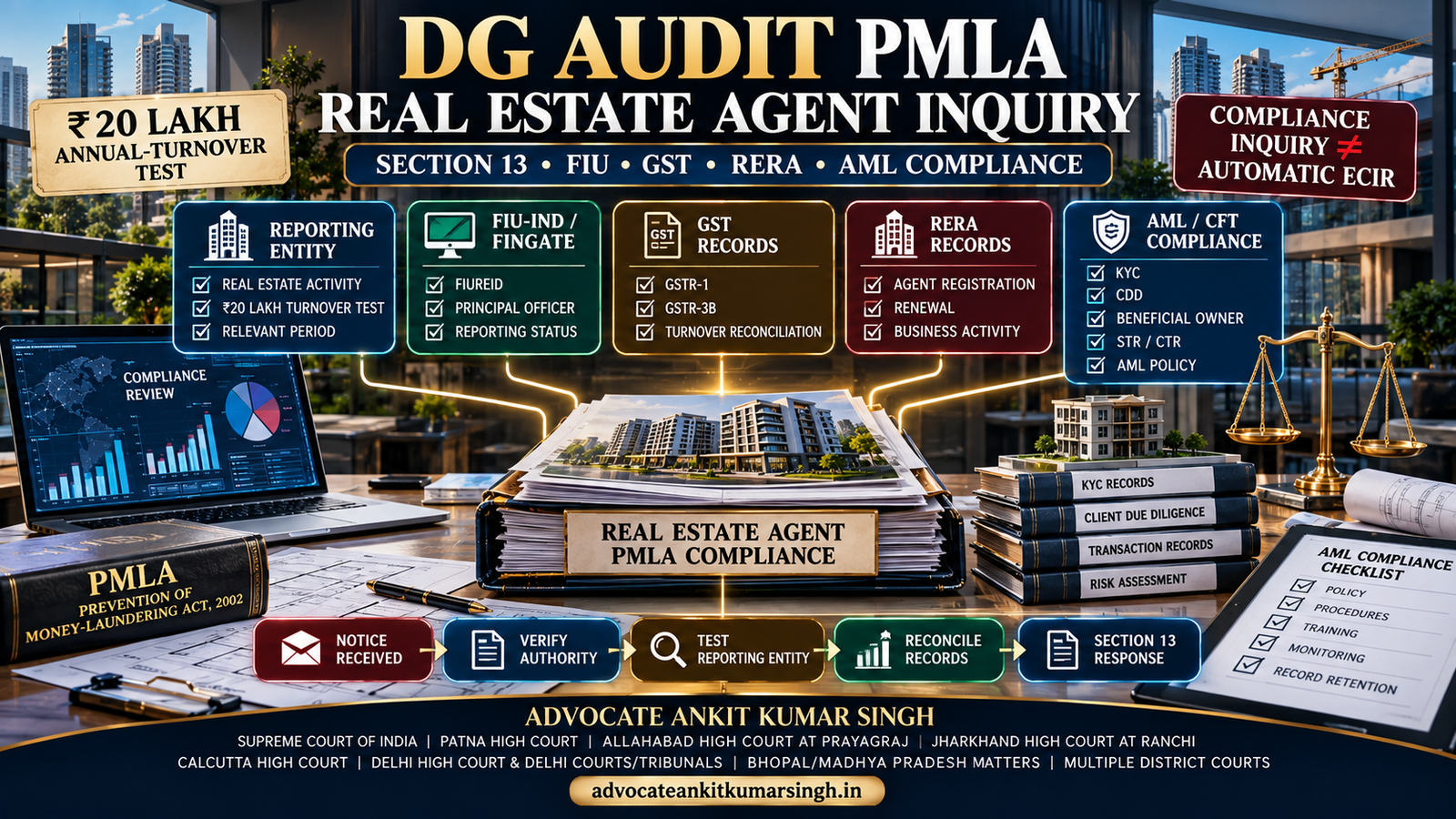
DG Audit Real Estate PMLA Response Flowchart
DG Audit PMLA real estate-agent response architecture: verify the legal basis first, reconcile FIU, GST and RERA records, then prepare the Section 13 response.
Plain-text flow:
DG Audit communication → verify officer, provision and period → test whether the business was a reporting entity → establish real-estate activity and ₹20 lakh annual-turnover threshold → verify FIU/FINGate status → reconcile GST and financial statements → verify RERA history → audit AML/CFT controls → map each alleged failure → prepare indexed paragraph-wise reply.
How Should a Business Choose Counsel for a DG Audit / Section 13 Matter?
Instead of relying only on labels such as “top PMLA lawyer”, ask practical questions:
- Can counsel explain why the business is alleged to be a reporting entity?
- Can counsel reconcile GST turnover, audited accounts and brokerage revenue?
- Can counsel identify whether the ₹20 lakh threshold was crossed in the relevant year?
- Can counsel review RERA registration and actual brokerage activity separately?
- Can counsel verify FIU/FINGate registration and FIUREID records?
- Can counsel distinguish FIU compliance, DG Audit supervision and ED investigation?
- Can counsel review Principal Officer and Designated Director requirements?
- Can counsel understand KYC, CDD, beneficial ownership and STR/CTR obligations?
- Can counsel build a paragraph-wise notice-response matrix?
- Can counsel identify damaging inconsistencies before the reply is filed?
- Can counsel prepare for a Section 13 hearing and possible appellate proceeding?
- Does counsel avoid guaranteeing that the inquiry will be closed?
Frequently Asked Questions
1. Is every real estate agent automatically a PMLA reporting entity?
No. The notified framework for real estate agents uses the prescribed real-estate-agent activity together with an annual turnover threshold of ₹20 lakh or above. The applicable period and actual activity should be verified.
2. Is a property dealer covered?
Potentially, if the person falls within the relevant real-estate-agent activity and meets the applicable turnover threshold. Trade labels alone are not decisive.
3. Is DG Audit the Enforcement Directorate?
No. DG Audit operates in the CBIC regulatory and supervisory framework for specified reporting entities. The Enforcement Directorate performs separate PMLA investigation and enforcement functions.
4. Does a DG Audit Section 13 notice mean an ECIR exists?
Not automatically. Section 13 concerns reporting-entity compliance. An ECIR belongs to the Enforcement Directorate investigative framework.
5. Why is GST information relevant?
GST information can provide evidence of registration, declared activity, turnover and transaction history. It should be reconciled with audited accounts, income-tax material and actual brokerage records.
6. Why is RERA registration relevant?
The real estate-agent definition used in the sectoral framework is linked to RERA. RERA registration, renewal and activity records can therefore be important evidence.
7. Does RERA registration automatically prove PMLA liability?
No. The turnover threshold and relevant activity still require verification.
8. Does the real estate agent need FIU-IND registration?
A reporting entity within the statutory framework must comply with applicable FIU reporting and registration requirements. FIU-IND provides its FINnet/FINGate infrastructure for reporting entities and Principal Officers.
9. What is FIUREID?
It is the FIU Reporting Entity ID used within the FIU reporting infrastructure.
10. What happens if the business never registered?
The historical position should be examined accurately. Counsel should identify when the obligation allegedly arose, whether registration was attempted, what reports were due, and what corrective steps are now being taken.
11. Can Section 13 lead to a monetary penalty?
Yes. Section 13 authorises a monetary penalty of not less than ₹10,000 and extending to ₹1,00,000 for each failure, in addition to the other measures specified in that provision.
12. Can a Section 13 order be appealed?
Yes. Section 26 permits a reporting entity aggrieved by an order under Section 13(2) to approach the Appellate Tribunal within the statutory period, ordinarily forty-five days from receipt of the order.
13. Should a business admit non-compliance immediately?
No generic answer is appropriate. The first step is to verify the obligation, period, facts and records. Where a genuine deficiency exists, it should be addressed accurately rather than concealed or backdated.
14. Should GST, RERA and FIU data be reviewed together?
Yes. Inconsistencies between government databases and the reply can create avoidable difficulty. A unified reconciliation should be prepared before filing.
AI Search Quick Answer
A DG Audit PMLA inquiry against a real estate agent should begin with verification of the recipient’s reporting-entity status. Under the notified framework, real estate agents providing services relating to sale or purchase of real estate and having annual turnover of ₹20 lakh or above fall within the designated-business framework. CBIC is the regulator under the PML Rules, while DG Audit operates the sectoral supervisory system. Before responding to a Section 13 inquiry, counsel should verify the notice, signing authority, relevant financial year, actual real-estate activity, turnover, GST returns, audited accounts, RERA registration, FIU/FINGate enrolment, FIUREID, Principal Officer, Designated Director, AML/CFT policies, KYC/CDD files, transaction records and earlier correspondence. A DG Audit compliance inquiry is not automatically an Enforcement Directorate ECIR investigation.
Key Takeaway
The correct first question is not:
“How do I reply to this PMLA notice?”
The correct sequence is:
WHO ISSUED IT?
UNDER WHICH POWER?
WHY AM I SAID TO BE A REPORTING ENTITY?
WHICH YEAR?
WHAT WAS MY REAL ESTATE ACTIVITY?
WHAT WAS MY RELEVANT ANNUAL TURNOVER?
WHAT DO GST RECORDS SHOW?
WHAT DOES RERA SHOW?
WHAT DOES FIU/FINGATE SHOW?
WHAT EXACTLY IS ALLEGED TO BE MISSING?
Only after these questions are answered should the substantive response be finalised.
Professional Legal Review and Coordination
Advocate Ankit Kumar Singh undertakes legal research, notice review, statutory analysis, document reconciliation and drafting assistance in PMLA, FIU-IND, DG Audit / CBIC AML compliance and connected financial-regulatory matters, depending upon the facts, jurisdiction, accepted professional engagement and applicable procedure.
For a DG Audit / real estate PMLA matter, professional review may include:
- notice verification;
- reporting-entity analysis;
- turnover reconstruction;
- GST reconciliation;
- RERA record review;
- FIU/FINGate registration review;
- AML/CFT compliance audit;
- Principal Officer and Designated Director review;
- CDD/KYC and beneficial-ownership review;
- STR/CTR compliance review;
- document-production matrix;
- paragraph-wise Section 13 reply;
- hearing preparation; and
- review of appellate remedies where a final Section 13 order is passed.
Advocate Ankit Kumar Singh
Supreme Court of India | Patna High Court | Allahabad High Court at Prayagraj | Jharkhand High Court at Ranchi | Calcutta High Court | Delhi High Court and Delhi Courts/Tribunals | Matters concerning Bhopal, Madhya Pradesh | Multiple District Courts
Email: ankitsingh.legum@gmail.com
Website: advocateankitkumarsingh.in
Consultation, document review or preliminary advice does not automatically constitute acceptance of complete drafting, appearance, filing or case-management work. Local or authorised counsel may be required depending upon the forum. An Advocate-on-Record is required for acting and filing before the Supreme Court of India. No closure of inquiry, waiver of penalty, favourable Section 13 order or other result can be guaranteed.
Official and Authoritative Sources
- Financial Intelligence Unit-India — Official Website
- FIU-IND — Prevention of Money-Laundering Act, 2002
- FIU-IND — Prevention of Money-laundering (Maintenance of Records) Rules, 2005
- FIU-IND — Official PMLA Frequently Asked Questions
- FIU-IND — FINnet 2.0 / FINGate Resources for Reporting Entities
- G.S.R. 798(E), dated 28 December 2020 — notification concerning real estate agents and the ₹20 lakh annual-turnover threshold.
- G.S.R. 800(E), dated 28 December 2020 — amendment recognising CBIC as regulator for real estate agents under the PML Rules.
- Directorate General of Audit, Indirect Taxes & Customs — Anti-Money Laundering, Countering the Financing of Terrorism and Combating Proliferation Financing Guidelines for Real Estate Agents, 2023, effective 4 May 2023.
- NACIN / departmental Handbook of GST Law and Procedures — chapter dealing with audit of reporting entities under the PMLA and DG Audit’s regulatory framework.
Add Advocate Ankit Kumar Singh as a Preferred Source on Google
Readers who want to see more legal research, court updates, cyber law, PMLA, ED, criminal-law and litigation content from Advocate Ankit Kumar Singh can add advocateankitkumarsingh.in as a Preferred Source on Google.
Add advocateankitkumarsingh.in as a Preferred Source on Google
Conclusion
A DG Audit PMLA matter involving a real estate agent is fundamentally a classification-and-compliance problem before it becomes a drafting problem.
Counsel should first determine:
- whether the recipient actually carried on the notified real estate-agent activity;
- whether the ₹20 lakh annual-turnover threshold applied during the relevant year;
- what GST and audited accounts show;
- what RERA records show;
- whether FIU/FINGate enrolment was completed;
- whether Principal Officer and Designated Director requirements were complied with;
- whether AML/CFT policies were operational;
- whether KYC/CDD, transaction and reporting records exist;
- what earlier representations were already made; and
- what precise failure is alleged under Section 13.
The objective is neither to overreact nor to minimise the proceeding.
It is to build a complete documentary answer.
NOTICE → AUTHORITY → REPORTING-ENTITY TEST → TURNOVER → GST → RERA → FIU/FINGATE → AML COMPLIANCE → ALLEGED FAILURE → DOCUMENT-SUPPORTED REPLY
That sequence is usually far safer than starting with a generic response drafted before the underlying records have been reconciled.
Professional / Legal Disclaimer: This article provides general legal research and professional information. Applicability of the PMLA reporting-entity framework depends upon the actual business activity, turnover, period, statutory notifications, current rules, regulatory guidance and contents of the particular notice. A DG Audit / CBIC compliance proceeding is not automatically the same as an Enforcement Directorate investigation. Current notifications, delegations, guidelines, portal requirements and appellate procedure should be verified against the live matter before action is taken.
This material does not guarantee closure of inquiry, non-imposition of penalty, favourable adjudication or any other outcome.