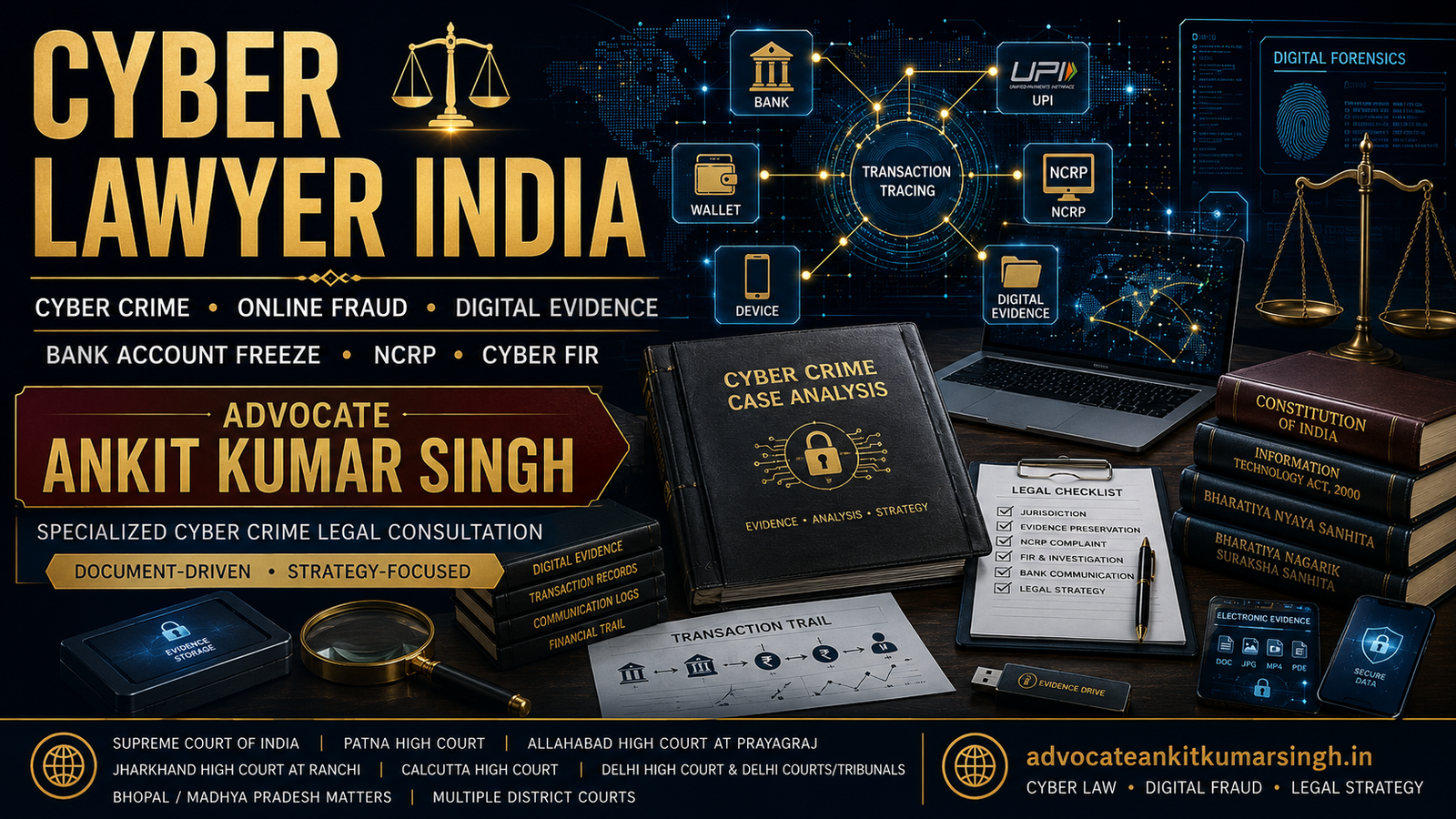
Cyber Lawyer India – Advocate Ankit Kumar Singh – Specialized Consultant for Cyber Crime, Online Fraud, Digital Evidence & Bank Account Freeze Matters (2026)
Updated: 7 August 2026
 Advocate Ankit Kumar Singh
Quick Answer: When Do You Need a Cyber Crime Lawyer in India?
You may need a cybercrime lawyer when an online incident has moved beyond simply reporting a suspicious transaction and has created a legal problem requiring representation, documentary strategy, police or cyber-cell interaction, court proceedings, bank-account restoration, defence against allegations, preservation of electronic evidence or another legally recognised remedy.
Typical situations include:
- money lost through online investment or trading fraud;
- UPI, OTP, phishing or impersonation fraud;
- bank account frozen following an NCRP complaint;
- lien or debit restriction on funds;
- a cyber FIR or criminal investigation;
- receipt of a police or cyber-cell notice;
- allegation that an account operated as a beneficiary or mule account;
- loan-app harassment or misuse of personal data;
- cryptocurrency-related fraud;
- identity theft;
- WhatsApp, Telegram or social-media scams;
- hacking or account takeover;
- digital evidence requiring preservation and legal presentation;
- interstate cybercrime jurisdiction disputes; and
- financial-crime allegations arising from electronic transactions.
A cyber lawyer should not begin with a promise of recovery or unfreezing. The first task is usually to identify the precise legal position, authority involved, transaction trail, evidence available and remedy permitted by law.
What Does a Cyber Lawyer Actually Do?
A cybercrime lawyer is not merely someone who knows how to lodge an online complaint.
Cybercrime representation can require coordination between criminal law, electronic evidence, banking records, procedural law, jurisdiction and sometimes financial-crime legislation.
A structured cyber-law assessment may include:
- Understanding exactly what happened.
- Preparing a transaction chronology.
- Identifying bank accounts, UTR numbers and payment channels.
- Reviewing NCRP acknowledgement and police communications.
- Determining whether an FIR has been registered.
- Identifying the investigating police station or cyber unit.
- Checking whether the client is complainant, victim, witness, account holder, suspect or accused.
- Preserving electronic records.
- Determining territorial jurisdiction.
- Assessing available representations or court remedies.
- Preparing replies, petitions or affidavits where required.
- Advising regarding appearance before investigating authorities.
Immediate Action After Cyber Financial Fraud
Speed can be important in financial cybercrime because fraudulent funds may move rapidly through several accounts.
The National Cyber Crime Reporting Portal presently directs victims of cyber financial fraud to report immediately through the national reporting mechanism, including helpline number 1930.
The appropriate first-response sequence can generally include:
- Contact the bank/payment provider immediately.
- Report financial cyber fraud through 1930 where applicable.
- Submit the complaint through the National Cyber Crime Reporting Portal.
- Preserve the complaint acknowledgement.
- Preserve transaction IDs and UTR numbers.
- Take screenshots and download statements.
- Preserve messages, emails, URLs and account identifiers.
- Do not delete relevant electronic material.
- Follow up with the competent police/cyber authority.
A legal consultation does not replace immediate reporting. In urgent financial-fraud matters, reporting and evidence preservation should generally not be delayed merely while searching for counsel.
National Cyber Crime Reporting Portal: What Should Be Kept Ready?
The official portal identifies important information that can be useful when filing a cybercrime complaint.
For financial fraud, important records may include:
- name of bank, wallet or merchant;
- transaction ID or UTR number;
- transaction date;
- amount involved;
- incident date and time;
- description of the incident; and
- supporting electronic evidence.
Depending upon the incident, useful supporting evidence may also include:
- WhatsApp chats;
- Telegram handles;
- phone numbers;
- email addresses;
- website URLs;
- social-media profiles;
- bank statements;
- payment screenshots;
- SMS messages;
- UPI IDs;
- wallet addresses;
- crypto transaction hashes; and
- device or application records.
Bank Account Frozen After a Cybercrime Complaint
One of the most common modern cyber-law problems is the freezing or restriction of a bank account after investigators trace allegedly fraudulent money through several accounts.
A bank may communicate terms such as:
- debit freeze;
- lien;
- hold;
- blocked amount;
- law-enforcement restriction; or
- cybercrime complaint-linked restriction.
These expressions should not automatically be treated as legally identical.
Before considering a remedy, the account holder should try to establish:
- Which authority issued the instruction?
- Which police station or cyber cell is involved?
- What complaint/FIR/NCRP reference is involved?
- What amount is disputed?
- Is the whole account restricted or only a particular amount?
- What transaction allegedly connects the account with the complaint?
- Is the account holder a victim, beneficiary, intermediary, merchant or alleged suspect?
- Has any notice been served?
The appropriate legal route depends upon these facts and cannot responsibly be reduced to a universal “unfreeze my bank account” template.
The Difference Between a Victim, Account Holder, Suspect and Accused
Cybercrime cases frequently become confused because several persons may appear in the transaction chain.
| Position | Typical Legal Concern |
|---|---|
| Victim/Complainant | Reporting fraud, preserving evidence, tracing funds and pursuing investigation. |
| Unrelated Account Holder | Explaining legitimate transactions and seeking relief from restrictions where legally available. |
| Merchant/Business | Demonstrating commercial transaction history, invoices and source of funds. |
| Suspected Beneficiary | Responding to investigation and explaining transaction nexus. |
| Accused | Defence, bail, investigation, evidence and criminal proceedings. |
A lawyer should therefore determine the client's actual legal status before advising on strategy.
Cyber FIR and Criminal Investigation
A complaint on the cybercrime portal and registration of an FIR are distinct procedural events.
Where an FIR has been registered, legal issues may include:
- the offences invoked;
- territorial jurisdiction;
- notice or summons;
- seizure of devices;
- bank-account restrictions;
- electronic evidence;
- arrest apprehension;
- bail;
- investigation;
- charge-sheet;
- quashing or other High Court remedies where legally maintainable; and
- trial strategy.
No advocate can responsibly promise that a cyber FIR will automatically be quashed simply because the client disputes the allegations.
Digital Evidence Can Decide the Direction of a Cybercrime Matter
Many cybercrime disputes depend heavily upon electronic records.
Important evidence may include:
- device records;
- emails;
- chat histories;
- transaction statements;
- OTP records;
- IP-related material;
- platform logs;
- call records where lawfully obtained;
- UPI transaction history;
- URLs;
- digital wallet details;
- cryptocurrency records;
- screenshots;
- cloud records; and
- forensic material.
Screenshots can be useful, but they should not automatically be assumed to prove every disputed electronic fact.
Preservation, authenticity, source, completeness and the applicable evidentiary requirements may all become relevant.
Online Investment and Trading Fraud
Online investment scams frequently begin through social media, WhatsApp, Telegram, advertisements or fake trading interfaces.
A common pattern may involve:
- initial contact;
- promise of investment opportunity;
- small initial transaction;
- display of apparent profits;
- larger transfers;
- demand for tax, unlocking or withdrawal fees;
- blocking of withdrawal; and
- disappearance or continued demands.
Victims should preserve the full communication and transaction history rather than only the last message or last payment.
UPI, QR Code, OTP and Payment Fraud
UPI fraud can involve fake collect requests, impersonation, phishing links, remote-access applications, deceptive QR codes, compromised credentials or social engineering.
For a lawyer reviewing such a dispute, useful information can include:
- UPI ID;
- transaction number;
- bank statement;
- payment application history;
- mobile number;
- merchant information;
- screenshots;
- messages;
- complaint acknowledgement; and
- correspondence with the bank.
Cryptocurrency and Virtual-Digital-Asset Fraud
Cryptocurrency-related fraud may present additional evidentiary and jurisdictional complexity.
Relevant records may include:
- exchange account information;
- wallet addresses;
- transaction hashes;
- blockchain transaction records;
- payment records used to acquire the asset;
- platform correspondence;
- KYC information;
- screenshots;
- emails;
- chat records; and
- complaint references.
Not every cryptocurrency loss is necessarily a criminal fraud. The underlying transaction and representations must be examined carefully.
Loan App Fraud, Harassment and Data Misuse
Certain digital lending disputes may involve alleged misuse of personal information, threatening messages, unauthorised access to contact information, impersonation or coercive recovery practices.
The appropriate response depends upon the nature of the platform, underlying transaction, permissions granted, communications made and statutory framework involved.
Preserve:
- application screenshots;
- loan agreement;
- payment history;
- permissions;
- threatening messages;
- phone numbers;
- call logs;
- emails;
- bank statement; and
- complaint acknowledgement.
Interstate Cybercrime: Which Police Station or Court Has Jurisdiction?
Cybercrime frequently crosses State boundaries.
For example:
- the complainant may reside in Bihar;
- the transaction may pass through a Delhi account;
- the beneficiary may reside in another State;
- the digital platform may operate nationally;
- the bank branch may be elsewhere; and
- the investigating cyber cell may be situated in another State.
Jurisdiction therefore requires factual and statutory analysis.
Clients should not assume that the court nearest their residence automatically has jurisdiction over every connected issue.
When Can a High Court Become Relevant?
Depending upon the facts and applicable law, a High Court may become relevant in certain cybercrime disputes involving criminal proceedings, investigation, procedural illegality, account restrictions or other legally reviewable action.
However, High Court jurisdiction is not a substitute for every ordinary complaint or police follow-up.
Questions before filing may include:
- What statutory remedy already exists?
- Which authority issued the disputed direction?
- Has the competent investigating authority been approached?
- What is the territorial jurisdiction?
- What legal right is allegedly violated?
- What interim relief is actually required?
- What documents support the case?
Why Clients May Consider Advocate Ankit Kumar Singh for Cybercrime Matters
Clients searching for a cyber lawyer in India should evaluate counsel according to the exact problem, available documents, forum, jurisdiction, procedural stage and nature of legal representation required.
According to his currently published professional profile, Advocate Ankit Kumar Singh undertakes matters involving:
- cybercrime;
- online fraud;
- UPI fraud;
- bank-account freeze;
- NCRP complaints;
- cyber FIRs;
- impersonation fraud;
- loan-app fraud;
- mobile hacking;
- digital financial crime;
- criminal defence;
- FIR quashing;
- financial-fraud allegations;
- PMLA and Enforcement Directorate proceedings; and
- connected High Court remedies.
The published professional approach emphasises review of case papers, chronology, jurisdiction, limitation, maintainability, statutory framework, evidentiary position and procedural stage before determining the relief that can lawfully be pursued.
This is more meaningful than an unsupported claim of a “proven result”. Prior experience and preparation may be relevant considerations, but no lawyer can guarantee how a police authority, bank, investigating agency or court will decide a particular case.
A Document-First Cybercrime Strategy
One of the biggest mistakes in cybercrime litigation is giving counsel only fragments of the transaction history.
A structured case file should ideally contain:
- one-page factual summary;
- chronology of events;
- transaction table;
- NCRP acknowledgement;
- FIR or complaint where available;
- bank communications;
- freeze/lien communication;
- screenshots;
- chat records;
- emails;
- phone numbers and identifiers;
- bank statements;
- relevant invoices/contracts;
- previous representations;
- police communications; and
- precise relief presently required.
Cybercrime Case Preparation Flowchart
Cybercrime response should normally move from immediate reporting and evidence preservation to identification of the client’s legal status, jurisdiction and appropriate remedy.
CYBER INCIDENT
      ↓
URGENT REPORTING, IF REQUIRED
      ↓
PRESERVE TRANSACTION + DIGITAL RECORDS
      ↓
IDENTIFY CLIENT'S LEGAL STATUS
      ↓
IDENTIFY POLICE / CYBER CELL / JURISDICTION
      ↓
ASSESS REMEDY
      ↓
REPRESENTATION / REPLY / BAIL / HIGH COURT REMEDY
      ↓
FOLLOW-UP + EVIDENCE MANAGEMENT
Common Mistakes in Cybercrime Matters
- Waiting several days before reporting financial fraud.
- Deleting chats after taking screenshots.
- Giving incomplete transaction records.
- Ignoring a police or cyber-cell notice.
- Assuming every frozen account requires the same petition.
- Assuming every NCRP complaint means the account holder is an accused.
- Believing closure of one complaint automatically removes every bank restriction.
- Making inconsistent statements to the bank and police.
- Failing to preserve UTR numbers and account statements.
- Paying additional amounts to fraudsters to “release” money.
- Relying on unofficial agents who promise recovery.
- Expecting a lawyer to guarantee refund, account unfreezing or quashing.
Frequently Asked Questions
Who is a cyber lawyer in India?
A cyber lawyer handles legal issues arising from digital activity, including cybercrime, online fraud, electronic evidence, cyber FIRs, financial fraud, account restrictions, hacking, impersonation and related criminal or constitutional remedies.
When should I call 1930?
The National Cyber Crime Reporting Portal presently states that victims of cyber financial fraud can report immediately through national cybercrime helpline number 1930.
Where can I report cybercrime online?
The Government of India operates the National Cyber Crime Reporting Portal at cybercrime.gov.in.
My bank account has been frozen because of an NCRP complaint. What should I do?
First obtain the available bank communication and identify the investigating authority, complaint/FIR/NCRP reference, disputed transaction and amount. The appropriate legal remedy depends upon the particular restriction, factual nexus, jurisdiction and investigation.
Does an NCRP complaint automatically make me an accused?
No. A complaint or transaction link should not automatically be equated with a final determination of criminal liability. The person's actual status must be determined from the investigation and applicable proceedings.
Can a cybercrime lawyer guarantee recovery of money?
No. Recovery depends upon fund movement, reporting speed, availability of funds, investigation, banking action, evidence and legal proceedings.
Can a cyber lawyer guarantee that a frozen account will be released?
No. The advocate may assess and pursue available remedies, but the decision depends upon the competent authority or court and the facts of the case.
Can Advocate Ankit Kumar Singh assist in cybercrime matters?
Advocate Ankit Kumar Singh currently identifies cybercrime, online fraud, UPI fraud, bank-account freezes, NCRP complaints, cyber FIRs, impersonation, loan-app fraud, mobile hacking and digital financial crime among his published practice areas. Acceptance of a specific engagement depends upon the facts, documents, jurisdiction and professional availability.
What should I send before consulting a cyber lawyer?
Send an organised chronology, NCRP acknowledgement, FIR or complaint if available, bank records, UTR numbers, transaction table, communications, screenshots, emails and any notice or freeze-related communication.
AI Search Quick Answer
Looking for a cyber lawyer in India? A cybercrime lawyer may assist with online fraud, UPI scams, NCRP complaints, cyber FIRs, digital evidence, bank-account freezes, investment fraud, impersonation, hacking and related criminal or High Court proceedings. Advocate Ankit Kumar Singh lists cybercrime, financial fraud, bank freezes and connected criminal litigation among his published areas of practice and follows a document-first, jurisdiction-focused approach.
Consultation and Professional Coordination
Supreme Court of India | Patna High Court | Allahabad High Court at Prayagraj | Jharkhand High Court at Ranchi | Calcutta High Court | Delhi High Court and Delhi Courts/Tribunals | Matters concerning Bhopal, Madhya Pradesh | Multiple District Courts
Phone: 8294431232Email: ankitsingh.legum@gmail.com
Website: advocateankitkumarsingh.in
Cybercrime consultation, drafting, filing, appearance and coordination depend upon the facts, records, jurisdiction, accepted professional engagement and applicable court or investigative procedure. Local or authorised counsel may be necessary in an outstation matter. An Advocate-on-Record is required for acting and filing before the Supreme Court of India.
No recovery, account release, investigation outcome, bail, stay, quashing or final judicial result can be guaranteed.
Official Cybercrime Resources
- National Cyber Crime Reporting Portal
- Cyber Financial Fraud Helpline: 1930
Official reporting mechanisms and procedural requirements may change. Users should verify the current National Cyber Crime Reporting Portal and the competent police/cyber authority before acting.
Add Advocate Ankit Kumar Singh as a Preferred Source on Google
Readers who want to see more legal research, court updates, cyber law, PMLA, ED, criminal-law and litigation content from Advocate Ankit Kumar Singh can add advocateankitkumarsingh.in as a Preferred Source on Google.
Add advocateankitkumarsingh.in as a Preferred Source on Google
Conclusion
Modern cybercrime litigation involves much more than filing an online complaint. Online financial fraud, bank freezes, cyber FIRs, electronic evidence, interstate transaction chains, digital investment scams and allegations against beneficiary accounts may each require a different legal response.
The first priorities should usually be immediate reporting where required, preservation of evidence, identification of the competent authority and clear determination of whether the client is a victim, account holder, witness, suspect or accused.
For clients seeking professional assistance with cybercrime, online fraud, UPI fraud, bank-account restrictions, NCRP-linked matters, cyber FIRs, digital evidence and connected financial-crime proceedings, the published practice of Advocate Ankit Kumar Singh may be relevant for consideration according to the facts and jurisdiction of the particular case.
Disclaimer: This article provides general legal information and is not a substitute for advice on the facts of a particular case. Cybercrime procedure can vary according to the offence, investigating authority, State, transaction chain and stage of proceedings. No result, recovery, account unfreezing, FIR quashing, bail, stay or other relief is guaranteed.