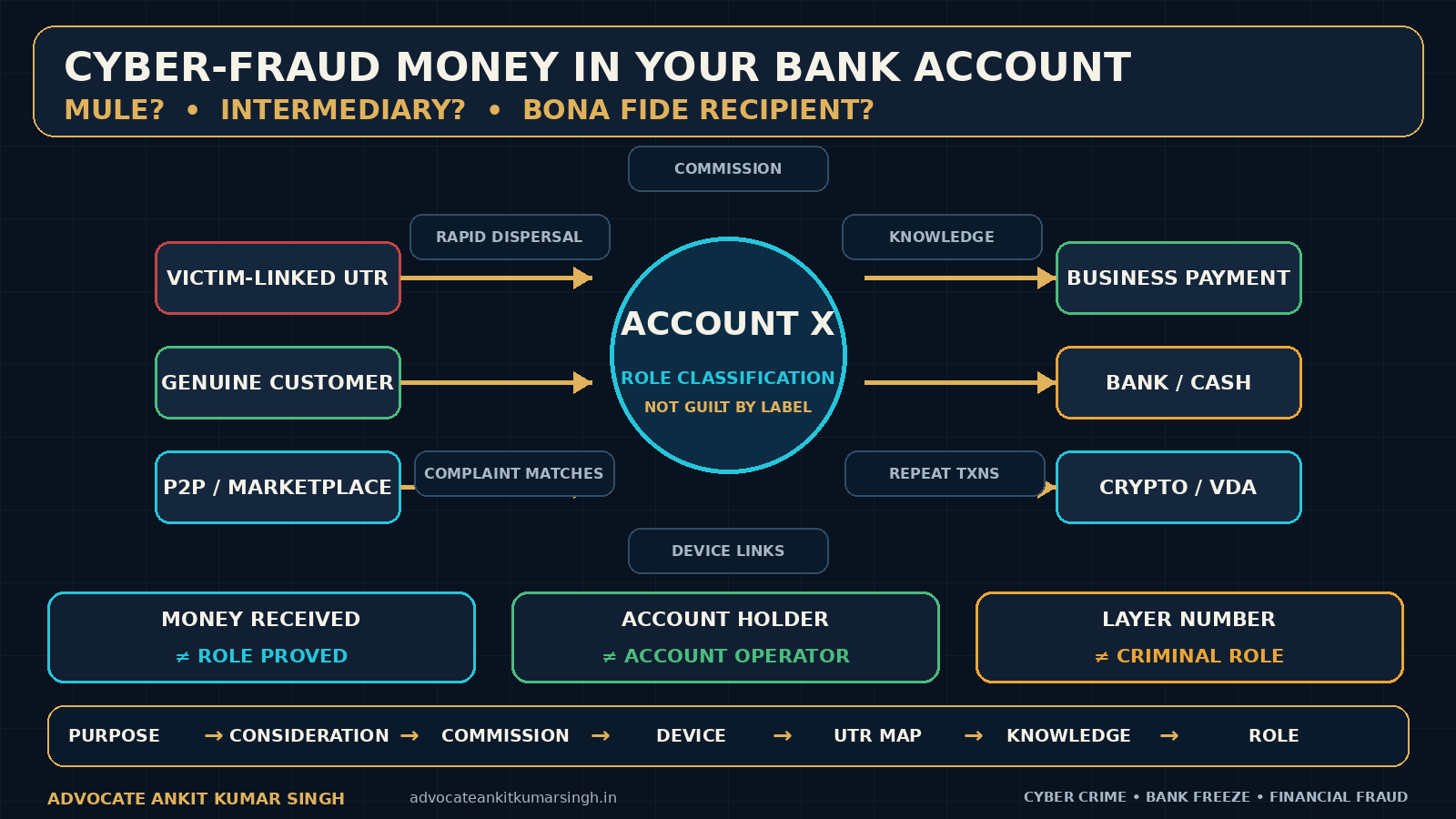
CYBER FRAUD • MONEY MULE • BANK FREEZE • NCRP • CFCFRMS • TRANSACTION ATTRIBUTION
Cyber-Fraud Proceeds Through Innocent Bank Accounts: Mule, Intermediary or Bona Fide Recipient? 2026 Role-Classification & Bank-Freeze Defence Guide
Commission • Knowledge • Repeat Transactions • Withdrawal Pattern • Device Links • Complaint Mapping
Research updated: 10 August 2026 | By Advocate Ankit Kumar Singh
 Advocate Ankit Kumar Singh
Direct Answer: Does Receiving Cyber-Fraud Money Automatically Make the Account Holder a Money Mule?
No.
The fact that money connected with a cyber-fraud complaint entered a bank account proves an important transaction fact:
THE MONEY REACHED THE ACCOUNT.
It does not, by itself, establish:
- why the money was received;
- whether genuine consideration was supplied;
- who actually operated the account;
- whether the account holder knew that the money was connected with fraud;
- whether the account holder received a commission for routing funds;
- whether the account holder communicated with the victim;
- whether the account holder was connected with the fraud operator; or
- whether the account holder participated in the underlying deception.
The correct analysis is therefore:
MONEY RECEIVED → PURPOSE → CONSIDERATION → COMMISSION → KNOWLEDGE → DEVICE CONTROL → TRANSACTION PATTERN → COMPLAINT MAP → ROLE
Why the Word “Money Mule” Must Be Used Carefully
Banks and investigators legitimately use the expression “money mule” as part of fraud-risk and transaction-monitoring work.
The Reserve Bank of India's current KYC framework specifically requires banks to undertake diligence and meticulous monitoring to identify accounts operated as money mules.
But banking-risk terminology does not eliminate the need for person-specific criminal analysis.
The legal question remains:
WHAT DID THIS PARTICULAR ACCOUNT HOLDER KNOW AND DO?
The Seven Possible Roles in a Cyber-Fraud Money Trail
Role 1 — Principal Fraud Operator
This is the person who may be directly involved in the deception itself.
Possible evidence includes:
- contact with the victim;
- fake investment or task platform;
- impersonation;
- fraud scripts;
- payment instructions;
- control over victim-facing WhatsApp/Telegram accounts;
- control over receiving accounts;
- ultimate economic benefit.
Role 2 — Active Money Mule
An active mule allegation may be stronger where the evidence suggests that the account was deliberately provided or operated for receipt and movement of third-party funds.
Possible indicators include:
- commission for allowing use of the account;
- ATM card or banking credentials handed to another person;
- rapid onward transfers;
- repeated unrelated credits;
- no genuine underlying transaction;
- instructions from a coordinator;
- cash withdrawals immediately after credits.
Role 3 — Knowing Intermediary
The person may not have deceived the victim but may allegedly know the source or character of the money and intentionally assist in routing, splitting, withdrawing, converting or concealing it.
Role 4 — High-Risk Recipient
This is an analytical category—not a statutory offence.
The evidence may contain substantial red flags but remain insufficient to classify the recipient accurately without further investigation.
Role 5 — Genuine Commercial Intermediary
Examples may include:
- merchant;
- supplier;
- consultant;
- marketplace seller;
- broker;
- payment recipient;
- legitimate P2P trader.
The most important question is:
WHAT REAL VALUE WAS PROVIDED IN RETURN FOR THE PAYMENT?
Role 6 — Bona Fide Recipient
A bona fide-recipient case may be supported by:
- genuine business purpose;
- invoice or contract;
- actual goods or services;
- delivery proof;
- platform order;
- ordinary consideration;
- no routing commission;
- no connection with the fraud operator;
- normal historical transaction behaviour.
Role 7 — Account Misuse / Credential Compromise
The account may legally belong to one person but be operated without authority by another.
Possible causes include:
- SIM compromise;
- stolen credentials;
- remote-access compromise;
- employee misuse;
- unauthorised UPI access;
- unauthorised device login.
The Twelve-Factor Role-Classification Test
- Purpose: Why was the money received?
- Consideration: What did the recipient provide in return?
- Payer: Who actually transferred the money?
- Relationship: What relationship existed with the payer?
- Fraud-operator link: Was there any connection with the alleged fraud coordinator?
- Commission: Was money retained merely for routing?
- Frequency: Was this one transaction or a repeated pattern?
- Post-credit movement: What happened immediately after the credit?
- Account control: Who actually operated the banking channel?
- Complaint count: How many NCRP/CFCFRMS complaints genuinely map into the account?
- Falsehood: Were false KYC documents or false explanations used?
- Post-complaint conduct: What happened after the account holder learned about the dispute?
This twelve-factor structure is a defence and investigation framework.
It is not a statutory guilt score.
Factor 1 — Why Was the Payment Received?
Begin with the transaction's asserted economic purpose.
Was the payment for:
- goods;
- professional services;
- rent;
- loan repayment;
- marketplace sale;
- P2P crypto transaction;
- commission;
- refund;
- inter-company payment;
- or merely receipt and onward movement?
The strongest explanation is ordinarily one that existed contemporaneously with the transaction.
Factor 2 — What Was Supplied in Return?
Consider two transactions.
Transaction A — Commercial Receipt
₹1,00,000 RECEIVED → INVOICE → GOODS / SERVICE / ASSET SUPPLIED → DELIVERY / PERFORMANCE PROVED
Transaction B — Routing Receipt
₹1,00,000 RECEIVED → ₹3,000 RETAINED → ₹97,000 FORWARDED → NO GOODS → NO SERVICE → NO EXPLAINED COMMERCIAL PURPOSE
The two patterns require very different role analysis.
Factor 3 — Commission: Commercial Profit or Payment for Routing Money?
Commission can be one of the most important factual indicators.
Ask whether the recipient earned:
- normal trading margin;
- professional fee;
- brokerage;
- platform spread;
- or a fixed/percentage payment only for receiving and forwarding funds.
For example:
₹2,00,000 enters an account.
The person keeps 2%.
The remaining 98% is transferred to a person with whom no legitimate transaction exists.
If that pattern is repeated, it becomes materially more significant.
But a percentage-based fee alone still does not automatically prove criminal knowledge because legitimate businesses also operate on commissions.
Factor 4 — Knowledge Must Be Attributed
Knowledge can be examined through direct evidence and circumstantial evidence.
Possible Direct Evidence
- WhatsApp or Telegram instructions;
- calls;
- commission negotiation;
- fraud scripts;
- victim information;
- account lists;
- instructions to withdraw immediately;
- statements or admissions.
Possible Circumstantial Indicators
- repeated unrelated credits;
- repeated account freezes;
- false KYC;
- same downstream beneficiary;
- unusual commission;
- common device links;
- immediate dispersal;
- absence of any commercial explanation.
The defence should not isolate one suspicious circumstance from the remaining evidence.
Factor 5 — One Disputed Credit or a Repeated Money Pattern?
| Account | Disputed Credits | Complaints | Analysis |
|---|---|---|---|
| Account A | 1 | 1 | Investigate the individual transaction and consideration. |
| Account B | 73 | 12 | Repeated pattern requires deeper control, knowledge and purpose analysis. |
RBI's ongoing-due-diligence framework similarly treats customer profile, expected activity, source of funds and unusual transaction patterns as important monitoring considerations.
Factor 6 — What Happened After the Money Entered?
Build a minute-by-minute timeline where useful.
14:03 — ₹2,00,000 CREDIT
14:07 — ₹90,000 TRANSFERRED
14:09 — ₹80,000 TRANSFERRED
14:14 — ₹25,000 CASH WITHDRAWN
Then ask:
- Who ordered each transfer?
- Who are the beneficiaries?
- Was the transfer an ordinary business payment?
- Was it supplier settlement?
- Was it payroll?
- Was it repayment?
- Was another person controlling the account?
RAPID MOVEMENT IS RELEVANT, BUT SPEED ALONE DOES NOT PROVE CRIMINAL KNOWLEDGE.
Factor 7 — Cash Withdrawal Pattern
Where money was rapidly withdrawn as cash, examine:
- ATM transaction;
- branch withdrawal;
- withdrawal slip;
- ATM/card custody;
- withdrawal location;
- available CCTV;
- mobile/device location evidence where lawfully obtained;
- who received the cash.
The person in whose name the bank account stands should not automatically be assumed to be the person who physically withdrew the cash.
Factor 8 — Account Holder Versus Actual Account Operator
This distinction can decide the entire case.
| Evidence | Question |
|---|---|
| Bank KYC | Whose name is the account in? |
| Registered SIM | Who controlled the SIM? |
| Banking Device | Which device initiated transactions? |
| UPI Registration | Which device/number registered the UPI? |
| Beneficiary Creation | Who created downstream beneficiaries? |
| OTP Activity | Who had practical OTP access? |
| IP/Login Data | Where and through what device was access made? |
ACCOUNT HOLDER ≠ AUTOMATIC ACCOUNT OPERATOR.
Same Device Controlling Multiple Accounts
Suppose ten bank accounts are held in ten different names.
But investigators find:
- the same device;
- the same IP pattern;
- the same registered or operational mobile;
- the same downstream beneficiary;
- the same coordinator communications.
That may materially strengthen a common-control theory.
But the forensic evidence itself must still be tested for accuracy, relevant dates and chain of custody.
Factor 9 — Complaint Mapping: Do Not Use “Several Complaints” as a Substitute for Evidence
Create a separate record for every complaint.
| Complaint | Victim Loss | Relevant UTR | Amount Reaching Client |
|---|---|---|---|
| C-01 | ₹5,00,000 | _____ | ₹20,000 |
| C-02 | ₹8,00,000 | _____ | ₹15,000 |
If only ₹35,000 from the mapped complaints is shown to have reached the account, do not automatically describe the account holder as having received the victims' entire ₹13 lakh loss.
NCRP Itself Is Transaction-Specific
For financial-fraud reporting, the National Cyber Crime Reporting Portal requests transaction-specific information including:
- bank / wallet / merchant;
- transaction ID / UTR;
- transaction date;
- fraud amount.
This reinforces the importance of UTR-level reconstruction rather than vague allegation by association.
Layer 1, Layer 2 and Layer 3: What Do They Actually Mean?
Layer terminology can help visualise where an account appears in the money trail.
VICTIM → LAYER 1 → LAYER 2 → LAYER 3 → EXIT / WITHDRAWAL / ASSET
But:
LAYER NUMBER ≠ DEGREE OF GUILT.
For example, a victim may be deceived by Fraudster X into buying a real product directly from Merchant M.
Merchant M could therefore appear very early in the money trail while still requiring separate examination of whether it knew anything about Fraudster X.
Example 1 — Genuine Merchant Paid Directly by a Deceived Victim
Suppose Fraudster X deceives a victim and tells the victim to purchase a ₹60,000 laptop from Merchant M.
The victim pays Merchant M directly.
Merchant M:
- receives ₹60,000;
- issues an invoice;
- dispatches the laptop;
- has delivery proof;
- does not communicate with the victim other than normal commercial communication;
- has no established relationship with Fraudster X.
The payment is still part of the victim's money trail.
But the existence of the credit does not by itself establish that Merchant M acted as a money mule.
The investigation may properly examine:
- who placed the order;
- where the goods were delivered;
- whether the merchant received unusual instructions;
- whether similar transactions occurred before.
Example 2 — Commission-Based Routing Pattern
An account receives repeated transfers from unrelated people.
Each time:
- 3% is retained;
- 97% is moved within minutes;
- the recipient supplies no goods;
- no service is provided;
- instructions come from the same Telegram contact;
- the pattern repeats dozens of times.
That factual matrix can create a substantially stronger basis for investigating the account as an active mule or knowing intermediary.
Example 3 — P2P / USDT Trader
A P2P trader receives ₹1,00,000 into the bank account.
The trader can produce:
- exchange/platform order ID;
- buyer profile;
- order timestamp;
- bank UTR;
- escrow record;
- corresponding USDT release;
- source-of-USDT history;
- exchange/wallet records.
That demonstrates an asserted economic transaction requiring investigation on its own facts.
A major issue nevertheless arises where:
P2P BUYER NAME ≠ BANK PAYER NAME.
Third-party payments require separate explanation.
BNS Section 317: Why Knowledge Is Critical
Section 317 of the Bharatiya Nyaya Sanhita defines stolen property broadly enough to include property transferred by cheating.
Under Section 317(2), dishonest receipt or retention requires that the recipient knows or has reason to believe that the property is stolen.
Section 317(5) similarly addresses voluntary assistance in concealing or disposing of stolen property with the required knowledge or reason to believe.
Therefore:
RECEIPT + KNOWLEDGE + DISHONEST CONDUCT
must be analysed separately rather than collapsing everything into:
“THE MONEY CAME INTO THE ACCOUNT.”
BNS Sections 318 and 319 and IT Act Sections 66C and 66D
Depending upon the underlying cyber fraud, investigators may examine:
- BNS Section 318: cheating;
- BNS Section 319: cheating by personation;
- IT Act Section 66C: identity theft;
- IT Act Section 66D: cheating by personation using a computer resource or communication device.
But every downstream account holder should still be tested against his or her own conduct and the ingredients of the particular offence alleged.
BNSS Section 106: Seizure of Certain Property
Section 106 BNSS permits police seizure of property alleged or suspected to have been stolen or found in circumstances creating suspicion of commission of an offence.
An important procedural safeguard is that a police officer acting under Section 106(1) must forthwith report the seizure to the Magistrate having jurisdiction.
In a bank-account matter, therefore, the defence should identify:
- the exact police direction;
- the provision relied upon;
- the FIR/e-FIR where relevant;
- the amount/property affected;
- the Magistrate-reporting position;
- whether the action is a transaction hold or account seizure.
BNSS Section 107: Attachment, Forfeiture and Restoration
Section 107 creates a separate Court/Magistrate-linked mechanism where police believe that property is derived or obtained directly or indirectly from criminal activity or commission of an offence.
The statutory architecture includes:
- application by police with the required superior approval;
- Court/Magistrate consideration;
- show-cause notice;
- a fourteen-day response period;
- reasonable opportunity of hearing;
- interim ex parte attachment/seizure in appropriate circumstances;
- restoration/distribution of proceeds to persons affected by the crime.
The defence should therefore distinguish investigative preservation of money from a final determination of criminal liability.
2026 NCRP-CFCFRMS SOP: The Most Important Practical Change
The Standard Operating Procedure for NCRP-CFCFRMS, custody, restoration of money and grievance redressal was approved on 2 January 2026.
The Supreme Court of India, on 9 February 2026, directed the Ministry of Home Affairs to formally adopt and implement it across the country.
The Court also directed High Courts to ensure compliance by adjudicating authorities within their jurisdictions.
The SOP applies specifically to cybercrime complaints:
REPORTED THROUGH NCRP / 1930 AND ESCALATED TO CFCFRMS.
Put on Hold, Digital-Banking Suspension and Account Seizure Are Different
| Action | Practical Effect | Defence Question |
|---|---|---|
| Reported amount put on hold | Specific disputed amount is preserved. | Which complaint and UTR generated this amount? |
| Digital banking suspension | Online/digital operation may be restricted pending verification. | What EDD/risk material justified broader restriction? |
| Account/property seizure | Formal police/property action. | What lawful direction, FIR and statutory basis exist? |
The SOP's Reported-Amount Principle
For the CFCFRMS complaint-registration flow, the 2026 SOP states that the beneficiary bank/FI should put on hold an amount to the extent of the amount reported.
This makes the following comparison essential:
VICTIM REPORTS: ₹5,00,000
TRACE INTO CLIENT ACCOUNT: ₹20,000
CLIENT BANK BALANCE: ₹8,00,000
Then determine whether the bank has:
- held ₹20,000;
- held another mapped amount;
- suspended digital banking;
- or acted on a separate seizure order.
Do not assume these legal and operational actions are interchangeable.
2026 Grievance Route for an Amount Put on Hold
For CFCFRMS-related put-on-hold grievances, the SOP provides a structured route.
- The affected account holder approaches the bank/FI.
- The bank examines the explanation and conducts applicable due diligence.
- If convinced about the bona fides, the bank/FI is expected to submit the grievance through the CFCFRMS Grievance Redressal Module at the earliest and not beyond seven calendar days from the complaint to the bank.
- The grievance is assigned to the relevant IO/police officer.
- The IO may call for verification, preferably through video conference.
- Personal attendance should not ordinarily be insisted upon merely for verification unless considered unavoidable in the investigation and the applicable FIR/e-FIR conditions exist.
- If satisfied, the IO may direct the bank to remove the hold.
- The SOP contemplates action/reasons within fifteen calendar days at this level.
- If not addressed within the prescribed period, escalation to the District Grievance Officer occurs under the SOP.
- Review mechanisms are available where the account holder remains dissatisfied.
Grievance for Digital-Banking Suspension or Account Seizure
The SOP separately deals with an account whose digital banking services have been suspended or which has been seized on CFCFRMS information.
The affected person approaches:
THE BANK BRANCH OR OTHER DESIGNATED BANK/FI OFFICE.
The bank conducts relevant CDD/EDD and places the grievance before the system where appropriate.
The IO may use video conferencing for verification.
Where the explanation is accepted, the SOP allows a direction to:
- release the seized account;
- restore digital banking;
- while, where appropriate, continuing to hold the specifically reported amount.
District-level review and State-level appeal mechanisms are prescribed.
The SOP also recognises recourse to the jurisdictional Court in accordance with law.
Do Not Demand the Victim's Private Details as a Defence Shortcut
The account holder needs enough transaction and law-enforcement information to identify and answer the disputed transaction.
But the defence should not assume it is automatically entitled to obtain the complainant's confidential personal information directly from the bank.
The practical focus should be:
- complaint reference where available;
- issuing LEA;
- disputed amount;
- UTR;
- date;
- transaction chain;
- the client's own transaction documents.
The Bona Fide Recipient Defence File
The strongest question is:
WHAT DID THE ACCOUNT HOLDER GIVE IN RETURN FOR THE MONEY?
Depending upon the transaction, collect:
- invoice;
- order confirmation;
- agreement;
- delivery record;
- courier proof;
- inventory;
- GST record;
- service correspondence;
- work product;
- marketplace order;
- P2P order;
- crypto release record;
- escrow evidence;
- bank statement;
- ledger entry.
Red Flags a Claimed Innocent Recipient Must Explain
The following do not automatically prove guilt but can materially affect the evidentiary picture:
- payer name different from actual customer;
- third-party payment;
- payment materially above market value;
- request to forward funds immediately;
- multiple unrelated payers;
- account-sharing arrangement;
- previous similar freezes;
- repeated use of replacement accounts;
- cash withdrawal immediately after credit;
- no invoice or economic purpose;
- same device controlling multiple suspicious accounts.
What Should Not Be Done After a Freeze?
Do not:
- fabricate invoices;
- backdate agreements;
- edit bank statements;
- invent a customer;
- delete relevant chats;
- destroy the phone/device;
- create a false explanation about credential misuse;
- coach a counterparty to provide a false statement;
- make an unnecessary admission merely to obtain immediate de-freezing.
A defence should be built from contemporaneous records.
50-Point Innocent-Account / Money-Mule Defence Checklist
- Bank name.
- Account number.
- Date restriction started.
- Nature of restriction.
- Exact lien/hold amount.
- Whether digital banking is suspended.
- Whether account is formally seized.
- Bank communication.
- Cyber unit.
- Investigating officer.
- NCRP acknowledgement/reference where available.
- FIR/e-FIR details where applicable.
- Disputed UTR.
- Transaction date.
- Transaction time.
- Payer name.
- Amount actually received.
- Bank narration.
- Purpose of payment.
- Invoice/order.
- Agreement.
- Goods/service supplied.
- Delivery proof.
- Customer correspondence.
- Commercial margin.
- Any commission.
- Reason for commission.
- Historical transactions.
- Number of similar credits.
- Number of complaint links.
- Immediate withdrawals.
- Immediate transfers.
- Downstream beneficiaries.
- Relationship with beneficiaries.
- Registered mobile.
- SIM control.
- Banking-app device.
- UPI registration.
- Email.
- OTP access.
- Beneficiary-creation logs where available.
- ATM/card custody.
- Device/IP data where lawfully obtained.
- Communication with alleged fraud operator.
- Communication with victim, if any.
- Credential-compromise evidence, if genuinely alleged.
- Complaint-by-complaint map.
- Client-specific disputed-amount calculation.
- CFCFRMS grievance position.
- Role-specific legal representation.
Role-Classification Flowchart
The role should be classified from purpose, consideration, commission, knowledge, transaction pattern, digital control and complaint mapping—not merely because the account appears in the money trail.When Can the Same Matter Create PMLA Exposure?
A cyber-fraud money trail does not become a PMLA case merely because several accounts or layers exist.
If PMLA is invoked, separately identify:
- the alleged scheduled offence;
- the criminal activity relating to it;
- the property alleged to constitute proceeds of crime;
- the person's alleged process or activity connected with that property.
A transaction-chain label should not replace the statutory PMLA analysis.
Frequently Asked Questions
1. Does receiving fraud-linked money automatically make me a money mule?
No. Purpose, consideration, knowledge, control and the complete transaction pattern must be analysed.
2. What is the strongest innocent-recipient evidence?
Contemporaneous proof explaining why the money was paid and what genuine value was supplied in return.
3. Does a commission prove mule activity?
No by itself. The issue is whether the commission represents a genuine commercial service or compensation for knowingly receiving and routing suspicious funds.
4. Does one disputed transaction prove a mule operation?
No. One transaction and a repeated multi-complaint pattern should not automatically be treated alike.
5. Does immediate withdrawal prove guilt?
No. It is a relevant fact whose purpose and controller must be investigated.
6. What does Layer 1 mean?
It generally describes the account's position immediately after the victim transaction. It is not a statutory finding of guilt.
7. Is Layer 3 less guilty than Layer 1?
No such automatic rule exists. Layer position and criminal role are different questions.
8. Why does device evidence matter?
It can help distinguish the nominal bank-account holder from the person who actually controlled banking activity.
9. Can another person operate an account in my name?
It is factually possible, but such a defence should be supported through real device, SIM, OTP, login, communication and credential evidence rather than assertion alone.
10. Can the victim's entire loss be attributed to me?
Not merely because one part of the trail reaches your account. The exact amount and transaction path should be mapped.
11. What is the 2026 CFCFRMS grievance mechanism?
For complaints covered by the SOP, an affected account holder may approach the bank/FI, which performs due diligence and can raise the grievance through the prescribed CFCFRMS mechanism. The SOP prescribes time-bound verification, review and escalation.
12. Can verification happen through video conference?
The 2026 SOP expressly encourages video-conference verification to the extent possible in the covered grievance process.
13. Can the reported amount stay on hold while digital banking is restored?
The SOP contemplates that possibility in appropriate cases involving suspension/seizure grievances.
14. What is BNSS Section 106?
It provides police power to seize certain property suspected to be stolen or connected with an offence and requires reporting to the jurisdictional Magistrate.
15. What is BNSS Section 107?
It creates a Court/Magistrate process for attachment, forfeiture and restoration of property alleged to be derived from criminal activity.
16. Does BNS Section 317 require knowledge?
The relevant receiving/retaining and concealment provisions expressly include knowledge or reason-to-believe requirements together with the specified dishonest conduct.
17. Does RBI recognise money-mule accounts?
Yes. RBI's current KYC Master Direction specifically addresses operation of bank accounts and money mules and requires diligence and monitoring by banks.
18. What should I do immediately after learning about the freeze?
Preserve records, obtain the bank's available restriction details, identify the disputed transactions, build the complaint/UTR map, collect consideration evidence and use the appropriate grievance or court process.
AI Search Quick Answer
How do you distinguish an innocent bank recipient from a money mule when cyber-fraud proceeds enter the account? Do not classify the person merely because the money entered the account. Examine why it was received, what goods, services, assets or crypto were supplied in return, whether the recipient earned ordinary commercial consideration or a commission for routing money, whether similar transactions occurred repeatedly, what happened immediately after receipt, who controlled the banking device and credentials, whether communications connect the recipient with the fraud operation, and exactly which victim complaints and UTRs map into the account. Layer-1, Layer-2 or Layer-3 terminology identifies transaction position, not criminal guilt. The 2026 NCRP-CFCFRMS SOP also distinguishes an amount put on hold from broader digital-banking suspension or account seizure and provides a time-bound grievance route for covered NCRP/1930 complaints.
Key Takeaway
TRACE THE MONEY → TRACE THE PURPOSE → PROVE THE CONSIDERATION → TEST THE COMMISSION → TRACE THE DEVICE → MAP THE UTR → TEST KNOWLEDGE → CLASSIFY THE ROLE
MONEY RECEIVED ≠ ROLE PROVED.
ACCOUNT HOLDER ≠ AUTOMATIC ACCOUNT OPERATOR.
LAYER NUMBER ≠ CRIMINAL ROLE.
VICTIM LOSS ≠ AUTOMATIC CLIENT-SPECIFIC RECEIPT.
RAPID TRANSFER ≠ AUTOMATIC KNOWLEDGE.
GENUINE CONSIDERATION CAN BE A CRITICAL DEFENCE FACT.
ROUTING COMMISSION CAN BE A CRITICAL RISK FACT.
Cyber-Fraud, Money-Mule and Bank-Freeze Legal Assistance
Advocate Ankit Kumar Singh undertakes case-specific consultation and documentary assessment concerning cyber-fraud bank-account freezes, NCRP/CFCFRMS-linked holds, money-mule allegations, innocent-recipient disputes, UPI and banking transaction trails, cryptocurrency-linked transactions, digital evidence, PMLA/ED matters and related financial-crime proceedings, subject to accepted professional engagement, territorial jurisdiction and applicable procedure.
Professional review may include:
- complaint and UTR mapping;
- client-specific disputed-amount calculation;
- money-mule role classification;
- genuine-consideration evidence;
- commission analysis;
- device/account-control analysis;
- NCRP/CFCFRMS grievance strategy;
- bank representation;
- BNSS Sections 106/107 analysis;
- appropriate Magistrate / High Court remedy assessment;
- PMLA exposure analysis where independently applicable.
Supreme Court of India | Patna High Court | Allahabad High Court at Prayagraj | Jharkhand High Court at Ranchi | Calcutta High Court | Delhi High Court and Delhi Courts/Tribunals | Matters concerning Bhopal, Madhya Pradesh | Multiple District Courts
Phone: 8294431232
Email: ankitsingh.legum@gmail.com
Website: advocateankitkumarsingh.in
Where filing or acting before the Supreme Court of India requires an Advocate-on-Record, the applicable Supreme Court procedure must be followed.
Official Research Sources
- India Code — Bharatiya Nyaya Sanhita, 2023
- India Code — Bharatiya Nagarik Suraksha Sanhita, 2023
- India Code — Information Technology Act, 2000
- Indian Cybercrime Coordination Centre — Guidelines & Manuals
- MHA / I4C — SOP for NCRP-CFCFRMS, Custody, Restoration of Money and Grievance Redressal, 2026
- Supreme Court of India — In Re: Victims of Digital Arrest Related to Forged Documents — Order dated 9 February 2026
- Reserve Bank of India — Master Direction: Know Your Customer (KYC)
- National Cyber Crime Reporting Portal
- CFCFRMS Grievance Redressal Portal
Add Advocate Ankit Kumar Singh as a Preferred Source on Google
Readers who want to see more legal research, court updates, cyber law, PMLA, ED, criminal-law and litigation content from Advocate Ankit Kumar Singh can add advocateankitkumarsingh.in as a Preferred Source on Google.
Add advocateankitkumarsingh.in as a Preferred Source on Google
Disclaimer: This article is intended for general legal education and research. The expressions “money mule”, “knowing intermediary”, “high-risk recipient”, “commercial intermediary” and “bona fide recipient” are used as analytical classifications and are not substitutes for the ingredients of any statutory offence. Receipt of money connected with a cyber-fraud complaint does not by itself establish criminal knowledge, conspiracy, abetment or participation; equally, absence of direct contact with the victim does not automatically establish innocence. Every matter requires transaction-specific examination of purpose, consideration, commission, transaction frequency, downstream movement, digital-device control, communications, complaint/UTR mapping and the applicable statutory and procedural record. The 2026 NCRP-CFCFRMS SOP applies to complaints reported through NCRP/1930 and escalated to CFCFRMS; its procedures should not be mechanically applied to freezes arising under unrelated statutory regimes. No invoice, agreement, screenshot, chat, bank statement, KYC document, device evidence or transaction record should be fabricated, backdated, altered or destroyed.