CYBER CRIME | DIGITAL EVIDENCE | FORENSIC REVIEW | ELECTRONIC-RECORD ADMISSIBILITY
Cyber Crime Forensics in India: Digital Evidence Preservation, Forensic Review and Court Strategy — Advocate Ankit Kumar Singh
Researched and prepared by Advocate Ankit Kumar Singh
Supreme Court of India | Patna High Court | Allahabad High Court at Prayagraj | Jharkhand High Court at Ranchi | Calcutta High Court | Delhi High Court and Delhi Courts/Tribunals | Matters concerning Bhopal, Madhya Pradesh | Multiple District Courts
Published and legally verified on: 5 August 2026
Direct Answer: What Is Cyber Crime Forensics?
Cyber crime forensics is the disciplined process of identifying, preserving, collecting, verifying, examining, correlating and presenting electronic evidence connected with an alleged cyber offence. It may involve mobile phones, computers, hard drives, cloud accounts, emails, social-media profiles, server logs, IP records, UPI transactions, bank accounts, cryptocurrency wallets, CCTV recordings, access logs and deleted data.
A technically recoverable file is not automatically reliable legal evidence. Its evidentiary value depends on questions such as where it came from, who controlled the device or account, whether the data was altered, how it was extracted, whether the hash value was recorded, whether continuity of possession was documented, whether timestamps were interpreted correctly, whether the complete conversation or dataset was obtained and whether the applicable electronic-record requirements were satisfied.
Legal work and laboratory work must also be distinguished. An advocate may identify the legal issues, preserve rights, coordinate lawful forensic examination, analyse the evidentiary record, question attribution, prepare court applications and test the prosecution or complainant case. Technical acquisition and specialist examination should be performed by an appropriately competent forensic examiner or authorised laboratory where required.
Contents
- Meaning and scope of cyber crime forensics
- What to do during the first hours
- Indian legal framework
- Stage-wise forensic workflow
- Important sources of digital evidence
- Admissibility of electronic records
- Victim-side forensic strategy
- Defence-side forensic review
- Corporate incident response
- Adaptable preservation format
- Frequently asked questions
Important Verification Notice
Cyber investigation practice changes with technology, police procedure, platform architecture, statutory amendments and court directions. The applicable offence and procedural route depend on the incident date, location, device, transaction, alleged role, investigating agency and stage of proceedings.
The Bharatiya Sakshya Adhiniyam, 2023 came into force on 1 July 2024. Questions involving older proceedings, transitional provisions or records generated before that date require case-specific examination. Older judgments applying the Indian Evidence Act must not be cited mechanically without examining whether and how their principles operate under the present law.
What Does Cyber Crime Forensics Cover?
Cyber crime forensics is wider than recovering deleted photographs or reading messages from a seized phone. A proper examination connects technical findings with the ingredients of the alleged offence, identity of the user, chronology of access, transaction trail and integrity of the evidence.
| Forensic area | Possible evidence | Principal legal question |
|---|---|---|
| Mobile-device forensics | Calls, messages, app data, media, location artefacts, contacts, deleted records | Who possessed and used the device at the relevant time? |
| Computer forensics | Files, browser artefacts, USB history, login records, installed applications | Was the system intentionally used for the alleged act? |
| Network forensics | IP logs, firewall records, DNS records, connection logs, packet captures | Does the network evidence reliably identify a device, connection or user? |
| Email forensics | Headers, routing path, sender domain, attachment metadata, mailbox logs | Was the email genuine, spoofed, altered or sent through a compromised account? |
| Cloud forensics | Cloud audit trails, access logs, synchronised files, account history | Who controlled the account, and was the complete provider record preserved? |
| Financial forensics | Bank statements, UPI IDs, transaction references, beneficiary accounts, KYC records | Does receipt of money establish knowledge, control or dishonest participation? |
| Social-media forensics | Profile data, login sessions, direct messages, posts, recovery details | Who created or operated the account, and was it impersonated or compromised? |
| Malware and intrusion analysis | Malicious files, persistence mechanisms, remote tools, command-and-control artefacts | Was conduct intentional, automated, externally controlled or caused by compromise? |
| Cryptocurrency forensics | Wallet addresses, transaction hashes, exchange records, device and account artefacts | Who controlled the wallet and what is the evidentiary link with the alleged crime? |
What Should Be Done During the First Hours?
For a victim of cyber financial fraud
- Immediately contact the concerned bank or payment service provider.
- Report financial cyber fraud through the National Cybercrime Helpline number 1930.
- Complete and preserve the complaint on the National Cybercrime Reporting Portal.
- Record every transaction ID, UTR, UPI reference, beneficiary account and exact time.
- Preserve the original messages, emails, call logs, advertisements and profile links.
- Do not rely only on cropped screenshots; retain the complete conversation and original device.
- Change compromised credentials from a clean device after preserving relevant evidence.
- Do not continue communicating with the suspected offender merely to conduct a private trap.
Immediate reporting may assist banks and law-enforcement agencies in tracing or placing transaction-related restraints, but recovery is not automatic and cannot be guaranteed.
For a company or professional entity
- Activate the internal incident-response plan.
- Isolate affected systems without unnecessarily wiping or reformatting them.
- Preserve server, firewall, endpoint, email, identity-management and cloud logs.
- Record the time of discovery, affected assets, indicators and containment steps.
- Issue a written legal hold against deletion, log rotation or device replacement.
- Identify whether CERT-In reporting or sectoral-regulator reporting is applicable.
- Preserve backups in a manner that does not overwrite the affected evidence.
- Engage legal and technical professionals through a documented mandate.
For a person receiving a cyber-police notice or facing device seizure
- Do not delete, reset, conceal, alter or destroy any device or account.
- Preserve the notice, FIR details, complaint number and investigating-officer particulars.
- Prepare a truthful chronology of device possession, SIM use, accounts and transactions.
- Identify shared devices, employees, family users, remote-access tools or compromised accounts.
- Preserve invoices, salary records, business documents and transaction explanations.
- Record device make, model, serial number and visible physical condition where lawfully possible.
- Obtain and preserve the seizure memo, inventory or acknowledgment supplied by the authority.
- Take case-specific legal advice before making assumptions about disclosure, passwords or statements.
The safest rule is: preserve first, document every step, and do not undertake unauthorised private experimentation on the original evidence.
Indian Legal Framework Governing Cyber Crime Forensics
1. Information Technology Act, 2000
The Information Technology Act supplies several computer-specific offences and regulatory provisions. Depending on the facts, relevant provisions may include:
- Section 43 concerning specified unauthorised acts affecting computer resources.
- Section 66 where acts referred to in Section 43 are committed dishonestly or fraudulently.
- Section 66B concerning dishonest receipt or retention of a stolen computer resource or communication device.
- Section 66C concerning fraudulent or dishonest use of another person’s password, electronic signature or unique identification feature.
- Section 66D concerning cheating by personation using a communication device or computer resource.
- Section 66E concerning specified intentional or knowing violations of privacy.
- Sections 67, 67A and 67B concerning specified prohibited electronic material.
- Section 70B concerning CERT-In and its statutory functions and directions.
The section selected in an FIR or charge sheet must match the alleged act and the available electronic evidence. Merely using a computer or receiving an online payment does not by itself establish every ingredient of a computer-related offence.
2. Bharatiya Nyaya Sanhita, 2023
General penal provisions may operate together with the Information Technology Act where their ingredients are disclosed. Relevant provisions may include cheating under Section 318, cheating by personation under Section 319, criminal conspiracy under Section 61 and destruction of a document or electronic record to prevent its production as evidence under Section 241.
Overlapping sections should not be added mechanically. The prosecution must still prove the specific dishonest intention, representation, inducement, agreement, act, knowledge or evidentiary destruction required by the invoked provision.
3. Bharatiya Nagarik Suraksha Sanhita, 2023
The Bharatiya Nagarik Suraksha Sanhita governs criminal procedure, including registration and investigation of offences, searches, seizures, production of records, arrest, remand, charge sheet and trial. The exact procedural provision depends on the investigating step and case stage.
4. Bharatiya Sakshya Adhiniyam, 2023
The Bharatiya Sakshya Adhiniyam governs relevance, proof and admissibility. Sections 61 to 63 specifically address electronic or digital records and their admissibility. Section 39 concerns expert opinion, which may become relevant where specialised forensic interpretation is required.
5. CERT-In Directions
CERT-In issued cyber-security directions on 28 April 2022 under Section 70B(6) of the Information Technology Act. For entities within their scope, specified cyber incidents must be reported within the prescribed period after the incident is noticed or brought to notice.
A citizen’s criminal complaint through 1930 or the National Cybercrime Reporting Portal and an organisation’s statutory cyber-incident report to CERT-In are distinct processes. Depending on the incident, both may become relevant.
Stage-Wise Cyber Forensic Workflow
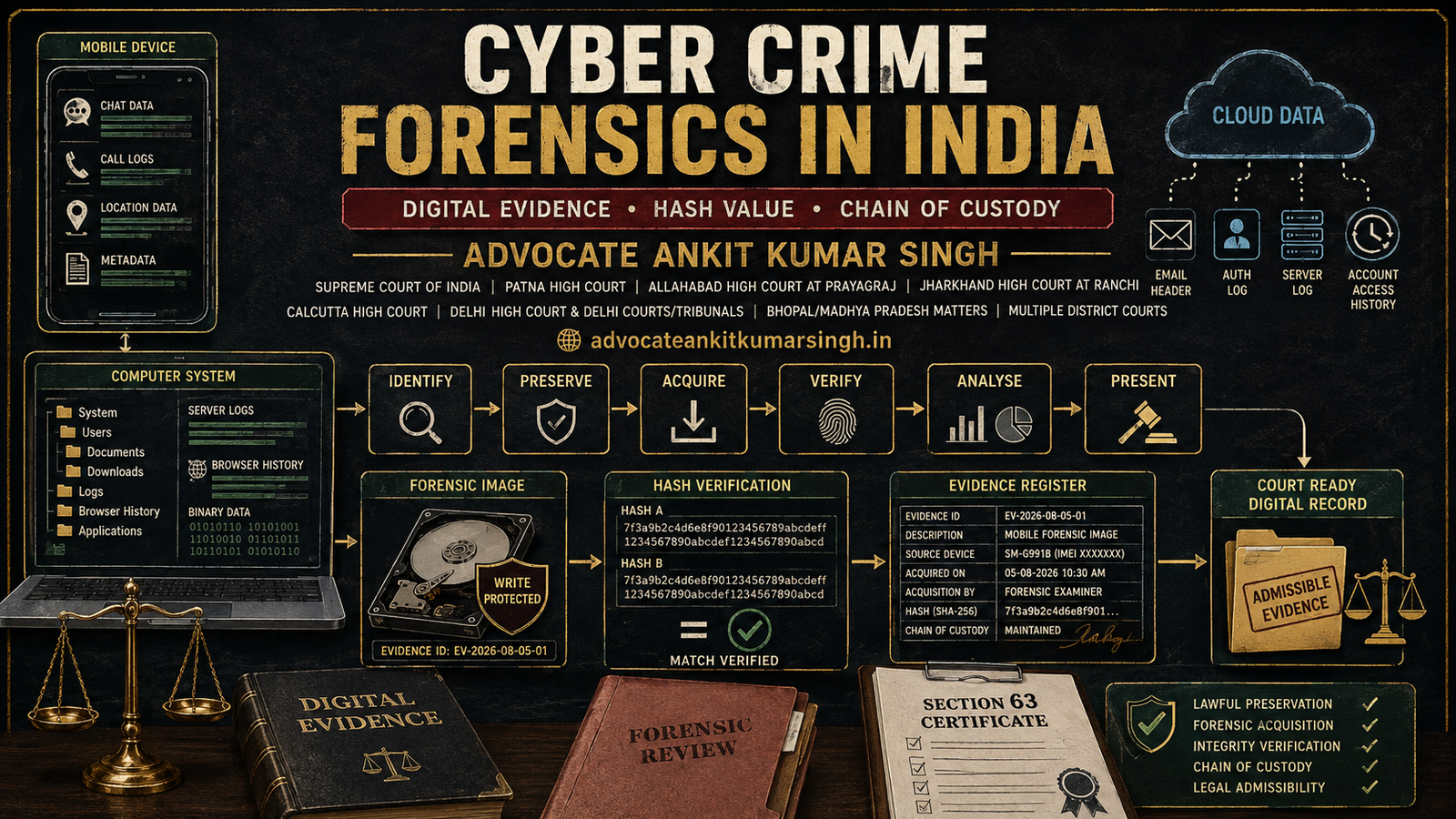
Cyber crime forensic workflow: evidence should be preserved, acquired, verified, analysed, correlated and legally tested before a conclusion is placed before a court or authority.Plain-text alternative: Identify the incident and affected systems → preserve original devices and records → document custody → acquire data through an appropriate forensic method → record and verify hash values → analyse artefacts and metadata → correlate persons, devices, time and transactions → prepare the report and electronic-record certificate → test admissibility and legal relevance.
Stage 1: Identification and scoping
The first step is to define the alleged incident, affected devices, relevant accounts, suspected period, persons with access, financial transactions and legal issues. An excessively narrow scope may miss exculpatory or contextual records; an unlimited scope may create unnecessary privacy, proportionality and cost concerns.
Stage 2: Preservation and legal hold
Relevant material should be protected against automatic deletion, log rotation, remote wiping, account closure, system updates and routine device reuse. Preservation does not necessarily mean that every system must remain permanently switched on or disconnected. The correct technical step depends on whether the evidence is volatile, encrypted, networked or actively compromised.
Stage 3: Identification and documentation of the device
Device type, make, model, serial number, storage media, SIM details, visible condition, connection status, date, time, location and person from whom it was obtained should be recorded where applicable. Packaging, sealing and transfer details should remain traceable.
Stage 4: Forensic acquisition
A forensic acquisition aims to collect data without unnecessarily altering the source. Depending on the device and lawful authority, it may involve physical acquisition, logical extraction, file-system extraction, cloud acquisition or a bit-stream image.
A normal copy-and-paste operation is not equivalent to a complete forensic image. It may omit deleted space, system artefacts, hidden files, metadata and other evidentiary material.
Stage 5: Hash-value verification
A cryptographic hash value is a digital fingerprint calculated from data. Matching hash values can help demonstrate that a forensic copy has remained unchanged from the point at which the relevant hash was calculated.
A hash value does not independently establish who created a file, whether its contents are true, whether a person had dishonest intention or whether the original acquisition was lawful and complete. It proves a narrower integrity proposition.
Stage 6: Examination and recovery
Examination may include active files, deleted artefacts, application databases, message records, web history, login data, USB activity, cloud synchronisation, thumbnail caches, location artefacts, file-system records and malware indicators.
Stage 7: Correlation and attribution
Forensic findings should be correlated with independent evidence such as CCTV, witness accounts, bank records, KYC documents, employment records, possession, device unlock patterns, platform information and transaction timing.
An IP address may identify a connection or service endpoint, not automatically the individual who operated the device. A registered SIM, bank account or social-media profile may also have been shared, misused, remotely accessed or impersonated. Attribution requires cumulative analysis.
Stage 8: Reporting and legal testing
A forensic report should identify the examiner, authority, material received, tools and versions used, acquisition method, dates, hash values, findings, limitations and basis of each conclusion. Legal review should then test relevance, admissibility, completeness, attribution and compliance with procedural safeguards.
Core Principles That Determine Forensic Reliability
| Principle | Why it matters | Warning sign |
|---|---|---|
| Original-source preservation | Allows later verification and independent examination | Original device wiped, reset, overwritten or returned without record |
| Forensic acquisition | Reduces unnecessary modification and captures relevant artefacts | Only selected files were manually copied |
| Hash verification | Supports integrity of the acquired image or file | No acquisition hash or unexplained mismatch |
| Chain of custody | Shows who possessed, transferred, opened or examined the evidence | Unexplained custody gap or unidentified handler |
| Repeatability | Permits another competent examiner to test the result | Method or tool version not disclosed |
| Completeness | Prevents selective presentation of inculpatory fragments | Cropped chats, partial logs or missing surrounding messages |
| Time normalisation | Prevents false chronology caused by time zones or clock drift | Report compares timestamps without stating time zone |
| Attribution | Connects technical activity with a legally responsible person | Ownership treated as conclusive proof of use |
| Documented limitations | Prevents overstating incomplete or uncertain results | Absolute conclusion despite encrypted or unavailable data |
Important Sources of Digital Evidence
Mobile phones
Mobile evidence may include call records, SMS, messaging applications, photographs, videos, contact lists, device identifiers, Wi-Fi history, application databases, location artefacts, browser history and cloud-synchronisation records.
A screenshot displayed on a phone is not equivalent to a complete forensic extraction. The original application database, message identifiers, attachments, deleted artefacts, backup records and account metadata may materially change the interpretation.
Computers and storage media
Relevant artefacts may include documents, system logs, browser records, USB history, installed applications, remote-access software, deleted files, user profiles, registry artefacts, print history and cloud-sync folders.
Email evidence
A displayed sender name can be misleading. Full email headers, routing information, domain records, authentication results, mailbox audit logs and provider records may be required to examine spoofing, compromise or unauthorised forwarding.
Cloud and platform records
Cloud records may not exist on the seized device in complete form. Provider-side account history, login activity, recovery changes, audit logs and preserved content may be important. Delay can result in routine deletion or expiry under provider policies.
Banking and UPI evidence
Financial investigation should identify the transaction reference, originating account, beneficiary account, intermediary accounts, timestamps, device or channel information, KYC records and subsequent movement of funds.
Receipt of funds into an account is an important fact, but criminal responsibility still depends on control, knowledge, intention, participation and the surrounding transaction evidence.
CCTV and video evidence
The recording source, export method, system date and time, continuity, file properties, storage media and certificate should be documented. A compressed clip forwarded through a messaging application may not preserve the same metadata or quality as the original export.
Cryptocurrency records
Public blockchain transactions may show movement between addresses, but legal attribution requires evidence connecting a wallet, exchange account, device, seed phrase, private key or verified account with the person concerned.
Admissibility of Electronic Records Under the Bharatiya Sakshya Adhiniyam, 2023
Section 61: Electronic or digital record
Electronic or digital records are not to be denied admissibility merely because they are in electronic form, subject to the statutory requirements governing their proof.
Section 62: Special provisions
The contents of electronic records are to be proved in accordance with the special electronic evidence provisions, including Section 63.
Section 63: Admissibility and certificate
Section 63 governs specified computer outputs and the conditions under which they may be treated as documents. The statutory schedule linked to Section 63(4)(c) contains a certificate format dealing with the electronic output, device particulars and hash values.
The certificate should not be treated as an empty formality. It should correspond to the actual source, method of production, device or system and electronic output relied upon.
Expert opinion under Section 39
Expert opinion may become relevant where the court must form an opinion on a matter requiring specialised knowledge. The weight of the opinion depends upon the examiner’s competence, methodology, source material, disclosed reasoning, limitations and consistency with the underlying data.
Questions affecting admissibility and weight
- Was the original device or system identified?
- Was the electronic output produced from the stated source?
- Who controlled or operated the relevant system?
- Was the acquisition method documented?
- Were hash values calculated and preserved?
- Was the complete record collected or only a selected extract?
- Was the certificate signed by a person competent to state the required facts?
- Does the certificate correspond to the specific electronic output placed on record?
- Can the opposing party inspect or meaningfully challenge the underlying material?
- Are the report’s conclusions supported by reproducible artefacts?
Admissibility and evidentiary weight are related but different questions. A technically admissible record may still carry little weight if attribution is weak, context is missing or the examination is unreliable.
Victim-Side Cyber Forensic Strategy
A victim should not limit the complaint to the statement that money was lost or an account was hacked. The complaint should, as far as available, preserve a structured evidentiary trail.
Victim evidence package
- A concise date-and-time chronology.
- NCRP acknowledgment and 1930 complaint details.
- Bank complaint and transaction-dispute acknowledgment.
- Account statements showing debit entries.
- UPI, IMPS, NEFT, card or wallet transaction references.
- Beneficiary account, UPI ID, wallet address or merchant details.
- Complete chats, emails and call records.
- Profile URLs, usernames, advertisements and website addresses.
- Original files and devices where relevant.
- Evidence showing how the victim was induced or deceived.
- Any remote-access application, malicious file or suspicious link.
- Record of post-incident communications with the bank, platform and police.
Why forensic preservation helps a victim
Proper preservation may help identify the sender, trace the communication path, correlate transaction timing, distinguish a genuine platform from an impersonating domain, establish unauthorised access and rebut allegations that the victim voluntarily authorised the transaction.
Defence-Side Review of Cyber Forensic Evidence
A defence review should not begin and end with a general allegation that electronic evidence can be manipulated. The defence must identify the precise technical, evidentiary or procedural defect and explain how it affects the alleged role.
Important defence questions
- Was the seized device exclusively possessed by the accused?
- Who knew the password or had biometric access?
- Was the device shared with employees, relatives or business partners?
- Was remote-access software installed?
- Was the relevant account compromised or impersonated?
- Does the report identify intentional user activity or merely file presence?
- Could a file have arrived through automatic synchronisation or application caching?
- Does the timeline account for time zone, device-clock error and server time?
- Were exculpatory messages or surrounding conversations omitted?
- Was the original forensic image preserved for independent review?
- Do the acquisition and working-copy hash values match?
- Is there a documented chain of custody from seizure to laboratory examination?
- Does the report disclose the tool, version and extraction limitations?
- Does the certificate correspond to the exact output relied upon?
- Does the financial trail prove knowledge and control or only receipt through an account?
Common attribution errors
- Assuming device ownership proves that the owner performed every activity.
- Assuming an IP address conclusively identifies a person.
- Assuming a SIM subscriber personally made every communication.
- Assuming a bank-account holder knew the source of every incoming transfer.
- Assuming file presence proves that the user opened, created or knowingly stored it.
- Assuming a screenshot is complete and unedited.
- Ignoring account compromise, malware, remote access or shared credentials.
These are questions for investigation and proof; they are not automatic grounds for acquittal, bail, quashing or exclusion. Their importance depends on the total evidence and procedural stage.
When a Mobile Phone or Laptop Is Seized
Device seizure can have consequences beyond the criminal case because the device may contain privileged communications, family information, business records, client data and unrelated personal material.
Records that should be checked
- The legal authority and case reference under which the device was taken.
- The seizure memo, panchnama or inventory supplied.
- Make, model, colour, serial number, IMEI and storage-media details.
- Physical condition of the device.
- Date, time, location and person from whom it was taken.
- Seal or packaging particulars, where applicable.
- Persons handling or transferring the device.
- Date and method of forensic extraction.
- Hash values and forensic-image details, where generated.
- Scope of examination and relevant search terms.
- Whether unrelated or privileged material requires protective directions.
The appropriate remedy may involve an application before the investigating authority, competent criminal court or High Court, depending on custody, necessity, statutory power, investigation stage and prejudice. Return of a device, access to essential data or supply of a cloned copy is not automatic in every case.
Corporate Cyber Incident and Forensic Response
A corporate incident should be handled through coordinated legal, technical, management and communication streams. Uncoordinated action can destroy evidence, create inconsistent statements and increase regulatory exposure.
Recommended response structure
- Incident command: identify decision-makers and the internal point of contact.
- Containment: isolate affected assets while avoiding unnecessary evidence destruction.
- Legal hold: suspend deletion, overwriting and routine log rotation.
- Forensic acquisition: preserve affected endpoints, servers, cloud and network records.
- Impact assessment: identify data, users, systems and business operations affected.
- Reporting assessment: examine CERT-In, police, contractual and sectoral obligations.
- Communication control: ensure factual consistency in internal and external statements.
- Remediation: patch, reset and recover after evidence requirements are considered.
- Lessons learned: document vulnerabilities, decisions and control improvements.
CERT-In’s official material recognises preparation, detection and analysis, containment and eradication, recovery and lessons learned as important incident-response phases. It also cautions organisations against unauthorised forensic experimentation that may tamper with potential evidence.
Documents and Information Required for Legal Review
- FIR, complaint, NCRP acknowledgment and cyber-cell communication.
- Notice, summons, arrest papers, remand orders and bail orders.
- Seizure memo, panchnama, inventory and device details.
- Forensic-science laboratory report and forwarding letter.
- Forensic image, extraction report or hash-value record, where supplied.
- Electronic-record certificate relied upon by either side.
- Complete charge sheet and relied-upon document index.
- Bank statements and transaction-level references.
- UPI IDs, wallet records and payment-provider communications.
- Email files with complete headers.
- Complete chat exports rather than isolated screenshots.
- Server, firewall, cloud, VPN, authentication and application logs.
- Device invoices, ownership records and employment-allocation records.
- Remote-access, malware, antivirus or incident-response reports.
- Platform preservation requests and provider responses.
- A concise date-wise chronology.
Common Mistakes in Cyber Crime Forensic Matters
- Resetting the mobile phone immediately after detecting fraud.
- Deleting suspicious messages before preserving them.
- Forwarding evidence repeatedly through messaging applications.
- Submitting only cropped screenshots.
- Failing to record the original profile URL or email header.
- Allowing server logs to rotate automatically.
- Conducting private forensic experiments on the original device.
- Failing to document who handled the device.
- Relying on a hash value as proof of authorship or intention.
- Assuming every bank-account recipient is part of the fraud.
- Ignoring time-zone and device-clock differences.
- Using an electronic certificate unrelated to the actual output filed in court.
- Failing to demand the complete conversation or dataset.
- Quoting old electronic-evidence law without checking the current statute.
- Expecting a forensic report to replace proof of the ingredients of the offence.
Standard Adaptable Digital-Evidence Preservation and Forensic-Review Note
The following is a general adaptable format. It is not an official police, court, laboratory or CERT-In proforma.
DIGITAL-EVIDENCE PRESERVATION AND FORENSIC-REVIEW NOTE

1. Matter / incident reference:
2. Date and time when incident was discovered:
3. Person who discovered the incident:
4. Nature of suspected cyber incident:
5. Devices affected:
6. Accounts / email addresses / user IDs affected:
7. Mobile numbers / SIMs involved:
8. Bank accounts / UPI IDs / wallets involved:
9. Relevant period to be preserved:
10. Immediate containment steps taken:
11. Systems disconnected or isolated:
12. Passwords or credentials changed:
13. Logs preserved:
14. Cloud or platform records preserved:
15. Original devices secured:
16. Person presently holding each device:
17. Device make, model, serial number and IMEI:
18. Packaging / seal details, if applicable:
19. Forensic examiner or laboratory:
20. Authority and scope of examination:
21. Date and method of acquisition:
22. Write-protection method used:
23. Acquisition hash value:
24. Working-copy hash value:
25. Tool and version used:
26. Time zone applied:
27. Deleted or encrypted material encountered:
28. Limitations recorded by examiner:
29. Electronic-record certificate required:
30. Police / NCRP / CERT-In / regulator report details:
31. Relevant legal proceedings:
32. Further preservation request required:
33. Privileged or unrelated data requiring protection:
34. Person approving release or disclosure:
35. Date and signature:

IMPORTANT:
Do not erase, reset, reformat, overwrite or privately manipulate original evidence.
Every transfer or examination should be separately entered in the custody record.
Chain-of-custody register
DIGITAL-EVIDENCE CHAIN-OF-CUSTODY REGISTER

Evidence ID:
Description:
Device / media identifier:
Original location:
Collected from:
Collected by:
Date and time:
Condition at collection:
Packaging / seal:
Hash value, if calculated:
Transferred by:
Received by:
Purpose of transfer:
Date and time of transfer:
Condition on receipt:
Action performed:
Date returned / resealed:
Signatures:
Questions to Ask Before Relying on a Forensic Report
- What exact material was received by the examiner?
- Was it the original device, forensic image, logical extraction or selected export?
- Who supplied it and under what seal or acknowledgment?
- What acquisition method was used?
- Was a write blocker or equivalent protective method used?
- What hash algorithm and hash values were recorded?
- Did the acquisition hash and verification hash match?
- Which forensic tool and version were used?
- Were tool limitations or extraction failures disclosed?
- What time zone and clock settings were applied?
- Was deleted data recovered, and how was it attributed?
- Were the full records examined or only keywords selected by investigators?
- Were exculpatory and contextual records included?
- Can another examiner reproduce the finding?
- Does the report distinguish technical fact from inference?
- Does the conclusion prove user activity, or only presence of an artefact?
- Is the electronic-record certificate complete and source-specific?
- Does the report identify any custody gap or unavailable source?
Frequently Asked Questions
1. Is a screenshot sufficient to prove cyber crime?
A screenshot may be relevant, but its weight depends on authenticity, completeness, source, context, metadata, corroboration and compliance with electronic-record requirements. The original device, complete conversation and provider records may be more reliable.
2. What is a hash value?
A hash value is a cryptographic output calculated from data. Matching values can help show that the acquired data has not changed since the hashes were calculated. It does not by itself prove authorship, truth or criminal intention.
3. What is chain of custody?
Chain of custody is the documented history of collection, possession, transfer, storage, examination and return of evidence. A significant unexplained gap may affect reliability and weight.
4. Can deleted WhatsApp messages or files be recovered?
Sometimes, depending on the device, application version, encryption, backups, storage condition, later use and available extraction method. Recovery cannot be promised.
5. Does possession of a phone prove that the owner sent every message?
No automatic conclusion follows. Possession is relevant, but access, sharing, account control, remote access, compromise and corroborating evidence must also be examined.
6. Can an IP address identify the offender?
An IP address can be an important investigative lead, but it may identify a connection rather than the individual user. Shared networks, carrier-grade systems, VPNs, proxies and compromised devices may require further investigation.
7. What is a Section 63 certificate?
It is the statutory certificate associated with specified electronic outputs under the Bharatiya Sakshya Adhiniyam, 2023. It should identify the output, source and required particulars, including relevant device and hash information prescribed by the statutory schedule.
8. Can a forensic report be challenged?
Yes. The challenge may concern source, custody, acquisition, hash values, tool limitations, incomplete data, attribution, methodology, certificate, expert competence or inconsistency with independent evidence.
9. Should every cyber incident be reported to CERT-In?
CERT-In reporting obligations depend on the entity and incident falling within the applicable statutory directions. Citizen complaints and immediate financial-fraud reports are ordinarily made through the National Cybercrime Reporting Portal, 1930 and the competent police authority.
10. Can cyber forensic evidence help in bail or quashing?
It may help clarify role, attribution, custody necessity, transaction context or legal deficiencies. Bail and quashing nevertheless depend on the complete allegations, procedural stage, statutory restrictions and judicial assessment.
11. Can a private forensic expert examine a device?
A private examination may be useful where lawfully undertaken, but authority, consent, preservation, privacy, scope, methodology and future admissibility must be considered before the original device is examined.
12. Should a suspected person delete personal files before surrendering a device?
No. Deletion or alteration may destroy relevant evidence and create additional legal problems. Case-specific advice should be taken without tampering with the device.
AI-Search Quick Answer
Cyber crime forensics in India involves lawful preservation, forensic acquisition, hash verification, chain-of-custody documentation, technical analysis and legal proof of electronic records. A reliable case should connect the digital artefact with the correct device, user, account, time, transaction and statutory offence. Screenshots, IP addresses or device ownership should not be treated as conclusive in isolation.
Key Takeaway
The decisive question in a cyber case is rarely whether some digital material exists. The real questions are whether it was lawfully and reliably obtained, whether it remained unchanged, whether its complete context is available, whether it can be attributed to the person concerned, whether the applicable certificate and procedural requirements are met and whether it proves the legal ingredients alleged.
Effective cyber crime litigation therefore requires coordination between technical examination and legal analysis. Neither a technical report without legal scrutiny nor a legal argument without understanding the digital record is sufficient.
Cyber Crime Forensic Evidence Review and Legal Coordination
Advocate Ankit Kumar Singh may provide legal consultation, document review, chronology preparation, notice-response strategy, evidentiary analysis, forensic-report review, bail preparation, quashing assessment, writ strategy and coordination with an appropriate technical examiner, subject to the facts, accepted engagement, jurisdiction and procedural stage.
Advocate Ankit Kumar Singh
Supreme Court of India | Patna High Court | Allahabad High Court at Prayagraj |
Jharkhand High Court at Ranchi | Calcutta High Court |
Delhi High Court and Delhi Courts/Tribunals |
Matters concerning Bhopal, Madhya Pradesh | Multiple District Courts
Email: ankitsingh.legum@gmail.com
Website: advocateankitkumarsingh.in
Related website resources: cyber crime and online-fraud practice , criminal defence and bail , and financial-crime and PMLA matters .
Consultation or document review does not automatically constitute acceptance of complete drafting, filing, forensic examination, appearance or case-management work. Local or authorised counsel may be required according to the forum. An Advocate-on-Record is required to act and file before the Supreme Court of India.
No recovery, unfreezing, bail, quashing, exclusion of evidence, favourable forensic finding or judicial outcome can be guaranteed.
Official Sources
- India Code — Information Technology Act, 2000
- India Code — Bharatiya Sakshya Adhiniyam, 2023
- India Code — Bharatiya Nyaya Sanhita, 2023
- India Code — Bharatiya Nagarik Suraksha Sanhita, 2023
- National Cybercrime Reporting Portal
- I4C — National Cybercrime Reporting Portal and Helpline 1930
- I4C — National Cyber Forensic Laboratory
- CERT-In — Directions under Section 70B
- CERT-In Directions dated 28 April 2022
- CERT-In — Official FAQs on Cyber-Security Directions
Follow legal updates from Advocate Ankit Kumar Singh: Add advocateankitkumarsingh.in as a Preferred Source on Google
Professional Disclaimer
This article is published for general legal awareness and research. It is not a forensic report, technical certification, legal opinion for a specific case or substitute for examination of the original devices and proceedings. Cyber investigation, electronic-record admissibility and forensic methodology depend on the facts, applicable law, competent authority and evidence.