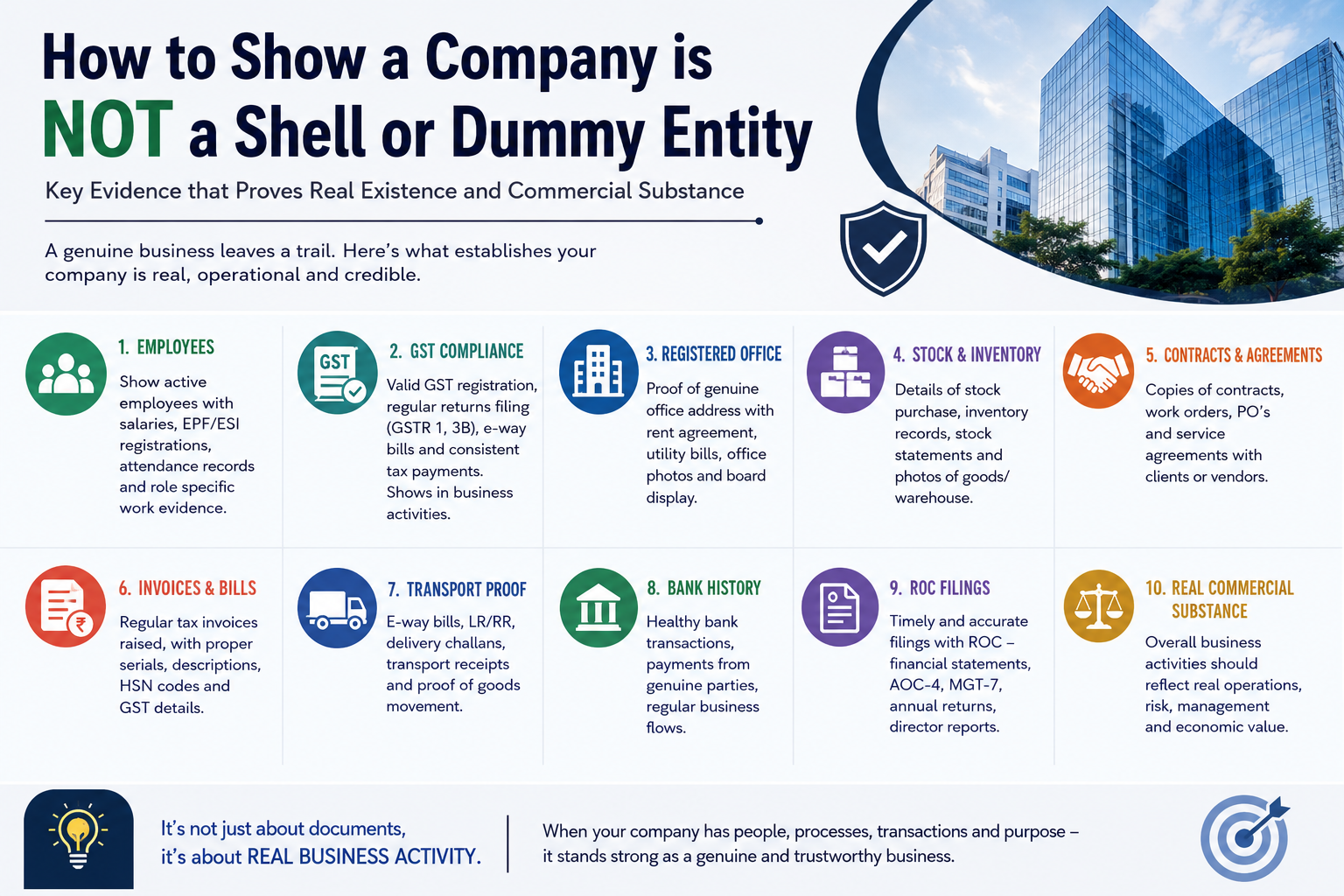
PMLA • ENFORCEMENT DIRECTORATE • SHELL COMPANY • COMMERCIAL SUBSTANCE • GST • STOCK • BANK TRAIL • ROC RECORDS
How to Show a Company Is Not a Shell or Dummy Entity in an ED/PMLA Case: Employees, GST, Stock, Invoices, Transport, Banking and Real Commercial Substance
Detailed legal research by Advocate Ankit Kumar Singh
Supreme Court of India | Patna High Court | Allahabad High Court at Prayagraj | Jharkhand High Court at Ranchi | Calcutta High Court | Delhi High Court and Delhi Courts/Tribunals | Matters concerning Bhopal, Madhya Pradesh | Multiple District Courts
Legally researched and updated: 10 August 2026
 Advocate Ankit Kumar Singh
Direct Answer: How Do You Prove That a Company Is Not Merely a Shell or Dummy Entity?
The strongest answer is usually not a certificate of incorporation, a GST registration, an income-tax return or a balance sheet viewed in isolation.
The more persuasive defence is a cross-corroborated commercial history showing that the company actually did what it claims to have done.
A genuine operating enterprise may be capable of demonstrating:
- real employees performing identifiable work;
- salaries actually paid through banking channels;
- a functioning registered or operational office;
- rent, electricity, internet and other recurring establishment expenses;
- independent customers and suppliers;
- contracts negotiated before transactions occurred;
- purchase orders and work orders;
- goods actually purchased, stored, processed or sold;
- services actually performed;
- invoices matching the underlying commercial transaction;
- GST returns corresponding with invoicing and turnover;
- stock registers and inventory reconciliation;
- e-way bills, delivery challans, transporter records and proof of delivery where goods moved;
- banking activity consistent with the stated business model;
- tax, salary, rent, utility, vendor and financing payments;
- audited accounts and contemporaneous books of account;
- annual returns and financial statements filed with the Registrar of Companies;
- board decisions reflecting genuine management activity;
- emails, ERP records and business correspondence created during ordinary operations;
- business risks, receivables, bad debts, profits and even genuine commercial losses; and
- independent third parties capable of verifying the transactions.
The critical principle is corroboration. If an invoice says goods worth ₹50 lakh were sold, the defence should ideally be capable of tracing the same transaction through the purchase order, inventory, dispatch, e-way bill, transporter, delivery, GST reporting, customer ledger and bank receipt.
That is much stronger than merely producing an invoice after ED questions the transaction.
Important 2026 Position: “Shell Company” Is Not a Defined Companies Act Category
The Ministry of Corporate Affairs stated in its answer to Lok Sabha Unstarred Question No. 2425, answered on 3 August 2026, that the term “shell company” is not defined under the Companies Act, 2013.
The Government nevertheless referred to operational warning indicators such as companies having insignificant business activities or assets and failure to maintain a genuine registered office.
That distinction is crucial.
An investigative description such as shell company, dummy company, paper company, conduit or accommodation-entry entity does not substitute for proof of the statutory ingredients of the offence alleged.
Likewise, the PMLA does not create an independent offence merely called “operating a shell company”.
The legal enquiry under PMLA must ultimately return to identifiable property, its alleged connection with criminal activity relating to a scheduled offence, the statutory definition of proceeds of crime and the conduct alleged under Section 3.
Commercial Substance and PMLA Are Related Questions, But They Are Not the Same Question
This is one of the most important distinctions in corporate PMLA defence.
Suppose Company A has 150 employees, a factory, audited accounts, GST returns, a genuine customer base and substantial annual turnover.
That evidence can strongly rebut an allegation that Company A exists only on paper. But it does not automatically answer whether a particular ₹2 crore transaction was connected with alleged proceeds of crime.
Conversely, suppose Company B has only two employees.
That fact does not automatically make it a shell. A lawful investment holding company, SPV, intellectual-property holding company or asset-owning entity may legitimately require very few employees.
The defence should therefore separate two questions:
- Entity-level question: Is this a real commercial organisation?
- Transaction-level question: What was the legal and commercial basis of the specific money/property challenged by ED?
A sophisticated response answers both.
The Four-Layer Commercial-Substance Test
| Layer | Question | Typical Evidence |
|---|---|---|
| Corporate existence | Was the entity legally constituted and maintained? | Incorporation, ROC filings, directors, statutory registers, financial statements |
| Operational existence | Did it actually function? | Office, employees, equipment, utilities, payroll, licences, correspondence |
| Commercial existence | Did genuine business occur? | Customers, vendors, contracts, purchase orders, stock, delivery, services, market risk |
| Financial substance | Does the money trail match the business story? | Bank history, ledgers, receivables, tax payments, financing, margins, payment cycles |
A company becomes substantially harder to dismiss as a mere paper entity when all four layers independently point to the same commercial reality.
1. Employees: Proving That Human Beings Actually Operated the Business
Employees are important because a business normally leaves a human operational footprint. But merely preparing an employee list after an investigation is weak evidence.
The stronger employee file may contain:
- appointment letters;
- joining documents;
- identity and KYC records lawfully maintained by the employer;
- organisation charts;
- department-wise reporting structures;
- attendance records;
- biometric or access records, where genuinely maintained;
- monthly payroll registers;
- salary slips;
- salary credits visible in company bank statements;
- TDS-related salary records where applicable;
- PF/ESI or other statutory employment records where applicable;
- leave records;
- official email accounts;
- work-product records;
- CRM/ERP user activity;
- expense reimbursements;
- travel connected with business work;
- performance reviews;
- resignation and relieving records; and
- employees capable of independently explaining their actual work.
What ED May Test
Investigators may ask:
- Did the employee actually work there?
- Who interviewed or hired the employee?
- Where did the employee sit?
- Who supervised the employee?
- What work did the employee perform?
- Did salary actually leave the company's account every month?
- Was salary subsequently returned?
- Were dozens of employees suddenly added only after scrutiny began?
- Do employee emails and digital records pre-date the investigation?
The objective should not be to produce a large headcount. It should be to show real people doing commercially intelligible work during the relevant period.
2. Registered Office and Operational Premises: Proving Physical Business Presence
Section 12 of the Companies Act, 2013 concerns the registered office of a company. The MCA's 2026 response also identifies non-maintenance of a genuine registered office as a relevant warning indicator in shell-company scrutiny.
A serious office-evidence file may include:
- registered-office documentation;
- lease deed or ownership documents;
- rent payment trail;
- landlord confirmation;
- electricity bills;
- internet bills;
- telephone bills;
- office-maintenance invoices;
- security and housekeeping records;
- workstations and equipment invoices;
- fixed-asset register;
- insurance records;
- courier receipts;
- incoming correspondence;
- visitor/access records where maintained;
- licences displaying the premises;
- GST registration details;
- bank KYC identifying the business address;
- historic photographs where naturally available; and
- employees and vendors who can independently confirm operations.
A rented office, co-working facility or small office does not by itself establish a dummy company. The relevant question is whether the physical arrangement is commercially consistent with the business actually undertaken.
A software consultancy may require little inventory. A warehouse trader may require substantial storage infrastructure. A manufacturing company would ordinarily require an entirely different operational footprint.
3. GST Evidence: Registration Is Only the Beginning
A GSTIN proves registration. Standing alone, it does not prove that every invoice issued by the taxpayer reflects a genuine transaction.
The stronger exercise is a GST-to-business reconciliation.
Records to Examine
- GST registration and declared places of business;
- periodic GST returns applicable to the taxpayer;
- outward-supply reporting;
- tax invoices;
- credit notes and debit notes;
- input-tax records;
- e-invoice records where applicable;
- e-way bills where applicable;
- delivery challans;
- customer GST details;
- vendor GST details;
- tax-payment history;
- stock records;
- sales ledger; and
- bank realisation.
The Reconciliation Question
For a material sale, ask whether the following chain agrees:
SALES LEDGER → INVOICE → GST REPORTING → STOCK REDUCTION → TRANSPORT/DISPATCH → CUSTOMER RECEIPT → BANK CREDIT
If the invoice exists but there is no stock, no movement, no delivery, no credible customer confirmation and the money immediately returns through connected accounts, the invoice alone will carry limited defensive value.
Conversely, consistent GST records supported by independent physical and financial evidence can significantly strengthen the commercial explanation.
4. Stock and Inventory: One of the Strongest Tests in a Goods Business
Under the GST record-keeping framework, registered businesses dealing in goods may be required to maintain detailed stock records. From an evidentiary perspective, inventory is particularly important because a fictitious trading story often breaks down when physical quantities are reconciled.
A stock defence may examine:
- opening stock;
- purchase quantities;
- goods-receipt notes;
- warehouse inward register;
- batch or lot records;
- production consumption;
- job-work movement;
- finished goods;
- scrap and wastage;
- sales quantities;
- returns;
- damaged or obsolete stock;
- closing stock;
- physical verification reports;
- warehouse rental;
- stock insurance;
- stock statements supplied to lenders; and
- auditor verification where available.
Quantity Reconciliation
OPENING STOCK
+ PURCHASES / PRODUCTION
- SALES
- AUTHORISED WASTAGE / SCRAP / RETURNS
= CLOSING STOCK
Where the mathematical and physical history substantially matches the books, GST filings, transport records and bank transactions, it can provide independent support for genuine commercial activity.
5. Contracts: Prove the Commercial Reason Before Proving the Payment
A bank transfer establishes that money moved. It does not necessarily establish why.
The underlying contract provides the commercial architecture of the transaction.
A well-supported contractual file may include:
- request for quotation or tender;
- quotation;
- commercial negotiation emails;
- purchase order;
- work order;
- executed agreement;
- scope of work;
- technical specifications;
- pricing discussions;
- board or management approval where required;
- amendments;
- performance correspondence;
- delivery schedule;
- completion certificate;
- acceptance email;
- invoice;
- payment request;
- payment approval;
- bank receipt; and
- post-performance correspondence or warranty records.
A contract signed shortly before investigation, containing no commercial correspondence and inconsistent with historic books, may invite greater scrutiny than a contract supported by an established pre-existing documentary trail.
6. Invoices: Necessary Evidence, But Frequently Overvalued
An invoice is an important commercial document, but it should not be treated as self-proving.
For each major invoice, examine:
- who generated it;
- when it was generated;
- invoice sequence;
- whether it appears in the accounting software;
- whether it was GST-reported where applicable;
- whether the customer recorded the corresponding purchase;
- whether goods or services were actually supplied;
- whether stock moved;
- whether transport occurred;
- whether payment was actually received;
- whether credit notes subsequently reversed it;
- whether the price is commercially intelligible; and
- whether electronic metadata is consistent with the stated date.
The defensible proposition is not:
“We have an invoice, therefore the transaction is genuine.”
It is:
“The invoice is one component of a transaction independently corroborated by the contract, performance, tax record, accounting record, delivery evidence, counterparty and money trail.”
7. Transport Evidence: Did the Goods Actually Move?
Where physical goods are said to have been bought or sold, transportation can become a decisive corroborating layer.
Relevant evidence may include:
- e-way bill;
- tax invoice;
- delivery challan;
- lorry receipt or goods receipt;
- transporter invoice;
- vehicle number;
- driver or transporter records;
- FASTag or toll records where legitimately available;
- weighbridge slips;
- warehouse gate entries;
- dispatch register;
- loading records;
- proof of delivery;
- recipient inward register;
- freight payment from bank account;
- GPS records where actually maintained; and
- insurance documentation for transit.
Common Transport Red Flags
- vehicle incapable of carrying the stated quantity;
- vehicle registration inconsistent with claimed transport;
- impossible travel times;
- repeated identical transport documentation;
- missing inward records at destination;
- no freight expenditure despite substantial goods movement;
- stock ledger showing no corresponding movement;
- transport company denying the transaction; or
- documents generated after the alleged delivery.
The CBIC framework concerning invoices, delivery challans and e-way bills can therefore serve as an important independent layer in reconstructing genuine goods movement.
8. Bank History: Examine Years, Not Merely the Alleged Transaction
One of the strongest ways to distinguish an operating enterprise from a temporary conduit is to study its banking behaviour over a meaningful period.
A Genuine Business Account May Show
- customer receipts over time;
- payments to multiple independent vendors;
- regular salaries;
- rent;
- utilities;
- tax payments;
- professional fees;
- insurance;
- loan instalments;
- working-capital interest;
- business travel;
- freight payments;
- asset purchases;
- ordinary operating expenses;
- seasonal fluctuations;
- receivable cycles;
- refunds and credit adjustments; and
- retained working capital.
Patterns Likely to Invite Greater Scrutiny
- large credits immediately followed by near-identical debits;
- funds repeatedly routed through connected entities;
- round-number transfers unsupported by commercial documentation;
- substantial turnover with negligible operating expenses;
- large stated sales but no salary, rent, logistics or inventory footprint;
- rapid cash withdrawals;
- same-day circular movements;
- funds ultimately returning to the original economic group;
- bank activity beginning only around the alleged offence period;
- transactions inconsistent with the company's declared business; or
- account operation by a person who has no documented corporate role.
The correct defence exercise is therefore not a selective bank-statement extract. It is a chronological bank-and-ledger reconstruction.
9. ROC Filings: Corporate Compliance Helps, But Incorporation Alone Proves Very Little
ROC records are important because they establish the formal corporate history.
Relevant documents may include:
- certificate of incorporation;
- memorandum and articles;
- registered-office filings;
- annual returns;
- financial statements;
- director appointment/resignation history;
- shareholding history;
- charges registered in favour of lenders;
- statutory registers;
- board and shareholder resolutions;
- significant-beneficial-ownership records where applicable;
- auditor appointment records; and
- historic MCA filing chronology.
Section 92 of the Companies Act deals with annual returns. Section 128 requires books of account and relevant records capable of explaining company transactions and reflecting the state of affairs. Section 137 deals with filing financial statements with the Registrar. Section 12 deals with the registered office.
But ROC compliance should be treated as one layer, not as conclusive proof of commercial substance.
A legally incorporated company can still be misused in a particular transaction. Equally, a small company with limited turnover is not automatically fictitious.
10. Real Commercial Substance: What Is the Business Actually Capable of Doing?
The most persuasive question is often extremely practical:
Could this company realistically have performed the business recorded in its books?
Examine:
- business model;
- number and competence of employees;
- premises;
- machinery and equipment;
- licences;
- inventory capacity;
- working capital;
- credit facilities;
- customer concentration;
- vendor concentration;
- gross margins;
- industry-standard pricing;
- receivable period;
- payable period;
- marketing and sales activity;
- commercial risk;
- warranty exposure;
- bad debts;
- returns;
- loss-making transactions;
- independent management decisions; and
- actual economic benefit retained by the company.
A genuine business normally has friction. Customers delay payment. Goods are returned. Prices change. Vendors dispute quantities. Employees resign. Stock becomes obsolete. Margins vary. Some transactions generate losses.
A perfectly circular sequence in which money enters, leaves almost immediately and produces no meaningful operating consequence may require a substantially stronger explanation.
11. The Most Powerful Method: Build a Transaction-by-Transaction Evidence Matrix
Do not submit 5,000 pages of documents without explaining how they connect.
Create a forensic transaction matrix for each material transaction challenged by ED.
| Field | Example of Evidence |
|---|---|
| Transaction ID | TX-001 |
| Date | Actual transaction date |
| Counterparty | Legal name, GSTIN/CIN where relevant |
| Commercial purpose | Goods/service/project description |
| Contract | Agreement/work order/purchase order |
| Invoice | Invoice number/date/value |
| GST | Relevant reporting/reconciliation |
| Stock | Inward/outward inventory entry |
| Transport | E-way bill/LR/POD where applicable |
| Performance | Delivery, completion, acceptance or work product |
| Accounting | Ledger/voucher entry |
| Bank | Debit/credit reference |
| Tax treatment | Relevant return/accounting treatment |
| Counterparty proof | Independent record held by customer/vendor |
| Digital evidence | Email/ERP/CRM records |
| Exception | Any mismatch requiring explanation |
This converts an abstract assertion of “genuine business” into a proposition that can be independently tested.
12. The Cross-Corroboration Rule: One Document Should Lead to Another
For a goods transaction:
CUSTOMER ENQUIRY
      ↓
QUOTATION / NEGOTIATION
      ↓
PURCHASE ORDER
      ↓
INVENTORY AVAILABILITY
      ↓
INVOICE
      ↓
GST RECORD
      ↓
E-WAY BILL / TRANSPORT
      ↓
DISPATCH
      ↓
CUSTOMER RECEIPT
      ↓
BANK REALISATION
      ↓
LEDGER RECONCILIATION
For a service transaction:
ENQUIRY
   ↓
PROPOSAL
   ↓
ENGAGEMENT / WORK ORDER
   ↓
EMPLOYEE OR PROFESSIONAL WORK
   ↓
EMAILS / DELIVERABLES / TIMESHEETS
   ↓
CLIENT ACCEPTANCE
   ↓
INVOICE
   ↓
GST / ACCOUNTING
   ↓
BANK RECEIPT
Where multiple independent records created at different times by different persons all confirm the same transaction, the evidentiary value is substantially greater than a self-generated document viewed alone.
13. Independent Third-Party Evidence Can Be More Powerful Than Self-Generated Records
A company controls its own invoices, ledgers and internal resolutions. An investigating authority may therefore test them against records held by independent persons.
Useful independent corroboration may come from:
- customers;
- vendors;
- banks;
- transporters;
- warehouse operators;
- landlords;
- utility providers;
- insurance companies;
- lenders;
- auditors;
- employees;
- courier operators;
- GST systems;
- ROC records;
- other regulatory authorities; and
- independent digital-platform records.
Before making a categorical statement in a reply to ED, counsel should ask:
If ED independently summons the customer, transporter, employee or landlord tomorrow, will that person and that person's records support the version being submitted today?
If the answer is uncertain, the discrepancy should be investigated before a definitive representation is made.
14. Employees + GST + Stock + Transport + Bank: The Five-Way Reconciliation
For a trading or manufacturing company, a particularly strong defence may emerge when five separate record systems agree.
| Evidence Stream | Question Answered |
|---|---|
| Employees | Who operated and administered the business? |
| GST | Was the transaction reported through the tax system where applicable? |
| Stock | Did the underlying goods exist and enter/leave inventory? |
| Transport | Did those goods physically move? |
| Bank | Did the commercial consideration move consistently with the transaction? |
If all five independently reconcile over a sustained period, the case for genuine operating substance becomes considerably stronger.
15. What If the Company Has Few Employees?
Do not create artificial manpower simply because investigators ask about headcount.
Some legitimate businesses operate with very small teams because they:
- outsource logistics;
- outsource manufacturing;
- use contract professionals;
- hold investments;
- operate as SPVs;
- own intellectual property;
- own particular assets;
- perform financing functions;
- use shared group services; or
- operate through technology-intensive models.
The defence should explain the business model and produce the outsourcing agreements, vendor bills, shared-service arrangements, professional invoices and operational evidence that account for the lean structure.
16. What If the Company Has No Stock?
Not every genuine company is a goods trader or manufacturer.
A service company may instead prove substance through:
- client engagements;
- employee timesheets;
- deliverables;
- software repositories;
- project-management records;
- consulting reports;
- customer correspondence;
- licences or subscriptions;
- professional qualifications;
- cloud-service bills;
- travel records;
- client acceptance; and
- bank realisation.
Evidence must therefore be tailored to the company's genuine economic function rather than mechanically copied from a manufacturing-company checklist.
17. Bank Turnover Is Not the Same as Business Turnover
A frequent analytical error is to treat every credit and debit in a bank account as independent commercial turnover.
The account may contain:
- own-account transfers;
- loan drawdowns;
- loan repayments;
- capital contribution;
- refunds;
- security deposits;
- inter-company settlements;
- customer advances;
- reversed entries;
- interest;
- tax refunds; and
- actual sales receipts.
The defence should classify each material credit by source and each material debit by use, rather than relying on aggregate bank turnover.
18. Historical Continuity Is Often More Persuasive Than Documents Created After the Investigation
One of the most valuable questions is:
What did this company look like before the alleged criminal activity supposedly began?
Compile year-wise evidence of:
- turnover;
- employees;
- premises;
- customers;
- vendors;
- stock;
- bank balances;
- borrowings;
- tax filings;
- ROC filings;
- fixed assets;
- profits/losses;
- directors;
- shareholding;
- capitalisation; and
- business correspondence.
A documented operating history extending years before the questioned transaction may be highly relevant when testing an allegation that the entity was incorporated or used merely as a temporary conduit.
19. Related-Party Business Does Not Automatically Mean Sham Business
Transactions between related entities deserve careful scrutiny, but relationship is not a substitute for analysing the transaction.
For each related-party transaction examine:
- relationship disclosure;
- commercial purpose;
- board approval where legally required;
- agreement;
- pricing methodology;
- actual supply or service;
- tax treatment;
- payment;
- repayment where financing is involved;
- ultimate fund destination;
- economic benefit; and
- whether funds returned to the originating party.
The correct question is not simply whether the parties were related, but whether the transaction had genuine legal and commercial substance.
20. Board Minutes and Corporate Governance: Were Decisions Actually Made by the Company?
A functioning company generally has a decision-making history.
Relevant material may include:
- board notices;
- agendas;
- board minutes;
- committee papers;
- shareholder resolutions;
- management approvals;
- capital-expenditure approvals;
- credit approvals;
- bank mandates;
- authorised-signatory changes;
- investment approvals;
- contract approvals; and
- records showing disagreement or commercial deliberation.
However, board paperwork manufactured retrospectively creates substantial risk. If a historical document does not exist, it is generally safer to identify the gap and reconstruct the transaction from authentic contemporaneous evidence than to create a false record.
21. Beneficial Ownership and Actual Control Must Be Addressed Separately
Even a genuinely operating company may face scrutiny over who actually controlled it.
Review:
- registered shareholding;
- beneficial-ownership declarations;
- significant-beneficial-ownership records where applicable;
- bank mandates;
- internet-banking users;
- digital signatures;
- board appointments;
- funding sources;
- share-purchase arrangements;
- powers of attorney;
- management emails; and
- who ultimately enjoyed the economic benefit.
“Real company” and “real controller” are separate questions. Both should be answered accurately.
22. How ED May Stress-Test a Claimed Genuine Business
A defence file should be prepared on the assumption that important assertions can be independently tested.
Possible enquiries may include:
- physical verification of premises;
- summoning directors;
- summoning employees;
- summoning customers and vendors;
- obtaining banking records;
- examining account mandates;
- examining accounting software;
- matching invoices with GST records;
- checking stock and warehouse records;
- verifying transporters;
- examining digital signatures;
- examining email correspondence;
- examining devices where lawfully seized;
- checking metadata;
- comparing ROC disclosures with actual control;
- testing fund circulation; and
- comparing statements recorded from different persons.
This is why an unsupported narrative is dangerous. The documentary record should be internally consistent before a categorical explanation is adopted.
23. Digital Business Records: Preserve Original Electronic Evidence
Modern commercial substance often exists electronically:
- emails;
- ERP data;
- accounting-software databases;
- CRM records;
- cloud documents;
- electronic invoices;
- digital signatures;
- server logs;
- attendance systems;
- project-management platforms;
- inventory systems;
- banking exports;
- GPS data; and
- electronic correspondence.
The Bharatiya Sakshya Adhiniyam, 2023 has governed the general evidentiary framework from 1 July 2024. Sections 61 and 63 are particularly relevant to electronic/digital records and their proof.
Accordingly:
- preserve original sources;
- preserve metadata;
- avoid editing historic files;
- document extraction methodology;
- retain device/source details where appropriate;
- calculate and preserve hashes in a forensic exercise where appropriate;
- maintain chain of custody; and
- prepare the applicable statutory certificate when electronic evidence is produced in court and the law requires it.
24. Never “Improve” the Evidence After Receiving an ED Summons
A genuine defence can be seriously damaged by an attempt to make the historical record look cleaner than it actually was.
Do not:
- backdate agreements;
- manufacture invoices;
- create fictitious employee records;
- alter historic ledgers;
- overwrite accounting entries;
- fabricate delivery records;
- coach counterparties into a false version;
- create retrospective board minutes presented as contemporaneous;
- delete emails;
- delete accounting data;
- destroy devices;
- change metadata;
- replace inconvenient records; or
- move funds or property for concealment.
A disclosed documentation gap is generally less damaging than a false document.
25. Prepare an “Exception Register” Instead of Pretending Every Record Matches
Real businesses often contain discrepancies.
Examples:
- invoice date differs from dispatch date;
- customer paid late;
- stock was returned;
- e-way bill was cancelled;
- invoice was revised;
- credit note was issued;
- transport document is unavailable;
- employee left before payment realisation;
- customer became insolvent;
- goods were damaged;
- payment came from an authorised third party;
- contract was orally modified and later documented;
- historic records were lost under an ordinary retention policy.
Create an exception register:
| Issue | Reason | Supporting Record | Person Who Can Explain | Legal Significance |
|---|---|---|---|---|
| Invoice/dispatch date difference | Commercial explanation | Dispatch email/POD | Logistics manager | Reconcile rather than conceal |
This gives counsel a controlled method of dealing with discrepancies before they become contradictions in statements.
26. The PMLA Question Still Has to Be Answered: Where Are the Alleged Proceeds of Crime?
Commercial substance should not distract from the statutory architecture of PMLA.
A transaction-specific defence should ask:
- What is the scheduled offence relied upon?
- What criminal activity is said to have generated property?
- What precise property is alleged to be proceeds of crime?
- What is the value attributed to it?
- When was it allegedly derived or obtained?
- Which account received it?
- What happened to it afterwards?
- Which person is alleged to have possessed, acquired, used, concealed, projected or claimed it as untainted, or otherwise participated within Section 3?
- How does the alleged laundering transaction differ from ordinary business activity?
- What contemporaneous commercial evidence supports the lawful explanation?
A company can therefore defend itself on two distinct evidentiary planes:
REAL COMPANY + REAL TRANSACTION
rather than relying only on the first proposition.
27. Section 23 and Inter-Connected Transactions: Why One Weak Transaction Can Matter
Section 23 PMLA contains a statutory presumption concerning inter-connected transactions in the circumstances specified by the provision.
This makes transaction segregation important.
If ED alleges that several inter-company transfers form one laundering chain, the defence should not merely submit a consolidated ledger.
Prepare:
- transaction-wise purpose;
- counterparty;
- source;
- contract;
- performance;
- invoice;
- bank leg;
- onward utilisation;
- relationship;
- beneficial owner; and
- ultimate economic result.
This allows counsel to test whether transactions are genuinely connected in the manner alleged or represent separate commercial events.
28. Section 24 PMLA: Do Not Ignore the Evidentiary Burden
Section 24 contains an important statutory burden-of-proof framework in proceedings relating to proceeds of crime.
For that reason, the defensive approach should not be:
“ED has to prove everything; therefore we need produce nothing.”
Where the statutory conditions are attracted, a properly organised source, ownership and commercial-substance record may become critically important.
The precise application of Section 24 depends upon the person's status, proceeding and facts and should be analysed against the current statutory text rather than reduced to a slogan.
29. Section 70 PMLA: The Company and Its Officers Require Role-Specific Analysis
Where an alleged offence concerns a company, Section 70 PMLA may become relevant.
The company's defence and the individual officer's defence should not automatically be treated as identical.
Prepare separate role files for:
- promoter;
- managing director;
- whole-time director;
- non-executive director;
- independent director;
- CFO;
- company secretary;
- accountant;
- authorised signatory;
- employee; and
- actual controller.
For each person, map responsibility, knowledge, period of involvement, authority, signatures, bank access, communications and actual participation.
30. Stage-Wise Defence Strategy
| Stage | Priority |
|---|---|
| Before or immediately after summons | Preserve records, understand allegation, freeze document destruction, prepare chronology |
| Section 50 document request | Produce indexed authentic records with controlled explanations |
| Search/seizure | Preserve search documents, identify seized devices/records and maintain copies where lawfully available |
| Bank freezing | Prepare account history, genuine receipts, payroll, operational expenses and source segregation |
| Section 5 attachment | Map alleged property to lawful source and transaction history |
| Section 8 adjudication | File document-heavy ownership, source and commercial-substance response |
| Prosecution complaint | Test role attribution, proceeds-of-crime nexus, documentary proof and admissibility |
| Trial | Use witnesses, original records, counterparty evidence, banking evidence and properly proved electronic records |
31. Recommended Corporate-Substance Defence File
VOLUME 1 — CORPORATE IDENTITY
1. Incorporation
2. MOA/AOA
3. Registered office
4. Directors
5. Shareholding
6. Beneficial ownership
7. Annual returns
8. ROC chronology

VOLUME 2 — PREMISES AND INFRASTRUCTURE
1. Lease/ownership
2. Rent
3. Electricity
4. Internet
5. Assets
6. Insurance
7. Office correspondence

VOLUME 3 — EMPLOYEES
1. Employee master
2. Appointment
3. Attendance
4. Payroll
5. Salary-bank reconciliation
6. Statutory employment records
7. Work output

VOLUME 4 — CUSTOMERS AND CONTRACTS
1. Customer master
2. Enquiries
3. Quotations
4. Contracts
5. Purchase/work orders
6. Performance
7. Acceptance

VOLUME 5 — PURCHASES AND VENDORS
1. Vendor master
2. Agreements
3. Purchase orders
4. Invoices
5. Goods receipt
6. Vendor payments

VOLUME 6 — GST AND TAX
1. GST registration
2. Returns
3. Invoice reconciliation
4. E-way bills
5. E-invoices where applicable
6. Tax-payment record
7. Income-tax material relevant to the transactions

VOLUME 7 — STOCK AND LOGISTICS
1. Opening stock
2. Purchases
3. Warehouse
4. Production
5. Sales
6. Closing stock
7. Transport
8. Delivery proof

VOLUME 8 — BANK AND ACCOUNTING
1. Complete bank statements
2. Ledgers
3. Bank reconciliation
4. Customer receipts
5. Vendor payments
6. Payroll
7. Loans
8. Taxes
9. Related-party accounts

VOLUME 9 — TRANSACTION MATRIX
One sheet for every transaction questioned by ED.

VOLUME 10 — DIGITAL EVIDENCE
Emails, ERP, accounting database, CRM and applicable electronic-evidence certification.

VOLUME 11 — EXCEPTION REGISTER
Every known discrepancy and its truthful explanation.

VOLUME 12 — PMLA NEXUS ANALYSIS
Scheduled offence → alleged proceeds → transaction → property → person → statutory allegation.
32. A Practical “Genuine Business” Evidence Matrix
| Claim | Weak Proof | Stronger Corroboration |
|---|---|---|
| We had employees | Employee list | Payroll + bank salary + attendance + work output + statutory records |
| We had an office | Address on letterhead | Lease + rent + utilities + employees + assets + historic correspondence |
| We sold goods | Invoice | PO + stock + GST + transport + delivery + bank receipt |
| We purchased goods | Purchase bill | Vendor + GRN + stock inward + payment + subsequent use/sale |
| We provided services | Invoice | Contract + personnel + work product + emails + acceptance + payment |
| Company was active | ROC status active | Years of customers + employees + expenses + tax + banking + operations |
| Money was business income | Bank credit | Contract + invoice + delivery/performance + accounting + tax + customer confirmation |
33. Dark Evidence-Flowchart: From Paper Company Allegation to Commercial-Substance Proof
Commercial-substance defence architecture: prove operations first, reconcile transactions second and separately test the alleged PMLA nexus.Plain-text alternative:
SHELL / DUMMY ALLEGATION
        ↓
REAL OFFICE + EMPLOYEES
        ↓
REAL CUSTOMERS + VENDORS + CONTRACTS
        ↓
GST + STOCK + TRANSPORT + PERFORMANCE
        ↓
BANK + LEDGER + ROC + TAX
        ↓
INDEPENDENT THIRD-PARTY CORROBORATION
        ↓
TRANSACTION-BY-TRANSACTION RECONCILIATION
        ↓
TEST THE SPECIFIC ALLEGED PROCEEDS-OF-CRIME NEXUS
34. Common Defence Mistakes
- Producing incorporation documents and stopping there.
- Treating GST registration as proof that every transaction was genuine.
- Relying on invoices without delivery or performance evidence.
- Submitting thousands of pages without a reconciliation index.
- Ignoring related-party transactions.
- Ignoring beneficial ownership.
- Ignoring the company's bank history before the alleged offence period.
- Failing to reconcile stock quantities.
- Failing to verify transport documents.
- Assuming audited accounts are immune from factual investigation.
- Giving categorical explanations before interviewing the employees who may be summoned.
- Creating documents retrospectively.
- Deleting or modifying electronic records.
- Hiding genuine discrepancies instead of explaining them.
- Showing a genuine company but failing to explain the exact transaction alleged to involve proceeds of crime.
35. Rapid 25-Point Commercial-Substance Checklist
- ☐ Incorporation history verified
- ☐ Registered office verified
- ☐ Operational premises verified
- ☐ Employee master prepared
- ☐ Payroll reconciled with bank
- ☐ Employee work evidence preserved
- ☐ Customer master prepared
- ☐ Vendor master prepared
- ☐ Major contracts indexed
- ☐ Purchase/work orders indexed
- ☐ Invoices reconciled
- ☐ GST records reconciled
- ☐ Stock reconciled
- ☐ Warehouse evidence collected
- ☐ Transport evidence reconciled
- ☐ Delivery/performance proved
- ☐ Full bank history reviewed
- ☐ Ledger-bank reconciliation completed
- ☐ ROC history reviewed
- ☐ Related-party dealings identified
- ☐ Beneficial ownership mapped
- ☐ Digital evidence preserved
- ☐ Independent witnesses/counterparties identified
- ☐ Exception register prepared
- ☐ Each ED-questioned transaction separately mapped to the alleged PMLA nexus
36. Frequently Asked Questions
Is a company with no employees automatically a shell company?
No. The business model must be examined. Certain lawful SPVs, holding companies and asset-owning entities may function with limited direct manpower. The company should, however, be able to explain how its actual functions were performed.
Does an active MCA status prove that a company is genuine?
It proves an aspect of formal corporate status. It does not by itself prove the commercial reality of every transaction.
Does GST registration prove that the business is genuine?
No. GST registration is relevant evidence, but stronger proof comes from reconciliation with invoices, returns, stock, delivery, customers, vendors and banking records.
Can audited financial statements defeat a shell-company allegation?
They may be important evidence but should be corroborated with underlying books, banking and operational documents.
What is the best proof that goods were actually sold?
Ordinarily, a combination of order, invoice, GST record, stock reduction, dispatch, transport, delivery acknowledgement, customer confirmation and payment is much stronger than any single document.
What is the best proof that services were genuinely supplied?
The contract, identified personnel, work product, correspondence, milestones, client acceptance, invoice,