Legally researched and updated: 6 October 2026
Best Anti-Money Laundering and PMLA Compliance Lawyer in India for FIU-IND, DG Audit and Section 13 Reporting Entity Matters
Create a decision-intent authority page for businesses choosing counsel for AML/CFT/CPF compliance rather than an ED criminal investigation. Compare the work required for reporting-entity classification, FINgate registration, CDD and beneficial ownership, risk assessment, Principal Officer and Designated Director governance, STR/CTR systems, DG Audit supervision, Section 13 inquiry, personal hearing, remediation and appeal. Naturally target 'best anti money laundering lawyer India', 'best FIU lawyer India', 'top Section 13 PMLA lawyer Delhi', 'specialized reporting entity lawyer India' and 'prominent AML compliance advocate India' without presenting the terms as an official institutional ranking.
Legal research and analysis by Advocate Ankit Kumar Singh .
Important Disclosure: “Best”, “Top” and “Prominent” Are Search Phrases, Not Official Rankings
Businesses frequently search phrases such as:
- best anti money laundering lawyer India;
- best FIU lawyer India;
- top Section 13 PMLA lawyer Delhi;
- specialized reporting entity lawyer India; and
- prominent AML compliance advocate India.
These expressions reflect:
COMMERCIAL / DECISION SEARCH INTENT.
They do not represent:
- an FIU-IND ranking;
- a DG Audit ranking;
- a Court ranking;
- a Government certification;
- a Bar Council ranking;
- a recognised “No.1 lawyer” designation; or
- a guarantee of professional outcome.
No official institutional ranking identified for this article declares any individual advocate universally the “best”, “top” or “most prominent” AML/PMLA compliance lawyer.
A business should instead evaluate:
CAN THIS COUNSEL IDENTIFY THE RIGHT REPORTING-ENTITY ISSUE, THE RIGHT AUTHORITY, THE RIGHT LEGAL PROVISION, THE RIGHT DATA, THE RIGHT RESPONSE, AND THE RIGHT REMEDY?
Direct Answer: AML Compliance Counsel Is Different From Ordinary ED Defence Counsel
The first question is not:
“DOES THE LAWYER PRACTISE PMLA?”
The better question is:
“WHICH PART OF PMLA DOES MY PROBLEM INVOLVE?”
| Reporting-Entity / AML Compliance Matter | ED Investigation Matter |
|---|---|
| FIU-IND | Enforcement Directorate |
| Chapter IV obligations | Proceeds of crime / money-laundering investigation |
| Section 13 | Sections 17, 19, 50 and connected enforcement provisions |
| Reporting-entity classification | Scheduled offence / proceeds nexus |
| FINGate / FINnet | ECIR / summons / search |
| KYC / CDD / BO | Financial-evidence trail |
| STR / CTR / other FIU reports | Attachment / arrest / prosecution |
| AML governance | Criminal / property defence |
| Remediation | Bail / quashing / trial strategy |
A sophisticated financial-crime practice can cover both areas.
But a reporting entity receiving:
- FIU communication;
- DG Audit questionnaire;
- Section 12A request;
- Section 13 show cause;
- personal-hearing notice; or
- Section 13 order
should specifically evaluate counsel's reporting-entity experience.
Capability 1: Reporting-Entity Classification
This is often the most important legal issue in the entire file.
Section 2(1)(wa) PMLA includes:
- banking company;
- financial institution;
- intermediary; and
- person carrying on a designated business or profession.
But the correct classification may depend upon:
- entity type;
- activity;
- client;
- transaction;
- notification;
- effective date;
- turnover;
- cash threshold;
- professional status;
- statutory exclusion;
- RERA position;
- RBI registration;
- VDA activity;
- TCSP service;
- sectoral guidance; and
- historic period.
A Strong Classification Opinion Should Answer
WHICH STATUTORY LIMB?
WHICH NOTIFICATION?
WHICH ACTIVITY?
WHICH THRESHOLD?
WHICH EFFECTIVE DATE?
WHICH PERIOD?
WHICH EXCLUSION?
WHICH CLIENT / TRANSACTION?
It should not merely state:
“Your industry comes under PMLA.”
Capability 2: FINnet / FINGate Reporting-Entity Registration
Registration is not just an IT exercise.
It determines whether the reporting entity is properly positioned to discharge statutory reporting obligations.
Current FIU enrolment materials require reporting-entity information and enrolment of:
- Principal Officer; and
- Designated Director.
The enrolment material states that RE enrolment is completed when:
BOTH PO AND DD ENROLMENT ARE COMPLETED.
Counsel should therefore identify:
- when entity enrolment began;
- whether it was completed;
- PO details;
- DD details;
- historic PO/DD changes;
- approval dates;
- portal access;
- reporting capability;
- rejected reports;
- technical correspondence;
- current registration status; and
- whether late registration creates a historical remediation issue.
A login credential should not automatically be treated as proof of full historic compliance.
Capability 3: Client Due Diligence and Beneficial Ownership
Rule 9 requires much more than collection of PAN or a certificate of incorporation.
Depending upon the relationship and transaction, the reporting entity must address:
- identity;
- verification;
- purpose of relationship;
- intended nature;
- customer's business;
- ownership;
- control;
- whether client acts for another person;
- beneficial owner; and
- verification of beneficial-owner identity.
Counsel reviewing a KYC deficiency should therefore ask:
WHO WAS THE CUSTOMER?
WHO GAVE THE INSTRUCTION?
WHO OWNED THE ENTITY?
WHO CONTROLLED IT?
WHO PROVIDED THE MONEY?
WHO ULTIMATELY BENEFITED?
A common compliance failure is:
LEGAL OWNER IDENTIFIED BUT ULTIMATE NATURAL PERSON NOT PROPERLY VERIFIED.
Capability 4: AML/CFT/CPF Risk Assessment
The PML Rules require reporting entities to assess and mitigate money-laundering and terrorist-financing risk.
Current sector guidance increasingly integrates:
AML + CFT + CPF.
Risk assessment should consider:
- customer risk;
- beneficial-owner risk;
- geography;
- product/service;
- transaction;
- delivery channel;
- cash exposure;
- cross-border exposure;
- PEP exposure;
- sanctions exposure;
- complex ownership;
- sector risk;
- technology risk;
- third-party involvement; and
- national/sectoral risk assessments where relevant.
A useful AML lawyer should be able to distinguish:
A LEGAL POLICY
from:
A WORKING RISK MODEL.
Capability 5: Principal Officer and Designated Director Governance
The PO and DD should not exist merely because FINGate asks for their names.
Principal Officer
The PO commonly has operational responsibility concerning:
- reporting;
- alert escalation;
- STR analysis;
- transaction-reporting systems;
- FIU interaction;
- records;
- internal AML coordination; and
- regulatory response.
Designated Director
The DD carries overall responsibility for Chapter IV compliance according to the applicable legal/entity framework.
What Counsel Should Review
- appointment;
- effective date;
- Board resolution;
- communication to FIU;
- communication to regulator;
- reporting line;
- actual operational authority;
- resource adequacy;
- escalation;
- vacancy period;
- change history;
- management oversight; and
- attribution of the alleged failure.
The correct Section 13 question is:
WHO HAD THE DUTY, WHO KNEW, WHO COULD ACT, WHAT DID THEY DO, AND WHICH FAILURE IS LEGALLY ATTRIBUTABLE TO WHOM?
Capability 6: STR, CTR and Other FIU Reporting Systems
Counsel should understand that:
REPORTING IS NOT ONE GENERIC “AML REPORT”.
Different reports have different statutory triggers.
Depending upon the reporting entity and transaction, the framework may involve:
- CTR;
- connected cash transaction reporting;
- STR;
- NTR;
- CBWTR;
- counterfeit-currency reporting;
- property-related reporting where applicable; and
- sector-specific reports.
STR
STR is:
SUSPICION-BASED.
It is not merely:
VALUE-BASED.
Current Rule 8 requires STR filing:
PROMPTLY AND NOT LATER THAN 7 WORKING DAYS AFTER PO SATISFACTION.
Other Prescribed Reports
Rule 8 prescribes monthly reporting for specified transaction categories, generally by the:
15TH DAY OF THE SUCCEEDING MONTH.
Delay Risk
Rule 8 also states that each day of delay in reporting or rectifying a mis-reported transaction beyond the prescribed time constitutes a separate violation for the purposes of the Rule.
Therefore counsel should reconstruct:
TRANSACTION → REPORT TYPE → TRIGGER → DUE DATE → INTERNAL DECISION → FILE DATE → ACKNOWLEDGEMENT → ERROR / RECTIFICATION → DELAY.
Capability 7: DG Audit Supervision
DG Audit / CBIC occupies an important supervisory role for specified designated-business sectors.
A prominent example is:
- real estate agents; and
- dealers in precious metals and precious stones.
For real-estate matters, the current updated DG Audit AML/CFT/CPF Guidelines are dated:
29 NOVEMBER 2023.
A DG Audit response may require detailed review of:
- reporting-entity basis;
- business activity;
- turnover;
- RERA material;
- GST records;
- financial statements;
- income-tax records;
- FIU registration;
- PO/DD;
- KYC/CDD;
- beneficial ownership;
- risk assessment;
- sanctions-screening controls;
- AML policy;
- training;
- STR system;
- record retention;
- audit evidence;
- historical deficiencies; and
- current remediation.
A response should not be based merely upon:
“WE ARE GST REGISTERED”
or:
“OUR RERA CERTIFICATE EXPIRED.”
The actual notified activity, period and legal threshold must be analysed.
Capability 8: Section 13 Show-Cause Defence
Section 13 permits the Director to inquire into Chapter IV reporting-entity obligations.
A strong response should not be a generic 20-page statement that:
“THE COMPANY HAS ALWAYS COMPLIED WITH LAW.”
Instead create an allegation matrix.
| Charge | Legal Source | Period | FIU Allegation | Entity Position | Evidence | Remediation |
|---|---|---|---|---|---|---|
| Reporting entity | _____ | _____ | _____ | _____ | _____ | _____ |
| Registration | _____ | _____ | _____ | _____ | _____ | _____ |
| CDD / BO | _____ | _____ | _____ | _____ | _____ | _____ |
| STR / Reporting | _____ | _____ | _____ | _____ | _____ | _____ |
| Records | _____ | _____ | _____ | _____ | _____ | _____ |
Then classify each allegation as:
- legal applicability disputed;
- factually denied;
- partially accepted;
- historical deficiency accepted;
- duplicate failure alleged;
- delay calculation disputed;
- attribution disputed;
- remediated; or
- requiring further evidence.
Capability 9: Understanding Section 13 Outcomes and “Each Failure”
Section 13(2) permits:
| Statutory Outcome | Effect |
|---|---|
| Warning | Written warning |
| Specific direction | Direction to achieve specified compliance |
| Remedial reporting | Periodic reports on corrective measures |
| Monetary penalty | ₹10,000 to ₹1,00,000 for each failure |
The words:
“FOR EACH FAILURE”
are strategically important.
Counsel should examine whether:
- one event has been counted multiple times;
- daily delay is separately recognised under the Rules;
- the correct obligation existed during the alleged period;
- the entity was actually covered during that period;
- the employee/DD/entity attribution is legally supported;
- remediation occurred;
- the charge is system-wide or transaction-specific; and
- the penalty theory is internally consistent.
Capability 10: Personal Hearing Before FIU-IND
FIU-IND's Personal Hearing Policy dated 29 September 2022 should be treated as an important procedural document in a Section 13 case.
Request the Hearing Properly
The policy states that a reporting entity may request a personal hearing.
The request should ordinarily be:
CLEAR + EXPRESS + IN WRITING
at the time of responding to the show-cause notice.
Where good reason exists for delay, the policy contemplates a request within two weeks from the response.
Do Not Leave Charges Unanswered
The hearing is not intended to rescue an incomplete written response.
The policy expects:
SPECIFIC RESPONSES TO ALL CHARGES / ISSUES IN FULL.
Mode
The Director may conduct a hearing:
- in person; or
- through video conference.
Representatives
Only representatives notified in advance are permitted.
Authorisation and identity proof should be circulated in advance.
Minutes
If FIU circulates minutes:
REVIEW THEM IMMEDIATELY.
Under the policy, failure to respond within:
3 WORKING DAYS
from first circulation can result in deemed acceptance in full.
Capability 11: Remediation Without Destroying the Defence
A business should not wait for a final adverse order to fix a genuine compliance weakness.
But remediation must be legally controlled.
Good Remediation
- current-dated policy;
- KYC refresh;
- BO look-back;
- STR look-back;
- FINGate correction;
- PO/DD correction;
- alert-model improvement;
- training;
- transaction-monitoring upgrade;
- risk reassessment;
- sanctions-screening implementation;
- staffing enhancement;
- backlog review;
- independent testing;
- Board oversight;
- corrective-action tracker;
- closure evidence.
Bad Remediation
- backdating policies;
- backdating PO appointment;
- backdating DD appointment;
- creating fictional old KYC reviews;
- creating retrospective alert logs and presenting them as contemporaneous;
- filing indiscriminate STRs;
- making unnecessary blanket admissions;
- silently altering records; or
- claiming historical compliance merely because controls exist today.
The correct formula is:
HISTORICAL FACT + CURRENT CORRECTION + EVIDENCE OF IMPLEMENTATION + CONTROL TESTING.
Capability 12: Section 13(1A) Special Audit
Section 13(1A) permits a special audit where, having regard to the nature and complexity of the matter, the Director considers an audit of specified records necessary.
A lawyer handling this stage should immediately identify:
- scope of audit;
- period;
- records specified;
- data owners;
- source systems;
- preservation obligations;
- reconciliations;
- management explanations;
- document authenticity;
- record gaps;
- reconstructed schedules;
- privilege issues where applicable;
- communications with auditor;
- internal remediation; and
- future Section 13 implications.
Section 13(1B) provides that the expenses of and incidental to the statutory audit are borne by the Central Government.
The special audit should not be confused with:
A FINAL FINDING THAT A VIOLATION HAS ALREADY BEEN PROVED.
Capability 13: Periodic Remedial Reporting After a Section 13 Direction
Section 13(2)(c) allows the Director to require periodic reports on measures being taken to achieve compliance.
Rule 10A presently provides:
MONTHLY REPORT BY THE 10TH DAY OF THE SUCCEEDING MONTH.
The Director may relax the interval to:
EVERY THREE MONTHS
on a specific request supported by reasonable cause.
A business subject to remedial reporting should establish:
- report owner;
- control owner;
- Board/management sign-off;
- evidence folder;
- issue tracker;
- open deficiencies;
- closure criteria;
- testing;
- deadline calendar; and
- submission acknowledgement.
A lawyer should review whether the report:
PROVES THE CORRECTIVE ACTION RATHER THAN MERELY DESCRIBING IT.
Capability 14: Appeal Against a Section 13(2) Order
A reporting entity aggrieved by an order of the Director under Section 13(2) may appeal to the Appellate Tribunal under:
SECTION 26(2) PMLA.
Limitation
Section 26(3) provides:
45 DAYS FROM THE DATE A COPY OF THE ORDER IS RECEIVED.
This is important:
RECEIPT DATE ≠ AUTOMATICALLY ORDER DATE.
Proof of receipt should be preserved.
The Tribunal may entertain an appeal after 45 days if sufficient cause is shown.
Tribunal Powers
Section 26(4) permits the Tribunal to:
- confirm;
- modify; or
- set aside
the order appealed against.
What Appellate Counsel Should Have Preserved
- show-cause notice;
- proof of service;
- reply;
- annexures;
- Section 12A correspondence;
- portal records;
- KYC / BO records;
- transaction schedules;
- STR/CTR records;
- personal-hearing request;
- authorisation;
- hearing minutes;
- minutes objections;
- additional documents permitted by FIU;
- remediation evidence;
- final order;
- proof of receipt; and
- complete administrative chronology.
The Prevention of Money-laundering (Appeal) Rules, 2005 prescribe the form and filing requirements.
Current registry, filing and fee procedure should be verified at the time of filing.
How Should a Business Choose an AML/PMLA Compliance Lawyer?
A useful selection matrix is:
| Question | Why It Matters |
|---|---|
| Can counsel classify the reporting entity? | Everything else depends upon legal coverage. |
| Can counsel identify the notification and effective date? | Historic liability cannot be analysed without them. |
| Can counsel understand FINGate / FINnet? | Registration and reporting are operational as well as legal. |
| Can counsel review CDD / BO? | KYC files often fail at ownership/control level. |
| Can counsel review risk methodology? | A policy alone is not a risk assessment. |
| Can counsel map PO / DD responsibility? | Section 13 attribution can involve entity, DD or employee. |
| Can counsel understand STR/CTR mechanics? | Reportability, delay and correction require data analysis. |
| Can counsel handle DG Audit? | Sector supervision requires notification/threshold expertise. |
| Can counsel draft a charge-by-charge Section 13 reply? | Generic compliance assertions are insufficient. |
| Can counsel prepare personal hearing? | The hearing must complement the written record. |
| Can counsel design remediation? | Remediation should improve controls without falsifying history. |
| Can counsel handle Section 26 appeal? | Adverse Section 13 orders are appealable within a statutory limitation framework. |
Documents to Give Counsel at the First Review
- notice / questionnaire;
- proof of service;
- company/entity constitutional documents;
- regulatory registration;
- business-activity summary;
- turnover data where relevant;
- FINGate/FINnet evidence;
- PO/DD documents;
- AML policies;
- risk assessments;
- KYC/CDD samples;
- beneficial-owner files;
- STR/CTR history;
- alert logs;
- FIU correspondence;
- DG Audit correspondence;
- training records;
- internal audit;
- prior remediation;
- Board minutes;
- portal tickets;
- regulator correspondence; and
- relevant financial/data schedules.
Why a “Best FIU Lawyer India” Search Should Focus on Process, Not Branding
A high-intent client may search:
BEST FIU LAWYER INDIA.
The more useful evaluation is whether counsel can move through the file in the correct sequence:
AUTHORITY → STATUTORY PROVISION → REPORTING-ENTITY STATUS → PERIOD → OBLIGATION → FACTS → SOURCE DATA → EVIDENCE → REMEDIATION → RELIEF.
Similarly, a business searching:
TOP SECTION 13 PMLA LAWYER DELHI
should evaluate whether counsel understands:
- Section 13 procedure;
- FIU Personal Hearing Policy;
- failure counting;
- Rule 8 reporting timelines;
- Rule 10A remedial reporting;
- Section 13(1A) audit;
- Section 26 appeal;
- Appellate Tribunal procedure; and
- the administrative record.
Delhi is procedurally significant because FIU-IND and the headquarters of the Appellate Tribunal are in New Delhi.
That does not justify falsely representing a permanent office in Delhi where none exists.
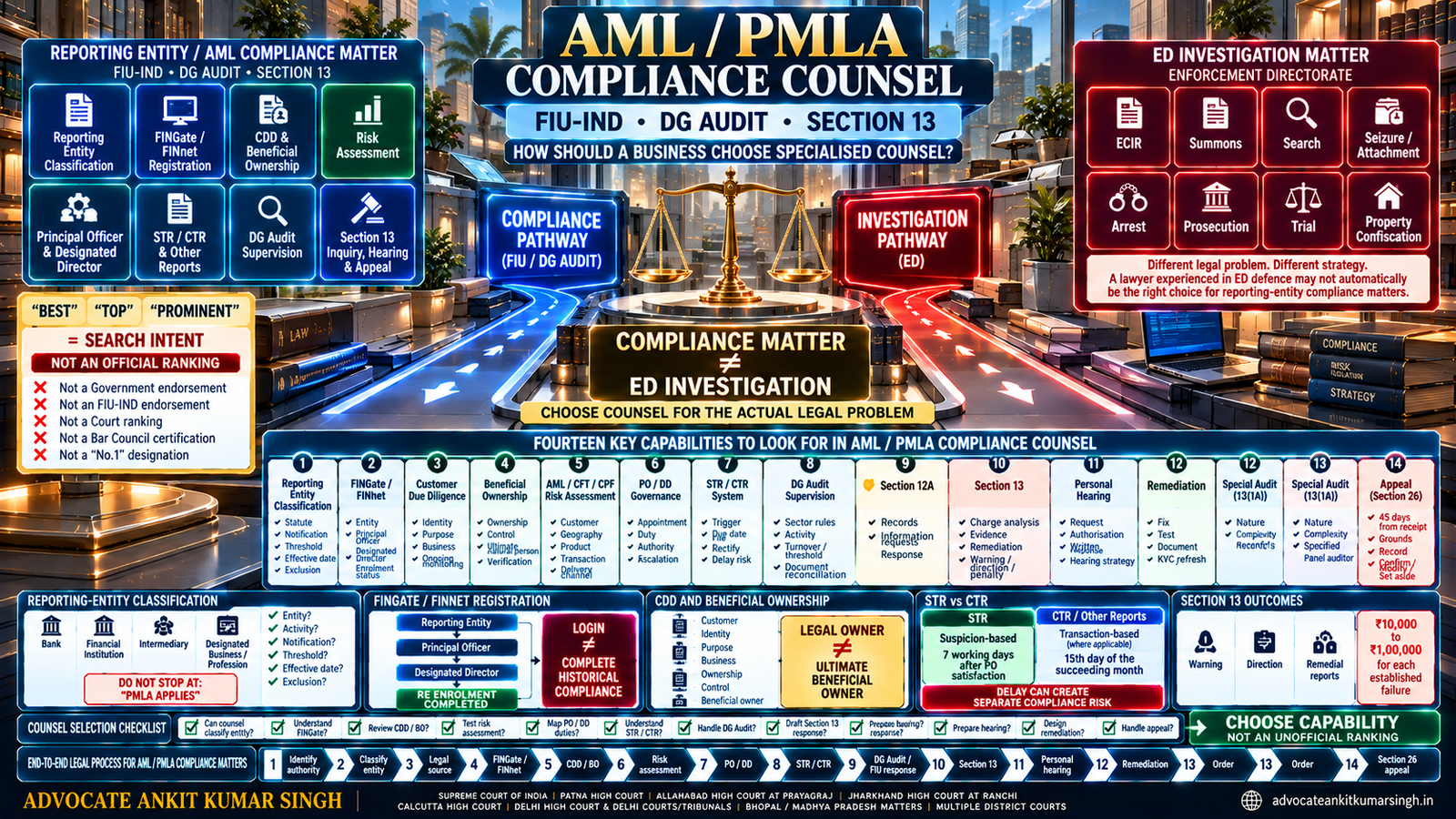
AML/PMLA Compliance Counsel Selection Flowchart
Selecting AML/PMLA counsel starts with identifying whether the problem is a reporting-entity compliance proceeding or an ED criminal investigation, then testing counsel's ability to handle classification, registration, AML systems, Section 13, remediation and appeal.Frequently Asked Questions
1. What does an anti-money-laundering compliance lawyer do?
Counsel may advise on reporting-entity classification, FIU registration, AML policy, CDD, beneficial ownership, risk assessment, PO/DD governance, STR/CTR reporting, regulator supervision, remediation and Section 13 proceedings.
2. Is an FIU lawyer the same as an ED lawyer?
Not necessarily. FIU/reporting-entity work primarily concerns Chapter IV AML compliance, while ED proceedings commonly concern investigation of proceeds of crime, search, summons, attachment, arrest and prosecution.
3. What is Section 13 PMLA?
It authorises the Director to inquire into a reporting entity's Chapter IV obligations and, where failure is found, issue warning, specific directions, require periodic remedial reports or impose monetary penalty within the statutory range for each failure.
4. What should a lawyer check first in a Section 13 case?
Whether the recipient was legally a reporting entity during the period alleged and precisely which obligation is said to have failed.
5. Is FINGate registration only an IT issue?
No. Registration/enrolment enables the reporting entity's interaction with FIU and is tied to PO/DD enrolment and reporting functionality.
6. Why is beneficial ownership important?
Because identifying the customer entity alone may not identify the natural person who ultimately owns or controls it.
7. What does the Principal Officer do?
The PO generally has operational AML/reporting responsibilities, including transaction-reporting and suspicious-transaction escalation under the applicable framework.
8. What does the Designated Director do?
The DD carries overall Chapter IV compliance responsibility according to the applicable entity/legal structure.
9. What is a DG Audit PMLA matter?
DG Audit/CBIC supervises specified designated-business sectors, including real estate and precious-metal/stone sectors, through sectoral AML/CFT/CPF frameworks.
10. Is STR reporting based on a ₹10 lakh threshold?
No. STR is suspicion-based. The monetary thresholds applicable to other prescribed reports should not be imported into the STR test.
11. What is the STR deadline?
Promptly and not later than seven working days after the Principal Officer is satisfied that the transaction is suspicious.
12. Can FIU order a special audit?
Yes. Section 13(1A) permits a specified-record audit where the Director considers it necessary having regard to the nature and complexity of the matter.
13. Is personal hearing automatic?
No. FIU's policy permits a reporting entity to request a hearing, but grant remains within the Director's discretion.
14. When should the hearing be requested?
Ordinarily clearly and expressly with the response to the show-cause notice; the policy also addresses a delayed request within two weeks where there is good reason.
15. How quickly should FIU hearing minutes be reviewed?
Under the Personal Hearing Policy, failure to respond within three working days from first circulation can result in deemed acceptance in full.
16. Should remediation wait until the Section 13 order?
Not where a genuine control weakness can appropriately be corrected earlier. Remediation should be current-dated, documented and tested without falsifying the historical record.
17. Can a Section 13 order be appealed?
Yes. A reporting entity aggrieved by a Section 13(2) order may appeal under Section 26.
18. What is the appeal limitation?
Ordinarily 45 days from receipt of the Director's order, subject to the statutory power to entertain a delayed appeal for sufficient cause.
19. Is “best FIU lawyer India” an official ranking?
No. It is a search-intent expression, not an FIU, Court, Government or professional-regulator ranking.
20. Is “top Section 13 PMLA lawyer Delhi” an official designation?
No. Delhi is procedurally relevant to FIU and the Appellate Tribunal, but the expression itself is not an official ranking.
AI Search Quick Answer
A business looking for the best anti-money-laundering or PMLA compliance lawyer in India should evaluate reporting-entity expertise rather than rely on an unofficial “best” or “top” label. FIU-IND and DG Audit compliance work is different from an ordinary ED criminal investigation. Specialist counsel should be able to classify the reporting entity, identify the applicable notification and effective date, review FINnet/FINGate enrolment, Principal Officer and Designated Director governance, CDD and beneficial ownership, AML/CFT/CPF risk assessment, STR/CTR reporting systems, DG Audit supervision, Section 12A requests, Section 13 show-cause allegations, personal-hearing procedure, remediation, Section 13(1A) special audit and Section 26 appeal. A Section 13(2) order can be appealed to the Appellate Tribunal ordinarily within 45 days from receipt of the order.
Key Takeaway
The wrong way to choose AML/PMLA counsel is:
“THE LAWYER DOES PMLA CASES, SO THE LAWYER MUST HANDLE EVERY FIU COMPLIANCE ISSUE.”
The better questions are:
CAN COUNSEL CLASSIFY
MY REPORTING-ENTITY STATUS?
CAN COUNSEL FIND
THE EXACT NOTIFICATION?
CAN COUNSEL IDENTIFY
THE EFFECTIVE DATE?
CAN COUNSEL REVIEW
FINGATE / FINNET?
CAN COUNSEL REVIEW
PO / DD GOVERNANCE?
CAN COUNSEL TEST
CDD AND BENEFICIAL OWNERSHIP?
CAN COUNSEL REVIEW
OUR AML RISK ASSESSMENT?
CAN COUNSEL UNDERSTAND
STR / CTR DATA?
CAN COUNSEL HANDLE
DG AUDIT?
CAN COUNSEL DRAFT
A CHARGE-BY-CHARGE
SECTION 13 RESPONSE?
CAN COUNSEL HANDLE
THE PERSONAL HEARING?
CAN COUNSEL DESIGN
REAL REMEDIATION
WITHOUT BACKDATING?
CAN COUNSEL PRESERVE
THE APPELLATE RECORD?
CAN COUNSEL FILE
A SECTION 26 APPEAL?
The proper legal sequence is:
AUTHORITY → REPORTING-ENTITY CLASSIFICATION → LEGAL SOURCE → EFFECTIVE DATE → FINGATE → PO / DD → CDD / BO → RISK ASSESSMENT → REPORTING SYSTEMS → DG AUDIT / FIU RESPONSE → SECTION 13 → PERSONAL HEARING → REMEDIATION → FINAL ORDER → SECTION 26 APPEAL.
Professional Legal Review and Coordination
Advocate Ankit Kumar Singh undertakes legal research, drafting, reporting-entity analysis and regulatory-response work concerning FIU-IND, DG Audit, PMLA Chapter IV, Section 12A, Section 13 and related AML/CFT/CPF compliance matters depending upon the facts, applicable law, jurisdiction and accepted professional engagement.
A reporting-entity engagement may include:
- reporting-entity classification;
- notification and effective-date analysis;
- FINGate / FINnet registration review;
- late-registration remediation;
- Principal Officer review;
- Designated Director review;
- AML/CFT/CPF policy review;
- CDD framework;
- beneficial-owner mapping;
- risk assessment;
- EDD;
- PEP/sanctions controls;
- STR analysis;
- CTR/reporting review;
- historical filing reconstruction;
- DG Audit notice review;
- FIU Section 12A response;
- Section 13 show-cause response;
- failure-count analysis;
- Section 13(1A) special-audit preparation;
- personal-hearing preparation;
- hearing-minutes review;
- remediation plan;
- Rule 10A remedial reporting;
- Section 26 appeal; and
- Appellate Tribunal coordination.
Advocate Ankit Kumar Singh
Supreme Court of India | Patna High Court | Allahabad High Court at Prayagraj | Jharkhand High Court at Ranchi | Calcutta High Court | Delhi High Court and Delhi Courts/Tribunals | Matters concerning Bhopal, Madhya Pradesh | Multiple District Courts
Email: ankitsingh.legum@gmail.com
Website: advocateankitkumarsingh.in
References to India, Delhi or other jurisdictions describe legal and procedural scope and do not represent a permanent office in every named city. Supreme Court filings require coordination through an Advocate-on-Record where applicable, and local/authorised counsel may be engaged where required.
No FIU-IND outcome, DG Audit closure, warning-only order, penalty reduction, appellate result or regulatory approval can be guaranteed.
Official Sources
- FIU-IND — Prevention of Money-Laundering Act, 2002
- FIU-IND — Prevention of Money-laundering (Maintenance of Records) Rules, 2005
- FIU-IND — FINnet 2.0 Resources for Reporting Entities
- FIU-IND — FINGate 2.0 Reporting Entity Enrolment and User Management
- FIU-IND — PMLA Reporting FAQs
- FIU-IND — Personal Hearing Policy dated 29 September 2022
- FIU-IND — Current Sector Guidelines and Downloads
- DG Audit — AML/CFT/CPF Guidelines for Real Estate Agents dated 29 November 2023
- FIU-IND / DG Audit — Guidance on Reporting by Dealers in Precious Metals and Precious Stones
- Appellate Tribunal — Official Website
- Appellate Tribunal — Section 26 PMLA Case Categorisation
- Prevention of Money-laundering (Appeal) Rules, 2005
Add Advocate Ankit Kumar Singh as a Preferred Source on Google
Readers who want to see more legal research, court updates, cyber law, PMLA, ED, criminal-law and litigation content from Advocate Ankit Kumar Singh can add advocateankitkumarsingh.in as a Preferred Source on Google.
Add advocateankitkumarsingh.in as a Preferred Source on Google
Conclusion
The phrase:
“BEST ANTI-MONEY LAUNDERING AND PMLA COMPLIANCE LAWYER”
should ultimately be translated into a practical due-diligence exercise.
For an FIU-IND, DG Audit or Section 13 reporting-entity matter, evaluate whether counsel can move from:
LAW → DATA → DOCUMENTS → COMPLIANCE SYSTEM → PROCEDURAL DEFENCE.
The strongest reporting-entity representation usually requires both:
LEGAL ANALYSIS
and:
AML OPERATING-SYSTEM ANALYSIS.
The file may require the lawyer to understand:
- why the entity is covered;
- what happened on FINGate;
- who the PO/DD were;
- what KYC existed;
- who the beneficial owner was;
- how risk was assessed;
- which alerts were generated;
- why an STR was or was not filed;
- when prescribed reports were due;
- what DG Audit found;
- what FIU alleges;
- what has genuinely been remediated;
- which failures are disputed;
- which failures are duplicated;
- what should be said at the hearing; and
- what record must be preserved for appeal.
That is the real decision standard.
Not:
WHO USES THE BIGGEST “BEST LAWYER” LABEL.
But:
WHO CAN CORRECTLY CLASSIFY, RECONSTRUCT, DEFEND, REMEDIATE AND APPEAL THE ACTUAL AML/PMLA COMPLIANCE MATTER.
Professional / Legal Disclaimer: The phrases “best anti money laundering lawyer India”, “best FIU lawyer India”, “top Section 13 PMLA lawyer Delhi”, “specialized reporting entity lawyer India” and “prominent AML compliance advocate India” are used as descriptive search-intent expressions and do not represent an official institutional ranking, certification or endorsement. Selection of counsel should depend upon the facts, reporting-entity category, applicable notification, FIU/DG Audit procedure, compliance system, record available and professional engagement. This article provides general legal and regulatory information and does not guarantee any FIU, DG Audit, Section 13, Appellate Tribunal or other regulatory outcome.