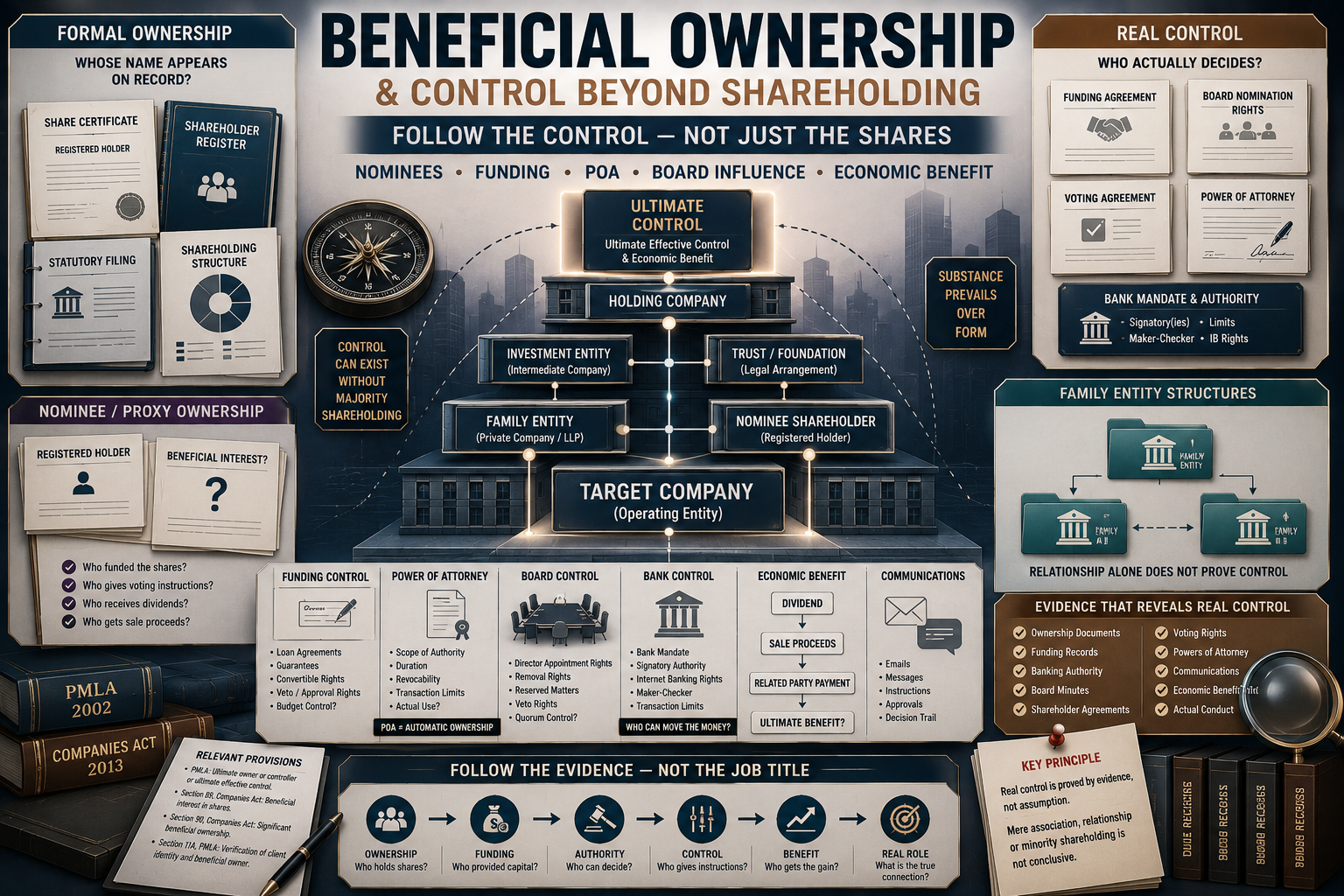
Beneficial Ownership and Control Beyond Shareholding: Proxies, Nominees, Family Entities, Funding, POA and Real Control under PMLA
Updated: 9 August 2026
In a corporate PMLA investigation, the name appearing in the shareholder register may be important—but it may not answer the most important question:
Who actually owns, controls or benefits from the entity?
Corporate structures may separate registered ownership from economic benefit and decision-making power through nominee shareholders, family entities, holding companies, shareholder agreements, funding arrangements, powers of attorney, board rights or informal control.
At the same time, investigators should not convert every family relationship, loan arrangement, minority veto right or professional association into an assumption of hidden beneficial ownership.
Real control must be proved through evidence.
This guide by Advocate Ankit Kumar Singh explains how beneficial ownership and effective control can be analysed beyond formal shareholding and what evidence may prove—or rebut—the allegation that another person is the company's real controller.
1. Registered Shareholder vs Beneficial Owner
A registered shareholder is the person whose name formally appears in the relevant ownership records.
Beneficial ownership asks a deeper question:
Who ultimately owns, controls or enjoys the benefit?
That distinction becomes especially important where ownership is distributed across companies, nominees, relatives, trusts or other legal structures.
2. Why Shareholding Percentage Is Not the Whole Story
A person may possess substantial equity yet exercise relatively limited operational control.
Conversely, depending upon the contractual and factual structure, a person with limited or indirect equity may exercise considerable influence through:
- director appointment rights;
- funding dependence;
- veto rights;
- voting arrangements;
- bank authority;
- powers of attorney;
- management instructions;
- beneficial ownership through intermediate entities.
The investigation must therefore move beyond the percentage column in the share register.
3. Ultimate Effective Control
The concept of beneficial ownership is designed to identify the natural person who ultimately owns or controls the relevant juridical person.
The analysis should therefore trace through intermediary structures until the actual natural-person ownership or control position becomes visible.
A corporate chain may look like:
Individual → Holding Company → Investment Company → LLP → Operating Company
Stopping at the immediate corporate shareholder may provide an incomplete picture.
4. Nominee Shareholders
A nominee arrangement requires careful factual analysis.
Important questions include:
- Who paid for the shares?
- Who receives dividends?
- Who determines voting?
- Who receives sale proceeds?
- Is there a nominee declaration?
- Is there a trust or beneficial-interest arrangement?
- Does the registered shareholder act independently?
The existence of a nominee structure should be established from evidence rather than assumption.
5. Proxy Ownership
Investigators may allege that a person shown as shareholder is merely acting for another individual.
Possible evidence may include:
- purchase consideration supplied by another person;
- consistent voting instructions;
- dividends transferred elsewhere;
- sale proceeds diverted to another person;
- communications showing instructions;
- absence of independent financial capacity.
No single factor should necessarily be treated as conclusive without examining the entire relationship.
6. Family Members as Shareholders
Family-held entities require particular care because genuine family ownership and alleged proxy arrangements can appear superficially similar.
The correct question is not:
“Is this shareholder related to the promoter?”
It is:
Does this shareholder actually exercise independent ownership and decision-making?
Relevant evidence may include personal funding, independent income, voting conduct, dividend treatment, board participation and communications.
7. Family Entity Control Matrix
| Issue | Evidence |
|---|---|
| Registered ownership | Share register / statutory filings |
| Funding | Bank trail |
| Voting | Resolutions / instructions |
| Management | Board records |
| Bank authority | Bank mandate |
| Economic benefit | Dividend / sale proceeds |
| Instructions | Email / digital communications |
8. Control Through Funding
An entity may depend heavily upon financing supplied by an individual or connected company.
That economic dependence can become relevant—but funding alone should not automatically be equated with beneficial ownership.
Counsel should examine what rights accompanied the money.
9. Funding Rights That May Matter
Examine whether the financing arrangement provided:
- board appointment rights;
- veto rights;
- budget approval;
- restriction on borrowing;
- approval of asset sales;
- conversion rights;
- control following default;
- rights over bank accounts.
A lender possessing only ordinary repayment and information rights occupies a different position from a funder who effectively controls management decisions.
10. Power of Attorney and Control
A power of attorney may be highly relevant where it authorises another person to:
- operate bank accounts;
- sell property;
- sign contracts;
- represent the company;
- exercise voting rights;
- manage investments.
But the existence of a POA does not itself establish beneficial ownership.
The document must be examined for scope, duration, revocability and actual use.
11. Board Appointment Rights
One of the strongest forms of corporate influence may be the ability to determine who sits on the board.
Examine:
- articles of association;
- shareholders' agreements;
- investment agreements;
- nomination rights;
- removal rights;
- quorum provisions;
- reserved matters.
12. Board Influence Without Formal Rights
Sometimes the allegation is not based upon a written contractual right.
Investigators may rely upon actual behaviour.
For example:
- management repeatedly seeks one person's approval;
- directors routinely follow external instructions;
- major payments require informal clearance;
- appointments are made on that person's directions;
- corporate strategy is dictated outside formal meetings.
The complete factual context must be examined before describing influence as actual control.
13. Shareholders' Agreements and Reserved Matters
Reserved-matter rights can be important.
However, not every contractual protection given to a minority investor necessarily amounts to control.
The document must be read as a whole.
Relevant clauses may concern:
- budgets;
- borrowing;
- capital expenditure;
- asset sales;
- new business;
- director appointments;
- related-party transactions;
- changes in capital.
14. Bank-Account Control
Banking evidence can be especially powerful because it shows who could actually move money.
Obtain:
- account-opening records;
- bank mandates;
- signatory lists;
- internet-banking rights;
- maker-checker hierarchy;
- transaction limits;
- payment instructions;
- token custody;
- changes in authority.
15. Bank Authority Is Not Automatically Beneficial Ownership
A CFO, employee or authorised signatory may possess banking authority without owning or beneficially controlling the company.
Therefore separate:
ABILITY TO EXECUTE A PAYMENT
from
POWER TO DECIDE WHY THE PAYMENT SHOULD BE MADE.
16. Personal Guarantees
Promoters and other persons may provide personal guarantees for company borrowing.
That can demonstrate financial involvement and economic risk.
But a guarantee should be considered alongside other evidence before being treated as proof of beneficial ownership or control.
17. Who Receives the Economic Benefit?
Follow the benefit.
Examine:
- dividends;
- sale consideration;
- capital distributions;
- related-party payments;
- loans;
- asset transfers;
- personal expenses paid by company;
- property acquisitions.
The economic-benefit trail may reveal a relationship that the shareholder register alone does not.
18. Corporate Layering
Ownership may run through several legal entities.
Prepare an ownership tree:
Target Company ↑ Immediate Shareholder ↑ Holding Entity ↑ Trust / LLP / Company ↑ Natural Persons
For each layer identify ownership, voting rights and control.
19. Beneficial Ownership Through Trusts
Where a trust appears in the ownership chain, examine:
- settlor;
- trustees;
- beneficiaries;
- protector, where relevant;
- distribution rights;
- revocation rights;
- investment/control powers.
The legal instrument and actual operation should both be examined.
20. Emails Can Reveal Real Control
Digital communications may show who actually makes decisions.
Create an instruction matrix containing:
- date;
- sender;
- recipient;
- decision involved;
- instruction given;
- action taken;
- formal authority;
- result.
21. Do Not Read an Isolated Email Out of Context
A message saying:
“Please speak to X before finalising.”
may indicate control—or simply consultation.
The surrounding correspondence, organisational structure and actual decision must be examined.
22. Board Minutes May Confirm or Contradict the Allegation
Board records can show:
- who proposed decisions;
- who voted;
- who dissented;
- who attended;
- whether external approval was required;
- whether directors exercised independent judgment.
23. Statutory Filings Matter—but They Are Not the Only Evidence
Relevant corporate filings may include records concerning:
- share ownership;
- beneficial interests;
- significant beneficial ownership;
- directors;
- registered office;
- charges;
- annual returns.
These records should be compared with the actual money trail and management conduct.
24. Sections 89 and 90 of the Companies Act
The Companies Act contains specific mechanisms concerning beneficial interests in shares and significant beneficial ownership.
Those disclosures can become relevant evidence in an ED or financial-crime investigation.
But the PMLA inquiry may still examine the underlying reality of ownership, control and transactions.
25. Control Through Related-Party Transactions
Repeated transfers between connected entities can become relevant when analysing who economically controls a group.
Examine:
- loans;
- advances;
- management fees;
- asset transfers;
- guarantees;
- inter-company deposits;
- common vendors;
- common bank instructions.
26. Common Directors Are Relevant but Not Conclusive
Two entities having common directors may suggest a connection.
It does not automatically establish that one person beneficially owns both companies.
Analyse actual ownership, funding, decision rights and economic benefit.
27. Employees and Nominee Directors
A person may appear as a director or shareholder despite having limited economic involvement.
Investigators should examine:
- salary;
- source of share-purchase money;
- knowledge of business;
- meeting participation;
- bank authority;
- communications;
- benefit received.
28. The Source of Share-Purchase Money
One of the most important questions is:
Who actually paid for the shares?
Trace:
Bank Account → Share-Purchase Consideration → Registered Shareholder → Funding Source
Unexplained funding by another person may require deeper analysis.
29. Dividend Trail
Where dividends are paid, determine:
- which bank account received them;
- whether they were transferred onward;
- whether the registered shareholder retained the economic benefit.
30. Share-Sale Proceeds
If shares are eventually sold, trace the consideration.
The recipient of the ultimate economic proceeds may provide important evidence concerning beneficial ownership.
31. Evidence Required to Prove Real Control
A robust investigation should not depend upon one document.
Build evidence from multiple independent categories:
- Ownership documents.
- Funding records.
- Bank authority.
- Voting and governance rights.
- Board records.
- Communications.
- Economic-benefit trail.
- Actual management conduct.
32. The Eight-Basket Control Test
| Basket | Question |
|---|---|
| Shares | Who legally owns? |
| Funding | Who paid? |
| Votes | Who decides? |
| Board | Who appoints/removes? |
| Bank | Who controls money? |
| Instructions | Whose directions are followed? |
| Benefit | Who receives economic value? |
| Conduct | Who actually runs the entity? |
33. Defence Against an Incorrect Beneficial-Ownership Allegation
Do not rely solely upon:
“My name is not in the share register.”
Instead prove:
- no share ownership;
- no beneficial declaration;
- no funding of shares;
- no voting rights;
- no director appointment powers;
- no bank authority;
- no POA;
- no economic benefit;
- no operational instructions;
- independent management.
34. Funding Defence
Where the allegation is based upon loans or financial support, produce:
- loan agreements;
- interest terms;
- repayment schedule;
- security documents;
- commercial rationale;
- board approvals;
- actual repayment records.
An arm's-length loan is different from undisclosed funding designed to exercise hidden control.
35. Family Relationship Defence
Where ED relies heavily upon family connection, document the independence of the alleged proxy shareholder.
Possible material includes:
- independent income;
- personal bank account;
- own investment records;
- independent voting behaviour;
- independent correspondence;
- actual participation in management.
36. POA Defence
Where a POA is relied upon, produce the complete instrument.
Do not permit one broad phrase to be quoted without:
- limitations;
- expiry;
- revocation;
- transaction scope;
- evidence of actual use.
37. Section 50 Statement Preparation
Where beneficial ownership is being investigated, ED may ask:
- Who funded the company?
- Who is the real owner?
- Who appointed directors?
- Who controlled bank accounts?
- Who approved transactions?
- Who received profits?
- Who gave instructions?
- Why were shares held in another person's name?
Answers should be reconciled with documents rather than based upon assumptions or memory alone.
38. Build an Ownership-and-Control Chart Before the Statement
Prepare a one-page chart containing:
ENTITY → SHAREHOLDERS → ULTIMATE NATURAL PERSONS → DIRECTORS → FUNDING → BANK SIGNATORIES → VOTING RIGHTS → BENEFICIARIES
This reduces contradictions in complex group structures.
39. Beneficial Ownership Is Not the Same as Money Laundering
This distinction is essential.
Even if a person is proved to be the beneficial owner or controller of an entity, the separate ingredients of the PMLA offence must still be analysed.
Corporate control is evidence relevant to attribution.
It is not, standing alone, proof that the person participated in money laundering.
40. Link Control Back to the Alleged Proceeds of Crime
The correct final inquiry is:
How does the alleged control connect this individual with the particular process or activity involving the alleged proceeds of crime?
That requires transaction-level analysis.
41. Master Beneficial-Ownership Decision Tree
Who is the registered shareholder?
↓
Who funded acquisition of the shares?
↓
Who exercises voting rights?
↓
Who appoints or influences directors?
↓
Who controls bank transactions?
↓
Who gives operational instructions?
↓
Who receives economic benefit?
↓
What contractual rights exist?
↓
What does actual conduct show?
↓
Does the evidence establish ultimate ownership/control?
42. Essential Document Checklist
- share register;
- share certificates;
- share-purchase agreements;
- beneficial-interest declarations;
- SBO records where applicable;
- annual returns;
- articles of association;
- shareholders' agreements;
- voting agreements;
- board minutes;
- board appointment records;
- bank statements;
- bank mandates;
- internet-banking rights;
- loan agreements;
- guarantees;
- funding records;
- POAs;
- trust deeds;
- LLP agreements;
- dividend records;
- share-sale proceeds;
- related-party transaction records;
- emails;
- WhatsApp / digital communications;
- ED statements;
- prosecution complaint;
- complete ownership chart.
43. Frequently Asked Questions
Is the biggest shareholder always the beneficial owner?
Not necessarily. Ultimate ownership and control require examination of the full ownership and governance structure.
Can someone control a company without owning most shares?
Depending upon the factual and contractual structure, significant control may potentially arise through governance rights, funding, voting arrangements, management influence or other mechanisms.
Is a nominee shareholder illegal?
The legal consequences depend upon the structure, disclosure obligations and purpose. A nominee arrangement should not itself be equated automatically with money laundering.
Does funding a company make someone its beneficial owner?
Not automatically. The rights and actual influence attached to the funding must be examined.
Does holding a POA prove beneficial ownership?
No automatic conclusion should be drawn. Scope, duration and actual use of the authority matter.
Can a family member be treated as a proxy shareholder?
Family relationship alone should not establish proxy ownership. Funding, voting, benefit and actual conduct require evidence.
Can bank authority prove control?
It can be relevant evidence but should be analysed alongside the person's broader role and decision-making powers.
Are board nomination rights important?
Yes. Governance and appointment rights may be relevant when determining effective control.
Can emails prove real control?
Communications can be important if they demonstrate actual instructions or approvals, but they must be interpreted in context.
Does beneficial ownership automatically prove money laundering?
No. The prosecution must still establish the statutory connection with the alleged proceeds-of-crime activity.
44. Final Legal Principle
Beneficial ownership analysis must look through corporate form without abandoning evidentiary discipline.
Neither proposition is safe:
“The shares are not in his name, therefore he cannot control the company.”
Nor:
“He is related to the shareholder or funded the company, therefore he must be the real owner.”
The correct inquiry combines:
LEGAL OWNERSHIP + FUNDING + VOTING RIGHTS + BOARD CONTROL + BANK AUTHORITY + COMMUNICATIONS + ECONOMIC BENEFIT + ACTUAL CONDUCT.
Only after those factors are analysed should a conclusion regarding ultimate beneficial ownership or effective control be drawn.
Conclusion
Modern corporate ownership cannot always be understood by looking at one share certificate or one MCA filing.
Nominee shareholders, holding entities, family companies, financing arrangements, powers of attorney and governance agreements can create layers between registered title and actual economic or managerial control.
For PMLA investigations, the appropriate approach is therefore to trace ownership and control until the relevant natural persons and their actual rights become clear.
At the same time, every alleged proxy, nominee or controller is entitled to insist that the conclusion be supported by evidence rather than inference based solely upon relationships or corporate association.
The strongest beneficial-ownership analysis is ultimately:
DOCUMENT-DRIVEN + MONEY-TRAIL-DRIVEN + GOVERNANCE-DRIVEN + CONDUCT-DRIVEN.
About the Author

Advocate Ankit Kumar Singh advises and represents clients in matters concerning the Prevention of Money Laundering Act (PMLA), Enforcement Directorate investigations, corporate ownership and control, financial crime, white-collar proceedings and connected appellate and constitutional remedies.
Website: advocateankitkumarsingh.in
Email: ankitsingh.legum@gmail.com
Phone: 8294431232
Google Preferred Source
Add advocateankitkumarsingh.in as a Preferred Source on Google
Disclaimer: This article is intended solely for general legal information and educational purposes. Beneficial ownership and corporate-control analysis is fact-specific and may depend upon statutory filings, shareholder agreements, beneficial-interest declarations, funding, governance rights, bank authority, powers of attorney, economic benefit, communications and actual conduct. Beneficial ownership should not itself be treated as proof of a PMLA offence without separately examining the statutory ingredients and alleged proceeds-of-crime nexus. This article does not constitute legal advice for any particular investigation or proceeding.