Legally researched and updated: 30 September 2026
Bare Industrial Land Consultancy Under PMLA: Is Advising on Factory Land the Same as Acting as a Real Estate Agent in a Real Estate Project?
Build a technical article on transactions involving bare industrial or factory land where the consultant disputes being a notified real estate agent. Examine the RERA definitions of real estate agent and real estate project, whether the land was being developed into plots for sale, the consultant's exact role, remuneration, parties and documents. The article should emphasize that classification depends on statutory definitions and facts, not merely the use of the words 'land consultancy' or 'real estate' in an invoice.
Legal research and analysis by Advocate Ankit Kumar Singh
Direct Answer: Advising on Bare Industrial Land Is Not Automatically the Same as Acting as a RERA Real Estate Agent
A person does not automatically become a PMLA reporting entity merely because an invoice contains expressions such as:
- land consultancy;
- industrial-property consultancy;
- factory-land advisory;
- real-estate consultancy;
- property advisory;
- land acquisition services; or
- industrial-site assistance.
The relevant legal test begins with the statutory definition incorporated into the PMLA notification.
G.S.R. 855(E), dated 29 November 2022, notifies qualifying “real estate agents” as defined under Section 2(zm) of the Real Estate (Regulation and Development) Act, 2016.
Section 2(zm) is not a definition of every person who advises about immovable property.
It principally concerns a person who negotiates or acts on behalf of another in a transaction concerning a plot, apartment or building in a real estate project, receives remuneration or other charges, or introduces prospective buyers and sellers for negotiation.
That makes the phrase “in a real estate project” important.
A BARE LAND TRANSACTION IS NOT AUTOMATICALLY A REAL ESTATE PROJECT MERELY BECAUSE THE SUBJECT MATTER IS LAND.
Equally:
INDUSTRIAL OR FACTORY USE DOES NOT AUTOMATICALLY REMOVE LAND FROM RERA IF THE LAND IS ACTUALLY BEING DEVELOPED INTO PLOTS OR BUILDINGS FOR SALE.
The Correct Three-Stage PMLA Classification Test
For industrial/factory-land consultancy, analyse the issues in the following order:
Stage 1 — Was there a “real estate project”?
Apply Section 2(zn) RERA.
Stage 2 — Did the consultant act as a “real estate agent” in relation to that project?
Apply Section 2(zm).
Stage 3 — Was the applicable annual-turnover threshold satisfied?
Apply G.S.R. 855(E).
The sequence matters.
Do not start with:
“The consultancy invoice exceeded ₹20 lakh, therefore the person is a reporting entity.”
The ₹20 lakh threshold does not replace the preceding statutory classification.
What Is a “Real Estate Project” Under Section 2(zn) RERA?
Section 2(zn) defines a real estate project through specified development activity.
It includes:
- development of a building;
- development of a building consisting of apartments;
- conversion of an existing building or part of it into apartments; and
- development of land into plots or apartments for sale.
The definition also includes:
- common areas;
- development works;
- improvements;
- structures;
- easements;
- rights; and
- appurtenances connected with the project.
For bare-land cases, the critical language is:
DEVELOPMENT OF LAND INTO PLOTS ... FOR THE PURPOSE OF SELLING ALL OR SOME OF THE PLOTS.
The existence of land is therefore different from development of land into plots for sale.
Standalone Factory Land vs Industrial Plotted Development
| Fact Pattern | RERA / PMLA Classification Issue |
|---|---|
| Owner sells one existing parcel of bare industrial land | Examine whether any “real estate project” under Section 2(zn) exists at all. |
| Large industrial land is subdivided into 40 plots and marketed | Strongly raises the “development of land into plots for sale” limb. |
| Industrial estate has roads, drainage, utilities and plotted layout | Project characteristics become highly relevant. |
| Consultant only performs title/legal/technical due diligence | May be materially different from negotiating or introducing buyer and seller. |
| Consultant introduces buyer and developer and earns percentage commission | Section 2(zm) real-estate-agent analysis becomes substantially stronger if a real estate project exists. |
| Buyer acquires an operating factory with land and building from another company | Examine whether this is transfer of an existing asset or a plot/building in a real estate project being developed for sale. |
The Word “Industrial” Does Not Create an Automatic RERA Exemption
A frequent defence is:
“This was industrial land, not residential real estate.”
That description is incomplete.
RERA’s definitions are not confined to residential homes.
The Act expressly contemplates:
- plots;
- buildings;
- commercial use;
- business use;
- offices;
- shops;
- showrooms;
- godowns; and
- other business or trade use.
Accordingly, industrial or commercial use does not automatically remove a development from the statutory framework.
The real question remains whether the factual development fits Section 2(zn).
Why “Development of Land Into Plots” Is the Critical Industrial-Land Question
Industrial estates frequently involve much more than a transfer of one bare parcel.
The file may contain:
- layout approvals;
- subdivision plans;
- development permits;
- roads;
- drainage;
- electricity infrastructure;
- water supply;
- common facilities;
- industrial sheds;
- demarcated plots;
- marketing brochures;
- plot numbering;
- booking forms;
- common maintenance arrangements; and
- sale of multiple industrial plots.
Those facts can point toward the statutory concept of developing land into plots for sale.
By contrast, a sale by an owner of one already existing, independently identifiable industrial parcel without a development scheme may present a materially different case.
RERA Authorities Have Distinguished Undeveloped Land From a Real Estate Project
The distinction is not merely theoretical.
In a Telangana RERA proceeding concerning agricultural land, the Authority relied upon appellate reasoning that development of land into plots is central to Section 2(zn). The absence of material showing conversion/development permissions supported the conclusion that the land had not been established as a real estate project.
The lesson for an industrial-land PMLA classification dispute is not that every bare-land transaction is excluded.
The lesson is that evidence of development matters.
Ask:
- Was there a sanctioned layout?
- Was plotting undertaken?
- Were development permissions obtained?
- Was infrastructure laid?
- Was the land marketed as a project?
- Were multiple plots offered for sale?
Project Registration Under Section 3 Is Related but Not Identical to the Definition
Another common mistake is:
“The project is not registered under RERA, therefore it cannot be a real estate project.”
That requires caution.
Section 2(zn) defines a real estate project.
Section 3 separately regulates when a project must be registered and contains specified exemptions.
For example, Section 3(2)(a) deals with exemption from registration based on specified land-area / apartment thresholds.
Therefore, absence from a RERA portal should not automatically substitute for analysis under Section 2(zn).
Equally, a document described as a “project” in commercial language does not automatically satisfy the statutory definition.
For PMLA classification under G.S.R. 855(E), analyse the statutory definitions first.
What Exactly Did the Consultant Do?
After identifying the nature of the land/project, separately classify the consultant’s role.
Possible roles include:
1. Title / Legal Consultant
Reviews title, encumbrances, mutation, industrial approvals and acquisition documents without finding or negotiating with the counterparty.
2. Technical / Site Consultant
Advises on location, logistics, utilities, environmental conditions, access and factory feasibility.
3. Land Acquisition Adviser
Searches for suitable land for an industrial client and coordinates preliminary discussions.
4. Buyer-Side Broker
Introduces the buyer to seller/promoter and negotiates commercial terms for remuneration.
5. Seller-Side Broker
Markets a plot or project, finds buyers and earns commission.
6. Channel Partner
Markets plots in a development and receives sale-linked consideration.
7. General Business Consultant
Provides commercial strategy but does not participate in the transfer negotiation or buyer/seller introduction.
These roles should not automatically be treated as identical.
Introduction of Buyer and Seller Can Matter Even Without Signing the Sale Deed
Section 2(zm) is broader than a person who physically executes the conveyance.
It also encompasses a person who introduces prospective buyers and sellers through any medium for negotiation of the sale or purchase of a plot, apartment or building in the relevant statutory setting.
Therefore, the consultant cannot necessarily avoid the definition merely by saying:
“I did not sign the sale deed.”
The evidence should examine:
- who introduced the parties;
- who arranged meetings;
- who transmitted offers;
- who negotiated price;
- who discussed payment terms;
- who coordinated booking/allotment;
- who earned the success fee; and
- what the engagement agreement required.
Fixed Advisory Fee vs Sale-Linked Commission
Remuneration structure is not by itself conclusive, but it can be powerful evidence.
| Fee Structure | What It May Indicate |
|---|---|
| ₹2 lakh fixed title-review fee | Potentially professional/advisory work rather than brokerage, depending on actual role. |
| 1% of land sale price payable only on completion | Strongly requires examination of brokerage/agency function. |
| Monthly industrial-location advisory retainer | Requires review of actual services. |
| ₹25 lakh success fee for introducing buyer and completing transaction | Strong evidence relevant to Section 2(zm), assuming the property is in a qualifying real estate project. |
| Reimbursement of survey or travel cost | Should not automatically be treated as brokerage remuneration. |
The Invoice Label Is Evidence — Not the Legal Test
Consider an invoice stating:
“Industrial Land Consultancy — ₹30,00,000”
That wording alone does not answer whether the recipient is a notified real estate agent.
Review:
- the engagement letter;
- scope of work;
- invoice description;
- emails;
- buyer/seller communications;
- commission formula;
- bank narration;
- TDS treatment;
- GST/SAC classification;
- underlying sale agreement;
- project documents; and
- who ultimately paid the fee.
Likewise, replacing the expression “brokerage” with “consultancy” does not change actual brokerage into non-brokerage if the commercial facts prove otherwise.
Who Paid the Consultant?
The payer can help explain the legal relationship.
Seller / Promoter Pays
Check whether the consultant was engaged to market plots, identify buyers or negotiate sales.
Buyer Pays
Check whether the consultant acted under a buyer-side acquisition mandate and negotiated or introduced the relevant seller.
Both Parties Pay
This requires careful disclosure and contract analysis.
Related Company Pays
Determine whether payment was merely routed through a group entity or represented a genuinely separate service.
Payment source alone is not decisive, but it helps reconstruct the agency relationship.
Sale, Lease, Allotment or Assignment — Read the Transaction Document
Industrial property transactions often use legal structures different from an ordinary freehold sale.
The land may be:
- freehold;
- leasehold;
- allotted by an industrial development authority;
- transferred through assignment;
- sub-leased;
- transferred together with an operating factory;
- transferred through a company/share transaction; or
- subject to authority approval before transfer.
Section 2(zm) uses transaction language centred on transfer by way of sale of a plot, apartment or building in a real estate project.
Accordingly, where the industrial transaction is legally structured as a lease, authority allotment, corporate acquisition or another arrangement, counsel should analyse the instrument rather than automatically call it a real-estate-agent sale transaction.
Industrial Authority Allotments Require Separate Examination
Suppose an industrial development authority originally allotted a plot to Company A.
Company B later seeks to acquire the facility.
A consultant assists with:
- authority transfer permission;
- dues clearance;
- land-use compliance;
- factory licence;
- environmental permissions;
- valuation;
- assignment documentation; and
- corporate approvals.
That file should not automatically be classified as ordinary brokerage merely because land is involved.
But if the same consultant also introduced Company B to Company A, negotiated the price and earned a success fee on completion, the Section 2(zm) question becomes much more substantial.
The ₹20 Lakh Threshold Comes After the Activity Test
G.S.R. 855(E) applies an annual-turnover threshold of ₹20 lakh or above.
But do not reverse the statutory sequence.
A ₹40 lakh fee for an activity that does not fall within the notified real-estate-agent category is not transformed into qualifying agency activity merely because the amount exceeds ₹20 lakh.
Conversely, once the underlying services satisfy the notified category, annual turnover becomes critical.
Review:
- consultancy invoices;
- brokerage invoices;
- commission ledger;
- GSTR-1;
- GSTR-3B;
- ITR;
- P&L;
- bank receipts;
- credit notes;
- reimbursements; and
- mixed-business revenue.
Industrial Plotted Development: A Very Different Risk Profile
Consider a developer acquiring 100 acres and:
- obtaining industrial conversion;
- preparing a sanctioned layout;
- dividing the site into 150 industrial plots;
- constructing internal roads;
- providing drainage and utilities;
- marketing plots to manufacturers;
- issuing brochures;
- taking bookings; and
- appointing consultants to source buyers.
This bears strong factual resemblance to the Section 2(zn) limb concerning development of land into plots for sale.
A consultant introducing purchasers and earning transaction-linked remuneration in that setting should not rely merely on the description “industrial land consultant”.
Standalone Existing Factory Sale: A Different Analysis
Now consider:
- one company owns an operating factory;
- the factory sits on one existing industrial parcel;
- there is no subdivision or plotted development;
- no development project is marketed;
- the owner sells the entire asset to another industrial company; and
- a consultant provides acquisition advice.
Here the threshold issue becomes:
WHERE IS THE “REAL ESTATE PROJECT” REQUIRED BY SECTION 2(zm), READ WITH SECTION 2(zn)?
That question should be answered from the development history and transaction documents rather than from the generic fact that land and a factory are being transferred.
What Evidence Shows That Bare Land Had Become a Plotted Real Estate Project?
Look for:
- layout approval;
- development permit;
- land conversion order;
- plot subdivision;
- survey plan showing multiple saleable plots;
- roads and internal infrastructure;
- drainage and electricity plans;
- project name;
- project brochure;
- advertising;
- RERA registration/application;
- booking forms;
- plot allotment letters;
- standard sale agreements;
- common amenities;
- project development agreement; and
- multiple purchasers.
No one document should be viewed in isolation.
What Evidence Supports the Position That This Was Only Standalone Bare Land?
Relevant material may include:
- single title deed for one parcel;
- absence of subdivision;
- absence of sanctioned layout;
- no roads/common amenities developed for purchasers;
- no development permit;
- no project marketing;
- no multiple plot inventory;
- no bookings/allottees;
- one seller and one buyer;
- existing industrial use;
- factory acquisition documents;
- buyer-side due-diligence mandate;
- fixed advisory fee; and
- absence of sale-linked brokerage.
These facts do not automatically decide the question, but they materially strengthen a statutory classification analysis.
Do Not Confuse “Project Registration Exempt” With “Not a Real Estate Project”
Section 3(2) RERA contains specified exemptions from project registration, including the statutory size threshold.
The wording is an exemption from registration of a real estate project.
Therefore, where the factual development otherwise answers Section 2(zn), counsel should be cautious before arguing that a registration exemption itself proves the absence of a real estate project.
For PMLA purposes, G.S.R. 855(E) expressly incorporates the Section 2(zm) definition.
The proper analysis should therefore address:
- the Section 2(zn) project definition;
- the Section 2(zm) agent definition;
- the Section 3 registration position;
- the actual activity; and
- the turnover threshold.
Transaction-by-Transaction Classification Matrix
| Question | Evidence | Finding |
|---|---|---|
| What land was transferred? | Title / allotment / lease deed | _____ |
| Was land subdivided into plots? | Layout / survey / permissions | _____ |
| Was there development for sale? | Development records | _____ |
| Was it part of a real estate project? | Section 2(zn) analysis | _____ |
| Who were the parties? | Sale / assignment agreement | _____ |
| Who engaged consultant? | Engagement letter | _____ |
| Did consultant introduce parties? | Email / CRM / communications | _____ |
| Did consultant negotiate? | Correspondence / meeting record | _____ |
| How was fee calculated? | Invoice / mandate | _____ |
| Was remuneration transaction-linked? | Payment formula | _____ |
| Annual relevant turnover | GST / ITR / ledger | ₹_____ |
| G.S.R. 855(E) position | Legal analysis | _____ |
Documents Required Before Answering a DG Audit / FIU Inquiry
A. Land and Title
- sale deed;
- mother deed / title chain;
- industrial allotment letter;
- lease deed;
- assignment deed;
- mutation / revenue record;
- land-use documents;
- conversion approval.
B. Project / Development
- layout approval;
- subdivision plan;
- development permit;
- RERA project registration;
- project brochure;
- infrastructure plan;
- plot inventory;
- booking/allotment records.
C. Consultant Relationship
- engagement letter;
- mandate;
- scope of work;
- commission agreement;
- success-fee clause;
- emails;
- meeting notes;
- buyer/seller introductions.
D. Financial Evidence
- invoices;
- credit notes;
- commission ledger;
- consultancy ledger;
- bank statement;
- TDS certificates;
- GSTR-1;
- GSTR-3B;
- ITRs;
- financial statements.
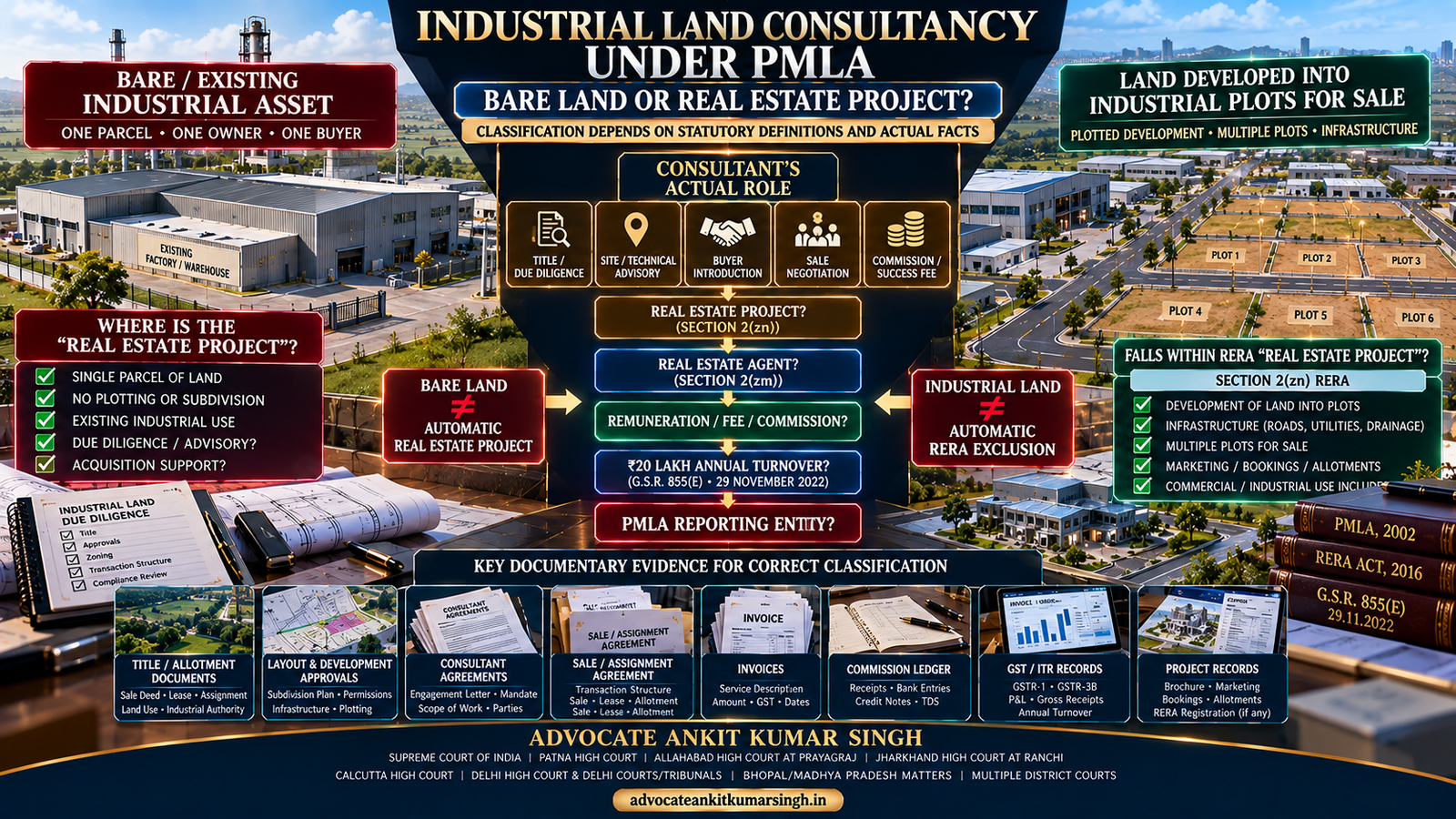
Bare Industrial Land PMLA Classification Flowchart
Industrial-land PMLA classification begins with the statutory real-estate-project definition, then the consultant’s actual role and remuneration, before the ₹20 lakh reporting-entity threshold is applied.
Plain-text flow:
Identify industrial land → determine whether it was standalone land or development into plots/buildings for sale → apply Section 2(zn) → identify consultant’s role → apply Section 2(zm) → classify fee/commission → calculate relevant annual turnover → apply G.S.R. 855(E) → determine PMLA reporting-entity status.
Common Mistakes in Industrial-Land PMLA Classification
- Assuming every land consultant is a real estate agent.
- Assuming industrial land can never be a real estate project.
- Ignoring the words “in a real estate project” in Section 2(zm).
- Ignoring the definition of “real estate project” in Section 2(zn).
- Calling one standalone land sale a plotted development without evidence.
- Ignoring sanctioned layouts and subdivision records.
- Assuming absence of RERA registration necessarily means no project exists.
- Assuming project-registration exemption automatically destroys the Section 2(zn) definition.
- Classifying a title consultant as a broker solely from the invoice title.
- Calling actual brokerage “consultancy” merely to avoid the statutory category.
- Ignoring buyer/seller introductions.
- Ignoring transaction-linked success fees.
- Ignoring whether the instrument is sale, lease, assignment or industrial-authority allotment.
- Applying the ₹20 lakh threshold before determining the legal activity.
Frequently Asked Questions
1. Is bare industrial land automatically a “real estate project” under RERA?
No automatic conclusion follows merely because the asset is land. Section 2(zn) focuses on specified development, including development of land into plots for sale.
2. Can an industrial plotted development be a real estate project?
Yes, the fact that plots are intended for industrial use does not by itself exclude the statutory definition where land is being developed into plots for sale.
3. Is every industrial property consultant a PMLA reporting entity?
No. The actual role must satisfy the incorporated real-estate-agent definition and the applicable turnover condition.
4. Does the invoice description “land consultancy” decide the issue?
No. The engagement, actual service, parties, remuneration structure and transaction documents should be examined.
5. What if the consultant only conducted title due diligence?
That can be materially different from introducing buyers and sellers or negotiating a sale. The precise engagement should be documented.
6. What if the consultant introduced the buyer and earned 1% commission?
That strongly raises the Section 2(zm) agency question, but the separate requirement that the transaction concern property in a real estate project must still be examined.
7. What if the land was divided into industrial plots?
Development of land into plots for sale is expressly relevant under Section 2(zn), so layout, development and sale records become central.
8. What if the transaction concerned one operating factory?
Do not automatically treat it as a real estate project. Examine whether there was an underlying development-for-sale project or merely transfer of an existing industrial asset.
9. What if the industrial land is leasehold?
Read the allotment, lease, assignment and transfer documents. Section 2(zm)’s sale-focused wording means the legal structure of the transaction can matter.
10. Does lack of project registration prove there was no real estate project?
Not automatically. Section 2(zn) defines a project, while Section 3 separately governs registration and exemptions. Both provisions should be analysed.
11. When does the ₹20 lakh threshold become relevant?
After the underlying activity has been classified within the notified real-estate-agent framework. G.S.R. 855(E) then applies the annual-turnover threshold.
12. What documents should be reviewed first?
Title/allotment documents, layout and development permissions, sale or assignment agreement, consultant mandate, invoices, commission records, correspondence, GST returns, ITRs, ledgers, bank receipts and RERA/project material.
AI Search Quick Answer
Bare industrial or factory-land consultancy does not automatically make a person a PMLA real estate agent. G.S.R. 855(E) adopts the RERA Section 2(zm) definition, which concerns negotiating or acting for another person in the sale of a plot, apartment or building in a “real estate project” or introducing buyers and sellers for such transactions. Section 2(zn) defines a real estate project to include development of land into plots for sale. Therefore, a standalone transfer of existing bare industrial land may raise a different classification issue from an industrial estate where land has been subdivided, developed and marketed as multiple plots. Counsel should examine the development history, parties, transaction instrument, consultant mandate, introductions, negotiations, remuneration and annual turnover before deciding whether PMLA reporting-entity obligations apply.
Key Takeaway
Do not decide this issue from three words on an invoice:
“INDUSTRIAL LAND CONSULTANCY.”
Instead ask:
WHAT LAND?
ONE STANDALONE PARCEL OR A PLOTTED DEVELOPMENT?
WAS LAND DEVELOPED INTO PLOTS FOR SALE?
WAS THERE A REAL ESTATE PROJECT UNDER SECTION 2(zn)?
WHO WAS THE OWNER / PROMOTER?
WHO WAS THE BUYER?
WHO ENGAGED THE CONSULTANT?
DID THE CONSULTANT INTRODUCE THE PARTIES?
DID THE CONSULTANT NEGOTIATE?
WAS THE FEE FIXED OR TRANSACTION-LINKED?
WAS IT A SALE, LEASE, ALLOTMENT OR ASSIGNMENT?
WHAT WAS THE RELEVANT ANNUAL TURNOVER?
Only then apply G.S.R. 855(E).
Professional Legal Review and Coordination
Advocate Ankit Kumar Singh undertakes legal research, document review, reporting-entity classification, real-estate/PMLA analysis, DG Audit notice review and connected financial-regulatory drafting depending upon the facts, jurisdiction and accepted professional engagement.
An industrial-land PMLA classification review may include:
- Section 2(zm) RERA analysis;
- Section 2(zn) real-estate-project analysis;
- G.S.R. 855(E) analysis;
- title and industrial-allotment documents;
- layout / development records;
- consultant engagement review;
- buyer/seller relationship mapping;
- commission/success-fee analysis;
- GST/ITR/ledger reconciliation;
- annual-turnover analysis;
- FIU/FINGate position;
- DG Audit correspondence; and
- Section 13 response strategy where applicable.
Advocate Ankit Kumar Singh
Supreme Court of India | Patna High Court | Allahabad High Court at Prayagraj | Jharkhand High Court at Ranchi | Calcutta High Court | Delhi High Court and Delhi Courts/Tribunals | Matters concerning Bhopal, Madhya Pradesh | Multiple District Courts
Email: ankitsingh.legum@gmail.com
Website: advocateankitkumarsingh.in
Consultation or document review does not automatically constitute acceptance of complete compliance implementation, filing, appearance or litigation work. No reporting-entity classification, inquiry closure or other legal outcome can be guaranteed.
Official and Primary Sources
- Real Estate (Regulation and Development) Act, 2016 — Section 2(zm), definition of real estate agent.
- Real Estate (Regulation and Development) Act, 2016 — Section 2(zn), definition of real estate project.
- Real Estate (Regulation and Development) Act, 2016 — Section 2(s), definition of development.
- Real Estate (Regulation and Development) Act, 2016 — Section 3, prior registration and exemptions.
- Gazette of India — G.S.R. 855(E), dated 29 November 2022.
- Directorate General of Audit — AML/CFT/CPF Guidelines for Real Estate Agents, 2023.
- Prevention of Money-Laundering Act, 2002 — Sections 2(1)(sa) and 2(1)(wa).
- Prevention of Money-laundering (Maintenance of Records) Rules, 2005.
- Applicable State/UT RERA, planning, land-use and industrial-development records for the specific land/project.
Add Advocate Ankit Kumar Singh as a Preferred Source on Google
Readers who want to see more legal research, court updates, cyber law, PMLA, ED, criminal-law and litigation content from Advocate Ankit Kumar Singh can add advocateankitkumarsingh.in as a Preferred Source on Google.
Add advocateankitkumarsingh.in as a Preferred Source on Google
Conclusion
Bare industrial land presents a classification question that should not be decided from commercial vocabulary alone.
Neither “real estate” nor “land consultancy” on an invoice conclusively proves that Section 2(zm) applies.
Equally, calling a transaction “industrial consultancy” cannot defeat the statute if the person was actually brokering plots in a qualifying development.
The correct sequence is:
IDENTIFY THE LAND → IDENTIFY DEVELOPMENT → APPLY SECTION 2(zn) → IDENTIFY THE CONSULTANT'S ACTUAL ROLE → APPLY SECTION 2(zm) → CLASSIFY REMUNERATION → CHECK TRANSACTION STRUCTURE → CALCULATE ANNUAL TURNOVER → APPLY G.S.R. 855(E) → DETERMINE REPORTING-ENTITY STATUS
For a standalone factory parcel, the central issue may be the absence of a qualifying real estate project.
For a developed industrial estate sold as multiple plots, the analysis may point in the opposite direction.
The answer comes from the statute and the documents—not the invoice label.
Professional / Legal Disclaimer: This article is intended for general legal research and education. Whether industrial or factory land forms part of a “real estate project” depends on the factual development, approvals, transaction documents and applicable RERA framework. PMLA reporting-entity status additionally requires application of the operative notification and turnover condition to the actual activity. A live DG Audit/FIU inquiry should therefore be answered from the complete transactional and regulatory record.