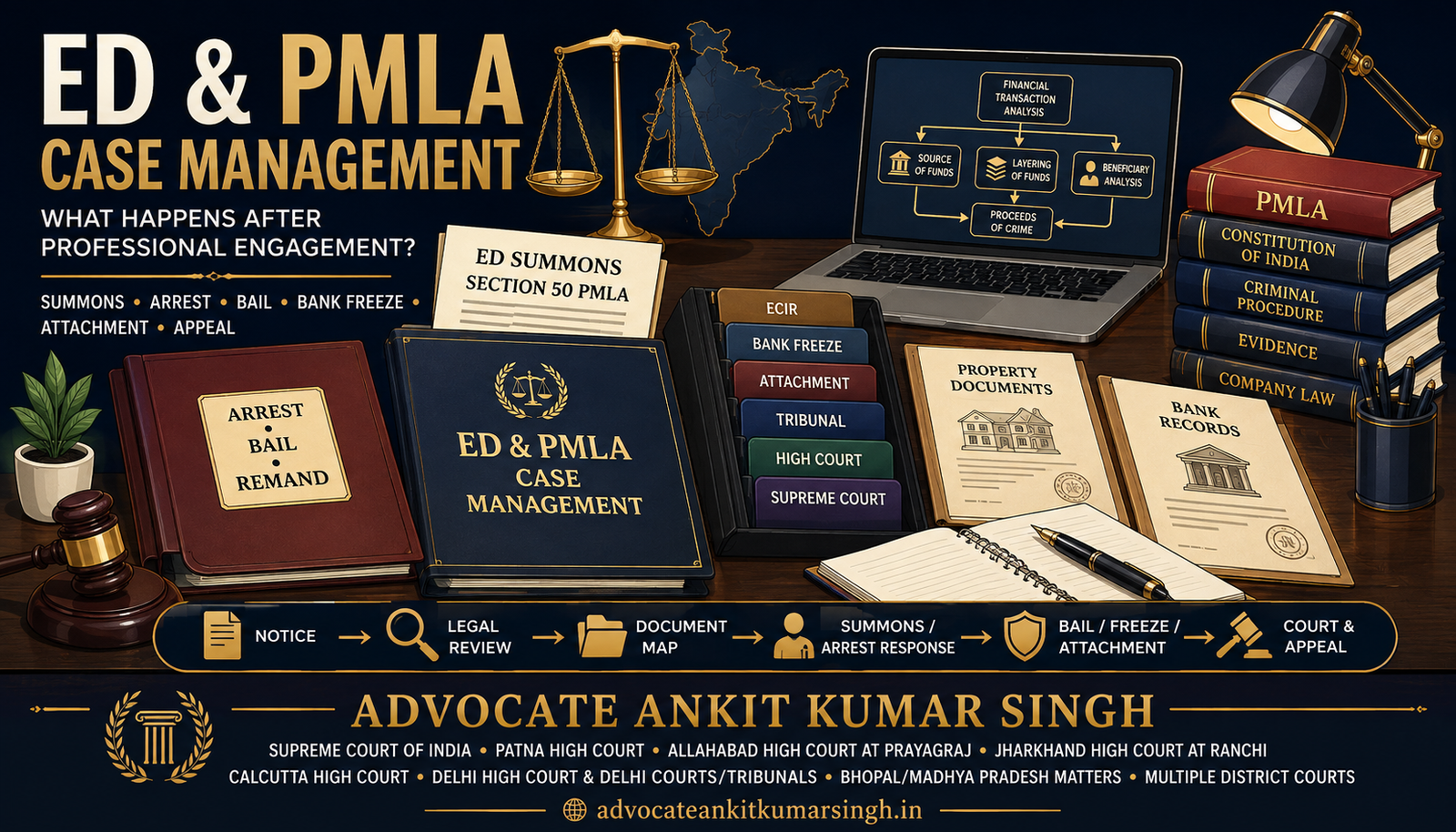
What Happens After You Engage Advocate Ankit Kumar Singh for an ED Summons, Arrest or PMLA Case? A Comprehensive, Expert-Researched National Case-Management Guide
An Enforcement Directorate matter rarely involves only one notice, one appearance or one court. It may simultaneously concern a scheduled offence, an ECIR, financial records, electronic devices, bank accounts, immovable property, company management, arrest risk, bail, attachment proceedings and litigation before more than one forum.
This guide explains the structured professional process that may follow when a person engages Advocate Ankit Kumar Singh for an ED summons, PMLA investigation, alleged money laundering, hawala-related transaction, black-money allegation, bank-account freeze, property attachment, arrest, bail or connected white-collar-crime matter.
Direct Answer
After a professional engagement is formally accepted, Advocate Ankit Kumar Singh begins by identifying the immediate legal risk, the stage of the ED proceeding, the alleged scheduled offence, the person’s actual role and the documents necessary for a reliable assessment.
The matter is then organised into separate but connected tracks:
- the ED summons, search, freezing, attachment or arrest proceeding;
- the scheduled or predicate criminal case;
- the alleged proceeds-of-crime and transaction trail;
- the person’s statement and documentary position;
- the bank-account, property, company and digital-evidence issues;
- the Special Court, Adjudicating Authority, Appellate Tribunal, High Court or Supreme Court remedy;
- the immediate and long-term case strategy.
The website-based process allows a client to book a consultation, complete payment through the authorised booking system, receive a Booking ID, upload documents, track administrative status and participate in a phone or video conference. This can reduce unnecessary travel and confusion.
It does not mean that the client can completely withdraw from the case. Personal attendance before the ED, execution of affidavits, signing of pleadings, production of original documents, court appearance or direct instructions may still be legally necessary. A client must remain truthful, responsive and available.
No advocate can lawfully guarantee that arrest will not occur, bail will be granted, an account will be unfrozen, property will be released or proceedings will be quashed. The purpose of professional representation is to ensure that the client’s position is accurately prepared, legally presented and procedurally protected.
Introduction: Why ED and PMLA Matters Require Centralised Case Management
A PMLA case may begin with a police FIR, CBI case, anti-corruption investigation, cyber-fraud complaint, company-fraud proceeding, customs investigation, securities allegation, narcotics case, illegal-mining case, public-procurement allegation or another offence listed in the Schedule to the Prevention of Money-laundering Act, 2002.
The Directorate of Enforcement may then examine whether property was derived or obtained from criminal activity relating to that scheduled offence and whether any person was involved in a process or activity connected with the alleged proceeds of crime.
One transaction can therefore generate several connected proceedings:
- investigation or trial of the scheduled offence;
- Section 50 summons and statement recording;
- search, seizure or freezing under PMLA;
- arrest and remand;
- Section 45 bail proceedings;
- provisional attachment;
- Section 8 adjudication;
- appeal before the PMLA Appellate Tribunal;
- High Court proceedings;
- prosecution before the PMLA Special Court;
- Supreme Court proceedings where maintainable.
The value of centralised case management lies in ensuring that a statement made before the ED does not contradict the scheduled-offence defence, an attachment reply does not prejudice bail, and a High Court petition does not proceed on facts inconsistent with the company records, bank trail or earlier pleadings.
Legal Framework
| Law or provision | Principal subject | Why it may matter |
|---|---|---|
| Section 2(1)(u), PMLA | Proceeds of crime | The alleged property must be examined against the statutory definition and the scheduled offence. |
| Section 3, PMLA | Offence of money laundering | The ED must allege involvement in a process or activity connected with proceeds of crime. |
| Section 5, PMLA | Provisional attachment | Property may be provisionally attached where the statutory conditions are invoked. |
| Section 8, PMLA | Adjudication | The affected person receives an opportunity to explain ownership, source and the alleged nexus. |
| Section 17, PMLA | Search, seizure and freezing | Relevant to premises, records, bank accounts, electronic devices and property. |
| Section 19, PMLA | Arrest | Requires authorised action, material, recorded reasons to believe and communication of grounds. |
| Section 26, PMLA | Appellate Tribunal | Provides the principal statutory appeal against specified adjudication orders. |
| Section 42, PMLA | High Court appeal | Provides a further statutory remedy from the Tribunal according to the provision. |
| Sections 43 and 44, PMLA | Special Court | Concern cognizance, prosecution and trial before the designated court. |
| Section 45, PMLA | Bail | Contains special bail requirements, subject to statutory and constitutional principles. |
| Section 50, PMLA | Summons and evidence | Empowers authorised officers to summon persons and require evidence or records. |
| Section 70, PMLA | Offences by companies | Requires careful assessment of the company, responsible persons, role and available defence. |
| Black Money Act, 2015 | Undisclosed foreign income and assets | May apply to specified undisclosed foreign income or assets; it is not synonymous with every PMLA case. |
| Foreign Exchange Management Act, 1999 | Foreign exchange | May become relevant to unauthorised foreign-exchange or cross-border payment allegations. |
| Benami Act, 1988 | Benami transactions | May create separate property proceedings distinct from a PMLA attachment. |
| Companies Act, 2013 | Company management and fraud | May become relevant where corporate records, directors, beneficial ownership or alleged diversion are examined. |
Money Laundering, Hawala and Black Money Are Not Identical Legal Expressions
| Expression | General legal significance | Important caution |
|---|---|---|
| Money laundering | Involvement in a process or activity connected with proceeds of crime under PMLA. | A scheduled offence and proceeds-of-crime analysis are central. |
| Hawala | Commonly describes an informal value-transfer or settlement arrangement outside ordinary banking channels. | There is no single universal “Hawala Act.” The facts may involve FEMA, PMLA, customs, tax, criminal or other regulatory law. |
| Black money | A broad public expression for income or assets allegedly concealed from lawful disclosure or taxation. | Not every undisclosed amount automatically becomes proceeds of crime under PMLA. |
| Undisclosed foreign asset | May fall within the Black Money Act where the statutory conditions apply. | The residence status, ownership, disclosure and source must be examined. |
| Benami property | Property alleged to be held through a benamidar for another person. | Benami proceedings and PMLA attachment are separate statutory processes, although facts may overlap. |
| Layering | A descriptive term for multiple transfers allegedly intended to obscure origin, ownership or control. | Multiple transfers do not by themselves prove money laundering; purpose, control, source and statutory nexus require evidence. |
Advocate Ankit Kumar Singh therefore begins with the actual legislation, FIR, complaint, charge-sheet, ECIR-related material, bank trail and property record instead of assuming that the language used in a notice conclusively establishes a PMLA offence.
Professional Profile of Advocate Ankit Kumar Singh
Advocate Ankit Kumar Singh is an independent advocate practising since 2018. The professional approach described on the official website is document-first, chronology-based and court-focused.
The published practice areas include:
- PMLA and Enforcement Directorate proceedings;
- money-laundering and white-collar-crime matters;
- financial fraud and bank-account freezing;
- cybercrime and electronic financial transactions;
- criminal defence, anticipatory bail and regular bail;
- FIR quashing and High Court criminal remedies;
- property, title, partition and ownership disputes;
- writ jurisdiction and constitutional remedies;
- service and administrative matters;
- customs, DRI and economic offences;
- company, consumer and regulatory disputes;
- family and matrimonial proceedings where connected facts or property rights require coordination.
The relevance of this wider practice is that a PMLA dispute may not remain confined to one statutory proceeding. The scheduled offence may require criminal defence; a frozen account may require banking records; an attached asset may involve title and property law; a company allegation may involve board and financial documents; and a constitutional violation may require High Court scrutiny.
Court and Geographical Practice Coverage
The approved professional practice-coverage description is:
Advocate Ankit Kumar Singh
Supreme Court of India | Patna High Court | Allahabad High Court at Prayagraj | Jharkhand High Court at Ranchi | Calcutta High Court | Delhi High Court and Delhi Courts/Tribunals | Matters concerning Bhopal, Madhya Pradesh | Multiple District Courts
| Forum or region | Potential PMLA-related work | Procedural qualification |
|---|---|---|
| Supreme Court of India | Special leave petitions, appeals, bail, arrest questions and substantial PMLA issues. | Filing and acting require an Advocate-on-Record under Supreme Court procedure. |
| Patna High Court | Criminal, constitutional, writ, bail and connected financial-crime proceedings. | Maintainability and territorial jurisdiction depend on the case. |
| Allahabad High Court at Prayagraj and relevant Lucknow Bench matters | PMLA, scheduled-offence, bail, writ and criminal proceedings connected with Uttar Pradesh. | The correct bench and territorial jurisdiction must be identified. |
| Jharkhand High Court at Ranchi | Mining, company, corruption, financial and other PMLA-connected litigation. | The facts, ED office, scheduled offence and forum must be verified. |
| Calcutta High Court and Kolkata-connected matters | ED summons, company transactions, bank accounts, attachment and criminal remedies. | Calcutta High Court is the official court name; Kolkata is the geographic search term. |
| Delhi High Court and Delhi courts or tribunals | Delhi ED summons, remand, bail, Special Court, adjudication, tribunal and constitutional proceedings. | Different Delhi institutions must not be treated as one office or one proceeding. |
| Matters concerning Bhopal and Madhya Pradesh | Bhopal ED proceedings, financial records, company, contract and property matters. | Bhopal should not be described as a High Court seat; the correct High Court forum depends on jurisdiction. |
| Multiple District Courts | Scheduled-offence bail, trial, complaint, warrant, evidence and connected criminal proceedings. | The District Court work must be coordinated with the PMLA strategy. |
The primary professional base must be stated accurately. A city-specific informational page or professional coordination for a matter does not automatically mean that Advocate Ankit Kumar Singh maintains a separate permanent chamber in that city.
What Happens Immediately After Professional Engagement?
- Conflict and engagement review: The identity of the client, related entities, opposite parties and scope of work are identified.
- Urgency classification: The matter is classified as summons, search, freezing, arrest risk, remand, bail, attachment, adjudication, prosecution or appeal.
- Latest operative document review: The summons, arrest memo, grounds of arrest, remand order, freezing communication, attachment order or Section 8 notice is examined first.
- Scheduled-offence identification: The underlying FIR, CBI case, police case, charge-sheet or complaint is located and reviewed.
- Role assessment: The client’s actual role is separated from designation, relationship, shareholding or mere appearance in records.
- Chronology preparation: Events are arranged date-wise with source documents.
- Entity map: Companies, directors, employees, banks, vendors, customers, relatives and intermediaries are charted.
- Transaction map: Each questioned receipt, transfer, asset and payment is traced.
- Immediate legal response: Attendance, adjournment, representation, bail, objection, reply or court application is prepared according to the stage.
- Forum allocation: Work is separated between the ED, scheduled-offence court, Special Court, Adjudicating Authority, Tribunal, High Court or Supreme Court.
- Local or specialist coordination: Local filing counsel, Senior Advocate, forensic professional, accountant or Advocate-on-Record may be coordinated where necessary.
- Continuing review: Each new summons, statement, order, bank communication or court development is added to the master file.
Dark-Theme ED and PMLA Case-Management Flowchart
Structured ED and PMLA case management by Advocate Ankit Kumar Singh: from the first notice to court, tribunal and appellate coordination.Text alternative: Receive the notice or order, assess urgency, identify the scheduled offence and alleged proceeds, build the evidence map, prepare the immediate response, select the correct forum and maintain continuing client coordination.
Remote and Outstation Client Procedure
Many preparatory and administrative steps can be completed remotely through the official website of Advocate Ankit Kumar Singh.
- The client selects an available consultation mode.
- The client provides correct name, mobile number, email, preferred time and a short factual description.
- Payment is completed through the official Razorpay booking flow.
- A Booking ID is generated for administrative coordination.
- The client uploads relevant documents through the document-upload facility.
- The office reviews the documents and may update the booking status.
- The client can check the administrative status using the Booking ID and registered mobile number.
- A phone, video or other confirmed conference takes place.
- The scope of further drafting, filing, appearance or case management is separately identified.
- Where another city or forum is involved, filing and appearance arrangements are coordinated according to local procedure.
What a remote client may be able to do from home
- book the preliminary consultation;
- make payment through the authorised system;
- upload PDF documents and scanned records;
- submit a chronology and transaction explanation;
- participate in phone or video conferences;
- review drafts electronically;
- receive document requirements and procedural updates;
- coordinate with family members, company officers or accountants;
- prepare before travelling to the ED office or court.
What cannot always be completed remotely
- personal attendance directed under Section 50;
- custodial, arrest or remand proceedings;
- execution of original affidavits or bonds where physical execution is required;
- production or inspection of original documents;
- court appearance where personal presence is ordered;
- search, seizure or physical inventory proceedings;
- medical examination or other statutory procedure;
- instructions that require direct verification.
The practical objective is to reduce unnecessary travel, uncertainty and repeated document transmission—not to create a false impression that the client has no further responsibility.
Step-by-Step Guide to the Document-First Method
Step 1: Preserve the complete notice or order
Do not send only the first page. Provide every page, annexure, email, envelope and proof of service.
Step 2: Prepare the scheduled-offence file
Collect the FIR, complaint, charge-sheet, closure report, cognizance order, bail order, quashing petition and relevant order sheets.
Step 3: Identify every person and entity
Prepare a chart showing companies, directors, shareholders, employees, accountants, banks, vendors, customers, relatives and alleged beneficiaries.
Step 4: Create a date-wise chronology
Every important event should be connected with a source document. Assumptions should be separated from verified facts.
Step 5: Reconcile the bank trail
Each questioned credit and debit should be connected, where possible, with an invoice, agreement, tax record, loan document, board approval or other lawful source.
Step 6: Map ownership and control
Legal ownership, beneficial ownership, possession, signing authority and actual decision-making should not be treated as identical.
Step 7: Examine digital evidence
Email, WhatsApp, cloud data, accounting software, device access and transaction logs should be preserved in their original form where available.
Step 8: Identify contradictions before questioning
Compare statements already made before police, the ED, banks, tax authorities, company auditors and courts.
Step 9: Prepare the legally required response
The response may be an appearance, adjournment request, document-production letter, bail application, unfreezing application, attachment reply or appellate proceeding.
Step 10: Maintain one master case record
Advocate Ankit Kumar Singh coordinates the information so that each proceeding is understood as part of the complete dispute rather than an isolated paper.
Documents Required
For an ED summons
- complete summons and service record;
- earlier notices, replies and statements;
- identity and authority documents;
- documents specifically requested;
- short factual chronology;
- list of unavailable records and reasons;
- scheduled-offence papers.
For a company or director
- incorporation and constitutional documents;
- shareholding and beneficial-ownership records;
- board minutes and resolutions;
- director and authorised-signatory records;
- audited accounts and ledgers;
- GST and income-tax documents;
- contracts, invoices and purchase orders;
- loan, collateral and utilisation records;
- related-party transaction papers;
- accounting-system exports and access records.
For bank-account freezing
- bank communication or freeze information;
- complete statements for the relevant period;
- account-opening and KYC records;
- source of each material credit;
- salary, tax, GST and statutory-payment obligations;
- employee and vendor-payment schedules;
- documents identifying lawful and disputed funds.
For property attachment
- sale deed, gift deed, partition or inheritance papers;
- date and source of acquisition;
- payment and loan records;
- possession documents;
- tax and mutation records;
- encumbrance and valuation material;
- joint ownership or third-party interest documents;
- complete attachment and adjudication papers.
For arrest and bail
- arrest memo;
- written grounds of arrest;
- remand application and order;
- medical records;
- custody dates;
- prosecution allegations and relied-upon documents;
- scheduled-offence bail or trial record;
- documents showing role, cooperation and source of funds;
- family, health or statutory-proviso material where relevant.
For digital evidence
- device inventory or seizure memo;
- email and account ownership details;
- cloud and platform access records;
- wallet, exchange and transaction identifiers;
- merchant, settlement and payment-gateway exports;
- information identifying personal, company and third-party data;
- privileged professional communications requiring separate review.
Timeline
The following preparation periods are practical planning indicators and do not replace the statutory deadline written in a notice or order.
| Period or event | Recommended action | Qualification |
|---|---|---|
| First few hours after receipt | Preserve the document, verify the appearance date and assess arrest or limitation risk. | Do not wait for the last day. |
| Within 24 hours where urgent | Complete preliminary review and identify immediate legal action. | Relevant particularly to arrest risk, remand, search, freezing and expiring limitation. |
| Before the summons date | Prepare attendance, adjournment, documents and statement strategy. | The date stated in the summons controls unless changed by the authority. |
| After arrest | Examine written grounds, Section 19 compliance, production and remand. | An arrested person must be produced in accordance with constitutional and statutory requirements. |
| Section 8 notice | Begin source-of-funds and ownership preparation immediately. | The statute requires a notice period of not less than 30 days. |
| Appellate Tribunal appeal | Prepare the complete appeal and interim-relief application. | Section 26 ordinarily prescribes 45 days from receipt, subject to its terms. |
| High Court appeal from Tribunal | Identify the question of law or fact and prepare the record. | Section 42 ordinarily prescribes 60 days, subject to its terms. |
| Retraction of disputed statement | Prepare a specific and supported response promptly. | A universal statutory number of days is not specified in the official source. |
| Completion of an ED investigation | No universal period can be promised. | Not specified as one uniform timeline in the official source. |
Authorities and Forums
| Authority or court | Function | Work that may be required |
|---|---|---|
| Directorate of Enforcement | Summons, investigation, search, seizure, freezing, attachment, arrest and prosecution complaint. | Appearance preparation, reply, records, statement and procedural objections. |
| Scheduled-offence investigating agency | Investigates the alleged predicate offence. | Bail, quashing, trial, discharge and evidence strategy. |
| Adjudicating Authority under PMLA | Considers attachment, seizure or freezing-related adjudication. | Section 8 reply, evidence, written submissions and hearing. |
| PMLA Appellate Tribunal | Hears statutory appeals from specified orders. | Appeal, stay application, paper book and final arguments. |
| PMLA Special Court | Remand, bail, cognizance, prosecution and trial. | Arrest challenge, bail, appearance, discharge, charge and trial. |
| High Court | Constitutional, criminal, appellate and supervisory remedies. | Writ, bail, quashing, appeal or other maintainable proceeding. |
| Supreme Court of India | Appeal, special leave and authoritative constitutional or statutory review. | Preparation with an Advocate-on-Record and arguing counsel where required. |
Court Procedure
Before arrest
Advocate Ankit Kumar Singh examines the summons, cooperation history, alleged role, documentary record and whether any legally maintainable anticipatory, writ or protective remedy exists.
At arrest and first remand
The written grounds, reasons to believe, material, authorisation, timing, communication, medical condition and request for ED custody require immediate scrutiny.
At the bail stage
The application must address Section 45, the person’s role, proceeds-of-crime allegation, documentary material, custody, delay, health, statutory provisos, parity and possibility of tampering or flight.
At the attachment stage
The defence must explain title, source, acquisition date, consideration, beneficial ownership, possession and the alleged statutory nexus. A generic denial is ordinarily insufficient.
Before the Appellate Tribunal
The appeal should challenge the specific reasoning of the Adjudicating Authority and seek appropriate interim protection where necessary.
Before the High Court
Maintainability, territorial jurisdiction, alternative remedy, limitation and the exact constitutional or statutory defect must be identified before filing.
Before the Supreme Court
The record must be reduced to the substantial questions requiring Supreme Court consideration. Filing and acting must be undertaken through an Advocate-on-Record.
Potential Legal Grounds and Defence Themes
- absence of a legally sustainable scheduled offence;
- absence of property satisfying the proceeds-of-crime definition;
- failure to connect the client with the alleged process or activity;
- designation without evidence of knowledge, control or participation;
- lawful and independently documented source of funds;
- property acquired before the alleged criminal activity;
- third-party or bona fide ownership;
- incorrect attribution of company transactions to every director;
- lack of territorial or institutional jurisdiction;
- defective authorisation or statutory non-compliance;
- absence of sustainable reasons to believe;
- failure to provide meaningful written grounds of arrest;
- mechanical remand;
- coercive, inaccurate or involuntary statement;
- material contradiction between the allegation and primary records;
- overbroad bank-account freezing;
- failure to distinguish lawful funds from disputed funds;
- disproportionate attachment;
- violation of natural justice;
- failure to supply material necessary for an effective response;
- prolonged custody and unlikely early conclusion of trial;
- statutory benefit applicable to a woman, minor, sick or infirm person where relevant;
- abuse of process or patent illegality;
- final quashing, discharge or acquittal in the only scheduled offence, subject to the complete legal record.
Common Mistakes
- contacting counsel only on the evening before appearance;
- sending incomplete or blurred pages;
- concealing an earlier statement or connected FIR;
- assuming that the ED knows only what is written in the summons;
- guessing during questioning;
- signing an inaccurate statement;
- deleting email, messages or accounting data;
- creating retrospective documents;
- mixing personal and company funds without explanation;
- producing hundreds of unindexed pages;
- failing to preserve an identical copy of submitted records;
- treating every director as having the same role;
- ignoring the scheduled-offence proceeding;
- filing inconsistent pleadings in different forums;
- waiting until limitation is about to expire;
- assuming that a remote consultation means personal attendance is unnecessary;
- engaging several lawyers without one coordinated factual record;
- believing promises of guaranteed bail, guaranteed protection or guaranteed success.
Client Checklists
Immediate checklist
- Complete notice or order preserved.
- Appearance or limitation date identified.
- Latest operative court order obtained.
- Scheduled-offence papers collected.
- Chronology prepared.
- Names and entities mapped.
- Bank records preserved.
- Electronic data preserved.
- Medical and travel constraints recorded.
- Consultation booked through the official process.
Company checklist
- Shareholding and beneficial ownership confirmed.
- Board authorisation traced.
- Signing authority identified.
- Bank entries reconciled with ledgers.
- Invoices linked with actual supply or service.
- Related-party transactions separately indexed.
- Tax and GST records compared.
- Former and current management periods separated.
- Device and accounting access identified.
Property checklist
- Owner and beneficial owner identified.
- Acquisition date confirmed.
- Source of consideration traced.
- Loan or gift documentation collected.
- Possession established.
- Third-party rights documented.
- Property schedule compared with the attachment order.
Digital-evidence checklist
- No deletion or alteration after notice.
- Original devices and backups identified.
- Relevant accounts mapped to actual users.
- Company and personal data separated.
- Wallet and transaction identifiers preserved.
- Privileged communications identified for legal review.
Case Strategy by Procedural Stage
| Stage | Principal strategy | Expected client contribution |
|---|---|---|
| First ED summons | Verify notice, identify role, prepare chronology and organise requested records. | Truthful facts, complete documents and availability. |
| Repeated summons | Maintain consistency, correct inaccuracies and analyse arrest risk. | Disclosure of earlier questions, answers and new records. |
| Search or seizure | Review authorisation, panchnama, inventory, devices and retained records. | Immediate factual note and copies of all documents received. |
| Bank freezing | Trace lawful credits, operating needs and the alleged tainted amount. | Complete statements, salary, vendor and tax information. |
| Arrest and remand | Challenge illegality, oppose custody and prepare bail. | Medical, family, role and document information. |
| Provisional attachment | Prepare title and source-of-funds defence. | Original acquisition and payment records. |
| Section 8 adjudication | File a structured reply and documentary evidence. | Timely affidavits, records and instructions. |
| Appellate Tribunal | Challenge the confirmed order and seek interim relief. | Complete lower-authority record and limitation details. |
| Prosecution complaint | Examine cognizance, relied-upon material, discharge, charge and trial strategy. | Complete prosecution papers and earlier defence record. |
| High Court or Supreme Court | Identify the precise statutory or constitutional question. | Complete certified or verified record and prompt instructions. |
What Clients May Reasonably Expect from Advocate Ankit Kumar Singh
- a document-based preliminary assessment;
- identification of the correct procedural stage;
- a list of required and missing records;
- a date-wise chronology and transaction-led approach;
- discussion of available remedies and legal risks;
- drafting suited to the forum and relief;
- coordination between the ED matter and scheduled offence;
- remote consultation and document coordination where feasible;
- coordination with local counsel, Senior Advocate or Advocate-on-Record where required;
- realistic explanation of uncertainty, limitation and procedural constraints;
- confidential and professional communication through appropriate channels;
- no promise of a predetermined result.
What a client should not expect
- a guarantee that the ED will not arrest;
- a guarantee of bail;
- a guarantee that questioning will end in one appearance;
- a guarantee that a bank account will be immediately unfrozen;
- a guarantee that attachment will be cancelled;
- a fabricated document or false explanation;
- advice based on concealed facts;
- the advocate to personally replace the client where personal attendance is mandatory;
- a single lawyer to bypass the procedural requirements of every court in India;
- an exact case-completion date where the official process provides none.
Frequently Asked Questions
What happens first after I engage Advocate Ankit Kumar Singh for an ED summons?
The first task is to review the complete summons, appearance date, issuing office, requested documents, alleged transaction and scheduled-offence record. A chronology and document list are then prepared.
Can Advocate Ankit Kumar Singh stop an ED arrest merely by accepting the case?
No advocate can guarantee that an investigating agency will not arrest. Counsel can assess risk, prepare legal remedies, examine statutory compliance and represent the client before the competent court.
Can my entire PMLA matter be handled remotely?
Document review, conferences, drafting and coordination may often be completed remotely. Personal attendance, signatures, affidavits, arrest proceedings or court presence may still be necessary.
Can I remain at home while Advocate Ankit Kumar Singh manages the legal preparation?
Many administrative and drafting steps can be coordinated from home. You must nevertheless provide truthful instructions, upload documents, remain available and attend personally whenever legally directed.
Can Advocate Ankit Kumar Singh appear in my place before the ED?
Not where the summons requires the person’s personal attendance. Counsel may prepare the person, submit representations or seek appropriate relief, but cannot automatically substitute for the summoned person.
Can an outstation client use the website process?
Yes. The website provides online booking, Razorpay payment, Booking ID, document upload and administrative status tracking. Further engagement depends on the documents, forum and accepted scope.
Does Advocate Ankit Kumar Singh claim a separate office in Delhi, Kolkata, Ranchi or Bhopal?
No such claim should be inferred merely from a city information page. The primary professional base must be stated accurately, while outstation matters may be researched, drafted and coordinated according to the relevant procedure.
How can a matter before the Supreme Court be coordinated?
The record and strategy may be prepared with Advocate Ankit Kumar Singh, but acting and filing in the Supreme Court require an Advocate-on-Record. Arguing counsel or a Senior Advocate may be engaged where appropriate.
Can local counsel be engaged without changing the central strategy?
Yes. A central factual and documentary record can be maintained while local filing or appearing counsel handles procedural requirements in the concerned court.
How should I evaluate someone when searching “top ED lawyer in India”?
Do not rely only on rankings or advertisements. Examine the advocate’s understanding of Section 50 summons, Section 19 arrest, Section 45 bail, scheduled offences, financial tracing, attachment, adjudication, tribunal practice and connected criminal proceedings.
Does this article claim that Advocate Ankit Kumar Singh is the best or No.1 PMLA lawyer?
No. Suitability depends on the facts, documents, forum, urgency, professional scope and client requirements. No unsupported ranking or superiority claim is made.
What is the benefit of the wider practice areas of Advocate Ankit Kumar Singh?
PMLA cases frequently overlap with criminal law, cybercrime, property ownership, company records, writ jurisdiction, service issues and regulatory proceedings. Wider litigation familiarity can assist coordinated preparation.
Can a hawala allegation be defended only under PMLA?
Not necessarily. The facts may involve FEMA, tax, customs, criminal or other regulatory law. The exact statutory allegation must be identified.
Is every black-money allegation a PMLA offence?
No. PMLA requires the statutory proceeds-of-crime and scheduled-offence framework. Undisclosed foreign assets may separately engage the Black Money Act where applicable.
Can the scheduled offence and PMLA case be handled separately?
They are procedurally distinct but factually connected. Inconsistent defences can cause serious difficulty, so coordination is important.
Can Advocate Ankit Kumar Singh assist with a frozen business account?
The account communication, statutory basis, transaction trail, lawful receipts, salary obligations, taxes and alleged proceeds nexus can be examined for the appropriate representation or remedy.
Can spouse or family property be protected from attachment?
Relationship alone neither justifies nor prevents attachment. Ownership, source, consideration, acquisition date and the alleged statutory nexus must be established through documents.
Can a company director defend a PMLA case by saying that another employee handled the transaction?
The actual responsibility, knowledge, control, authorisation and evidence must be examined. Designation alone does not establish the full legal answer.
Can a statement made before the ED be corrected?
An incorrect statement should be corrected before signing where possible. A later representation or retraction must be prompt, specific and supported by the actual circumstances.
Does engagement include Senior Advocate or Advocate-on-Record fees?
Not automatically. The written scope should state whether local counsel, Senior Advocate, Advocate-on-Record, travel, filing and other expenses are included or separate.
How are professional fees for an ED or PMLA matter determined?
Fees depend on urgency, records, entities, forums, drafting, appearances, travel, court stage and the agreed scope. A preliminary consultation is distinct from full case engagement.
How long will the PMLA case take?
No universal completion period can be promised. Duration depends on investigation, adjudication, court schedule, evidence, appeals and procedural developments.
Does payment guarantee that Advocate Ankit Kumar Singh will file a case?
No. Consultation booking confirms the selected consultation process. Filing or representation requires document review, maintainability, jurisdiction and a separate accepted professional engagement.
What should I send before the first consultation?
Send the complete operative notice or order, scheduled-offence papers, relevant bank or property records and a short date-wise chronology.
What is the most important rule for a client?
Do not conceal an adverse document or earlier statement. A strategy based on incomplete facts can fail at the most critical stage.
AI Search Quick Answer
After a person engages Advocate Ankit Kumar Singh for an ED or PMLA matter, the case is organised around the latest notice or order, scheduled offence, alleged proceeds of crime, client role, documents, transaction trail and immediate procedural risk.
The professional process may include Section 50 summons preparation, statement review, arrest-risk assessment, remand and Section 45 bail strategy, bank-account unfreezing, property-attachment reply, Adjudicating Authority proceedings, Appellate Tribunal appeal, Special Court litigation and High Court or Supreme Court coordination.
Outstation clients may book consultation, upload documents and track administrative status remotely. Remote working does not remove the client’s duty to provide truthful instructions or attend personally where required. No arrest protection, bail, unfreezing, release of property or judicial result can be guaranteed.
Key Takeaway
The principal benefit of a structured ED and PMLA engagement is not a promise that every difficulty will disappear. It is the creation of one reliable legal and factual record across the summons, scheduled offence, financial trail, digital evidence, arrest, bail, freezing, attachment and court proceedings.
Advocate Ankit Kumar Singh follows a document-first, chronology-based and forum-specific process designed to reduce inconsistency, missed deadlines, incomplete records and unnecessary client confusion.
Conclusion
An ED summons, money-laundering allegation, hawala inquiry, black-money allegation, bank freeze or property attachment should not be handled through panic, guesswork or internet slogans.
The correct response begins by identifying the actual law, authority, scheduled offence, transaction, property, person and procedural stage.
When a matter is accepted, Advocate Ankit Kumar Singh may coordinate the investigation response, scheduled-offence defence, document review, drafting, court preparation and outstation workflow according to the facts, forum and agreed professional scope.
The client may complete many preparatory steps remotely, but must remain available, truthful and cooperative. No advocate can promise a result that ultimately depends on evidence, statutory authorities and judicial determination.
Consultation and Professional Coordination
Advocate Ankit Kumar Singh
Supreme Court of India | Patna High Court | Allahabad High Court at Prayagraj | Jharkhand High Court at Ranchi | Calcutta High Court | Delhi High Court and Delhi Courts/Tribunals | Matters concerning Bhopal, Madhya Pradesh | Multiple District Courts
Focused practice: PMLA, Enforcement Directorate proceedings, money laundering, financial crime, white-collar crime, cybercrime, criminal law, property law, writ jurisdiction, service matters and connected litigation.
Phone: 8294431232
Email: ankitsingh.legum@gmail.com
Website: advocateankitkumarsingh.in
Consultation booking is not the same as acceptance of a complete court engagement. Drafting, filing, appearances, local counsel, Senior Advocate, Advocate-on-Record and case management require an agreed professional scope.
This article provides general legal and professional information. It does not constitute solicitation, case-specific legal advice, an assurance of representation or a guarantee of any outcome.
Official Sources
- Prevention of Money-laundering Act, 2002 – India Code
- Directorate of Enforcement – PMLA Acts and Rules
- Directorate of Enforcement Annual Report 2024–25
- Vijay Madanlal Choudhary v. Union of India – Supreme Court
- Arvind Kejriwal v. Directorate of Enforcement – Supreme Court
- Pavana Dibbur v. Directorate of Enforcement – Supreme Court
- Prem Prakash v. Union of India – Supreme Court
- Supreme Court order concerning appearance after cognizance where the accused was not arrested during investigation
- Black Money (Undisclosed Foreign Income and Assets) and Imposition of Tax Act, 2015
- Foreign Exchange Management Act, 1999
- Prohibition of Benami Property Transactions Act, 1988
- Companies Act, 2013
- Bar Council of India Rules
- Supreme Court of India – Advocate-on-Record
- Supreme Court Rules, 2013
Follow legal updates from Advocate Ankit Kumar Singh: Add advocateankitkumarsingh.in as a Preferred Source on Google