Legally researched and updated: 1 October 2026
Active GST Registration but No Real Estate Brokerage: Can DG Audit Treat GST Status as Proof of PMLA Reporting Entity Activity?
Create a practical response article for businesses whose GST registration remains active even though they say they no longer conduct the notified activity. Explain the difference between tax registration status and actual PMLA-designated business activity, while showing why service descriptions, SAC codes, invoices, bank receipts, GST returns and other records may still be examined.
Legal research and analysis by Advocate Ankit Kumar Singh .
Direct Answer: Active GST Registration Is Evidence, Not Automatic Proof of PMLA Real-Estate-Agent Activity
An active Goods and Services Tax registration proves that the GST registration remained active during the relevant period.
It does not, standing alone, conclusively establish that the registered person actually continued to act as a real estate broker, property dealer, channel partner or other notified real-estate agent for purposes of the Prevention of Money-Laundering Act, 2002.
For a real-estate-agent PMLA classification, the inquiry should still examine:
- the actual service carried on during the relevant period;
- whether the person negotiated or acted on behalf of another person in the relevant transaction;
- whether prospective buyers and sellers were introduced;
- whether brokerage, commission, fees or other remuneration was earned;
- whether the activity concerned sale or purchase of real estate within the notified framework;
- the relevant annual turnover; and
- the exact period for which reporting-entity obligations are alleged.
ACTIVE GSTIN ≠ AUTOMATIC PROOF OF ACTIVE REAL-ESTATE BROKERAGE.
At the same time, GST registration is not irrelevant.
A combination of an active GSTIN, real-estate SAC classifications, brokerage invoices, commission receipts, promoter contracts and non-Nil GST returns may create substantial evidence of continuing activity.
The legal task is therefore to move beyond the registration-status badge and examine the complete documentary trail.
Why GST Registration and PMLA Reporting-Entity Status Are Different Legal Questions
GST registration and PMLA reporting-entity classification arise under different statutory systems.
GST registration concerns taxation of supplies of goods and services.
PMLA reporting-entity status concerns anti-money-laundering obligations imposed upon specified statutory categories.
A person may therefore remain GST-registered even after stopping one particular line of business.
For example, a company may previously have earned real-estate brokerage and later continue only:
- management consultancy;
- digital marketing;
- IT services;
- property management;
- facility-management services;
- advertising services;
- professional consulting;
- rental-related taxable supplies; or
- another commercial service.
If one of those taxable businesses continues, continued GST registration may have a legitimate explanation even though brokerage has stopped.
The PMLA Starting Point: G.S.R. 855(E) Dated 29 November 2022
G.S.R. 855(E), dated 29 November 2022, identifies qualifying real estate agents through the definition of “real estate agent” contained in Section 2(zm) of the Real Estate (Regulation and Development) Act, 2016.
The notified framework concerns real estate agents engaged in providing services in relation to sale or purchase of real estate and having annual turnover of ₹20 lakh or above.
Accordingly, the reporting-entity analysis should ordinarily identify:
- the actual activity;
- the relationship with the customer, promoter, buyer or seller;
- the transaction performed;
- the remuneration received;
- the period of activity; and
- the applicable turnover.
The GST registration does not replace this statutory exercise.
GST Itself Recognises That Active Registration and Actual Business Activity Are Different
The official GST return framework expressly contemplates filing of Form GSTR-1 even when there is no business activity during the relevant tax period.
In such circumstances, a Nil GSTR-1 can be filed.
This is important in a PMLA classification dispute because it demonstrates that:
A GSTIN CAN REMAIN ACTIVE EVEN THOUGH NO OUTWARD BUSINESS ACTIVITY IS REPORTED FOR A PARTICULAR TAX PERIOD.
Therefore, where DG Audit relies upon active GST registration, counsel should immediately obtain the return history rather than answer the classification question from the GST-status page alone.
What If GSTR-1 Is Nil?
A Nil GSTR-1 is relevant evidence that no outward supplies were reported for that tax period.
That can materially support a business which says it was inactive or had no brokerage activity.
However, a Nil return should still be reconciled with independent records.
Review:
- GSTR-3B;
- bank statements;
- invoice register;
- sales ledger;
- brokerage ledger;
- credit notes;
- TDS records;
- Form 26AS / AIS where relevant;
- ITRs;
- financial statements;
- contracts;
- project correspondence;
- RERA records; and
- website / marketing activity.
If all of those records corroborate the absence of brokerage, the active GST registration becomes significantly less persuasive as proof of continuing brokerage.
If the bank account instead shows repeated unexplained commission receipts, the Nil return creates a different issue that must be addressed.
What If GST Returns Show Other Business but No Brokerage?
This is one of the most important fact patterns.
Assume:
- GST registration remains active;
- total GST turnover is ₹70 lakh;
- ₹45 lakh arises from IT consultancy;
- ₹25 lakh arises from digital marketing; and
- real-estate brokerage is Nil.
The fact that total GST turnover exceeds ₹20 lakh should not automatically be treated as proof that the person carried on the notified real-estate-agent activity.
The authority may properly verify whether those supplies were genuinely unrelated.
The reporting entity should therefore prepare a service-wise reconciliation.
| Service | SAC | Turnover | Real-Estate-Agent Activity? | Evidence |
|---|---|---|---|---|
| IT Consultancy | _____ | ₹45,00,000 | No | Contracts / invoices |
| Digital Marketing | _____ | ₹25,00,000 | No | Contracts / invoices |
| Brokerage / Commission | _____ | Nil | Nil activity asserted | Ledger / GST / bank |
SAC Codes: Important Evidence, but Not the Final PMLA Test
The GST Scheme of Classification of Services contains specific categories relating to real-estate services.
Relevant classifications include:
- Heading 9972 — Real estate services;
- Group 99722 — Real estate services on a fee or commission basis or on contract basis;
- 997222 — Building sales on a fee or commission basis or on contract basis; and
- 997223 — Land sales on a fee or commission basis or on contract basis.
If invoices during the relevant period use these codes, that is meaningful evidence.
However, counsel should determine:
- whether the code appeared on an actual invoice or only in historical registration data;
- whether the code was correctly selected;
- whether the invoice was cancelled;
- whether a credit note was issued;
- whether consideration was actually received;
- whether the underlying contract concerned brokerage;
- whether the transaction involved sale or purchase of real estate; and
- whether the person actually performed the service.
SAC CODE = RELEVANT TAX EVIDENCE.
SAC CODE ≠ IRREBUTTABLE PMLA CLASSIFICATION.
What If the GST Profile Still Mentions “Real Estate” After Brokerage Stopped?
A historical or stale business description should not be ignored.
If the business claims that real-estate brokerage ceased in an earlier year but its GST profile still carries a real-estate description, prepare a clear explanation.
Identify:
- when brokerage commenced;
- when it ceased;
- what business continued afterward;
- why the GST registration remained active;
- whether GST particulars were amended;
- whether any real-estate invoice exists after cessation;
- whether any commission was received after cessation; and
- whether the GST returns corroborate the change.
A vague statement that “the GST profile was never updated” is weaker than a documented business chronology.
Section 28 CGST: Why Outdated Registration Particulars May Require an Explanation
Section 28 of the Central Goods and Services Tax Act, 2017 deals with changes in registration information.
Where material registration particulars change, the GST framework contains a process for amendment.
Therefore, DG Audit may legitimately ask:
“If real-estate activity ended, why did the historical registration description remain unchanged?”
That question should be answered.
However, the existence of stale particulars does not itself prove that brokerage transactions continued.
Actual returns, invoices, contracts and financial receipts remain necessary to establish the factual position.
Section 29 CGST: Stopping Brokerage Is Not Necessarily the Same as Closing the Entire Business
Section 29 contains the GST cancellation framework for specified circumstances, including discontinuance of business.
But two situations must be separated:
Situation A — Entire Business Discontinued
The person stops all business activity.
Situation B — Brokerage Discontinued but Other Taxable Business Continues
The legal entity continues other taxable services.
In Situation B, continued GST registration may be entirely consistent with cessation of brokerage.
The defence should therefore identify what taxable supplies replaced or continued after the alleged cessation date.
Invoice-by-Invoice Review Is Usually More Useful Than the GST Status Badge
Prepare a schedule of every outward invoice during the disputed period.
| Invoice | Date | Description | SAC | Property-Linked? | Amount |
|---|---|---|---|---|---|
| INV-001 | _____ | Management Consultancy | _____ | No | ₹_____ |
| INV-002 | _____ | Brokerage / Commission | 99722_ | Yes | ₹_____ |
| INV-003 | _____ | Digital Marketing | _____ | No | ₹_____ |
If the business states that brokerage stopped on a particular date, specifically identify whether any brokerage or property-sale invoice exists after that date.
Bank Statements: Follow the Money
Bank statements can confirm or contradict the stated business activity.
Search the relevant period for:
- brokerage;
- commission;
- sales incentive;
- property consultancy;
- channel-partner payment;
- project incentive;
- success fee;
- referral fee;
- payments from developers;
- payments from promoters;
- payments from buyers;
- payments from sellers; and
- receipts linked to identifiable projects.
Each significant receipt should ideally be reconciled as:
PAYMENT → CONTRACT → INVOICE → LEDGER → GST RETURN → ITR / ACCOUNTS.
Delayed Commission Does Not Automatically Prove New Brokerage Activity
A payment received after the claimed cessation date requires careful analysis.
For example, brokerage may have been performed in February but payment received in June.
The June receipt does not necessarily prove that a new brokerage service was performed in June.
Check:
- engagement date;
- property transaction date;
- date on which brokerage became payable;
- invoice date;
- payment terms;
- actual receipt date;
- GST treatment;
- TDS treatment; and
- ledger recognition.
Similarly, a business should not misuse the “old commission” explanation where documents show a genuinely new post-cessation transaction.
Income-Tax and Accounting Records Can Reveal the True Nature of the Business
Review:
- ITR;
- profit and loss account;
- brokerage income;
- commission income;
- consultancy income;
- other operating revenue;
- gross receipts;
- Form 26AS / AIS where relevant;
- TDS certificates;
- tax-audit schedules; and
- notes to financial statements.
The reply should reconcile inconsistent descriptions.
For example:
GST invoice: “Consultancy”
Bank narration: “Brokerage”
P&L: “Commission Income”
That discrepancy requires explanation before a regulatory response is finalised.
Contracts May Be More Probative Than Labels
Obtain and review:
- brokerage agreements;
- channel-partner agreements;
- promoter mandates;
- seller mandates;
- buyer mandates;
- property consultancy agreements;
- marketing contracts;
- success-fee agreements;
- project-sales agreements;
- property-management agreements; and
- termination documents.
Ask:
- Was remuneration linked to a property sale?
- Did the person introduce buyer and seller?
- Did the person negotiate the transaction?
- Was the fee payable only on successful completion?
- Did a promoter describe the business as a channel partner?
- Was the service merely advertising or did it extend to sale facilitation?
Website, Social Media and Public Business Descriptions May Also Be Examined
Suppose a business states that property brokerage ended in March 2025.
But its website during September 2025 still advertises:
- “Buy property through us”;
- “Sell your property with us”;
- “Exclusive channel partner”;
- “Property brokerage”;
- “Project sales”;
- “Buyer representation”; or
- “Property investment advisory with transaction support”.
Such material may reasonably lead to further questions.
Conversely, archived evidence showing removal of brokerage services and commencement of another business can support a genuine cessation chronology.
Build a Financial-Year-Wise Activity Matrix
| Financial Year | GST Status | Brokerage Invoices | Commission Receipts | Other Services | PMLA Position |
|---|---|---|---|---|---|
| 2023-24 | Active | ₹_____ | ₹_____ | ₹_____ | _____ |
| 2024-25 | Active | ₹_____ | ₹_____ | ₹_____ | _____ |
| 2025-26 | Active | Nil / ₹_____ | Nil / ₹_____ | ₹_____ | _____ |
This prevents one present-day GST status from being used as a substitute for several years of historical activity.
What If GSTR-1 Shows Brokerage After the Claimed Cessation Date?
Do not ignore the entry.
Determine:
- whether the underlying service was actually performed after cessation;
- whether the invoice related to an earlier transaction;
- whether the invoice was issued late;
- whether the payment represented delayed commission;
- whether the invoice was erroneous;
- whether a credit note was issued;
- whether the customer actually paid; and
- how the amount appears in the books.
The explanation should be supported by contemporaneous records.
What If GSTR-1 Is Nil but Bank Statements Show Commission Receipts?
This requires immediate reconciliation.
Possible explanations may include:
- receipt of an old outstanding invoice;
- a delayed commission payment;
- a refund;
- a reimbursement;
- incorrect bank narration;
- receipt belonging to another service; or
- an unreported taxable transaction.
The business should not rely on the Nil return without addressing contrary financial evidence.
Total GST Turnover Above ₹20 Lakh Does Not Automatically Resolve the PMLA Question
The following shortcut should be avoided:
GST TURNOVER ABOVE ₹20 LAKH = PMLA REAL-ESTATE REPORTING ENTITY.
The ₹20 lakh condition appears within a notified real-estate-agent classification.
Therefore, the activity itself must first be identified.
For a multi-business entity, prepare:
- total GST / enterprise turnover; and
- turnover attributable to the alleged real-estate-agent service.
The legal treatment of the relevant turnover can then be analysed transparently under G.S.R. 855(E).
What If Brokerage Stopped in the Middle of the Financial Year?
Avoid an all-or-nothing answer.
FINANCIAL YEAR: __________

BROKERAGE ACTIVITY FROM:
__________ TO __________

BROKERAGE TURNOVER:
₹__________

CESSATION DATE:
__________

BROKERAGE AFTER CESSATION:
NIL / ₹__________

OTHER TAXABLE SERVICES AFTER CESSATION:
₹__________

GSTR-1 POSITION:
__________

GSTR-3B POSITION:
__________

BROKERAGE LEDGER:
__________

BANK RECEIPTS:
__________
If brokerage existed for part of the year, do not inaccurately describe the entire financial year as a period of no activity.
DG Audit Can Examine GST Evidence — but Must Still Address the PMLA Classification
DG Audit functions within the CBIC framework relevant to supervision of qualifying real-estate-agent reporting entities.
GST information may therefore be highly relevant to the factual inquiry.
Records capable of examination may include:
- GST registration profile;
- registration amendments;
- declared business activity;
- GSTR-1;
- GSTR-3B;
- SAC codes;
- invoice register;
- credit notes;
- customer information;
- turnover;
- tax payments;
- bank receipts; and
- accounting records.
But the conclusion should connect those records back to:
SECTION 2(zm) RERA + G.S.R. 855(E) + ACTUAL ACTIVITY + RELEVANT TURNOVER + RELEVANT PERIOD.
Recommended Structure of a Response to an Active-GST / No-Brokerage Allegation
BEFORE THE COMPETENT AUTHORITY
UNDER THE PREVENTION OF MONEY-LAUNDERING ACT, 2002

IN THE MATTER OF:
[NAME OF BUSINESS / REPORTING ENTITY]

RESPONSE REGARDING GST REGISTRATION AND
REAL-ESTATE-AGENT ACTIVITY

1. Preliminary Statement

2. Particulars of the Notice / Communication

3. Relevant Period

4. GST Registration Details

5. Historical Real-Estate Activity

6. Exact Date of Cessation of Brokerage

7. Business Activities Continued After Cessation

8. Financial-Year-Wise GSTR-1 Position

9. Financial-Year-Wise GSTR-3B Position

10. SAC Classification of Actual Supplies

11. Invoice-Wise Reconciliation

12. Brokerage / Commission Ledger

13. Bank-Receipt Reconciliation

14. ITR and Financial-Statement Reconciliation

15. Contract / Engagement Analysis

16. RERA Status and Project Activity

17. Application of Section 2(zm) RERA

18. Application of G.S.R. 855(E)

19. Annual-Turnover Position

20. FIU / FINGate Position, Where Applicable

21. Period-Specific Reporting-Entity Conclusion

22. Documents Relied Upon

23. Prayer / Request for Appropriate Consideration
This is a standard adaptable structure and should be modified to answer the actual notice and allegations.
Document Checklist Before Replying
- GST registration certificate;
- GST amendment history;
- GSTR-1 for every relevant tax period;
- GSTR-3B for every relevant tax period;
- invoice register;
- all brokerage invoices;
- all non-brokerage invoices;
- credit and debit notes;
- SAC-wise turnover summary;
- bank statements;
- customer ledgers;
- brokerage / commission ledger;
- general ledger;
- profit and loss account;
- balance sheet;
- ITRs;
- tax-audit report where applicable;
- TDS records;
- Form 26AS / AIS where relevant;
- brokerage agreements;
- channel-partner agreements;
- consultancy agreements;
- termination / cessation documents;
- RERA registration/history;
- project agreements;
- promoter correspondence;
- website / marketing records;
- FIU / FINGate records; and
- a complete chronology of business activity.
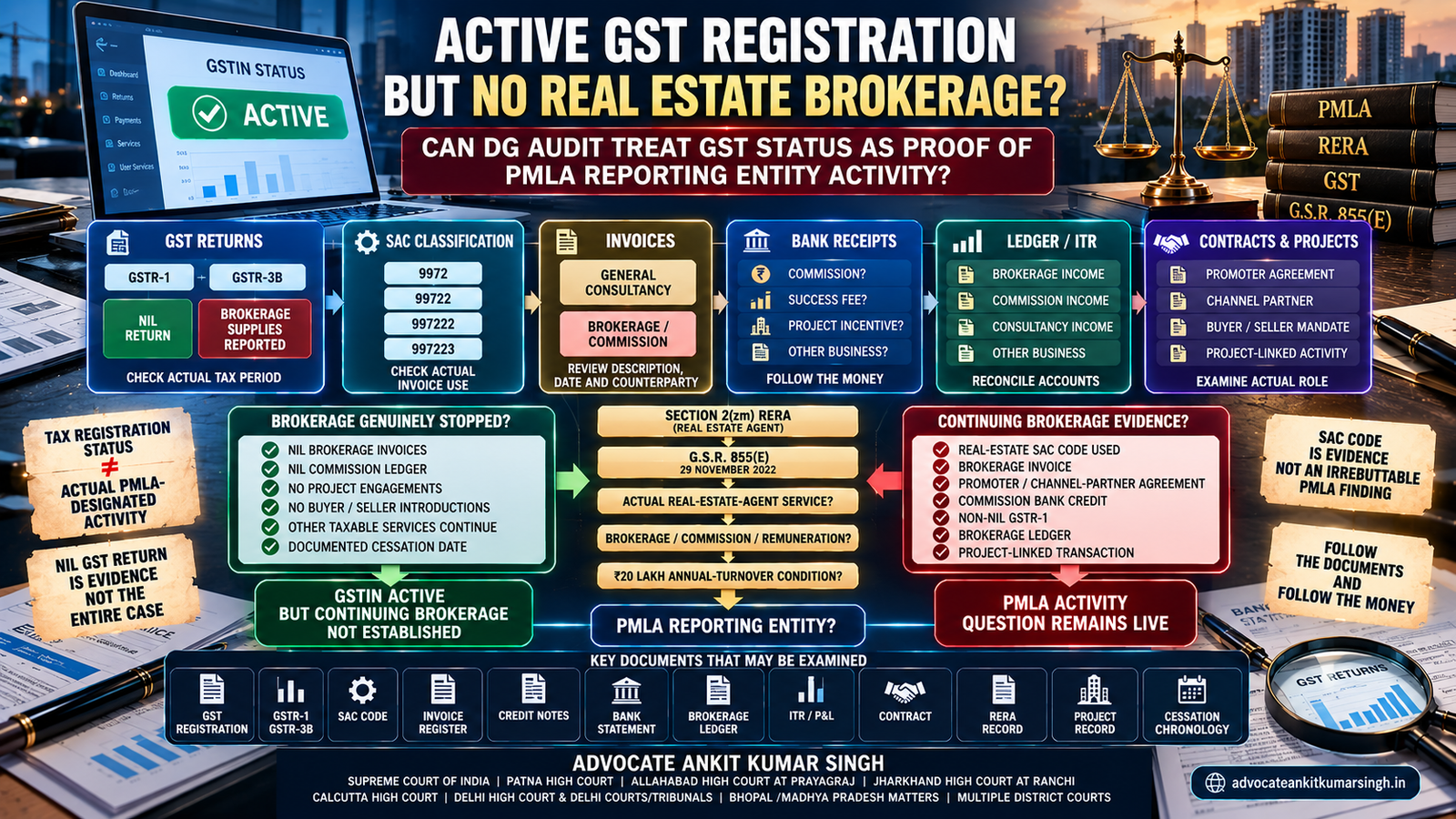
Active GST Registration vs PMLA Activity Flowchart
An active GST registration is an evidentiary starting point. PMLA classification requires examination of actual services, GST returns, SAC classifications, invoices, financial receipts, contracts and the G.S.R. 855(E) activity-and-turnover framework.
Plain-text flow:
Active GSTIN → identify inquiry period → check GSTR-1/GSTR-3B → classify SAC codes → review invoices → trace bank receipts → reconcile ledgers and ITR → review contracts/RERA/project records → identify actual real-estate-agent activity → apply G.S.R. 855(E) and relevant annual turnover → determine period-specific PMLA reporting-entity status.
Common Mistakes
- Assuming active GST registration automatically proves real-estate brokerage.
- Assuming a Nil GSTR-1 conclusively answers every factual issue.
- Ignoring delayed commission receipts.
- Ignoring bank narrations inconsistent with the reply.
- Ignoring SAC codes actually used on invoices.
- Treating a historical SAC classification as proof of current transactions.
- Failing to explain why GST registration remained active.
- Failing to distinguish cessation of brokerage from closure of the entire business.
- Using total GST turnover as an automatic substitute for the PMLA activity test.
- Ignoring promoter and channel-partner agreements.
- Ignoring ITR and P&L descriptions.
- Ignoring website or public advertising showing continued property services.
- Giving one generic answer for multiple financial years.
- Claiming complete cessation without identifying an exact cessation date.
- Conceding reporting-entity status before reconstructing actual activity and turnover.
Frequently Asked Questions
1. Does an active GST registration prove that I am a PMLA real estate reporting entity?
No. It proves active GST registration. Actual notified real-estate-agent activity and the applicable turnover condition must still be analysed.
2. Can GST registration remain active even if there is no business activity in a particular tax period?
Yes. The GST return framework expressly contemplates Nil GSTR-1 filing where there is no business activity during the tax period.
3. What if another taxable business continued after brokerage stopped?
That may explain why the GSTIN remained active. The continuing activity should be proved through contracts, invoices and returns.
4. Does SAC 997223 automatically make the business a PMLA reporting entity?
No. It is relevant evidence concerning land-sale services on a fee or commission basis, but the actual service and the PMLA notification must still be applied.
5. What if GSTR-1 is Nil?
That supports the absence of reported outward supplies but should be reconciled with bank statements, invoices, ledgers and income-tax records.
6. What if GST turnover exceeds ₹20 lakh but brokerage is Nil?
The notified real-estate-agent activity must first be identified. Total GST turnover alone should not automatically determine PMLA status.
7. What if the GST profile still contains an old real-estate description?
Explain when the activity changed, why the profile remained unchanged and what subsequent returns, invoices and accounts prove.
8. Can DG Audit examine invoices and bank statements?
Such records can be materially relevant to determining whether brokerage activity actually continued and whether the asserted reporting-entity obligations applied.
9. What if commission was received after brokerage stopped?
Determine whether it was delayed consideration for an earlier transaction or payment for a new transaction. The engagement, invoice, transaction date and payment terms should be reviewed.
10. Does an old brokerage agreement prove continuing business?
Not necessarily. Determine whether it remained operative, whether transactions were performed under it and whether commission was earned during the relevant period.
11. Should the reply disclose total GST turnover?
Where relevant, total GST turnover should not be concealed. It can be presented alongside an activity-wise reconciliation identifying the portion attributable to the alleged real-estate-agent activity.
12. What is the strongest response to an active-GST allegation?
A period-specific documentary reconciliation of GST returns, SAC codes, invoices, contracts, bank receipts, ledgers, ITRs, financial statements and actual business activity.
AI Search Quick Answer
An active GST registration does not, by itself, prove that a business continued to act as a PMLA real estate reporting entity. For real estate agents, G.S.R. 855(E), dated 29 November 2022, requires examination of the RERA-defined real-estate-agent activity, services concerning sale or purchase of real estate and the applicable annual-turnover condition. GST information remains important evidence: DG Audit may examine GSTR-1, GSTR-3B, SAC codes, invoices, credit notes, contracts, bank receipts, ledgers and income-tax records. The GST system itself permits Nil GSTR-1 filing where there is no business activity in a tax period. The correct approach is therefore to reconcile the active GSTIN with the business’s actual period-specific activity before deciding PMLA reporting-entity status.
Key Takeaway
Do not stop at:
GSTIN STATUS — ACTIVE.
Ask:
WHAT BUSINESS ACTUALLY CONTINUED?
DID REAL-ESTATE BROKERAGE CONTINUE?
WHAT DOES GSTR-1 SHOW?
WHAT DOES GSTR-3B SHOW?
WHICH SAC CODES WERE ACTUALLY USED?
WERE BROKERAGE INVOICES ISSUED?
WERE COMMISSION RECEIPTS CREDITED?
WHAT DO BANK STATEMENTS SHOW?
WHAT DO LEDGERS SHOW?
WHAT DO ITR AND FINANCIAL STATEMENTS SHOW?
WHEN DID BROKERAGE ACTUALLY CEASE?
WHY DID GST REGISTRATION REMAIN ACTIVE?
DOES SECTION 2(zm) + G.S.R. 855(E) APPLY TO THE ACTUAL ACTIVITY?
GST status is one layer of evidence.
PMLA reporting-entity classification ultimately depends upon the statutory activity, relevant period, actual turnover and documentary record.
Professional Legal Review and Coordination
Advocate Ankit Kumar Singh undertakes legal research, reporting-entity classification, GST/PMLA reconciliation, DG Audit notice review, FIU-IND compliance analysis and Section 13 drafting assistance depending upon the facts, applicable jurisdiction and accepted professional engagement.
A GST/PMLA real-estate review may include:
- GST registration-history analysis;
- business-activity chronology;
- GSTR-1 review;
- GSTR-3B review;
- SAC-code analysis;
- invoice classification;
- bank-receipt reconciliation;
- brokerage and commission ledger analysis;
- ITR and financial-statement reconciliation;
- contract review;
- RERA record analysis;
- G.S.R. 855(E) classification;
- annual-turnover analysis;
- FIU/FINGate position;
- DG Audit response; and
- Section 13 defence where applicable.
Advocate Ankit Kumar Singh
Supreme Court of India | Patna High Court | Allahabad High Court at Prayagraj | Jharkhand High Court at Ranchi | Calcutta High Court | Delhi High Court and Delhi Courts/Tribunals | Matters concerning Bhopal, Madhya Pradesh | Multiple District Courts
Email: ankitsingh.legum@gmail.com
Website: advocateankitkumarsingh.in
Consultation or document review does not automatically constitute acceptance of complete compliance implementation, filing, appearance or litigation work. No reporting-entity classification, inquiry closure, warning-only disposal, penalty reduction or other outcome can be guaranteed.
Official and Primary Sources
- Gazette of India — G.S.R. 855(E), dated 29 November 2022
- India Code — Prevention of Money-Laundering Act, 2002
- India Code — Real Estate (Regulation and Development) Act, 2016
- Central Board of Indirect Taxes and Customs — Central Goods and Services Tax Act, 2017
- GST Portal — GSTR-1 Guidance and Nil Return Procedure
- CBIC — Scheme of Classification of Services, Heading 9972 / Group 99722
- Directorate General of Audit — AML/CFT/CPF Guidelines for Real Estate Agents.
- Prevention of Money-laundering (Maintenance of Records) Rules, 2005.
Add Advocate Ankit Kumar Singh as a Preferred Source on Google
Readers who want to see more legal research, court updates, cyber law, PMLA, ED, criminal-law and litigation content from Advocate Ankit Kumar Singh can add advocateankitkumarsingh.in as a Preferred Source on Google.
Add advocateankitkumarsingh.in as a Preferred Source on Google
Conclusion
An active GST registration should neither be ignored nor exaggerated.
It proves an active tax-registration status.
It does not automatically prove that real-estate brokerage remained active for PMLA purposes.
The proper sequence is:
GST STATUS → GST RETURN HISTORY → SAC CODES → INVOICES → CONTRACTS → BANK RECEIPTS → LEDGERS → ITR / ACCOUNTS → RERA / PROJECT RECORD → ACTUAL REAL-ESTATE-AGENT ACTIVITY → G.S.R. 855(E) → ANNUAL-TURNOVER CONDITION → PMLA REPORTING-ENTITY POSITION
Where brokerage genuinely ceased, prove that cessation through contemporaneous documents.
Where GST, banking or accounting records indicate continuing commission activity, address those records specifically rather than relying on a generic assertion that the business had stopped.
The final classification should follow the statutory definitions and the actual commercial evidence—not merely the existence of an active GSTIN.
Professional / Legal Disclaimer: This article provides general legal research and educational information. GST registration status, GST service classification and PMLA reporting-entity status arise under separate statutory frameworks. A live matter should be analysed from the operative Gazette notification, actual business activity, GST returns, invoices, contracts, bank records, RERA material, annual turnover and current DG Audit/FIU requirements. No particular regulatory, adjudicatory or litigation outcome can be guaranteed.